A Presentation on Medicinal Plants
Health & Medicine
Medicinal Plants
The use of medicinal plants can be considered as a
living tradition. The World Health Organisation
estimates that the primary health care needs of
approximately 80% of the developing world’s
population are met by traditional medicine. Traditional
medicine systems range from the Ayurvedic, Unani,
Siddha and Tibetan in India, the Kampo in Japan, the
Jamu in Indonesia, and many more. The traditional
systems of medicine largely depend on plants for their
medicines. The Natural Products Alert databases at the
University of Illinois document the ethnomedicinal uses
for more than 9,000 species.
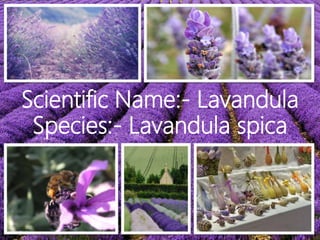
❶Lavender
Scientific Name:- Lavandula
Species:- Lavandula spica
About the Plant
Lavender is a shrubby plant indigenous to
the mountainous regions of the countries
bordering the western half of the
Mediterranean, and cultivated extensively for
its aromatic flowers in various parts of
France, in Italy and in England and even as
far north as Norway. It is also now being
grown as a perfume plant in Australia.
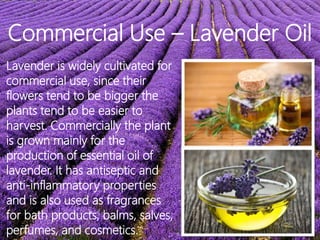
Commercial Use – Lavender Oil
Lavender is widely cultivated for
commercial use, since their
flowers tend to be bigger the
plants tend to be easier to
harvest. Commercially the plant
is grown mainly for the
production of essential oil of
lavender. It has antiseptic and
anti-inflammatory properties
and is also used as fragrances
for bath products, balms, salves,
perfumes, and cosmetics.
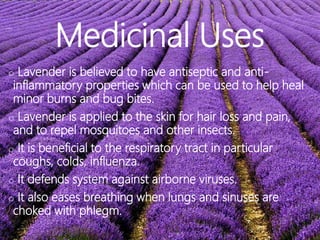
Medicinal Uses
o Lavender is believed to have antiseptic and anti-
inflammatory properties which can be used to help heal
minor burns and bug bites.
o Lavender is applied to the skin for hair loss and pain,
and to repel mosquitoes and other insects.
o It is beneficial to the respiratory tract in particular
coughs, colds, influenza.
o It defends system against airborne viruses.
o It also eases breathing when lungs and sinuses are
choked with phlegm.
Medicinal Uses
o It is beneficial for the nervous system. Lavender oil has a
calming fragrance and hence works as a tonic for the nerves.
o It helps treating migraines, depression, headaches, anxiety,
emotional stress and nervous tension.
o Its refreshing aroma removes restlessness, nervous
exhaustion and increases mental activity which helps induce
sleep.
o It helps in improving and increasing the blood circulation.
o It is also recommended to people suffering from
hypertension as it helps lower blood pressure.
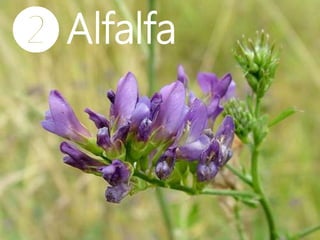
❷Alfalfa
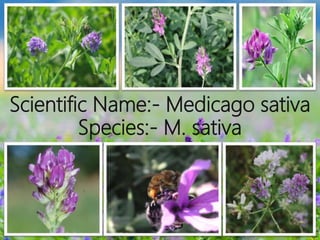
Scientific Name:- Medicago sativa
Species:- M. sativa
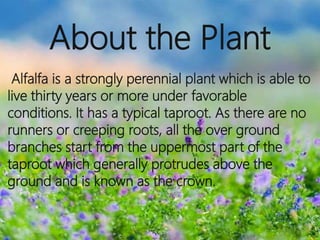
Alfalfa is a strongly perennial plant which is able to
live thirty years or more under favorable
conditions. It has a typical taproot. As there are no
runners or creeping roots, all the over ground
branches start from the uppermost part of the
taproot which generally protrudes above the
ground and is known as the crown.
About the Plant
Commercial Use – Alfalfa as Fodder
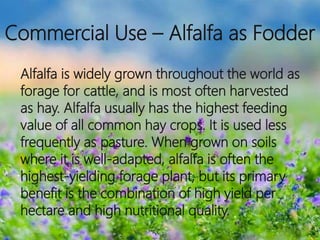
Alfalfa is widely grown throughout the world as
forage for cattle, and is most often harvested
as hay. Alfalfa usually has the highest feeding
value of all common hay crops. It is used less
frequently as pasture. When grown on soils
where it is well-adapted, alfalfa is often the
highest-yielding forage plant, but its primary
benefit is the combination of high yield per
hectare and high nutritional quality.
Medicinal Uses
o It prevents cholesterol absorption in the gut.
o It is used for kidney and bladder conditions, and also to
increase urine flow.
o People take Alfalfa as a source of vitamins A, C, E, and
K4, and minerals calcium, potassium, phosphorous, and
iron.
o It is used in treating heart diseases and other arterial
problems.
o As alfalfa juice is an excellent source of chlorophyll, one
of the benefits of alfalfa is that it is effective in treating
respiratory discomfort.
Medicinal Uses
o It is used in the treatment of stomach related ailments.
o Its effectiveness in treating diabetes naturally as it helps
those individuals who are not able to properly utilize
insulin.
o It helps in softening any hardened arteries thereby
acting as a natural treatment for high blood pressure.
o It helps in building ones immunity against stomach
distress.
o It is known to help against hyperacidity as well as the
digestion of the food more so after a rich meal.
A Presentation on Medicinal Plants

A Presentation on Medicinal Plants

  • 1.
    A Presentation onMedicinal Plants Health & Medicine
  • 2.
    Medicinal Plants The useof medicinal plants can be considered as a living tradition. The World Health Organisation estimates that the primary health care needs of approximately 80% of the developing world’s population are met by traditional medicine. Traditional medicine systems range from the Ayurvedic, Unani, Siddha and Tibetan in India, the Kampo in Japan, the Jamu in Indonesia, and many more. The traditional systems of medicine largely depend on plants for their medicines. The Natural Products Alert databases at the University of Illinois document the ethnomedicinal uses for more than 9,000 species.
  • 3.
  • 4.
  • 5.
    About the Plant Lavenderis a shrubby plant indigenous to the mountainous regions of the countries bordering the western half of the Mediterranean, and cultivated extensively for its aromatic flowers in various parts of France, in Italy and in England and even as far north as Norway. It is also now being grown as a perfume plant in Australia.
  • 6.
    Commercial Use –Lavender Oil Lavender is widely cultivated for commercial use, since their flowers tend to be bigger the plants tend to be easier to harvest. Commercially the plant is grown mainly for the production of essential oil of lavender. It has antiseptic and anti-inflammatory properties and is also used as fragrances for bath products, balms, salves, perfumes, and cosmetics.
  • 7.
    Medicinal Uses o Lavenderis believed to have antiseptic and anti- inflammatory properties which can be used to help heal minor burns and bug bites. o Lavender is applied to the skin for hair loss and pain, and to repel mosquitoes and other insects. o It is beneficial to the respiratory tract in particular coughs, colds, influenza. o It defends system against airborne viruses. o It also eases breathing when lungs and sinuses are choked with phlegm.
  • 8.
    Medicinal Uses o Itis beneficial for the nervous system. Lavender oil has a calming fragrance and hence works as a tonic for the nerves. o It helps treating migraines, depression, headaches, anxiety, emotional stress and nervous tension. o Its refreshing aroma removes restlessness, nervous exhaustion and increases mental activity which helps induce sleep. o It helps in improving and increasing the blood circulation. o It is also recommended to people suffering from hypertension as it helps lower blood pressure.
  • 9.
  • 10.
    Scientific Name:- Medicagosativa Species:- M. sativa
  • 11.
    Alfalfa is astrongly perennial plant which is able to live thirty years or more under favorable conditions. It has a typical taproot. As there are no runners or creeping roots, all the over ground branches start from the uppermost part of the taproot which generally protrudes above the ground and is known as the crown. About the Plant
  • 12.
    Commercial Use –Alfalfa as Fodder Alfalfa is widely grown throughout the world as forage for cattle, and is most often harvested as hay. Alfalfa usually has the highest feeding value of all common hay crops. It is used less frequently as pasture. When grown on soils where it is well-adapted, alfalfa is often the highest-yielding forage plant, but its primary benefit is the combination of high yield per hectare and high nutritional quality.
  • 13.
    Medicinal Uses o Itprevents cholesterol absorption in the gut. o It is used for kidney and bladder conditions, and also to increase urine flow. o People take Alfalfa as a source of vitamins A, C, E, and K4, and minerals calcium, potassium, phosphorous, and iron. o It is used in treating heart diseases and other arterial problems. o As alfalfa juice is an excellent source of chlorophyll, one of the benefits of alfalfa is that it is effective in treating respiratory discomfort.
  • 14.
    Medicinal Uses o Itis used in the treatment of stomach related ailments. o Its effectiveness in treating diabetes naturally as it helps those individuals who are not able to properly utilize insulin. o It helps in softening any hardened arteries thereby acting as a natural treatment for high blood pressure. o It helps in building ones immunity against stomach distress. o It is known to help against hyperacidity as well as the digestion of the food more so after a rich meal.