WELCOME
TO THE POWER POINT PRESENTATION
ON THE FOLLOWING
HERBAL PLANTS BY
THE STUDENTS OF CHOWGULE PUBLIC SCHOOL OF
CLASS X-B
THIS PRESENTATION IS FULLY DEDICTED TO OUR
ENGLISH TEACHER MRS. GAURI RAGESH
WE HOPE U WILL ENJOY IT

 About ,Scientific name, growth Allium sativum, commonly known
as garlic, is a species in the onion genus, Allium. Its close relatives include
the onion, shallot, leek, chive, and rakkyo. With a history of human use of over 7,000 years, garlic is
native to central Asia,and has long been a staple in the Mediterranean region, as well as a frequent
seasoning in Asia, Africa, and Europe. It was known to Ancient Egyptians, and has been used for
both culinary and medicinal purposes.
 USES
 High blood pressure. Some research shows that garlic can reduce blood pressure in people with high
blood pressure by as much as 7% or 8%.
 It also seems to lower blood pressure in people with normal blood pressure.
 Most studies have used a specific garlic powder product
 (Kwai, from Lichtwer Pharma).
 Colon cancer, rectal cancer, and stomach cancer.
 Eating garlic seems to reduce the risk of developing these cancers.
 However, garlic supplements don’t seem to offer the same benefit.
 Tick bites. Scientists have compared the number of tick bites in
people who take high doses of garlic compared to people who
do not take garlic. High doses of dietary garlic, over about a
five-month period, seem to reduce the number of tick bites.
 Fungal infections of the skin (including ringworm, jock itch
and athlete’s foot). Ringworm and jock itch respond to
treatment with a garlic gel containing 0.6% ajoene (a chemical in garlic)
that is applied to the skin. A garlic gel with a higher concentration of ajoene (1%) is needed to be
effective against athlete’s foot. In fact, garlic gel with 1% ajoene seems to be about as effective against
athlete’s foot as the medicine Lamisil.
 Garlic is LIKELY SAFE for most people when taken by mouth. Garlic can cause bad breath, a
burning sensation in the mouth or stomach, heartburn, gas, nausea, vomiting, body odor, and
diarrhea. These side effects are often worse with raw garlic. Garlic may also increase the risk of
bleeding. There have been reports of bleeding after surgery in people who have taken garlic.
Asthma has been reported in people working with garlic, and other allergic reactions are possible.
When used on the skin, garlic is POSSIBLY UNSAFE. Using as a thick paste (poultice), garlic can
cause damage to the skin that is similar to a burn.
 Special Precautions & Warnings:
 Pregnancy and breast-feeding: Garlic is LIKELY SAFE in pregnancy when taken in the amounts
normally found in food. Garlic is POSSIBLY UNSAFEwhen used in medicinal amounts in
pregnancy and breast-feeding. There isn’t enough reliable information about the safety of using
garlic on the skin if you are pregnant or breast-feeding. Stay on the safe side, and avoid use.
Children: Garlic is POSSIBLY SAFE when taken by mouth and appropriately for a short-term in
children. But garlic is POSSIBLY UNSAFE when taken by mouth in large doses. Some sources
suggest that high doses of garlic could be dangerous or even fatal to children; however, the
reason for this warning is not known. There are no case reports available of significant adverse
events or mortality in children associated with taking garlic by mouth.
Bleeding disorder: Garlic, especially fresh garlic, might increase bleeding.
Stomach or digestion problems: Garlic can irritate the gastrointestinal (GI) tract. Use with
caution if you have stomach or digestion problems.
Surgery: Garlic might prolong bleeding. Stop taking garlic at least two weeks before a scheduled
surgery.
 ABOUT, SCIENTIFIC NAME, GROWTH :-
 The açaí palm (Euterpe oleracea) is a
species of palm tree in the genus Euterpe cultivated
for their fruit and superior hearts of palm. Its name
comes from the Portuguese adaptation of
the Tupian word ïwaca'i, '[fruit that] cries or expels
water'. Global demand for the fruit has expanded
rapidly in recent years, and açaí is now cultivated
for that purpose primarily. Euterpe edulis (juçara) is
a closely related species which is now the primary
source of hearts of palm.
 Eight species are native to Central and South
America, from Belize southward to Brazil and Peru,
growing mainly in swamps and floodplains. Açaí
palms are tall, slender palms growing upwards of
25+ meters (82 feet), with pinnate leaves up to 3
meters (9.8 feet) long.
USES :-
Apart from the use of its fruit as food or
beverage, the açaí palm has other commercial
uses. Leaves may be made into hats, mats,
baskets, brooms and roof thatch for homes, and
trunk wood, resistant to pests, for building
construction. Tree trunks may be processed to
yield minerals. The palm heart is widely
exploited as a delicacy.
Comprising 80% of the fruit mass, açaí seeds may
be ground for livestock food or as a component
of organic soil for plants. Planted seeds are used
for new palm tree stock, which, under the right
growing conditions, can require months to form
seedlings. The seeds are a source
of polyunsaturated and saturated fatty acids.
Orally administered açaí has been tested as
a contrast agent for magnetic resonance
imaging of the gastrointestinal system
Its anthocyanins have also been characterized for
stability as a natural food coloring agent.
Dietary supplement
 In 2004, it became popular to consume açaí as a supplement
due in part to the rapid success of multi-level
marketing company MonaVie that sells an açaí blend tonic for
$40 a bottle. Another reason is the proliferation of various açaí
supplement companies that misused celebrity names
like Oprah Winfrey andRachael Ray to promote açaí weight
loss pills online.
 Marketers of these products make unfounded claims that açaí
and its antioxidant qualities provide a variety of health
benefits, none of which has scientific confirmation to date.
False claims include reversal of diabetes and other chronic
illnesses, as well as expanding size of the penis and increasing
men's sexual virility. As of April 2012, there are no scientifically
controlled studies providing proof of any health benefits from
consuming açaí. No açaí products have been evaluated by
the FDA, and their efficacy is doubtful. Specifically, there is no
scientific evidence that açaí consumption affects body weight,
promotes weight loss or has any positive health effect.
 According to the Washington, D.C. based Center for Science in
the Public Interest (CSPI) thousands of consumers have had
trouble stopping recurrent charges on their credit cards when
they cancel free trials of açai-based products. Even some web
sites purporting to warn about açai-related scams are
themselves perpetrating scams.
 In late 2008, lawyers for The Oprah Winfrey Show began
investigating statements from supplement manufacturers who
alleged that frequent Oprah guest Dr.Mehmet Oz had
recommended their product or açai in general for weight loss.
 One laboratory study found that commercially available açaí
powder added to the diet of fruit flies lengthened their lives
when challenged by chemical or geneticoxidative stress.
Dietary açaí also restored the flies' circadian rhythm disturbed
HAMDARDSAFI
As mentioned earlier, Safi is a herbal blood purifier that si very effective in healing all skin related
disorders. Two teaspoons of safi can be consumed either directly or by mixing in a cup of milk of
water preferably in the morning. For children the dosage varies according to age from 1/3rd teaspoon
to ½ teaspoon. Safi is available in two packages – 175 ml bottle and 400 ml bottle.
The ingredients of Safi are
• Bauhinia variegata
• Canscora decussate
• Cassia angustifolia
• Chrozophora plicata
• Curcuma caesia
• Cuscuta reflexa
• Dalbergia sissoo
• Fumaria parviflora
• Ipomoea turpethum
• Lavandula stoechas
• Melia azadirachta
• Nymphaea lotus
• Ocimum canum
• Pterocarpus santalinus
• Rosa damascena
• Smilax china
• Sphaeranthus indicus
• Swertia chirata
• Tephrosia purpurea
• Terminalia chebula
• Tinospora cordifolia
• Syrup
ABOUT, SCIENTIFIC NAME, GROWTH
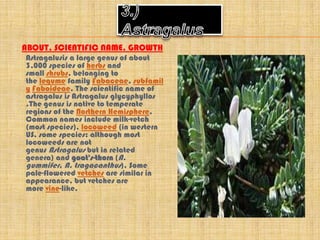
Astragalusis a large genus of about
3,000 species of herbs and
small shrubs, belonging to
the legume family Fabaceae, subfamil
y Faboideae. The scientific name of
astragalus is Astragalus glycyphyllos
.The genus is native to temperate
regions of the Northern Hemisphere.
Common names include milk-vetch
(most species), locoweed (in western
US, some species; although most
locoweeds are not
genus Astragalus but in related
genera) and goat's-thorn (A.
gummifer, A. tragacanthus). Some
pale-flowered vetches are similar in
appearance, but vetches are
more vine-like.
USES
Extracts of Astragalus
membranaceus (syn. Astragalus propinquus) are
marketed as life prolonging extracts in humans.
A proprietary extract of the dried root
ofAstragalus membranaceus, called TA-65, 'was
associated with a significant age-reversal effect
in the immune system, in that it led to declines in
the percentage of senescent cytotoxic T cells
and natural killer cells after six to twelve months
of use. In October 2010, Intertek/AAC Labs, an
ISO 17025 internationally recognized lab, found
the largest component of TA-65 to be
Cycloastragenol. Telomerase activation was
feared to pose an increased risk of cancer
because telomereshortening is a mechanism that
limits cell proliferation. However, short telomeres
result in chromosome instability, hence there is
also a potential mechanism for telomere
lengthening to protect against cancer (as distinct
from mutation-induced activation). The natural
gum tragacanth is made from several species
of Astragalus occurring in the Middle East,
including A. adscendens, A. gummifer, A.
brachycalyx,[3][4] and A. tragacanthus.
Also Astragalus propinquus (also known
SIDE EFFECTS
4.)Selaginella bryopteris
DESCRIPTION,SCIENTIFIC NAME, GROWTH
Selaginella bryopteris, known commonly
as sanjeevani and sanjivini
booti (Devanagari: ), is a lithophytic plant. It is
used medicinally in India. The popular
name sanjeevani which translates as "One that infuses
life" derives from the medicinal properties. Sanjeevani
grows on the hills of tropical areas, particularly
the Arawali Mountain terrains from east to west in India.
The dry plants have traditionally been used as a remedy
for several human health complications for centuries in
India, particularly by tribal peoples. Traditional uses
include relief from heat stroke, dysuria,
irregular menstruation, and jaundice, but the
effectiveness has not been scientifically validated.
Selaginella bryopteris
In Hindu mythology, Sanjeevani is a
magical herb which has the power to
cure any malady. It was believed that
medicines prepared from this herb
could revive a dead person. This herb is
mentioned in
the Ramayana when,Ravana's
son Indrajit hurls a powerful weapon
at Lakshmana. Lakshmana is badly
wounded and is nearly killed by
Indrajeet. Hanuman was called upon to
fetch this herb from the
mount Dunagiri (Mahodaya) in
the Himalayas orValley of Flowers.Upon
reaching Mount Sumeru, Hanuman was
unable to identify the herb and decided
to lift the entire mountain and bring it to
the battlefield.
Selaginella bryopteris is called in hindi
“SANGIVANI BUTI”
Product Description
Drishti eye drop is a unique Researche based product of Patanjali Ayurved
Limited. which was brought to a success by an efficient team of research
scholars and doctors under visionary guidance of P.P Swami Ram dev
ji and P.P. Acharya Balkrishna ji.
Drishti eye Drop is a powerful antiseptic solution which gives a colling and
soothing effects on eyes without any harmful effect on eye tissue. It helps
controlling the cataract improves vision and its prolonged use helps keeping
away all eyes problem. It balances the doshas and thus keeps the eyes
healthy. The drop may cause irritation to the eyes while using but keeping the
eyes closed for 2-3 minutes will help reducing the irritation. However the
irritation does not cause any harm to the eyes. (Please refer toxicity study).
Composition - Each 10 ml contains
Shwet pyaz rasa (allium cepa) : 1.68 ml
Adark rasa (zingiber officinale): 1.66 ml
Nimbu rasa (citrus aurantifolia): 1.66 ml
Shahad (Honey): 5.0 ml
Preservative Benzalkonium chloride I.P.
CONCLUSION
 1.) Medical plants are very useful in
day to day life.
 2.) Plant more and more medicinal
plants.
 3.) We always want to use ayurvedic
medicines.
 Thank you
THIS IS NOT ENDING BUT THIS IS
BEGINNING

THANK YOU ! FOR BEING SO
ATTENTIVE
WE HOPE U ENJOY IT

Herbal plants

  • 1.
    WELCOME TO THE POWERPOINT PRESENTATION ON THE FOLLOWING HERBAL PLANTS BY THE STUDENTS OF CHOWGULE PUBLIC SCHOOL OF CLASS X-B THIS PRESENTATION IS FULLY DEDICTED TO OUR ENGLISH TEACHER MRS. GAURI RAGESH WE HOPE U WILL ENJOY IT 
  • 4.
     About ,Scientificname, growth Allium sativum, commonly known as garlic, is a species in the onion genus, Allium. Its close relatives include the onion, shallot, leek, chive, and rakkyo. With a history of human use of over 7,000 years, garlic is native to central Asia,and has long been a staple in the Mediterranean region, as well as a frequent seasoning in Asia, Africa, and Europe. It was known to Ancient Egyptians, and has been used for both culinary and medicinal purposes.  USES  High blood pressure. Some research shows that garlic can reduce blood pressure in people with high blood pressure by as much as 7% or 8%.  It also seems to lower blood pressure in people with normal blood pressure.  Most studies have used a specific garlic powder product  (Kwai, from Lichtwer Pharma).  Colon cancer, rectal cancer, and stomach cancer.  Eating garlic seems to reduce the risk of developing these cancers.  However, garlic supplements don’t seem to offer the same benefit.  Tick bites. Scientists have compared the number of tick bites in people who take high doses of garlic compared to people who do not take garlic. High doses of dietary garlic, over about a five-month period, seem to reduce the number of tick bites.  Fungal infections of the skin (including ringworm, jock itch and athlete’s foot). Ringworm and jock itch respond to treatment with a garlic gel containing 0.6% ajoene (a chemical in garlic) that is applied to the skin. A garlic gel with a higher concentration of ajoene (1%) is needed to be effective against athlete’s foot. In fact, garlic gel with 1% ajoene seems to be about as effective against athlete’s foot as the medicine Lamisil.
  • 5.
     Garlic isLIKELY SAFE for most people when taken by mouth. Garlic can cause bad breath, a burning sensation in the mouth or stomach, heartburn, gas, nausea, vomiting, body odor, and diarrhea. These side effects are often worse with raw garlic. Garlic may also increase the risk of bleeding. There have been reports of bleeding after surgery in people who have taken garlic. Asthma has been reported in people working with garlic, and other allergic reactions are possible. When used on the skin, garlic is POSSIBLY UNSAFE. Using as a thick paste (poultice), garlic can cause damage to the skin that is similar to a burn.  Special Precautions & Warnings:  Pregnancy and breast-feeding: Garlic is LIKELY SAFE in pregnancy when taken in the amounts normally found in food. Garlic is POSSIBLY UNSAFEwhen used in medicinal amounts in pregnancy and breast-feeding. There isn’t enough reliable information about the safety of using garlic on the skin if you are pregnant or breast-feeding. Stay on the safe side, and avoid use. Children: Garlic is POSSIBLY SAFE when taken by mouth and appropriately for a short-term in children. But garlic is POSSIBLY UNSAFE when taken by mouth in large doses. Some sources suggest that high doses of garlic could be dangerous or even fatal to children; however, the reason for this warning is not known. There are no case reports available of significant adverse events or mortality in children associated with taking garlic by mouth. Bleeding disorder: Garlic, especially fresh garlic, might increase bleeding. Stomach or digestion problems: Garlic can irritate the gastrointestinal (GI) tract. Use with caution if you have stomach or digestion problems. Surgery: Garlic might prolong bleeding. Stop taking garlic at least two weeks before a scheduled surgery.
  • 6.
     ABOUT, SCIENTIFICNAME, GROWTH :-  The açaí palm (Euterpe oleracea) is a species of palm tree in the genus Euterpe cultivated for their fruit and superior hearts of palm. Its name comes from the Portuguese adaptation of the Tupian word ïwaca'i, '[fruit that] cries or expels water'. Global demand for the fruit has expanded rapidly in recent years, and açaí is now cultivated for that purpose primarily. Euterpe edulis (juçara) is a closely related species which is now the primary source of hearts of palm.  Eight species are native to Central and South America, from Belize southward to Brazil and Peru, growing mainly in swamps and floodplains. Açaí palms are tall, slender palms growing upwards of 25+ meters (82 feet), with pinnate leaves up to 3 meters (9.8 feet) long.
  • 7.
    USES :- Apart fromthe use of its fruit as food or beverage, the açaí palm has other commercial uses. Leaves may be made into hats, mats, baskets, brooms and roof thatch for homes, and trunk wood, resistant to pests, for building construction. Tree trunks may be processed to yield minerals. The palm heart is widely exploited as a delicacy. Comprising 80% of the fruit mass, açaí seeds may be ground for livestock food or as a component of organic soil for plants. Planted seeds are used for new palm tree stock, which, under the right growing conditions, can require months to form seedlings. The seeds are a source of polyunsaturated and saturated fatty acids. Orally administered açaí has been tested as a contrast agent for magnetic resonance imaging of the gastrointestinal system Its anthocyanins have also been characterized for stability as a natural food coloring agent.
  • 8.
    Dietary supplement  In2004, it became popular to consume açaí as a supplement due in part to the rapid success of multi-level marketing company MonaVie that sells an açaí blend tonic for $40 a bottle. Another reason is the proliferation of various açaí supplement companies that misused celebrity names like Oprah Winfrey andRachael Ray to promote açaí weight loss pills online.  Marketers of these products make unfounded claims that açaí and its antioxidant qualities provide a variety of health benefits, none of which has scientific confirmation to date. False claims include reversal of diabetes and other chronic illnesses, as well as expanding size of the penis and increasing men's sexual virility. As of April 2012, there are no scientifically controlled studies providing proof of any health benefits from consuming açaí. No açaí products have been evaluated by the FDA, and their efficacy is doubtful. Specifically, there is no scientific evidence that açaí consumption affects body weight, promotes weight loss or has any positive health effect.  According to the Washington, D.C. based Center for Science in the Public Interest (CSPI) thousands of consumers have had trouble stopping recurrent charges on their credit cards when they cancel free trials of açai-based products. Even some web sites purporting to warn about açai-related scams are themselves perpetrating scams.  In late 2008, lawyers for The Oprah Winfrey Show began investigating statements from supplement manufacturers who alleged that frequent Oprah guest Dr.Mehmet Oz had recommended their product or açai in general for weight loss.  One laboratory study found that commercially available açaí powder added to the diet of fruit flies lengthened their lives when challenged by chemical or geneticoxidative stress. Dietary açaí also restored the flies' circadian rhythm disturbed
  • 9.
    HAMDARDSAFI As mentioned earlier,Safi is a herbal blood purifier that si very effective in healing all skin related disorders. Two teaspoons of safi can be consumed either directly or by mixing in a cup of milk of water preferably in the morning. For children the dosage varies according to age from 1/3rd teaspoon to ½ teaspoon. Safi is available in two packages – 175 ml bottle and 400 ml bottle. The ingredients of Safi are • Bauhinia variegata • Canscora decussate • Cassia angustifolia • Chrozophora plicata • Curcuma caesia • Cuscuta reflexa • Dalbergia sissoo • Fumaria parviflora • Ipomoea turpethum • Lavandula stoechas • Melia azadirachta • Nymphaea lotus • Ocimum canum • Pterocarpus santalinus • Rosa damascena • Smilax china • Sphaeranthus indicus • Swertia chirata • Tephrosia purpurea • Terminalia chebula • Tinospora cordifolia • Syrup
  • 10.
    ABOUT, SCIENTIFIC NAME,GROWTH Astragalusis a large genus of about 3,000 species of herbs and small shrubs, belonging to the legume family Fabaceae, subfamil y Faboideae. The scientific name of astragalus is Astragalus glycyphyllos .The genus is native to temperate regions of the Northern Hemisphere. Common names include milk-vetch (most species), locoweed (in western US, some species; although most locoweeds are not genus Astragalus but in related genera) and goat's-thorn (A. gummifer, A. tragacanthus). Some pale-flowered vetches are similar in appearance, but vetches are more vine-like.
  • 11.
    USES Extracts of Astragalus membranaceus(syn. Astragalus propinquus) are marketed as life prolonging extracts in humans. A proprietary extract of the dried root ofAstragalus membranaceus, called TA-65, 'was associated with a significant age-reversal effect in the immune system, in that it led to declines in the percentage of senescent cytotoxic T cells and natural killer cells after six to twelve months of use. In October 2010, Intertek/AAC Labs, an ISO 17025 internationally recognized lab, found the largest component of TA-65 to be Cycloastragenol. Telomerase activation was feared to pose an increased risk of cancer because telomereshortening is a mechanism that limits cell proliferation. However, short telomeres result in chromosome instability, hence there is also a potential mechanism for telomere lengthening to protect against cancer (as distinct from mutation-induced activation). The natural gum tragacanth is made from several species of Astragalus occurring in the Middle East, including A. adscendens, A. gummifer, A. brachycalyx,[3][4] and A. tragacanthus. Also Astragalus propinquus (also known
  • 12.
  • 13.
    4.)Selaginella bryopteris DESCRIPTION,SCIENTIFIC NAME,GROWTH Selaginella bryopteris, known commonly as sanjeevani and sanjivini booti (Devanagari: ), is a lithophytic plant. It is used medicinally in India. The popular name sanjeevani which translates as "One that infuses life" derives from the medicinal properties. Sanjeevani grows on the hills of tropical areas, particularly the Arawali Mountain terrains from east to west in India. The dry plants have traditionally been used as a remedy for several human health complications for centuries in India, particularly by tribal peoples. Traditional uses include relief from heat stroke, dysuria, irregular menstruation, and jaundice, but the effectiveness has not been scientifically validated.
  • 14.
  • 15.
    In Hindu mythology,Sanjeevani is a magical herb which has the power to cure any malady. It was believed that medicines prepared from this herb could revive a dead person. This herb is mentioned in the Ramayana when,Ravana's son Indrajit hurls a powerful weapon at Lakshmana. Lakshmana is badly wounded and is nearly killed by Indrajeet. Hanuman was called upon to fetch this herb from the mount Dunagiri (Mahodaya) in the Himalayas orValley of Flowers.Upon reaching Mount Sumeru, Hanuman was unable to identify the herb and decided to lift the entire mountain and bring it to the battlefield.
  • 16.
    Selaginella bryopteris iscalled in hindi “SANGIVANI BUTI”
  • 17.
    Product Description Drishti eyedrop is a unique Researche based product of Patanjali Ayurved Limited. which was brought to a success by an efficient team of research scholars and doctors under visionary guidance of P.P Swami Ram dev ji and P.P. Acharya Balkrishna ji. Drishti eye Drop is a powerful antiseptic solution which gives a colling and soothing effects on eyes without any harmful effect on eye tissue. It helps controlling the cataract improves vision and its prolonged use helps keeping away all eyes problem. It balances the doshas and thus keeps the eyes healthy. The drop may cause irritation to the eyes while using but keeping the eyes closed for 2-3 minutes will help reducing the irritation. However the irritation does not cause any harm to the eyes. (Please refer toxicity study). Composition - Each 10 ml contains Shwet pyaz rasa (allium cepa) : 1.68 ml Adark rasa (zingiber officinale): 1.66 ml Nimbu rasa (citrus aurantifolia): 1.66 ml Shahad (Honey): 5.0 ml Preservative Benzalkonium chloride I.P.
  • 18.
    CONCLUSION  1.) Medicalplants are very useful in day to day life.  2.) Plant more and more medicinal plants.  3.) We always want to use ayurvedic medicines.  Thank you
  • 19.
    THIS IS NOTENDING BUT THIS IS BEGINNING  THANK YOU ! FOR BEING SO ATTENTIVE WE HOPE U ENJOY IT