Outlines
Herbal Medicine
History
Herbs as therapeutic agents
Preparing herbs as therapeutics in
traditional medicine
Areas of practice
Significant herbs used in CAM
4.
Cont…
Medical herbalism, orsimply, herbalism or
herbology, is “the study of herbs and their
medicinal uses”.
include the cultivation, collection, or dispensing
of aromatic plants, especially those considered
to have medicinal properties.
Can be substituted by herbal or botanical
medicine, or phytotherapy, previously defined
as “the use of plant materials to prevent and
treat ill health or promote wellness”.
5.
Herbal Medicine:
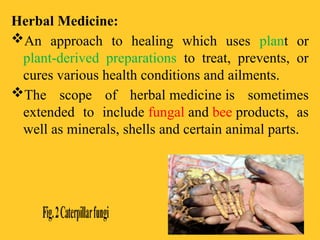
An approachto healing which uses plant or
plant-derived preparations to treat, prevents, or
cures various health conditions and ailments.
The scope of herbal medicine is sometimes
extended to include fungal and bee products, as
well as minerals, shells and certain animal parts.
6.
Cont.…
Herbal medicinesdo not differ greatly from
conventional drugs in terms of how they work.
This enables herbal medicines to be as effective
as conventional medicines, but also gives them
the same potential to cause harmful side effects.
Many of the pharmaceuticals currently available
to physicians have a long history of use as herbal
remedies, including aspirin, digitalis, quinine,
and opium.
Cont.…
A large amountof archaeological evidence exists w/c
indicates that humans were using medicinal plants
during the Paleolithic, approximately 60,000 years
ago.
The use of herbs and spices in cuisine developed in
part as a response to the threat of food-borne
pathogens.
Studies show that in tropical climates where pathogens
are the most abundant, recipes are the most highly
spiced.
9.
Cont.…
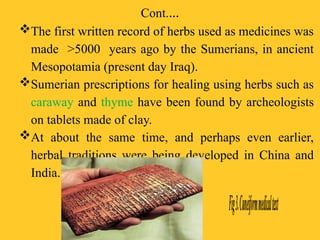
The first writtenrecord of herbs used as medicines was
made >5000 years ago by the Sumerians, in ancient
Mesopotamia (present day Iraq).
Sumerian prescriptions for healing using herbs such as
caraway and thyme have been found by archeologists
on tablets made of clay.
At about the same time, and perhaps even earlier,
herbal traditions were being developed in China and
India.
10.
Cont.…
In 2005 cuneiformscholars succeeded in
translating the greater part of the pharmacopoeia.
They identified substances as varied as turtle
shell, willow bark and cannabis, most of which
were ground into wine or beer as the universal
dissolving agent.
The tablet is believed to be the first known
documentation of aspirin, aloe Vera and opium,
demonstrating a sophistication and level of medical
knowledge equivalent to 17th century England.
11.
Cont.…
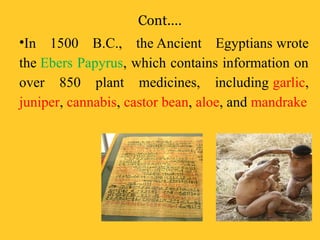
•In 1500 B.C.,the Ancient Egyptians wrote
the Ebers Papyrus, which contains information on
over 850 plant medicines, including garlic,
juniper, cannabis, castor bean, aloe, and mandrake
12.
Cont.…
Early 19th
century: scientistsbegan to use
chemical analysis to extract and modify the active
ingredients from plants.
Later chemists began making synthetic versions of
plant compounds and
the use of herbal medicines declined in favor of
conventional drugs in most industrialized countries;
In contrast, many non-industrialized countries
never abandoned medical herbalism and continued
to develop their existing traditional medical
systems
13.
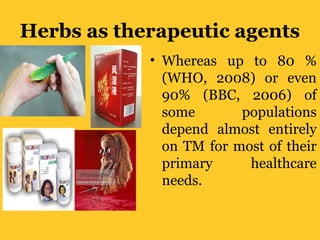
Herbs as therapeuticagents
• Whereas up to 80 %
(WHO, 2008) or even
90% (BBC, 2006) of
some populations
depend almost entirely
on TM for most of their
primary healthcare
needs.
14.
Cont…
• In welldeveloped countries, herbal drugs are better
regulated – that is:
• herbal drugs are produced according good manufacturing
practice (GMP); and
• utilized in accordance with good clinical practice (GCP).
• Thus, although herbal drugs are not “pharmaceuticals”
(precise chemical entities or combinations there of), they are
nevertheless treated with about the same degree of
diligence.
• In china, India and Korea, where TM systems have been
integrated into the national health scheme
– TMs are treated with the same degree of respect as synthetic
“pharmaceuticals”.
15.
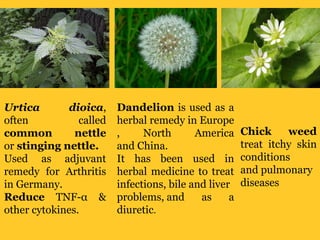
Urtica dioica,
often called
commonnettle
or stinging nettle.
Used as adjuvant
remedy for Arthritis
in Germany.
Reduce TNF-α &
other cytokines.
Dandelion is used as a
herbal remedy in Europe
, North America
and China.
It has been used in
herbal medicine to treat
infections, bile and liver
problems, and as a
diuretic.
Chick weed
treat itchy skin
conditions
and pulmonary
diseases
INFUSION
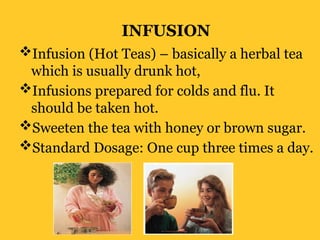
Infusion (Hot Teas)– basically a herbal tea
which is usually drunk hot,
Infusions prepared for colds and flu. It
should be taken hot.
Sweeten the tea with honey or brown sugar.
Standard Dosage: One cup three times a day.
18.
MACERATION (Cold extract)
•Suitablefor the preparation of mucilage
containing herbs such as flax seed or psyllium
seeds.
•Method of preparation: Prepared by allowing a
tea herb to steep in cold water for several hours to
extract its active principles.
•The different types of teas are Loose tea, tea
bags and instant teas.
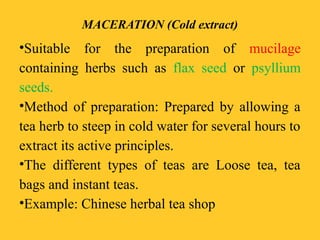
•Example: Chinese herbal tea shop
19.
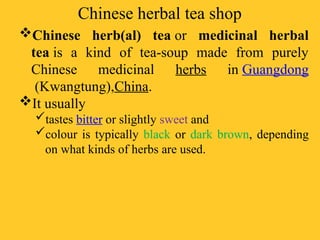
Chinese herbal teashop
Chinese herb(al) tea or medicinal herbal
tea is a kind of tea-soup made from purely
Chinese medicinal herbs in Guangdong
(Kwangtung),China.
It usually
tastes bitter or slightly sweet and
colour is typically black or dark brown, depending
on what kinds of herbs are used.
20.
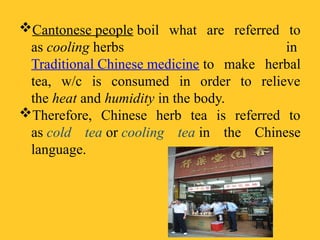
Cantonese people boilwhat are referred to
as cooling herbs in
Traditional Chinese medicine to make herbal
tea, w/c is consumed in order to relieve
the heat and humidity in the body.
Therefore, Chinese herb tea is referred to
as cold tea or cooling tea in the Chinese
language.
21.
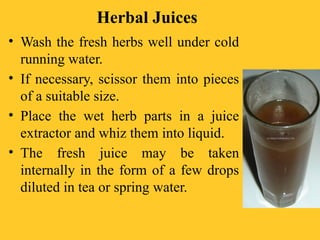
Herbal Juices
• Washthe fresh herbs well under cold
running water.
• If necessary, scissor them into pieces
of a suitable size.
• Place the wet herb parts in a juice
extractor and whiz them into liquid.
• The fresh juice may be taken
internally in the form of a few drops
diluted in tea or spring water.
22.
Cont.…
• For someconditions, the juice may prove
valuable when dabbed externally on the affected
parts of the body.
• Fresh juices are generally used immediately
after extraction.
• However, if you place the liquid in a small glass
bottle, cork it tightly, and refrigerate it,
• it will keep for several days without an
appreciable loss of vital properties.
23.
Example: Herbal juicefor common cold
Ingredients
• Black pepper – 1 tea spoon
• Coriander seeds – 1 table spoon
• Glycyrrhiza glabra – 3 small pieces
• Alpinia galangal – 2 small pieces
• Dry ginger – 3 small pieces
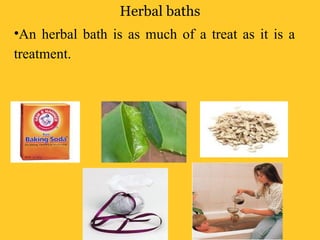
Ways to preparean herbal bath
•If you are using a soluble ingredient, such as
baking soda or aloe vera gel, simply dissolve it in
hot bath water.
•If you are using oatmeal, you can either whirl it
into a powder in your blender or bag it.
•Oatmeal seems soft, but it doesn't dissolve
completely unless it has first been very finely
milled.
• If you are using fresh herbs, you can bag them in
a square of cheesecloth or a washcloth.
26.
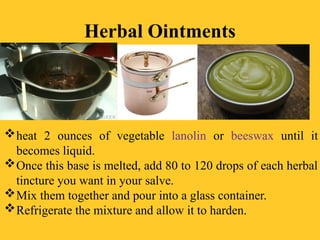
Herbal Ointments
heat 2ounces of vegetable lanolin or beeswax until it
becomes liquid.
Once this base is melted, add 80 to 120 drops of each herbal
tincture you want in your salve.
Mix them together and pour into a glass container.
Refrigerate the mixture and allow it to harden.
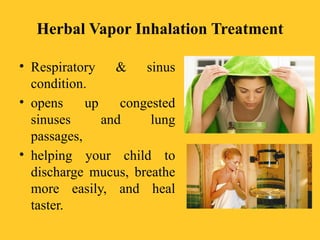
Herbal Vapor InhalationTreatment
• Respiratory & sinus
condition.
• opens up congested
sinuses and lung
passages,
• helping your child to
discharge mucus, breathe
more easily, and heal
taster.
30.
Theory (Areas ofpractices)
1. Cleansing the body.
2. Mobilising the circulation.
3. Stimulating digestion.
4. Nourishment and repair.
31.
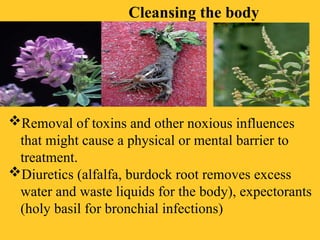
Cleansing the body
Removalof toxins and other noxious influences
that might cause a physical or mental barrier to
treatment.
Diuretics (alfalfa, burdock root removes excess
water and waste liquids for the body), expectorants
(holy basil for bronchial infections)
32.
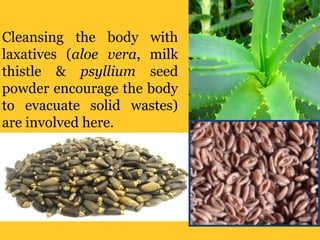
Cleansing the bodywith
laxatives (aloe vera, milk
thistle & psyllium seed
powder encourage the body
to evacuate solid wastes)
are involved here.
33.
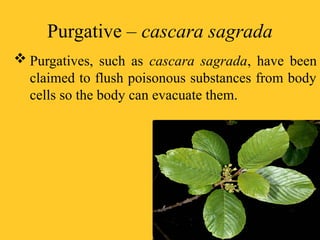
Purgative – cascarasagrada
Purgatives, such as cascara sagrada, have been
claimed to flush poisonous substances from body
cells so the body can evacuate them.
34.
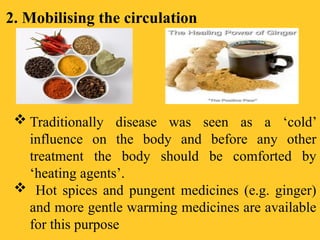
2. Mobilising thecirculation
Traditionally disease was seen as a ‘cold’
influence on the body and before any other
treatment the body should be comforted by
‘heating agents’.
Hot spices and pungent medicines (e.g. ginger)
and more gentle warming medicines are available
for this purpose
35.
3. Stimulating digestion:
theso-called ‘cooling medicines’ are those used to treat
these circumstances, leading to improved digestion.
Anti-inflammatories, antiallergics and sedatives are
examples of therapeutic classes of drugs that fall into
this category.
inappropriate or too much heat in the body
manifests itself as fevers and inflammatory
conditions.
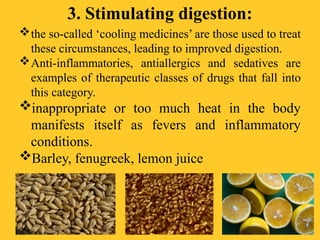
Barley, fenugreek, lemon juice
36.
4. Nourishment andrepair:
in this phase the herbalist deals with the
debility arising from disease in the body.
The term ‘tonic’ covers a wide range of
medicines used to support the body.
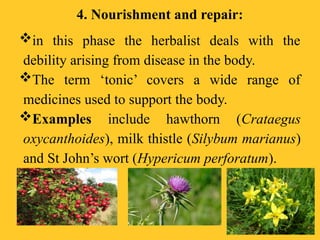
Examples include hawthorn (Crataegus
oxycanthoides), milk thistle (Silybum marianus)
and St John’s wort (Hypericum perforatum).
37.
Active constituents inherbal medicines
• Bitters
• The ‘hot’ medicines
• Resins
• Saponins
• Tannins
• Volatile oils
38.
Bitters
Traditionally thesewere used extensively to
stimulate appetite.
It is now thought that they will be effective only if
a malnourished state exists.
The most effective chemicals are the monoterpene
secoiridoid glycosides of gentian.
Other extracts that have been used as bitters
include quassia, quinine (Cinchona) and strychnine
(Nux vomica).
40.
The ‘hot’ medicines
•The three most commonly used ‘hot’ medicines
include black pepper (Piper nigrum), cayenne
pepper (Capsicum) and ginger (Zingiber).
• They are used as metabolic stimulants, more
specifically as a ‘facilitating agent’ to accompany
other herbs whose stimulatory activity may be
augmented.
41.
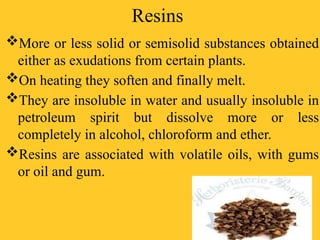
Resins
More or lesssolid or semisolid substances obtained
either as exudations from certain plants.
On heating they soften and finally melt.
They are insoluble in water and usually insoluble in
petroleum spirit but dissolve more or less
completely in alcohol, chloroform and ether.
Resins are associated with volatile oils, with gums
or oil and gum.
42.
Saponins
• Detergent properties
•Saponaria officinalis (Europe) & Quillaja
saponaria (south america) – High % of saponins
• Hemolytic – Inject into blood stream are highly
toxic
• Harmless – Oral
• Sarsaparilla – used in the preparation of Non
alcoholic drinks
• Decoctions of soapwort (saponaria) – Wash &
restore ancient fabrics
43.
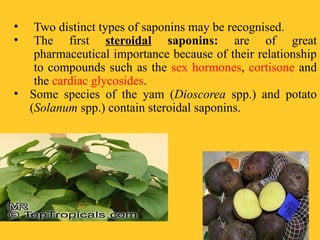
• Two distincttypes of saponins may be recognised.
• The first steroidal saponins: are of great
pharmaceutical importance because of their relationship
to compounds such as the sex hormones, cortisone and
the cardiac glycosides.
• Some species of the yam (Dioscorea spp.) and potato
(Solanum spp.) contain steroidal saponins.
44.
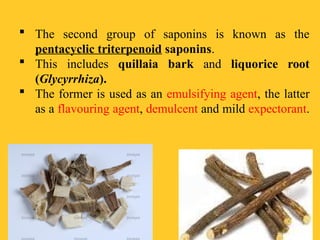
The secondgroup of saponins is known as the
pentacyclic triterpenoid saponins.
This includes quillaia bark and liquorice root
(Glycyrrhiza).
The former is used as an emulsifying agent, the latter
as a flavouring agent, demulcent and mild expectorant.
45.
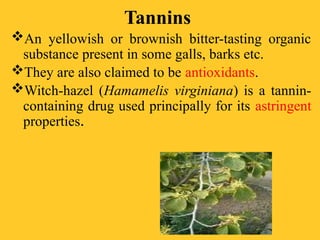
Tannins
An yellowish orbrownish bitter-tasting organic
substance present in some galls, barks etc.
They are also claimed to be antioxidants.
Witch-hazel (Hamamelis virginiana) is a tannin-
containing drug used principally for its astringent
properties.
46.
Volatile oils
• Volatileoils are volatile in steam.
• They differ widely in both chemical and physical
properties from fixed oils.
• They are secreted in oil cells, in secretion ducts or
cavities, or in glandular hairs, and are frequently
associated with gums and resins.
• With the exception of oils derived from glycosides (e.g.
bitter almonds and mustard oil), volatile oils are generally
mixtures of hydrocarbons and oxygenated derivatives
mainly responsible for odour and taste.
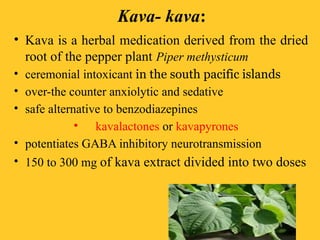
Kava- kava:
• Kavais a herbal medication derived from the dried
root of the pepper plant Piper methysticum
• ceremonial intoxicant in the south pacific islands
• over-the counter anxiolytic and sedative
• safe alternative to benzodiazepines
• kavalactones or kavapyrones
• potentiates GABA inhibitory neurotransmission
• 150 to 300 mg of kava extract divided into two doses
50.
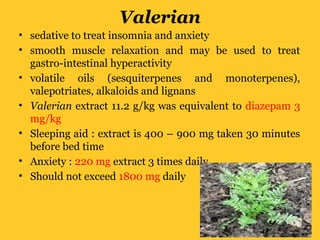
Valerian
• sedative totreat insomnia and anxiety
• smooth muscle relaxation and may be used to treat
gastro-intestinal hyperactivity
• volatile oils (sesquiterpenes and monoterpenes),
valepotriates, alkaloids and lignans
• Valerian extract 11.2 g/kg was equivalent to diazepam 3
mg/kg
• Sleeping aid : extract is 400 – 900 mg taken 30 minutes
before bed time
• Anxiety : 220 mg extract 3 times daily
• Should not exceed 1800 mg daily
51.
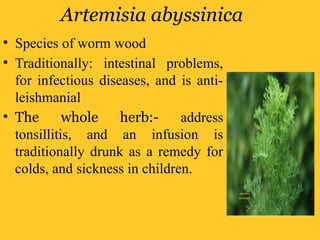
Artemisia abyssinica
• Speciesof worm wood
• Traditionally: intestinal problems,
for infectious diseases, and is anti-
leishmanial
• The whole herb:- address
tonsillitis, and an infusion is
traditionally drunk as a remedy for
colds, and sickness in children.
52.
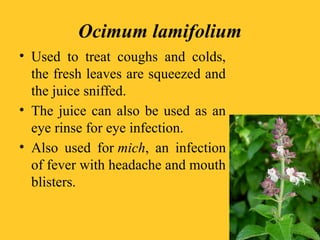
Ocimum lamifolium
• Usedto treat coughs and colds,
the fresh leaves are squeezed and
the juice sniffed.
• The juice can also be used as an
eye rinse for eye infection.
• Also used for mich, an infection
of fever with headache and mouth
blisters.
53.
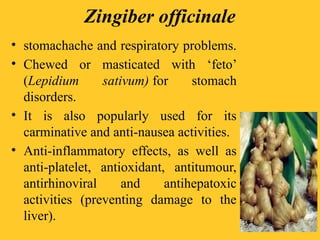
Zingiber officinale
• stomachacheand respiratory problems.
• Chewed or masticated with ‘feto’
(Lepidium sativum) for stomach
disorders.
• It is also popularly used for its
carminative and anti-nausea activities.
• Anti-inflammatory effects, as well as
anti-platelet, antioxidant, antitumour,
antirhinoviral and antihepatoxic
activities (preventing damage to the
liver).
54.
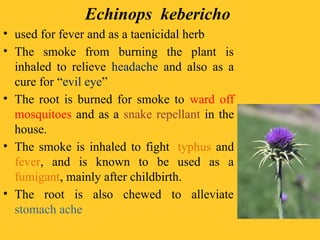
Echinops kebericho
• usedfor fever and as a taenicidal herb
• The smoke from burning the plant is
inhaled to relieve headache and also as a
cure for “evil eye”
• The root is burned for smoke to ward off
mosquitoes and as a snake repellant in the
house.
• The smoke is inhaled to fight typhus and
fever, and is known to be used as a
fumigant, mainly after childbirth.
• The root is also chewed to alleviate
stomach ache
55.
Verbena officinalis
• InEthiopian traditional practice:
– Roots of Verbena or Atuch, are soaked in water
and drunk to expel roundworm, help with snake
bite, and relieve stomach ache and diarrhoea
• Have antimicrobial properties and is
traditionally used for treating tropical ulcers.
• Mixed with olive oil, the juice of the fruit is
used as ear drops ;
• a juice made by crushing the fresh leaves,
filtering and mixing with honey, is also used
to alleviate dry cough
56.
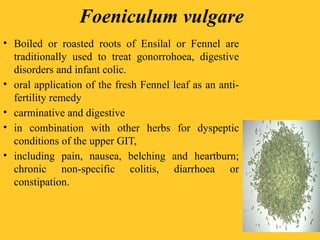
Foeniculum vulgare
• Boiledor roasted roots of Ensilal or Fennel are
traditionally used to treat gonorrohoea, digestive
disorders and infant colic.
• oral application of the fresh Fennel leaf as an anti-
fertility remedy
• carminative and digestive
• in combination with other herbs for dyspeptic
conditions of the upper GIT,
• including pain, nausea, belching and heartburn;
chronic non-specific colitis, diarrhoea or
constipation.
57.
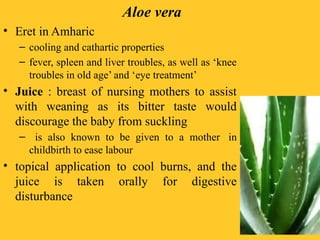
Aloe vera
• Eretin Amharic
– cooling and cathartic properties
– fever, spleen and liver troubles, as well as ‘knee
troubles in old age’ and ‘eye treatment’
• Juice : breast of nursing mothers to assist
with weaning as its bitter taste would
discourage the baby from suckling
– is also known to be given to a mother in
childbirth to ease labour
• topical application to cool burns, and the
juice is taken orally for digestive
disturbance
58.
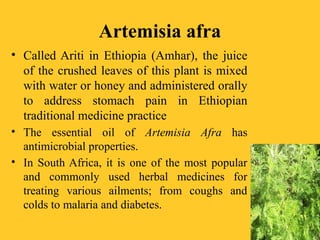
Artemisia afra
• CalledAriti in Ethiopia (Amhar), the juice
of the crushed leaves of this plant is mixed
with water or honey and administered orally
to address stomach pain in Ethiopian
traditional medicine practice
• The essential oil of Artemisia Afra has
antimicrobial properties.
• In South Africa, it is one of the most popular
and commonly used herbal medicines for
treating various ailments; from coughs and
colds to malaria and diabetes.
#5 Plants have the ability to synthesize a wide variety of chemical compounds that are used to perform important biological functions, and to defend against attack from predators such as insects, fungi and herbivorous mammals.
Pharmacognosy is the study of all medicines that are derived from natural sources.
Slide after herbal medicine
This approach is incorporated into various medical systems. Although herbal medicine does not have a specific point of conception, at present majority of the world’s population rely on medicinal plant preparations for their primary healthcare needs, according to the World Health Organization. Despite the extensive use which can be attributed to the use of plants in traditional medical systems, our knowledge of the plants and their values remain largely unexplored.
#6 Chemical compounds in plants mediate their effects on the human body through processes identical to those already well understood for the chemical compounds in conventional drugs; thus herbal medicines do not differ greatly from conventional drugs in terms of how they work
The use of herbs to treat disease is almost universal among non-industrialized societies, and is often more affordable than purchasing expensive modern pharmaceuticals.
The WHO estimates that 80% of the population of some Asian and African countries presently use herbal medicine for some aspect of primary health care.
Studies in the USA and Europe have shown that their use is less common in clinical settings, but has become increasingly more in recent years as scientific evidence about the effectiveness of herbal medicine has become more widely available.
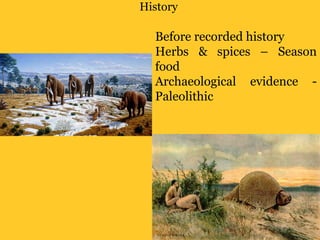
#7 Plants have been used for medicinal purposes since before recorded history. Many of the herbs and spices used by humans to season food also yield useful medicinal compounds. The use of herbs and spices in cuisine developed in part as a response to the threat of food-borne pathogens. Studies show that in tropical climates where pathogens are the most abundant, recipes are the most highly spiced. Further, the spices with the most potent antimicrobial activity tend to be selected. In all cultures vegetables are spiced less than meat, presumably because they are more resistant to spoilage. Many of the common weeds that populate human settlements, such as nettle, dandelion and chickweed, also have medicinal properties. (Furthermore, other non-human primates are also known to ingest medicinal plants to treat illness).
Paleolithic: The Paleolithic (US spelling; also spelled Palaeolithic) Age, Era or Period is a prehistoric period of human history distinguished by the development of the most primitive stone tools discovered (Grahame Clark's Modes I and II), and covers roughly 99% of human technological prehistory. It extends from the earliest known use of stone tools, probably by hominins such as australopithecines, 2.6 million years ago, to the end of the Pleistocene around 10,000 BP.
#8 2. Further, the spices with the most potent antimicrobial activity tend to be selected. In all cultures vegetables are spiced less than meat, presumably because they are more resistant to spoilage.
3. (Furthermore, other non-human primates are also known to ingest medicinal plants to treat illness).
#9 (Sumerian was an ancient civilization and historical region in southern Mesopotamia (modern day southern Iraq).
The Cuneiform medical text (fig 3), 2100 BC was the largest stone tablet, 15 x 8.5 cm, 30 mm thick, have inscription on both sides. Buried 4,000 years beneath the ruins of ancient Nippur in Iraq, this 2100 BC tablet is the oldest medical text known. Towards the end of the third millennium BC an anonymous Sumerian herbalist recorded popular remedies of the period for posterity, inscribing fifteen detailed prescriptions in Old Sumerian Cuneiform
#12 2. With the invention of the printing press in 1440 A.D., herbalists began to spread the word about effective preparations.
#14 In 2001, a total of 1249 traditional Chinese medicines (TCMs) were listed in China’s national essential drugs list, with sales of US$ 9.8 billion. “Chinese herbalism is the most prevalent of the ancient herbal traditions currently practiced in Britain”. The presence and impact of TCM and Ayurvedic Medicine in the US are well documented. Yoruba Medicine from Africa is also known in the Americas; and Chinese herbal teas are everywhere including African city supermarkets and international airports. Notably, Niprisan, the sickle cell drug, granted orphan drug status by the US-FDA and EMEA in 2003 had been developed from Yoruba Medicine. Niprisan is also known and patented in India.
Herbal medicines are generally regarded “as the major remedy in traditional medical systems” (WHO, 1993). A clear indication of their importance is evident from the following: “About one-quarter of all U.S. prescription drugs are derived from herbs. The pharmaceutical industry uses around 120 different compounds derived from plants in the drugs it manufactures, and it discovered nearly three-quarters of these compounds by studying folk remedies. Examples of drugs from plants include quinine, from the bark of the South American cinchona tree, used to treat some strains of malaria; digitalis, a widely prescribed heart medication, derived from the foxglove plant; salicylic acid, the source of aspirin, from willow bark; and taxol, for treating ovarian cancer, from the yew tree”.
#15 Nettle : Nettle leaf is a herb that has a long tradition of use as an adjuvant remedy in the treatment of arthritis in Germany. Nettle leaf extract contains active compounds that reduce TNF-α and other inflammatory cytokines. It has been demonstrated that nettle leaf lowers TNF-α levels by potently inhibiting the genetic transcription factor that activates TNF-α and IL-1B in the synovial tissue that lines the joint.
Urtica dioica herb has been used in the traditional Austrian medicine internally (as tea or fresh leaves) for treatment of disorders of the kidneys and urinary tract, gastrointestinal tract, locomotor system, skin, cardio-vascular system, hemorrhage, flu, rheumatism and gout.
Nettle is used in shampoo to control dandruff and is said to make hair more glossy, which is why some farmers include a handful of nettles with cattle feed.
Nettle root extracts have been extensively studied in human clinical trials as a treatment for symptoms of benign prostatic hyperplasia (BPH). These extracts have been shown to help relieve symptoms compared to placebo both by themselves and when combined with other herbal medicines.
Because it contains 3,4-divanillyltetrahydrofuran, certain extracts of the nettle are used by bodybuilders in an effort to increase free testosterone by occupying sex-hormone binding globulin.
As Old English stiðe, nettle is one of the nine plants invoked in the pagan Anglo-Saxon Nine Herbs Charm, recorded in the 10th century. Nettle is believed to be a galactagogue, a substance that promotes lactation.
Urtication, or flogging with nettles, is the process of deliberately applying stinging nettles to the skin in order to provoke inflammation. An agent thus used is known as a rubefacient (something that causes redness). This is done as a folk remedy for rheumatism, providing temporary relief from pain. The counter-irritant action to which this is often attributed can be preserved by the preparation of an alcoholic tincture which can be applied as part of a topical preparation, but not as an infusion, which drastically reduces the irritant action.
As a food
Urtica dioica has a flavour similar to spinach and cucumber when cooked and is rich in vitamins A, C, iron, potassium, manganese, and calcium. Young plants were harvested by Native Americans and used as a cooked plant in spring when other food plants were scarce. Soaking stinging nettles in water or cooking will remove the stinging chemicals from the plant, which allows them to be handled and eaten without incidence of stinging. After the stinging nettle enters its flowering and seed setting stages the leaves develop gritty particles called"cystoliths", which can irritate the urinary tract. In its peak season, nettle contains up to 25% protein, dry weight, which is high for a leafy green vegetable. The young leaves are edible and make a very good pot-herb. The leaves are also dried and may then be used to make a tisane, as can also be done with the nettle's flowers.
Nettles can be used in a variety of recipes, such as polenta, pesto and purée. Nettle soup is a common use of the plant, particularly in Northern and Eastern Europe. In Nepal and the Kumaon & Gargwal region of Northern India, stinging nettle is known as sisnu, kandeli and bicchu-booti (बिच्छू-बूटी in Hindi) respectively. It is also found in abundance in Kashmir. There it is called soi. It is a very popular vegetable and cooked with Indian spices.
Nettles are sometimes used in cheese making, for example in the production of Yarg and as a flavouring in varieties of Gouda.
Nettles are used in Albania as part of the dough filling for the byrek. Its name is byrek me hithra. The top baby leaves are selected and simmered, then mixed with other ingredients like herbs, rice, etc. before being used as a filling between dough layers.
Chick weed:
The plant has medicinal purposes and is used in folk medicine. It has been used as a remedy to treat itchy skin conditions and pulmonary diseases. 17th century herbalist John Gerard recommended it as a remedy for mange. Modern herbalists mainly prescribe it for skin diseases, and also for bronchitis, rheumatic pains, arthritis and period pain. A poultice of chickweed can be applied to cuts, burns and bruises. Not all of these uses are supported by scientific evidence.
#16 Various traditional dosage forms are as follows: Tea, Decoction, Infusion, Maceration, Juice, Syrup, Tincture and Extract. Some of the preparations from fresh plant materials are as follows:
#17 It is suitable for the preparation of delicate or finely chopped herbs (leaves, flowers, seeds, barks, roots) with volatile and thermolabile constituents. (Essential oils)
Avoid using the processed white sugar.
#19 Although it is referred to as "tea", it seldom contains any part of the tea plant (Camellia sinensis) and is thus a tisane.
#21 If you are lucky enough to have a reliable source of fresh herbs and a juicer, you may want to prepare a fresh essence.
#23 Method
Break Athimadhuram, Chitharathai and Sukku into small pieces; dry roast all the six items together just to make them warm when you touch (I did this in microwave oven).
Grind it as powder and put it in a air tight container and keep.
Khashayam preparation:
for adults: put half tea spoon of this powder in one cup of water and boil for 3 to 4 minutes; filter, add little sugar or honey and drink it warm twice a day.
for children above five years: put half tea spoon of this powder in one cup of milk and boil for 3 to 4 minutes; filter, add little sugar or honey and drink it warm twice a day.
#24 If you are using oatmeal, you can either whirl it into a powder in your blender or bag it. Oatmeal seems soft, but it doesn't dissolve completely unless it has first been very finely milled.
If you are using fresh herbs, you can bag them in a square of cheesecloth or a washcloth. A two- or three-thickness square of cheesecloth is ideal. The loose weave permits maximum release of the herbal essence, yet keeps the parts from floating free in the bath water. One method of bagging herbs is to stitch three sides of a cheesecloth square closed and run a drawstring through the top, or tie the bag closed with a sturdy string. An easier and quicker method is to place a suitable quantity of herbs in the middle of a cheesecloth square. Then simply pull the four corners of the square together and secure them with string. (You can do this with a washcloth or small towel, too, but cheesecloth is easier to manage.) For a full bath, use approximately 6 ounces of dried or fresh herbs.
Fill the tub, placing the bagged herbs under a forceful stream of comfortably hot water. As the tub fills, swish the herbs through the bath water. During the bath, gently squeeze an essence-rich stream of water from the herb bag directly on the part of the body you wish to treat. Your child may enjoy soaking and squeezing the bag. If you are treating an itchy skin condition, you may gently rub the bag across the affected areas. Unless you can trust your child not to rub itchy places raw, however, you may want to do this gentle scratching yourself. If you are using dried herbs, you will have to guard against rough parts, which may be irritating.
If your child is comforted and soothed by an herbal bath, you may want to be ready with a pre-prepared herbal infusion. Soak 6 tablespoons of dried or fresh herbs overnight in 3 cups of water. Start with very hot water and allow it to cool naturally. The following morning, heat the infusion and strain out the residue. No bag is needed; just pour the strained infusion directly into the bath water.
#25 There are several ways to prepare an herbal bath
#26 Herbal Ointments
There are many very fine herbal ointments and salves available. Purchased ointments and salves are often much more attractive and pleasant to use than the homemade variety. But if you wish to emulate yesterday's herbalists, here's how to make your own herbal ointment.
In a double boiler (preferably ceramic or glass) (A double boiler is a specialized piece of kitchen equipment consisting of two fitted saucepans. The larger saucepan is partially filled with water brought to a simmer or boil. The inner saucepan uses this indirect heat to melt the ingredients), heat 2 ounces of vegetable lanolin or beeswax until it becomes liquid
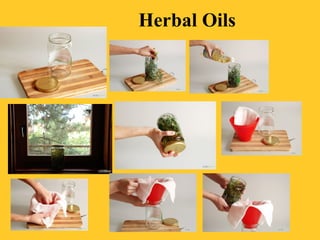
#27 To prepare a fragrant herbal oil, wash the fresh herbs of your choice and permit them to dry overnight. Place scissored fresh herbs or crumbled dried herbs in a glass bottle or jar. Slowly add light virgin olive oil or almond oil until the oil level is an inch above the herb parts. Cover the container tightly and allow it to stand in a very warm place for two weeks. You may place it near the stove to gather warmth from cooking, or outside in the sun (but remember to bring it in before night cools the air). Strain the oil before using it.
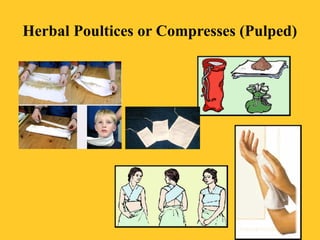
#28 Herbal Poultices or Compresses (Pulped)
Only fresh herbs are suitable for making a pulped poultice. Dried herbs do not pulp well. By pulping the herbs directly onto the poultice cloth, you retain all the juices and improve the effectiveness of the poultice. Place a quantity of fresh herb parts on a clean white cloth several folds thick (cotton, gauze, linen, and muslin are ideal). Wrap several thicknesses of the cloth over the herbs. Using a rolling pin, thoroughly crush the herbs to a pulp. Unwrap a layer or two of the cloth, until you uncover a thoroughly wetted area. Apply this to the affected area of the body. To trap the juices and hold the poultice in place, overwrap it well with a woolen cloth or a towel. A pulped compress can remain in place overnight.
#29 An herbal inhalation treatment is very helpful for respiratory and sinus conditions.
Fill your bathroom sink with very hot water and add 2 to 5 drops of herbal oil. To keep the water hot and steaming, allow a small, continuous trickle of hot water to flow into the basin (the overflow outlet in your sink should prevent the water from spilling over). Have your child inhale the steam for at least five minutes. As the treated water becomes diluted, add a few more drops of herbal oil as needed. If it is not feasible to use the bathroom sink for this purpose, or if you are using dried or whole herbs, use a pot of water heated on the stove to prepare an inhalation treatment. Fill a pot "preferably one that is wide but not too tall) with water. If using whole or dried herbs, add a small handful, heat the water to boiling, and simmer for about five minutes. Then remove the pot from the heat, place it on a hot pad or trivet on a tabletop, and allow it to cool slightly. If using herbal oil, heat the water to just short of boiling, remove it from the heat, place it on a tabletop, and add 4 to 5 drops of the oil. Have your child drape a large towel over his head, forming a tent, and lean over the pot. Have him inhale the steam for at least five minutes. (Be careful that the mixture is not too hot; if it is, it can burn the nasal passages.)To help clear lung congestion, encourage your child to take several deep, full breaths of air after an inhalation treatment.
#30 Traditionally, the herbalist has recognised four clear stages when offering treatment for any particular condition, individualising the prescription according to holistic methodology to take account of their patients’ particular needs:
#35 Thus, • Barley: the extract from barley has always been used for lowering the high temperature. It has a useful natural properties for lowering the high temperatures caused by an inflammation of the mucosa of the airways (such as bronchitis) or the mucosa of the walls of the intestine;
• Fenugreek: the fenugreek tea lowers the temperature. It is better to add lemon juice and honey too. This drink at the same time has an exceptional nutritional value, it nurtures the body and reduces the fever;
• Lemon: taking lemon juice or lemonade lowers the body temperature. This recipe is very effective. Take one big, fresh lemon, cleaned and cut into slices with peel. Put it in three cups of boiling water and cook it until the water evaporates, so that there is only one cup (be careful not to use aluminum containers when cooking). The mixture is then strained and given to the sick person. Also, it is useful to mix the lemon juice with an extract of barley (barley water) and use it to lower the temperature, but also as an antibiotic. Bitter orange also used and it also acts as an sedative.
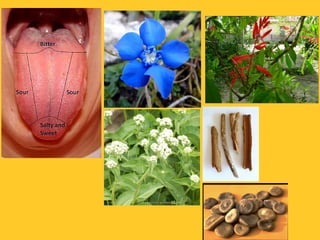
#38 The bitter constituents simulate the bitter receptors in the taste buds at the back of the mouth and give rise to an increase in the psychic secretion of gastric juice.
#41 The term 'resin' is applied to more or less solid, amorphous products of complex chemical nature. Resins are usually produced in ducts or cavities, they may be found in the other positions for example: in the resin cells of blood root, in the elements of heartwood of guaiacum, in the external glands of Indian hemp, in the internal glands of male fern or in the glands on the surface of the lac insect. Resins are used as astringents and antiseptics of the mouth and throat and have also been applied to inflammatory conditions of the upper digestive tract.
#42 Plant materials containing saponins have long been used in many parts of the world for their detergent properties. For example, in Europe the root of saponaria officinalis and in the south america the bark of Quillaja saponaria. Such plants contains a high percentage of glycosides known as saponins (Latin sapo, soap) which are characterized by their property of producing a frothing aqueous solution. They also have haemolytic properties and when injected into the bloodstream are highly toxic. When taken by mouth saponins appear to be comparatively harmless. Sarsaparilla is rich in saponins but is widely used in the preparation of non-alcoholic drinks. Decoctions of soapwort (Saponaria) have been used to wash and restore ancient fabrics.
#45 Tannin-producing drugs will precipitate protein and have been used traditionally externally as styptics, and for burns and weeping eczema, and internally for the protection of inflamed surfaces of the mouth and throat.
#50 Kava- kava: Kava is a herbal medication derived from the dried root of the pepper plant Piper methysticum. It has a long history of use as a ceremonial intoxicant. Kava has gained popularity as an over-the counter anxiolytic and sedative. It is purported to be a safe alternative to benzodiazepines. The active constituents are called kavalactones or kavapyrones. The mechanism of action of kava has not been fully elucidated, but multiple effector sites are involved. The anxiolytic and sedative effects of kava suggested that it potentiates GABA inhibitory neurotransmission. The recommended dose is 150 – 300 mg of kava extract divided into two doses.
#51 valerian is used as a sedative to treat insomnia and anxiety. Virtually all herbal sleep-aid preparations contain valerian. During World War I, ‘shell-shocked’ soldiers were treated with valerian. Valerian also promotes smooth muscle relaxation and may be used to treat gastro-intestinal hyperactivity. Valerian contains multiple chemical constituents that act synergistically. These include volatile oils (sesquiterpenes and monoterpenes), valepotriates, alkaloids and lignans. Valerian extract 11.2 g/kg was equivalent to diazepam 3 mg/kg in doubling hexobarbital sleep time in mice. In humans, valerian produced dose-dependent electroencephalogram changes consistent with sedation. As a sleep aid, the recommended dosage of valerian extract is 400 – 900 mg taken 30 minutes before bed time. For anxiety, the recommended dosage of valerian extract is 220 mg of extract three times daily. The daily dosage of valerian extract should not exceed 1800 mg and it is not meant for long-term use.
#52 Artemisia abyssinica or Chikugn (Amharic) is a species of wormwood that is traditionally used for intestinal problems, for infectious diseases, and is anti-leishmanial (acts against Leishmania parasites). The whole herb can be used to address tonsillitis, and an infusion is traditionally drunk as a remedy for colds, and sickness in children.
#54 The rhizome (root) of ginger is popularly used in Ethiopia for stomachache and respiratory problems. It is chewed or masticated with ‘feto’ (Lepidium sativum) for stomach disorders. It is also popularly used for its carminative (relieves gas ) and anti-nausea activities. Ginger is equally popular in western herbal medicine and there has been extensive investigation of the rhizome and its constituents. Zingiber officinale has demonstrated anti-inflammatory effects, as well as anti-platelet, antioxidant, antitumour, antirhinoviral and antihepatoxic activities (preventing damage to the liver).
#55 Endemic to Ethiopia, Echinops kebericho, is used for fever and as a taenicidal herb (to expell tapeworm).
The smoke from burning the plant is inhaled to relieve headache and also as a cure for “evil eye” (possession by evil spirits in Ethiopian folk religion).
#56 A ‘herb of all trades’, Verbena is found to have antimicrobial properties and is traditionally used for treating tropical ulcers.
Mixed with olive oil, the juice of the fruit is used as ear drops and a juice made by crushing the fresh leaves, filtering and mixing with honey, is also used to alleviate dry cough in Ethiopia.
#57 In Ethiopia, the boiled or roasted roots of Ensilal or Fennel are traditionally used to treat gonorrohoea, digestive disorders and infant colic.
The juice of the fresh or dried leaves is used to stem nosebleeds and the plant is also known for its anti-fertility properties. Studies record the traditional use of an oral application of the fresh Fennel leaf as an antifertility remedy.
Western herbalists are familiar with the use of Fennel seed as a carminative and digestive; and evidence from randomized, double-blind, placebo controlled trials suggest that Fennel is effective in reducing infantile colic. Clinical trials also support the use of Fennel in combination with other herbs for dyspeptic conditions of the upper GIT, including pain, nausea, belching and heartburn; chronic non-specific colitis, diarrhoea or constipation.
#58 Aloe vera, or Eret in Amharic, is known for its cooling and cathartic properties. It is used in Ethiopia for fever, spleen and liver troubles, as well as ‘knee troubles in old age’ and ‘eye treatment’.
The juice of the plant would be used on the breast of nursing mothers to assist with weaning as its bitter taste would discourage the baby from suckling. The juice of the leaf is also known to be given to a mother in childbirth to ease labour.
In western medicine, the fresh juice of the Aloe vera plant is used as a topical application to cool burns, and the juice is taken orally for digestive disturbance.
#59 Called Ariti in Ethiopia (Amhar), the juice of the crushed leaves of this plant is mixed with water or honey and administered orally to address stomach pain in Ethiopian traditional medicine practice.
The essential oil of Artemisia Afra has antimicrobial properties. In South Africa, it is one of the most popular and commonly used herbal medicines for treating various ailments; from coughs and colds to malaria and diabetes.