Module IV:
Biologically-based Therapy
Traditional Herbal Medicines
COMPLEMENTARY AND ALTERNATIVE MEDICINE
PCAM 211
UNIT OUTCOMES
At the end of this unit, the students are expected to:
◉ Demonstrate competence in applying concepts and
use of biologically-based therapy in medical health
care.
◉ Understand Republic Act 8423.
◉ Enumerate the 10 DOH Approved Herbal Medicine.
◉ Identify the uses of the 10 DOH Approved Herbal
Medicine.
2
OUTLINE OF DISCUSSION:
◉ Traditional Herbal Medicines
Ø Republic Act 8423
Ø Ten DOH Approved Herbal Plants
3
TRADITIONAL HERBAL
MEDICINES
REPUBLIC ACT 8423
• Otherwise known as TAMA
• An act creating the Philippine Institute of Traditional
and Alternative Health Care (PITAHC) to accelerate
the development of traditional and alternative health
care in the Philippines, providing for a traditional and
alternative health care development fund and for
other purposes.
TAMA TRADITIONAL AND ALTERNATIVE
MEDICINE ACT OF 1997
Reminders on the Use of Herbal
Medicine
qAvoid the use of insecticides as these may leave poison on
plants.
qIn the preparation of herbal medicine, use a clay pot and
remove cover while boiling at low heat.
qUse only the part of the plant being advocated.
qFollow accurate dose of suggested preparation.
qUse only one kind of herbal plant for each type of symptoms
or sickness.
qUse only half the dosage prescribed for fresh parts like leaves
when using dried parts
Reminders on the Use of Herbal
Medicine
qDecoctions loose potency after some time. Dispose of
decoctions after one day. To keep fresh during the day,
keep lukewarm in a flask or thermos.
qLeaves, fruits, flowers or nuts must be mature before
harvesting. Less medicinal substances are found on young
parts.
qStop giving the herbal medication in case untoward
reaction such as allergy occurs.
qIf signs and symptoms are not relieved after 2 or 3 doses of
herbal medication, consult a doctor
SAMBONG
• A plant that reaches 1 ½ to 3
meters in height with rough hairy
leaves.
• Young plants around mother plant
may be separated when they have
three or more leaves.
Scientific Name: Blumea balsamifera
SAMBONG
USES:
Anti-urolithiasis
Diuretic
Anti-edema
PREPARATION:
Boil chopped leaves in water for 15 minutes
until one glassful remains. Cool and strain.
NOTE: Sambong is not a medicine for kidney
infection Divide decoction into 3 parts. Drink
one part 3 times a day
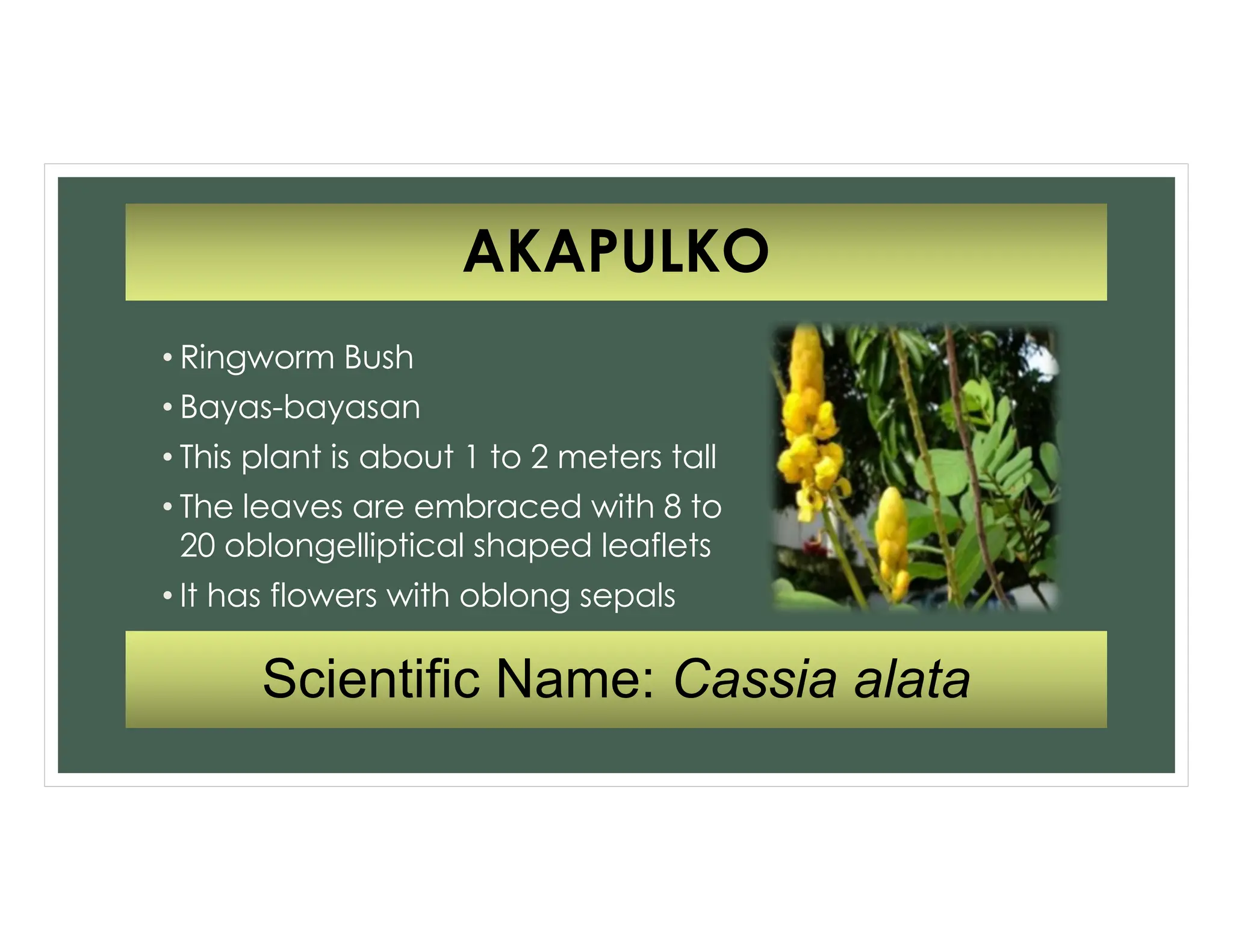
AKAPULKO
• Ringworm Bush
• Bayas-bayasan
• This plant is about 1 to 2 meters tall
• The leaves are embraced with 8 to
20 oblongelliptical shaped leaflets
• It has flowers with oblong sepals
Scientific Name: Cassia alata
AKAPULKO
USES:
Anti-fungal: Tinea Flava, Ringworm, Athlete ’s
Foot and Scabies
PREPARATION:
Fresh, matured leaves are pounded.
Apply as a soap to the affected part 1 to 2
times a day.
NIYUG-NIYOGAN
• Chinese Honey Suckle
• A vine which bears tiny fruits and
grows wild in backyards.
• The seeds must come from mature,
dried but newly opened fruits.
• Propagated through stem cuttings
about 20cm in height.
Scientific Name: Quisqualis indica L.
NIYUG-NIYOGAN
USES:
Anti-helmintic (used to expel parasitic worms.)
PREPARATION:
Adults may take 10 seeds; children 4 to 7 years of
age may eat up to four seeds only; ages 8 to 9 may
take six seeds and seven seeds may be eaten by
children 10 to 12 years old.
Seeds of niyug-niyogan are eaten raw two hours
before the patient’s last meal of the day.
Not to be given to children below four years old.
TSAANG GUBAT
• Forest Tea or Wild Tea
• A shrub with small, shiny nice-
looking leaves that grows in wild
uncultivated areas and forests.
Scientific Name: Carmona retusa
TSAANG GUBAT
USES:
Stomach ache
Diarrhea
PREPARATION:
Boil the following amount of chopped leaves in
2 glasses of water for 15 minutes or until
amount of water goes down to 1 glass. Cool and
strain.
Wash leaves and chop. Boil chopped leaves in
1 glass of water for 15 minutes. Cool and
filter/strain and drink.
AMPALAYA
• Bitter Gourd or Bitter melon
• A climbing vine with tendrils that grow up
to 20 cms long.
• Leaves are heartshaped, which are 5 to
10 cms in diameter
• Fruits have ribbed and wrinkled surface
that are fleshy green with pointed ends at
length and has a bitter taste.
Scientific Name: Momordica charantia
AMPALAYA
USES:
Lowers blood sugar levels
Diabetes Mellitus
PREPARATION:
Gather and wash young leaves very well. Chop.
Boil 6 tablespoons in two glassfuls of water for
15 minutes under low fire. Do not cover pot.
Cool and strain. Take one third cup 3 times a
day after meals.
LAGUNDI
• 5 Leaved-Chaste Tree
• A shrub growing wild in vacant lots and
waste land.
• Matured branches are planted.
• The flowers are blue and bellshaped.
• The small fruits turn black when ripe. It is
better to collect the leaves when are in
bloom.
Scientific Name: Vitex negundo
LAGUNDI
USES:
Fever, Dysentery, Colds
Asthma and cough and pain
Aromatic bath for sick patients
Rheumatism, sprain, contusions, insect
bites.
Headache
Skin diseases and wounds
LAGUNDI
PREPARATION:
For Asthma, cough and fever, boil
chopped raw fruits or leaves in 2 glasses
of water left for 15 minutes until the
water left in only 1 glass (decoction).
Strain.
For Dysentery, colds and pain, boil a
handful of leaves and flowers in water to
produce a glass full of decoction 3 time
a day.
LAGUNDI
PREPARATION:
For skin diseases (dermatitis, scabies,
ulcer, ecze ma) and wounds, prepare a
decoction of the leaves. Wash and clean
the skin/wound with the decoction.
For headache, crushed leaves may be
applied on the forehead.
For rheumatism, sprain, contusions and
insect bites, pound the leaves and apply
on the affected part.
ULASIMANG BATO
• Silver bush or Shiny bush
• Pansit-pansitan
• A weed with heartshaped leaves that
grow in shady parts of the garden and
yard.
Scientific Name: Peperomia pellucida
ULASIMANG BATO
USES:
Lowers uric acid (Rheumatism and
Gout)
PREPARATION:
Wash the leaves well. One and a half
cup leaves are boiled in two glassfuls of
water over low fire. Do not cover pot.
Cool and strain. Divide into three parts
and drink each part 3 times a day a day.
ULASIMANG BATO
PREPARATION:
May also be eaten as salad. Wash the
leaves well. Prepare one and a half
cups of leaves (not closely packed).
Divide into three parts and take as salad
3 times a day
BAWANG
• A low herb and grows up to
sixty cms high
• Leaves are flat and linear
• Bulbs consist of several tubers
Scientific Name: Allium sativum
BAWANG
USES:
For hypertension
Toothache
Lowers cholesterol levels in the blood
PREPARATION:
May be fried, roasted, soaked in vinegar
for 30 minutes, or blanched in boiled
water for 5 minutes. Take two pieces
three times a day after meals.
BAWANG
PREPARATION:
For toothache, pound a small piece and
apply to affected part.
CAUTION: Take on full stomach to prevent
stomach and intestinal ulcers.
BAYABAS
• Guava
• A tree about 4 to 5 meters high
with tiny white flowers with
round or oval fruits that are
eaten raw.
Scientific Name: Psidium guajava
BAYABAS
USES:
For washing wounds
For Toothache
For Diarrhea
PREPARATION:
Warm decoction is used for gargle.
Freshly pounded leaves are used for
toothache. Guava leaves are to be washed
well and chopped. Boil for 15 minutes at low
fire. Do not cover pot. Cool and strain
before use.
YERBA BUENA
• A small multibranching aromatic
herb. The leaves are small,
elliptical and with toothed margin
• The stem creeps to the ground,
and develop roots.
Scientific Name: Clinopodium douglasii
YERBA BUENA
USES:
For pain in different parts of the body as
head ache, stomach ache
Rheumatism, arthritis and headache
Cough and cold
Swollen gums & toothache
Menstrual and gas pain
Nausea and fainting
Insect bites & Pruritus
YERBA BUENA
PREPARATION:
For pain in diff. parts of the body, boil
chopped leaves in 2 glasses of water for
15 minutes. Cool and strain.
For rheumatism, arthritis and headache,
crush the fresh leaves and squeeze
sap. Massage sap on painful parts with
eucalyptus.
YERBA BUENA
PREPARATION:
For cough and cold, get about 10 fresh
leaves and soak in a glass of hot water.
Drink as tea. Acts as an expectorant
For toothache, cut fresh plant and squeeze
sap. Soak a piece of cotton in the sap and
insert this in aching tooth cavity. Mouth
should be rinsed by gargling salt solution
before inserting the cotton.
To prepare salt solution: add 5g of table salt to
one glass of water.
YERBA BUENA
PREPARATION:
For Menstrual pain and gas pain, soak a
handful of leaves in a glass of boiling water.
Drink infusion. It induces menstrual flow
and sweating.
For nausea and fainting, crush leaves and
apply at nostrils of patient.
For insect bites, crush leaves and apply
juice on affected part or pound leaves until
paste-like and rub this on the affected part
TERMINOLOGIES
◉ Traditional herbal medicines are naturally occurring,
plant-derived substances with minimal or no
industrial processing that have been used to treat
illness within local or regional healing practices.
(https://www.who.int/bulletin/volumes/86/8/07-042820/en/)
40
TERMINOLOGIES
◉ Herbalism is the practice of making or prescribing
plant based herbal remedies for medical conditions.
Also referred to as phytotherapy or botanical
medicine, is one of the earliest systems of medicine
known.
(https://www.medicinenet.com/script/main/art.asp?articlekey=11465)
◉ Decoctions are aqueous preparations of plant parts
boiled in water for 15–20 min until the water volume is
halved.
41
VIDEO LINKS
◉ https://www.youtube.com/watch?v=XUBkb3tlfjY
(Sampung Halamang Gamot)
◉ https://www.youtube.com/watch?v=s8jCBt_itAU
(Herbal Medicine: Best Documentary)
42
REFERENCES:
◉ https://mediko.ph/sampung-halamang-gamot-na-
aprubado-ng-doh/ (Retrieved from Mediko)
◉ https://lawphil.net/statutes/repacts/ra1997/ra_842
3_1997.html (Retrieved from The LawPhil Project)
43
Thanks!
ANY QUESTIONS?
44

Topic 9 - Traditional Herbal Medicines.pdf

  • 1.
    Module IV: Biologically-based Therapy TraditionalHerbal Medicines COMPLEMENTARY AND ALTERNATIVE MEDICINE PCAM 211
  • 2.
    UNIT OUTCOMES At theend of this unit, the students are expected to: ◉ Demonstrate competence in applying concepts and use of biologically-based therapy in medical health care. ◉ Understand Republic Act 8423. ◉ Enumerate the 10 DOH Approved Herbal Medicine. ◉ Identify the uses of the 10 DOH Approved Herbal Medicine. 2
  • 3.
    OUTLINE OF DISCUSSION: ◉Traditional Herbal Medicines Ø Republic Act 8423 Ø Ten DOH Approved Herbal Plants 3
  • 4.
  • 9.
    REPUBLIC ACT 8423 •Otherwise known as TAMA • An act creating the Philippine Institute of Traditional and Alternative Health Care (PITAHC) to accelerate the development of traditional and alternative health care in the Philippines, providing for a traditional and alternative health care development fund and for other purposes. TAMA TRADITIONAL AND ALTERNATIVE MEDICINE ACT OF 1997
  • 11.
    Reminders on theUse of Herbal Medicine qAvoid the use of insecticides as these may leave poison on plants. qIn the preparation of herbal medicine, use a clay pot and remove cover while boiling at low heat. qUse only the part of the plant being advocated. qFollow accurate dose of suggested preparation. qUse only one kind of herbal plant for each type of symptoms or sickness. qUse only half the dosage prescribed for fresh parts like leaves when using dried parts
  • 12.
    Reminders on theUse of Herbal Medicine qDecoctions loose potency after some time. Dispose of decoctions after one day. To keep fresh during the day, keep lukewarm in a flask or thermos. qLeaves, fruits, flowers or nuts must be mature before harvesting. Less medicinal substances are found on young parts. qStop giving the herbal medication in case untoward reaction such as allergy occurs. qIf signs and symptoms are not relieved after 2 or 3 doses of herbal medication, consult a doctor
  • 13.
    SAMBONG • A plantthat reaches 1 ½ to 3 meters in height with rough hairy leaves. • Young plants around mother plant may be separated when they have three or more leaves. Scientific Name: Blumea balsamifera
  • 14.
    SAMBONG USES: Anti-urolithiasis Diuretic Anti-edema PREPARATION: Boil chopped leavesin water for 15 minutes until one glassful remains. Cool and strain. NOTE: Sambong is not a medicine for kidney infection Divide decoction into 3 parts. Drink one part 3 times a day
  • 15.
    AKAPULKO • Ringworm Bush •Bayas-bayasan • This plant is about 1 to 2 meters tall • The leaves are embraced with 8 to 20 oblongelliptical shaped leaflets • It has flowers with oblong sepals Scientific Name: Cassia alata
  • 16.
    AKAPULKO USES: Anti-fungal: Tinea Flava,Ringworm, Athlete ’s Foot and Scabies PREPARATION: Fresh, matured leaves are pounded. Apply as a soap to the affected part 1 to 2 times a day.
  • 17.
    NIYUG-NIYOGAN • Chinese HoneySuckle • A vine which bears tiny fruits and grows wild in backyards. • The seeds must come from mature, dried but newly opened fruits. • Propagated through stem cuttings about 20cm in height. Scientific Name: Quisqualis indica L.
  • 18.
    NIYUG-NIYOGAN USES: Anti-helmintic (used toexpel parasitic worms.) PREPARATION: Adults may take 10 seeds; children 4 to 7 years of age may eat up to four seeds only; ages 8 to 9 may take six seeds and seven seeds may be eaten by children 10 to 12 years old. Seeds of niyug-niyogan are eaten raw two hours before the patient’s last meal of the day. Not to be given to children below four years old.
  • 19.
    TSAANG GUBAT • ForestTea or Wild Tea • A shrub with small, shiny nice- looking leaves that grows in wild uncultivated areas and forests. Scientific Name: Carmona retusa
  • 20.
    TSAANG GUBAT USES: Stomach ache Diarrhea PREPARATION: Boilthe following amount of chopped leaves in 2 glasses of water for 15 minutes or until amount of water goes down to 1 glass. Cool and strain. Wash leaves and chop. Boil chopped leaves in 1 glass of water for 15 minutes. Cool and filter/strain and drink.
  • 21.
    AMPALAYA • Bitter Gourdor Bitter melon • A climbing vine with tendrils that grow up to 20 cms long. • Leaves are heartshaped, which are 5 to 10 cms in diameter • Fruits have ribbed and wrinkled surface that are fleshy green with pointed ends at length and has a bitter taste. Scientific Name: Momordica charantia
  • 22.
    AMPALAYA USES: Lowers blood sugarlevels Diabetes Mellitus PREPARATION: Gather and wash young leaves very well. Chop. Boil 6 tablespoons in two glassfuls of water for 15 minutes under low fire. Do not cover pot. Cool and strain. Take one third cup 3 times a day after meals.
  • 23.
    LAGUNDI • 5 Leaved-ChasteTree • A shrub growing wild in vacant lots and waste land. • Matured branches are planted. • The flowers are blue and bellshaped. • The small fruits turn black when ripe. It is better to collect the leaves when are in bloom. Scientific Name: Vitex negundo
  • 24.
    LAGUNDI USES: Fever, Dysentery, Colds Asthmaand cough and pain Aromatic bath for sick patients Rheumatism, sprain, contusions, insect bites. Headache Skin diseases and wounds
  • 25.
    LAGUNDI PREPARATION: For Asthma, coughand fever, boil chopped raw fruits or leaves in 2 glasses of water left for 15 minutes until the water left in only 1 glass (decoction). Strain. For Dysentery, colds and pain, boil a handful of leaves and flowers in water to produce a glass full of decoction 3 time a day.
  • 26.
    LAGUNDI PREPARATION: For skin diseases(dermatitis, scabies, ulcer, ecze ma) and wounds, prepare a decoction of the leaves. Wash and clean the skin/wound with the decoction. For headache, crushed leaves may be applied on the forehead. For rheumatism, sprain, contusions and insect bites, pound the leaves and apply on the affected part.
  • 27.
    ULASIMANG BATO • Silverbush or Shiny bush • Pansit-pansitan • A weed with heartshaped leaves that grow in shady parts of the garden and yard. Scientific Name: Peperomia pellucida
  • 28.
    ULASIMANG BATO USES: Lowers uricacid (Rheumatism and Gout) PREPARATION: Wash the leaves well. One and a half cup leaves are boiled in two glassfuls of water over low fire. Do not cover pot. Cool and strain. Divide into three parts and drink each part 3 times a day a day.
  • 29.
    ULASIMANG BATO PREPARATION: May alsobe eaten as salad. Wash the leaves well. Prepare one and a half cups of leaves (not closely packed). Divide into three parts and take as salad 3 times a day
  • 30.
    BAWANG • A lowherb and grows up to sixty cms high • Leaves are flat and linear • Bulbs consist of several tubers Scientific Name: Allium sativum
  • 31.
    BAWANG USES: For hypertension Toothache Lowers cholesterollevels in the blood PREPARATION: May be fried, roasted, soaked in vinegar for 30 minutes, or blanched in boiled water for 5 minutes. Take two pieces three times a day after meals.
  • 32.
    BAWANG PREPARATION: For toothache, pounda small piece and apply to affected part. CAUTION: Take on full stomach to prevent stomach and intestinal ulcers.
  • 33.
    BAYABAS • Guava • Atree about 4 to 5 meters high with tiny white flowers with round or oval fruits that are eaten raw. Scientific Name: Psidium guajava
  • 34.
    BAYABAS USES: For washing wounds ForToothache For Diarrhea PREPARATION: Warm decoction is used for gargle. Freshly pounded leaves are used for toothache. Guava leaves are to be washed well and chopped. Boil for 15 minutes at low fire. Do not cover pot. Cool and strain before use.
  • 35.
    YERBA BUENA • Asmall multibranching aromatic herb. The leaves are small, elliptical and with toothed margin • The stem creeps to the ground, and develop roots. Scientific Name: Clinopodium douglasii
  • 36.
    YERBA BUENA USES: For painin different parts of the body as head ache, stomach ache Rheumatism, arthritis and headache Cough and cold Swollen gums & toothache Menstrual and gas pain Nausea and fainting Insect bites & Pruritus
  • 37.
    YERBA BUENA PREPARATION: For painin diff. parts of the body, boil chopped leaves in 2 glasses of water for 15 minutes. Cool and strain. For rheumatism, arthritis and headache, crush the fresh leaves and squeeze sap. Massage sap on painful parts with eucalyptus.
  • 38.
    YERBA BUENA PREPARATION: For coughand cold, get about 10 fresh leaves and soak in a glass of hot water. Drink as tea. Acts as an expectorant For toothache, cut fresh plant and squeeze sap. Soak a piece of cotton in the sap and insert this in aching tooth cavity. Mouth should be rinsed by gargling salt solution before inserting the cotton. To prepare salt solution: add 5g of table salt to one glass of water.
  • 39.
    YERBA BUENA PREPARATION: For Menstrualpain and gas pain, soak a handful of leaves in a glass of boiling water. Drink infusion. It induces menstrual flow and sweating. For nausea and fainting, crush leaves and apply at nostrils of patient. For insect bites, crush leaves and apply juice on affected part or pound leaves until paste-like and rub this on the affected part
  • 40.
    TERMINOLOGIES ◉ Traditional herbalmedicines are naturally occurring, plant-derived substances with minimal or no industrial processing that have been used to treat illness within local or regional healing practices. (https://www.who.int/bulletin/volumes/86/8/07-042820/en/) 40
  • 41.
    TERMINOLOGIES ◉ Herbalism isthe practice of making or prescribing plant based herbal remedies for medical conditions. Also referred to as phytotherapy or botanical medicine, is one of the earliest systems of medicine known. (https://www.medicinenet.com/script/main/art.asp?articlekey=11465) ◉ Decoctions are aqueous preparations of plant parts boiled in water for 15–20 min until the water volume is halved. 41
  • 42.
    VIDEO LINKS ◉ https://www.youtube.com/watch?v=XUBkb3tlfjY (SampungHalamang Gamot) ◉ https://www.youtube.com/watch?v=s8jCBt_itAU (Herbal Medicine: Best Documentary) 42
  • 43.
    REFERENCES: ◉ https://mediko.ph/sampung-halamang-gamot-na- aprubado-ng-doh/ (Retrievedfrom Mediko) ◉ https://lawphil.net/statutes/repacts/ra1997/ra_842 3_1997.html (Retrieved from The LawPhil Project) 43
  • 44.