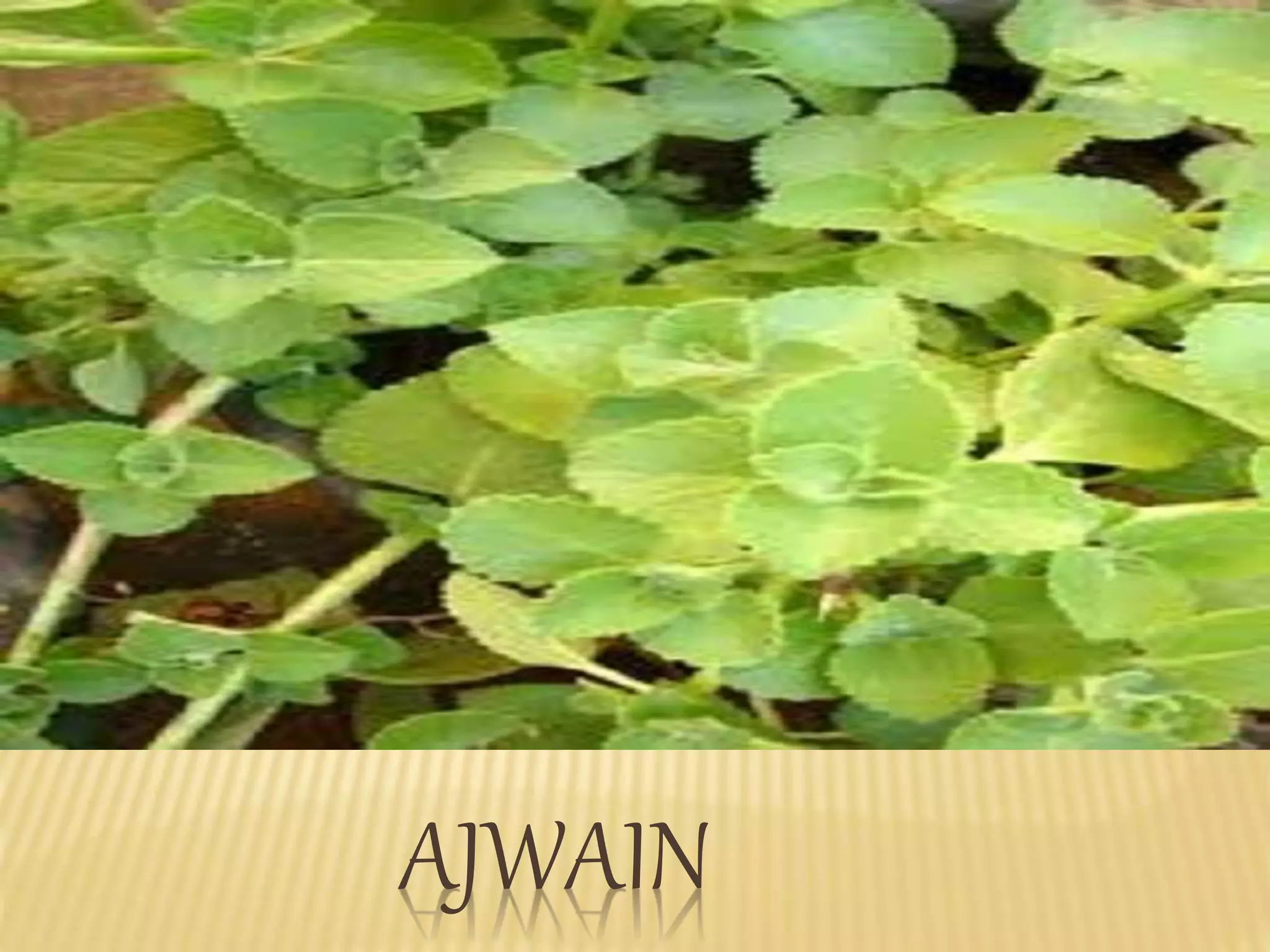
AJWAIN
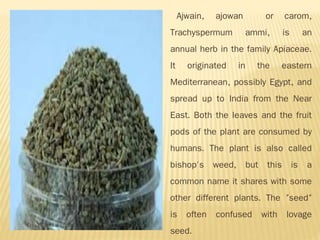
Ajwain, ajowan or carom,
Trachyspermum ammi, is an
annual herb in the family Apiaceae.
It originated in the eastern
Mediterranean, possibly Egypt, and
spread up to India from the Near
East. Both the leaves and the fruit
pods of the plant are consumed by
humans. The plant is also called
bishop's weed, but this is a
common name it shares with some
other different plants. The "seed"
is often confused with lovage
seed.
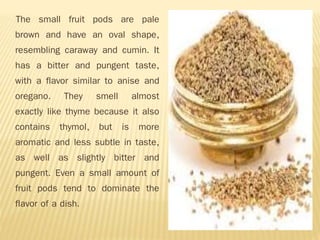
The small fruit pods are pale
brown and have an oval shape,
resembling caraway and cumin. It
has a bitter and pungent taste,
with a flavor similar to anise and
oregano. They smell almost
exactly like thyme because it also
contains thymol, but is more
aromatic and less subtle in taste,
as well as slightly bitter and
pungent. Even a small amount of
fruit pods tend to dominate the
flavor of a dish.
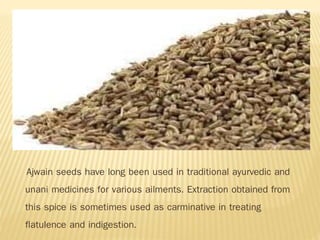
Ajwain seeds have long been used in traditional ayurvedic and
unani medicines for various ailments. Extraction obtained from
this spice is sometimes used as carminative in treating
flatulence and indigestion.
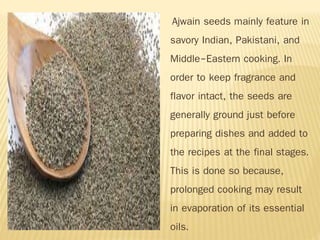
Ajwain seeds mainly feature in
savory Indian, Pakistani, and
Middle-Eastern cooking. In
order to keep fragrance and
flavor intact, the seeds are
generally ground just before
preparing dishes and added to
the recipes at the final stages.
This is done so because,
prolonged cooking may result
in evaporation of its essential
oils.
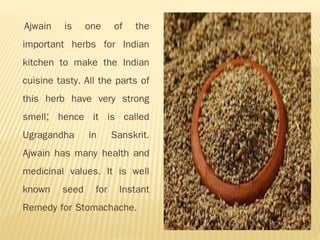
Ajwain is one of the
important herbs for Indian
kitchen to make the Indian
cuisine tasty. All the parts of
this herb have very strong
smell; hence it is called
Ugragandha in Sanskrit.
Ajwain has many health and
medicinal values. It is well
known seed for Instant
Remedy for Stomachache.
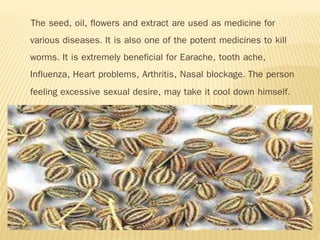
The seed, oil, flowers and extract are used as medicine for
various diseases. It is also one of the potent medicines to kill
worms. It is extremely beneficial for Earache, tooth ache,
Influenza, Heart problems, Arthritis, Nasal blockage. The person
feeling excessive sexual desire, may take it cool down himself.

Ajwain

  • 1.
  • 2.
    Ajwain, ajowan orcarom, Trachyspermum ammi, is an annual herb in the family Apiaceae. It originated in the eastern Mediterranean, possibly Egypt, and spread up to India from the Near East. Both the leaves and the fruit pods of the plant are consumed by humans. The plant is also called bishop's weed, but this is a common name it shares with some other different plants. The "seed" is often confused with lovage seed.
  • 3.
    The small fruitpods are pale brown and have an oval shape, resembling caraway and cumin. It has a bitter and pungent taste, with a flavor similar to anise and oregano. They smell almost exactly like thyme because it also contains thymol, but is more aromatic and less subtle in taste, as well as slightly bitter and pungent. Even a small amount of fruit pods tend to dominate the flavor of a dish.
  • 4.
    Ajwain seeds havelong been used in traditional ayurvedic and unani medicines for various ailments. Extraction obtained from this spice is sometimes used as carminative in treating flatulence and indigestion.
  • 5.
    Ajwain seeds mainlyfeature in savory Indian, Pakistani, and Middle-Eastern cooking. In order to keep fragrance and flavor intact, the seeds are generally ground just before preparing dishes and added to the recipes at the final stages. This is done so because, prolonged cooking may result in evaporation of its essential oils.
  • 6.
    Ajwain is oneof the important herbs for Indian kitchen to make the Indian cuisine tasty. All the parts of this herb have very strong smell; hence it is called Ugragandha in Sanskrit. Ajwain has many health and medicinal values. It is well known seed for Instant Remedy for Stomachache.
  • 7.
    The seed, oil,flowers and extract are used as medicine for various diseases. It is also one of the potent medicines to kill worms. It is extremely beneficial for Earache, tooth ache, Influenza, Heart problems, Arthritis, Nasal blockage. The person feeling excessive sexual desire, may take it cool down himself.