Herbal Drug Technology
B. Pharm VI Sem
Dr. Snehal S. Manekar
Assistant Professor
Dr. Rajendra Gode Institute of Pharmacy,
Amravati, Maharashtra
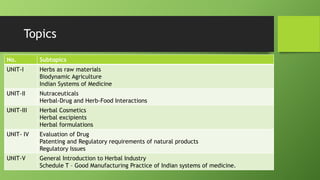
Topics
No. Subtopics
UNIT-I Herbs as raw materials
Biodynamic Agriculture
Indian Systems of Medicine
UNIT-II Nutraceuticals
Herbal-Drug and Herb-Food Interactions
UNIT-III Herbal Cosmetics
Herbal excipients
Herbal formulations
UNIT- IV Evaluation of Drug
Patenting and Regulatory requirements of natural products
Regulatory Issues
UNIT-V General Introduction to Herbal Industry
Schedule T – Good Manufacturing Practice of Indian systems of medicine.
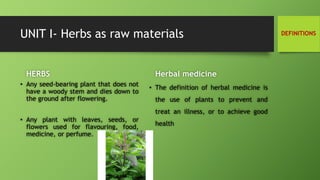
UNIT I- Herbs as raw materials
• Any seed-bearing plant that does not
have a woody stem and dies down to
the ground after flowering.
• Any plant with leaves, seeds, or
flowers used for flavouring, food,
medicine, or perfume.
Herbal medicine
• The definition of herbal medicine is
the use of plants to prevent and
treat an illness, or to achieve good
health
HERBS
DEFINITIONS
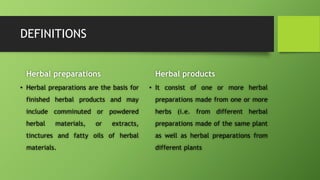
DEFINITIONS
• Herbal preparations are the basis for
finished herbal products and may
include comminuted or powdered
herbal materials, or extracts,
tinctures and fatty oils of herbal
materials.
Herbal products
• It consist of one or more herbal
preparations made from one or more
herbs (i.e. from different herbal
preparations made of the same plant
as well as herbal preparations from
different plants
Herbal preparations
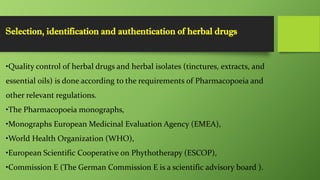
Selection, identification and authentication of herbal drugs
•Quality control of herbal drugs and herbal isolates (tinctures, extracts, and
essential oils) is done according to the requirements of Pharmacopoeia and
other relevant regulations.
•The Pharmacopoeia monographs,
•Monographs European Medicinal Evaluation Agency (EMEA),
•World Health Organization (WHO),
•European Scientific Cooperative on Phythotherapy (ESCOP),
•Commission E (The German Commission E is a scientific advisory board ).
Selection, identification and authentication of herbal drugs
Identification tests should be specific for the herbal material and are usually
a combination of three or more of the following:
➢ macroscopic characters
➢ microscopic characters
➢ chemical testing
➢ chromatographic confirmation
➢ Biological evaluation
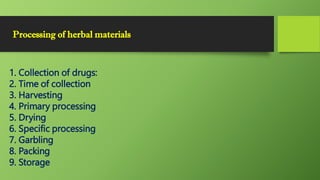
Processing of herbal materials
1. Collection of drugs:
2. Time of collection
3. Harvesting
4. Primary processing
5. Drying
6. Specific processing
7. Garbling
8. Packing
9. Storage
Processing of herbal materials
Cultivation of medicinal plants is also known as propagation, Which can
be done by sexual and asexual methods.
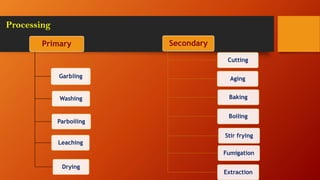
Processing of herbal raw materials involves various stages from which the
crude drugs undergo after harvesting. It can be classified into primary and
secondary processing which are further sub categorized as follows.
Processing
Primary
Garbling
Washing
Parboiling
Leaching
Drying
Secondary
Cutting
Aging
Baking
Boiling
Stir frying
Fumigation
Extraction
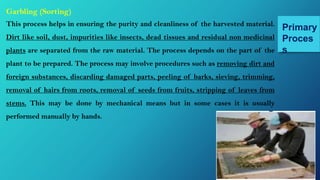
Garbling (Sorting)
This process helps in ensuring the purity and cleanliness of the harvested material.
Dirt like soil, dust, impurities like insects, dead tissues and residual non medicinal
plants are separated from the raw material. The process depends on the part of the
plant to be prepared. The process may involve procedures such as removing dirt and
foreign substances, discarding damaged parts, peeling of barks, sieving, trimming,
removal of hairs from roots, removal of seeds from fruits, stripping of leaves from
stems. This may be done by mechanical means but in some cases it is usually
performed manually by hands.
Primary
Proces
s
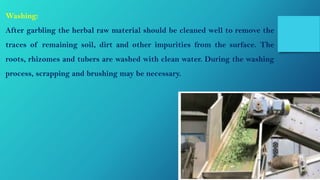
Washing:
After garbling the herbal raw material should be cleaned well to remove the
traces of remaining soil, dirt and other impurities from the surface. The
roots, rhizomes and tubers are washed with clean water. During the washing
process, scrapping and brushing may be necessary.
Parboiling (Blanching) :
After washing, certain herbal raw materials need to undergo parboiling
process in which they are put in boiling water for a short period.
This may help in improving the storage life of the raw material and prevent
insect/ mould contamination.
It may also facilitate in further processing such as removal of stubborn
impurities as well as outer coats/ covering of raw materials.
Leaching:
Some impurities can be removed by subjecting the plant material under
running water known as leaching. However the duration of leaching should
be controlled to prevent the loss of chemical constituents present in the
drug. Dr Snehal S Manekar
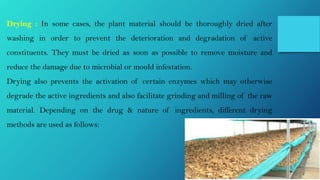
Drying : In some cases, the plant material should be thoroughly dried after
washing in order to prevent the deterioration and degradation of active
constituents. They must be dried as soon as possible to remove moisture and
reduce the damage due to microbial or mould infestation.
Drying also prevents the activation of certain enzymes which may otherwise
degrade the active ingredients and also facilitate grinding and milling of the raw
material. Depending on the drug & nature of ingredients, different drying
methods are used as follows:
I) Natural drying
a)Sun drying:
Most herbal raw material can be dried in open air under direct sunshine
provided the climate is suitable. The duration of drying process depends on
the physical structure of the plant material and weather conditions. The
plant material should be spread out in thin layers, care should be taken to
prevent contamination by diet impurities. While drying the plant material
should also be protected from insects, Birds, rodents, pests and other
domestic animals.
b) Shade drying:
Some medicinal plants cannot be directly exposed to sunlight, hence need to
be dried under shade. This drying process is slow but helps in minimizing
loss of colour, volatile oils and aromatic components from being evaporated.
II)Artificial drying
Drying by artificial heat is more rapid than open air drying and is necessary in rainy
season and regions where there is high humidity. The temperature and equipment
used for drying depends on the physical and chemical nature of the drug and its
constituents. Various equipment's such as tray dryers, spray dryers, vacuum dryers
are used. Over heating may lead to excessive loss of volatile components as well as
decomposition of chemical constituents. The temperature should be kept below 60
0C wherever possible.
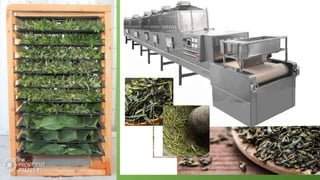
a. Tray dryers (Oven)
The drugs which do not contain volatile oils and are quite stable to heat or which
need deactivation of enzymes are dried in tray dryers.
In this process, hot air of the desired temperature is circulated through the dryers
and this facilitates the removal of water content of the drugs (belladonna roots,
cinchona bark, tea and raspberry leaves and gums are dried by this method).
b. Vacuum dryers
The drugs which are sensitive to higher temperature are dried by this process,
e.g. Tannic acid and digitalis leaves. Dr Snehal S Manekar
c. Spray dryers
Few drugs which are highly sensitive to atmospheric conditions and also to
temperature of vacuum-drying are dried by spray-drying method. The
technique is followed for quick drying of economically important plant or
animal constituents rather than crude drugs.
Ex. Papaya latex, pectin, tannins etc.
The secondary processing differs from one herb to another depending on
the nature of active ingredients as well as therapeutic properties. Secondary
processing includes techniques such as removal of foreign substances,
prevention of microbial presence/ infestation, enhancing the efficacy of
drugs, reducing the toxicity, extraction using suitable solvents, conc. &
drying of extracts. These are further standardized by different methods.
a. Cutting, Sectioning and Communition :
After thoroughly drying, the herbal materials are processed by cutting and
sectioning into smaller sizes which are convenient for storage as well as
extraction. Various sizes can be obtained depending on the part of herb and
extraction methods used. It may be small particles, coarse powder or fine
powder.
Secondary
processing
b. Aging /Sweating :
Aging refers to storing the raw material for a specified time after
harvesting. It is generally done under sun or in shade for up to a year.
During the process of aging excessive water is evaporated & enzymatic
reactions may occur to alter the chemical composition of herbal material.
Example:
Cascara bark should be aged for at least one year prior to use in medicinal preparations
to reduce its irritant effects. Sweating is done by subjecting the herbal materials at a
temperature between 45 to 65°C with high humidity for a period ranging from one
week to few months. The herbal materials are stacked between woollen blankets or
other kind of cloth. .The sweating process is considered a hydrolytic and oxidative
process in which some of the chemical ingredients ofthe herbs are hydrolysed or
oxidised.
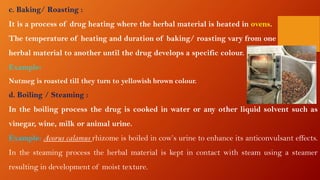
c. Baking/ Roasting :
It is a process of drug heating where the herbal material is heated in ovens.
The temperature of heating and duration of baking/ roasting vary from one
herbal material to another until the drug develops a specific colour.
Example:
Nutmeg is roasted till they turn to yellowish brown colour.
d. Boiling / Steaming :
In the boiling process the drug is cooked in water or any other liquid solvent such as
vinegar, wine, milk or animal urine.
Example: Acorus calamus rhizome is boiled in cow’s urine to enhance its anticonvulsant effects.
In the steaming process the herbal material is kept in contact with steam using a steamer
resulting in development of moist texture.
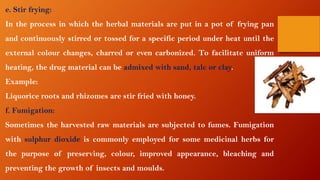
e. Stir frying:
In the process in which the herbal materials are put in a pot of frying pan
and continuously stirred or tossed for a specific period under heat until the
external colour changes, charred or even carbonized. To facilitate uniform
heating, the drug material can be admixed with sand, talc or clay.
Example:
Liquorice roots and rhizomes are stir fried with honey.
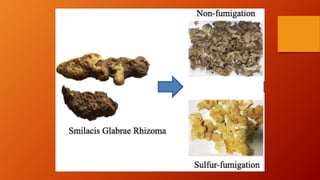
f. Fumigation:
Sometimes the harvested raw materials are subjected to fumes. Fumigation
with sulphur dioxide is commonly employed for some medicinal herbs for
the purpose of preserving, colour, improved appearance, bleaching and
preventing the growth of insects and moulds.
Herbs as raw material.pdf

Herbs as raw material.pdf

  • 1.
    Herbal Drug Technology B.Pharm VI Sem Dr. Snehal S. Manekar Assistant Professor Dr. Rajendra Gode Institute of Pharmacy, Amravati, Maharashtra
  • 2.
    Topics No. Subtopics UNIT-I Herbsas raw materials Biodynamic Agriculture Indian Systems of Medicine UNIT-II Nutraceuticals Herbal-Drug and Herb-Food Interactions UNIT-III Herbal Cosmetics Herbal excipients Herbal formulations UNIT- IV Evaluation of Drug Patenting and Regulatory requirements of natural products Regulatory Issues UNIT-V General Introduction to Herbal Industry Schedule T – Good Manufacturing Practice of Indian systems of medicine.
  • 3.
    UNIT I- Herbsas raw materials • Any seed-bearing plant that does not have a woody stem and dies down to the ground after flowering. • Any plant with leaves, seeds, or flowers used for flavouring, food, medicine, or perfume. Herbal medicine • The definition of herbal medicine is the use of plants to prevent and treat an illness, or to achieve good health HERBS DEFINITIONS
  • 4.
    DEFINITIONS • Herbal preparationsare the basis for finished herbal products and may include comminuted or powdered herbal materials, or extracts, tinctures and fatty oils of herbal materials. Herbal products • It consist of one or more herbal preparations made from one or more herbs (i.e. from different herbal preparations made of the same plant as well as herbal preparations from different plants Herbal preparations
  • 5.
    Selection, identification andauthentication of herbal drugs •Quality control of herbal drugs and herbal isolates (tinctures, extracts, and essential oils) is done according to the requirements of Pharmacopoeia and other relevant regulations. •The Pharmacopoeia monographs, •Monographs European Medicinal Evaluation Agency (EMEA), •World Health Organization (WHO), •European Scientific Cooperative on Phythotherapy (ESCOP), •Commission E (The German Commission E is a scientific advisory board ).
  • 6.
    Selection, identification andauthentication of herbal drugs Identification tests should be specific for the herbal material and are usually a combination of three or more of the following: ➢ macroscopic characters ➢ microscopic characters ➢ chemical testing ➢ chromatographic confirmation ➢ Biological evaluation
  • 7.
    Processing of herbalmaterials 1. Collection of drugs: 2. Time of collection 3. Harvesting 4. Primary processing 5. Drying 6. Specific processing 7. Garbling 8. Packing 9. Storage
  • 8.
    Processing of herbalmaterials Cultivation of medicinal plants is also known as propagation, Which can be done by sexual and asexual methods. Processing of herbal raw materials involves various stages from which the crude drugs undergo after harvesting. It can be classified into primary and secondary processing which are further sub categorized as follows.
  • 9.
  • 10.
    Garbling (Sorting) This processhelps in ensuring the purity and cleanliness of the harvested material. Dirt like soil, dust, impurities like insects, dead tissues and residual non medicinal plants are separated from the raw material. The process depends on the part of the plant to be prepared. The process may involve procedures such as removing dirt and foreign substances, discarding damaged parts, peeling of barks, sieving, trimming, removal of hairs from roots, removal of seeds from fruits, stripping of leaves from stems. This may be done by mechanical means but in some cases it is usually performed manually by hands. Primary Proces s
  • 11.
    Washing: After garbling theherbal raw material should be cleaned well to remove the traces of remaining soil, dirt and other impurities from the surface. The roots, rhizomes and tubers are washed with clean water. During the washing process, scrapping and brushing may be necessary.
  • 12.
    Parboiling (Blanching) : Afterwashing, certain herbal raw materials need to undergo parboiling process in which they are put in boiling water for a short period. This may help in improving the storage life of the raw material and prevent insect/ mould contamination. It may also facilitate in further processing such as removal of stubborn impurities as well as outer coats/ covering of raw materials. Leaching: Some impurities can be removed by subjecting the plant material under running water known as leaching. However the duration of leaching should be controlled to prevent the loss of chemical constituents present in the drug. Dr Snehal S Manekar
  • 13.
    Drying : Insome cases, the plant material should be thoroughly dried after washing in order to prevent the deterioration and degradation of active constituents. They must be dried as soon as possible to remove moisture and reduce the damage due to microbial or mould infestation. Drying also prevents the activation of certain enzymes which may otherwise degrade the active ingredients and also facilitate grinding and milling of the raw material. Depending on the drug & nature of ingredients, different drying methods are used as follows:
  • 14.
    I) Natural drying a)Sundrying: Most herbal raw material can be dried in open air under direct sunshine provided the climate is suitable. The duration of drying process depends on the physical structure of the plant material and weather conditions. The plant material should be spread out in thin layers, care should be taken to prevent contamination by diet impurities. While drying the plant material should also be protected from insects, Birds, rodents, pests and other domestic animals. b) Shade drying: Some medicinal plants cannot be directly exposed to sunlight, hence need to be dried under shade. This drying process is slow but helps in minimizing loss of colour, volatile oils and aromatic components from being evaporated.
  • 15.
    II)Artificial drying Drying byartificial heat is more rapid than open air drying and is necessary in rainy season and regions where there is high humidity. The temperature and equipment used for drying depends on the physical and chemical nature of the drug and its constituents. Various equipment's such as tray dryers, spray dryers, vacuum dryers are used. Over heating may lead to excessive loss of volatile components as well as decomposition of chemical constituents. The temperature should be kept below 60 0C wherever possible. a. Tray dryers (Oven) The drugs which do not contain volatile oils and are quite stable to heat or which need deactivation of enzymes are dried in tray dryers. In this process, hot air of the desired temperature is circulated through the dryers and this facilitates the removal of water content of the drugs (belladonna roots, cinchona bark, tea and raspberry leaves and gums are dried by this method). b. Vacuum dryers The drugs which are sensitive to higher temperature are dried by this process, e.g. Tannic acid and digitalis leaves. Dr Snehal S Manekar
  • 17.
    c. Spray dryers Fewdrugs which are highly sensitive to atmospheric conditions and also to temperature of vacuum-drying are dried by spray-drying method. The technique is followed for quick drying of economically important plant or animal constituents rather than crude drugs. Ex. Papaya latex, pectin, tannins etc.
  • 18.
    The secondary processingdiffers from one herb to another depending on the nature of active ingredients as well as therapeutic properties. Secondary processing includes techniques such as removal of foreign substances, prevention of microbial presence/ infestation, enhancing the efficacy of drugs, reducing the toxicity, extraction using suitable solvents, conc. & drying of extracts. These are further standardized by different methods. a. Cutting, Sectioning and Communition : After thoroughly drying, the herbal materials are processed by cutting and sectioning into smaller sizes which are convenient for storage as well as extraction. Various sizes can be obtained depending on the part of herb and extraction methods used. It may be small particles, coarse powder or fine powder. Secondary processing
  • 19.
    b. Aging /Sweating: Aging refers to storing the raw material for a specified time after harvesting. It is generally done under sun or in shade for up to a year. During the process of aging excessive water is evaporated & enzymatic reactions may occur to alter the chemical composition of herbal material. Example: Cascara bark should be aged for at least one year prior to use in medicinal preparations to reduce its irritant effects. Sweating is done by subjecting the herbal materials at a temperature between 45 to 65°C with high humidity for a period ranging from one week to few months. The herbal materials are stacked between woollen blankets or other kind of cloth. .The sweating process is considered a hydrolytic and oxidative process in which some of the chemical ingredients ofthe herbs are hydrolysed or oxidised.
  • 20.
    c. Baking/ Roasting: It is a process of drug heating where the herbal material is heated in ovens. The temperature of heating and duration of baking/ roasting vary from one herbal material to another until the drug develops a specific colour. Example: Nutmeg is roasted till they turn to yellowish brown colour. d. Boiling / Steaming : In the boiling process the drug is cooked in water or any other liquid solvent such as vinegar, wine, milk or animal urine. Example: Acorus calamus rhizome is boiled in cow’s urine to enhance its anticonvulsant effects. In the steaming process the herbal material is kept in contact with steam using a steamer resulting in development of moist texture.
  • 21.
    e. Stir frying: Inthe process in which the herbal materials are put in a pot of frying pan and continuously stirred or tossed for a specific period under heat until the external colour changes, charred or even carbonized. To facilitate uniform heating, the drug material can be admixed with sand, talc or clay. Example: Liquorice roots and rhizomes are stir fried with honey. f. Fumigation: Sometimes the harvested raw materials are subjected to fumes. Fumigation with sulphur dioxide is commonly employed for some medicinal herbs for the purpose of preserving, colour, improved appearance, bleaching and preventing the growth of insects and moulds.