Name : Purva V. Yeole
Roll no : 516
Class : M.Pharm first year (Pharmaceutics)
Dr. D. Y. Patil Institute of Pharmaceutical Science &
Research Pimpri, Pune
GUIDELINES FOR HERBAL COSMETICS BY
PRIVATE BODIES LIKE COSMOS
2
Lesson Plan:
• What are Cosmetics?
• What are Herbal Cosmetics?
• Advantages of Herbal Cosmetics
• What is Cosmos?
• Guiding principle of Cosmos
• Certification signatures & Benefits
• What the Cosmos standard covers?
• Approval of ingredients
• Preservatives
• Emollients
• Foaming agents
• Emulsifiers
• Rheology modifiers
WHAT ARE COSMETICS?
Definition:
◈ According to D & C Act 1940
◈ Any article intended to be rubbed, poured, sprinkled or sprayed
on or introduced to or applied to any part of human body for
cleansing, beautifying, promoting, attractiveness or altering the
appearance and includes any article intended for use as
component of cosmetics.
3
WHAT ARE HERBAL COSMETICS?
◈ Herbal Cosmetics, referred as Products, are formulated, using
various permissible cosmetic ingredients to form the base in
which one or more herbal ingredients are used to provide defined
cosmetic benefits only.
◈ Natural products include oils, extracts, secretions etc. Phyto-
ingredients include pure constituents obtained by various
process.
4
ADVANTAGES OF HERBAL COSMETICS
◈ They do not provoke allergic reaction & do not have negative side
effects.
◈ They are easily incorporated with skin and hair.
◈ Extract form of the plants decreases the bulk properties of the
cosmetics and give appropriate effects.
◈ Easily available & found in large variety & quantity.
5
WHAT IS COSMOS?
◈ COSMOS stands for "cosmetic organic and natural standard",
which sets certification requirements for organic and natural
cosmetics products in the Europe.
◈ The standard is recognized globally by the cosmetic industry.
◈ By adhering to specific guidelines, cosmetics marketers can use
COSMOS signatures, which are registered trademarks, on
packaging to confirm the products meet minimum industry
requirements to be considered organic or natural.
6
7
8
In 2002 five European organizations liable for setting organic and
natural cosmetics standards met at a trade show to share ideas for
broader standards to be used globally. These five COSMOS members
are:
• BDIH (Germany)
• Cosmebio (France)
• Ecocert (France)
• ICEA (Italy)
• Soil Association (Great Britain)
9
GUIDING PRINCIPLE OF COSMOS
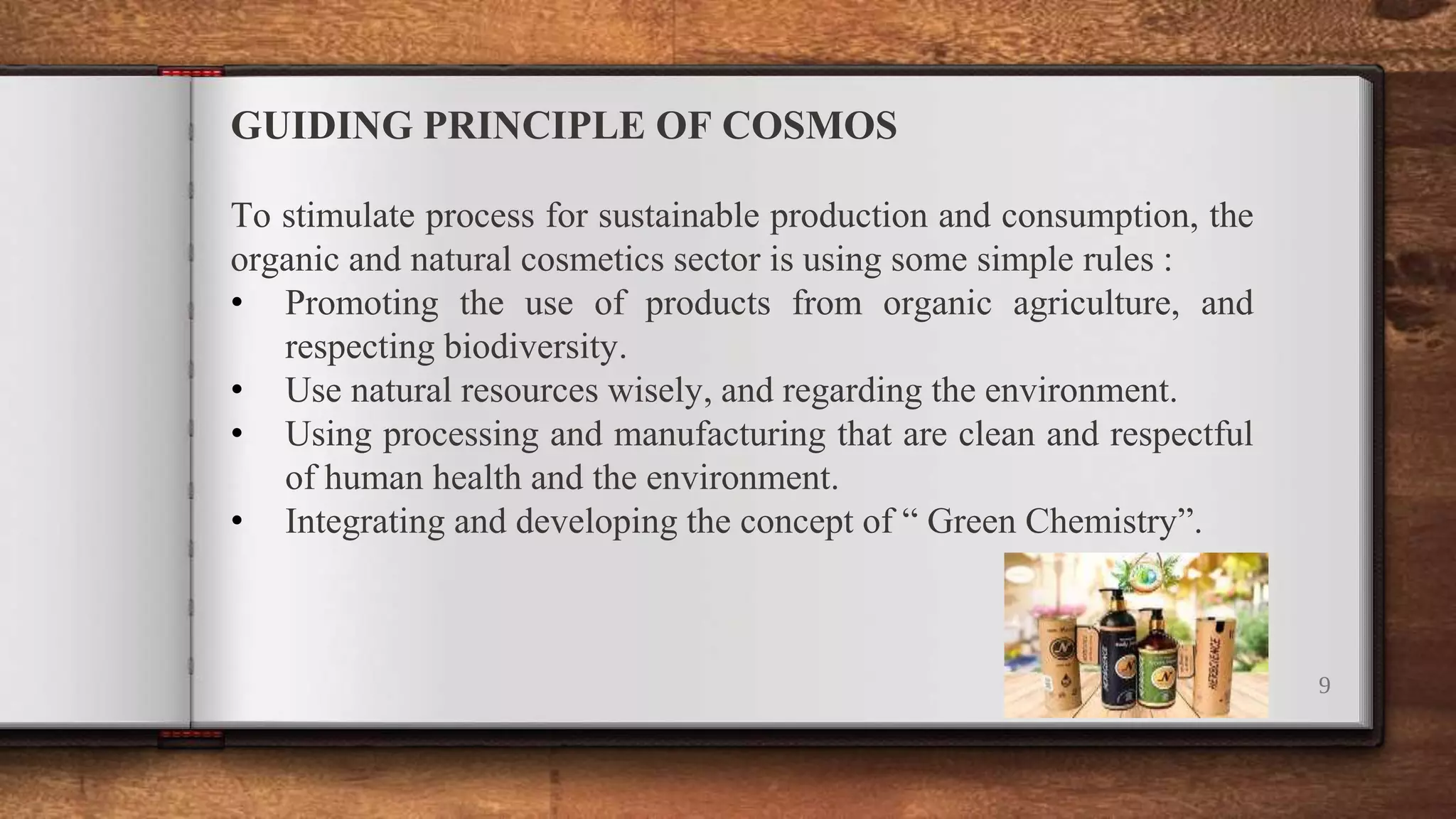
To stimulate process for sustainable production and consumption, the
organic and natural cosmetics sector is using some simple rules :
• Promoting the use of products from organic agriculture, and
respecting biodiversity.
• Use natural resources wisely, and regarding the environment.
• Using processing and manufacturing that are clean and respectful
of human health and the environment.
• Integrating and developing the concept of “ Green Chemistry”.
10
Organic and Natural Certification for Cosmetics
• The COSMOS-standard signature is a reliable consumer guarantee
for organic and natural cosmetics.
• COSMOS ORGANIC or COSMOS NATURAL trademark is used
by 16,00 enterprises in 71 countries who manufacture and sell
over 29,000 items.
• COSMOS CERTIFIED seal can be found on over 12,000
substances.
• The five members eventually formed a non-profit worldwide
organization to manage the standard.
• COSMOS is present in about 7,000 basic materials APPROVED
SIGNATURE.
11
• In June 2010 the COSMOS standard AISBL was awarded Royal
Assent from Belgian authorities.
• The document published with the standard include:
1. The Control Manual : describes how the control system works
2. The Labelling Rules : explains how to use COSMOS labels.
3. The Technical Guide : additional interpretation.
Four main certification signatures
◈ Cosmos Organic
◈ Cosmos Natural
◈ Cosmos certified
◈ Cosmos Approved
Some questions:
Who will be certified?
◈ Producers of raw materials
◈ Manufacturers
◈ Any player of the cosmetics sector
12
Benefits
◈ Cosmos certified organic certified ingredients
◈ Cosmos approved natural raw materials
◈ Perfumers offering fragrance composition
◈ Validated packaging
How will the label look like
13
WHAT COSMOS STANDARD COVERS?
◈ To be certified these products must comply with the defined
criteria on:
• Origin and processing of ingredients.
• Composition of total product.
• Storage, manufacturing and packaging.
• Environment management.
• Labelling and communication.
• Inspection, certification and control.
14
15
1. Origin and processing of ingredients.
Ingredients
• Water
• Minerals and ingredients of mineral origin.
• Physically processed agro-ingredients.
• Chemically processed agro-ingredients.
• Other ingredients.
16
2. Composition of total product.
• Rules for cosmetic products under organic certification.
1. Ingredients - At least 95% of the physically processed agro-
ingredients must be organic.
2. Total product - At least 20% of the total product must be organic.
• Rules for cosmetic product under natural certification. There is no
requirement to use a minimum level of organic ingredients.
• Calculation rules for natural origin percentage.
% Natural origin of total = [wt of total product - wt of non-natural
origin ingredients (appendix V.1) - wt of petrochemical moieties
(appendix V.3) / wt of all ingredients] х 100.
17
3. Storage, manufacturing and packaging.
 Storage
 Manufacturing
There must be a Quality Control System which includes:
• complete traceability of ingredients and final products
• manufacturing procedures throughout all stages
• ingredient and product testing, and
• analysis, manufacturing and storage records.
18
 Packaging
To minimize packaging's direct and indirect environmental consequences
throughout its life cycle, it must:
• minimize the amount of material used
• maximize the amount of material that can be reused or recycled, and
• use materials with recycled content where possible.
19
4. Environment management.
 Environmental management plan
It is required to:
• sort cardboard, glass, paper and all other waste materials
• recycle or process of waste
Cleaning and hygiene
Following disinfection materials can be used:
• Iso-propyl alcohol
• Amphoteric surfactants
• Hydrogen peroxide
• Mineral acids and alkalis
• Peracetic acid
• Formic acid
• ozone
20
21
5. Labelling and communication
• General rules should be clear and non misleading to the
consumer
• For product under organic certification must be labelled with
signature ‘COSMOS ORGANIC’ and ‘COSMOSS NATURAL’
in conjugation with the seal of the COSMOS- standard
organization. The product must not be called “organic”, for
example, “organic shampoo”, unless it is at least 95% organic,
measured as a percentage of the total product.
• Indicate the certification body and percentage on the label.
• Organic content – COSMOS CERTIFIED
• Raw material – COSMOS APPROVED
22
• Organic in the name of company or product name
• Use of signature, name or term related to the standard:
- literature
- advertising
- publicity
- Website
23
6. Inspection, certification and control
This standard requires that cosmetic ingredients be certified as
natural or organic if they meet the following criteria:
• Hold a valid operational certificate from that body.
• Undergo an on-site annual inspection cycle which may include
possible unannounced inspections and other additional
inspections.
• Allows certification body to take samples and carry out analysis
using laboratory conforming to ingredients.
Approval of ingredients
◈ The approval of non-organic cosmetic ingredients consists of a
documentary validation without on-site inspection. The approval
delivered by a certification body only states that a non-organic
ingredient is acceptable for use under this Standard.
It is required to:
◈ It is forbidden to label or otherwise indicate that approved
cosmetic ingredients are certified according to this Standard.
24
PRESERVATIVES
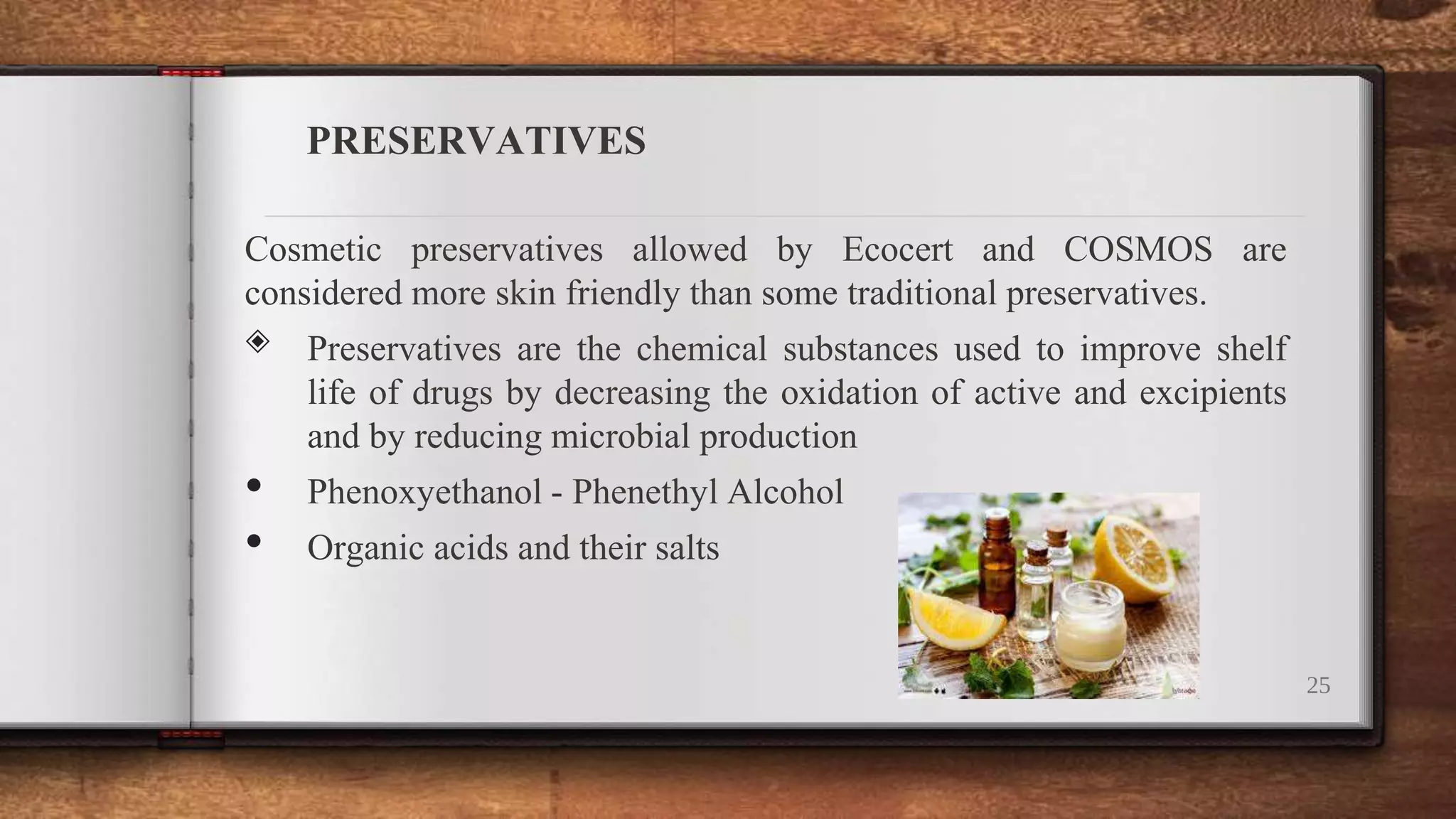
Cosmetic preservatives allowed by Ecocert and COSMOS are
considered more skin friendly than some traditional preservatives.
◈ Preservatives are the chemical substances used to improve shelf
life of drugs by decreasing the oxidation of active and excipients
and by reducing microbial production
• Phenoxyethanol - Phenethyl Alcohol
• Organic acids and their salts
25
26
These include:
• Benzoic acid
• Sodium benzoate
• Sorbic acid
• Potassium sorbate
• Dehydroacetic acid
• Salicylic acid
• Benzyl Alcohol
• They only work at lower pH - to formulate below pH 5.0
EMOLLIENTS
◈ Emollients are cosmetic preparation used for protecting,
moisturizing and lubricating the skin. It reduces evaporation and
thus increases the moisture content of the skin.
◈ According to COSMOS standard for Natural & Organic
Cosmetics : - Candelilla Cera
- Palmitic & Stearic Acid
- Isopropyl Myristate
- Isopropyl Palmitate
27
28
• Jojoba Esters / Sunflower Seed Wax / Polyglycerin
• Propanediol
• Decyl glycoside
• Pentylene Glycol
• Apricot Kernel Extract
• Glycerine (and) Water (and) Hydrogenated Lecithin
• Citric Acid
• Beeswax
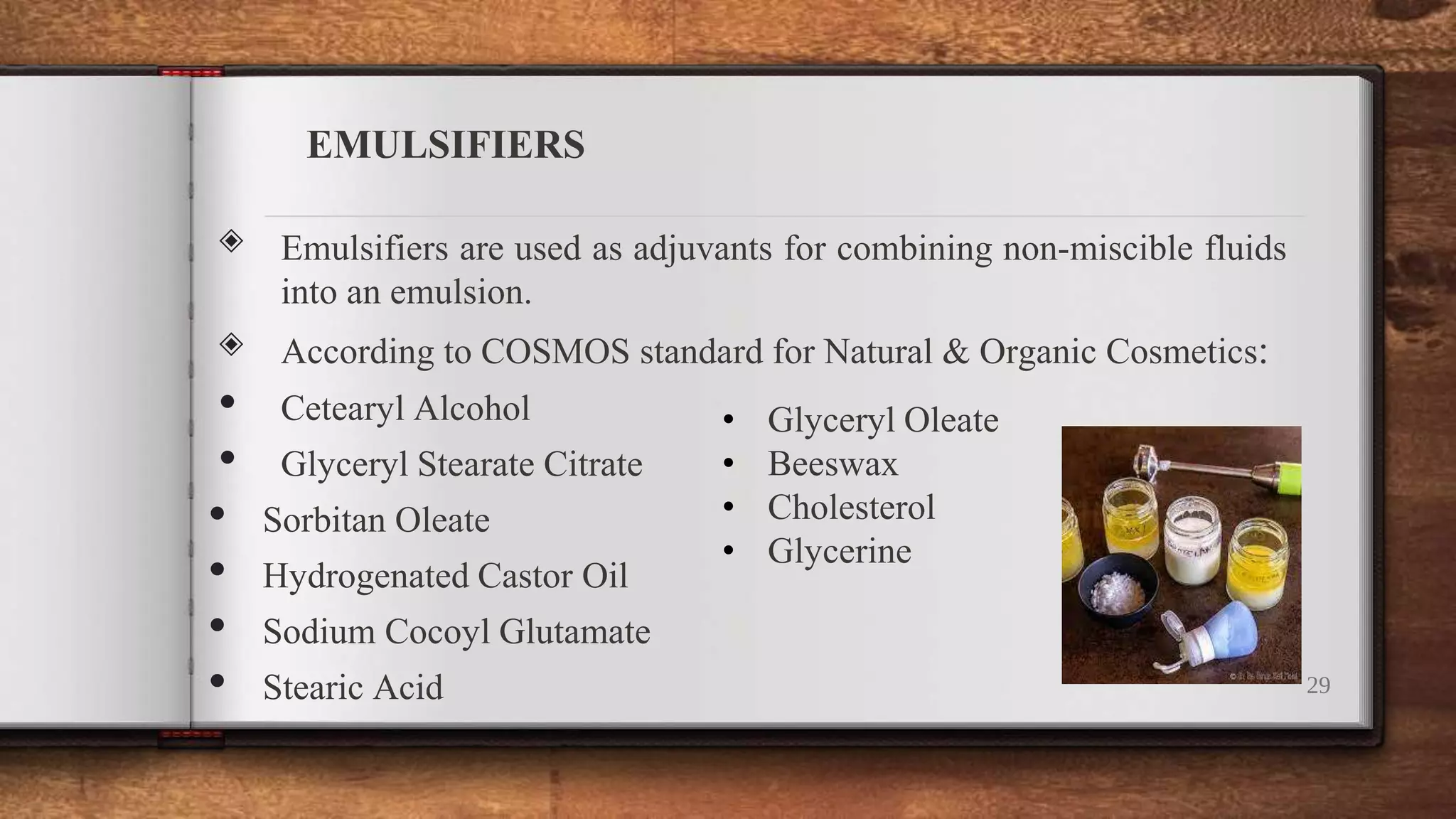
EMULSIFIERS
◈ Emulsifiers are used as adjuvants for combining non-miscible fluids
into an emulsion.
◈ According to COSMOS standard for Natural & Organic Cosmetics:
• Cetearyl Alcohol
• Glyceryl Stearate Citrate
• Sorbitan Oleate
• Hydrogenated Castor Oil
• Sodium Cocoyl Glutamate
• Stearic Acid 29
• Glyceryl Oleate
• Beeswax
• Cholesterol
• Glycerine
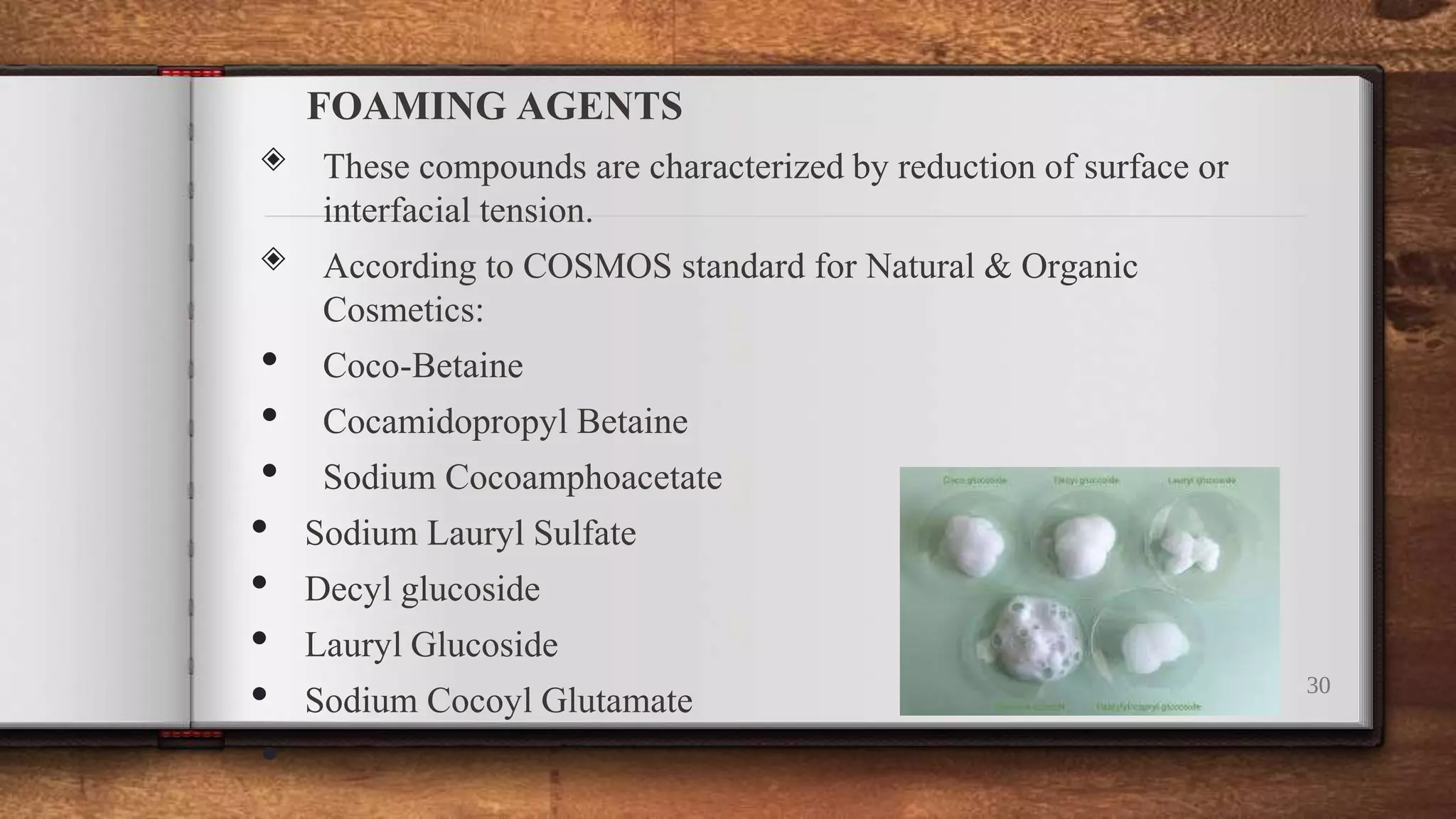
FOAMING AGENTS
◈ These compounds are characterized by reduction of surface or
interfacial tension.
◈ According to COSMOS standard for Natural & Organic
Cosmetics:
• Coco-Betaine
• Cocamidopropyl Betaine
• Sodium Cocoamphoacetate
• Sodium Lauryl Sulfate
• Decyl glucoside
• Lauryl Glucoside
• Sodium Cocoyl Glutamate
•
30
RHEOLOGY MODIFIERS
◈ It deals with the fluids flow.
◈ Rheological additives generally focused to Thickeners.
◈ Their primary roles in flow behavior may include detergency,
emulsification, foam stability or conditioning.
31
According to COSMOS standard for Natural & Organic
Cosmetics:
◈ Xanthan Gum
◈ Hydrogenated Rapeseed Alcohol
◈ Apricot Kernel Oil
◈ Hydrogenated Vegetable Oil
◈ Cellulose Gum and Microcrystalline Cellulose
◈ Avocado Oil
32
REFERENCES
◈ Vimaladevi.m., Text book of Herbal cosmetics, Page no:74-103.
◈ https://cosmos-standard.org/the-cosmos- standard
◈ review-of-guidelines-for-herbal-cosmetics-by-private-bodies-
like-cosmos-250027556
◈ Alex, Casper. "Understanding organic and natural standard“
◈ COSMOS-standard AISBL Control Manual – version 1.9
33
.

HERBAL COSMETICS BY PRIVATE BODIES LIKE COSMOS.pptx

  • 1.
    Name : PurvaV. Yeole Roll no : 516 Class : M.Pharm first year (Pharmaceutics) Dr. D. Y. Patil Institute of Pharmaceutical Science & Research Pimpri, Pune GUIDELINES FOR HERBAL COSMETICS BY PRIVATE BODIES LIKE COSMOS
  • 2.
    2 Lesson Plan: • Whatare Cosmetics? • What are Herbal Cosmetics? • Advantages of Herbal Cosmetics • What is Cosmos? • Guiding principle of Cosmos • Certification signatures & Benefits • What the Cosmos standard covers? • Approval of ingredients • Preservatives • Emollients • Foaming agents • Emulsifiers • Rheology modifiers
  • 3.
    WHAT ARE COSMETICS? Definition: ◈According to D & C Act 1940 ◈ Any article intended to be rubbed, poured, sprinkled or sprayed on or introduced to or applied to any part of human body for cleansing, beautifying, promoting, attractiveness or altering the appearance and includes any article intended for use as component of cosmetics. 3
  • 4.
    WHAT ARE HERBALCOSMETICS? ◈ Herbal Cosmetics, referred as Products, are formulated, using various permissible cosmetic ingredients to form the base in which one or more herbal ingredients are used to provide defined cosmetic benefits only. ◈ Natural products include oils, extracts, secretions etc. Phyto- ingredients include pure constituents obtained by various process. 4
  • 5.
    ADVANTAGES OF HERBALCOSMETICS ◈ They do not provoke allergic reaction & do not have negative side effects. ◈ They are easily incorporated with skin and hair. ◈ Extract form of the plants decreases the bulk properties of the cosmetics and give appropriate effects. ◈ Easily available & found in large variety & quantity. 5
  • 6.
    WHAT IS COSMOS? ◈COSMOS stands for "cosmetic organic and natural standard", which sets certification requirements for organic and natural cosmetics products in the Europe. ◈ The standard is recognized globally by the cosmetic industry. ◈ By adhering to specific guidelines, cosmetics marketers can use COSMOS signatures, which are registered trademarks, on packaging to confirm the products meet minimum industry requirements to be considered organic or natural. 6
  • 7.
  • 8.
    8 In 2002 fiveEuropean organizations liable for setting organic and natural cosmetics standards met at a trade show to share ideas for broader standards to be used globally. These five COSMOS members are: • BDIH (Germany) • Cosmebio (France) • Ecocert (France) • ICEA (Italy) • Soil Association (Great Britain)
  • 9.
    9 GUIDING PRINCIPLE OFCOSMOS To stimulate process for sustainable production and consumption, the organic and natural cosmetics sector is using some simple rules : • Promoting the use of products from organic agriculture, and respecting biodiversity. • Use natural resources wisely, and regarding the environment. • Using processing and manufacturing that are clean and respectful of human health and the environment. • Integrating and developing the concept of “ Green Chemistry”.
  • 10.
    10 Organic and NaturalCertification for Cosmetics • The COSMOS-standard signature is a reliable consumer guarantee for organic and natural cosmetics. • COSMOS ORGANIC or COSMOS NATURAL trademark is used by 16,00 enterprises in 71 countries who manufacture and sell over 29,000 items. • COSMOS CERTIFIED seal can be found on over 12,000 substances. • The five members eventually formed a non-profit worldwide organization to manage the standard. • COSMOS is present in about 7,000 basic materials APPROVED SIGNATURE.
  • 11.
    11 • In June2010 the COSMOS standard AISBL was awarded Royal Assent from Belgian authorities. • The document published with the standard include: 1. The Control Manual : describes how the control system works 2. The Labelling Rules : explains how to use COSMOS labels. 3. The Technical Guide : additional interpretation.
  • 12.
    Four main certificationsignatures ◈ Cosmos Organic ◈ Cosmos Natural ◈ Cosmos certified ◈ Cosmos Approved Some questions: Who will be certified? ◈ Producers of raw materials ◈ Manufacturers ◈ Any player of the cosmetics sector 12
  • 13.
    Benefits ◈ Cosmos certifiedorganic certified ingredients ◈ Cosmos approved natural raw materials ◈ Perfumers offering fragrance composition ◈ Validated packaging How will the label look like 13
  • 14.
    WHAT COSMOS STANDARDCOVERS? ◈ To be certified these products must comply with the defined criteria on: • Origin and processing of ingredients. • Composition of total product. • Storage, manufacturing and packaging. • Environment management. • Labelling and communication. • Inspection, certification and control. 14
  • 15.
    15 1. Origin andprocessing of ingredients. Ingredients • Water • Minerals and ingredients of mineral origin. • Physically processed agro-ingredients. • Chemically processed agro-ingredients. • Other ingredients.
  • 16.
    16 2. Composition oftotal product. • Rules for cosmetic products under organic certification. 1. Ingredients - At least 95% of the physically processed agro- ingredients must be organic. 2. Total product - At least 20% of the total product must be organic. • Rules for cosmetic product under natural certification. There is no requirement to use a minimum level of organic ingredients. • Calculation rules for natural origin percentage. % Natural origin of total = [wt of total product - wt of non-natural origin ingredients (appendix V.1) - wt of petrochemical moieties (appendix V.3) / wt of all ingredients] х 100.
  • 17.
    17 3. Storage, manufacturingand packaging.  Storage  Manufacturing There must be a Quality Control System which includes: • complete traceability of ingredients and final products • manufacturing procedures throughout all stages • ingredient and product testing, and • analysis, manufacturing and storage records.
  • 18.
    18  Packaging To minimizepackaging's direct and indirect environmental consequences throughout its life cycle, it must: • minimize the amount of material used • maximize the amount of material that can be reused or recycled, and • use materials with recycled content where possible.
  • 19.
    19 4. Environment management. Environmental management plan It is required to: • sort cardboard, glass, paper and all other waste materials • recycle or process of waste
  • 20.
    Cleaning and hygiene Followingdisinfection materials can be used: • Iso-propyl alcohol • Amphoteric surfactants • Hydrogen peroxide • Mineral acids and alkalis • Peracetic acid • Formic acid • ozone 20
  • 21.
    21 5. Labelling andcommunication • General rules should be clear and non misleading to the consumer • For product under organic certification must be labelled with signature ‘COSMOS ORGANIC’ and ‘COSMOSS NATURAL’ in conjugation with the seal of the COSMOS- standard organization. The product must not be called “organic”, for example, “organic shampoo”, unless it is at least 95% organic, measured as a percentage of the total product. • Indicate the certification body and percentage on the label. • Organic content – COSMOS CERTIFIED • Raw material – COSMOS APPROVED
  • 22.
    22 • Organic inthe name of company or product name • Use of signature, name or term related to the standard: - literature - advertising - publicity - Website
  • 23.
    23 6. Inspection, certificationand control This standard requires that cosmetic ingredients be certified as natural or organic if they meet the following criteria: • Hold a valid operational certificate from that body. • Undergo an on-site annual inspection cycle which may include possible unannounced inspections and other additional inspections. • Allows certification body to take samples and carry out analysis using laboratory conforming to ingredients.
  • 24.
    Approval of ingredients ◈The approval of non-organic cosmetic ingredients consists of a documentary validation without on-site inspection. The approval delivered by a certification body only states that a non-organic ingredient is acceptable for use under this Standard. It is required to: ◈ It is forbidden to label or otherwise indicate that approved cosmetic ingredients are certified according to this Standard. 24
  • 25.
    PRESERVATIVES Cosmetic preservatives allowedby Ecocert and COSMOS are considered more skin friendly than some traditional preservatives. ◈ Preservatives are the chemical substances used to improve shelf life of drugs by decreasing the oxidation of active and excipients and by reducing microbial production • Phenoxyethanol - Phenethyl Alcohol • Organic acids and their salts 25
  • 26.
    26 These include: • Benzoicacid • Sodium benzoate • Sorbic acid • Potassium sorbate • Dehydroacetic acid • Salicylic acid • Benzyl Alcohol • They only work at lower pH - to formulate below pH 5.0
  • 27.
    EMOLLIENTS ◈ Emollients arecosmetic preparation used for protecting, moisturizing and lubricating the skin. It reduces evaporation and thus increases the moisture content of the skin. ◈ According to COSMOS standard for Natural & Organic Cosmetics : - Candelilla Cera - Palmitic & Stearic Acid - Isopropyl Myristate - Isopropyl Palmitate 27
  • 28.
    28 • Jojoba Esters/ Sunflower Seed Wax / Polyglycerin • Propanediol • Decyl glycoside • Pentylene Glycol • Apricot Kernel Extract • Glycerine (and) Water (and) Hydrogenated Lecithin • Citric Acid • Beeswax
  • 29.
    EMULSIFIERS ◈ Emulsifiers areused as adjuvants for combining non-miscible fluids into an emulsion. ◈ According to COSMOS standard for Natural & Organic Cosmetics: • Cetearyl Alcohol • Glyceryl Stearate Citrate • Sorbitan Oleate • Hydrogenated Castor Oil • Sodium Cocoyl Glutamate • Stearic Acid 29 • Glyceryl Oleate • Beeswax • Cholesterol • Glycerine
  • 30.
    FOAMING AGENTS ◈ Thesecompounds are characterized by reduction of surface or interfacial tension. ◈ According to COSMOS standard for Natural & Organic Cosmetics: • Coco-Betaine • Cocamidopropyl Betaine • Sodium Cocoamphoacetate • Sodium Lauryl Sulfate • Decyl glucoside • Lauryl Glucoside • Sodium Cocoyl Glutamate • 30
  • 31.
    RHEOLOGY MODIFIERS ◈ Itdeals with the fluids flow. ◈ Rheological additives generally focused to Thickeners. ◈ Their primary roles in flow behavior may include detergency, emulsification, foam stability or conditioning. 31
  • 32.
    According to COSMOSstandard for Natural & Organic Cosmetics: ◈ Xanthan Gum ◈ Hydrogenated Rapeseed Alcohol ◈ Apricot Kernel Oil ◈ Hydrogenated Vegetable Oil ◈ Cellulose Gum and Microcrystalline Cellulose ◈ Avocado Oil 32
  • 33.
    REFERENCES ◈ Vimaladevi.m., Textbook of Herbal cosmetics, Page no:74-103. ◈ https://cosmos-standard.org/the-cosmos- standard ◈ review-of-guidelines-for-herbal-cosmetics-by-private-bodies- like-cosmos-250027556 ◈ Alex, Casper. "Understanding organic and natural standard“ ◈ COSMOS-standard AISBL Control Manual – version 1.9 33
  • 34.