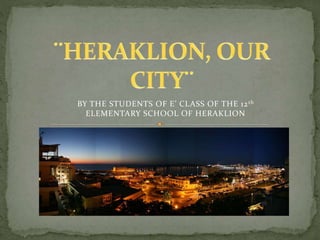
BY THE STUDENTS OF E’ CLASS OF THE 12 th 
ELEMENTARY SCHOOL OF HERAKLION
Heraklion is the capital and largest city of Crete. According to the 2011 
census the municipality of Heraklion has a population of 173.993 
inhabitants. 
The main economic sectors of the city are tourism, agriculture and 
trade. Heraklion also has one of the busiest airports (airport "Nikos 
Kazantzakis") as well as a port busy with passengers and freight. 
It has a strategic geopolitical position in the east basin of the 
Mediterranean, connecting three continents and many different 
cultures. 
It is a dynamic city that unites the past and present.
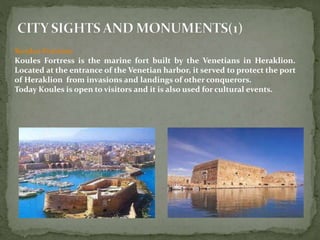
Koules Fortress 
Koules Fortress is the marine fort built by the Venetians in Heraklion. 
Located at the entrance of the Venetian harbor, it served to protect the port 
of Heraklion from invasions and landings of other conquerors. 
Today Koules is open to visitors and it is also used for cultural events.
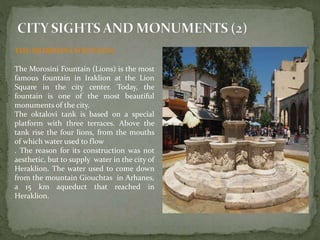
THE MOROSINI FOUNTAIN 
The Morosini Fountain (Lions) is the most 
famous fountain in Iraklion at the Lion 
Square in the city center. Today, the 
fountain is one of the most beautiful 
monuments of the city. 
The oktalovi tank is based on a special 
platform with three terraces. Above the 
tank rise the four lions, from the mouths 
of which water used to flow 
. The reason for its construction was not 
aesthetic, but to supply water in the city of 
Heraklion. The water used to come down 
from the mountain Giouchtas in Arhanes, 
a 15 km aqueduct that reached in 
Heraklion.
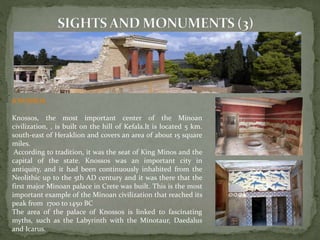
KNOSSOS 
Knossos, the most important center of the Minoan 
civilization, , is built on the hill of Kefala.It is located 5 km. 
south-east of Heraklion and covers an area of about 15 square 
miles. 
According to tradition, it was the seat of King Minos and the 
capital of the state. Knossos was an important city in 
antiquity, and it had been continuously inhabited from the 
Neolithic up to the 5th AD century and it was there that the 
first major Minoan palace in Crete was built. This is the most 
important example of the Minoan civilization that reached its 
peak from 1700 to 1450 BC 
The area of the palace of Knossos is linked to fascinating 
myths, such as the Labyrinth with the Minotaur, Daedalus 
and Icarus.
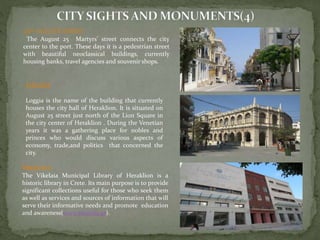
25th AUGUST STREET 
The August 25 Martyrs’ street connects the city 
center to the port. These days it is a pedestrian street 
with beautiful neoclassical buildings, currently 
housing banks, travel agencies and souvenir shops. 
LOGGIA 
Loggia is the name of the building that currently 
houses the city hall of Heraklion. It is situated on 
August 25 street just north of the Lion Square in 
the city center of Heraklion . During the Venetian 
years it was a gathering place for nobles and 
princes who would discuss various aspects of 
economy, trade,and politics that concerned the 
city. 
VIKELAIA 
The Vikelaia Municipal Library of Heraklion is a 
historic library in Crete. Its main purpose is to provide 
significant collections useful for those who seek them 
as well as services and sources of information that will 
serve their informative needs and promote education 
and awareness(www.vikelaia.gr).
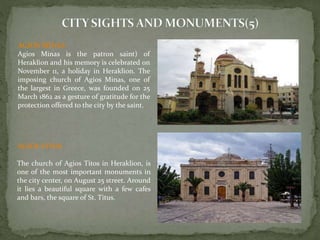
AGIOS MINAS 
Agios Minas is the patron saint) of 
Heraklion and his memory is celebrated on 
November 11, a holiday in Heraklion. The 
imposing church of Agios Minas, one of 
the largest in Greece, was founded on 25 
March 1862 as a gesture of gratitude for the 
protection offered to the city by the saint. 
AGIOS TITOS 
The church of Agios Titos in Heraklion, is 
one of the most important monuments in 
the city center, on August 25 street. Around 
it lies a beautiful square with a few cafes 
and bars, the square of St. Titus.
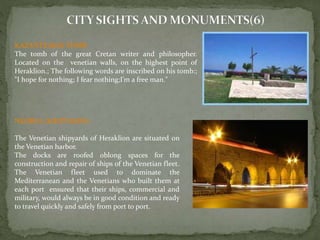
KAZANTZAKIS TOMB 
The tomb of the great Cretan writer and philosopher. 
Located on the venetian walls, on the highest point of 
Heraklion.; The following words are inscribed on his tomb:; 
"I hope for nothing; I fear nothing;I’m a free man." 
NEORIA (SHIPYARDS) 
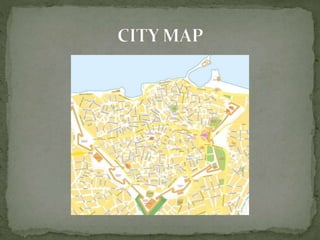
The Venetian shipyards of Heraklion are situated on 
the Venetian harbor. 
The docks are roofed oblong spaces for the 
construction and repair of ships of the Venetian fleet. 
The Venetian fleet used to dominate the 
Mediterranean and the Venetians who built them at 
each port ensured that their ships, commercial and 
military, would always be in good condition and ready 
to travel quickly and safely from port to port.
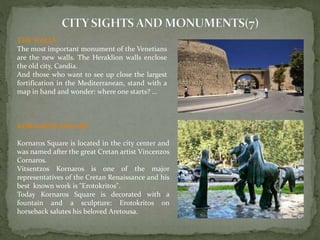
THEWALLS 
The most important monument of the Venetians 
are the new walls. The Heraklion walls enclose 
the old city, Candia. 
And those who want to see up close the largest 
fortification in the Mediterranean, stand with a 
map in hand and wonder: where one starts? ... 
KORNAROS SWUARE 
Kornaros Square is located in the city center and 
was named after the great Cretan artist Vincenzos 
Cornaros. 
Vitsentzos Kornaros is one of the major 
representatives of the Cretan Renaissance and his 
best known work is "Erotokritos". 
Today Kornaros Square is decorated with a 
fountain and a sculpture: Erotokritos on 
horseback salutes his beloved Aretousa.
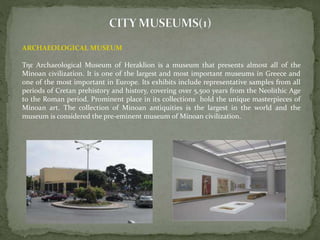
ARCHAEOLOGICAL MUSEUM 
Τηε Archaeological Museum of Heraklion is a museum that presents almost all of the 
Minoan civilization. It is one of the largest and most important museums in Greece and 
one of the most important in Europe. Its exhibits include representative samples from all 
periods of Cretan prehistory and history, covering over 5,500 years from the Neolithic Age 
to the Roman period. Prominent place in its collections hold the unique masterpieces of 
Minoan art. The collection of Minoan antiquities is the largest in the world and the 
museum is considered the pre-eminent museum of Minoan civilization.
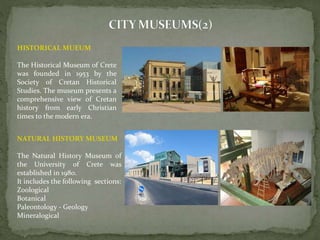
HISTORICAL MUEUM 
The Historical Museum of Crete 
was founded in 1953 by the 
Society of Cretan Historical 
Studies. The museum presents a 
comprehensive view of Cretan 
history from early Christian 
times to the modern era. 
NATURAL HISTORY MUSEUM 
The Natural History Museum of 
the University of Crete was 
established in 1980. 
It includes the following sections: 
Zoological 
Botanical 
Paleontology - Geology 
Mineralogical
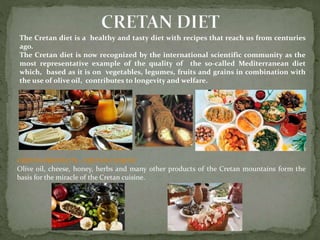
The Cretan diet is a healthy and tasty diet with recipes that reach us from centuries 
ago. 
The Cretan diet is now recognized by the international scientific community as the 
most representative example of the quality of the so-called Mediterranean diet 
which, based as it is on vegetables, legumes, fruits and grains in combination with 
the use of olive oil, contributes to longevity and welfare. 
CRETAN PRODUCTS – CRETAN CUISINE 
Olive oil, cheese, honey, herbs and many other products of the Cretan mountains form the 
basis for the miracle of the Cretan cuisine.
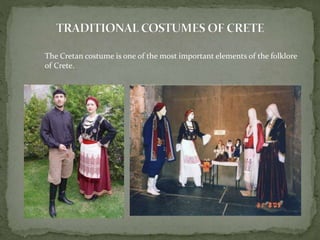
The Cretan costume is one of the most important elements of the folklore 
of Crete.
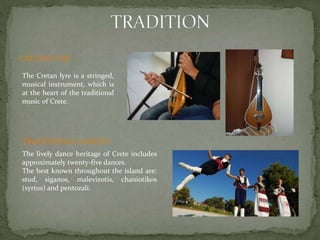
CRETAN LYRE 
The Cretan lyre is a stringed, 
musical instrument, which is 
at the heart of the traditional 
music of Crete. 
TRADITIONAL DANCES 
The lively dance heritage of Crete includes 
approximately twenty-five dances. 
The best known throughout the island are: 
stud, siganos, malevizotis, chaniotikos 
(syrtos) and pentozali.
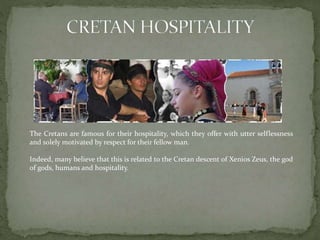
The Cretans are famous for their hospitality, which they offer with utter selflessness 
and solely motivated by respect for their fellow man. 
Indeed, many believe that this is related to the Cretan descent of Xenios Zeus, the god 
of gods, humans and hospitality.
http://el.wikipedia.org/ 
http://www.heraklion.gr/ 
http://olympia.gr/ 
www.explorecrete.com 
http://cretazine.com/heraklion 
http://www.incrediblecrete.gr/ 
http://cretancostume.blogspot.gr/ 
forum.kithara.gr 
www.agonaskritis.gr 
http://www.tsouchlarakis.com/

Heraklion our city

  • 1.
    BY THE STUDENTSOF E’ CLASS OF THE 12 th ELEMENTARY SCHOOL OF HERAKLION
  • 2.
    Heraklion is thecapital and largest city of Crete. According to the 2011 census the municipality of Heraklion has a population of 173.993 inhabitants. The main economic sectors of the city are tourism, agriculture and trade. Heraklion also has one of the busiest airports (airport "Nikos Kazantzakis") as well as a port busy with passengers and freight. It has a strategic geopolitical position in the east basin of the Mediterranean, connecting three continents and many different cultures. It is a dynamic city that unites the past and present.
  • 4.
    Koules Fortress KoulesFortress is the marine fort built by the Venetians in Heraklion. Located at the entrance of the Venetian harbor, it served to protect the port of Heraklion from invasions and landings of other conquerors. Today Koules is open to visitors and it is also used for cultural events.
  • 5.
    THE MOROSINI FOUNTAIN The Morosini Fountain (Lions) is the most famous fountain in Iraklion at the Lion Square in the city center. Today, the fountain is one of the most beautiful monuments of the city. The oktalovi tank is based on a special platform with three terraces. Above the tank rise the four lions, from the mouths of which water used to flow . The reason for its construction was not aesthetic, but to supply water in the city of Heraklion. The water used to come down from the mountain Giouchtas in Arhanes, a 15 km aqueduct that reached in Heraklion.
  • 6.
    KNOSSOS Knossos, themost important center of the Minoan civilization, , is built on the hill of Kefala.It is located 5 km. south-east of Heraklion and covers an area of about 15 square miles. According to tradition, it was the seat of King Minos and the capital of the state. Knossos was an important city in antiquity, and it had been continuously inhabited from the Neolithic up to the 5th AD century and it was there that the first major Minoan palace in Crete was built. This is the most important example of the Minoan civilization that reached its peak from 1700 to 1450 BC The area of the palace of Knossos is linked to fascinating myths, such as the Labyrinth with the Minotaur, Daedalus and Icarus.
  • 7.
    25th AUGUST STREET The August 25 Martyrs’ street connects the city center to the port. These days it is a pedestrian street with beautiful neoclassical buildings, currently housing banks, travel agencies and souvenir shops. LOGGIA Loggia is the name of the building that currently houses the city hall of Heraklion. It is situated on August 25 street just north of the Lion Square in the city center of Heraklion . During the Venetian years it was a gathering place for nobles and princes who would discuss various aspects of economy, trade,and politics that concerned the city. VIKELAIA The Vikelaia Municipal Library of Heraklion is a historic library in Crete. Its main purpose is to provide significant collections useful for those who seek them as well as services and sources of information that will serve their informative needs and promote education and awareness(www.vikelaia.gr).
  • 8.
    AGIOS MINAS AgiosMinas is the patron saint) of Heraklion and his memory is celebrated on November 11, a holiday in Heraklion. The imposing church of Agios Minas, one of the largest in Greece, was founded on 25 March 1862 as a gesture of gratitude for the protection offered to the city by the saint. AGIOS TITOS The church of Agios Titos in Heraklion, is one of the most important monuments in the city center, on August 25 street. Around it lies a beautiful square with a few cafes and bars, the square of St. Titus.
  • 9.
    KAZANTZAKIS TOMB Thetomb of the great Cretan writer and philosopher. Located on the venetian walls, on the highest point of Heraklion.; The following words are inscribed on his tomb:; "I hope for nothing; I fear nothing;I’m a free man." NEORIA (SHIPYARDS) The Venetian shipyards of Heraklion are situated on the Venetian harbor. The docks are roofed oblong spaces for the construction and repair of ships of the Venetian fleet. The Venetian fleet used to dominate the Mediterranean and the Venetians who built them at each port ensured that their ships, commercial and military, would always be in good condition and ready to travel quickly and safely from port to port.
  • 10.
    THEWALLS The mostimportant monument of the Venetians are the new walls. The Heraklion walls enclose the old city, Candia. And those who want to see up close the largest fortification in the Mediterranean, stand with a map in hand and wonder: where one starts? ... KORNAROS SWUARE Kornaros Square is located in the city center and was named after the great Cretan artist Vincenzos Cornaros. Vitsentzos Kornaros is one of the major representatives of the Cretan Renaissance and his best known work is "Erotokritos". Today Kornaros Square is decorated with a fountain and a sculpture: Erotokritos on horseback salutes his beloved Aretousa.
  • 11.
    ARCHAEOLOGICAL MUSEUM ΤηεArchaeological Museum of Heraklion is a museum that presents almost all of the Minoan civilization. It is one of the largest and most important museums in Greece and one of the most important in Europe. Its exhibits include representative samples from all periods of Cretan prehistory and history, covering over 5,500 years from the Neolithic Age to the Roman period. Prominent place in its collections hold the unique masterpieces of Minoan art. The collection of Minoan antiquities is the largest in the world and the museum is considered the pre-eminent museum of Minoan civilization.
  • 12.
    HISTORICAL MUEUM TheHistorical Museum of Crete was founded in 1953 by the Society of Cretan Historical Studies. The museum presents a comprehensive view of Cretan history from early Christian times to the modern era. NATURAL HISTORY MUSEUM The Natural History Museum of the University of Crete was established in 1980. It includes the following sections: Zoological Botanical Paleontology - Geology Mineralogical
  • 13.
    The Cretan dietis a healthy and tasty diet with recipes that reach us from centuries ago. The Cretan diet is now recognized by the international scientific community as the most representative example of the quality of the so-called Mediterranean diet which, based as it is on vegetables, legumes, fruits and grains in combination with the use of olive oil, contributes to longevity and welfare. CRETAN PRODUCTS – CRETAN CUISINE Olive oil, cheese, honey, herbs and many other products of the Cretan mountains form the basis for the miracle of the Cretan cuisine.
  • 14.
    The Cretan costumeis one of the most important elements of the folklore of Crete.
  • 15.
    CRETAN LYRE TheCretan lyre is a stringed, musical instrument, which is at the heart of the traditional music of Crete. TRADITIONAL DANCES The lively dance heritage of Crete includes approximately twenty-five dances. The best known throughout the island are: stud, siganos, malevizotis, chaniotikos (syrtos) and pentozali.
  • 16.
    The Cretans arefamous for their hospitality, which they offer with utter selflessness and solely motivated by respect for their fellow man. Indeed, many believe that this is related to the Cretan descent of Xenios Zeus, the god of gods, humans and hospitality.
  • 18.
    http://el.wikipedia.org/ http://www.heraklion.gr/ http://olympia.gr/ www.explorecrete.com http://cretazine.com/heraklion http://www.incrediblecrete.gr/ http://cretancostume.blogspot.gr/ forum.kithara.gr www.agonaskritis.gr http://www.tsouchlarakis.com/