 Articles are a part of a large grammatical
 category named Determiners. Although
 they appear to be a simple subject, they
 can be quite problematic. Some
 languages, for instance, have no articles.
 When their speakers learn them in
 English, they see no real use in them and
 tend to omit them. However, it’s important
 that they learn them in order to develop a
 proper understanding of other important
 workings of the English language.
A DEFINITION

Articles are words used before nouns to
 indicate the type of reference being made by
 the noun. It states the degree of grammatical
 definiteness attributed to the noun, ranging
 from a general definiteness to a more
 specific one (a house vs. the house). Articles
 can either be DEFINITE or INDEFINITE.
INDEFINITE ARTICLES A AND AN
   Indefinite articles indicate that a noun isn’t a
    particular one identifiable to a listener.

   They’re used only before singular count nouns which
    are not specific and weren’t mentioned before;

   “A” is for words beggining in consonant sounds (a
    computer, a book, a pencil);

   “An” is for words begging in vowel sounds (an apple,
    an ear, an order)
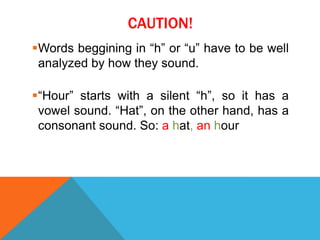
CAUTION!
Words beggining in “h” or “u” have to be well
 analyzed by how they sound.

“Hour” starts with a silent “h”, so it has a
 vowel sound. “Hat”, on the other hand, has a
 consonant sound. So: a hat, an hour
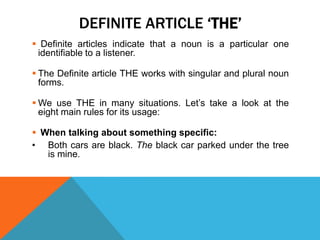
DEFINITE ARTICLE ‘THE’
 Definite articles indicate that a noun is a particular one
 identifiable to a listener.

 The Definite article THE works with singular and plural noun
  forms.

 We use THE in many situations. Let’s take a look at the
  eight main rules for its usage:

 When talking about something specific:
• Both cars are black. The black car parked under the tree
   is mine.
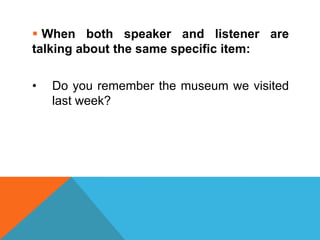
 When both speaker and listener are
talking about the same specific item:

•   Do you remember the museum we visited
    last week?
 For the second and all other references to
the same noun:

• I discovered a new restaurant last
  month. The restaurant was really good.
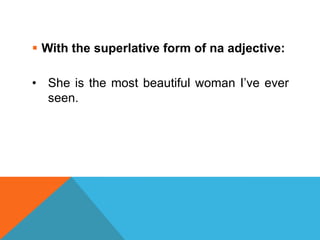
 With the superlative form of na adjective:

• She is the most beautiful woman I’ve ever
  seen.
 Names of countries that look plural, end
 in    “s”    or   have       the   words
 United, Union, Republic or Kingdom:

•   The United States, the Kingdom of
    Saudi Arabia
 For parts of something.

• Mary’s house is beautiful. The living room
  is huge, the bedrooms are colorful and the
  kitchen is well lighted.
With most bodies       of   water    except
 individual lakes.

• The Pacific Ocean, the Great Lake
 With geographic parts of the globe and
 geographic    areas,     deserts    and
 peninsulas.

• The equator, the Middle East, the Northern
  Hemisphere,
SITUATIONS WHERE WE DON’T
USE ARTICLES

1. To talk about a category or a group in
  general. Ex.: Computers can be expensive.

2. Before abstract nouns. Ex.: Julia felt
  sadness when she saw that abandoned
  dog.
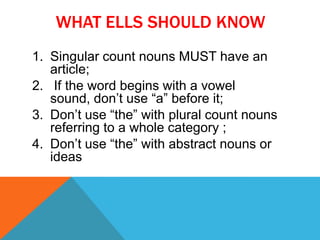
WHAT ELLS SHOULD KNOW
1. Singular count nouns MUST have an
   article;
2. If the word begins with a vowel
   sound, don’t use “a” before it;
3. Don’t use “the” with plural count nouns
   referring to a whole category ;
4. Don’t use “the” with abstract nouns or
   ideas

Antonio e vitoria

  • 2.
     Articles area part of a large grammatical category named Determiners. Although they appear to be a simple subject, they can be quite problematic. Some languages, for instance, have no articles. When their speakers learn them in English, they see no real use in them and tend to omit them. However, it’s important that they learn them in order to develop a proper understanding of other important workings of the English language.
  • 3.
    A DEFINITION Articles arewords used before nouns to indicate the type of reference being made by the noun. It states the degree of grammatical definiteness attributed to the noun, ranging from a general definiteness to a more specific one (a house vs. the house). Articles can either be DEFINITE or INDEFINITE.
  • 4.
    INDEFINITE ARTICLES AAND AN  Indefinite articles indicate that a noun isn’t a particular one identifiable to a listener.  They’re used only before singular count nouns which are not specific and weren’t mentioned before;  “A” is for words beggining in consonant sounds (a computer, a book, a pencil);  “An” is for words begging in vowel sounds (an apple, an ear, an order)
  • 5.
    CAUTION! Words beggining in“h” or “u” have to be well analyzed by how they sound. “Hour” starts with a silent “h”, so it has a vowel sound. “Hat”, on the other hand, has a consonant sound. So: a hat, an hour
  • 6.
    DEFINITE ARTICLE ‘THE’ Definite articles indicate that a noun is a particular one identifiable to a listener.  The Definite article THE works with singular and plural noun forms.  We use THE in many situations. Let’s take a look at the eight main rules for its usage:  When talking about something specific: • Both cars are black. The black car parked under the tree is mine.
  • 7.
     When bothspeaker and listener are talking about the same specific item: • Do you remember the museum we visited last week?
  • 8.
     For thesecond and all other references to the same noun: • I discovered a new restaurant last month. The restaurant was really good.
  • 9.
     With thesuperlative form of na adjective: • She is the most beautiful woman I’ve ever seen.
  • 10.
     Names ofcountries that look plural, end in “s” or have the words United, Union, Republic or Kingdom: • The United States, the Kingdom of Saudi Arabia
  • 11.
     For partsof something. • Mary’s house is beautiful. The living room is huge, the bedrooms are colorful and the kitchen is well lighted.
  • 12.
    With most bodies of water except individual lakes. • The Pacific Ocean, the Great Lake
  • 13.
     With geographicparts of the globe and geographic areas, deserts and peninsulas. • The equator, the Middle East, the Northern Hemisphere,
  • 14.
    SITUATIONS WHERE WEDON’T USE ARTICLES 1. To talk about a category or a group in general. Ex.: Computers can be expensive. 2. Before abstract nouns. Ex.: Julia felt sadness when she saw that abandoned dog.
  • 15.
    WHAT ELLS SHOULDKNOW 1. Singular count nouns MUST have an article; 2. If the word begins with a vowel sound, don’t use “a” before it; 3. Don’t use “the” with plural count nouns referring to a whole category ; 4. Don’t use “the” with abstract nouns or ideas