Brand & Reputation: A Leadership Perspective Reputation Conference 2008  Henley Business School  John Madejski Centre for Reputation  November 25, 2008 Elliot S. Schreiber, Ph.D. Clinical Professor Bennett S. LeBow College of Business Drexel University Philadelphia, Pennsylvania, USA [email_address]
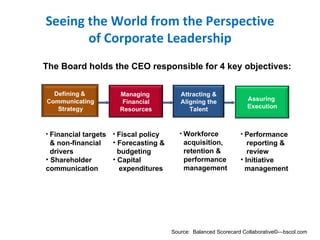
Seeing the World from the Perspective of Corporate Leadership Financial targets & non-financial drivers Shareholder  communication Fiscal policy Forecasting & budgeting Capital  expenditures Workforce acquisition,  retention & performance management Performance reporting & review Initiative management Source:  Balanced Scorecard Collaborative©—bscol.com The Board holds the CEO responsible for 4 key objectives: Managing  Financial Resources Attracting & Aligning the Talent Assuring  Execution
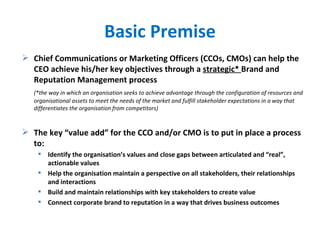
Basic Premise Chief Communications or Marketing Officers (CCOs, CMOs) can help the CEO achieve his/her key objectives through a  strategic*  Brand and Reputation Management process   (*the way in which an organisation seeks to achieve advantage through the configuration of resources and organisational assets to meet the needs of the market and fulfill stakeholder expectations in a way that differentiates the organisation from competitors) The key “value add” for the CCO and/or CMO is to put in place a process to: Identify the organisation’s values and close gaps between articulated and “real”, actionable values Help the organisation maintain a perspective on all stakeholders, their relationships and interactions Build and maintain relationships with key stakeholders to create value Connect corporate brand to reputation in a way that drives business outcomes
Six Leadership Challenges/Issues Boards and CEOs feel unprepared for managing reputation risk: Issues: The insurance company, AON, surveyed 360 global CEOs on risk concerns in 2007 The #1 concern  of 31 categories of risk presented was Reputation Risk 48% of CEOs felt their company was ill prepared for reputation risk Boards recognize the criticality of risk management and are engaged in the review of risk issues Companies often look to Corporate Advertising, Corporate Social Responsibility, Crisis Management and Philanthropy as reputation management: Issues :  These are tactics, not strategy; corporate leadership is expected to be strategic CEOs need reputation and associated risk to be managed strategically, as one would manage other risks (e.g., market, capital, legal, etc.)
Six Leadership Challenges/Issues 3 . Reputation has not been clearly defined: Issues :  We cannot manage or measure reputation if we do not know what it is Without clarity, reputation becomes a “catch-all” phase or a substitute term for public relations or corporate advertising Now becoming used as a euphemism for search engine optimisation 4.  Communications professionals often eschew the term brand, associating it with marketing and products: Issues :  Brand is better understood than is reputation by management because it is taught in business schools and used by strategy firms as an “umbrella” term Organisational brand is interrelated with reputation—a good reputation requires that the organization have a well-considered and actionable corporate brand
Six Leadership Challenges/Issues 5. Brand and Reputation Management are typically focused on communications to external stakeholders: Issues :  Actions more than communications build reputation Employees are the most important stakeholder group for any organisation There is often a failure to understand that relationships build value --customer service and stakeholder relations are often the points in non-consumer products companies at which brand is defined at reputation is built 6.  Brand and Reputation Management are too important to be left to any one function: Issues: Brand and reputation management must be holistic, or enterprise-wide--we need to integrate across the organization and down through strategic business units and regions Boards need to be focused on reputation since it drives or diminishes value and not simply delegate this to management
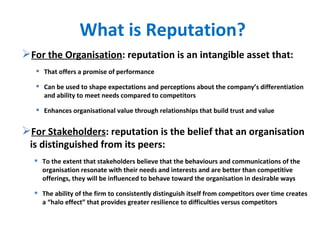
What is Reputation? For the Organisation : reputation is an intangible asset that: That offers a promise of performance  Can be used to shape expectations and perceptions about the company’s differentiation and ability to meet needs compared to competitors Enhances organisational value through relationships that build trust and value For Stakeholders : reputation is the belief that an organisation is distinguished from its peers: To the extent that stakeholders believe that the behaviours and communications of the organisation resonate with their needs and interests and are better than competitive offerings, they will be influenced to behave toward the organisation in desirable ways The ability of the firm to consistently distinguish itself from competitors over time creates a “halo effect” that provides greater resilience to difficulties versus competitors
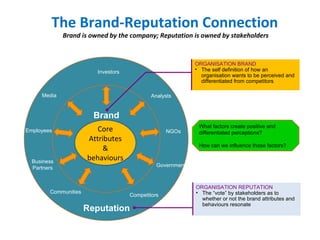
The Brand-Reputation Connection   Brand is owned by the company; Reputation is owned by stakeholders Employees Competitors Business Partners Media Government NGOs Investors  Reputation Brand ORGANISATION BRAND   The self definition of how an organisation wants to be perceived and differentiated from competitors  What  factors create positive and  differentiated perceptions? How can we influence those factors? ORGANISATION REPUTATION  The “vote” by stakeholders as to whether or not the brand attributes and behaviours resonate Analysts Communities Core Attributes & behaviours
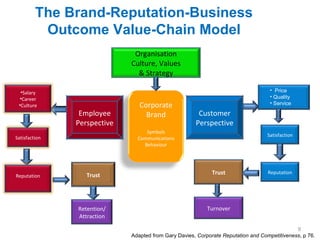
The Brand-Reputation-Business Outcome Value-Chain Model Employee Perspective Customer Perspective Price Quality Service Adapted from Gary Davies,  Corporate Reputation and Competitiveness , p 76.  Satisfaction Retention/ Attraction Trust Satisfaction Reputation Turnover Trust Corporate Brand Symbols Communications Behaviour Salary Career Culture Organisation Culture, Values & Strategy Reputation
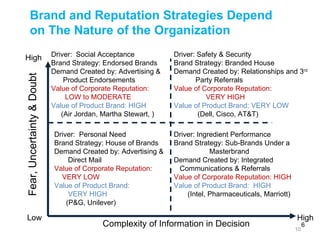
Fear, Uncertainty & Doubt Complexity of Information in Decision Low  High  High Brand and Reputation Strategies Depend on The Nature of the Organization 6 Driver:  Personal Need  Brand Strategy: House of Brands Demand Created by: Advertising & Direct Mail Value of Corporate Reputation:  VERY LOW Value of Product Brand: VERY HIGH (P&G, Unilever) Driver:  Social Acceptance  Brand Strategy: Endorsed Brands  Demand Created by: Advertising & Product Endorsements Value of Corporate Reputation:  LOW to MODERATE Value of Product Brand: HIGH (Air Jordan, Martha Stewart, ) Driver: Safety & Security Brand Strategy: Branded House Demand Created by: Relationships and 3 rd   Party Referrals Value of Corporate Reputation:  VERY HIGH Value of Product Brand: VERY LOW (Dell, Cisco, AT&T) Driver: Ingredient Performance Brand Strategy: Sub-Brands Under a  Masterbrand Demand Created by: Integrated Communications & Referrals Value of Corporate Reputation: HIGH Value of Product Brand:  HIGH (Intel, Pharmaceuticals, Marriott)
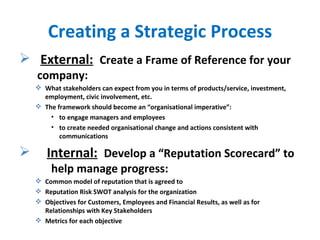
Creating a Strategic Process External:   Create a Frame of Reference for your company: What stakeholders can expect from you in terms of products/service, investment, employment, civic involvement, etc. The framework should become an “organisational imperative”: to engage managers and employees to create needed organisational change and actions consistent with communications Internal:   Develop a “Reputation Scorecard” to  help manage progress: Common model of reputation that is agreed to  Reputation Risk SWOT analysis for the organization Objectives for Customers, Employees and Financial Results, as well as for Relationships with Key Stakeholders Metrics for each objective
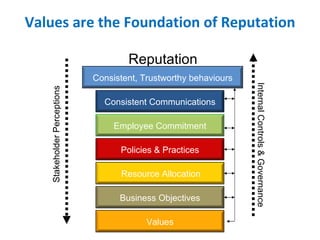
Values are the Foundation of Reputation Reputation Internal Controls & Governance Stakeholder Perceptions Resource Allocation Consistent, Trustworthy behaviours Consistent Communications Employee Commitment Policies & Practices Business Objectives Values
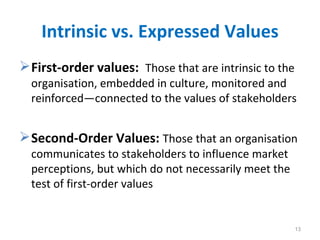
First-order values:  Those that are intrinsic to the organisation, embedded in culture, monitored and reinforced—connected to the values of stakeholders Second-Order Values:  Those that an organisation communicates to stakeholders to influence market perceptions, but which do not necessarily meet the test of first-order values Intrinsic vs. Expressed Values
Financial Returns are a Proxy of Employee and Customer Satisfaction Employee satisfaction and commitment are related to how employees’ perceive their organisation is seen externally (Carmeli & Freund,  Corporate Reputation Review , 2002) There is a strong relationship between employee & customer satisfaction, and the interaction between these drives financial value (Girouard, Waukesha, Stowers, Barr & Franklin, Chicago School of Professional Psychology, 2007) Companies perceived as good places to work earn returns double that of others  (Alex Edmunds, Knowledge@Wharton, 2007)   HOWEVER Schultz & Hatch,  The Expressive Organisation  (2007) found that 90% of employees did not understand the company’s brand;  70% were not committed it
The EBP is  an internal brand for employees,  both  current and   future prospects Builds  understanding and actions  of employees with the external brand Addresses two questions:   1.  Why would a talented person want  to work here versus someplace else? 2.  What can employees do to help enhance  stakeholder value? Employee Brand Proposition (EBP)
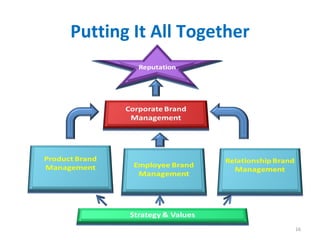
Putting It All Together
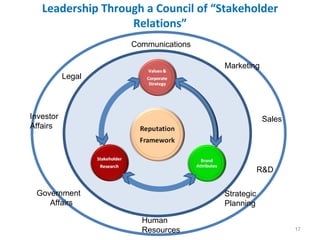
Leadership Through a Council of “Stakeholder Relations” Communications Marketing Sales R&D Legal Investor  Affairs Government Affairs Human  Resources Strategic  Planning
Leadership in Reputation Management Focus-  Define your brand attributes, get everyone to understand and agree to them, and make certain that everyone is committed to them Establish a Common Strategy Framework  that integrates brand and reputation—they are interrelated and cannot be separated Concentrate on Behaviours More than on Communications Create an Internal Coalition-- use   a “Stakeholder Relations” Council
Leadership in Reputation Management Be Authentic–  make certain that your communicated values are your real values. “Walk the Talk”, do not “Talk the Walk” Inspire–  emotions, not intellectual arguments, drive behaviours Strive to be Consistent in Everything You Do —inside and outside of the organization Seek to be Disproportionately Valued from Competitors
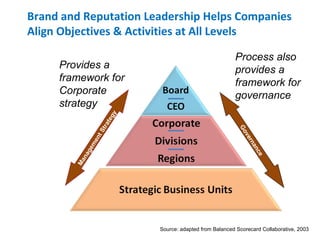
Brand and Reputation Leadership Helps Companies Align Objectives & Activities at All Levels Corporate Group Division Provides a framework for Corporate  strategy Process also provides a  framework for governance Governance Management Strategy Source: adapted from Balanced Scorecard Collaborative, 2003 Board CEO

Henley Presentation

  • 1.
    Brand & Reputation:A Leadership Perspective Reputation Conference 2008 Henley Business School John Madejski Centre for Reputation November 25, 2008 Elliot S. Schreiber, Ph.D. Clinical Professor Bennett S. LeBow College of Business Drexel University Philadelphia, Pennsylvania, USA [email_address]
  • 2.
    Seeing the Worldfrom the Perspective of Corporate Leadership Financial targets & non-financial drivers Shareholder communication Fiscal policy Forecasting & budgeting Capital expenditures Workforce acquisition, retention & performance management Performance reporting & review Initiative management Source: Balanced Scorecard Collaborative©—bscol.com The Board holds the CEO responsible for 4 key objectives: Managing Financial Resources Attracting & Aligning the Talent Assuring Execution
  • 3.
    Basic Premise ChiefCommunications or Marketing Officers (CCOs, CMOs) can help the CEO achieve his/her key objectives through a strategic* Brand and Reputation Management process (*the way in which an organisation seeks to achieve advantage through the configuration of resources and organisational assets to meet the needs of the market and fulfill stakeholder expectations in a way that differentiates the organisation from competitors) The key “value add” for the CCO and/or CMO is to put in place a process to: Identify the organisation’s values and close gaps between articulated and “real”, actionable values Help the organisation maintain a perspective on all stakeholders, their relationships and interactions Build and maintain relationships with key stakeholders to create value Connect corporate brand to reputation in a way that drives business outcomes
  • 4.
    Six Leadership Challenges/IssuesBoards and CEOs feel unprepared for managing reputation risk: Issues: The insurance company, AON, surveyed 360 global CEOs on risk concerns in 2007 The #1 concern of 31 categories of risk presented was Reputation Risk 48% of CEOs felt their company was ill prepared for reputation risk Boards recognize the criticality of risk management and are engaged in the review of risk issues Companies often look to Corporate Advertising, Corporate Social Responsibility, Crisis Management and Philanthropy as reputation management: Issues : These are tactics, not strategy; corporate leadership is expected to be strategic CEOs need reputation and associated risk to be managed strategically, as one would manage other risks (e.g., market, capital, legal, etc.)
  • 5.
    Six Leadership Challenges/Issues3 . Reputation has not been clearly defined: Issues : We cannot manage or measure reputation if we do not know what it is Without clarity, reputation becomes a “catch-all” phase or a substitute term for public relations or corporate advertising Now becoming used as a euphemism for search engine optimisation 4. Communications professionals often eschew the term brand, associating it with marketing and products: Issues : Brand is better understood than is reputation by management because it is taught in business schools and used by strategy firms as an “umbrella” term Organisational brand is interrelated with reputation—a good reputation requires that the organization have a well-considered and actionable corporate brand
  • 6.
    Six Leadership Challenges/Issues5. Brand and Reputation Management are typically focused on communications to external stakeholders: Issues : Actions more than communications build reputation Employees are the most important stakeholder group for any organisation There is often a failure to understand that relationships build value --customer service and stakeholder relations are often the points in non-consumer products companies at which brand is defined at reputation is built 6. Brand and Reputation Management are too important to be left to any one function: Issues: Brand and reputation management must be holistic, or enterprise-wide--we need to integrate across the organization and down through strategic business units and regions Boards need to be focused on reputation since it drives or diminishes value and not simply delegate this to management
  • 7.
    What is Reputation?For the Organisation : reputation is an intangible asset that: That offers a promise of performance Can be used to shape expectations and perceptions about the company’s differentiation and ability to meet needs compared to competitors Enhances organisational value through relationships that build trust and value For Stakeholders : reputation is the belief that an organisation is distinguished from its peers: To the extent that stakeholders believe that the behaviours and communications of the organisation resonate with their needs and interests and are better than competitive offerings, they will be influenced to behave toward the organisation in desirable ways The ability of the firm to consistently distinguish itself from competitors over time creates a “halo effect” that provides greater resilience to difficulties versus competitors
  • 8.
    The Brand-Reputation Connection Brand is owned by the company; Reputation is owned by stakeholders Employees Competitors Business Partners Media Government NGOs Investors Reputation Brand ORGANISATION BRAND The self definition of how an organisation wants to be perceived and differentiated from competitors What factors create positive and differentiated perceptions? How can we influence those factors? ORGANISATION REPUTATION The “vote” by stakeholders as to whether or not the brand attributes and behaviours resonate Analysts Communities Core Attributes & behaviours
  • 9.
    The Brand-Reputation-Business OutcomeValue-Chain Model Employee Perspective Customer Perspective Price Quality Service Adapted from Gary Davies, Corporate Reputation and Competitiveness , p 76. Satisfaction Retention/ Attraction Trust Satisfaction Reputation Turnover Trust Corporate Brand Symbols Communications Behaviour Salary Career Culture Organisation Culture, Values & Strategy Reputation
  • 10.
    Fear, Uncertainty &Doubt Complexity of Information in Decision Low High High Brand and Reputation Strategies Depend on The Nature of the Organization 6 Driver: Personal Need Brand Strategy: House of Brands Demand Created by: Advertising & Direct Mail Value of Corporate Reputation: VERY LOW Value of Product Brand: VERY HIGH (P&G, Unilever) Driver: Social Acceptance Brand Strategy: Endorsed Brands Demand Created by: Advertising & Product Endorsements Value of Corporate Reputation: LOW to MODERATE Value of Product Brand: HIGH (Air Jordan, Martha Stewart, ) Driver: Safety & Security Brand Strategy: Branded House Demand Created by: Relationships and 3 rd Party Referrals Value of Corporate Reputation: VERY HIGH Value of Product Brand: VERY LOW (Dell, Cisco, AT&T) Driver: Ingredient Performance Brand Strategy: Sub-Brands Under a Masterbrand Demand Created by: Integrated Communications & Referrals Value of Corporate Reputation: HIGH Value of Product Brand: HIGH (Intel, Pharmaceuticals, Marriott)
  • 11.
    Creating a StrategicProcess External: Create a Frame of Reference for your company: What stakeholders can expect from you in terms of products/service, investment, employment, civic involvement, etc. The framework should become an “organisational imperative”: to engage managers and employees to create needed organisational change and actions consistent with communications Internal: Develop a “Reputation Scorecard” to help manage progress: Common model of reputation that is agreed to Reputation Risk SWOT analysis for the organization Objectives for Customers, Employees and Financial Results, as well as for Relationships with Key Stakeholders Metrics for each objective
  • 12.
    Values are theFoundation of Reputation Reputation Internal Controls & Governance Stakeholder Perceptions Resource Allocation Consistent, Trustworthy behaviours Consistent Communications Employee Commitment Policies & Practices Business Objectives Values
  • 13.
    First-order values: Those that are intrinsic to the organisation, embedded in culture, monitored and reinforced—connected to the values of stakeholders Second-Order Values: Those that an organisation communicates to stakeholders to influence market perceptions, but which do not necessarily meet the test of first-order values Intrinsic vs. Expressed Values
  • 14.
    Financial Returns area Proxy of Employee and Customer Satisfaction Employee satisfaction and commitment are related to how employees’ perceive their organisation is seen externally (Carmeli & Freund, Corporate Reputation Review , 2002) There is a strong relationship between employee & customer satisfaction, and the interaction between these drives financial value (Girouard, Waukesha, Stowers, Barr & Franklin, Chicago School of Professional Psychology, 2007) Companies perceived as good places to work earn returns double that of others (Alex Edmunds, Knowledge@Wharton, 2007) HOWEVER Schultz & Hatch, The Expressive Organisation (2007) found that 90% of employees did not understand the company’s brand; 70% were not committed it
  • 15.
    The EBP is an internal brand for employees, both current and future prospects Builds understanding and actions of employees with the external brand Addresses two questions: 1. Why would a talented person want to work here versus someplace else? 2. What can employees do to help enhance stakeholder value? Employee Brand Proposition (EBP)
  • 16.
  • 17.
    Leadership Through aCouncil of “Stakeholder Relations” Communications Marketing Sales R&D Legal Investor Affairs Government Affairs Human Resources Strategic Planning
  • 18.
    Leadership in ReputationManagement Focus- Define your brand attributes, get everyone to understand and agree to them, and make certain that everyone is committed to them Establish a Common Strategy Framework that integrates brand and reputation—they are interrelated and cannot be separated Concentrate on Behaviours More than on Communications Create an Internal Coalition-- use a “Stakeholder Relations” Council
  • 19.
    Leadership in ReputationManagement Be Authentic– make certain that your communicated values are your real values. “Walk the Talk”, do not “Talk the Walk” Inspire– emotions, not intellectual arguments, drive behaviours Strive to be Consistent in Everything You Do —inside and outside of the organization Seek to be Disproportionately Valued from Competitors
  • 20.
    Brand and ReputationLeadership Helps Companies Align Objectives & Activities at All Levels Corporate Group Division Provides a framework for Corporate strategy Process also provides a framework for governance Governance Management Strategy Source: adapted from Balanced Scorecard Collaborative, 2003 Board CEO