Excellence in Communications
´It´s all about brand and reputation´
Rostov-on-Don, 4 June 2013
CORPORATE COMMUNICATION & BRAND STRATEGY
Koenraad van Hasselt
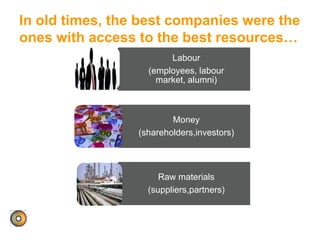
In old times, the best companies were the
ones with access to the best resources…
Labour
(employees, labour
market, alumni)
Money
(shareholders,investors)
Raw materials
(suppliers,partners)
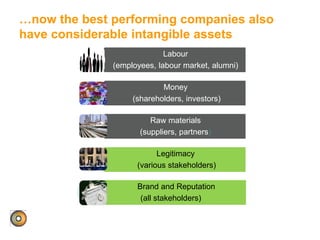
…now the best performing companies also
have considerable intangible assets
Labour
(employees, labour market, alumni)
Money
(shareholders, investors)
Raw materials
(suppliers, partners)
Legitimacy
(various stakeholders)
Brand and Reputation
(all stakeholders)
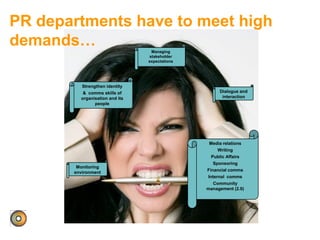
PR departments have to meet high
demands…
Monitoring
environment
Managing
stakeholder
expectations
Media relations
Writing
Public Affairs
Sponsoring
Financial comms
Internal comms
Community
management (2.0)
Dialogue and
interaction
Strengthen identity
& comms skills of
organisation and its
people
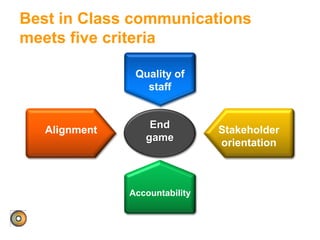
Best in Class communications
meets five criteria
Quality of
staff
Alignment End
game
Accountability
Stakeholder
orientation
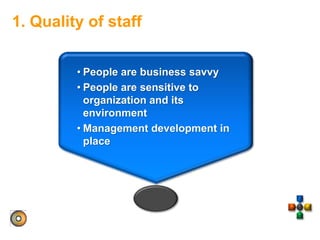
1. Quality of staff
• People are business savvy
• People are sensitive to
organization and its
environment
• Management development in
place
PR people need to possess many
skills and competences
• Strategic (visionary, analytical, lateral thinker) as well
operational (planning, organising)
• Sensitive to the outside world as well as the inside world
• Pro-active as well as the trusted advisor
• A good communicator (listening, speaking, writing,
presenting, social media ) as well as a business partner
and conflict solver
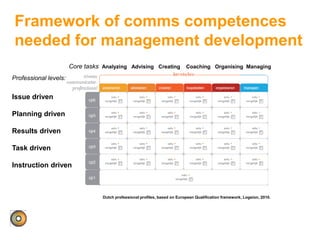
Framework of comms competences
needed for management development
Dutch professional profiles, based on European Qualification framework, Logeion, 2010.
Core tasks Analyzing Advising Creating Coaching Organising Managing
Professional levels:
Issue driven
Planning driven
Results driven
Task driven
Instruction driven
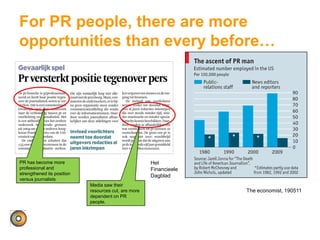
For PR people, there are more
opportunities than every before…
The economist, 190511
Het
Financieele
Dagblad
PR has become more
professional and
strengthened its position
versus journalists
Media saw their
resources cut, are more
dependent on PR
people.
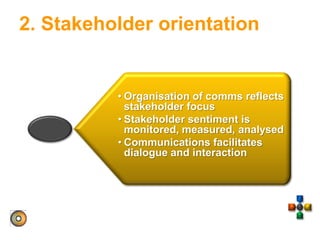
2. Stakeholder orientation
• Organisation of comms reflects
stakeholder focus
• Stakeholder sentiment is
monitored, measured, analysed
• Communications facilitates
dialogue and interaction
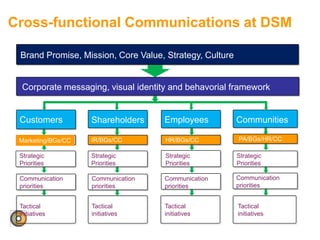
Brand Promise, Mission, Core Value, Strategy, Culture
Cross-functional Communications at DSM
Corporate messaging, visual identity and behavorial framework
EmployeesShareholders Communities
Marketing/BGs/CC IR/BGs/CC PA/BGs/HR/CCHR/BGs/CC
Strategic
Priorities
Strategic
Priorities
Strategic
Priorities
Strategic
Priorities
Customers
Communication
priorities
Communication
priorities
Communication
priorities
Communication
priorities
Tactical
initiatives
Tactical
initiatives
Tactical
initiatives
Tactical
initiatives
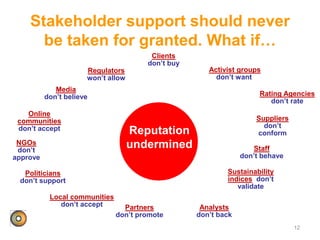
Clients
don’t buy
Activist groups
don’t want
Rating Agencies
don’t rate
Suppliers
don’t
conform
Staff
don’t behave
Sustainability
indices don’t
validate
Analysts
don’t back
Partners
don’t promote
Local communities
don’t accept
Politicians
don’t support
NGOs
don’t
approve
Online
communities
don’t accept
Media
don’t believe
Regulators
won’t allow
Corporate
Reputation
12
Stakeholder support should never
be taken for granted. What if…
Reputation
undermined
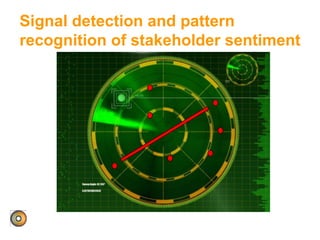
Signal detection and pattern
recognition of stakeholder sentiment
3. Accountability
• Measuring input, output and
outcome
• Independent analysis of data
• Individual performance
management and target setting
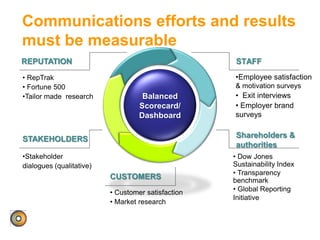
Balanced
Scorecard/
Dashboard
Communications efforts and results
must be measurable
REPUTATION
• RepTrak
• Fortune 500
•Tailor made research
STAFF
•Employee satisfaction
& motivation surveys
• Exit interviews
• Employer brand
surveys
STAKEHOLDERS
•Stakeholder
dialogues (qualitative)
Shareholders &
authorities
• Dow Jones
Sustainability Index
• Transparency
benchmark
• Global Reporting
Initiative
CUSTOMERS
• Customer satisfaction
• Market research
4. Alignment
• Communications strategy derived
from corporate & business
strategies
• Cooperation with other comms
´owners´ (CEO, CFO, HR, Legal,
Finance, Marketing, Country
Managers etc.)
• Orchestration based on overall
functional comms ´ownership´
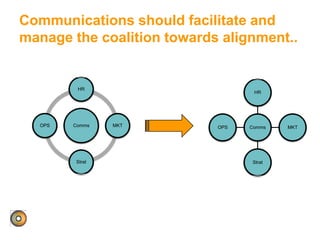
Communications should facilitate and
manage the coalition towards alignment..
Comms
HR
MKT
Strat
OPS Comms
HR
MKT
Strat
OPS
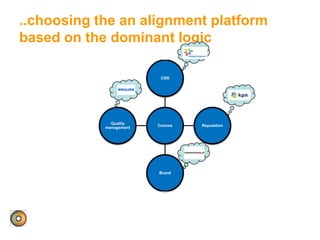
..choosing the an alignment platform
based on the dominant logic
Comms
CSR
Reputation
Brand
Quality
management
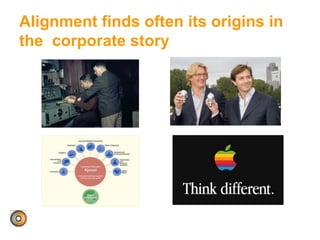
Alignment finds often its origins in
the corporate story
What makes a good corporate story ?
• It makes the essence, the soul of the organisation, clear, in a way that is
relevant, attractive and realistic to all stakeholders.
• It makes the organization stand out from others.
• It describes the (unique) history of the organization, the core competences
and its ambitions.
• It gives the organization a personality.
• It is a real story, with a plot, a beginning, middle and an end.
• It forms the basis for all communications and dialogue.
• It is well embedded in the organization, the CEO is the owner.
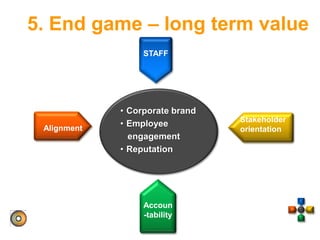
5. End game – long term value
STAFF
Alignment
Accoun
-tability
Stakeholder
orientation
• Corporate brand
• Employee
engagement
• Reputation
Brand is an anchor as well as a compass
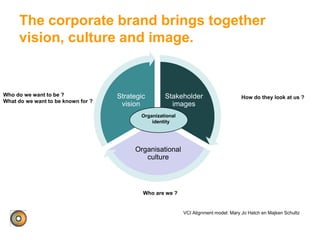
The corporate brand brings together
vision, culture and image.
VCI Alignment model: Mary Jo Hatch en Majken Schultz
Who do we want to be ?
What do we want to be known for ?
How do they look at us ?
Who are we ?
Stakeholder
images
Organisational
culture
Strategic
vision
Organizational
identity
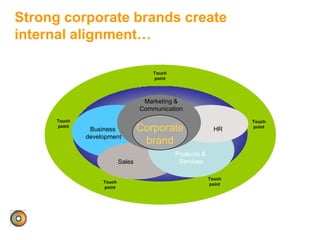
Strong corporate brands create
internal alignment…
Marketing &
Communication
HR
Products &
ServicesSales
Business
development
Corporate
brand
Touch
point
Touch
point
Touch
point
Touch
point
Touch
point
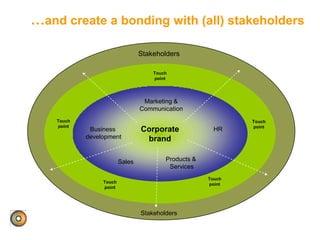
…and create a bonding with (all) stakeholders
Marketing &
Communication
HR
Products &
Services
Sales
Corporate
brand
Touch
point
Touch
point
Touch
point
Touch
point
Touch
point
Business
development
Stakeholders
Stakeholders
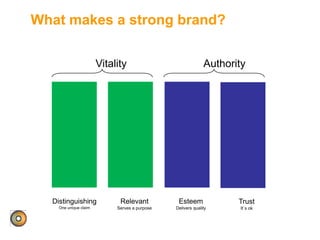
What makes a strong brand?
Authority
Esteem
Delivers quality
Trust
It´s ok
Vitality
Distinguishing
One unique claim
Relevant
Serves a purpose
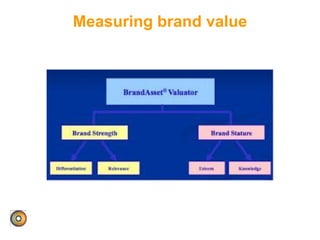
Measuring brand value
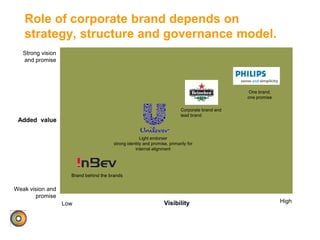
Role of corporate brand depends on
strategy, structure and governance model.
One brand,
one promise
Light endorser
strong identity and promise, primarily for
internal alignment
Brand behind the brands
Added value
Visibility High
Strong vision
and promise
Weak vision and
promise
Low
Corporate brand and
lead brand
A corporate brand represents a
promise
?
?
?
?
?
?
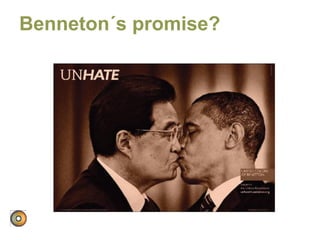
Benneton´s promise?
Delivering on the brand promise will
influence reputation positively
Corporate reputation is the observers’ collective
judgment of a corporation based on the assessments
of the financial, social and environmental impacts
attributed to the corporation over time
Barnett et al.
Reputation: about stakeholder support
and licence to operate
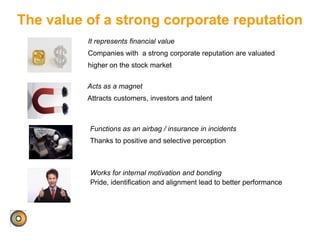
The value of a strong corporate reputation
Works for internal motivation and bonding
Pride, identification and alignment lead to better performance
Functions as an airbag / insurance in incidents
Thanks to positive and selective perception
Acts as a magnet
Attracts customers, investors and talent
It represents financial value
Companies with a strong corporate reputation are valuated
higher on the stock market
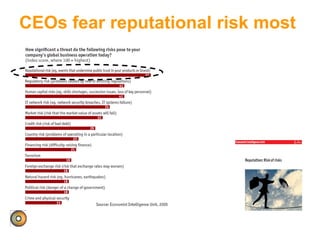
CEOs fear reputational risk most
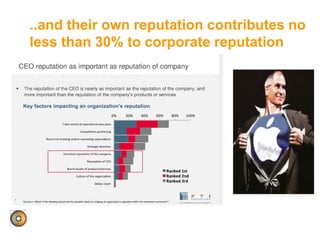
..and their own reputation contributes no
less than 30% to corporate reputation
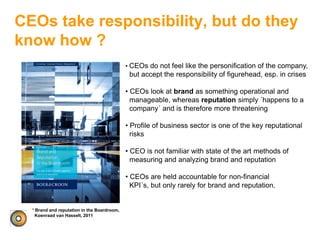
CEOs take responsibility, but do they
know how ?
* Brand and reputation in the Boardroom,
Koenraad van Hasselt, 2011
• CEOs do not feel like the personification of the company,
but accept the responsibility of figurehead, esp. in crises
• CEOs look at brand as something operational and
manageable, whereas reputation simply ´happens to a
company´ and is therefore more threatening
• Profile of business sector is one of the key reputational
risks
• CEO is not familiar with state of the art methods of
measuring and analyzing brand and reputation
• CEOs are held accountable for non-financial
KPI´s, but only rarely for brand and reputation.
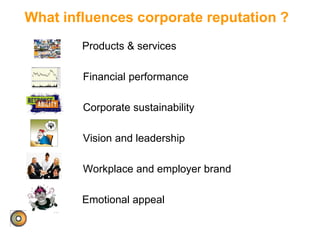
What influences corporate reputation ?
Products & services
Financial performance
Corporate sustainability
Vision and leadership
Workplace and employer brand
Emotional appeal
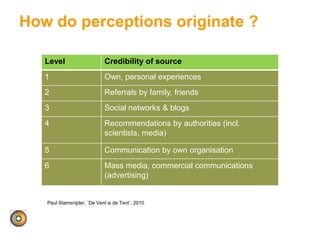
How do perceptions originate ?
Level Credibility of source
1 Own, personal experiences
2 Referrals by family, friends
3 Social networks & blogs
4 Recommendations by authorities (incl.
scientists, media)
5 Communication by own organisation
6 Mass media, commercial communications
(advertising)
Paul Stamsnijder, ´De Vent is de Tent´, 2010
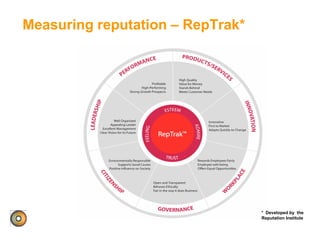
Measuring reputation – RepTrak*
* Developed by the
Reputation Institute
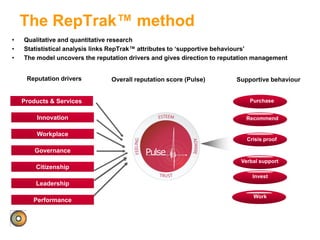
The RepTrak™ method
• Qualitative and quantitative research
• Statististical analysis links RepTrak™ attributes to ‘supportive behaviours’
• The model uncovers the reputation drivers and gives direction to reputation management
Purchase
Recommend
Crisis proof
Verbal support
Leadership
Workplace
Performance
Citizenship
Innovation
Products & Services
Governance
Reputation drivers Supportive behaviourOverall reputation score (Pulse)
I
Invest
Work
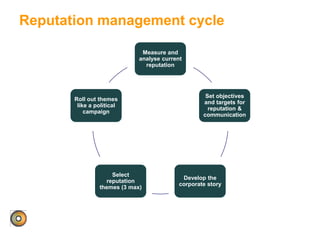
Reputation management cycle
Measure and
analyse current
reputation
Set objectives
and targets for
reputation &
communication
Develop the
corporate story
Select
reputation
themes (3 max)
Roll out themes
like a political
campaign
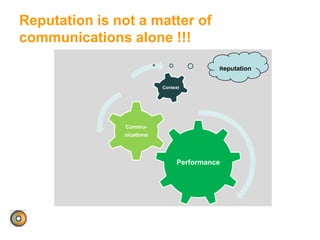
Reputation is not a matter of
communications alone !!!
Performance
Commu-
nications
Context
Reputation
Three determinants that may put
reputation at risk*
• Reputation is stronger than reality (over promising)
• Extent to which external opinions and expectations
change
• Quality of coordination within an organization
* Eccles et al., 2007
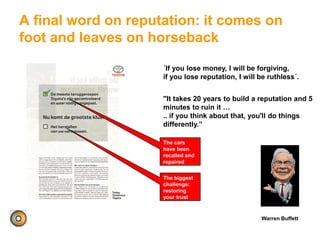
A final word on reputation: it comes on
foot and leaves on horseback
Warren Buffett
"It takes 20 years to build a reputation and 5
minutes to ruin it …
.. if you think about that, you'll do things
differently.”
´If you lose money, I will be forgiving,
if you lose reputation, I will be ruthless´.
The cars
have been
recalled and
repaired
The biggest
challenge:
restoring
your trust
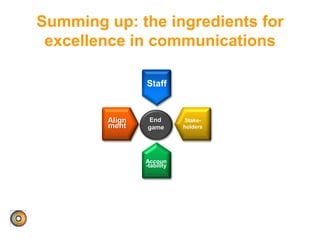
Summing up: the ingredients for
excellence in communications
Staff
Align
ment
End
game
Accoun
-tability
Stake-
holders
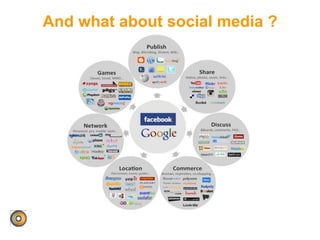
And what about social media ?
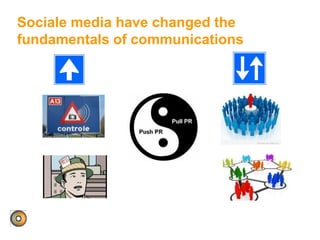
Sociale media have changed the
fundamentals of communications
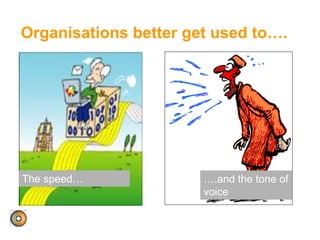
Organisations better get used to….
The speed… ….and the tone of
voice
Social media are an extension of the
traditional media
• Tell your story via social media (blogs, podcasts, Flickr, Slideshare, LinkedIn,
Myspace, Facebook, Twitter, Wikis, Yelp)
• Build a relationship with specific communities
• Collect mails, Facebook links, Twitter IDs like you collect and manage telephone
numbers
• Monitor what is said about your company and its competitors (e.g. via Google Alerts,
Google Blog search, Twitter search etc.)
• Analyse your social media exposure and compare this with the offline media
• Develop social media rules for your employees
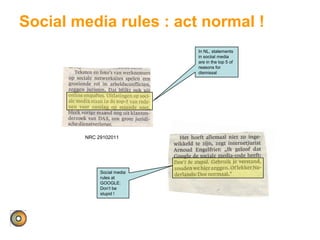
Social media rules : act normal !
NRC 29102011
In NL, statements
in sociial media
are in the top 5 of
reasons for
dismissal
Social media
rules at
GOOGLE:
Don’t be
stupid !
www.reputationmatters.nl
Thank you for your attention !

Бренд и репутация. Строим безупречную коммуникацию

  • 1.
    Excellence in Communications ´It´sall about brand and reputation´ Rostov-on-Don, 4 June 2013 CORPORATE COMMUNICATION & BRAND STRATEGY Koenraad van Hasselt
  • 2.
    In old times,the best companies were the ones with access to the best resources… Labour (employees, labour market, alumni) Money (shareholders,investors) Raw materials (suppliers,partners)
  • 3.
    …now the bestperforming companies also have considerable intangible assets Labour (employees, labour market, alumni) Money (shareholders, investors) Raw materials (suppliers, partners) Legitimacy (various stakeholders) Brand and Reputation (all stakeholders)
  • 4.
    PR departments haveto meet high demands… Monitoring environment Managing stakeholder expectations Media relations Writing Public Affairs Sponsoring Financial comms Internal comms Community management (2.0) Dialogue and interaction Strengthen identity & comms skills of organisation and its people
  • 5.
    Best in Classcommunications meets five criteria Quality of staff Alignment End game Accountability Stakeholder orientation
  • 6.
    1. Quality ofstaff • People are business savvy • People are sensitive to organization and its environment • Management development in place
  • 7.
    PR people needto possess many skills and competences • Strategic (visionary, analytical, lateral thinker) as well operational (planning, organising) • Sensitive to the outside world as well as the inside world • Pro-active as well as the trusted advisor • A good communicator (listening, speaking, writing, presenting, social media ) as well as a business partner and conflict solver
  • 8.
    Framework of commscompetences needed for management development Dutch professional profiles, based on European Qualification framework, Logeion, 2010. Core tasks Analyzing Advising Creating Coaching Organising Managing Professional levels: Issue driven Planning driven Results driven Task driven Instruction driven
  • 9.
    For PR people,there are more opportunities than every before… The economist, 190511 Het Financieele Dagblad PR has become more professional and strengthened its position versus journalists Media saw their resources cut, are more dependent on PR people.
  • 10.
    2. Stakeholder orientation •Organisation of comms reflects stakeholder focus • Stakeholder sentiment is monitored, measured, analysed • Communications facilitates dialogue and interaction
  • 11.
    Brand Promise, Mission,Core Value, Strategy, Culture Cross-functional Communications at DSM Corporate messaging, visual identity and behavorial framework EmployeesShareholders Communities Marketing/BGs/CC IR/BGs/CC PA/BGs/HR/CCHR/BGs/CC Strategic Priorities Strategic Priorities Strategic Priorities Strategic Priorities Customers Communication priorities Communication priorities Communication priorities Communication priorities Tactical initiatives Tactical initiatives Tactical initiatives Tactical initiatives
  • 12.
    Clients don’t buy Activist groups don’twant Rating Agencies don’t rate Suppliers don’t conform Staff don’t behave Sustainability indices don’t validate Analysts don’t back Partners don’t promote Local communities don’t accept Politicians don’t support NGOs don’t approve Online communities don’t accept Media don’t believe Regulators won’t allow Corporate Reputation 12 Stakeholder support should never be taken for granted. What if… Reputation undermined
  • 13.
    Signal detection andpattern recognition of stakeholder sentiment
  • 14.
    3. Accountability • Measuringinput, output and outcome • Independent analysis of data • Individual performance management and target setting
  • 15.
    Balanced Scorecard/ Dashboard Communications efforts andresults must be measurable REPUTATION • RepTrak • Fortune 500 •Tailor made research STAFF •Employee satisfaction & motivation surveys • Exit interviews • Employer brand surveys STAKEHOLDERS •Stakeholder dialogues (qualitative) Shareholders & authorities • Dow Jones Sustainability Index • Transparency benchmark • Global Reporting Initiative CUSTOMERS • Customer satisfaction • Market research
  • 16.
    4. Alignment • Communicationsstrategy derived from corporate & business strategies • Cooperation with other comms ´owners´ (CEO, CFO, HR, Legal, Finance, Marketing, Country Managers etc.) • Orchestration based on overall functional comms ´ownership´
  • 17.
    Communications should facilitateand manage the coalition towards alignment.. Comms HR MKT Strat OPS Comms HR MKT Strat OPS
  • 18.
    ..choosing the analignment platform based on the dominant logic Comms CSR Reputation Brand Quality management
  • 19.
    Alignment finds oftenits origins in the corporate story
  • 20.
    What makes agood corporate story ? • It makes the essence, the soul of the organisation, clear, in a way that is relevant, attractive and realistic to all stakeholders. • It makes the organization stand out from others. • It describes the (unique) history of the organization, the core competences and its ambitions. • It gives the organization a personality. • It is a real story, with a plot, a beginning, middle and an end. • It forms the basis for all communications and dialogue. • It is well embedded in the organization, the CEO is the owner.
  • 21.
    5. End game– long term value STAFF Alignment Accoun -tability Stakeholder orientation • Corporate brand • Employee engagement • Reputation
  • 22.
    Brand is ananchor as well as a compass
  • 23.
    The corporate brandbrings together vision, culture and image. VCI Alignment model: Mary Jo Hatch en Majken Schultz Who do we want to be ? What do we want to be known for ? How do they look at us ? Who are we ? Stakeholder images Organisational culture Strategic vision Organizational identity
  • 24.
    Strong corporate brandscreate internal alignment… Marketing & Communication HR Products & ServicesSales Business development Corporate brand Touch point Touch point Touch point Touch point Touch point
  • 25.
    …and create abonding with (all) stakeholders Marketing & Communication HR Products & Services Sales Corporate brand Touch point Touch point Touch point Touch point Touch point Business development Stakeholders Stakeholders
  • 26.
    What makes astrong brand? Authority Esteem Delivers quality Trust It´s ok Vitality Distinguishing One unique claim Relevant Serves a purpose
  • 27.
  • 28.
    Role of corporatebrand depends on strategy, structure and governance model. One brand, one promise Light endorser strong identity and promise, primarily for internal alignment Brand behind the brands Added value Visibility High Strong vision and promise Weak vision and promise Low Corporate brand and lead brand
  • 29.
    A corporate brandrepresents a promise ? ? ? ? ? ?
  • 30.
  • 31.
    Delivering on thebrand promise will influence reputation positively
  • 32.
    Corporate reputation isthe observers’ collective judgment of a corporation based on the assessments of the financial, social and environmental impacts attributed to the corporation over time Barnett et al. Reputation: about stakeholder support and licence to operate
  • 33.
    The value ofa strong corporate reputation Works for internal motivation and bonding Pride, identification and alignment lead to better performance Functions as an airbag / insurance in incidents Thanks to positive and selective perception Acts as a magnet Attracts customers, investors and talent It represents financial value Companies with a strong corporate reputation are valuated higher on the stock market
  • 34.
  • 35.
    ..and their ownreputation contributes no less than 30% to corporate reputation
  • 36.
    CEOs take responsibility,but do they know how ? * Brand and reputation in the Boardroom, Koenraad van Hasselt, 2011 • CEOs do not feel like the personification of the company, but accept the responsibility of figurehead, esp. in crises • CEOs look at brand as something operational and manageable, whereas reputation simply ´happens to a company´ and is therefore more threatening • Profile of business sector is one of the key reputational risks • CEO is not familiar with state of the art methods of measuring and analyzing brand and reputation • CEOs are held accountable for non-financial KPI´s, but only rarely for brand and reputation.
  • 37.
    What influences corporatereputation ? Products & services Financial performance Corporate sustainability Vision and leadership Workplace and employer brand Emotional appeal
  • 38.
    How do perceptionsoriginate ? Level Credibility of source 1 Own, personal experiences 2 Referrals by family, friends 3 Social networks & blogs 4 Recommendations by authorities (incl. scientists, media) 5 Communication by own organisation 6 Mass media, commercial communications (advertising) Paul Stamsnijder, ´De Vent is de Tent´, 2010
  • 39.
    Measuring reputation –RepTrak* * Developed by the Reputation Institute
  • 40.
    The RepTrak™ method •Qualitative and quantitative research • Statististical analysis links RepTrak™ attributes to ‘supportive behaviours’ • The model uncovers the reputation drivers and gives direction to reputation management Purchase Recommend Crisis proof Verbal support Leadership Workplace Performance Citizenship Innovation Products & Services Governance Reputation drivers Supportive behaviourOverall reputation score (Pulse) I Invest Work
  • 41.
    Reputation management cycle Measureand analyse current reputation Set objectives and targets for reputation & communication Develop the corporate story Select reputation themes (3 max) Roll out themes like a political campaign
  • 42.
    Reputation is nota matter of communications alone !!! Performance Commu- nications Context Reputation
  • 43.
    Three determinants thatmay put reputation at risk* • Reputation is stronger than reality (over promising) • Extent to which external opinions and expectations change • Quality of coordination within an organization * Eccles et al., 2007
  • 44.
    A final wordon reputation: it comes on foot and leaves on horseback Warren Buffett "It takes 20 years to build a reputation and 5 minutes to ruin it … .. if you think about that, you'll do things differently.” ´If you lose money, I will be forgiving, if you lose reputation, I will be ruthless´. The cars have been recalled and repaired The biggest challenge: restoring your trust
  • 45.
    Summing up: theingredients for excellence in communications Staff Align ment End game Accoun -tability Stake- holders
  • 46.
    And what aboutsocial media ?
  • 47.
    Sociale media havechanged the fundamentals of communications
  • 48.
    Organisations better getused to…. The speed… ….and the tone of voice
  • 49.
    Social media arean extension of the traditional media • Tell your story via social media (blogs, podcasts, Flickr, Slideshare, LinkedIn, Myspace, Facebook, Twitter, Wikis, Yelp) • Build a relationship with specific communities • Collect mails, Facebook links, Twitter IDs like you collect and manage telephone numbers • Monitor what is said about your company and its competitors (e.g. via Google Alerts, Google Blog search, Twitter search etc.) • Analyse your social media exposure and compare this with the offline media • Develop social media rules for your employees
  • 50.
    Social media rules: act normal ! NRC 29102011 In NL, statements in sociial media are in the top 5 of reasons for dismissal Social media rules at GOOGLE: Don’t be stupid !
  • 51.