your products and services provides  your customer with a choice, an option ...  your brand is the REASON YOU are CHOSEN over your competition By Being RELEVANT
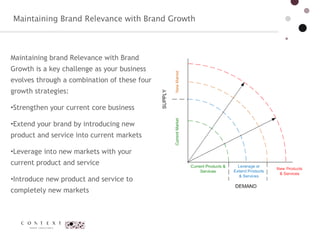
Maintaining Brand Relevance with Brand Growth  Maintaining brand Relevance with Brand Growth is a key challenge as your business evolves through a combination of these four growth strategies: Strengthen your current core business  Extend your brand by introducing new product and service into current markets  Leverage into new markets with your current product and service  Introduce new product and service to completely new markets
So Let’s Defining Relevance
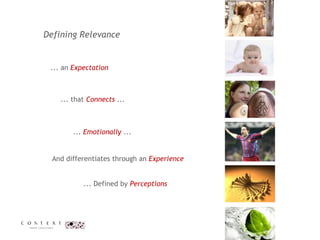
Defining Relevance  ... an  Expectation   ...  Emotionally  ... ... that  Connects   ...  And differentiates through an  Experience  ... Defined by  Perceptions
Brand Relevance and Brand Positioning    … is defined by Perceptions?  But Perceptions are  not rational constructs  …  …  they  defy   logic  and  reason  … . and are  defined  by  perceptions …  which defines our  reality
Brand Perceptions  The key to managing your brands  …  and  how people behave  around them … …  is  manage  the  perceptions  of the brand!  You need to manage …  …  the  conscious  and  subconscious  elements …. … .of your Brand  Then you can  control  the  perceptions  around your brand  …  whether this is for … Your  Executive  … Your  Staff  …    … Your  Customers  … or even Your  Competition
your products and services provides  your customer with a choice, an option ...  your brand is the  REASON YOU are CHOSEN over your competition
DECSIONS BASED ON PERCEPTIONS Context Branding Focus
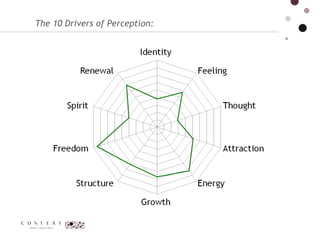
The 10 Drivers of Perception:
What are the 10 Perception Drivers ? The 10 Perception drivers are based on ten fundamental archetypes.  We call them Brand Archetypes.  They operate in the collective psyche of humankind which can be used to modify choices and  behaviours  in relation to a brand. These are: Identity  Feeling  Thought  Attraction  Energy  Growth  Structure  Freedom  Spirit  Renewal  Individuality & Uniqueness  Emotional Impact  Communication  Social Intelligence  Competitiveness  Growth & Expansiveness  Authority & Respect  Innovation & Unconventionality  Intuition & Inspiration  Power & Transformation  [who we are]  [the emotional impact of our brand]  [how and what we really communicate]   [the impact of the brand on relationships]  [how does the brand motivate action]  [the capacity to expand]  [what we are respected for]  [how our brand generates excitement] [how our brand inspires]  [power of our brand to change people’s lives]
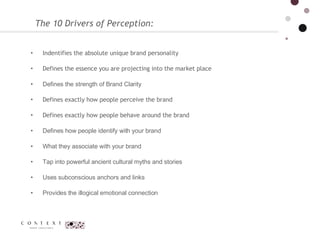
Indentifies the absolute unique brand personality Defines the essence you are projecting into the market place Defines the strength of Brand Clarity  Defines exactly how people perceive the brand Defines exactly how people behave around the brand Defines how people identify with your brand  What they associate with your brand  Tap into powerful ancient cultural myths and stories  Uses subconscious anchors and links  Provides the illogical emotional connection  The 10 Drivers of Perception:
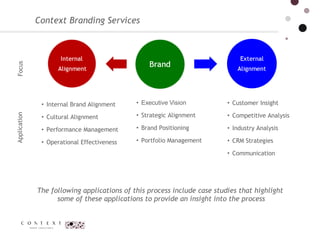
Context Branding Services Internal Brand Alignment  Cultural Alignment  Performance Management  Operational Effectiveness Customer Insight  Competitive Analysis  Industry Analysis  CRM Strategies  Communication  Executive Vision  Strategic Alignment  Brand Positioning Portfolio Management  The following applications of this process include case studies that highlight  some of these applications to provide an insight into the process Application Focus
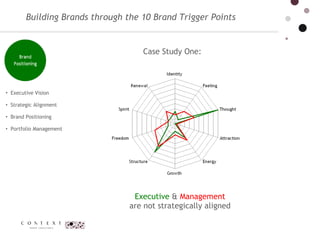
Executive Vision  Strategic Alignment  Brand Positioning Portfolio Management  Case Study One:  Executive  &  Management   are not strategically aligned  Building Brands through the 10 Brand Trigger Points
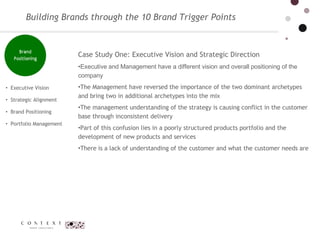
Executive Vision  Strategic Alignment  Brand Positioning Portfolio Management  Case Study One: Executive Vision and Strategic Direction Executive and Management have a different vision and overall positioning of the company  The Management have reversed the importance of the two dominant archetypes and bring two in additional archetypes into the mix The management understanding of the strategy is causing conflict in the customer base through inconsistent delivery  Part of this confusion lies in a poorly structured products portfolio and the development of new products and services  There is a lack of understanding of the customer and what the customer needs are Building Brands through the 10 Brand Trigger Points
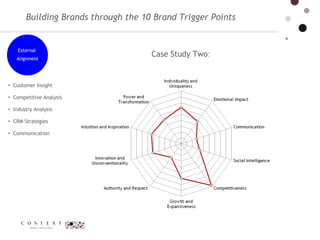
Customer Insight  Competitive Analysis  Industry Analysis  CRM Strategies  Communication  Case Study Two :  Building Brands through the 10 Brand Trigger Points External  Alignment
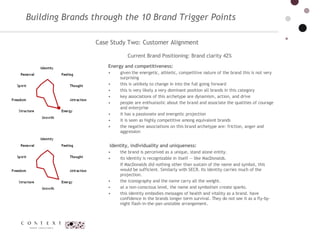
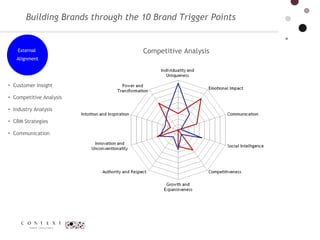
Energy and competitiveness: given the energetic, athletic, competitive nature of the brand this is not very surprising this is unlikely to change in into the full going forward this is very likely a very dominant position all brands in this category  key associations of this archetype are dynamism, action, and drive people are enthusiastic about the brand and associate the qualities of courage and enterprise it has a passionate and energetic projection  it is seen as highly competitive among equivalent brands  the negative associations on this brand archetype are: friction, anger and aggression Identity, individuality and uniqueness: the brand is perceived as a unique, stand alone entity.  its identity is recognizable in itself -- like MacDonalds.  If MacDonalds did nothing other than sustain of the name and symbol, this would be sufficient. Similarly with SECR. Its identity carries much of the projection.  the iconography and the name carry all the weight.  at a non-conscious level, the name and symbolism create sparks.  this identity embodies messages of health and vitality as a brand. have confidence in the brands longer term survival. They do not see it as a fly-by-night flash-in-the-pan unstable arrangement. Case Study Two: Customer Alignment  Current Brand Positioning: Brand clarity  42% Building Brands through the 10 Brand Trigger Points
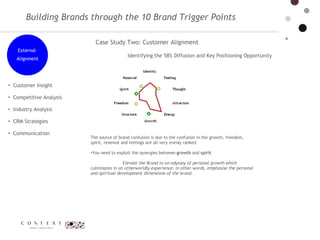
Customer Insight  Competitive Analysis  Industry Analysis  CRM Strategies  Communication  The source of brand confusion is due to the confusion in the growth, freedom, spirit, renewal and feelings are all very evenly ranked You need to exploit the synergies between  growth  and  spirit  Elevate the Brand to an odyssey of personal growth which culminates in an otherworldly experience; in other words, emphasise the personal and spiritual development dimensions of the brand.  Case Study Two: Customer Alignment  Identifying the 58% Diffusion and Key Positioning Opportunity Building Brands through the 10 Brand Trigger Points External  Alignment
Customer Insight  Competitive Analysis  Industry Analysis  CRM Strategies  Communication  Competitive Analysis Building Brands through the 10 Brand Trigger Points External  Alignment
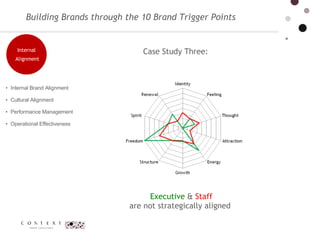
Internal Brand Alignment  Cultural Alignment  Performance Management  Operational Effectiveness Case Study Three:  Executive  &  Staff are not strategically aligned  Building Brands through the 10 Brand Trigger Points Internal Alignment
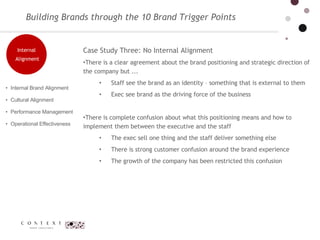
Case Study Three: No Internal Alignment  There is a clear agreement about the brand positioning and strategic direction of the company but ... Staff see the brand as an identity – something that is external to them  Exec see brand as the driving force of the business  There is complete confusion about what this positioning means and how to implement them between the executive and the staff  The exec sell one thing and the staff deliver something else  There is strong customer confusion around the brand experience  The growth of the company has been restricted this confusion Internal Brand Alignment  Cultural Alignment  Performance Management  Operational Effectiveness Building Brands through the 10 Brand Trigger Points Internal Alignment
10 Brand Archetypes
1. Individuality and Uniqueness  [Who are we] Exec: > This is a very good result.  The core identity of the brand mirrors the dominant    archetypes produced by the analysis of the totality of her questionnaire.    > Exec has their ducks in a row and know what they are doing. Management : > Communication is in semi-alignment with Exec.  > But Innovation & Unconventionality and Growth & Expansiveness have no    relation whatsoever to anything Exec had to say.  > This is disturbing when we consider that there is a 75% agreement factor among    the staff.  > So in terms of the this question, we can see that the staff are way off base    when compared to Exec. Comments: > Which positioning is right and how do we manage the challenges of conflicting    energies Communication  Competitiveness Innovation & Unconventionality Growth & Expansiveness Authority  & Respect  75%
CBC is a specialist strategic brand assessment and implementation organisation Work with specialised brand implementation agencies  Operation is run virtually  Our clients Include:  Strate Exxaro  Debis Fleet Management (Daimler Chrysler)  MNET  Urban Dynamics  Investment Avenue  Sabie Experience Cycle Race Savannah Fine Chemicals  Cellar d’Or  Outlearning   Danfoss Electroflex Profile
“ A company's primary responsibility is to serve its customers.  Profit is not the primary goal, but rather an essential condition for the company's continued existence.”   Peter Drucker

Context Branding And Some Case Studies

  • 1.
    your products andservices provides your customer with a choice, an option ... your brand is the REASON YOU are CHOSEN over your competition By Being RELEVANT
  • 2.
    Maintaining Brand Relevancewith Brand Growth Maintaining brand Relevance with Brand Growth is a key challenge as your business evolves through a combination of these four growth strategies: Strengthen your current core business Extend your brand by introducing new product and service into current markets Leverage into new markets with your current product and service Introduce new product and service to completely new markets
  • 3.
  • 4.
    Defining Relevance ... an Expectation ... Emotionally ... ... that Connects ... And differentiates through an Experience ... Defined by Perceptions
  • 5.
    Brand Relevance andBrand Positioning … is defined by Perceptions? But Perceptions are not rational constructs … … they defy logic and reason … . and are defined by perceptions … which defines our reality
  • 6.
    Brand Perceptions The key to managing your brands … and how people behave around them … … is manage the perceptions of the brand! You need to manage … … the conscious and subconscious elements …. … .of your Brand Then you can control the perceptions around your brand … whether this is for … Your Executive … Your Staff … … Your Customers … or even Your Competition
  • 7.
    your products andservices provides your customer with a choice, an option ... your brand is the REASON YOU are CHOSEN over your competition
  • 8.
    DECSIONS BASED ONPERCEPTIONS Context Branding Focus
  • 9.
    The 10 Driversof Perception:
  • 10.
    What are the10 Perception Drivers ? The 10 Perception drivers are based on ten fundamental archetypes. We call them Brand Archetypes. They operate in the collective psyche of humankind which can be used to modify choices and behaviours in relation to a brand. These are: Identity Feeling Thought Attraction Energy Growth Structure Freedom Spirit Renewal Individuality & Uniqueness Emotional Impact Communication Social Intelligence Competitiveness Growth & Expansiveness Authority & Respect Innovation & Unconventionality Intuition & Inspiration Power & Transformation [who we are] [the emotional impact of our brand] [how and what we really communicate]  [the impact of the brand on relationships] [how does the brand motivate action] [the capacity to expand] [what we are respected for] [how our brand generates excitement] [how our brand inspires] [power of our brand to change people’s lives]
  • 11.
    Indentifies the absoluteunique brand personality Defines the essence you are projecting into the market place Defines the strength of Brand Clarity Defines exactly how people perceive the brand Defines exactly how people behave around the brand Defines how people identify with your brand What they associate with your brand Tap into powerful ancient cultural myths and stories Uses subconscious anchors and links Provides the illogical emotional connection The 10 Drivers of Perception:
  • 12.
    Context Branding ServicesInternal Brand Alignment Cultural Alignment Performance Management Operational Effectiveness Customer Insight Competitive Analysis Industry Analysis CRM Strategies Communication Executive Vision Strategic Alignment Brand Positioning Portfolio Management The following applications of this process include case studies that highlight some of these applications to provide an insight into the process Application Focus
  • 13.
    Executive Vision Strategic Alignment Brand Positioning Portfolio Management Case Study One: Executive & Management are not strategically aligned Building Brands through the 10 Brand Trigger Points
  • 14.
    Executive Vision Strategic Alignment Brand Positioning Portfolio Management Case Study One: Executive Vision and Strategic Direction Executive and Management have a different vision and overall positioning of the company The Management have reversed the importance of the two dominant archetypes and bring two in additional archetypes into the mix The management understanding of the strategy is causing conflict in the customer base through inconsistent delivery Part of this confusion lies in a poorly structured products portfolio and the development of new products and services There is a lack of understanding of the customer and what the customer needs are Building Brands through the 10 Brand Trigger Points
  • 15.
    Customer Insight Competitive Analysis Industry Analysis CRM Strategies Communication Case Study Two : Building Brands through the 10 Brand Trigger Points External Alignment
  • 16.
    Energy and competitiveness:given the energetic, athletic, competitive nature of the brand this is not very surprising this is unlikely to change in into the full going forward this is very likely a very dominant position all brands in this category key associations of this archetype are dynamism, action, and drive people are enthusiastic about the brand and associate the qualities of courage and enterprise it has a passionate and energetic projection it is seen as highly competitive among equivalent brands the negative associations on this brand archetype are: friction, anger and aggression Identity, individuality and uniqueness: the brand is perceived as a unique, stand alone entity. its identity is recognizable in itself -- like MacDonalds. If MacDonalds did nothing other than sustain of the name and symbol, this would be sufficient. Similarly with SECR. Its identity carries much of the projection. the iconography and the name carry all the weight. at a non-conscious level, the name and symbolism create sparks. this identity embodies messages of health and vitality as a brand. have confidence in the brands longer term survival. They do not see it as a fly-by-night flash-in-the-pan unstable arrangement. Case Study Two: Customer Alignment Current Brand Positioning: Brand clarity 42% Building Brands through the 10 Brand Trigger Points
  • 17.
    Customer Insight Competitive Analysis Industry Analysis CRM Strategies Communication The source of brand confusion is due to the confusion in the growth, freedom, spirit, renewal and feelings are all very evenly ranked You need to exploit the synergies between growth and spirit Elevate the Brand to an odyssey of personal growth which culminates in an otherworldly experience; in other words, emphasise the personal and spiritual development dimensions of the brand. Case Study Two: Customer Alignment Identifying the 58% Diffusion and Key Positioning Opportunity Building Brands through the 10 Brand Trigger Points External Alignment
  • 18.
    Customer Insight Competitive Analysis Industry Analysis CRM Strategies Communication Competitive Analysis Building Brands through the 10 Brand Trigger Points External Alignment
  • 19.
    Internal Brand Alignment Cultural Alignment Performance Management Operational Effectiveness Case Study Three: Executive & Staff are not strategically aligned Building Brands through the 10 Brand Trigger Points Internal Alignment
  • 20.
    Case Study Three:No Internal Alignment There is a clear agreement about the brand positioning and strategic direction of the company but ... Staff see the brand as an identity – something that is external to them Exec see brand as the driving force of the business There is complete confusion about what this positioning means and how to implement them between the executive and the staff The exec sell one thing and the staff deliver something else There is strong customer confusion around the brand experience The growth of the company has been restricted this confusion Internal Brand Alignment Cultural Alignment Performance Management Operational Effectiveness Building Brands through the 10 Brand Trigger Points Internal Alignment
  • 21.
  • 22.
    1. Individuality andUniqueness [Who are we] Exec: > This is a very good result. The core identity of the brand mirrors the dominant archetypes produced by the analysis of the totality of her questionnaire.   > Exec has their ducks in a row and know what they are doing. Management : > Communication is in semi-alignment with Exec. > But Innovation & Unconventionality and Growth & Expansiveness have no relation whatsoever to anything Exec had to say. > This is disturbing when we consider that there is a 75% agreement factor among the staff. > So in terms of the this question, we can see that the staff are way off base when compared to Exec. Comments: > Which positioning is right and how do we manage the challenges of conflicting energies Communication Competitiveness Innovation & Unconventionality Growth & Expansiveness Authority & Respect 75%
  • 23.
    CBC is aspecialist strategic brand assessment and implementation organisation Work with specialised brand implementation agencies Operation is run virtually Our clients Include: Strate Exxaro Debis Fleet Management (Daimler Chrysler)  MNET  Urban Dynamics  Investment Avenue Sabie Experience Cycle Race Savannah Fine Chemicals  Cellar d’Or  Outlearning   Danfoss Electroflex Profile
  • 24.
    “ A company'sprimary responsibility is to serve its customers. Profit is not the primary goal, but rather an essential condition for the company's continued existence.”  Peter Drucker