The Agenda Importance of corporate reputation for realization of business strategy The role of CEO Conclusions and Q&A
“ In today’s world, where ideas are increasingly  displacing the physical in the production of economic value, competition for  REPUTATION  becomes a significant driving force, propelling our economy forward.” Alan Greenspan, former chairman, Federal Reserve
WHY DOES IT MATTER?
BUILDING AND SAFEGUARDING CORPORATE REPUTATIO N 60% OF MARKET VALUE ATTRIBUTABLE TO REPUTATION (Weber Shandwick, 2006) 1% REPUTATION INCREASE RESULTS IN 3% INCREASE OF MARKET VALUE (Weber Shandwick, 2006) INVESTORS ARE PREPARED TO PAY A 12-30% PRICE PREMIUM TO A GOOD GOVERNANCE (McKinsey, 2002) COMPANY CAN LOSE IN EXCESS OF 30% OF ITS SHARE VALUE AS A RESULT OF A HIGHLY PUBLICIZED CRISIS  (Weber Shandwick, 2007) 73% OF SURVEYED MBA STUDENTS SAID THAT CORPORATE REPUTATION IS EITHER AN "EXTREMELY" OR "VERY" IMPORTANT FACTOR WHEN DECIDING WHERE THEY WILL WORK (Hill and Knowlton, 2007)
WHAT IS IT ALL ABOUT? C  R
IT’S ABOUT BRINGING YOUR VALUES TO LIFE COMMUNICATE WHAT YOU STAND FOR, TO ALL OF YOUR STAKEHOLDERS!
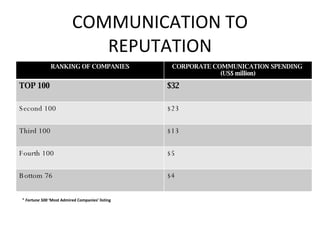
COMMUNICATION TO REPUTATION *  Fortune 500  ‘Most Admired Companies’ listing  RANKING OF COMPANIES CORPORATE COMMUNICATION SPENDING  (US$ million) TOP 100  $32  Second 100  $23 Third 100  $13 Fourth 100  $5 Bottom 76 $4
IT MEANS MANAGING… …  PERCEPTIONS How do we want to be seen? How do we aim to be positioned in the mind of our stakeholders? Do they even know we exist?
IT MEANS MANAGING… …  UNDERSTANDING Are we being clear? Do they understand our values?
IT MEANS MANAGING… …  RELATIONS How do they relate to our values? Does it work for them? What kind of behavior we seek for?
BENEFITS OF A GOOD REPUTATION Increased CUSTOMER/CONSUMER/CLIENT preference and loyalty Enhanced EMPLOYEES` satisfaction and productivity Increased INVESTORS` interest and willingness to invest  Improved understanding and support among OPINION LEADERS Faster recovery from business CRISES
CORPORATE COMMUNICATION IS A PROCESS… IDENTITY OBJECTIVE, STATIC CATEGORY Defined specific features of a corporation and external symbol  ( visual and material tools )  reflecting it and communicating with publics Slogan Logo Graphic standards Print  production Website Code of conduct Publication of corporate data Office space  Corporate film
CORPORATE COMMUNICATION IS A PROCESS… IDENTITY IMAGE OBJECTIVE, STATIC CATEGORY Defined specific features of a corporation and external symbol  ( visual and material tools )  reflecting it and communicating with publics SUBJECTIVE, DYNAMIC CATEGORY Impression of the public on a corporation, established upon a  perception  of corporate identity COMMUNICATION
CORPORATE IMAGE HONEST FAIR-PLAY RELIABLE  COMPETENT LOCALLY IMPORTANT AND ACCESSIBLE  TRUST DEDICATED TO COMMUNITY IMPORTANT SPONSORS  PARTNERS AND SUPPORT ENVIRONMENT FRIENDLY CARE QUALITY INNNOVATIVE EXCELLENCE GOOD EXAMPLE LEADERSHIP HOW DO WE DESIRE TO BE SEEN?
CORPORATE COMMUNICATION IS A PROCESS… …  OF TRANSFORMING THE IDENTITY INTO IMAGE AND REPUTATION IDENTITY IMAGE REPUTATION OBJECTIVE, STATIC CATEGORY Defined specific features of a corporation and external symbol  ( visual and material tools )  reflecting it and communicating with publics SUBJECTIVE, DYNAMIC CATEGORY Impression of the public on a corporation, established upon a  perception  of corporate identity JUDGMENT Set of values attributed to company by its stakeholders, based on their  interpretation and validation  of the corporate identity and image COMMUNICATION EXPERIENCE COMMUNICATION
IMAGE AND REPUTATION IMAGE MEANS CREATION OF A  PROMISE . REPUTATION MEANS LETTING EVERYONE UNDERSTAND YOU`RE  DELIVERING  ON THAT PROMISE.
“ The way to gain a good reputation is to endeavor to be what you desire to appear ” Socrates
MOST IMPORTANT REPUTATION DRIVERS EXCELLENCE OF PRODUCTS AND SERVICES SOCIALLY RESPONSIBLE CONDUCT FINANCIAL PERFORMANCE WORKING ENVIRONMENT EMOTIONAL APPEAL MANAGEMENT LEADERSHIP AND EXPERTISE
THE ROLE OF CEO IN BUILDING, MAINTAININ G  AND RECOVERING REPUTATION
CEO REPUTATION “ CEO reputation represents 65% of corporate reputation.” CEO Capital Research
“ ...n avigating the chaotic yet   exciting time when a new CEO begins ...” McKinsey & Company
CHANGE MANAGEMENT Structured approach to transitioning individuals, teams,  a nd   organizations from a current state to a desired future  state. The current definition of Change Management  includes both organizational change management  processes and individual change management models, which together are used to manage the people side of  change. http://en.wikipedia.org/wiki/Change_management
CHANGE THE ONLY CERTAIN THING TODAY
WHAT DOES CHANGE MEAN ?   DANGER      Resistance Fear     OPPORTUNITY Fresh ideas Interest GRAB THE OPPORTUNITY!
“ About  60% of all management problems  are due to poor  or  faulty   communication .” Peter Drucke r
THE STAGES  OF CEO SUCCESION COUNTDOWN FIRST 100 DAYS FIRST YEAR TURNING POINT  REVISION AND  REINVENTION CEO Capital, A Guide to Building CEO Reputation and Company  Success, Dr. Leslie Gaines-Ross, John Wiley & Sons, Inc.
THE COUNTDOWN Q uiet period CEO plans the future L earns  about country,  people, programs and activities S ets the stage
FIRST 100 DAYS Opportunity – interest in new CEO D elicate balance of action and listening L istens and learns to gain the support  P roactive in completing   unfinished
END OF THE FIRST YEAR P eople, programs and actions in place E verything may not have been resolved or changed S takeholders see progress  and  feel the CEO is leading the company in the right direction
TURNING POINT CEO has prepare d  the organization for the future Now it is time to produce! Everyone coldly evaluate s  CEO's vision and actions CEO has  generated  personal and  professional capital
REVISION AND REINVENTION CEO is comfortable in his role He  is living the company's vision C omplete team is collaborating on developing new strategies and executing new tactics
“ 40% of my time I communicate  our company’s credo” Jim Burke,  Johnson&Johnson CEO
CEO ROLE CEO  sets vision, direction and plan of  action s . But i t’s  communication that fans  the flames for   enthusiasm, support and  commitment. Who gives details??? Employees = BRAND AMBASSADORS
BRAND AMBASSADORS Contact with target audiences: PR and marketing Information desk Bank clerks Call center Advisors Security
Surveys suggest that 9% of customers  are lured away by competitors, but as  many as 68% are lost by employees’  indifference . Journal of Marketing
WHAT KEEPS LEADERS AWAKE AT NIGHT? Performance Reputation Innovations Satisfaction Crisis ...
FOR A PEACEFUL SLEEP Listening Measuring Feedback Adjustment
BARCLAY’S CASE “ Financial performance is vital, of course, and easy  measurable. But financials alone are not enough to  measure either performance or health.  Soft-side  strategies  are the foundation stones of hard-side- strategy success. They are additive, not alternative.“ John S. Varley, CEO of Barclay’s Bank (2005)
AT THE END...
Far too much  communication  effort is externally focused Get your employees to understand and believe in the brand START AT HOME
HOW TO APPROACH EMPLOYEES? Proactive and on time Provide info What do you think? Kill rumours! Formal – circulars, corporate events, newsletter, ... Informal – MBWA – push method   - Open Door Day – pull method
TIPS Use social occasions to breakdown barriers Deliberately work around select ed  “unimportant” employees and listen to their opinions – get back to them After you have instructed someone with a task, check their understanding You cannot beat the “personal touch”
Q& A
THANK YOU FOR YOUR ATTENTION

The Reputation And CEO

  • 1.
  • 2.
    The Agenda Importanceof corporate reputation for realization of business strategy The role of CEO Conclusions and Q&A
  • 3.
    “ In today’sworld, where ideas are increasingly displacing the physical in the production of economic value, competition for REPUTATION becomes a significant driving force, propelling our economy forward.” Alan Greenspan, former chairman, Federal Reserve
  • 4.
    WHY DOES ITMATTER?
  • 5.
    BUILDING AND SAFEGUARDINGCORPORATE REPUTATIO N 60% OF MARKET VALUE ATTRIBUTABLE TO REPUTATION (Weber Shandwick, 2006) 1% REPUTATION INCREASE RESULTS IN 3% INCREASE OF MARKET VALUE (Weber Shandwick, 2006) INVESTORS ARE PREPARED TO PAY A 12-30% PRICE PREMIUM TO A GOOD GOVERNANCE (McKinsey, 2002) COMPANY CAN LOSE IN EXCESS OF 30% OF ITS SHARE VALUE AS A RESULT OF A HIGHLY PUBLICIZED CRISIS (Weber Shandwick, 2007) 73% OF SURVEYED MBA STUDENTS SAID THAT CORPORATE REPUTATION IS EITHER AN "EXTREMELY" OR "VERY" IMPORTANT FACTOR WHEN DECIDING WHERE THEY WILL WORK (Hill and Knowlton, 2007)
  • 6.
    WHAT IS ITALL ABOUT? C R
  • 7.
    IT’S ABOUT BRINGINGYOUR VALUES TO LIFE COMMUNICATE WHAT YOU STAND FOR, TO ALL OF YOUR STAKEHOLDERS!
  • 8.
    COMMUNICATION TO REPUTATION* Fortune 500  ‘Most Admired Companies’ listing RANKING OF COMPANIES CORPORATE COMMUNICATION SPENDING (US$ million) TOP 100 $32 Second 100 $23 Third 100 $13 Fourth 100 $5 Bottom 76 $4
  • 9.
    IT MEANS MANAGING…… PERCEPTIONS How do we want to be seen? How do we aim to be positioned in the mind of our stakeholders? Do they even know we exist?
  • 10.
    IT MEANS MANAGING…… UNDERSTANDING Are we being clear? Do they understand our values?
  • 11.
    IT MEANS MANAGING…… RELATIONS How do they relate to our values? Does it work for them? What kind of behavior we seek for?
  • 12.
    BENEFITS OF AGOOD REPUTATION Increased CUSTOMER/CONSUMER/CLIENT preference and loyalty Enhanced EMPLOYEES` satisfaction and productivity Increased INVESTORS` interest and willingness to invest Improved understanding and support among OPINION LEADERS Faster recovery from business CRISES
  • 13.
    CORPORATE COMMUNICATION ISA PROCESS… IDENTITY OBJECTIVE, STATIC CATEGORY Defined specific features of a corporation and external symbol ( visual and material tools ) reflecting it and communicating with publics Slogan Logo Graphic standards Print production Website Code of conduct Publication of corporate data Office space Corporate film
  • 14.
    CORPORATE COMMUNICATION ISA PROCESS… IDENTITY IMAGE OBJECTIVE, STATIC CATEGORY Defined specific features of a corporation and external symbol ( visual and material tools ) reflecting it and communicating with publics SUBJECTIVE, DYNAMIC CATEGORY Impression of the public on a corporation, established upon a perception of corporate identity COMMUNICATION
  • 15.
    CORPORATE IMAGE HONESTFAIR-PLAY RELIABLE COMPETENT LOCALLY IMPORTANT AND ACCESSIBLE TRUST DEDICATED TO COMMUNITY IMPORTANT SPONSORS PARTNERS AND SUPPORT ENVIRONMENT FRIENDLY CARE QUALITY INNNOVATIVE EXCELLENCE GOOD EXAMPLE LEADERSHIP HOW DO WE DESIRE TO BE SEEN?
  • 16.
    CORPORATE COMMUNICATION ISA PROCESS… … OF TRANSFORMING THE IDENTITY INTO IMAGE AND REPUTATION IDENTITY IMAGE REPUTATION OBJECTIVE, STATIC CATEGORY Defined specific features of a corporation and external symbol ( visual and material tools ) reflecting it and communicating with publics SUBJECTIVE, DYNAMIC CATEGORY Impression of the public on a corporation, established upon a perception of corporate identity JUDGMENT Set of values attributed to company by its stakeholders, based on their interpretation and validation of the corporate identity and image COMMUNICATION EXPERIENCE COMMUNICATION
  • 17.
    IMAGE AND REPUTATIONIMAGE MEANS CREATION OF A PROMISE . REPUTATION MEANS LETTING EVERYONE UNDERSTAND YOU`RE DELIVERING ON THAT PROMISE.
  • 18.
    “ The wayto gain a good reputation is to endeavor to be what you desire to appear ” Socrates
  • 19.
    MOST IMPORTANT REPUTATIONDRIVERS EXCELLENCE OF PRODUCTS AND SERVICES SOCIALLY RESPONSIBLE CONDUCT FINANCIAL PERFORMANCE WORKING ENVIRONMENT EMOTIONAL APPEAL MANAGEMENT LEADERSHIP AND EXPERTISE
  • 20.
    THE ROLE OFCEO IN BUILDING, MAINTAININ G AND RECOVERING REPUTATION
  • 21.
    CEO REPUTATION “CEO reputation represents 65% of corporate reputation.” CEO Capital Research
  • 22.
    “ ...n avigatingthe chaotic yet exciting time when a new CEO begins ...” McKinsey & Company
  • 23.
    CHANGE MANAGEMENT Structuredapproach to transitioning individuals, teams, a nd organizations from a current state to a desired future state. The current definition of Change Management includes both organizational change management processes and individual change management models, which together are used to manage the people side of change. http://en.wikipedia.org/wiki/Change_management
  • 24.
    CHANGE THE ONLYCERTAIN THING TODAY
  • 25.
    WHAT DOES CHANGEMEAN ? DANGER Resistance Fear OPPORTUNITY Fresh ideas Interest GRAB THE OPPORTUNITY!
  • 26.
    “ About 60% of all management problems are due to poor or faulty communication .” Peter Drucke r
  • 27.
    THE STAGES OF CEO SUCCESION COUNTDOWN FIRST 100 DAYS FIRST YEAR TURNING POINT REVISION AND REINVENTION CEO Capital, A Guide to Building CEO Reputation and Company Success, Dr. Leslie Gaines-Ross, John Wiley & Sons, Inc.
  • 28.
    THE COUNTDOWN Quiet period CEO plans the future L earns about country, people, programs and activities S ets the stage
  • 29.
    FIRST 100 DAYSOpportunity – interest in new CEO D elicate balance of action and listening L istens and learns to gain the support P roactive in completing unfinished
  • 30.
    END OF THEFIRST YEAR P eople, programs and actions in place E verything may not have been resolved or changed S takeholders see progress and feel the CEO is leading the company in the right direction
  • 31.
    TURNING POINT CEOhas prepare d the organization for the future Now it is time to produce! Everyone coldly evaluate s CEO's vision and actions CEO has generated personal and professional capital
  • 32.
    REVISION AND REINVENTIONCEO is comfortable in his role He is living the company's vision C omplete team is collaborating on developing new strategies and executing new tactics
  • 33.
    “ 40% ofmy time I communicate our company’s credo” Jim Burke, Johnson&Johnson CEO
  • 34.
    CEO ROLE CEO sets vision, direction and plan of action s . But i t’s communication that fans the flames for enthusiasm, support and commitment. Who gives details??? Employees = BRAND AMBASSADORS
  • 35.
    BRAND AMBASSADORS Contactwith target audiences: PR and marketing Information desk Bank clerks Call center Advisors Security
  • 36.
    Surveys suggest that9% of customers are lured away by competitors, but as many as 68% are lost by employees’ indifference . Journal of Marketing
  • 37.
    WHAT KEEPS LEADERSAWAKE AT NIGHT? Performance Reputation Innovations Satisfaction Crisis ...
  • 38.
    FOR A PEACEFULSLEEP Listening Measuring Feedback Adjustment
  • 39.
    BARCLAY’S CASE “Financial performance is vital, of course, and easy measurable. But financials alone are not enough to measure either performance or health. Soft-side strategies are the foundation stones of hard-side- strategy success. They are additive, not alternative.“ John S. Varley, CEO of Barclay’s Bank (2005)
  • 40.
  • 41.
    Far too much communication effort is externally focused Get your employees to understand and believe in the brand START AT HOME
  • 42.
    HOW TO APPROACHEMPLOYEES? Proactive and on time Provide info What do you think? Kill rumours! Formal – circulars, corporate events, newsletter, ... Informal – MBWA – push method - Open Door Day – pull method
  • 43.
    TIPS Use socialoccasions to breakdown barriers Deliberately work around select ed “unimportant” employees and listen to their opinions – get back to them After you have instructed someone with a task, check their understanding You cannot beat the “personal touch”
  • 44.
  • 45.
    THANK YOU FORYOUR ATTENTION