Reputation
Management
Jessica Scopacasa
Public Relations Manager
This presentation is based on the Reputation Management
Certificate Program of the Public Relations Society of
America (PRSA)
Certificate Program Modules presented by:
Laura Kane, Chief Communications Officer, PRSA
Anthony Johndrow, CEO, Reputation Economy Advisors
Leslie Gaines-Ross, Chief Reputation Strategist, Weber Shandwick
Leigh Horner, Vice President, Corporate Communications & Corporate Social Responsibility, Hershey
Jim Issokson, Senior Vice President, North American communications, Mastercard
Billy Mann, Partner, Quadrant Strategies
Pamela Gill Alabaster, Senior Vice President, Corporate Communications & Corporate Social
Responsibility, Revlon Inc.
Lisa Ryan, Senior Vice President, Heyman Associates
TR Straub, Senior Vice President, Heyman Associates
Mike Fernandez, CEO, Burson-Marsteller USA
More info the PRSA Program:
http://apps.prsa.org/Learning/Calendar/di
splay/7574/Reputation_Management_Cert
ificate_Program#.WYMbDoSGPIU
1.
Why Reputation
matters
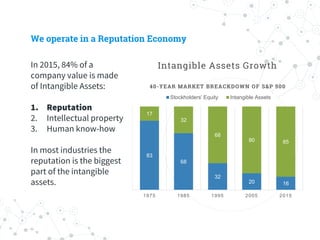
We operate in a Reputation Economy
In 2015, 84% of a
company value is made
of Intangible Assets:
1. Reputation
2. Intellectual property
3. Human know-how
In most industries the
reputation is the biggest
part of the intangible
assets.
83
68
32
20 16
17
32
68
80 85
1975 1985 1995 2005 2015
Intangible Assets Growth
40-YEAR MARKET BREACKDOWN OF S&P 500
Stockholders' Equity Intangible Assets
Reputation is Money
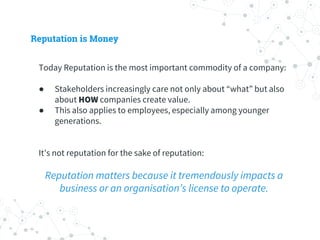
Today Reputation is the most important commodity of a company:
● Stakeholders increasingly care not only about “what” but also
about HOW companies create value.
● This also applies to employees, especially among younger
generations.
It’s not reputation for the sake of reputation:
Reputation matters because it tremendously impacts a
business or an organisation’s license to operate.
Reputation Risk is a Top Strategic Business Risk
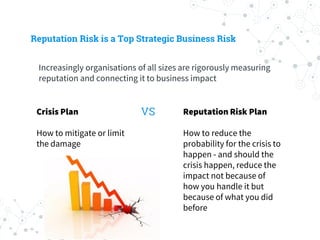
Increasingly organisations of all sizes are rigorously measuring
reputation and connecting it to business impact
Crisis Plan
How to mitigate or limit
the damage
Reputation Risk Plan
How to reduce the
probability for the crisis to
happen - and should the
crisis happen, reduce the
impact not because of
how you handle it but
because of what you did
before
VS
2.
The role of the CEO
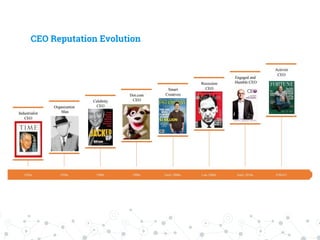
CEO Reputation Evolution
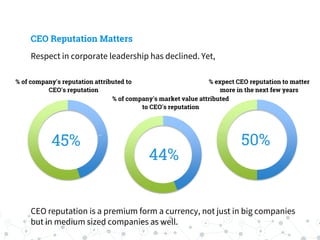
CEO Reputation Matters
45%
% of company's reputation attributed to
CEO's reputation
44%
% of company's market value attributed
to CEO's reputation
50%
% expect CEO reputation to matter
more in the next few years
Respect in corporate leadership has declined. Yet,
CEO reputation is a premium form a currency, not just in big companies
but in medium sized companies as well.
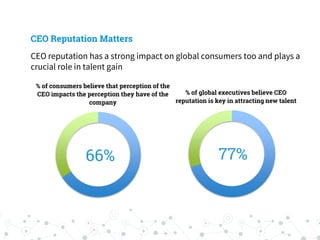
CEO Reputation Matters
66%
% of consumers believe that perception of the
CEO impacts the perception they have of the
company
77%
% of global executives believe CEO
reputation is key in attracting new talent
CEO reputation has a strong impact on global consumers too and plays a
crucial role in talent gain
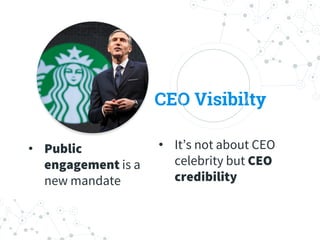
CEO Visibilty
• Public
engagement is a
new mandate
• It’s not about CEO
celebrity but CEO
credibility
How to increase CEO visibility
● Speak at industry related confernces
to highlight CEO competency
● Be accessible to news media
● Be visible on company website
● Share new insights and trends with the public
● Be active in local community
● Be visible on the company video/YouTube channel
● Hold position of leadership outside the company
● Publicly take positions on issues that affect society at large:
46% of people believe that companies should express opinions or
take actions on controversial issues
“One thing that you’re seeing is that there is a third [political] party
emerging in this country, which is the party of CEOs”
- Marc Benioff, CEO Salesforce.com
3.
The way forward
A new approach to Reputation
Management
Enterprise Risk Management (ERM) is not enough
Today, ERM covers issues identification and prioritization BUT:
● Outputs lack depth and strategic planning
● CFOs and Chief Risk Officers are uncomfortable with the Breadth
and Subjectivity of Reputational Risk
● CCOs are only empowered to do Crisis Planning
● Other functions (business units) lack accountability: silos block
their views
The new approach
CCOs to action Reputation Management:
● Enterprise Risk Management (ERM) owned process, with Risk
Identification, Evaluation, Prioritization
● Analyze: Evaluate Cause and Business Impact
● Report: Document and deliver to senior management
● Develop an Action Plan
● Ensure Cross-functional collaboration for plan execution
(marketing, sales, operations, etc)
● Monitor Identified Risk and have a crisis plan in place; build an
infrastructure with colleagues to mitigate risk
Reputation Manager’s key responsibilities
● Social listening
● CEO reputation
● Reputation risk
● Breaking down silos to facilitate inter-department
communications
● Measurement and KPIs
● Social Engagement
● CSR strategy
● Digital influencers
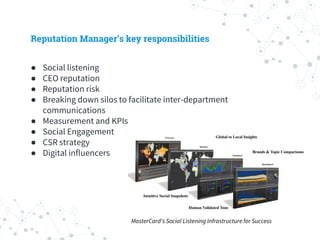
MasterCard's Social Listening Infrastructure for Success
4.
Reputation
Management, hands-on
How to optimize an Intangible
Asset
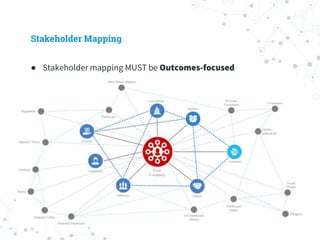
Stakeholder Mapping
● Stakeholder mapping MUST be Outcomes-focused
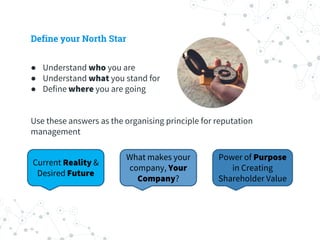
Define your North Star
● Understand who you are
● Understand what you stand for
● Define where you are going
Use these answers as the organising principle for reputation
management
Current Reality &
Desired Future
What makes your
company, Your
Company?
Power of Purpose
in Creating
Shareholder Value
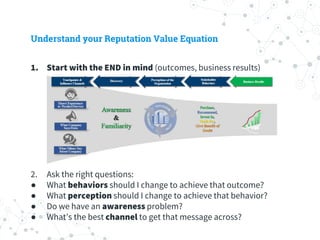
Understand your Reputation Value Equation
1. Start with the END in mind (outcomes, business results)
2. Ask the right questions:
● What behaviors should I change to achieve that outcome?
● What perception should I change to achieve that behavior?
● Do we have an awareness problem?
● What’s the best channel to get that message across?
Research
Managing reputation starts with MEASURING:
● You need to understand what your reputation is, both
quantitatively and qualitatively
● You need to benchmark
● You need to know what drives it, what its weaknesses are and
what to do about it
The research approach must be based on data that provides an
actionable strategy:
“Research for action” & “Forward-focused research”
Use advanced analytics that reveal HIDDEN DRIVERS (vs stated
drivers), strong drivers of consideration but not top-of mind: this is
where real value comes from for communicators
Research results
1. Figure out strengths you can win with (and what you can’t afford
to lose)
2. Identify vulnerabilities to monitor or inoculate against
3. Flag potential issues to watch
4. Define audiences at risk
5. Establish the starting numbers against which future waves will
be compared (Benchmark numbers to monitor progress)
Message Testing Poll. Based on the above, brainstorm, write
messages, test and then create a strategy:
● Score the messages on a series of metrics - consideration intent,
purchase intent, favorability
● Create a message scoring table, look for the trends, understand
Why some messages work more than others, calculate a score
based on a combination of these metrics to determine winning
messages
Keep tracking
Reputation Tracking Poll: check if you are hitting the goals, if the
strategy works.
● Set targets for short, medium and long term
● Use tracking polling to measure progress
● If numbers are not improving, research will identify why and can
determine how to course correct (use also open ended questions)
Social listening: use analytics tools to pull conversations from
around the web to develop actionable insights.
● Check tone of conversation VS competitors
● Global to Local Insights
● Brands & Topics Comparisons
● Flag potential issues
● Measure media reputation
5.
Corporate Social
Responsibility
(CSR)
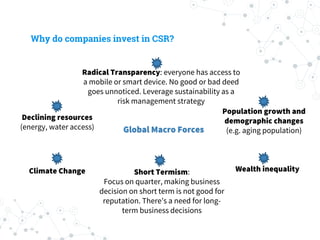
Why do companies invest in CSR?
Gl Global Macro Forces
Declining resources
(energy, water access)
Climate Change Wealth inequality
Radical Transparency: everyone has access to
a mobile or smart device. No good or bad deed
goes unnoticed. Leverage sustainability as a
risk management strategy
Population growth and
demographic changes
(e.g. aging population)
Short Termism:
Focus on quarter, making business
decision on short term is not good for
reputation. There’s a need for long-
term business decisions
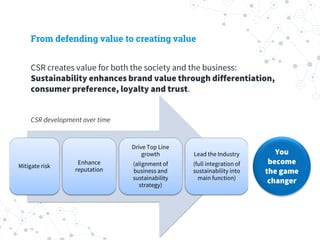
From defending value to creating value
CSR creates value for both the society and the business:
Sustainability enhances brand value through differentiation,
consumer preference, loyalty and trust.
CSR development over time
Mitigate risk
Enhance
reputation
Drive Top Line
growth
(alignment of
business and
sustainability
strategy)
Lead the Industry
(full integration of
sustainability into
main function)
You
become
the game
changer
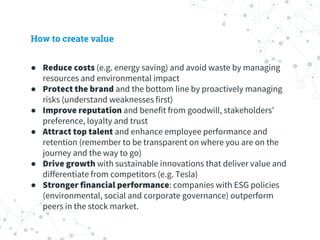
How to create value
● Reduce costs (e.g. energy saving) and avoid waste by managing
resources and environmental impact
● Protect the brand and the bottom line by proactively managing
risks (understand weaknesses first)
● Improve reputation and benefit from goodwill, stakeholders’
preference, loyalty and trust
● Attract top talent and enhance employee performance and
retention (remember to be transparent on where you are on the
journey and the way to go)
● Drive growth with sustainable innovations that deliver value and
differentiate from competitors (e.g. Tesla)
● Stronger financial performance: companies with ESG policies
(environmental, social and corporate governance) outperform
peers in the stock market.
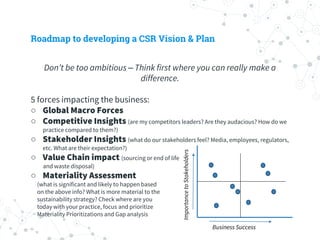
Roadmap to developing a CSR Vision & Plan
Don’t be too ambitious – Think first where you can really make a
difference.
5 forces impacting the business:
○ Global Macro Forces
○ Competitive Insights (are my competitors leaders? Are they audacious? How do we
practice compared to them?)
○ Stakeholder Insights (what do our stakeholders feel? Media, employees, regulators,
etc. What are their expectation?)
○ Value Chain impact (sourcing or end of life
and waste disposal)
○ Materiality Assessment
(what is significant and likely to happen based
on the above info? What is more material to the
sustainability strategy? Check where are you
today with your practice, focus and prioritize
Materiality Prioritizations and Gap analysis
Business Success
ImportancetoStakeholders
6.
Recommendations
Key takeaways and best practices
In practice
● Milestones and KPIs need to be based on business objectives
● Be transparent
● Empower employees, executives and influencers to be vocal
about the brand BUT only do that once you’ve created clear
guidelines for what they should/could be talking about and how
they should be talking about it
● Ask for feedback
● Don’t hide from criticism
● Calibrate the right level of ambition
● Build internal alignment
● Monitor what the audience is sharing and saying
● React quickly BUT only when you’re ready
● Address issues head-on
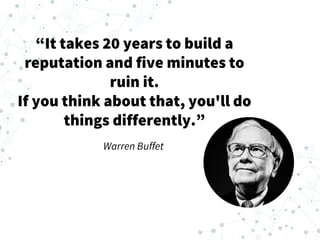
“It takes 20 years to build a
reputation and five minutes to
ruin it.
If you think about that, you'll do
things differently.”
Warren Buffet
Thank you!
Questions?
Jessica Scopacasa
E: jessicascopcasa@dmgeventsme.com
M: +971 50 3659468

Reputation Management for PR and Communications professionals

  • 1.
  • 2.
    This presentation isbased on the Reputation Management Certificate Program of the Public Relations Society of America (PRSA) Certificate Program Modules presented by: Laura Kane, Chief Communications Officer, PRSA Anthony Johndrow, CEO, Reputation Economy Advisors Leslie Gaines-Ross, Chief Reputation Strategist, Weber Shandwick Leigh Horner, Vice President, Corporate Communications & Corporate Social Responsibility, Hershey Jim Issokson, Senior Vice President, North American communications, Mastercard Billy Mann, Partner, Quadrant Strategies Pamela Gill Alabaster, Senior Vice President, Corporate Communications & Corporate Social Responsibility, Revlon Inc. Lisa Ryan, Senior Vice President, Heyman Associates TR Straub, Senior Vice President, Heyman Associates Mike Fernandez, CEO, Burson-Marsteller USA More info the PRSA Program: http://apps.prsa.org/Learning/Calendar/di splay/7574/Reputation_Management_Cert ificate_Program#.WYMbDoSGPIU
  • 3.
  • 4.
    We operate ina Reputation Economy In 2015, 84% of a company value is made of Intangible Assets: 1. Reputation 2. Intellectual property 3. Human know-how In most industries the reputation is the biggest part of the intangible assets. 83 68 32 20 16 17 32 68 80 85 1975 1985 1995 2005 2015 Intangible Assets Growth 40-YEAR MARKET BREACKDOWN OF S&P 500 Stockholders' Equity Intangible Assets
  • 5.
    Reputation is Money TodayReputation is the most important commodity of a company: ● Stakeholders increasingly care not only about “what” but also about HOW companies create value. ● This also applies to employees, especially among younger generations. It’s not reputation for the sake of reputation: Reputation matters because it tremendously impacts a business or an organisation’s license to operate.
  • 6.
    Reputation Risk isa Top Strategic Business Risk Increasingly organisations of all sizes are rigorously measuring reputation and connecting it to business impact Crisis Plan How to mitigate or limit the damage Reputation Risk Plan How to reduce the probability for the crisis to happen - and should the crisis happen, reduce the impact not because of how you handle it but because of what you did before VS
  • 7.
  • 8.
  • 9.
    CEO Reputation Matters 45% %of company's reputation attributed to CEO's reputation 44% % of company's market value attributed to CEO's reputation 50% % expect CEO reputation to matter more in the next few years Respect in corporate leadership has declined. Yet, CEO reputation is a premium form a currency, not just in big companies but in medium sized companies as well.
  • 10.
    CEO Reputation Matters 66% %of consumers believe that perception of the CEO impacts the perception they have of the company 77% % of global executives believe CEO reputation is key in attracting new talent CEO reputation has a strong impact on global consumers too and plays a crucial role in talent gain
  • 11.
    CEO Visibilty • Public engagementis a new mandate • It’s not about CEO celebrity but CEO credibility
  • 12.
    How to increaseCEO visibility ● Speak at industry related confernces to highlight CEO competency ● Be accessible to news media ● Be visible on company website ● Share new insights and trends with the public ● Be active in local community ● Be visible on the company video/YouTube channel ● Hold position of leadership outside the company ● Publicly take positions on issues that affect society at large: 46% of people believe that companies should express opinions or take actions on controversial issues “One thing that you’re seeing is that there is a third [political] party emerging in this country, which is the party of CEOs” - Marc Benioff, CEO Salesforce.com
  • 13.
    3. The way forward Anew approach to Reputation Management
  • 14.
    Enterprise Risk Management(ERM) is not enough Today, ERM covers issues identification and prioritization BUT: ● Outputs lack depth and strategic planning ● CFOs and Chief Risk Officers are uncomfortable with the Breadth and Subjectivity of Reputational Risk ● CCOs are only empowered to do Crisis Planning ● Other functions (business units) lack accountability: silos block their views
  • 15.
    The new approach CCOsto action Reputation Management: ● Enterprise Risk Management (ERM) owned process, with Risk Identification, Evaluation, Prioritization ● Analyze: Evaluate Cause and Business Impact ● Report: Document and deliver to senior management ● Develop an Action Plan ● Ensure Cross-functional collaboration for plan execution (marketing, sales, operations, etc) ● Monitor Identified Risk and have a crisis plan in place; build an infrastructure with colleagues to mitigate risk
  • 16.
    Reputation Manager’s keyresponsibilities ● Social listening ● CEO reputation ● Reputation risk ● Breaking down silos to facilitate inter-department communications ● Measurement and KPIs ● Social Engagement ● CSR strategy ● Digital influencers MasterCard's Social Listening Infrastructure for Success
  • 17.
    4. Reputation Management, hands-on How tooptimize an Intangible Asset
  • 18.
    Stakeholder Mapping ● Stakeholdermapping MUST be Outcomes-focused
  • 19.
    Define your NorthStar ● Understand who you are ● Understand what you stand for ● Define where you are going Use these answers as the organising principle for reputation management Current Reality & Desired Future What makes your company, Your Company? Power of Purpose in Creating Shareholder Value
  • 20.
    Understand your ReputationValue Equation 1. Start with the END in mind (outcomes, business results) 2. Ask the right questions: ● What behaviors should I change to achieve that outcome? ● What perception should I change to achieve that behavior? ● Do we have an awareness problem? ● What’s the best channel to get that message across?
  • 21.
    Research Managing reputation startswith MEASURING: ● You need to understand what your reputation is, both quantitatively and qualitatively ● You need to benchmark ● You need to know what drives it, what its weaknesses are and what to do about it The research approach must be based on data that provides an actionable strategy: “Research for action” & “Forward-focused research” Use advanced analytics that reveal HIDDEN DRIVERS (vs stated drivers), strong drivers of consideration but not top-of mind: this is where real value comes from for communicators
  • 22.
    Research results 1. Figureout strengths you can win with (and what you can’t afford to lose) 2. Identify vulnerabilities to monitor or inoculate against 3. Flag potential issues to watch 4. Define audiences at risk 5. Establish the starting numbers against which future waves will be compared (Benchmark numbers to monitor progress) Message Testing Poll. Based on the above, brainstorm, write messages, test and then create a strategy: ● Score the messages on a series of metrics - consideration intent, purchase intent, favorability ● Create a message scoring table, look for the trends, understand Why some messages work more than others, calculate a score based on a combination of these metrics to determine winning messages
  • 23.
    Keep tracking Reputation TrackingPoll: check if you are hitting the goals, if the strategy works. ● Set targets for short, medium and long term ● Use tracking polling to measure progress ● If numbers are not improving, research will identify why and can determine how to course correct (use also open ended questions) Social listening: use analytics tools to pull conversations from around the web to develop actionable insights. ● Check tone of conversation VS competitors ● Global to Local Insights ● Brands & Topics Comparisons ● Flag potential issues ● Measure media reputation
  • 24.
  • 25.
    Why do companiesinvest in CSR? Gl Global Macro Forces Declining resources (energy, water access) Climate Change Wealth inequality Radical Transparency: everyone has access to a mobile or smart device. No good or bad deed goes unnoticed. Leverage sustainability as a risk management strategy Population growth and demographic changes (e.g. aging population) Short Termism: Focus on quarter, making business decision on short term is not good for reputation. There’s a need for long- term business decisions
  • 26.
    From defending valueto creating value CSR creates value for both the society and the business: Sustainability enhances brand value through differentiation, consumer preference, loyalty and trust. CSR development over time Mitigate risk Enhance reputation Drive Top Line growth (alignment of business and sustainability strategy) Lead the Industry (full integration of sustainability into main function) You become the game changer
  • 27.
    How to createvalue ● Reduce costs (e.g. energy saving) and avoid waste by managing resources and environmental impact ● Protect the brand and the bottom line by proactively managing risks (understand weaknesses first) ● Improve reputation and benefit from goodwill, stakeholders’ preference, loyalty and trust ● Attract top talent and enhance employee performance and retention (remember to be transparent on where you are on the journey and the way to go) ● Drive growth with sustainable innovations that deliver value and differentiate from competitors (e.g. Tesla) ● Stronger financial performance: companies with ESG policies (environmental, social and corporate governance) outperform peers in the stock market.
  • 28.
    Roadmap to developinga CSR Vision & Plan Don’t be too ambitious – Think first where you can really make a difference. 5 forces impacting the business: ○ Global Macro Forces ○ Competitive Insights (are my competitors leaders? Are they audacious? How do we practice compared to them?) ○ Stakeholder Insights (what do our stakeholders feel? Media, employees, regulators, etc. What are their expectation?) ○ Value Chain impact (sourcing or end of life and waste disposal) ○ Materiality Assessment (what is significant and likely to happen based on the above info? What is more material to the sustainability strategy? Check where are you today with your practice, focus and prioritize Materiality Prioritizations and Gap analysis Business Success ImportancetoStakeholders
  • 29.
  • 30.
    In practice ● Milestonesand KPIs need to be based on business objectives ● Be transparent ● Empower employees, executives and influencers to be vocal about the brand BUT only do that once you’ve created clear guidelines for what they should/could be talking about and how they should be talking about it ● Ask for feedback ● Don’t hide from criticism ● Calibrate the right level of ambition ● Build internal alignment ● Monitor what the audience is sharing and saying ● React quickly BUT only when you’re ready ● Address issues head-on
  • 31.
    “It takes 20years to build a reputation and five minutes to ruin it. If you think about that, you'll do things differently.” Warren Buffet
  • 32.
    Thank you! Questions? Jessica Scopacasa E:jessicascopcasa@dmgeventsme.com M: +971 50 3659468