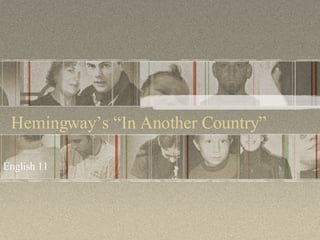
Hemingway’s “In Another Country” English 11
About World War I World War I was a nineteenth-century war fought with twentieth-century weapons; the military tactics lagged behind the capabilities of the weaponry.  As a result, casualties were staggering and the wounds extraordinary and appalling.  Although some soldiers came home with psychological wounds and others with illnesses, some were simply ripped apart.
About World War I It has been estimated that more than 12 percent of all injured soldiers suffered from facial wounds. Perhaps a third of these unfortunate men were permanently disfigured.  Polite society sometimes shunned them. Much of the support the hundreds of decorated veterans received was from their fellow victims.
About World War I Attempting to dignify their experience, they bonded together to form mutual-aid societies.
Hemingway’s experience Parts of this story describe experiences much like Hemingway’s own as a Red Cross volunteer during World War I. He didn’t take part in the fighting; he was an ambulance driver.  During one run he was hit by several fragments from a mortar shell and wounded. For this he received medals and glowing citations.
About the story True to Hemingway’s style, this story of a soldier in a World War I military hospital describes a time, but  does not create and then resolve a single conflict .  The narrator, an American serving as an officer in the Italian army during World War I, recuperates after a serious injury to his leg.
About the story He befriends other wounded soldiers, but once they decide his medals were awarded because he is an American while theirs were won for acts of valor and self-sacrifice, he feels  isolated  from them.  The narrator is “in another country” both physically and emotionally. It is a place where he feels no connection to anyone else.
As You Read Read the story (pp. 809-814) Write a double-entry diary, asking  5 questions  of the text Tie the questions to specific points – no generalizing the whole story. Be prepared to share your questions with others – so make them legitimate.
Citation Information from:  Prentice Hall Literature: Timeless Voices, Timeless Themes, the American Experience (Teacher’s Edition) . Upper Saddle River, NJ: Pearson Prentice Hall, 2005. 806.

Hemingway's "In Another Country"

  • 1.
    Hemingway’s “In AnotherCountry” English 11
  • 2.
    About World WarI World War I was a nineteenth-century war fought with twentieth-century weapons; the military tactics lagged behind the capabilities of the weaponry. As a result, casualties were staggering and the wounds extraordinary and appalling. Although some soldiers came home with psychological wounds and others with illnesses, some were simply ripped apart.
  • 3.
    About World WarI It has been estimated that more than 12 percent of all injured soldiers suffered from facial wounds. Perhaps a third of these unfortunate men were permanently disfigured. Polite society sometimes shunned them. Much of the support the hundreds of decorated veterans received was from their fellow victims.
  • 4.
    About World WarI Attempting to dignify their experience, they bonded together to form mutual-aid societies.
  • 5.
    Hemingway’s experience Partsof this story describe experiences much like Hemingway’s own as a Red Cross volunteer during World War I. He didn’t take part in the fighting; he was an ambulance driver. During one run he was hit by several fragments from a mortar shell and wounded. For this he received medals and glowing citations.
  • 6.
    About the storyTrue to Hemingway’s style, this story of a soldier in a World War I military hospital describes a time, but does not create and then resolve a single conflict . The narrator, an American serving as an officer in the Italian army during World War I, recuperates after a serious injury to his leg.
  • 7.
    About the storyHe befriends other wounded soldiers, but once they decide his medals were awarded because he is an American while theirs were won for acts of valor and self-sacrifice, he feels isolated from them. The narrator is “in another country” both physically and emotionally. It is a place where he feels no connection to anyone else.
  • 8.
    As You ReadRead the story (pp. 809-814) Write a double-entry diary, asking 5 questions of the text Tie the questions to specific points – no generalizing the whole story. Be prepared to share your questions with others – so make them legitimate.
  • 9.
    Citation Information from: Prentice Hall Literature: Timeless Voices, Timeless Themes, the American Experience (Teacher’s Edition) . Upper Saddle River, NJ: Pearson Prentice Hall, 2005. 806.