Shakespeare: A closer look English 9
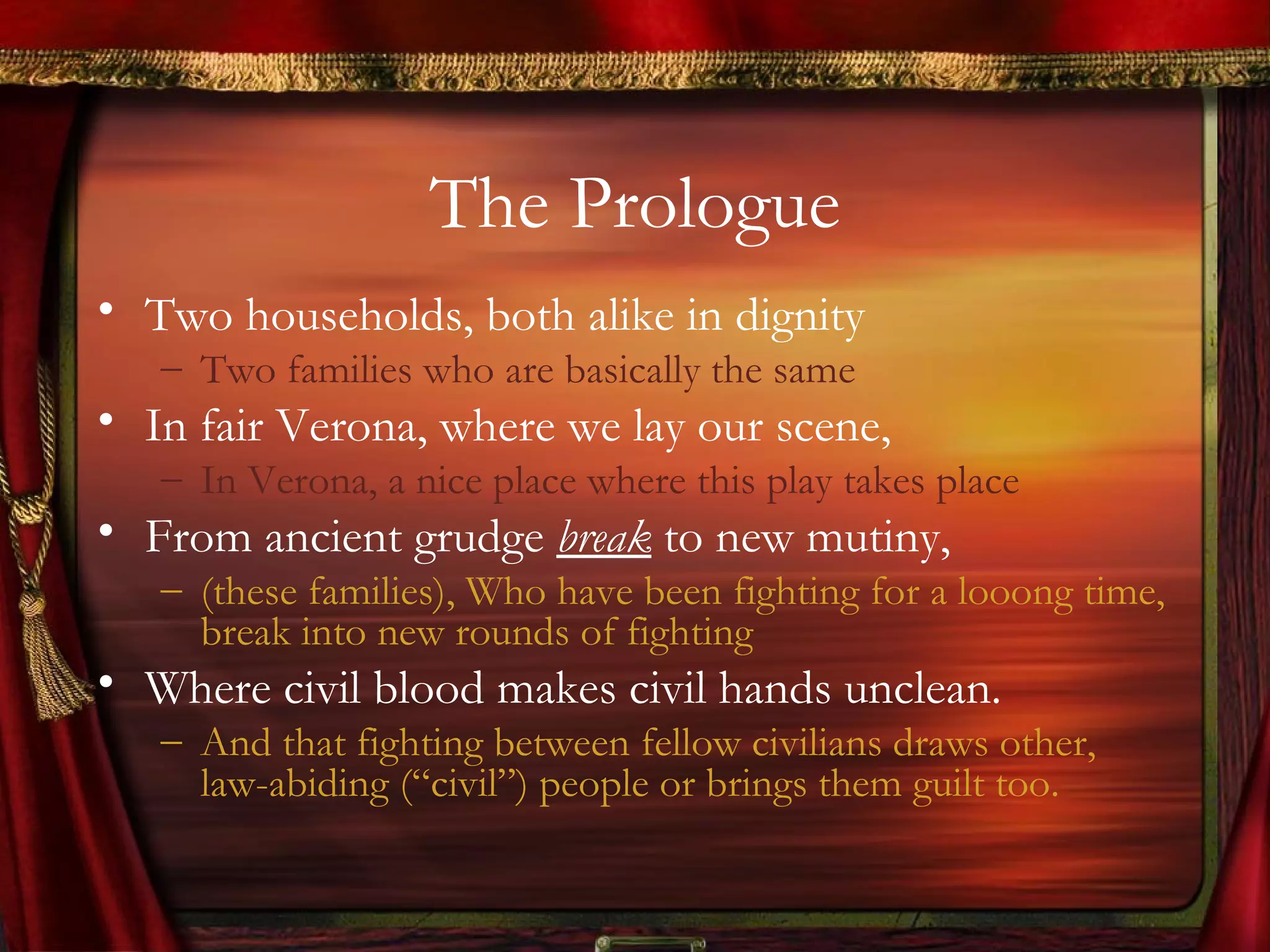
The Prologue Two households, both alike in dignity Two families who are basically the same In fair Verona, where we lay our scene, In Verona, a nice place where this play takes place From ancient grudge  break  to new mutiny, (these families), Who have been fighting for a looong time, break into new rounds of fighting Where civil blood makes civil hands unclean. And that fighting between fellow civilians draws other, law-abiding (“civil”) people or brings them guilt too.
The Prologue From forth the fatal loins of these two foes A pair of star-crossed lovers take their life; Each of these rival families had a child, and  they are the  doomed   lovers of the play Whose misadventured piteous overthrows Doth with their death bury their parents’ strife. And their tragic, sad story, which transcended the hatred of their families, ends with their death and finally finishes the war between the families.
The Prologue The fearful passage of their death-marked love, This scary way of their doomed love And the continuance of the parents’ rage, And the way their parents  continue to fight Which, but their children’s end, naught could remove, And that fighting could be stopped only by their children’s death Is now the two hours’ traffic of our stage; Is the topic of the coming play
The Prologue The which if you with patient ears attend, The play, if you will listen patiently  What here shall miss, our toil shall strive to mend. Will fill in anything that is unclear from our prologue.
The Prologue: Beyond the surface Word Play (puns!) – meaning one thing while bringing to mind another civil  blood makes  civil  hands unclean with their death  bury  their parents’ strife A pair of star-crossed lovers  take their life The fearful  passage  of their death-marked love Emerging themes Fate: fatal loins, star-crossed lovers Good coming from bad: Which, but their children’s end, naught could remove
Terms to know from Go! Aside : a character’s brief remark, made to the audience Another character can hear it only when explicitly mentioned in the text (“aside to Gregory”) Monologue : a long speech given by a character Other characters can hear it
Pun: defined A play on words The word in question means more than one thing, giving the statement a type of double meaning Example : Mercutio tells Romeo what his dream was about: Romeo : Well, what was yours? Mercutio : That dreamers often lie.
Oxymoron : defined A contradiction that at first seems impossible, but makes sense in the context it is used. paired opposites It is a literary play on words, similar to a pun.
Soliloquies Definition:  when a character talks to himself so the audience can hear. A character  always  tells the truth in a soliloquy. If other characters are on stage, they cannot hear the speaker’s words.
Romeo’s Soliloquy Hyperbole : when a writer exaggerates to highlight a point being made Imagery to look for Light (day, night, sun, moon, stars) What’s he doing?  Admiring her beauty Deciding whether to talk to her
Romeo’s soliloquy But soft! What light through yonder window breaks? It is the East, and Juliet is the sun! (ll. 2-3) Here begins the metaphor  and imagery of Juliet as  light. Note that Romeo exalts Juliet above the stars, sun, and moon.  Her eye discourses; I will answer it.  I am too bold; ‘tis not to me she speaks (ll. 13-14) He’s trying to decide whether to speak to her and whether he might be the object of her amorous looks.
Romeo’s soliloquy What if her eyes were there, they in her head? The brightness of her cheek would shame those stars As daylight doth a lamp; her eyes in heaven Would through the airy region stream so bright That birds would sing and think it were not night (ll. 18-22). Back to the light imagery, again exalting Juliet as a source of light Ever turn on a light during the day?  Connect  with the image. Note how  passionate  his speech is.
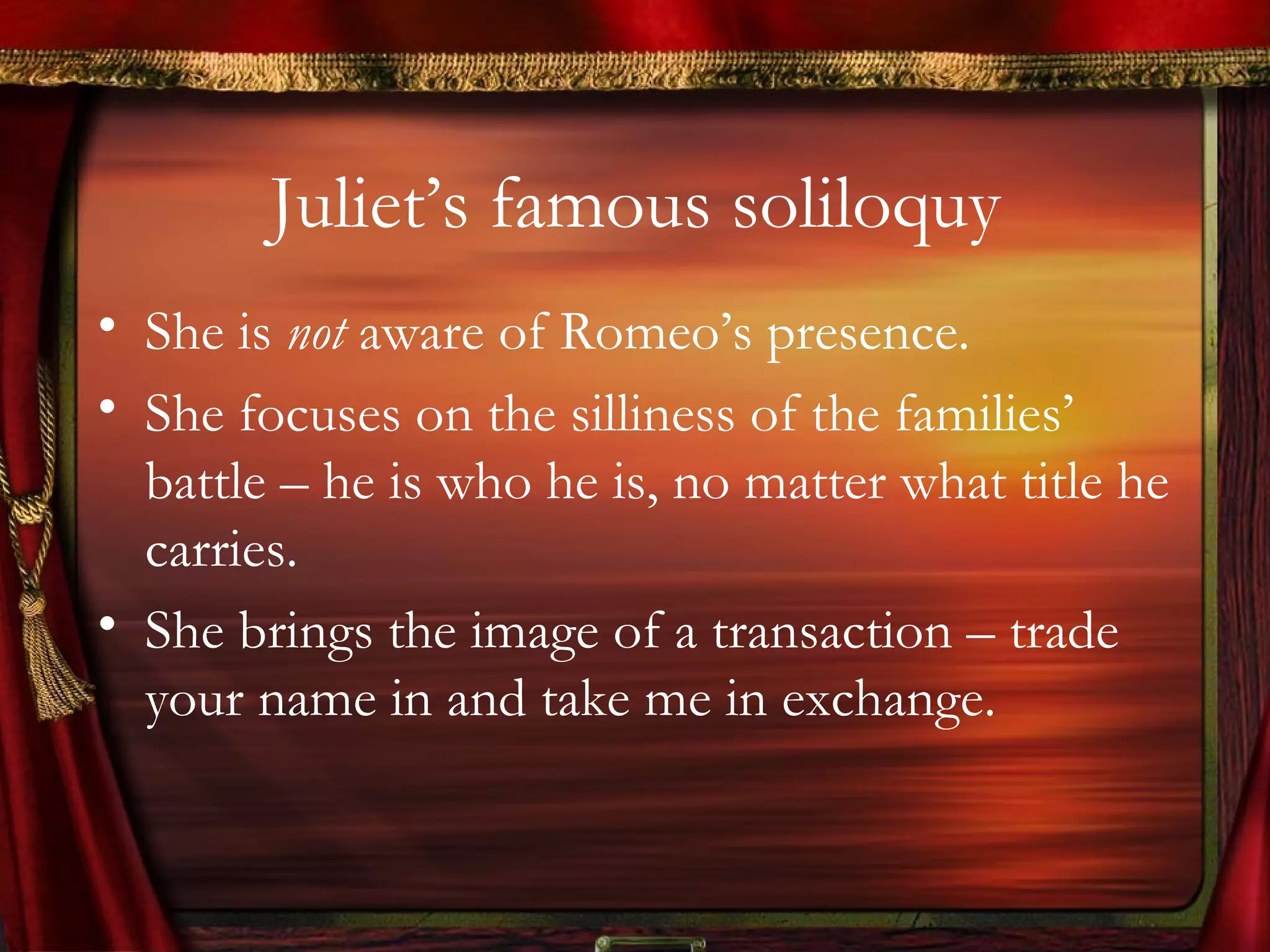
Juliet’s famous soliloquy She is  not  aware of Romeo’s presence. She focuses on the silliness of the families’ battle – he is who he is, no matter what title he carries. She brings the image of a transaction – trade your name in and take me in exchange.
Mercutio’s Last Words Continues to play, even in death “’ tis not so deep as a well, nor so wide as a church door; but ‘tis enough, ‘twill serve.”  “ Ask for me tomorrow, and you will find me a grave man.” “  . . . a cat, to scratch a man to death!” Moments of seriousness “ A plague on both your houses!”  (but what  about  this?) “ Why the devil came you between us?”
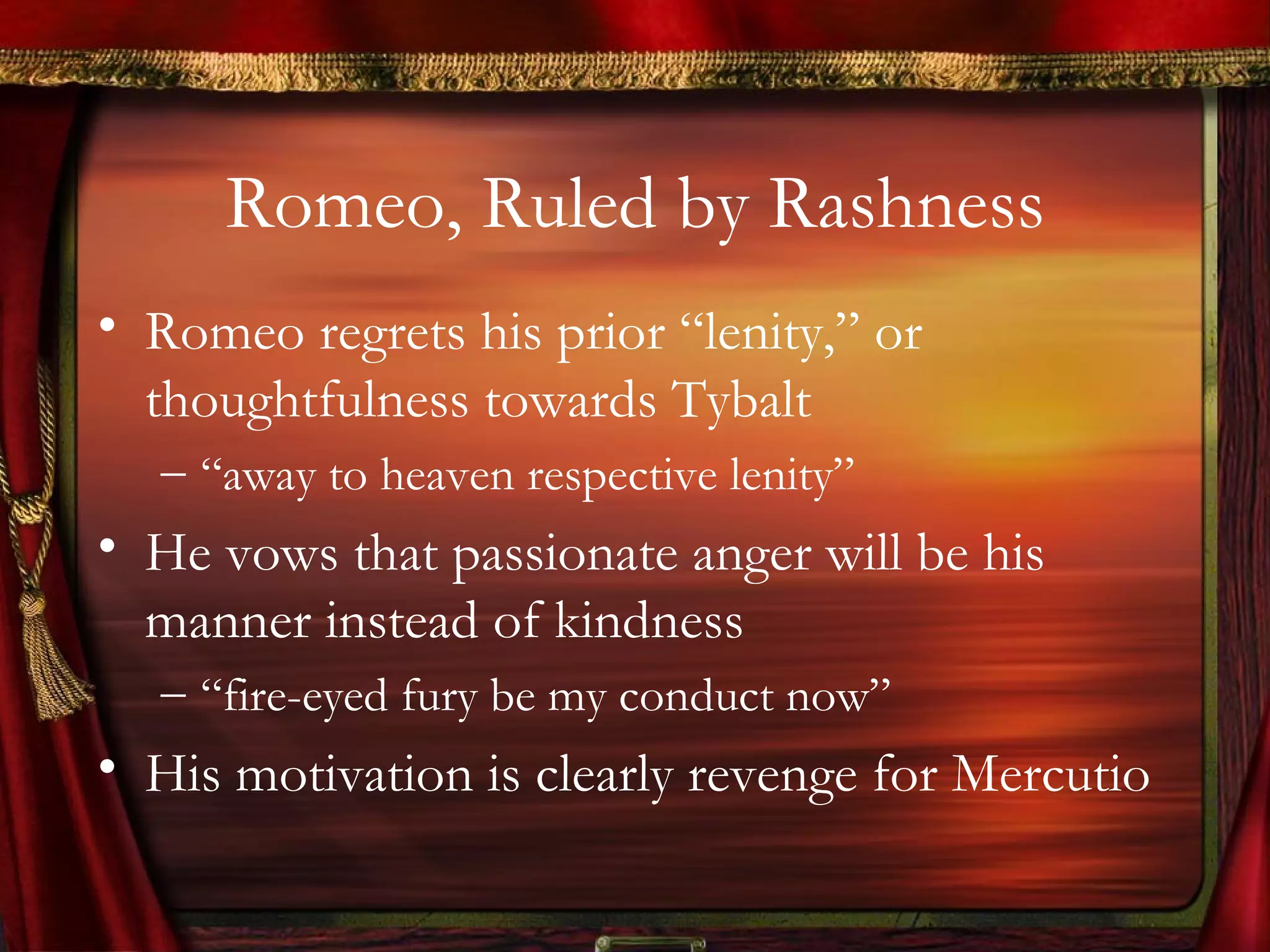
Romeo, Ruled by Rashness Romeo regrets his prior “lenity,” or thoughtfulness towards Tybalt “ away to heaven respective lenity” He vows that passionate anger will be his manner instead of kindness “ fire-eyed fury be my conduct now” His motivation is clearly revenge for Mercutio
Juliet’s Frustration with Romeo She laments the contradictions present in Romeo Waxes with a long list of oxymorons The theme is that Romeo is beautiful on the outside and ugly within This marks the only moment of wavering in Juliet’s love for Romeo Moments later, she will regret these thoughts
Papa Capulet goes overboard Here, Capulet finishes his train of abuse against Juliet with a threat The threat : wed Paris Thursday “or never after look me in the face” He declares to his wife that having her is having a curse “we have a curse in having her” Sounds like he’ll regret such anger, eh?
The Nurse’s worst advice Marry Paris – he’s hot “ I think it best you married with the County, O, he’s a lovely gentleman!” Still judging physical intimacy as the only important thing “ Your first is dead – or ‘twere as good he were As living here and you no use of him.” This is the last time Juliet trusts the Nurse
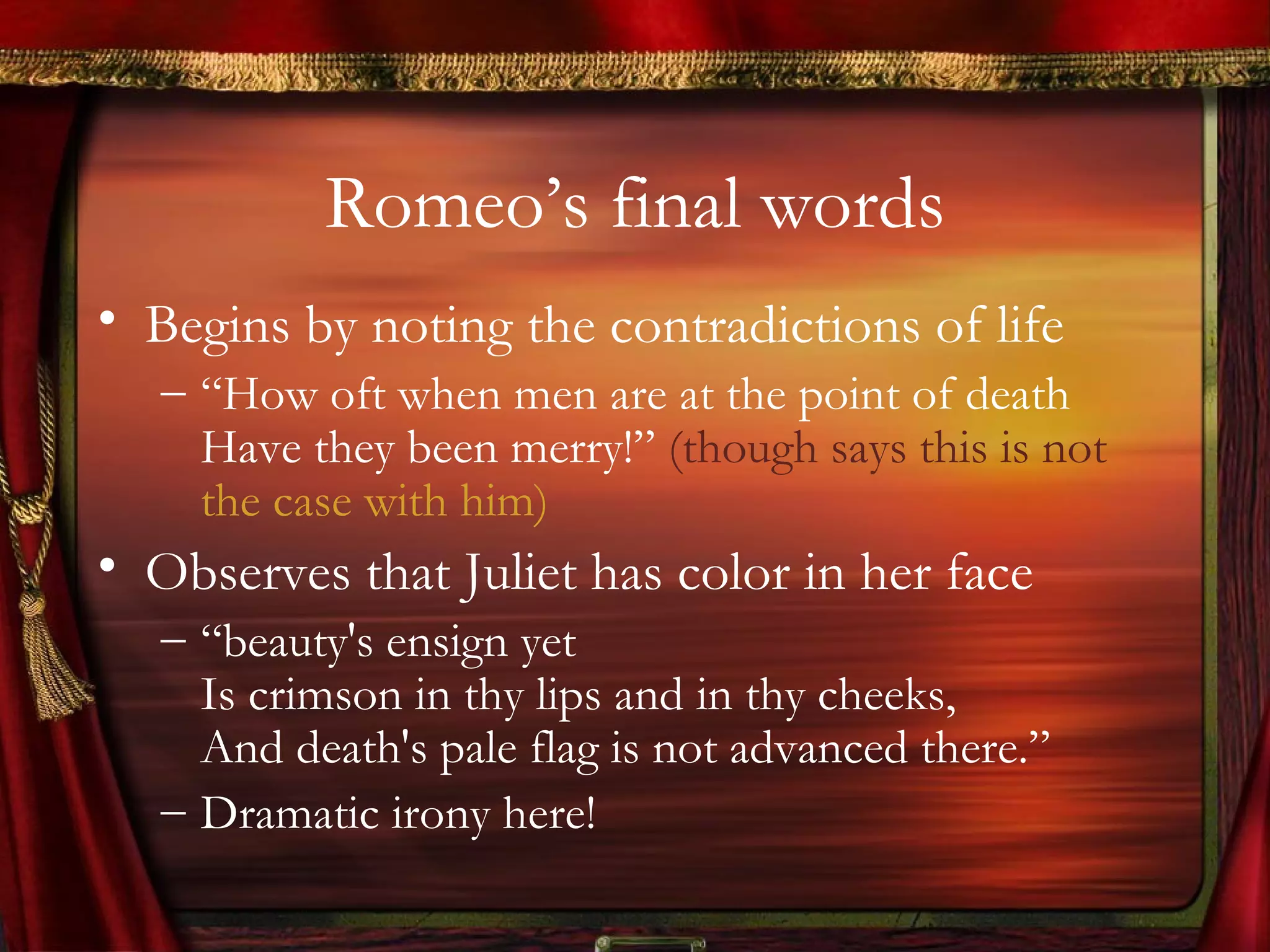
Romeo’s final words Begins by noting the contradictions of life “How oft when men are at the point of death Have they been merry!”  (though says this is not  the case with him) Observes that Juliet has color in her face “beauty's ensign yet Is crimson in thy lips and in thy cheeks, And death's pale flag is not advanced there.” Dramatic irony here!
Romeo’s final words Speaks of himself as a victim of fate “Thou desperate pilot, now at once run on The dashing rocks thy sea-sick weary bark!” “O, here / Will I . . . shake the yoke of inauspicious stars / From this world-wearied flesh.”

Romeo and Juliet: A closer look

  • 1.
    Shakespeare: A closerlook English 9
  • 2.
    The Prologue Twohouseholds, both alike in dignity Two families who are basically the same In fair Verona, where we lay our scene, In Verona, a nice place where this play takes place From ancient grudge break to new mutiny, (these families), Who have been fighting for a looong time, break into new rounds of fighting Where civil blood makes civil hands unclean. And that fighting between fellow civilians draws other, law-abiding (“civil”) people or brings them guilt too.
  • 3.
    The Prologue Fromforth the fatal loins of these two foes A pair of star-crossed lovers take their life; Each of these rival families had a child, and they are the doomed lovers of the play Whose misadventured piteous overthrows Doth with their death bury their parents’ strife. And their tragic, sad story, which transcended the hatred of their families, ends with their death and finally finishes the war between the families.
  • 4.
    The Prologue Thefearful passage of their death-marked love, This scary way of their doomed love And the continuance of the parents’ rage, And the way their parents continue to fight Which, but their children’s end, naught could remove, And that fighting could be stopped only by their children’s death Is now the two hours’ traffic of our stage; Is the topic of the coming play
  • 5.
    The Prologue Thewhich if you with patient ears attend, The play, if you will listen patiently What here shall miss, our toil shall strive to mend. Will fill in anything that is unclear from our prologue.
  • 6.
    The Prologue: Beyondthe surface Word Play (puns!) – meaning one thing while bringing to mind another civil blood makes civil hands unclean with their death bury their parents’ strife A pair of star-crossed lovers take their life The fearful passage of their death-marked love Emerging themes Fate: fatal loins, star-crossed lovers Good coming from bad: Which, but their children’s end, naught could remove
  • 7.
    Terms to knowfrom Go! Aside : a character’s brief remark, made to the audience Another character can hear it only when explicitly mentioned in the text (“aside to Gregory”) Monologue : a long speech given by a character Other characters can hear it
  • 8.
    Pun: defined Aplay on words The word in question means more than one thing, giving the statement a type of double meaning Example : Mercutio tells Romeo what his dream was about: Romeo : Well, what was yours? Mercutio : That dreamers often lie.
  • 9.
    Oxymoron : definedA contradiction that at first seems impossible, but makes sense in the context it is used. paired opposites It is a literary play on words, similar to a pun.
  • 10.
    Soliloquies Definition: when a character talks to himself so the audience can hear. A character always tells the truth in a soliloquy. If other characters are on stage, they cannot hear the speaker’s words.
  • 11.
    Romeo’s Soliloquy Hyperbole: when a writer exaggerates to highlight a point being made Imagery to look for Light (day, night, sun, moon, stars) What’s he doing? Admiring her beauty Deciding whether to talk to her
  • 12.
    Romeo’s soliloquy Butsoft! What light through yonder window breaks? It is the East, and Juliet is the sun! (ll. 2-3) Here begins the metaphor and imagery of Juliet as light. Note that Romeo exalts Juliet above the stars, sun, and moon. Her eye discourses; I will answer it. I am too bold; ‘tis not to me she speaks (ll. 13-14) He’s trying to decide whether to speak to her and whether he might be the object of her amorous looks.
  • 13.
    Romeo’s soliloquy Whatif her eyes were there, they in her head? The brightness of her cheek would shame those stars As daylight doth a lamp; her eyes in heaven Would through the airy region stream so bright That birds would sing and think it were not night (ll. 18-22). Back to the light imagery, again exalting Juliet as a source of light Ever turn on a light during the day? Connect with the image. Note how passionate his speech is.
  • 14.
    Juliet’s famous soliloquyShe is not aware of Romeo’s presence. She focuses on the silliness of the families’ battle – he is who he is, no matter what title he carries. She brings the image of a transaction – trade your name in and take me in exchange.
  • 15.
    Mercutio’s Last WordsContinues to play, even in death “’ tis not so deep as a well, nor so wide as a church door; but ‘tis enough, ‘twill serve.” “ Ask for me tomorrow, and you will find me a grave man.” “ . . . a cat, to scratch a man to death!” Moments of seriousness “ A plague on both your houses!” (but what about this?) “ Why the devil came you between us?”
  • 16.
    Romeo, Ruled byRashness Romeo regrets his prior “lenity,” or thoughtfulness towards Tybalt “ away to heaven respective lenity” He vows that passionate anger will be his manner instead of kindness “ fire-eyed fury be my conduct now” His motivation is clearly revenge for Mercutio
  • 17.
    Juliet’s Frustration withRomeo She laments the contradictions present in Romeo Waxes with a long list of oxymorons The theme is that Romeo is beautiful on the outside and ugly within This marks the only moment of wavering in Juliet’s love for Romeo Moments later, she will regret these thoughts
  • 18.
    Papa Capulet goesoverboard Here, Capulet finishes his train of abuse against Juliet with a threat The threat : wed Paris Thursday “or never after look me in the face” He declares to his wife that having her is having a curse “we have a curse in having her” Sounds like he’ll regret such anger, eh?
  • 19.
    The Nurse’s worstadvice Marry Paris – he’s hot “ I think it best you married with the County, O, he’s a lovely gentleman!” Still judging physical intimacy as the only important thing “ Your first is dead – or ‘twere as good he were As living here and you no use of him.” This is the last time Juliet trusts the Nurse
  • 20.
    Romeo’s final wordsBegins by noting the contradictions of life “How oft when men are at the point of death Have they been merry!” (though says this is not the case with him) Observes that Juliet has color in her face “beauty's ensign yet Is crimson in thy lips and in thy cheeks, And death's pale flag is not advanced there.” Dramatic irony here!
  • 21.
    Romeo’s final wordsSpeaks of himself as a victim of fate “Thou desperate pilot, now at once run on The dashing rocks thy sea-sick weary bark!” “O, here / Will I . . . shake the yoke of inauspicious stars / From this world-wearied flesh.”