Voluntary Exchange
Michael Alonzo
(This file is from ACDC Econ Concepts)
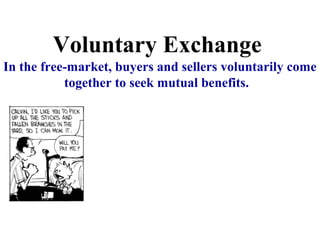
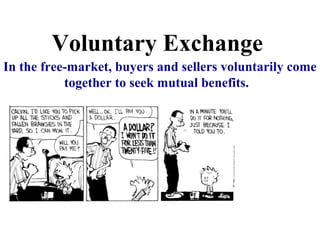
Voluntary Exchange
In the free-market, buyers and sellers voluntarily come
together to seek mutual benefits.
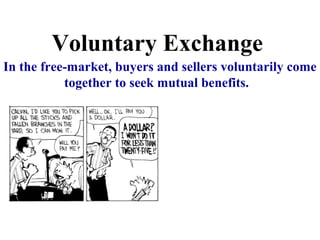
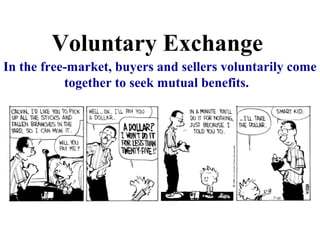
Voluntary Exchange
In the free-market, buyers and sellers voluntarily come
together to seek mutual benefits.
Voluntary Exchange
In the free-market, buyers and sellers voluntarily come
together to seek mutual benefits.
Voluntary Exchange
In the free-market, buyers and sellers voluntarily come
together to seek mutual benefits.
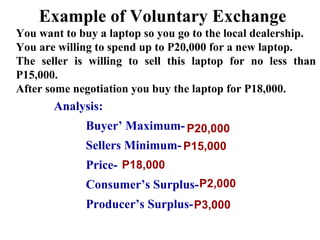
Example of Voluntary Exchange
You want to buy a laptop so you go to the local dealership.
You are willing to spend up to P20,000 for a new laptop.
The seller is willing to sell this laptop for no less than
P15,000.
After some negotiation you buy the laptop for P18,000.
Analysis:
Buyer’ Maximum-
Sellers Minimum-
Price-
Consumer’s Surplus-
Producer’s Surplus-
P20,000
P15,000
P18,000
P2,000
P3,000
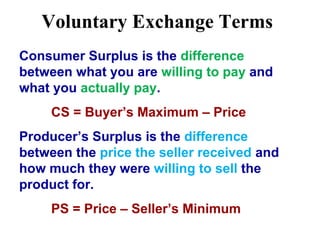
Consumer Surplus is the difference
between what you are willing to pay and
what you actually pay.
CS = Buyer’s Maximum – Price
Producer’s Surplus is the difference
between the price the seller received and
how much they were willing to sell the
product for.
PS = Price – Seller’s Minimum
Voluntary Exchange Terms
The Pearl Exchange
WARNING: Many students complain that
their teachers don’t do enough hands-on
activities. Many teachers complain that
hands-on activities are a waste of time because
the students slack off. I promise to create fun
and meaningful activities, if you promise to
actively participate and stay focused.
The Pearl Exchange
There will be four trading sessions.
In each session, you can only buy or sell ONCE.
When you make a deal, shake hands and come to the
board to record your negotiated price. Then go back to
your seat and record your surplus in the table.
If you do not make a sale or purchase, you take the
entire minimum or maximum price for a LOSS.
Are you the best negotiator in the class? Let’s find out.
Good Luck!
Supply and Demand Analysis
Easy as 1, 2, 3
1. Before the change:
• Draw supply and demand
• Label original equilibrium price and quantity
2. The change:
• Did it affect supply or demand first?
• Which determinant caused the shift?
• Draw increase or decrease
3. After change:
• Label new equilibrium?
• What happens to Price?
• What happens to Output (Quantity)?
Qo
P
11
S
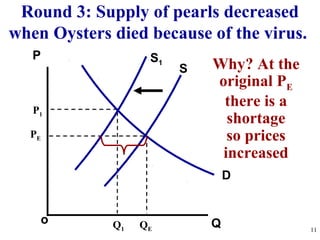
Round 3: Supply of pearls decreased
when Oysters died because of the virus.
Why? At the
original PE
there is a
shortage
so prices
increased
D
QE
PE
P1
Q1
S1
Voluntary Exchange Activity
Qo
P
13
D1
S
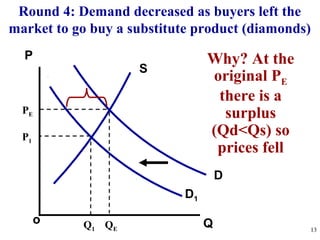
Round 4: Demand decreased as buyers left the
market to go buy a substitute product (diamonds)
Why? At the
original PE
there is a
surplus
(Qd<Qs) so
prices fell
D
QE
PE
P1
Q1

Pearl exchange and voluntary exchange

  • 1.
    Voluntary Exchange Michael Alonzo (Thisfile is from ACDC Econ Concepts)
  • 2.
    Voluntary Exchange In thefree-market, buyers and sellers voluntarily come together to seek mutual benefits.
  • 3.
    Voluntary Exchange In thefree-market, buyers and sellers voluntarily come together to seek mutual benefits.
  • 4.
    Voluntary Exchange In thefree-market, buyers and sellers voluntarily come together to seek mutual benefits.
  • 5.
    Voluntary Exchange In thefree-market, buyers and sellers voluntarily come together to seek mutual benefits.
  • 6.
    Example of VoluntaryExchange You want to buy a laptop so you go to the local dealership. You are willing to spend up to P20,000 for a new laptop. The seller is willing to sell this laptop for no less than P15,000. After some negotiation you buy the laptop for P18,000. Analysis: Buyer’ Maximum- Sellers Minimum- Price- Consumer’s Surplus- Producer’s Surplus- P20,000 P15,000 P18,000 P2,000 P3,000
  • 7.
    Consumer Surplus isthe difference between what you are willing to pay and what you actually pay. CS = Buyer’s Maximum – Price Producer’s Surplus is the difference between the price the seller received and how much they were willing to sell the product for. PS = Price – Seller’s Minimum Voluntary Exchange Terms
  • 8.
    The Pearl Exchange WARNING:Many students complain that their teachers don’t do enough hands-on activities. Many teachers complain that hands-on activities are a waste of time because the students slack off. I promise to create fun and meaningful activities, if you promise to actively participate and stay focused.
  • 9.
    The Pearl Exchange Therewill be four trading sessions. In each session, you can only buy or sell ONCE. When you make a deal, shake hands and come to the board to record your negotiated price. Then go back to your seat and record your surplus in the table. If you do not make a sale or purchase, you take the entire minimum or maximum price for a LOSS. Are you the best negotiator in the class? Let’s find out. Good Luck!
  • 10.
    Supply and DemandAnalysis Easy as 1, 2, 3 1. Before the change: • Draw supply and demand • Label original equilibrium price and quantity 2. The change: • Did it affect supply or demand first? • Which determinant caused the shift? • Draw increase or decrease 3. After change: • Label new equilibrium? • What happens to Price? • What happens to Output (Quantity)?
  • 11.
    Qo P 11 S Round 3: Supplyof pearls decreased when Oysters died because of the virus. Why? At the original PE there is a shortage so prices increased D QE PE P1 Q1 S1
  • 12.
  • 13.
    Qo P 13 D1 S Round 4: Demanddecreased as buyers left the market to go buy a substitute product (diamonds) Why? At the original PE there is a surplus (Qd<Qs) so prices fell D QE PE P1 Q1