The document describes a new rendering method called bidirectional ray tracing using adaptive radiosity textures. It separates surface interaction into diffuse and specular components. It computes the specular component on the fly during ray tracing, and stores the diffuse component (radiosity) in adaptive radiosity textures on diffuse surfaces. These textures adaptively subdivide to resolve sharp shadows. It uses a three-pass algorithm: 1) a size pass records visibility, 2) a light pass traces light rays to deposit photons and construct textures, 3) an eye pass traces eye rays to render the image using the textures. This hybrid approach aims to provide accurate global illumination simulation for realistic image synthesis.
![~ ComputerGraphics,Volume24, Number4, August1990
AdaptiveRadiosityTexturesfor BidirectionalRay Tracing
Paul S. Heckbert
Dept. of Electrical Engineering and Computer Science
University of California, Berkeley, CA 94720
Abstract
We present a rendering method designed to provide
accurate, general simulation of global illumination for re-
alistic image synthesis. Separating surface interaction into
diffuse plus specular, we compute the specular component
on the fly, as in ray tracing, and store the diffuse compo-
nent (the radiosity) for later-reuse, similar to a radiosity
algorithm. Radiosities are stored in adaptive radiosity tez-
lures (fezes) that record the pattern of light and shadow
on every diffuse surface in the scene. They adaptively sub-
divide themselves to the appropriate level of detail for the
picture being made, resolving sharp shadow edges auto-
matically.
We use a three-pass, bidirectional ray tracing algorithm
that traces rays from both the lights and the eye. The "size
pass" records visibility iufornmtion on diffuse surfaces; the
"light pass" progressivelytraces rays from lights and bright
surfaces to deposit photons on diffuse surfaces to construct
the radiosity textures; and the "eye pass" traces rays from
the eye, collecting light from diffuse surfaces to make a
picture.
CtL Categories: 1.3.3 [Computer Graphicsl: Picture/Image
Generation- display algorithms; 1.3.7 [Computer Graphics]:
Three-Dimensional Graphics and ReMism - visible line~surface
algorithms.
General Terms: algorithms.
Additional Key Words and Phrases: global illumination, den-
sity estimation, texture mapping, quadtree, adaptive subdivision,
sampling.
1 Introduction
The presentation is divided into four sections. We first discuss
previous work on the global illumination problem. Then we out-
line our bidirectional ray tracing approach in an intuitive way.
Next we describe our implementation and some early results. We
conclude with a summary of the method and of our experiences
to date.
Permission to copy without fee all or part of this material is granted
provided that the copies are not made or distributed for direct
commercial advantage, the ACM copyright notice and the title of the
publication and its date appear, and notice is given that copying is by
permission of the Association for Computing Machinery. To copy
otherwise, or to republish, requires a fee and/or specific permission.
2 The Global Illumination Problem
The primary goal of realistic image synthesis is the develop-
ment of methods for modeling and realistically rendering three-
dimensional scenes. One of the most chMlenging tasks of realistic
image synthesis is the accurate and efficient simulation of global
illumination effects: the illumination of surfaces in a scene by
other surfaces. Early rendering programs treated the visibility
(hidden surface) and shading tasks independently, employing a
local illumination model which assumed that the shading of each
surface is independent of the shading of every other surface. Lo-
cal illumination typically assumes that light comes from a finite
set of point light sources only. Global illumination models, on the
other hand~ recognize that the visibility and shading are interre-
lated: the shade of a sm'face point is determined by the shades
of all of the surfaces visible fl'om that point.
The intensity of light traveling in a given outgoing direction
o~t from a surface point is the integral of the incident inten-
sity times the bidirectional distribution function (BDF) over all
possible incoming directions in:
intensity(oWl) = fphere intensity(i~) BDF(in, o~t) d(in)
The bidirectional distribution function is the fraction of energy
reflected or transmitted from the incoming direction in = (¢i, Oi)
to the outgoing direction out = (¢o, 0o); it is the sum of the
bidirectional reflectance distribution function (BRDF) and the
bidirectional transmittance distribution function (BTDF). See
[Hall89] for a more detailed discussion of the physics of illumina-
tion. We will characterize previous global illumination algorithms
by the approximations they make to the above integral.
Because of the superposition properties of electromagnetic ra-
diatlon, we can segregate surface reflectance into two types: dif-
fuse and specular. We define diffuse interaction (both reflection
and transmission) to be the portion of interaction that scatters
fight equally in all directions, and specular interaction to be the
remaining portion. BDF = BDFdilf + BDF~pee. For many ma-
terials, specular interaction scatters light in only a small cone of
directions. When this cone includes just a finite number of direc-
tions, each a cone with solid angle zero, we call the interaction
ideal specular, otherwise, when the cone(s) have a positive finite
angle, we call it rough specular. Two examples of ideal specular
surfaces are: (1) a perfect mirror that reflects in one direction,
and (2) a perfect transmitter that refracts in one direction and
reflects in another. An ideal specular surface with micro-bumps
behaves statistically like a rough specular surface. Oar three
classes of interaction are diagrammed in figure 1.
©1990 ACM-O-89791-344-2/90/O0810145 $00.75 145](https://image.slidesharecdn.com/heckbertpsadaptiveradiositytexturesforbidirectionalr-130608110849-phpapp01/85/Heckbert-p-s__adaptive_radiosity_textures_for_bidirectional_r-1-320.jpg)
![O SIGGRAPH '90, Dallas, August 6-10, 1990
diffuse roughspecular ideal specular
Figure 1: Three classes of reflectance: diffuse, rough specular,
and ideal specular; showing a polar plot of the reflectance coeffi-
cient for fixed incoming direction and varying outgoing direction.
Transmittance is similar.
A diffuse surface appears equally bright from all viewing di-
rections, but a specular surface's brightness varies with viewing
direction, so we say that diffuse interaction is view-independent
while specular interaction is view-dependent. The simplest ma-
terials have a position-invariant, isotropic BDF consisting of a
linear combination of diffuse and ideal specular interaction, but
a fully-general BDF can simulate textured, anisotropic, diffuse
and rough specular surfaces.
2.1 Ray Tracing vs. l:tadiosity
The two most popular algorithms for global illumination are ray
tracing and radiosity. Ray tracing is both a visibility algorithm
and a shading algorithm~ but radiosity is just a shading algo-
rithm.
2.1.1 Ray Tracing
Classic ray tracing generates a picture by tracing rays from the
eye into the scene, reeursively exploring specularly reflected and
transmitted directions, and tracing rays towaxd point light sources
to simulate shadowing [Whitted80]. It assumes that the BDF
contains no rough specular, and that the incident light relevant
to the diffuse computation is a sum of delta functions in the di-
rection of each light source. This latter assumption implies a
local illumination model for diffuse.
A more realistic illumination model includes rough specular
BDF's and computes diffuse interaction globally. Exact simu-
lation of these effects requires the integration of incident light
over cones of finite solid angle. Ray tracing can be generalized
to approximate such computations using distribution ray trac-
ing [Cook84], ILee85], [Dippe85], [Cook86], [Kajiya86]. (We pro-
pose the name "distribution ray tracing" as an alternative to
the current name, "distributed ray tracing", which is confusing
because of its parallel hardware connotations.) In distribution
ray tracing, rays are distributed, either uniformly or stochasti-
cally, throughout any distributions needing integration. Many
rays must be traced to accurately integrate the broad reflectance
distributions of rough specular and diffuse surfaces: often hun-
dreds or thousands per surface intersection.
2.1.2 Radiosity
The term radiosity is used in two senses. First, radiosity is a
physical quantity equal to power per unit area, which determines
the intensity of light diffusely reflected by a surface, and second,
radiosity is a shading algorithm. The meaning of each use should
be clear by context.
The Classic radiosity algorithm subdivides each surface into
polygons and determines the fraction of energy diffusely radi-
ated from each polygon to every other polygon: the pair's form
]actor. From the form factors, a large system of equations is
constructed whose solution is the radiosities of each polygon
[SiegelS1], [Gora184], [Nishita85]. This system can be solved ei-
ther with Gauss-Seidel iteration or, most conveniently, with pro-
gressive techniques that compute the matrix and solve the sys-
tem a piece at a time [Cohen88]. Form factors can be determined
analytically for simple geometries [Siege181], [Baum89], but for
complex geometries a numerical approach employing a visibility
algorithm is necessary. The most popular visibility method for
this purpose is a hemicube computed using a z-buffer [Cohen85],
but ray tracing has recently been promoted as an alternative
[Wallace89], [Sillion89]. Classic radiosity assumes an entirely dif-
fuse reflectance, so it does not simulate specular interaction at
all.
The output of the radiosity algorithm is one radiosity value
per polygon. Since diffuse interaction is by definition view-inde-
pendent, these radiosities are valid from any viewpoint. The
radiosity computation must be followed by a visibility algorithm
to generate a picture.
The radiosity method can be generalized to simulate specu-
lar interaction by storing not just a single radiosity value with
each polygon, but a two-dimensional array [Imme186], [Shao88],
[Buckalew89]. The resulting algorithm, which we call directional
radiosity, simulates both diffuse and specular interaction globally,
but the memory requirements are so excessive as to be impracti-
cal.
2.1.3 Hybrid Methods
Ray tracing is best at speculax and radiosity is best at diffuse,
and the above attempts to generalize ray tracing to diffuse and
to generalize radiosity to specular stretch the algorithms beyond
the reflectance realms for which each is best suited, making them
less accurate and less efficient. Another class of algorithms is
formed by hybridizing the methods, using a two-pass algorithm
that applies a radiosity pass followed by the ray tracing pass.
This is the approach used by [Wallace87] and [Sillion89].
The first pass of Wallace's algorithm consists of classic radios-
ity extended to include diffuse-to-diffuse interactions that bounce
off planar mirrors. He follows this with a classic ray tracing pass
(implemented using a z-buffer). Unfortunately, the method is
limited to planar surfaces (because of the polygonization involved
in the radiosity algorithm) and to perfect planar mirrors.
Sillion's algorithm is llke Wallace's but it computes its form
factors using ray tracing instead of hemicubes. This eliminates
the restriction to planar mirrors. The method still suffers from
the polygonization inherent in the radiosity step, however.
2.2 Sampling Radlositles
Many of the sampling problems of ray tracing have been solved
by recent adaptive algorithms [WhittedS0], [Cook86], [Lee85],
[Dippe85], [Mitchel187], [Painter89], particularly for the simula-
tion of specular interaction. The sampling problems of the radios-
ity algorithm are less well studied, probably because its sampling
process is less explicit than that of ray tracing.
146](https://image.slidesharecdn.com/heckbertpsadaptiveradiositytexturesforbidirectionalr-130608110849-phpapp01/85/Heckbert-p-s__adaptive_radiosity_textures_for_bidirectional_r-2-320.jpg)
![~' ComputerGraphics,Volume24, Number4, August1990
We examine four data structures for storing radiosities: light
images, polygons, samples in 3-D, and textures. Several different
algorithms have been used to generate these data structures: ra-
diosities have been generated analytically, with hemicubes at the
receiver (gathering), with hemieubes at the sender (shooting),
and by tracing rays from the eye or from the light.
2.2.1 Light Images
The simplest data structure, the light image, simulates only shad-
ows, the first order effects of diffuse interreflection. Light images
are pictures of the scene from the point of view of each light
~ource. They are most often generated using the z-buffer shadow
algorithm, which saves the z-buffers of these light images and
uses them while rendering from the point of view of the eye to
test if visible points are in shadow [Wilhams78], [Reeves87]. This
shadow algorithm is more flexible than most, since it is not lim-
ited to polygons, but it is difficult to tune. Choosing the resolu-
tion for the light images is critical, since aliasing of shadow edges
results if the light images are too. coarse.
2.2.2 Polygonlzed l~adioslty
The Atherton-Weiler algorithm is another method for comput-
ing shadows that renders from the point of view of the lights
[Atherton78]. It uses the images rendered from the lights to gen-
erate "surface detail polygons", modifying the scene description
by splitting all polygons into shadowed and unshadowed portions
that are shaded appropriately in the final rendering from the eye.
Surface detail polygons are an example of polygonized radiosity,
the storage of radiosity as polygons. The shadows computed by
the Atherton-Weiler algorithm are a first-approximation to the
interrefiection simulated by radiosity algorithms.
The most common method for computing polygonized radios-
ity is, of course, the classic radiosity algorithm. A major prob-
lem with this Mgorithm is that surfaces are polygonized before
radiosities are computed. Difficulties result if this polygonization
is either too coarse or too fine.
Sharp shadow edges caused by small light sources can be un-
dersampled if the polygonization is too coarse, resulting in blur-
ring or abasing of the radiosities. Cohen developed the "sub-
structuring" technique in response to this problem [Cohen86].
It makes an initial pass computing radiosities at low resolution,
then splits polygons that appear to be in high-variance regions
and recomputes radiosities. Substructuring helps, but it is not
fully automatic, as the subdivision stopping criterion appears to
be a polygon size selected in some ad hoc manner. The limi-
tations of the method are further demonstrated by the absence
to date of radiosity pictures in published work exhibiting sharp
shadow edges.
The other extreme of radiosity problems is oversampling of
radiosities due to polygonization that is too fine for the hemicube.
The resulting quantization can be cured by adaptive subdivision
of the hemicube or of the light rays [Wallace89], [Baum89].
We conclude that polygonization criteria remain a difficult
problem for the radiosity method.
It is interesting to note the similaxities between radiosity al-
gorithms and the Atherton-Weiler algorithm. Conceptually, the
original radiosity method gathers light to each polygon by ren-
dering the scene from the point of view of each receiver, but
the progressive radiosity algorithm shoots light by rendering the
scene from the point of view of each sender (a light source). A
progressive radiosity algorithm using a hemicube is thus much
like repeated application of the Atherton-Weiler shadow algo-
rithm.
2.2.3 Samples in 3-D
l~adiosities can be computed using brute force distribution ray
tracing [Kajiya86], but the method is inefficient because it sam-
ples the slowly-varying radiosity function densely. To exploit the
coherence of radiosity values, Ward sampled the diffuse compo-
nent sparsely, and saved this information in a world space octree
[Ward88]. Because his algorithm shot rays from the eye toward
the lights, and not vice-versa, it had difficulty detecting light
sources reflected by specular surfaces.
2.2.4 Radiosity Texture
The fourth data structure for radiosities is the radiosity texture.
Instead of polygonizing each surface and storing one radiosity
value per polygon, radiosity samples are stored in a texture on
every diffuse surface in the scene [Arvo86]. Arvo called his tex-
tures "illumination maps". He computed them by tracing rays
from the light sources.
2.3 Light Ray Tracing
Rays traced from the eye we call eye rays and rays traced from the
lights we call light rays. We avoid the terms "forward ray tracing"
and "backward ray tracing" because they are ambiguous: some
people consider photon motion ~'forward', while others consider
Whitted's rays "forward".
Light ray tracing was originally proposed by Appel [Appe168],
who "stored" his radiosities on paper with a plotter. Light ray
tracing was proposed for beams in previous work with Hanra-
han [Heckbert84] where we stored radiosities as surface detail
polygons like Atherton-Weiler. This approach was modified by
Strauss, who deposited light directly in screen pixels when a dif-
fuse surface was hit by a beam, rather than store the radiosities
with the surface [Strauss88]. Watt has recently implemented light
beam tracing to simulate refraction at water surfaces [Wattg0].
Arvo used light ray tracing to compute his radiosity textures
[Arvo86]. Light ray tracing is often discussed but has been little
used, to date.
3 Bidirectional Ray Tracing Using Adap-
tive Radiosity Textures
In quest of realistic image synthesis, we seek efficient algorithms
for simulating global illumination that can accommodate curved
surfaces, complex scenes, and arbitrary surface characteristics
(BDF's), and generate pictures perceptually indistinguishable
from reality. These goals are not realizable at present, but we
can make progress if we relax our requirements.
147](https://image.slidesharecdn.com/heckbertpsadaptiveradiositytexturesforbidirectionalr-130608110849-phpapp01/85/Heckbert-p-s__adaptive_radiosity_textures_for_bidirectional_r-3-320.jpg)
![O SIGGRAPH '90, Dallas, August 6-10, 1990
We make the following assumptions:
(1) Only surfaces are relevant. The scattering or absorp-
tion of volumes can be ignored.
(2) Curved surfaces are important. The world is not
polygonal.
(3) Shadows, penumbras, texture, diffuse interreflection,
specular reflection, and refraction are all important.
(4) We can ignore the phenomena of fluorescence (light
wavelength crosstalk), polarization, and diffraction.
(5) Surface properties can be expressed as a linear com-
bination of diffuse and specular reflectance and trans-
mission functions:
BDF =kd~BRDFdity + ksrB1~DF~pec+
kdtBTDFdi// + kstBTDFspec
The coet-ficients klj are not assumed constant.
(6) Specular surfaces are not rough; all specular interac-
tion is ideal.
3.1 Approach
Our approach is a hybrid of radiosity and ray tracing ideas.
Rather than patch together these two Mgorithms, however, we
seek a simple, coherent, hybrid algorithm. To provide the great-
est generality of shape primitives and optical effects, we choose
ray tracing as the visibility algorithm. Because ray tracing is
weak at simulating global diffuse interaction, the principal task
before us is therefore to determine an etficient method for calcu-
lating radiosities using ray tracing.
To exploit the view-independence and coherence of radiosity,
we store radioslty with each diffuse surface, using an adaptive
radiosity texture, or rex. A rex records the pattern of light and
shadow and color bleeding on a surface. We store radiosity as
a texture, rather than as a polygonization, in order to decouple
the data structures for geometry and shading, and to facilitate
adaptive subdivision of radieslty information; and we store it
with the surface, ratlier than in a global octree [Ward88], or in a
light image, based on the intuition that radiosities are intrinsic
properties of a surface. We expect that the memory required for
rexes will not be excessive, since dense sampling of radiosity will
be necessary only where it has a high gradient, such as at shadow
edges.
Next we need a general technique for computing the rexes.
The paths by which photons travel through a scene can motivate
our algorithm (figure 2). We can characterize each interaction
along a photon's path from light (L) to eye (E) as either diffuse
(D) or specular (S). Each path can therefore be labeled with
some string in the set given by the regular expression L(D]S)*E.
Classic ray tracing simulates only LDS*E [LS*E paths, while
classic radioslty simulates only LD*E. Eye ray tracing has dif-
ficulty finding paths such as LS+DE because it doesn't know
where to look for specularly reflected light when integrating the
hemisphere. Such paths are easily simulated by light ray tracing,
however.
We digress for a moment to discuss units. Light rays carry
power (energy/time) and eye rays carry intensity (energy / (time
* projected area * solid angle)). Each light ray carries a fraction
Figure 2: Selected photon paths from light (L) to eye (E) by
way of diffuse (D) and specular (S) surfaces. For simplicity, the
surfaces shown are entirely diffuse or entirely specular; normally
each surface would be a mixture.
D
° /
Figure 3: Left: first level light ray tracing propagates photons
from the light to the first diffuse surface on a path (e.g. LD
and LSD); higher levels of progressive light ray tracing simulate
indirect diffuse interaction (e.g. LDD). Right: eye ray trac-
ing shoots rays from the eye, extracting radiosities from diffuse
surfaces (e.g. it traces DE and DSE in reverse).
of the total power emitted by the light.
We can simulate paths of the form LS*D by shooting light
rays (photons) into the scene, depositing the photon's power into
the rex of the first diffuse surface encountered (figure 3, left).
Such a light ray tracing pass will compute a first approximation
to the radiosities. This can be followed by an eye ray tracing pass
in which we trace DS*E paths in a backward direction, extract-
ing intensity from the rex of the first diffuse surface encountered
(figure 3, right). The net effect of these two passes will be the
simulation of all LS*DS*E paths. The rays of the two passes
"meet in the middle" to exchange information. To simulate dif-
fuse interreflection, we shoot progressively from bright surfaces
[Cohen88] during the light ray tracing pass, thereby accounting
for all paths: L(S*D)*S*E = L(D[S)*E. We call these two
passes the light pass and eye pass. Such bidirectional ray tracing
using adaptive radiosity textures can thus simulate all photon
paths, in principle.
Our bidirectional ray tracing algorithm is thus a hybrid. From
radiosity we borrowed the idea of saving and reusing the diffuse
component, whicil is view-independent, and from ray tracing we
borrowed the idea of discarding and recomputing the specular
component, which is view-dependent.
148](https://image.slidesharecdn.com/heckbertpsadaptiveradiositytexturesforbidirectionalr-130608110849-phpapp01/85/Heckbert-p-s__adaptive_radiosity_textures_for_bidirectional_r-4-320.jpg)
![~ ComputerGraphics,Volume24, Number4, August1990
3.2 All Sampling is Adaptive
There are three separate multidimensional sampling processes
involved in this approach: sampling of directions from the light,
sampling of directions from the eye (screen sampling), and sam-
pling of radiosity on each diffuse surface.
3.3 Adaptive Radiosity Textures (Rexes)
Rexes are textures indexed by surface parameters u and v, as in
standard texture mapping [Blinn76], [Heckbert86]. We associate
a rex with every diffuse or partially-diffuse surface. By using
a texture and retaining the initial geometry, instead of polygo-
nizing, we avoid the polygonized silhouettes of curved surfaces
common in radiosity pictures.
In the bidirectional ray tracing algorithm, the rexes collect
power from incident photons during the light pass, and this in-
formation is used to estimate the true radiosity function during
the eye pass (figure 4). Our rexes thus serve much like den-
sity estimators that estimate the probability density of a random
variable from a set of samples of that random variable [Silver-
man86]. Density can be estimated using either histogram meth-
ods, which subdivide the domain into buckets; or kernel estima-
tors, which store every sample and reconstrnct the density as a
sum of weighted kernels (similar to a spline).
The resolution of a rex should be related to its screen size.
Ideally, we want to resolve shadow edges sharply in the final
picture, which means that rexes should store details as fine as
the preimage of a screen pixel. On the other hand, resolution
of details smaller than this is unnecessary, since subpixel detail
is beyond the Nyquist limit of screen sampling. Cohen's sub-
structuring technique is adaptive, but its criteria appear to be
independent of screen space, so it cannot adapt and optimize the
radiosity samples for a particular view.
To provide the light pass with information about rex resolu-
tion we precede the light pass with a size pass in which we trace
rays from the eye, labeling each diffuse surface with the minimum
rex feature size.
3.8.1 Adaptive Light Sampling
Adaptive sampling of light rays is desirable for seYeral reasons.
Sharp resolution of shadow edges requires rays only where the
light source sees a silhouette. Also, it is only necessary to trace
light paths that hit surfaces visible (directly or indirectly) to the
eye. Thirdly, omnidirectional lights disperse photons in a sphere
of directions, but when such lights are far from the visible scene,
as is the sun, the light ray directions that affect the final picture
subtend a small solid angle. Finally, stratified sampling should be
used for directional lights to effect their goniometric distribution.
Thus, to avoid tracing irrelevant rays, we sample the sphere of
directions adaptively [Sillion89], [Wallace89].
For area light sources, we use stratified sampling to distribute
the ray origins across the surface with a density proportional to
the local radiosity. Stratified sampling should also be used to
shoot more light rays near the normal, since it is intensity that
is constant with outgoing angle, while power is proportional to
the cosine of the angle with the normal. If the surface has both a
standard texture and a rex mapped onto it, then the rex should
be modulated by this standard texture before shooting. With
Figure 4: Photons incident on a rex (shown as spikes with height
proportional to power) are samples from the true, piecewise-
continuous radiosity function (the curve). We try to estimate
the function from the samples.
area light sources, the distribution to be integrated is thus four-
dimensional: two dimensions for surface parameters u and v,
and two dimensions for ray direction. For best results, a 4-D
data structure such as a k-d tree should be used to record and
adapt the set of light rays used.
3.3.2 Adaptive Eye Sampling
Eye rays (screen pixels) are sampled adaptively as well. Tech-
niques for adaptive screen sampling have been covered well by
others [Warnock69], [Whitted80], [Mitchell87], [Painter89].
3.4 Three Pass Algorithm
Our bidirectional ray tracing algorithm thus has three passes.
We discuss these passes here in a general way; the details of a
particular implementation are discussed in §4. The passes are:
size pass - record screen size information in each rex
light pass - progressively trace rays from lights and bright
surfaces, depositing photons on diffuse surfaces to
construct radiosity textures
eye pass - trace rays from eye, extracting light from dif-
fuse surfaces to make a picture
Specular reflection and transmission bounces are followed on all
three passes. Distribution ray tracing can be used in all passes
to simulate the broad distributions of rough specular reflections
and other effects.
3.4.1 Size Pass
As previously described, the size pass traces rays from the eye,
recording information about the mapping between surface pa-
rameter space and screen space. This information is used by each
rex during the light pass to terminate its adaptive subdivision.
3.4.2 Light Pass
Indirect diffuse interaction is simulated during the llght pass by
regarding bright diffuse surfaces as light sources, and shooting
light rays from them~ as in progressive radiosity. The rex records
the shot and unshot power.
149](https://image.slidesharecdn.com/heckbertpsadaptiveradiositytexturesforbidirectionalr-130608110849-phpapp01/85/Heckbert-p-s__adaptive_radiosity_textures_for_bidirectional_r-5-320.jpg)
![@SIGGRAPH '90, Dallas, August 6-10, 1990
The adaptive algorithm for light ray tracing must ensure that:
(a) a minimum level of light sampling is achieved; (b) more rays
are devoted near silhouettes, shadows, and high curvature areas;
(c) sharp radiosity gradients are resolved to screen pixel size; and
(d) light rays and rexes are subdivided cooperatively.
3.4.3 Eye Pass
The eye pass is like a standard ray tracing algorithm except that
the diffuse intensity is extracted out of the text instead of from a
shadow ray. The radiosity of a surface patch is its power divided
by its world-space surface area.
After the three passes are run, one could move the eye point
and re-run the eye pass to generate other views of the seen% but
the results would be inferior to those made by recomputing the
rexes adapted to the new viewpoint.
3.4.4 Observations
Because light rays are concentrated on visible portions of the
scene and radlosity is resolved adaptive to each surface~s projec-
tion in screen space, the radiosity calculation performed in the
light pass is view-dependent. But this is as it should be: al-
though the exact radiosity values are view-independent, the ra-
diosity sample locations needed to make a picture are not. When
computing moving-camera animation~ one could prime the rexes
by running the size pass for selected key frames to achieve more
view-independent sampling.
4 Implementation and Results
The current implementation realizes many, but not all, of the
ideas proposed here. It performs bidirectional ray tracing using
adaptive sampling for light~ eyed and rex. It has no size pass e
just a light pass and an eye pass. The program can render scenes
consisting of CSG combinations of spheres and polyhedra. Spec-
ular interaction is assumed ideal, and diffuse transmission is not
simulated. The light pass shoots photons from omnidirectional
point light sources, and does not implement progressive radios-
ity. The implementation thus simulates only iS*DS*E paths at
present. We trace ray trees, not just ray paths [Kajiya86].
4.0.5 Data Structures
Quadtrees were used for each of the 2-D sampling processes
[Samet90]: one for the outgoing directions of each light, one for
the parameter space of each radiosity texture, and one for the
eye.
The light and eye quadtrees are quite similar; their records
are shown below in pseudocode. Each node contains pointers to
its child nodes (if not a leaf) and to its parent node. Light space
is parameterized by (r,s), where r is latitude and s is longitude.
and eye space (screen space) is parameterized by (x,y). Each
node represents a square region of the parameter space whose
corner is given by (to, so) or (x0, y0) and whose size is propor-
tional to 2 -level.
low
Figure 5: I~ex quadtree on a surface. Adaptive fez subdivision
tries to subdivide more finely near a shadow edge.
The light quadtree sends one light ray per node at a location
uniformly distributed over the square. Also stored in each light
quadtree node is the ID of the surface hit by the light ray, if any,
and the surface parameters (u, v) at the intersection point. This
information is used to determine the distance in parameter space
between rex hits.
Eye quadtrees are simpler. Each node has pointers to the
intensities at its corners. These are shared with neighbors and
children. Eye ray tracing is currently uniform, not stochastic.
A rex quadtree node represents a square re,on of (u, v) pa-
rameter space on a diffuse surface (figure 5). Leaves in the rex
quadtree act as histogram buckets~ accumulating the number of
photons and their power. Rex nodes also record the world space
surface area of their surface patch.
lisht_node: type =
record
leaf: boolean;
mark: boolean;
level: int;
parent: "lisht_node;
nw, ne, se, ss: "light_node;
tO, sO: real;
r~ e: real;
surfnc: int;
u, v: real;
end;
eye_node: type =
record
leaf: boolean;
mark: boolean;
level: int;
parent: "eye_node;
nw, ne. se, sw: "eye_node;
xO. yO: real;
inw. ine. ise. is,: "color;
end;
{LIGHT QUADTREE NODE>
{is this a leaf?>
{should node be split?}
{level in tree (rook=O)}
{parent node. if any}
{four child/sn, if not a leaf}
{params of corner of square}
{dir. params o2 ray (lat.lon)}
{id of surface hit. if any}
{surf params of surface hit}
{EYE QUADTREE NODE}
{is this a leaf?}
{should node be split?}
{level in tree (root=O)}
{parent node. if any}
{four children, if not a leaf}
{coords of corner of square}
{intensity samples at corners}
rex_node: type =
record
leaf: boolean;
mark: boolean;
level: int;
parent: "rex_node;
nw, ne, se, sw: "rex_node;
nO. vO: real;
area: real;
count: int;
power: color;
end;
{REX QUADTREENODE}
{is this a leaf?}
{should node be split?}
{level in tree (root=O)}
{parent node. if any}
{four children, if not a leaf}
{surf params of square corner}
{surface area of this bucket}
{~photon~ in bucket, if leaf}
{accumulated power of bucket}
150](https://image.slidesharecdn.com/heckbertpsadaptiveradiositytexturesforbidirectionalr-130608110849-phpapp01/85/Heckbert-p-s__adaptive_radiosity_textures_for_bidirectional_r-6-320.jpg)
![~ ComputerGraphics,Volume24, Number4, August1990
1/16 1/16...
O0 i! 0
• • 0 o
Figure 6: Light quadtree shown schematically (left) and in light
direction parameter space (right). When a light quadtree node is
split, its power is redistributed to its four sub-nodes, which each
send a ray in a direction (r,s) jittered ~oithin their parameter
square. The fractional power of each light ray is shown next to
the leaf node that sends it.
The current implementation uses the following algorithm.
4.1 Light Pass
First, rex quaxitrees are initialized to a chosen starting level (level
3, say, for 8x8 subdivision), and the counts and powers of all
leaves are zeroed.
For each light, light ray tracing proceeds in breadth first order
within the light quadtree, at level 0 tracing a single ray carrying
the total power of the light, at level 1 tracing up to 4 rays, at level
2 tracing up to 16 rays, etc (figure 6). At each level, we adaptively
subdivide both the light quadtree and the rex quadtrees. Chang-
ing the rex quadtrees in the midst of light ray shooting raises
the histogram redistribution problem, however: if a histogram
bucket is split during collection, it is necessary to redistribute
the parent's mass among the children. There is no way to do this
reliably without a priori knowledge, so we clear the rex at the
beginning of each level and reshoot.
Processing a given level k of light rays involves three steps:
(1) rex subdivision to split rex buckets containing a high density
of photons, (2) light marking to mark light quadtree nodes where
more light rays should be sent, and (3) light subdivision to split
marked light nodes.
Rex subdivision consists of a sweep through every rex quadtree
in the scene, splitting all rex buckets whose photon count exceeds
a chosen limit. All counts and powers are zeroed at the end of
this sweep.
Light marking traverses the light quadtree, marking all level
k nodes that meet the subdivision criteria listed below.
(1) Always subdivide until a minimum level is reached.
(2) Never subdivide beyond a maximum level (if a size
pass were implemented, it would determine this max-
imum level locally).
Otherwise, look at the light quadtree neighbors above, below,
left, and right, and subdivide if the following is true:
(3) The ray hit a diffuse surface, and one of the four
neighbors of the rex node hit a different surface or
was beyond a threshold distance in (u, v) parameter
space from the center ray's.
To help prevent small feature neglect, we also mark for subdi-
vision all level k - 1 leaves that neighbor on level k leaves that
are m~ked for subdivision. This last rule guarantees a restricted
quadtree [Von Herzen87] where each leaf node's neighbors are at
a level within plus or minus one of the center node's.
Light subdivision traverses the light quadtree splitting the
marked nodes. Subdividing a node splits a ray of power p into
four rays of power p/4 (figure 6). When a light node is cre-
ated (during initialization or subdivision) we select a point at
random within its square (r, s) domain to achieve jittered sam-
pling [Cook86] and trace a ray in that direction. Marked nodes
thus shoot four new rays, while unmarked nodes re-shoot their
rays. During light ray tracing we follow specular bounces, split-
ting the ray tree and subdividing the power according to the re-
flectance/transmittance coefficients kij, and deposit their power
on any diffuse surface that are hit. When a diffuse surface is hit,
we determine (u,v) of the intersection point, and descend the
surface's rex quadtree to find the rex node containing that point.
The power of that node is incremented by the power of the ray
times the cosine of the incident angle.
4.2 Eye Pass
The eye pass is a fairly standard adaptive supersampling ray
tracing algorithm: nodes are split when the intensity difference
between the four corners exceeds some threshold. To generate a
picture, nodes larger than a pixel perform bilinear interpolation
to fill in the pixels they cover, while nodes smaller than a pixel
are averaged together to compute a pixel. The picture is stored
in floating point format initially, then scaled and clamped to the
range [0,255] in each channel.
4.3 Results
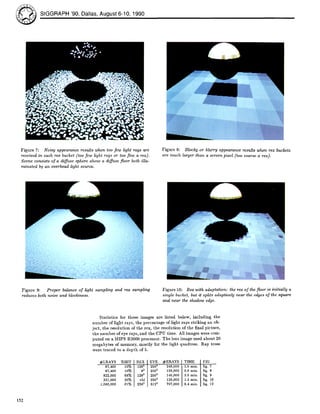
Figures 7-12 were generated with this program. Figures 7, 8, and
9 show the importance of coordinating the light ray sampling pro-
cess with the rex resolution. Sending too few light rays results
in a noisy radiosity estimate from the rex, and too coarse a rex
results in blocky appearance. When the rex buckets are approxi-
mately screen pixel size and the light ray density deposits several
photons per bucket (at least 10, s~y), the results are satisfac-
tory. We estimate the radiosity using a function that is constant
within each bucket; this simple estimator accounts for the blocki-
ness of the images. If bilinear interpolation were used, as in most
radiosity algorithms, we could trade off blockiness for blurriness.
Figure 10 shows adaptive subdivision of a rex quadtree, split-
ting more densely near shadow edges (the current splitting cri-
teria cause unnecessary splitting near the border of the square).
Its rex quadtree is shown in figure 11.
Figure 12 shows off some of the effects that are simulated by
this algorithm.
151](https://image.slidesharecdn.com/heckbertpsadaptiveradiositytexturesforbidirectionalr-130608110849-phpapp01/85/Heckbert-p-s__adaptive_radiosity_textures_for_bidirectional_r-7-320.jpg)
![~ ComputerGraphics,Volume24, Number4, August1990
Figure 11: Rex quadtree in (u, v) space of previous figure's floor.
Each leaf node's square is colored randomly. Note the subdivision
near the shadow edge and the quadtree restriction.
5 Conclusions
The bidirectional ray tracing algorithm outlined here appears to
be an accurate, general approach for global illumination of scenes
consisting of diffuse and pure specular surfaces. It is accurate be-
cause it can account for all possible light paths; and it is general
because it supports both the radiosity and ray tracing realms:
shapes bosh planar and curved materials both diffuse and spec-
ular, and lights both large and small. Distribution ray tracing
can be used to simulate effects not directly supported by the
algorithm.
Adaptive radiosity textures (rexes) are a new data struc-
ture that have several advantages over previous radiosity storage
schemes. They can adaptively subdivide themselves to resolve
sharp shadow edges to screen pixel size, thereby eliminating vis-
ible artifacts of radiosity sampling. Their subdivision can be
automatic, requiring no ad hoc user-selected parameters.
The current implementation is young, however, and many
problems remain. A terse fist follows: Good adaptive sampling
of area light sources appears to require a 4-D data structure. Bet-
ter methods are needed to determine the number of light rays.
The redistribution problems of histograms caused us to send each
light ray multiple times. To avoid this problem we could store
all (or selected) photon locations using kernel estimators [Sil-
verman86]. Excessive memory is currently devoted to the light
quadtree, since one node is stored per light ray. Perhaps the
quadtree could be subdivided in more-or-less scanline order, and
the memory recycled (quadtree restriction appears to complicate
this, however). Adaptive subdivision algorithms that compare
the ray trees of neighboring rays do not mix easily with path
tracing and distribution ray tracing, because the latter obscure
coherence. Last but not least, the interdependence of light ray
subdivision and rex subdivision is precarious.
Figure 12: Light focusing and reflection from a lens and chrome
ball. Scene is a glass lens formed by CSG intersection of two
spheres, a chrome ball, and a diffuse floor~ illuminated by a light
source off screen to the right. Note focusing of light through lens
onto floor at center (an LSSD path), reflection of refracted light
off ball onto floor (an LSS SD path involving both transmission
and reflection), the reflection of light off lens onto floor forming
a parabolic arc (an LSD path), and the reflection of the lens in
the ball (a LSSDSSE path, in full).
In spite of these challenges, we are hopeful. The approach
of bidirectional ray tracing using adaptive radiosity textures ap-
pears to contain the mechanisms needed to simulate global illu-
mination in a general way.
6 Acknowledgements
Thanks to Greg Ward for discussions about the global illumina-
tion problem, to Steve Omohundro for pointing me to the density
estimation literature, to Ken Turkowski and Apple Computer for
financial support, and to NSF grant CDA-8722788 for "Mam-
moth" time.
7 References
[Appe168] Arthur Appel, "Some Techniques for Shading Machine Render-
ings of Solids", AFIPS 1968 Spring Joint Computer Con].,col. 32,
1968, pp. 37-45.
[Arvo86] James Afro, "Backward Ray Tracing", SIGGRAPH '86Develop-
ments in Ray Tracingseminar notes,Aug. 1986.
[Atherton?8] Peter R. Atherton, Kevin Weiler, Donald P. Greenberg, "Poly-
gon Shadow Generation°, Computer Graphics(SIGGRAPH '78 Pro-
ceedings), vol. 12, no. 3, Aug. 1978~pp. 275-281.
[Baurn89] Daniel R. Baum, Holly E. Rushmeier, James M. Winget, "Im-
proving lqadiosity Solutions Through the Use of Analytically Deter-
mined Form Factors", Computer Graphics(SIGGRAPH '89 Proceed-
ings), col. 23, no. 3, July 1989, pp. 325-334.
[BlJnn76] James F. Blinn, Martin E. Newell, "Texture and Reflection in
Computer Generated Images", CACM, col. 19, no. 10, Oct. 1976,
pp. 842-547.
153](https://image.slidesharecdn.com/heckbertpsadaptiveradiositytexturesforbidirectionalr-130608110849-phpapp01/85/Heckbert-p-s__adaptive_radiosity_textures_for_bidirectional_r-9-320.jpg)
![@SIGGRAPH '90, Dallas, August 6-10, 1990
[Buckalew89] Chris Buckalew, Donald FusseU, "Illumination Networks: Fast
Realistic Rendering with General Reflectance Functions", Computer
Graphics (SIGGRAPH '89 Proceedings), vol. 23, no. 3, July 1989,
pp. 89-98.
[Cohengg] Michael F. Cohen, Donald P. Greenberg, "The Hemi-Cube: A
Radiosity Solution for Complex Environments", Computer Graphics
(SIGGRAPH '85 Proceedings), vol. 19, no. 3, July 1985, pp. 31-40.
[Cohen86] Michael F. Cohen, Donald P. Greenberg, David S. ]rnmel, Philip
J. Brock, "An Efficient Radiosity Approach for Realistic Image Syn-
thesis", [EEE Computer Graphics and Applications, Mar. 1986, pp.
26-35.
[CohenS8] Michael F. Cohen, Shenehang Eric Chen, John R. Wallace, Don-
ald P. Greenberg, "A Progressive R.ellnement Approach to Fast R.~.-
diosity Image Generation", Computer Graphics(SIGGRAPH '88 Pro-
eeedings), vol. 22, no. 4, Aug. 1988, pp. 75-84.
[Cook84] Robert L. Cook, Thomas Porter, Loren Carpenter, "Distributed
Ray Tracing", Computer Graphics(SIGGRAPH '84 Proceedings), vol.
18, no. 3, July 1984, pp. 137-145.
[Cook86] P~obert L. Cook, "Stocha~stie Sampling in Computer Graphics",
ACM Transactions on Graphics, vol. 5, no. 1, Jan. 1986, pp. 51-72.
[Dippe851 Mark A. Z. Dippe, Erling Henry Wold, "Antiallaslng Through
Stochastic Sampling", Computer Graphics(SIGGRAPH '85 Proceed-
ings), vol. 19, no. 3, July 1985, pp. 69-78.
[Gora184] Cindy M. Goral, Kenneth E. Torrance, Donald P. Greenberg,
Bennett Battaile, "Modeling the Interaction of Light Between Diffuse
Surfaces", Computer Graphics(SIGGRAPH '84 Proceedings), vol. 18,
no. 3, July 1984, pp. 213-222.
[Hallg9] Roy Hall, Rlumination and Color in Computer Generatedlmagery,
Springer Verlag, New York, 1989.
[I-Iockbert84] Paul S. Heekbert, Pat Hanrahan, "Beam Tracing Polygonal
Objects", Computer Graphics (SIGGRAPH '84 Proceedings), vol. 18,
no. 3, July 1984, pp. 119-127.
[Heckbert86] Paul S. Heckbezt, "Survey of Texture Mapping", 1EEE Com-
puter Graphicsand Applications, vol. 6, no. 11, Nov. 1986, pp. 56-67.
[ImmelS6~ David S. Immel, Michael F. Cohen, Donald P. Greenherg, "A
Radiosity Method for Non-Diffuse Environments", Computer Graphics
(SIGGRAPH '86 Proceedings), vol. 20, no. 4, Aug. 1986, pp. 133-
142.
[Kajiya88] James T. Kajiya, "The Rendering Equation", Computer Graph-
ics (SIGGRAPH '86 Proceedings), vol. 20, no. 4, Aug. 1986, pp.
143-150.
[Lee85] Mark E. Lee, 1Lichard A. Redner, Samuel P. Uselton, "Statistically
Optimized Sampling for Distributed Ray Tracing", Computer Graph-
ics (SIGGRAPH '85 Proceedings), vol. 19, no. 3, July 1985, pp.
61-67.
[Mitchell87] Don P. Mitchell, "Generating Antialiased Images at Low Sam-
piing Densities", Computer Graphics (SIGGRAPH '87 Proceedings),
vol. 21, us. 4, July 1987, pp. 65-72.
[INishita85] Tomoyukilqishita, EihachiroNakamae, "Continuous Tone Rep-
resentation of 3-D Objects Taking Account ofShadows and lute,reflec-
tion", Computer Graphics (SIGGRAPH '85 Proceedings), voh 19, no.
3, July 1985, pp. 23-30.
[Painter89] James Painter, Kenneth S]oan, "Antialiased Ray Tracing by
Adaptive Progressive Refinement", Computer Graphics(SIGGRAPH
'89 Pxoceedings), vol. 23, no. 3, July 1989, pp. 281-288.
[Keeves87] William T. Reeves, David H. Salesin, Robert L. Cook, "Ren-
dering Antialiascd Shadows with Depth Maps", Computer Graphics
(SIGGRAPH '87 Proceedings), vol. 21, no. 4, July 1987, pp. 283-291.
[Samet90] Hanan Samet, The Design and Analysis of Spatial Data Struc-
tures, Reading, MA, Addison-Wesley, 1990.
[Shaog8] Min-Zhi ShaD, Qun-Slieng Peng, You-Dong Liang, "A New Ra-
diosity Approach by Procedural Refinements for Realistic Image Syn-
thesis", Computer Graphics (SIGGRAPH '88 Proceedings), vol. 22,
us. 4, Aug. 1988, pp. 93-101.
[Siegel81] Robert Siegel, John R. Howell, Thermal Radiation Heat Trans-
fer, Hemisphere Publishing Corp., Washington, DC, 1981.
[SiUion89] Francois Sillion, Claude Puech, ~A General Two-Pass Method
Integrating Specular and Diffuse ReflectionS, Computer Graphics(SIC-
GRAPH '89 Proceedings), vol. 23, no. 3~July 1989~ pp. 335-344.
[Silvermang6] B.W. Silverman, Density Estimation for Statistics and Data
Analysis, Chapman and Hall, London, 1986.
[Strnuasg8] Paul S. Strauss, BAGS: The Brotvn Animation GenerationSys-
tern, PhD thesis, Tech. Report CS-88-2, Dept. of CS, Brown U, May
1988.
[Von Herren87] Brian Von Herren, Alan H. Burr, "Accurate Triangula-
tions of Deformed, Intersecting Surfaces", Computer Graphics (SIC-
GRAPH '87 Proceedings), vol. 21, no. 4, July 1987, pp. 103-110.
[WallaceS7] John R. Wallace, Michael F. Cohen, Donald P. Greenber8~ "A
Two-Pass Solution to the Rendering Equation: A Synthesis of Ray
Tracing and Radiosity Methods", Computer Graphics (SIGGRAPH
'87 Proceedings), vol. 21, no. 4, July 1987, pp. 311-320.
[Wallace89] John R. Wallace, Kells A. Elmquist, Eric A. Haines, "A Ray
Tracing Algorithm for Progressive Radiosity", Computer Graphics
(SIGGRAPH '89 Proceedings), vol. 23, no. 3, July 1989, pp. 315-324.
[Ward88] Gregory J. Ward, Francis M. Rubinstein, Robert D. Clear, "A
Ray Tracing Solution for Diffuse Interrefleetion", Computer Graphics
(SIGGRAPH '88 Proceedings), vol. 22, no. 4, Aug. 1988, pp. 85-92.
[Warnock69] John E. Warnoek, A Hidden Surface Algorithm for Computer
Generated Halftone Pictures, TR 4-15, CS Dept, U. of Utah, June
1969.
[Watt90] Mark Watt, "Light-Ware, interaction using Backward BeamTrae
ing', Computer Graphics (SIGGRAPH '90 Proceedings), Aug. 1990.
[Whlttedg0] Turner Whirred, "An Improved Illumination Model for Shaded
Display"~ CACM, voh 23, no. 6, June 1980, pp. 343-349.
[Wllllams78] Lance Williams, "Casting Curved Shadows on Curved Sur-
faces", Computer Graphics (SIGGRAPH '78 ProeeedingS)r voL 12,
no. 3, Aug. 1978, pp. 270-274.
154](https://image.slidesharecdn.com/heckbertpsadaptiveradiositytexturesforbidirectionalr-130608110849-phpapp01/85/Heckbert-p-s__adaptive_radiosity_textures_for_bidirectional_r-10-320.jpg)


