HEAT
CONTENTS
01
HEAT AND TEMPERATURE
02
MEASUREMENTS OF TEMPERATURE
03
TEMPERATURE SCALES
04
TRANSFER OF HEAT
Heat And temperature
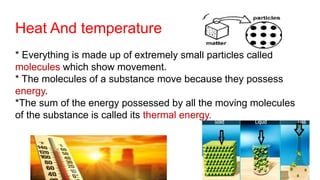
* Everything is made up of extremely small particles called
molecules which show movement.
* The molecules of a substance move because they possess
energy.
*The sum of the energy possessed by all the moving molecules
of the substance is called its thermal energy.
Heat
When a hot object and a cold object come in
contact with each other, a type of energy flows
from the hot object to the colder one. This energy
is called heat energy.
The SI unit of heat is Joule (J).
Calorie is the older metric unit.
Temperature
The degree of hotness or coldness of an object
is called its temperature.
The SI unit of temperature is Kelvin (K).
Measurement of Temperature
The instrument used to measure temperature is
called a thermometer.
Clinical Thermometer:
• The commonly used clinical thermometer
is made up of a narrow tube (capillary) of thick
glass.
• At the end of the capillary tube is a thin
glass bulb filled with mercury.
• Mercury is preferred in thermometers
because it is present in liquid state over a wide
range of temperatures. It is a silvery grey in
colour, therefore it is relatively easy to observe.
It does not stick to the glass in which it is
enclosed.
• The scale in a clinical thermometer
extends over a few degrees on either side of the
32 'C 42 'C
It can measure temperature from 35 degree Celsius to 42 degree
Celsius.
• The clinical thermometer is marked to indicate a small
change of 0.2 degree Celsius.
• The capillary tube of a clinical thermometer has a kink or
bend that does not allow the mercury to flow back into the bulb
before the temperature has been read.
• To lower the level of mercury, the thermometer has to be
given a firm jerk.
While using a clinical thermometer, the following
precautions should be taken:
1. The thermometer should be washed before and
after use preferably with an antiseptic solution.
2. The thermometer should be read keeping the level
of Mercury along the line of sight.
3. It should be handled with care.
4. The bulb of the thermometer should not be touched
while taking a reading. Hold the thermometer by its glass
body.
5. It should be ensured that before use, the mercury
level is below 35 degree Celsius or 95-degree
Fahrenheit.
Digital thermometer:
• Nowadays, digital
thermometers are used to
measure body temperature.
• They work on tiny dry
cells.
• It is a safer device
because it does not contain
mercury which is a toxic
substance.
Laboratory thermometer:
• A laboratory thermometer is made up of a glass
tube.
• It has a glass work with mercury which on
gaining heat rises in the glass capillary of the
tube.
• The range of temperature that laboratory
thermometers can measure is between -10 degree
Celsius to 110 degree Celsius.
The following are some precautions to be taken while using a
laboratory thermometer:
1. Handle the thermometer with care.
2. Do not hold the thermometer by the bulb while taking a reading.
3. The thermometer should be kept upright, not tilted. The bulb
should not touch the surface of the container.
4. Removing the thermometer from a boiling water bath and
immediately immersing it in an ice bath may cause the thermometer to
break.
Temperature Scales
Temperature is measured using different
temperature scales. In a temperature scale
two reference temperatures are chosen
(most commonly the freezing and boiling
point of water).
The commonly used scales are the Celsius
scale the Fahrenheit scale and the Kelvin
scale.
Celsius scale:
Around 1743, Anders Celsius
invented the Celsius scale. He
determined the freezing temperature
for water to be at 0 degree and the
boiling temperature at 100 degrees.
There are 100 divisions between
these two points.
Fahrenheit scale:
This scale was developed by Daniel
Gabriel Fahrenheit. The unit of this
scale is degree F.
On this scale, the freezing point of
water is taken as 32 Fahrenheit and
the boiling point of water is taken as
212 Fahrenheit. There are 180
divisions between these two points.
Kelvin scale:
This scale was invented by Lord
kelvin. The unit of the scale is K.
On this scale, the freezing point
of water is taken as 273 K and
the boiling point of water is
taken as 373 K.
Temperature scale.
BP of water. FP of water
Degree Fahrenheit 212. 32
Degree Celsius 100 0
Kelvin 373 273
Conversion of Scales:
Celcisus to Kelvin. Kelvin to celcisus
C=K−273.15
K= C+273.15
Celsius to Farenhiet
C = 5/9 (F-32)

Heat wps office

  • 1.
  • 2.
    CONTENTS 01 HEAT AND TEMPERATURE 02 MEASUREMENTSOF TEMPERATURE 03 TEMPERATURE SCALES 04 TRANSFER OF HEAT
  • 3.
    Heat And temperature *Everything is made up of extremely small particles called molecules which show movement. * The molecules of a substance move because they possess energy. *The sum of the energy possessed by all the moving molecules of the substance is called its thermal energy.
  • 4.
    Heat When a hotobject and a cold object come in contact with each other, a type of energy flows from the hot object to the colder one. This energy is called heat energy. The SI unit of heat is Joule (J). Calorie is the older metric unit.
  • 5.
    Temperature The degree ofhotness or coldness of an object is called its temperature. The SI unit of temperature is Kelvin (K). Measurement of Temperature The instrument used to measure temperature is called a thermometer.
  • 6.
    Clinical Thermometer: • Thecommonly used clinical thermometer is made up of a narrow tube (capillary) of thick glass. • At the end of the capillary tube is a thin glass bulb filled with mercury. • Mercury is preferred in thermometers because it is present in liquid state over a wide range of temperatures. It is a silvery grey in colour, therefore it is relatively easy to observe. It does not stick to the glass in which it is enclosed. • The scale in a clinical thermometer extends over a few degrees on either side of the 32 'C 42 'C
  • 7.
    It can measuretemperature from 35 degree Celsius to 42 degree Celsius. • The clinical thermometer is marked to indicate a small change of 0.2 degree Celsius. • The capillary tube of a clinical thermometer has a kink or bend that does not allow the mercury to flow back into the bulb before the temperature has been read. • To lower the level of mercury, the thermometer has to be given a firm jerk.
  • 8.
    While using aclinical thermometer, the following precautions should be taken: 1. The thermometer should be washed before and after use preferably with an antiseptic solution. 2. The thermometer should be read keeping the level of Mercury along the line of sight. 3. It should be handled with care. 4. The bulb of the thermometer should not be touched while taking a reading. Hold the thermometer by its glass body. 5. It should be ensured that before use, the mercury level is below 35 degree Celsius or 95-degree Fahrenheit.
  • 9.
    Digital thermometer: • Nowadays,digital thermometers are used to measure body temperature. • They work on tiny dry cells. • It is a safer device because it does not contain mercury which is a toxic substance.
  • 10.
    Laboratory thermometer: • Alaboratory thermometer is made up of a glass tube. • It has a glass work with mercury which on gaining heat rises in the glass capillary of the tube. • The range of temperature that laboratory thermometers can measure is between -10 degree Celsius to 110 degree Celsius.
  • 11.
    The following aresome precautions to be taken while using a laboratory thermometer: 1. Handle the thermometer with care. 2. Do not hold the thermometer by the bulb while taking a reading. 3. The thermometer should be kept upright, not tilted. The bulb should not touch the surface of the container. 4. Removing the thermometer from a boiling water bath and immediately immersing it in an ice bath may cause the thermometer to break.
  • 12.
    Temperature Scales Temperature ismeasured using different temperature scales. In a temperature scale two reference temperatures are chosen (most commonly the freezing and boiling point of water). The commonly used scales are the Celsius scale the Fahrenheit scale and the Kelvin scale.
  • 13.
    Celsius scale: Around 1743,Anders Celsius invented the Celsius scale. He determined the freezing temperature for water to be at 0 degree and the boiling temperature at 100 degrees. There are 100 divisions between these two points.
  • 14.
    Fahrenheit scale: This scalewas developed by Daniel Gabriel Fahrenheit. The unit of this scale is degree F. On this scale, the freezing point of water is taken as 32 Fahrenheit and the boiling point of water is taken as 212 Fahrenheit. There are 180 divisions between these two points.
  • 15.
    Kelvin scale: This scalewas invented by Lord kelvin. The unit of the scale is K. On this scale, the freezing point of water is taken as 273 K and the boiling point of water is taken as 373 K.
  • 16.
    Temperature scale. BP ofwater. FP of water Degree Fahrenheit 212. 32 Degree Celsius 100 0 Kelvin 373 273
  • 17.
    Conversion of Scales: Celcisusto Kelvin. Kelvin to celcisus C=K−273.15 K= C+273.15
  • 18.