Introduction
Name :- Ayush Shukla
Subject :- Science
Class :- Seventh
Topic:- Difference Between
Clinical Thermometer and
Laboratory Thermometer.
Clinical
Thermometer
Made by Ayush
Diagram of Clinical Thermometer
What is a
Clinical
Thermoter
 Clinical thermometers are meant for
clinical purposes. It is developed for
measuring the human body
temperature. It is a long narrow glass
tube with a bulb containing mercury at
the end. The normal human body
temperature is 37˚C; which can fluctuate
between the ranges 35˚C to 42˚C.
Hence, the clinical thermometers have
the range 35˚C to 42˚C. The level of
mercury tells our body temperature in
˚C. Since mercury is a toxic element,
thus these thermometers have been
replaced by digital thermometers
nowadays.
Who and when invented the Clinical
Thermoter
1836–1925
Sir Thomas Clifford Allbutt (1836–1925)
was a celebrated British physician. He
spent 20 years working in Leeds during
which time he devised the small clinical
thermometer.
1867
. A local company, Harvey and Reynolds,
first manufactured this special
thermometer in 1867, followed by
Thackeray in London.
Laboratory
Thermometer
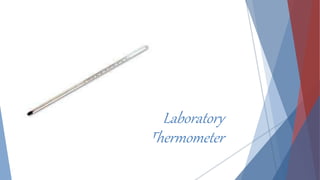
Diagram of Laboratory Thermometer
What is a
Laboratory
Thermometer
 Since clinical thermometers can’t be
used to measure temperature other than
the human body, we need a special type
of thermometers for other purposes. A
laboratory thermometer, which is
colloquially known as the lab
thermometer, is used for measuring
temperatures other than the human
body temperature. It ranges from -10˚C
to 110˚C. Laboratory thermometers are
designed for lab purposes such as
checking boiling point, freezing point, or
temperature of other substances. You
can use a laboratory thermometer for
checking the temperature of a solvent
but not a clinical one.
Who and when invented the Clinical
Thermometer
1561–1636
Santorio Santorini (Sanctorius, 1561-
1636) is commonly credited with the
invention of the first Laboratory
thermometer
1612
Santorio Santorini invented the
first thermometer in 1612. It was
invented in Italy.

Difference between Clinical And Laboratory thermometer

  • 1.
    Introduction Name :- AyushShukla Subject :- Science Class :- Seventh
  • 2.
    Topic:- Difference Between ClinicalThermometer and Laboratory Thermometer.
  • 4.
  • 5.
  • 6.
    What is a Clinical Thermoter Clinical thermometers are meant for clinical purposes. It is developed for measuring the human body temperature. It is a long narrow glass tube with a bulb containing mercury at the end. The normal human body temperature is 37˚C; which can fluctuate between the ranges 35˚C to 42˚C. Hence, the clinical thermometers have the range 35˚C to 42˚C. The level of mercury tells our body temperature in ˚C. Since mercury is a toxic element, thus these thermometers have been replaced by digital thermometers nowadays.
  • 7.
    Who and wheninvented the Clinical Thermoter 1836–1925 Sir Thomas Clifford Allbutt (1836–1925) was a celebrated British physician. He spent 20 years working in Leeds during which time he devised the small clinical thermometer. 1867 . A local company, Harvey and Reynolds, first manufactured this special thermometer in 1867, followed by Thackeray in London.
  • 8.
  • 9.
  • 10.
    What is a Laboratory Thermometer Since clinical thermometers can’t be used to measure temperature other than the human body, we need a special type of thermometers for other purposes. A laboratory thermometer, which is colloquially known as the lab thermometer, is used for measuring temperatures other than the human body temperature. It ranges from -10˚C to 110˚C. Laboratory thermometers are designed for lab purposes such as checking boiling point, freezing point, or temperature of other substances. You can use a laboratory thermometer for checking the temperature of a solvent but not a clinical one.
  • 11.
    Who and wheninvented the Clinical Thermometer 1561–1636 Santorio Santorini (Sanctorius, 1561- 1636) is commonly credited with the invention of the first Laboratory thermometer 1612 Santorio Santorini invented the first thermometer in 1612. It was invented in Italy.