


Heat Treatment
Presented to
Irish Light Aviation Society
17/06/2015 Iriah Ligh6t Aviation Society 1
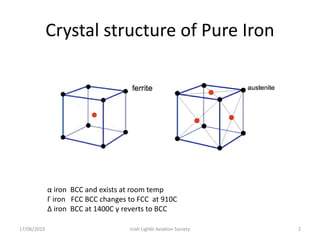
Crystal structure of Pure Iron
17/06/2015 Iriah Ligh6t Aviation Society 2
α iron BCC and exists at room temp
Γ iron FCC BCC changes to FCC at 910C
Δ iron BCC at 1400C γ reverts to BCC
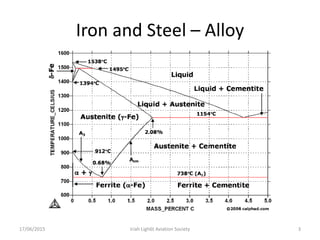
Iron and Steel – Alloy
17/06/2015 Iriah Ligh6t Aviation Society 3
Phase diagram - Summary
17/06/2015 Iriah Ligh6t Aviation Society 4
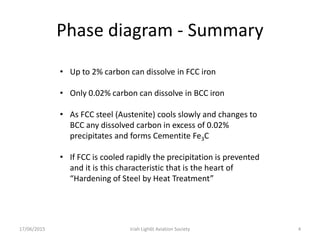
• Up to 2% carbon can dissolve in FCC iron
• Only 0.02% carbon can dissolve in BCC iron
• As FCC steel (Austenite) cools slowly and changes to
BCC any dissolved carbon in excess of 0.02%
precipitates and forms Cementite Fe3C
• If FCC is cooled rapidly the precipitation is prevented
and it is this characteristic that is the heart of
“Hardening of Steel by Heat Treatment”
Slow Cooling
17/06/2015 Iriah Ligh6t Aviation Society 5
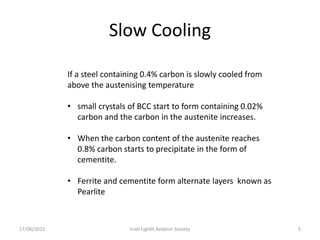
If a steel containing 0.4% carbon is slowly cooled from
above the austenising temperature
• small crystals of BCC start to form containing 0.02%
carbon and the carbon in the austenite increases.
• When the carbon content of the austenite reaches
0.8% carbon starts to precipitate in the form of
cementite.
• Ferrite and cementite form alternate layers known as
Pearlite
Slow Cooling - continued
17/06/2015 Iriah Ligh6t Aviation Society 6
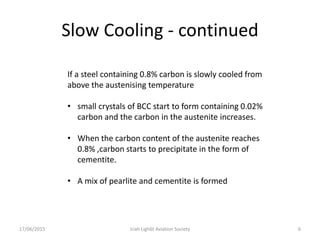
If a steel containing 0.8% carbon is slowly cooled from
above the austenising temperature
• small crystals of BCC start to form containing 0.02%
carbon and the carbon in the austenite increases.
• When the carbon content of the austenite reaches
0.8% ,carbon starts to precipitate in the form of
cementite.
• A mix of pearlite and cementite is formed
Microscopic Images
17/06/2015 Iriah Ligh6t Aviation Society 7
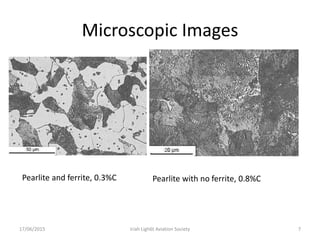
Pearlite and ferrite, 0.3%C Pearlite with no ferrite, 0.8%C
Rapid Cooling - Quenching
17/06/2015 Iriah Ligh6t Aviation Society 8
When austenite is rapidly cooled another structure called
Martensite is formed. This is not shown on the phase diagram
because it is not an equilibrium state. Rapid cooling prevented
the equilibrium state from forming.
In simple terms the FCC structure of austenite has changed to
BCC of ferrite but the carbon hasn’t diffused out of the structure.
In effect Martensite, is a highly stressed, supersaturated BCC
structure.
Martensite is very hard and very brittle.
Quenching Rate
17/06/2015 Iriah Ligh6t Aviation Society 9
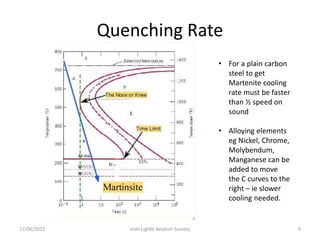
• For a plain carbon
steel to get
Martenite cooling
rate must be faster
than ½ speed on
sound
• Alloying elements
eg Nickel, Chrome,
Molybendum,
Manganese can be
added to move
the C curves to the
right – ie slower
cooling needed.
Microscope images of hardened steel
17/06/2015 Iriah Ligh6t Aviation Society 10
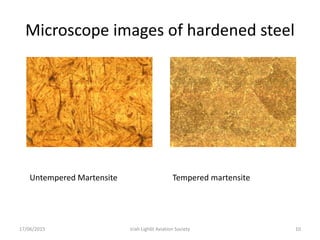
Untempered Martensite Tempered martensite
Measurement of Hardness
17/06/2015 Iriah Ligh6t Aviation Society 11
• Hardness is not an intrinsic material property dictated in terms of
fundamental units but people instinctively know know what it is.
• Hardness is the property that enable the material to resist plastic
deformation.
• Hardness is devined by the test method which is invariably an indent
method.
• Various methods, Rockwell A, B, C. scales.
• Vickers, Brinell, Microhardness.
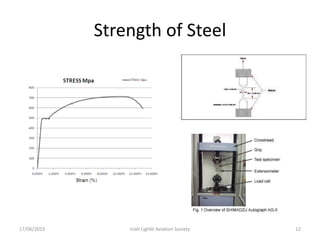
Strength of Steel
17/06/2015 Iriah Ligh6t Aviation Society 12
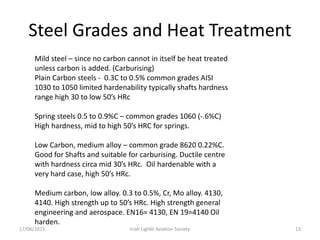
Steel Grades and Heat Treatment
17/06/2015 Iriah Ligh6t Aviation Society 13
Mild steel – since no carbon cannot in itself be heat treated
unless carbon is added. (Carburising)
Plain Carbon steels - 0.3C to 0.5% common grades AISI
1030 to 1050 limited hardenability typically shafts hardness
range high 30 to low 50’s HRc
Spring steels 0.5 to 0.9%C – common grades 1060 (-.6%C)
High hardness, mid to high 50’s HRC for springs.
Low Carbon, medium alloy – common grade 8620 0.22%C.
Good for Shafts and suitable for carburising. Ductile centre
with hardness circa mid 30’s HRc. Oil hardenable with a
very hard case, high 50’s HRc.
Medium carbon, low alloy. 0.3 to 0.5%, Cr, Mo alloy. 4130,
4140. High strength up to 50’s HRc. High strength general
engineering and aerospace. EN16= 4130, EN 19=4140 Oil
harden.
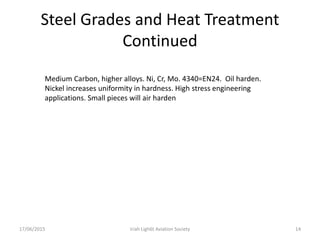
Steel Grades and Heat Treatment
Continued
17/06/2015 Iriah Ligh6t Aviation Society 14
Medium Carbon, higher alloys. Ni, Cr, Mo. 4340=EN24. Oil harden.
Nickel increases uniformity in hardness. High stress engineering
applications. Small pieces will air harden
Steel grades and Heat Treatment
Continued
17/06/2015 Iriah Ligh6t Aviation Society 15
Tool Steels – AISI teminology
W – Water hardenable tool steel rarely seen now
S grades – Shock resistant rarely seen high Silicon give the
shock resistance
O grade – Oil Hardening O1 very common. Cold work, shear
blades etc. Max hardness 62HRc
A grades – Air hardening A2 commonly seen. Air hardening
and cold work applications.
D series – high carbon, high Cr. Cold work tool steel. D2. Dies
for car body parts.
H series – hot work tool steels. H13 commonly seen. Plastic
injection moulding. Hardness low 50’s. Vanadium give the
higher heat resistance
Steel grades and Heat Treatment
Continued
17/06/2015 Iriah Ligh6t Aviation Society 16
High speed steels – Cutting tools
T series circa 0.75C with 18% Tungsten (W) Air hardenable, mid
60’s HRc.
M series - primarily Molybdenum (8.5%) + others . High 60;’s
HRC.
Martensitic Stainless Steels
4 series 410, 420, 430 & 440 with increasing hardness, ie
increasing carbon lower corrosion resistance. Low 40’s (410) to
high 50’s (440). Chrome is locked up by Carbon so less Cr for
corrosion resistnace.
Processes at NHTC
17/06/2015 Iriah Ligh6t Aviation Society 17
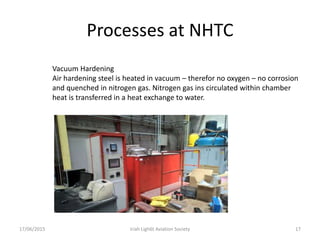
Vacuum Hardening
Air hardening steel is heated in vacuum – therefor no oxygen – no corrosion
and quenched in nitrogen gas. Nitrogen gas ins circulated within chamber
heat is transferred in a heat exchange to water.
Process at NHTC
17/06/2015 Iriah Ligh6t Aviation Society 18
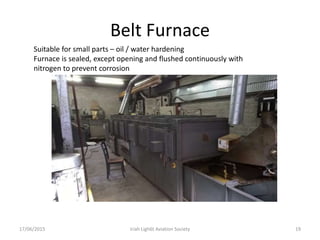
Belt Furnace
17/06/2015 Iriah Ligh6t Aviation Society 19
Suitable for small parts – oil / water hardening
Furnace is sealed, except opening and flushed continuously with
nitrogen to prevent corrosion
Carburising
17/06/2015 Iriah Ligh6t Aviation Society 20
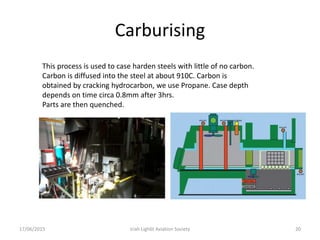
This process is used to case harden steels with little of no carbon.
Carbon is diffused into the steel at about 910C. Carbon is
obtained by cracking hydrocarbon, we use Propane. Case depth
depends on time circa 0.8mm after 3hrs.
Parts are then quenched.
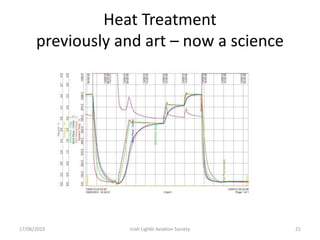
Heat Treatment
previously and art – now a science
17/06/2015 Iriah Ligh6t Aviation Society 21
Precipitation Hardening
17/06/2015 Iriah Ligh6t Aviation Society 22
Certain grades of aluminium harden by precipitates forming
Solution treatment involves heating the parts to dissolve the precipitate
In the metal and then rapid (water) quenching. This locks the parts in
Solution.
The parts are precipitated slowly at room temperature (age hardening) or
The process is accelerated by higher temperature.
The PH range of steels can also be processed by this method.
Nitriding
17/06/2015 Iriah Ligh6t Aviation Society 23
Nitriding is not a quenching process – hardening is achieved
by diffusing nitrogen atoms into the steel which form Nitrides
with the iron and these are very hard. If there is a little 1%
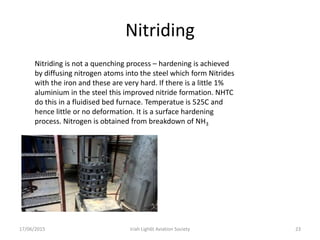
aluminium in the steel this improved nitride formation. NHTC
do this in a fluidised bed furnace. Temperatue is 525C and
hence little or no deformation. It is a surface hardening
process. Nitrogen is obtained from breakdown of NH3
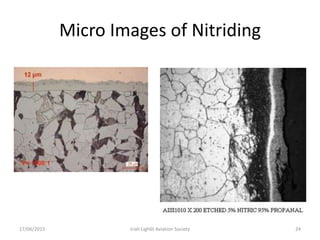
Micro Images of Nitriding
17/06/2015 Iriah Ligh6t Aviation Society 24

Heat treatment

  • 1.
    Heat Treatment Presented to IrishLight Aviation Society 17/06/2015 Iriah Ligh6t Aviation Society 1
  • 2.
    Crystal structure ofPure Iron 17/06/2015 Iriah Ligh6t Aviation Society 2 α iron BCC and exists at room temp Γ iron FCC BCC changes to FCC at 910C Δ iron BCC at 1400C γ reverts to BCC
  • 3.
    Iron and Steel– Alloy 17/06/2015 Iriah Ligh6t Aviation Society 3
  • 4.
    Phase diagram -Summary 17/06/2015 Iriah Ligh6t Aviation Society 4 • Up to 2% carbon can dissolve in FCC iron • Only 0.02% carbon can dissolve in BCC iron • As FCC steel (Austenite) cools slowly and changes to BCC any dissolved carbon in excess of 0.02% precipitates and forms Cementite Fe3C • If FCC is cooled rapidly the precipitation is prevented and it is this characteristic that is the heart of “Hardening of Steel by Heat Treatment”
  • 5.
    Slow Cooling 17/06/2015 IriahLigh6t Aviation Society 5 If a steel containing 0.4% carbon is slowly cooled from above the austenising temperature • small crystals of BCC start to form containing 0.02% carbon and the carbon in the austenite increases. • When the carbon content of the austenite reaches 0.8% carbon starts to precipitate in the form of cementite. • Ferrite and cementite form alternate layers known as Pearlite
  • 6.
    Slow Cooling -continued 17/06/2015 Iriah Ligh6t Aviation Society 6 If a steel containing 0.8% carbon is slowly cooled from above the austenising temperature • small crystals of BCC start to form containing 0.02% carbon and the carbon in the austenite increases. • When the carbon content of the austenite reaches 0.8% ,carbon starts to precipitate in the form of cementite. • A mix of pearlite and cementite is formed
  • 7.
    Microscopic Images 17/06/2015 IriahLigh6t Aviation Society 7 Pearlite and ferrite, 0.3%C Pearlite with no ferrite, 0.8%C
  • 8.
    Rapid Cooling -Quenching 17/06/2015 Iriah Ligh6t Aviation Society 8 When austenite is rapidly cooled another structure called Martensite is formed. This is not shown on the phase diagram because it is not an equilibrium state. Rapid cooling prevented the equilibrium state from forming. In simple terms the FCC structure of austenite has changed to BCC of ferrite but the carbon hasn’t diffused out of the structure. In effect Martensite, is a highly stressed, supersaturated BCC structure. Martensite is very hard and very brittle.
  • 9.
    Quenching Rate 17/06/2015 IriahLigh6t Aviation Society 9 • For a plain carbon steel to get Martenite cooling rate must be faster than ½ speed on sound • Alloying elements eg Nickel, Chrome, Molybendum, Manganese can be added to move the C curves to the right – ie slower cooling needed.
  • 10.
    Microscope images ofhardened steel 17/06/2015 Iriah Ligh6t Aviation Society 10 Untempered Martensite Tempered martensite
  • 11.
    Measurement of Hardness 17/06/2015Iriah Ligh6t Aviation Society 11 • Hardness is not an intrinsic material property dictated in terms of fundamental units but people instinctively know know what it is. • Hardness is the property that enable the material to resist plastic deformation. • Hardness is devined by the test method which is invariably an indent method. • Various methods, Rockwell A, B, C. scales. • Vickers, Brinell, Microhardness.
  • 12.
    Strength of Steel 17/06/2015Iriah Ligh6t Aviation Society 12
  • 13.
    Steel Grades andHeat Treatment 17/06/2015 Iriah Ligh6t Aviation Society 13 Mild steel – since no carbon cannot in itself be heat treated unless carbon is added. (Carburising) Plain Carbon steels - 0.3C to 0.5% common grades AISI 1030 to 1050 limited hardenability typically shafts hardness range high 30 to low 50’s HRc Spring steels 0.5 to 0.9%C – common grades 1060 (-.6%C) High hardness, mid to high 50’s HRC for springs. Low Carbon, medium alloy – common grade 8620 0.22%C. Good for Shafts and suitable for carburising. Ductile centre with hardness circa mid 30’s HRc. Oil hardenable with a very hard case, high 50’s HRc. Medium carbon, low alloy. 0.3 to 0.5%, Cr, Mo alloy. 4130, 4140. High strength up to 50’s HRc. High strength general engineering and aerospace. EN16= 4130, EN 19=4140 Oil harden.
  • 14.
    Steel Grades andHeat Treatment Continued 17/06/2015 Iriah Ligh6t Aviation Society 14 Medium Carbon, higher alloys. Ni, Cr, Mo. 4340=EN24. Oil harden. Nickel increases uniformity in hardness. High stress engineering applications. Small pieces will air harden
  • 15.
    Steel grades andHeat Treatment Continued 17/06/2015 Iriah Ligh6t Aviation Society 15 Tool Steels – AISI teminology W – Water hardenable tool steel rarely seen now S grades – Shock resistant rarely seen high Silicon give the shock resistance O grade – Oil Hardening O1 very common. Cold work, shear blades etc. Max hardness 62HRc A grades – Air hardening A2 commonly seen. Air hardening and cold work applications. D series – high carbon, high Cr. Cold work tool steel. D2. Dies for car body parts. H series – hot work tool steels. H13 commonly seen. Plastic injection moulding. Hardness low 50’s. Vanadium give the higher heat resistance
  • 16.
    Steel grades andHeat Treatment Continued 17/06/2015 Iriah Ligh6t Aviation Society 16 High speed steels – Cutting tools T series circa 0.75C with 18% Tungsten (W) Air hardenable, mid 60’s HRc. M series - primarily Molybdenum (8.5%) + others . High 60;’s HRC. Martensitic Stainless Steels 4 series 410, 420, 430 & 440 with increasing hardness, ie increasing carbon lower corrosion resistance. Low 40’s (410) to high 50’s (440). Chrome is locked up by Carbon so less Cr for corrosion resistnace.
  • 17.
    Processes at NHTC 17/06/2015Iriah Ligh6t Aviation Society 17 Vacuum Hardening Air hardening steel is heated in vacuum – therefor no oxygen – no corrosion and quenched in nitrogen gas. Nitrogen gas ins circulated within chamber heat is transferred in a heat exchange to water.
  • 18.
    Process at NHTC 17/06/2015Iriah Ligh6t Aviation Society 18
  • 19.
    Belt Furnace 17/06/2015 IriahLigh6t Aviation Society 19 Suitable for small parts – oil / water hardening Furnace is sealed, except opening and flushed continuously with nitrogen to prevent corrosion
  • 20.
    Carburising 17/06/2015 Iriah Ligh6tAviation Society 20 This process is used to case harden steels with little of no carbon. Carbon is diffused into the steel at about 910C. Carbon is obtained by cracking hydrocarbon, we use Propane. Case depth depends on time circa 0.8mm after 3hrs. Parts are then quenched.
  • 21.
    Heat Treatment previously andart – now a science 17/06/2015 Iriah Ligh6t Aviation Society 21
  • 22.
    Precipitation Hardening 17/06/2015 IriahLigh6t Aviation Society 22 Certain grades of aluminium harden by precipitates forming Solution treatment involves heating the parts to dissolve the precipitate In the metal and then rapid (water) quenching. This locks the parts in Solution. The parts are precipitated slowly at room temperature (age hardening) or The process is accelerated by higher temperature. The PH range of steels can also be processed by this method.
  • 23.
    Nitriding 17/06/2015 Iriah Ligh6tAviation Society 23 Nitriding is not a quenching process – hardening is achieved by diffusing nitrogen atoms into the steel which form Nitrides with the iron and these are very hard. If there is a little 1% aluminium in the steel this improved nitride formation. NHTC do this in a fluidised bed furnace. Temperatue is 525C and hence little or no deformation. It is a surface hardening process. Nitrogen is obtained from breakdown of NH3
  • 24.
    Micro Images ofNitriding 17/06/2015 Iriah Ligh6t Aviation Society 24