
Heat Transfer
Heat Transfer
 Heat travels from a region of higher
temperature to a region of lower
temperature.
 This process is carried out by
 Conduction
 Convection
 Radiation
Conduction
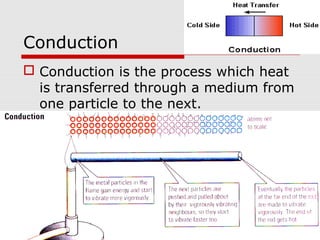
 Conduction is the process which heat
is transferred through a medium from
one particle to the next.
Convection
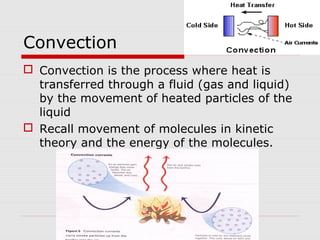
 Convection is the process where heat is
transferred through a fluid (gas and liquid)
by the movement of heated particles of the
liquid
 Recall movement of molecules in kinetic
theory and the energy of the molecules.
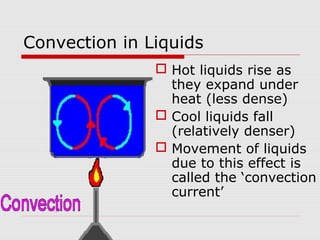
Convection in Liquids
 Hot liquids rise as
they expand under
heat (less dense)
 Cool liquids fall
(relatively denser)
 Movement of liquids
due to this effect is
called the ‘convection
current’
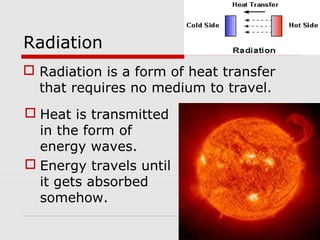
Radiation
 Radiation is a form of heat transfer
that requires no medium to travel.
 Heat is transmitted
in the form of
energy waves.
 Energy travels until
it gets absorbed
somehow.
Conduction, Convection and
Radiation – Applying knowledge
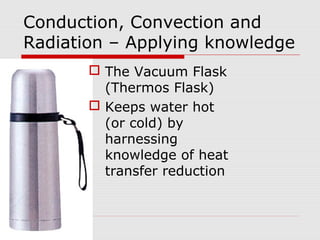
 The Vacuum Flask
(Thermos Flask)
 Keeps water hot
(or cold) by
harnessing
knowledge of heat
transfer reduction
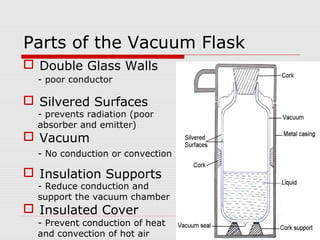
Parts of the Vacuum Flask
 Double Glass Walls
 Silvered Surfaces
 Vacuum
 Insulation Supports
 Insulated Cover
- poor conductor
- prevents radiation (poor
absorber and emitter)
- No conduction or convection
- Reduce conduction and
support the vacuum chamber
- Prevent conduction of heat
and convection of hot air
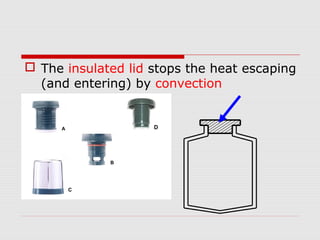
 The insulated lid stops the heat escaping
(and entering) by convection
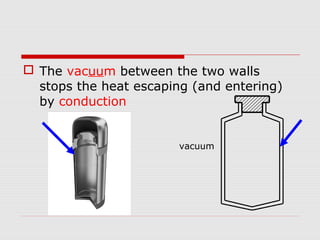
 The vacuum between the two walls
stops the heat escaping (and entering)
by conduction
vacuum
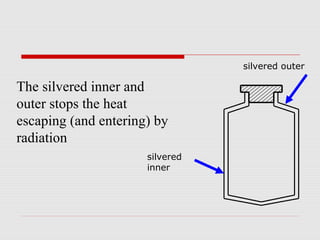
The silvered inner and
outer stops the heat
escaping (and entering) by
radiation
silvered outer
silvered
inner
Heat transfer

Heat transfer

  • 1.
  • 2.
    Heat Transfer  Heattravels from a region of higher temperature to a region of lower temperature.  This process is carried out by  Conduction  Convection  Radiation
  • 3.
    Conduction  Conduction isthe process which heat is transferred through a medium from one particle to the next.
  • 4.
    Convection  Convection isthe process where heat is transferred through a fluid (gas and liquid) by the movement of heated particles of the liquid  Recall movement of molecules in kinetic theory and the energy of the molecules.
  • 5.
    Convection in Liquids Hot liquids rise as they expand under heat (less dense)  Cool liquids fall (relatively denser)  Movement of liquids due to this effect is called the ‘convection current’
  • 6.
    Radiation  Radiation isa form of heat transfer that requires no medium to travel.  Heat is transmitted in the form of energy waves.  Energy travels until it gets absorbed somehow.
  • 7.
    Conduction, Convection and Radiation– Applying knowledge  The Vacuum Flask (Thermos Flask)  Keeps water hot (or cold) by harnessing knowledge of heat transfer reduction
  • 8.
    Parts of theVacuum Flask  Double Glass Walls  Silvered Surfaces  Vacuum  Insulation Supports  Insulated Cover - poor conductor - prevents radiation (poor absorber and emitter) - No conduction or convection - Reduce conduction and support the vacuum chamber - Prevent conduction of heat and convection of hot air
  • 9.
     The insulatedlid stops the heat escaping (and entering) by convection
  • 10.
     The vacuumbetween the two walls stops the heat escaping (and entering) by conduction vacuum
  • 11.
    The silvered innerand outer stops the heat escaping (and entering) by radiation silvered outer silvered inner