This document discusses analyzing heart rate variability (HRV) signals using smoothed pseudo Wigner-Ville distribution (SPWVD), a time-frequency analysis method. It provides background on HRV, including that it reflects autonomic nervous system activity and can predict health outcomes. The document explains challenges with analyzing unevenly sampled HRV data and describes resampling methods. It then introduces the SPWVD method, which provides high time-frequency resolution while reducing cross-term interference seen in other distributions. Simulation results applying SPWVD to HRV data from an online database are presented and show the method's ability to assess dynamic cardiac changes and patterns.
![Sundarapandian et al. (Eds) : ITCS, SIP, CS & IT 09,
pp. 23–32, 2013. © CS & IT-CSCP 2013 DOI : 10.5121/csit.2013.3103
HEART RATE VARIABILITY ANALYSIS FOR
ABNORMALITY DETECTION
USING TIME FREQUENCY DISTRIBUTION
– SMOOTHED PSEUDO WINGER VILLE
METHOD
Veena N. Hegde 1
, Ravishankar Deekshit 2
,P.S.Satyanarayana3
1
Associate Professor, Instrumentation Tech. BMS College of Engineering, Bangalore
veena.bms@gmail.com
2
Professor and Head, Department of EEE, BMS College of Engineering, Bangalore.
3
Former Professor, Department of ECE, BMS College of Engineering, Bangalore.
ABSTRACT
Heart rate variability (HRV) is derived from the time duration between consecutive heart beats.
The HRV is to reflect the heart’s ability to adapt to changing circumstances by detecting and
quickly responding to unpredictable stimuli to cardiac system. Depressed HRV is a powerful
predictor of mortality and of arrhythmic complications in patients after diseases like acute
Myocardial Infarction. The degree of variability in the HR provides information about the
nervous system control on the HR and the heart’s ability to respond .Spectral analysis of HRV is
a frequency domain approach to assess the cardiac condition. In this paper one such method for
analyzing HRV signals known as smoothed pseudo Wigner Ville distribution (SPWVD) is
applied, The sub-band decomposition technique used in SPWVD, based on Instantaneous
Autocorrelation (IACR) of the signal provides time-frequency representation for very low-
frequency (VLF), low-frequency (LF) and high-frequency (HF) regions identified in HRV
spectrum. Results suggest that SPWVD analysis provides useful information for the assessment
of dynamic changes and patterns of HRV during cardiac abnormalities.
KEYWORDS: HRV,RR Tachogram, Resampling, STFT,WVD,SPWVD
1. INTRODUCTION
The Electrocardiogram (ECG) is a periodic signal containing information about the functioning of
the heart. The duration and amplitudes of P, QRS and T wave in an ECG cycle contain useful
information about the nature of heart disease. However, always it may not be possible to directly
monitor the subtle details of the functioning of the heart just by observing EGC. The symptoms of
certain diseases may appear at random in the time which will be not be seen for quite a long to
give any consistent information. In, 1965, Heart Rate was identified as another significant tool in
research and clinical studies of cardiology when distress was preceded by alterations in inter heart
beat intervals before any appreciable change occurred in heart rate itself. Later it was found that
HRV computed from 24-hour Holter records are more sensitive than simple bedside tests [1]
Therefore, HRV signal parameters, extracted and analyzed using computers, are highly useful in
diagnostics. Analysis of HRV also has become a popular non-invasive tool for assessing the](https://image.slidesharecdn.com/csit3103-180117062636/75/HEART-RATE-VARIABILITY-ANALYSIS-FOR-ABNORMALITY-DETECTION-USING-TIME-FREQUENCY-DISTRIBUTION-SMOOTHED-PSEUDO-WINGER-VILLE-METHOD-1-2048.jpg)
![24 Computer Science & Information Technology (CS & IT)
activities of the autonomic nervous system [2].These signals are essentially non-stationary; may
contain indicators of disease. The indicators may be present at all times or may occur at random
in the time scale [3].
The HRV which is inversely proportional to the time differences between two consecutive R-
waves in a time series of ECG is given by the equation
[60 / 1,60 / 2, 60 / ]HRV t t tn= − − − − − (1)
where[ 1, 2 ]T
t t tn− − − − − − − represent a time series composed of time intervals between
consecutive R peaks in an ECG signal and HRV is expressed as beats per minute. Various
researchers have contributed in automated analysis of HRV as an alternative to ECG
characterization. Researchers have extensively discussed the investigated tools to indirectly assess
the biological conditions based on HRV parameters under normal and different pathological
conditions of cardiovascular system [4]. The continuous recording of HR shows regular
fluctuations that reflect parasympathetic and sympathetic neural control on the sinus node [5].
The HRV has proved to be non stationary in nature. Hence the analysis of HRV expressing
quantitative parameters has been carried out using time domain, frequency domain and non-linear
approaches [4].Though time domain HRV analysis is popular, when it does to the assessment of
the cardiac conditions based on the HRV, it is recommended to carryout spectral analysis of the
signal [5]. In frequency domain the typical spectral pattern in normal conditions of HRV show the
presence of three frequency bands: a very low frequency (VLF) band from 0.00 to 0.03 Hz, a low
frequency (LF) band from 0.03 to 0.15 Hz and a high frequency (HF) band in respiratory range
generally more than 0.25 Hz. The value of the LF component are related to the sympathetic
activation whereas the area of the high frequency component (HF) provides a quantitative index
of the influence of respiration on the ECG signal and may be connected to the vagal activity.
Thus the LF/HF ratio is an important marker of sympatho-vagal balance on heart rate variability
control .
0 0.05 0.1 0.15 0.2 0.25 0.3 0.35 0.4 0.45 0.5
-110
-100
-90
-80
-70
-60
-50
-40
-30
-20
-10
0
Frequency (Hz)
Power(dB)
Typical HRV frequency bands
Figure 1. Spectrum for a normal HRV pattern showing typical VLF , LF and HF regions
The Figure 1 shows the typical spectrum of a HRV signal indicating a normal functioning of the
heart. HRV spectrum obtained by RR Interval of ECG is an unusual time series as both x and y
axis indicates time intervals, one being related to the other. Further, since the variability in HR](https://image.slidesharecdn.com/csit3103-180117062636/75/HEART-RATE-VARIABILITY-ANALYSIS-FOR-ABNORMALITY-DETECTION-USING-TIME-FREQUENCY-DISTRIBUTION-SMOOTHED-PSEUDO-WINGER-VILLE-METHOD-2-2048.jpg)
![Computer Science & Information Technology (CS & IT) 25
occurs on a beat-to-beat basis, the time series is inherently unevenly spaced along the horizontal
axis as the number of ECG samples within each RR peaks are different [6]
0 2000 4000 6000 8000 10000 12000 14000 16000 18000
0
50
100
150
200
250
300
350
400
Sample No
RRDuration
RR-INTERVALS PLOT
Figure .2 The unevenly sampled RR Tachogram
Figure 2 shows the RR-interval data where the total numbers of samples of ECG considered for
obtaining RR-intervals are shown in x-axis. The y-axis represents the distances between
consecutive R-R peaks. It is seen from the plot that both x and y axes are indicating number of
samples. As shown the horizontal distance between each point (time stamp) is different for each
adjacent pair, with the difference recorded on the vertical axis. This plot is called RR Tachogram.
0 0.5 1 1.5 2 2.5 3 3.5 4 4.5
x 10
4
0
0.1
0.2
0.3
0.4
0.5
0.6
0.7
0.8
0.9
1
ECG R-Peak Detection Plot
Figure.3 R Peak detection in an abnormal ECG Detection
Figure 3 shows R peak detection in an abnormal ECG which also has an unevenly sampled RR
Tachogram. From the examples explained till now, fact that the RR Tachogram is unevenly
sampled and this shows the necessity for re-sampling. Because, whenever spectral analysis is
carried out using transformed domain approach, it is expected that the signal will have uniform
sampling. Hence it is necessary to resample the Heart Rate or RR interval data before performing
frequency domain analysis. Typical human heart rate is 72-82 bpm leading to heart rate of 1.5
Hz. A sampling rate of 4Hz is ideally preferred. Since the human heart rate can sometimes
exceed 3Hz (180 beats per minute). However, if one knows that the RR Tachogram is unlikely to](https://image.slidesharecdn.com/csit3103-180117062636/75/HEART-RATE-VARIABILITY-ANALYSIS-FOR-ABNORMALITY-DETECTION-USING-TIME-FREQUENCY-DISTRIBUTION-SMOOTHED-PSEUDO-WINGER-VILLE-METHOD-3-2048.jpg)
![26 Computer Science & Information Technology (CS & IT)
exceed 120 beats per minute then a re-sampling rate of 4Hz is sufficient. A choice of 7 Hz for the
up-sampling of the RR-Tachogram satisfies the Nyquist criterion and gives a value of 2100
points in a 5-minute window. There are different approaches to have uniformly sampled RR
Tachogram. In [6] the re-sampling methods have been discussed.
2 2.5 3 3.5 4 4.5
40
50
60
70
80
90
100
110
120
130
140
150
Heart Rate Variabilty
Time in Secs
RRInterval
Figure. 4. HRV for 4.5 Seconds with RR Low limit of
0. 421 sec and RR High limit of 1.007 Sec
Figure 4 shows typical HRV derived from re-sampling method for time duration of 4.5 seconds.
The Computation of HRV is based on the Equ. (1) and Resampling rate of 4Hz is used using
linear interpolation. The European and North American Task force on standards in HRV [8]
suggested that the shortest time period over which HRV metrics should be assessed is 5 minutes.
Though the approaches discussing the HRV derivation from RR Tachogram and HRV has been
addressed by different researchers and the time frequency distribution of the HRV signals give
additional information about cardiac activities. This paper aims to bring out such details using
SPWVD technique. Section 2 gives the mathematical background about the method proposed.
Section 3 gives the simulation results. The paper is concluded in section 4.
2. SPWVD METHOD FOR TIME FREQUENCY ANALYSIS
Fourier Transform (FT) provides good description of the frequencies in a waveform, but not their
time of occurrence. Complex exponentials representing frequency information of the signal
stretch out to infinity in time. FT analyze the signal globally, not locally. To overcome the
limitation of FT the Short-Time Fourier Transform (STFT) was introduced for processing non-
stationary signals [8]. A window function is applied to a segment of data, effectively isolating that
segment from the overall waveform, and the FT is applied to that segment. But this necessitates a
tradeoff between time localization and frequency resolution. By considering the window size as
small, an increase in frequency resolution is achieved at the cost of time resolution and vice versa.
As an alternative approach, the Wigner–Ville distribution (WVD) [9] alleviates this tradeoff. The
WVD at any instant is the FT of the instantaneous autocorrelation (IACR) sequence of infinite lag
length[10].Though WVD gives high resolution in time-frequency domain, it is not used widely
for practical application due to the interaction between different signal components, introducing
cross frequency values into the spectrum called as “cross term”. These terms demonstrate
energies at time–frequency values where they do not exist. The Wigner function cannot be
directly interpreted as a probability distribution function because, in the general case, it is
necessarily negative in some regions of phase space. For an indirect probabilistic interpretation, a
non-negative phase space function is necessary. The phase space distribution which is produced
in simultaneous un-sharp measurements of position and momentum can be represented as a](https://image.slidesharecdn.com/csit3103-180117062636/75/HEART-RATE-VARIABILITY-ANALYSIS-FOR-ABNORMALITY-DETECTION-USING-TIME-FREQUENCY-DISTRIBUTION-SMOOTHED-PSEUDO-WINGER-VILLE-METHOD-4-2048.jpg)
![Computer Science & Information Technology (CS & IT) 27
convolution sum of the WVDs of the individual signals plus additional term, the cross term. They
represent the interaction of two frequencies and their relative phases. These terms may exist even
for values of time at which the signal is zero and may not be negligible. The WVD may take
negative values [10]. Practically, it is the Pseudo WVD (PWVD) that is computed which
considers IACR only for a finite number of lags. In the PWVD the IACR is weighted by a
common window function to overcome the abrupt truncation effect known as Gibbs effect. Short-
time Fourier transforms (STFTs) cannot accurately track changes in a signal's spectrum that occur
over the course of a few seconds, this is a significant limitation for many biological signals.
Smoothing time and frequency functions are used to enhance the readability of the Pseudo
Wigner-Ville spectrum by eliminating the cross terms inherent to the bilinear nature of the
distribution without affecting the resolution. This is called Smoothed pseudo WVD (SPWVD)
[11]. The use of different smoothing kernels results in a class of distribution, called the Cohen's
class. But the WVD obtained by using common smoothing kernel (other than rectangular) do not
satisfy some of the TFR properties [12].
FT is a reversible transform. For a signal x(t), the FT is :
( ) ( ) jwt
X w x t e dt
∞
−
∞
= ∫ (2)
Time domain signal is:
1
( ) ( )
2
jwt
x t X w e dw
π
∞
−∞
= ∫ (3)
Where x(t) is the time domain signal of interest. In equation(2), the ( )X w shows the strength of
the each frequency component over the entire interval ( −∞ , ∞ ).It does not show when those
frequencies occurred. In STFT, the Fourier Transform is applied to a segment of data that is
shorter, often much shorter, than the overall waveform. A window function ( )h t is chosen whose
length is equal to the lengths of the segments. The window function used is a Gaussian function
in the form:
2
( )
2
( )
t
a
w t e
−
= (4)
The basic equation for the STFT in the continuous domain is:
X(t,f) ( ) ( ) j ft
x w t e dπ
τ τ τ
∞
−
−∞
= −∫ (5)
where ( )w t τ− is the window function and τ is the variable that slides the window across the
waveform, ( )x t . However STFT suffers from the Gibb’s phenomena. A time-frequency energy
distribution which is particularly interesting is the WVD defined as:
*
( , ) ( ) ( )
2 2
j f
t f x t x t e dπ ττ τ
ψ τ
∞
−
−∞
= + −∫ (7)
Where *
( , ) ( ) ( )
2 2
r t x t x t
τ τ
τ
∞
−∞
= + −∫ (8)
is the instantaneous auto-correlation sequence and τ is the time lag. In frequency domain, the
WVD is given by:
'
* '
( , ) ( ) ( )
2 2
jwt
x
w w
W t w X w X t e dw
∞
−
−∞
= + −∫ (9)
The interference terms in WVD can be reduced by smoothing in time and frequency. The result
is the smoothed-pseudo Wigner-Ville distribution (SPWVD) which is defined as follows.](https://image.slidesharecdn.com/csit3103-180117062636/75/HEART-RATE-VARIABILITY-ANALYSIS-FOR-ABNORMALITY-DETECTION-USING-TIME-FREQUENCY-DISTRIBUTION-SMOOTHED-PSEUDO-WINGER-VILLE-METHOD-5-2048.jpg)
![28 Computer Science & Information Technology (CS & IT)
If one chooses a separable kernel function ( , ) ( ) ( )f G hξ τ ξ τ= , with a Fourier transform of the
form :
( , ) [ ( , )] ( ) ( )F t v FT f g t H vξ τ= = (10)
We obtain the smoothed pseudo Wigner-Ville distribution as:
* 2
( , ) ( )[ ( ) ( ) ( ) ]
2 2
j vt
t vSPWVD h g s t x s x s ds e dπτ τ
τ τ−
= − + −∫ ∫ (11)
3. SIMULATION RESULTS
In 1999, researchers at Boston’s Beth Israel Deaconess Medical Center, Boston University,
McGill University, and MIT initiated a new resource for the biomedical research community.
This resource is setup to help with simulation for current research and new investigations in the
study of complex biomedical signals. Physio Net is an online forum for dissemination and
exchange of recorded biomedical signals, by providing facilities for analysis of data and
evaluation of proposed new algorithms. The resource website http://www.physionet.org,
PhysioNet is used for carrying out the SPWVD time frequency analysis for the HRV in this
paper. The ECG signals of different data sets available in this resource are chosen for the
simulation work in this paper. The HRV is derived from RR Tachogram and is analyzed using
SPWVD technique.
The following set of data files give the details as recorded in MIT data base and their
corresponding analysis.The record 101 has 342 normal beats, 3 APC beats and 2 unclassified with
total of 1860 beats. The normal rhythm rate is 55 to 79. There is clean ECG for duration of 30
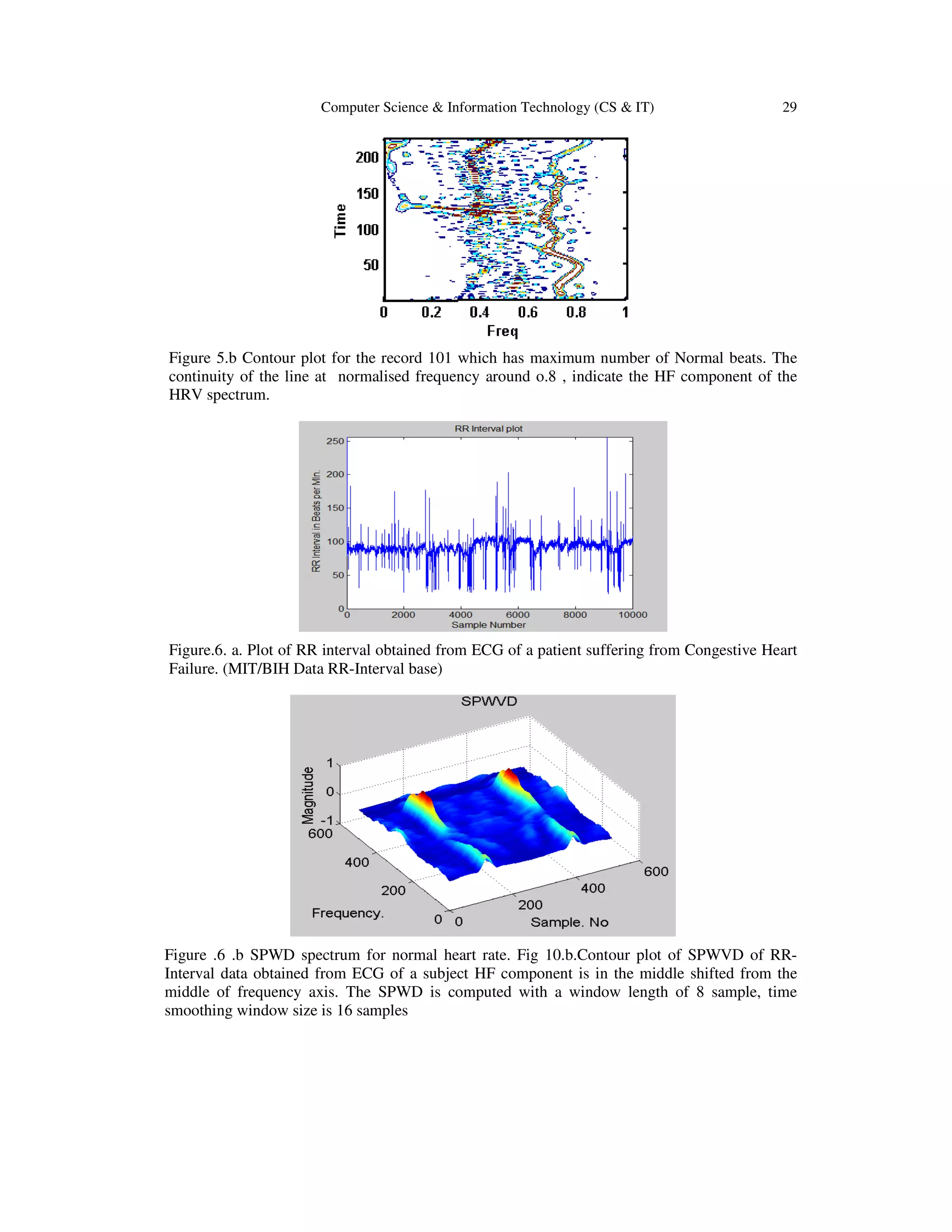
minutes. Figure 5.a shows the SPWVD spectrum and Figure 5.b shows its contour. The continuity
of the line in the frequency axis in Figure 5.b shows the HF component of the HRV spectrum. In
abnormal heart rate the HF and LF component position will be shifted indicating abnormality of
the heart. .
Figure 5. a normal RR interval spectrogram with ECG database 101,
from MIT/BIH data base](https://image.slidesharecdn.com/csit3103-180117062636/75/HEART-RATE-VARIABILITY-ANALYSIS-FOR-ABNORMALITY-DETECTION-USING-TIME-FREQUENCY-DISTRIBUTION-SMOOTHED-PSEUDO-WINGER-VILLE-METHOD-6-2048.jpg)
![32 Computer Science & Information Technology (CS & IT)
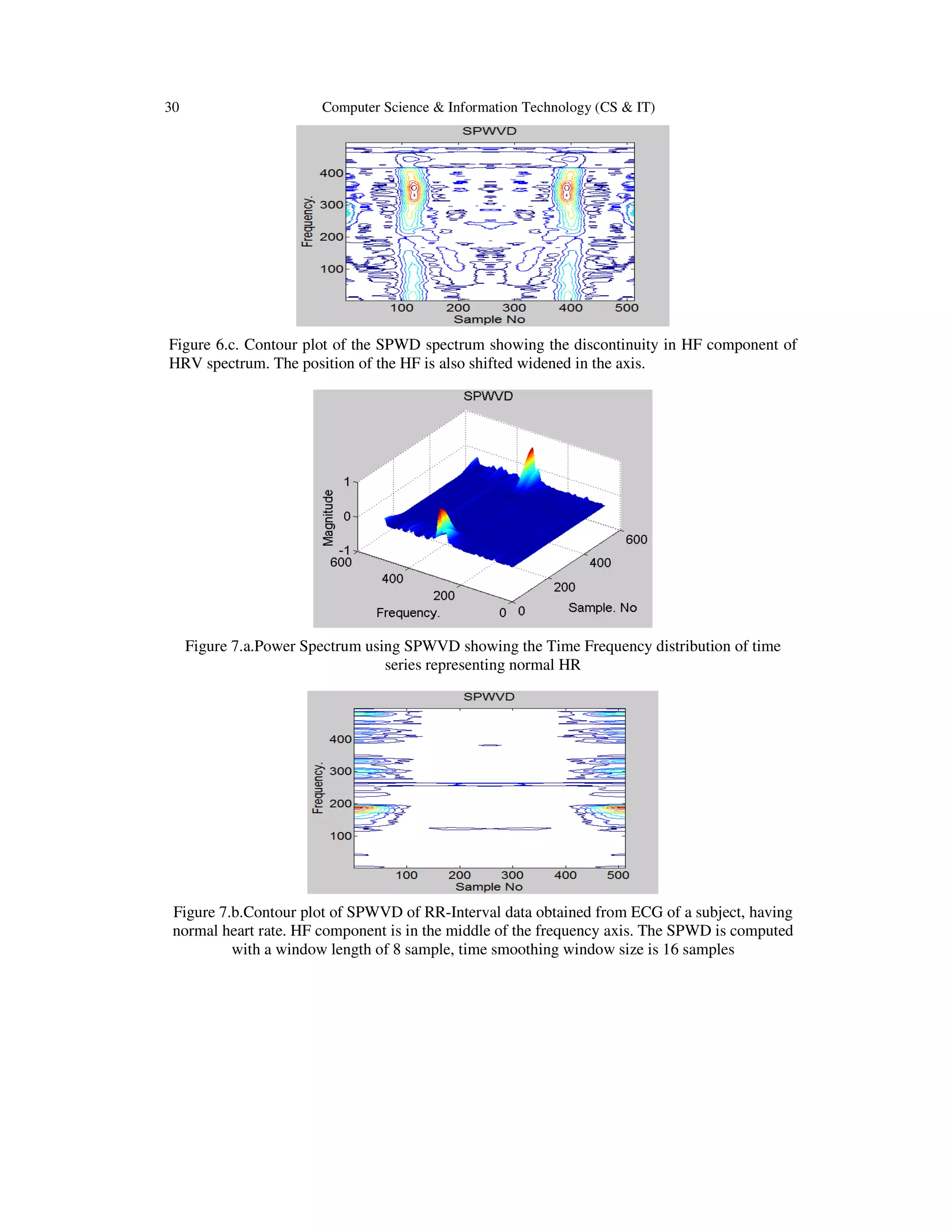
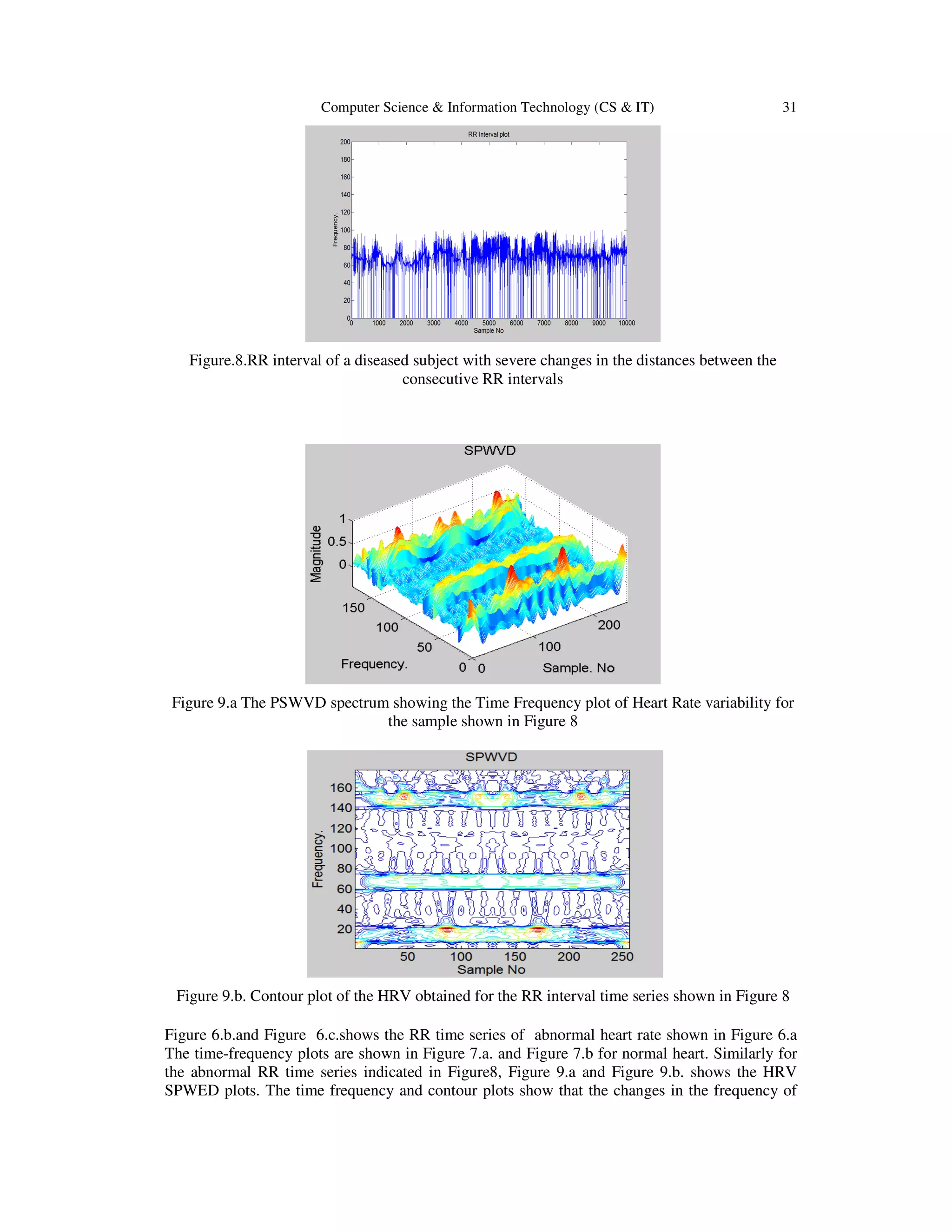
the components correspond to physiological changes which will be taking place. In the HRV
spectrum, strength of the second component (HF) relative to that of the first decides about the
normal and abnormal classification. From this point of view, the sub band processing algorithms
like SPWVD have better performance However, the frequency transition from one band to the
other may not have brought out well which is not of importance in this case.
4. CONCLUSION
The SPWVD with any time and frequency smoothing, provides good time and frequency
resolution. Paper shows how it is possible to have time frequency distribution of different HRV
signal obtained for MIT database, using SPWVD. The corresponding TFDs show that whenever
there are deviations from normal beating of the heart like congestive heart failure , heart beats
after Myocardial Infarction ,the regular repetitive patterns of frequency distributions are changed.
Though the attempt here is not made to give the statistics about time frequency analysis for the
various data files used for the experimentation, it is possible to observe the extent of non-
stationary behaviour of HRV in a longer duration data analysis.
REFERENCES
[1] Norhashimah Mohd Saad, Abdul Rahim Abdullah, and Yin Fen LowDetection of Heart Blocks in
ECG Signals by Spectrum and Time-Frequency Analysis, 4th Student Conference on Research and
Development (SCOReD 2006), Shah Alam, Selangor, MALAYSIA, 27-28 June, 2006
[2] Schwartz, P.J., and Priori, S.G. (1990): ‘Sympathetic nervous system and cardiac arrythmias’, In:
Zipes, D.P., and Jalife, J. eds. Cardiac Electrophysiology, From Cell to Bedside. Philadelphia:
Saunders, W.B. pp. 330–343.
[3] Levy, M.N., and Schwartz, P.J. (1994): ‘Vagal control of the heart: Experimental basis and clinical
implications’, Armonk: Future.
[4] Task Force of the European Society of Cardiology and North American Society of Pacing and
Electrophysiology. (1996): ‘Heart Rate Variability: Standards of measurement, physiological
interpretation and clinical use’, European HeartJournal, 17, pp. 354–381.
[5] Berger, R.D., Akselrod, S., Gordon, D., and Cohen, R.J. (1986): ‘An efficient algorithm for spectral
analysis of heart rate variability’, IEEE Transactions on Biomedical Engineering, 33, pp. 900–904.
[6] Kamath, M.V., and Fallen, E.L. (1995): ‘Correction of the heart rate variability signal for ectopics and
missing beats’, In: Malik, M., and Camm, A.J. eds. Heartrate variability, Armonk: Futura, pp. 75–85.
[7] Kobayashi, M., and Musha, T. (1982): ‘1/f fluctuation of heart beat period’, IEEE transactions on
Biomedical Engineering, 29, pp. 456–457.
[8] Boomsma, F.T., and Manintveld. (1999): ‘Cardiovascular control and plasma catecholamines during
restand mental stress: effects of posture’, Clinical Science, 96, pp. 567–576.
[9] Viktor, A., Jurij-Matija, K., Roman, T., and Borut, G. (2003): ‘Breathingrates and heart rate
spectrograms regarding body position in normal subjects’,Computers in Biology and Medicine, 33,
pp. 259–266.
[10] Rosenstien, M., Colins, J.J., and De Luca, C.J. (1993): ‘A practical method for calculating largest
Lyapunov exponents from small data sets’, Physica D,65, pp. 117–134.
[11] Pincus, S.M. (1991): ‘Approximate entropy as a measure of system complexity’, Proceedings of
National Acadamic Science, USA, 88, pp. 2297–2301.12.
[12] Peng, C.K., Havlin, S., Hausdorf, J.M., Mietus, J.E., Stanley, H.E., andGoldberger, A.L. (1996):
‘Fractal mechanisms and heart rate dynamics’, Journal on Electrocardiology, 28 (suppl), pp. 59–64.
[13] Grossman, P., Karemaker, J., and Wieling, W. (1991): ‘Prediction of tonicparasympathetic cardiac
control using respiratory sinus arrhythmia: the need for respiratory control’, Psychophysiology, 28,
pp. 201–216.](https://image.slidesharecdn.com/csit3103-180117062636/75/HEART-RATE-VARIABILITY-ANALYSIS-FOR-ABNORMALITY-DETECTION-USING-TIME-FREQUENCY-DISTRIBUTION-SMOOTHED-PSEUDO-WINGER-VILLE-METHOD-10-2048.jpg)


![Hepatic dopp us [1]](https://cdn.slidesharecdn.com/ss_thumbnails/hepaticdoppus1-210813101656-thumbnail.jpg?width=640&height=640&fit=bounds)


![Guidelines heart rate_variability_ft_1996[1]](https://cdn.slidesharecdn.com/ss_thumbnails/guidelinesheartratevariabilityft19961-100604162052-phpapp01-thumbnail.jpg?width=640&height=640&fit=bounds)


