• Healthy Eating and Healthy Habits
Healthy eating and
healthy habits
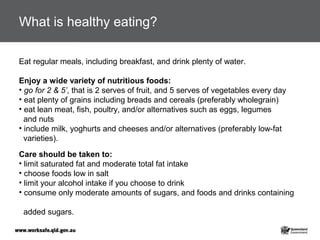
What is healthy eating?
Eat regular meals, including breakfast, and drink plenty of water.
Enjoy a wide variety of nutritious foods:
• go for 2 & 5’, that is 2 serves of fruit, and 5 serves of vegetables every day
• eat plenty of grains including breads and cereals (preferably wholegrain)
• eat lean meat, fish, poultry, and/or alternatives such as eggs, legumes
and nuts
• include milk, yoghurts and cheeses and/or alternatives (preferably low-fat
varieties).
Care should be taken to:
• limit saturated fat and moderate total fat intake
• choose foods low in salt
• limit your alcohol intake if you choose to drink
• consume only moderate amounts of sugars, and foods and drinks containing
added sugars.
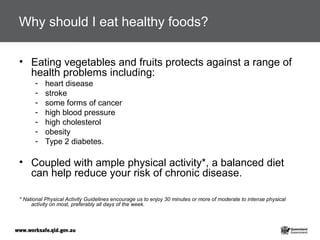
Why should I eat healthy foods?
• Eating vegetables and fruits protects against a range of
health problems including:
- heart disease
- stroke
- some forms of cancer
- high blood pressure
- high cholesterol
- obesity
- Type 2 diabetes.
• Coupled with ample physical activity*, a balanced diet
can help reduce your risk of chronic disease.
* National Physical Activity Guidelines encourage us to enjoy 30 minutes or more of moderate to intense physical
activity on most, preferably all days of the week.
How does healthy eating affect safety?
• Eating a healthy, balanced diet provides nutrients to
your body.
• Skipping meals or eating a poor diet can lead to lowered
levels of alertness, low energy, poor concentration, poor
sleep and fatigue.
• These can have a negative affect on your safety at work
and increase your likelihood of having a work related
incident.
• Additionally, overweight and obese workers have a
higher rate of injury within the workplace. They also
are more likely to be absent from work due to an
injury or illness.
What can be done in your workplace?
Individual
• Provide education sessions on healthy eating, and healthy lunch
options.
• Encourage workers to bring their lunch to work
• Host workplace challenges e.g. eat well for a week; try a different
fruit or vegetable every day; competition to eat more fruit and
vegetables.
• Consider hosting a weight management program in the workplace.
• Host cooking demonstrations and taste testing that showcase
healthy options.
• Produce and distribute a healthy cooking recipe book which
includes recipes contributed by employees.
What can be done in your workplace? (cont’d)
Environmental
• Put up healthy eating posters around your workplace.
• Ensure adequate facilities are supplied (i.e. lunch room with
refrigeration, microwave, space to prepare healthy food etc)
• Remove the biscuit or lolly jar as well as fundraising chocolate
boxes and replace with healthier snacks such as nuts and dried
fruits.
• Change vending machines to stock healthier drink and snack
options.
• Encourage staff to take lunch breaks.
• Offer complimentary or subsidised fruit in the workplace.
What can be done in your workplace? (cont’d)
Policy
• Develop a workplace healthy eating or nutrition policy
that covers several aspects of food provision:
• internal and external catering for meetings, functions
and events
• vending machines
• food and drinks sold in the staff canteen
• fundraising
Helpful Tools
• Visit www.gofor2and5.com.au
• Visit http://www.measureup.gov.au
• Visit www.worksafe.qld.gov.au
• Phone Infoline 1300 369 915
• Sign up for eNEWS (free email subscription
service) at www.worksafe.qld.gov.au.
• Follow @WorkSafeQLD on Twitter
• Tune into Workplace Health & Safety Qld on
YouTube.
Debunking the myth
• Myth: Energy and sports drinks are a healthy
way to hydrate.
• Truth: Energy and sport drinks typically contain
sugars and caffeine (up to 80mg per can, about
the same as an espresso coffee). These drinks
can affect your heartbeat and blood pressure
and may lead to addiction.
Water is a more suitable alternative. Drink plenty
of water throughout the day, don’t wait until you
are thirsty.

Healthy eating-presentation

  • 2.
    • Healthy Eatingand Healthy Habits Healthy eating and healthy habits
  • 3.
    What is healthyeating? Eat regular meals, including breakfast, and drink plenty of water. Enjoy a wide variety of nutritious foods: • go for 2 & 5’, that is 2 serves of fruit, and 5 serves of vegetables every day • eat plenty of grains including breads and cereals (preferably wholegrain) • eat lean meat, fish, poultry, and/or alternatives such as eggs, legumes and nuts • include milk, yoghurts and cheeses and/or alternatives (preferably low-fat varieties). Care should be taken to: • limit saturated fat and moderate total fat intake • choose foods low in salt • limit your alcohol intake if you choose to drink • consume only moderate amounts of sugars, and foods and drinks containing added sugars.
  • 4.
    Why should Ieat healthy foods? • Eating vegetables and fruits protects against a range of health problems including: - heart disease - stroke - some forms of cancer - high blood pressure - high cholesterol - obesity - Type 2 diabetes. • Coupled with ample physical activity*, a balanced diet can help reduce your risk of chronic disease. * National Physical Activity Guidelines encourage us to enjoy 30 minutes or more of moderate to intense physical activity on most, preferably all days of the week.
  • 5.
    How does healthyeating affect safety? • Eating a healthy, balanced diet provides nutrients to your body. • Skipping meals or eating a poor diet can lead to lowered levels of alertness, low energy, poor concentration, poor sleep and fatigue. • These can have a negative affect on your safety at work and increase your likelihood of having a work related incident. • Additionally, overweight and obese workers have a higher rate of injury within the workplace. They also are more likely to be absent from work due to an injury or illness.
  • 6.
    What can bedone in your workplace? Individual • Provide education sessions on healthy eating, and healthy lunch options. • Encourage workers to bring their lunch to work • Host workplace challenges e.g. eat well for a week; try a different fruit or vegetable every day; competition to eat more fruit and vegetables. • Consider hosting a weight management program in the workplace. • Host cooking demonstrations and taste testing that showcase healthy options. • Produce and distribute a healthy cooking recipe book which includes recipes contributed by employees.
  • 7.
    What can bedone in your workplace? (cont’d) Environmental • Put up healthy eating posters around your workplace. • Ensure adequate facilities are supplied (i.e. lunch room with refrigeration, microwave, space to prepare healthy food etc) • Remove the biscuit or lolly jar as well as fundraising chocolate boxes and replace with healthier snacks such as nuts and dried fruits. • Change vending machines to stock healthier drink and snack options. • Encourage staff to take lunch breaks. • Offer complimentary or subsidised fruit in the workplace.
  • 8.
    What can bedone in your workplace? (cont’d) Policy • Develop a workplace healthy eating or nutrition policy that covers several aspects of food provision: • internal and external catering for meetings, functions and events • vending machines • food and drinks sold in the staff canteen • fundraising
  • 9.
    Helpful Tools • Visitwww.gofor2and5.com.au • Visit http://www.measureup.gov.au • Visit www.worksafe.qld.gov.au • Phone Infoline 1300 369 915 • Sign up for eNEWS (free email subscription service) at www.worksafe.qld.gov.au. • Follow @WorkSafeQLD on Twitter • Tune into Workplace Health & Safety Qld on YouTube.
  • 10.
    Debunking the myth •Myth: Energy and sports drinks are a healthy way to hydrate. • Truth: Energy and sport drinks typically contain sugars and caffeine (up to 80mg per can, about the same as an espresso coffee). These drinks can affect your heartbeat and blood pressure and may lead to addiction. Water is a more suitable alternative. Drink plenty of water throughout the day, don’t wait until you are thirsty.

Editor's Notes

  • #4 Healthy eating means eating a variety of foods such as fruit and vegetables, wholegrains, lean meats and low-fat dairy products as well as limiting the amount of fat and sugar consumed. However, only one in ten Queensland adults eats the recommended daily five serves of vegetables and two serves of fruit (5 per cent males, 11.7 per cent females). What we eat at work can have a major influence on our long term health and wellbeing. What is a fruit and vegetable Serve? 1 serve of vegetables = ½ cup cooked vegetables, 1 medium potato, 1 cup salad vegetables, ½ cup cooked legumes (dried beans, peas or lentils). I serve of Fruit = 1 medium-sized piece (eg. apple), 2 smaller pieces (eg apricots), 1 cup canned or chopped fruit, ½ cup (125mL) 100% fruit juice, 1½ tablespoon dried fruit (eg. Sultanas or 4 dried apricot halves) N.B. Choose fresh fruit instead of fruit juice or dried fruit where possible. Juices have lower fibre content than fresh fruit. Dried fruit if eaten in large quantities, can contribute to tooth decay because it contains a concentrated form of sugar that stick to your teeth. Saturated fats – are bad fats, they are commonly found in many takeaway (‘fast’) foods, in commercial products such as biscuits and pastries, and in dairy products. Replace saturated fats with healthy fats, such as naturally occurring fats in avocado, olive oil and fish (i.e. salmon) Reading food labels Food labels contain a variety of information, including how much fat, salt and sugars, as well as total energy are in your food of choice. As a quick guide, look for products that have the following as a good choice: Total Fat – less than 10g per 100g Sugar – less than 15g per 100g Fibre - at least 3g of dietary fibre per 100g. Sodium (i.e. Salt) - less than 300mg of sodium per 100g.
  • #5 Lifestyle behaviours explain high levels of current disease burden 84% of coronary heart disease burden is due to modifiable risk factors, mostly high blood pressure and cholesterol, physical inactivity, for diet, high body mass and smoking. 69% of stroke is due to similar modifiable risk factors. 74% of diabetes burden is due to high body mass and physical inactivity. 16% of total disease burden is due to unhealthy diet and physical inactivity. Source – The Health of Queenslanders (the Chief Health Officer Report 2010)
  • #7 There are lots of ways that workplaces can support employees to make healthier food choices. These can be broken down into those that are done at the individual level, those done to the workplace environment, and those done at the policy level. There are many work related risk factors, and non-work related risk factors that can be considered when trying to improve the nutrition and therefore health of your employees. Work Related Risk Factors for unhealthy eating include: Lack of access to healthy snacks or meals at work Lack of time to take breaks for meals Lack of refrigeration to store healthy foods Increased job stress (time pressure) Job insecurity Lack of availability of fruit and vegetables Long work hours Shift work Cafeteria choices, availability of “healthy” foods in vending machines for snacking and late afternoon and evening meals can contribute to the choices made by individuals at work Non-Work Related Risk Factors for unhealthy eating include: Lack of knowledge of health eating Limited income and cost of fruit and vegetables Partner and children not eating fruit and vegetables Unexpected changes to daily routines Being overweight
  • #8 There are lots of ways that workplaces can support employees to make healthier food choices. These can be broken down into those that are done at the individual level, those done to the workplace environment, and those done at the policy level. There are many work related risk factors, and non-work related risk factors that can be considered when trying to improve the nutrition and therefore health of your employees. Work Related Risk Factors for unhealthy eating include: Lack of access to healthy snacks or meals at work Lack of time to take breaks for meals Lack of refrigeration to store healthy foods Increased job stress (time pressure) Job insecurity Lack of availability of fruit and vegetables Long work hours Shift work Cafeteria choices, availability of “healthy” foods in vending machines for snacking and late afternoon and evening meals can contribute to the choices made by individuals at work Non-Work Related Risk Factors for unhealthy eating include: Lack of knowledge of health eating Limited income and cost of fruit and vegetables Partner and children not eating fruit and vegetables Unexpected changes to daily routines Being overweight
  • #9 There are lots of ways that workplaces can support employees to make healthier food choices. These can be broken down into those that are done at the individual level, those done to the workplace environment, and those done at the policy level. There are many work related risk factors, and non-work related risk factors that can be considered when trying to improve the nutrition and therefore health of your employees. Work Related Risk Factors for unhealthy eating include: Lack of access to healthy snacks or meals at work Lack of time to take breaks for meals Lack of refrigeration to store healthy foods Increased job stress (time pressure) Job insecurity Lack of availability of fruit and vegetables Long work hours Shift work Cafeteria choices, availability of “healthy” foods in vending machines for snacking and late afternoon and evening meals can contribute to the choices made by individuals at work Non-Work Related Risk Factors for unhealthy eating include: Lack of knowledge of health eating Limited income and cost of fruit and vegetables Partner and children not eating fruit and vegetables Unexpected changes to daily routines Being overweight