Healthcare Industry


          By Group 2; Section B

          » Neha Sikarwar; Roll No. – 12
          » Souvik Roy; Roll No. - 14
          » Boby Sebastian; Roll No. - 16
          » Rahul Bedi; Roll No. - 18
          » Vipul Bajaj; Roll No. - 20
Objective


 To study the various aspects of the Health care
  industry in India with respect to the Marketing
segmentation, issues at hand and opportunities of
                      growth.
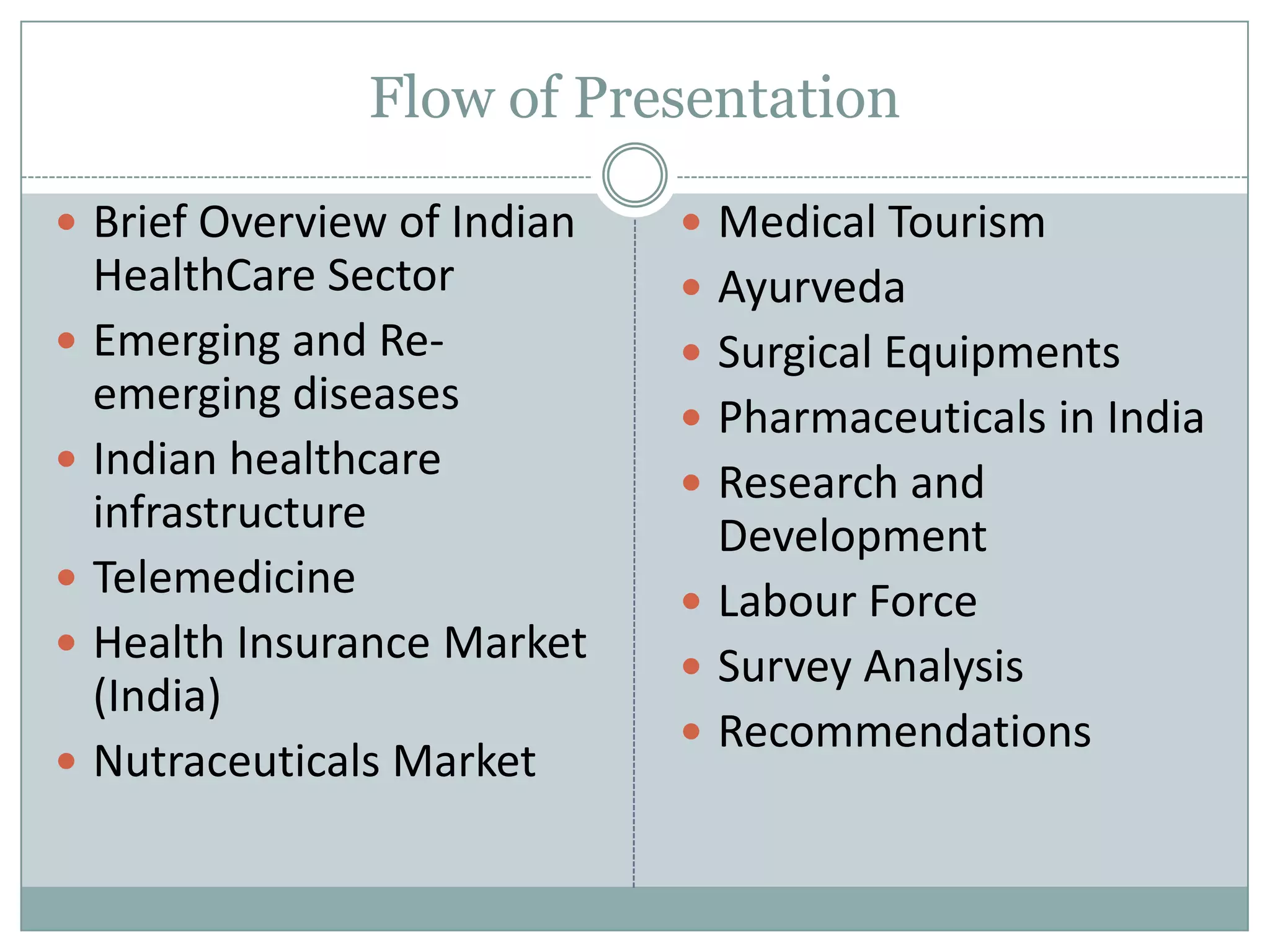
Flow of Presentation

 Brief Overview of Indian     Medical Tourism
    HealthCare Sector          Ayurveda
   Emerging and Re-           Surgical Equipments
    emerging diseases          Pharmaceuticals in India
   Indian healthcare          Research and
    infrastructure              Development
   Telemedicine               Labour Force
   Health Insurance Market    Survey Analysis
    (India)
                               Recommendations
   Nutraceuticals Market
Brief Overview

 The Healthcare Sector comprises of
   Hospitals
   Diagnostics
   Pathology
   Equipment and Supplies
   Medical Tourism
   Telemedicine, etc

 It is one the prominent contributors to India’s GDP.
 It attracts large number of domestic as well as international
  players
 India has become an attractive destination for
       Medical Tourism
       Clinical Studies
       Research and Development Programs
 There is massive growth potential and scope for expansion

copyright (your organization) 2003                           5/5/2012
HealthCare : Market Size


 The HealthCare Industry is presently worth $50bn.
 Second largest service sector employer in the
  country.
 Provides jobs for 4.5mn people directly or indirectly.
 Ratings agency Sitch estimates doubling of size of
  the sector to $100bn by 2015.
Indian HealthCare : The Growth Story

 A sudden in paradigm shift in the last five years.
 This shift has become visible only in the last two
  years.
 A shift from an unorganized to an organized
  structure.
 It was earlier seen only as a social sector but now
  there is a move towards corporatization.
 Apollo pioneered the trend of corporate hospitals in
  India.
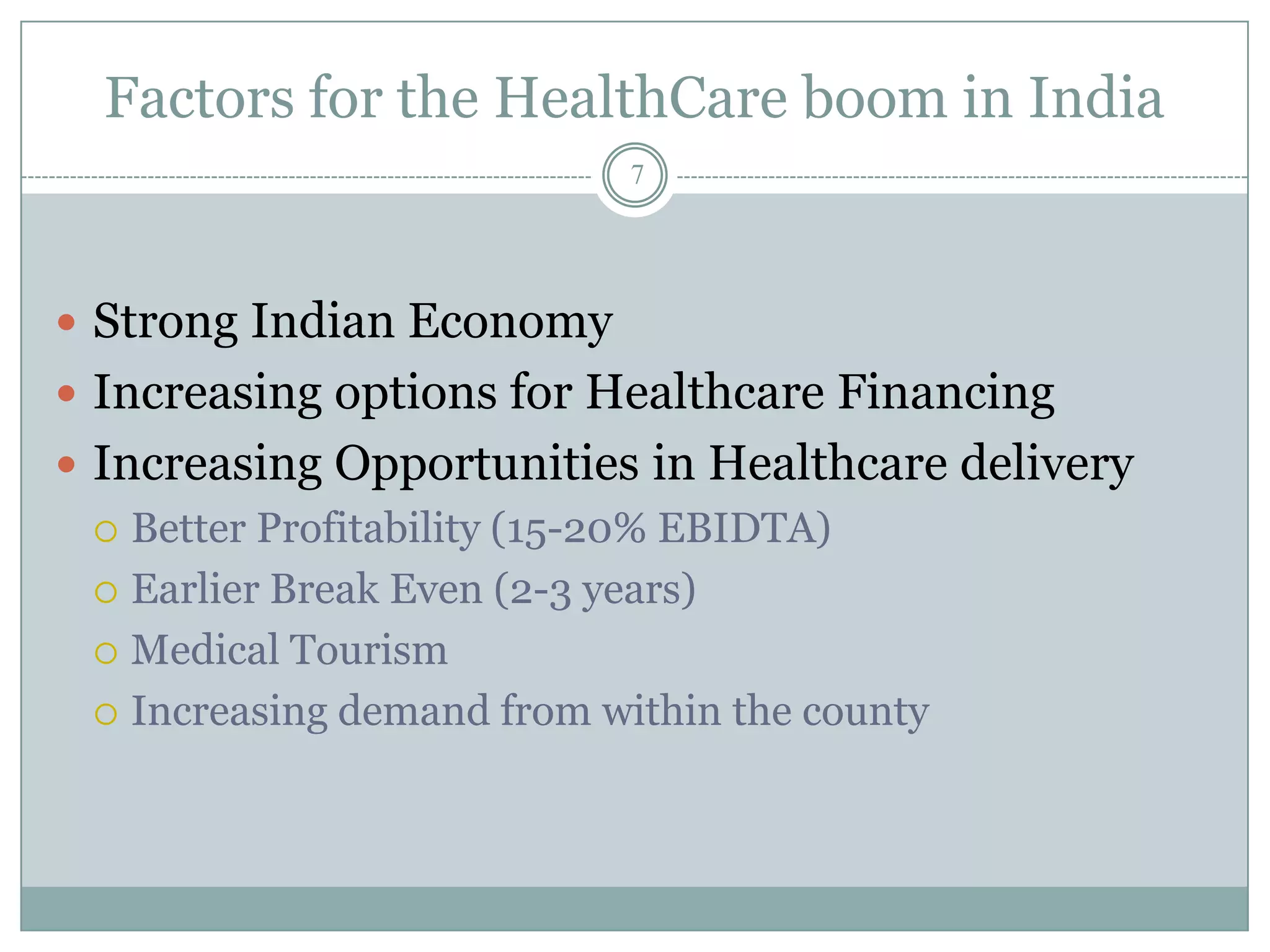
Factors for the HealthCare boom in India
                          7


 Strong Indian Economy
 Increasing options for Healthcare Financing
 Increasing Opportunities in Healthcare delivery
   Better Profitability (15-20% EBIDTA)

   Earlier Break Even (2-3 years)

   Medical Tourism

   Increasing demand from within the county
Increasing Demand from Within the Country
                    8
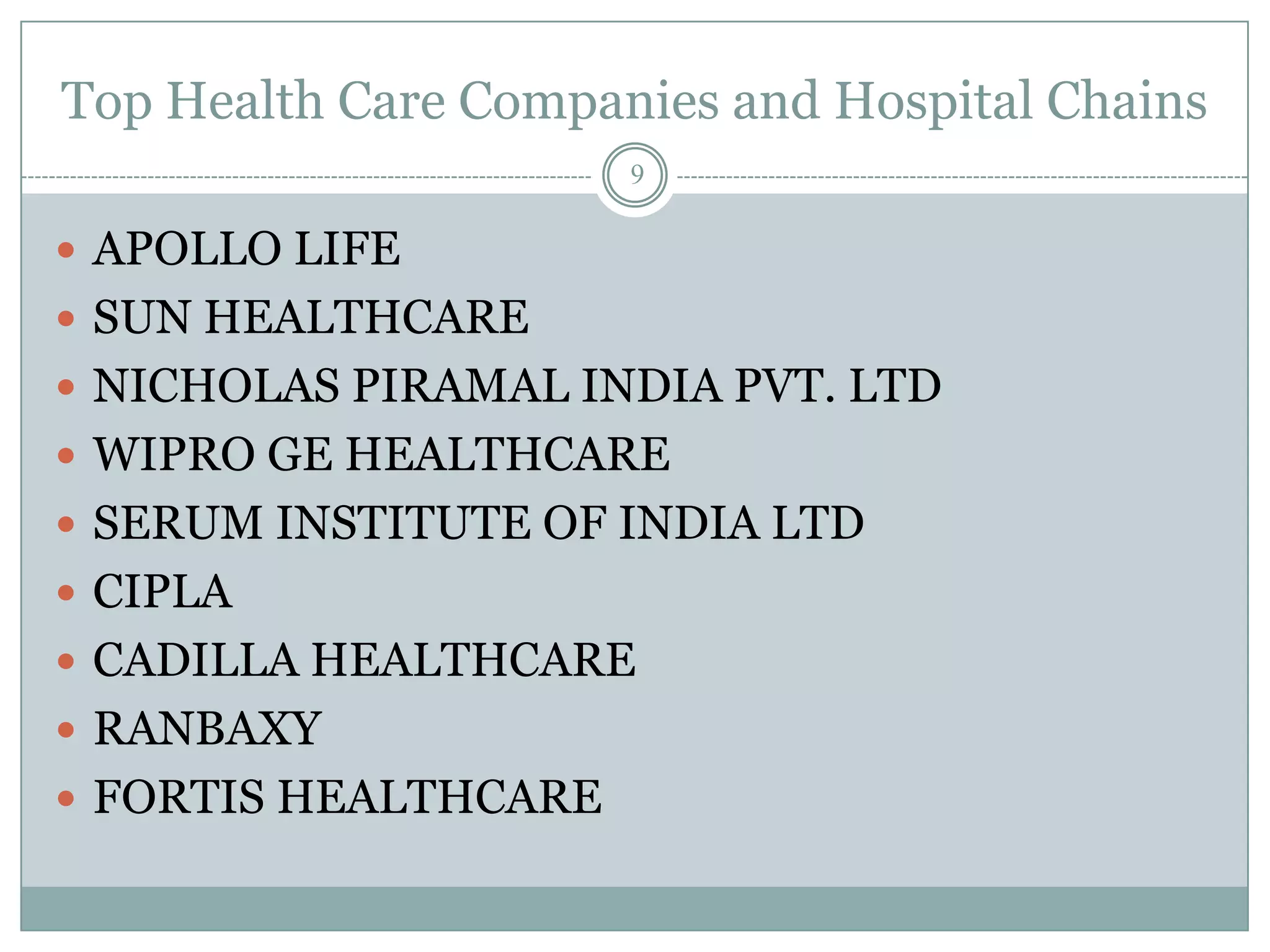
Top Health Care Companies and Hospital Chains
                      9

 APOLLO LIFE
 SUN HEALTHCARE
 NICHOLAS PIRAMAL INDIA PVT. LTD
 WIPRO GE HEALTHCARE
 SERUM INSTITUTE OF INDIA LTD
 CIPLA
 CADILLA HEALTHCARE
 RANBAXY
 FORTIS HEALTHCARE
Emerging & Re-Emerging Diseases

 Pneumonia - The deadliest Acute respiratory
 infections (ARIs) are responsible for most deaths in
 the developing nations.

 HIV/AIDS - Over 33 million people are living with
 HIV/AIDS worldwide. There is still no cure on the
 horizon. Worst affected is sub-Saharan Africa
Emerging & Re-Emerging Diseases(contd)

 Diarrhea - It imposes a heavy burden on developing
  countries - accounting for 1.5 billion bouts of illness
  a year in children under five. The burden is highest
  in deprived areas where there is poor sanitation,
  inadequate hygiene and unsafe drinking water.
 Tuberculosis (TB) - a disease once thought to be
  under control, has bounced back with a vengeance
  to kill 1.5 million people a year - even more when in
  combination with HIV/AIDS. Nearly two billion
  people - one-third of the world's population - have
  latent TB infection
Emerging & Re-Emerging Diseases(contd)

 Influenza - It is a greatly misunderstood disease.
 Each year we confront seasonal, or interpandemic
 influenza. Seasonal influenza kills about 250,000 to
 300,000 people each year throughout the world

 Measles - It is the most contagious disease known to
 man. It is a major childhood killer in developing
 countries - accounting for about 900 000 deaths a
 year
“In an era of increasing globalization, emerging
  infectious diseases are everybody's problem”

 SARS - Nearly three years ago, the world experienced another
  newly emerging microbe—a previously unknown corona virus—that
  caused severe acute respiratory syndrome (SARS). Fortunately, the
  morbidity and mortality associated with the SARS outbreak were not
  as great as what we observe every year with influenza. The SARS
  outbreak turned out to be a classic study in epidemiology with
  regard to tracking the point source, the spread, and the
  containment. SARS first appeared in Guangdong Province in China. It
  was not reported to authorities until it emerged in Hong Kong, when
  an index case, which traveled from Guangdong to Hong Kong, stayed
  at the Metropole hotel and infected at least 14 people. Those
  individuals did some traveling throughout the world. Within months
  we had an epidemic that temporarily transfixed the world and did
  extraordinary economic damage in Canada, China, and Hong Kong,
  and other countries. There were 8,098 reported cases and 774
  deaths.
Indian Healthcare Infrastructure

 As on December 2010, there were 335 medical
  colleges which were recognized by the Indian
  Medical Council.
 As on 2001, a total of 5, 39, 00 MBBS doctors were
  registered with the Medical council number of
  Physicians and specialists available is less than the
  estimated requirements.
 The current doctor population ratio is 1:1800.
 Though at present approximately 50000 doctors are
  being produced annually in the nation, but the
  number needs to go up.
Indian Healthcare Infrastructure(contd)


 By 2020, the Indian healthcare industry is estimated
 to be worth US$ 275.6 billion. Currently, 8 per cent
 of India’s GDP is spent on healthcare. India needs to
 spend at least US$ 80 billion more in the next five
 years to meet targets, according to Mr Pradipta K
 Mohapatra, Chairman, Executive & Business
 Coaching Foundation India Ltd and Past
 Chairman, Confederation of Indian Industry
 (CII), Southern Region.
Survey Analysis on Infrastructure

 51% of the surveyed population believes that there is
  considerable difference between performances of
  hospitals in their region.
 39% of the population believes that quality of govt.
  hospitals is bad and 35% of population believes that
  the quality is just an average. 18% believes that the
  quality of the govt. hospitals is very bad. Only 8%
  believes that quality of govt. hospitals are good.
Survey Analysis on Infrastructure(contd)

 57% of the population believes that quality of
 private hospitals is good and 22% of population
 believes that the quality is just an average. 21%
 believes that the quality of the private hospitals is
 very good.

 83% of the population is of the opinion that cost of
 private hospital is quite expensive.
Measures Taken to Improve

 Medical practitioners to undergo knowledge and skill up
  gradation and recertification every five years are
  proposed in the Tenth Plan.
 Promoting Open Universities for providing continuous up
  gradation of medical knowledge
 Setting up of Medical Grants Commission for funding new
  Government Medical and Dental colleges
 Developing decentralized district based health manpower
  planning that would meet the demands of health
  services, and encouraging all States to establish
  University of Health Sciences (UHS)
Telemedicine
 Telemedicine is the
 ability to provide
 interactive healthcare     Real-Time
 utilizing modern
 technology and
                            Store and Forward
 telecommunications.
                            (asynchronous):

 Various telemedicine
                            Home Health
 usage models
                            Telemedicine
Recommendations

 More medical colleges
 Attract more FDI investment
 Student exchange programmes
 More special medical schemes
 Branding Healthcare Industry
 Preserve and promote Ayurvedic Medical System
 Telemarketing and social marketing
 Seminars and workshop (build awareness; stop
 corruption)
The Health Insurance
  Market of India
Need of Health Insurance

 Government Hospitals: Inadequate facilities


 Expensive Medicines: Diagnostic charges are beyond
  common man’s reach.

 High cost of Specialists.


 Tax benefit under section 80 D of the Income Tax Act
Standard Health Insurance: Features

 Room and boarding expenses provided by the hospital
 Nursing expenses
 Diagnostic and medicine expenses
 Other Services: Surgeon, Anesthetist, Medical
  Practitioner, Consultants, Specialist
  fees, Anesthesia, blood, oxygen, operation theatre
  expenses, cost of surgical appliances, medicines and
  drugs and similar expenses.
 Pre-hospitalization and post hospitalization expenses
  subject to conditions and limits.
Companies Category
 Non-Life Insurance:

     Public: Companies like Oriental, National Insurance, United India, etc.
     Private: Companies like ICICI Lombard, Reliance, Bajaj Allianz, etc.

 Specialized Health Insurance Companies:
  Offers Core Health Insurance services & Products only.
  Examples: Star Health & Allied Insurance, Apollo DKV Insurance

 Life Insurance Companies:
  Addresses following needs:
   Saving
   Pension
   Retirement
   Investment
  Players are LIC and other private players
Market Segmentation

 Working Class Individuals
 Working Professionals with Family.
 Students
 Senior Citizens
 Small and Medium Enterprises/ Corporate Houses:
Product Ranges

 Individual Health Insurance Products (Single Person).
 Family Health Insurance
 Senior citizen Health Insurance
 Individual Personal Accident
 Overseas Travel Health Insurance
 Group Health Insurance Policy for corporate /
 Organization
Industry Statistics
Inferences

 Dominance: The four state-owned general insurers,
  account for almost 60 per cent of the premiums written
  in the first nine months of this fiscal.
 National Insurance Company: sharp rise in premium of
  54% during the period.
 Private players:
    ICICI Lombard:
     at top position
    third spot in the industry with a growth of over 70 per cent and a
     market share of 13.2 per cent,
    Star Health & Allied Insurance (Star Health) with a share of 11.5
     percent.
NUTRACEUTICALS MARKET

 Dietary supplements


 To fill nutritional deficiencies in food


 To prevent diseases
Segmentation

 Functional foods


 Functional beverages


 Mineral supplements
Challenges


 Lack of awareness


 Lack of Trust among People


 Lack of regulations


 Expensive Products
Major Companies

 Amway India-NUTRILITE
 Herb life


Distribution channel: Multi-level Marketing
MEDICAL TOURISM
MEDICAL TOURISM

                     INTRODUCTION
 20% growth rate
 History
 International healthcare accreditation organizations


               MEDICAL TOURISM IN INDIA
 30% growth rate
 9500 crores by 2015
 Health capital of India
ADVANTAGES OF INDIA

 Quality and experience of doctors and surgeons


 Most doctors and nurses are fluent in English


 Latest medical equipments


 Quality of nurses


 Low cost
COMPETITION

 Thailand, Singapore, Malaysia and Philippines are
    the major competitors
   Thailand is more popular for cosmetic surgery.
   In complex procedures Singapore has a technology
    advantage.
   Cost in Thailand is also less than Singapore
   The Malaysian government is aggressively promoting
    medical tourism.
SOURCE MARKET


SOURCE: http://www.tourism.gov.in
SOURCE OF FINANCIAL SUPPORT


      SOURCE: http://www.tourism.gov.in
AYURVEDA

 INTRODUCTION
 Increasing popularity in Western Countries
 Availability of good infrastructure
 HERBAL TOURISM IN KERALA
 Kerala is becoming one of the major destination of
  herbal tourism
 Kerala has an excellent network of hospitals
 International standard of facilities
SURGICAL EQUIPMENTS

 World market growing at a rate of 6% from 2010
 Market is highly price sensitive.
 Good network of distribution channels
 Powered Instruments :- 47% of the total market
 Non-Powered Surgical Instruments:- blades,
  scissors etc
 Wound Closure Devices:- staplers, wound closure
  strips etc
Pharmaceuticals in India

•The Indian pharmaceutical industry is the world's second-largest by
volume.

•India's bio-tech industry clocked a 17 percent growth with revenues
of Rs.137 billion ($3 billion) in the 2009-10 financial year .

•Bio-Pharmaceutical was the biggest contributor generating 60
percent of the industry's growth at Rs. 8,829/- crore, followed by bio-
services at Rs.2,639/- crore and bio-agri at Rs.1,936 crore.
Pharmaceuticals in India (contd)
                                     42

• The first pharmaceutical company was Bengal
    Chemicals and Pharmaceutical Works, which still exists
    today as one of 5 government-owned drug
    manufacturers, formed in Calcutta in 1903.

• For the next 60 years, most of the drugs in India were
    imported by multinationals either in fully formulated or
    bulk form.


copyright (your organization) 2003                      5/5/2012
Government’s Role

Encouraged growth of drug manufacturing in the early 1960s, and with
the Patents Act in 1970, enabled the industry to become what it is today.

The patent act removed composition patents from food & drugs, and though it
kept process patents, these were shortened to 5 to 7 years.

Lack of patent protection made the Indian market undesirable for multinational
companies & while they went out, Indian companies took their place.

They carved a niche in both the Indian & world markets with their expertise in
reverse-engineering new processes for manufacturing at low costs.

Very few companies have taken steps towards drug innovation, the industry has
been following the older model.
Overview
 Purely Indian pharmaceutical companies is fairly low.


 Mainly operated, controlled by dominant foreign companies having
  subsidiaries in India.

 In 2002, over 20,000 registered drug manufacturers in India sold $9
  billion worth of formulations & bulk drugs.
   85% of these were sold in India, while over 60% were exported, mostly to the
     U.S. & Russia.

 Players in the market are mostly SME’s;
     250 of the largest companies control 70% of the market.

 Thanks to the 1970 Patent Act;
      multinationals represent only 35% of the market, down from 70% thirty
      years ago.
Overview (contd..)

 Pharmaceutical companies operating in India, even the multinationals,
  employ Indians at all levels.

     Mirroring the social structure, firms are very hierarchical.
     Home grown pharmaceuticals, are often a mix of public & private enterprise.
     Leadership passes from father to son & the founding family holds a majority
      share.

 Globally, India currently holds a modest 1-2% share, growing at around
  10% per year.

 There are 74 U.S. FDA-approved manufacturing facilities in India.
     More than in any other country outside the U.S.A.
     In 2005, almost 20% of all Abbreviated New Drug Applications (ANDA) to the
      FDA were filed by Indian companies.
Top 10 Pharmaceutical Companies in India, as
                 of 2010.
 Rank                 Company                    Revenue 2010 (Rs crore)   Revenue 2010 (Rs billion)


  1                     Cipla                          4,198.96                    41.989

                      Ranbaxy
  2                                                    4,162.25                    41.622
        (taken over by Daiichi Sankyo in 2008)

  3           Dr. Reddy's Laboratories                 3,763.72                    37.637

  4              Sun Pharmaceutical                    2,463.59                    24.635

  5                   Lupin Ltd                        2,215.52                    22.155

  6          Aurobindo Pharmaceutical                  2,081.19                    20.801

  7               GlaxoSmithKline                      1,773.41                    17.734

  8               Cadila Healthcare                      1,613                      16.13

  9            Aventis Pharmaceutical                   983.80                      9.838

 10               Ipca Laboratories                     980.44                     9.8044
Patents
 The industry is being forced to adapt its business model to recent
  changes in the operating environment.
 The 1st & most significant change was the January 1, 2005 enactment
  of an amendment to India’s patent law that reinstated product
  patents for the first time since 1972.
     The WTO’s Trade-Related Aspects of Intellectual Property Rights (TRIPS)
      agreement, which mandated patent protection on both products & processes
      for a period of 20 years.
     India was forced to recognize not only new patents but also patents filed after
      January 1, 1995.
 The new patent legislation has resulted in fairly clear segmentation.
     The multinationals narrowed their focus onto high-end patients who make up
      only 12% of the market, taking advantage of their newly bestowed patent
      protection.
     Meanwhile, Indian firms have chosen to take their existing product portfolios &
      target semi-urban & rural populations.
Product development


 Indian companies are adapting to the new environment.

 Firms have made their ways into the global market,
   By researching generic competitors to patented drugs
   Following up with litigation to challenge the patent.


 Those who can afford it, have set their sights on an even
  higher goal: new molecule discovery.
     Initial investment is huge, but companies are promised hefty profit
      margins & recognition globally.

 Local firms have been investing money into their R&D
  programs or have formed alliances.
Small & Medium enterprises

 The outlook for small and medium enterprises (SME) is not as bright. The excise
    tax of 16% on the MRP of their products. Was a major issue.
   Larger companies were cutting back on outsourcing & business is shifting to
    companies with facilities in tax-free states of - Himachal Pradesh, Jammu &
    Kashmir, Uttaranchal & Jharkhand.
   But in a matter of a couple of years the excise duty was revised on two occasions,
    first it was reduced to 8% & then to 4%. As a result, the benefits of shifting to a tax
    free zone were negated.
     This resulted in, factories in the tax free zones, to start up third party manufacturing.
       Under this these factories produced goods under the brand names of other parties on
       job work basis.
   As SMEs wrestled with the tax structure, they were also scrambling to meet the
    deadline for compliance with the revised Schedule M Good Manufacturing
    Practices (GMP).
   While this should be beneficial to consumers & the industry at large, SMEs have
    been finding it difficult to find the funds to upgrade their manufacturing plants,
    resulting in the closure of many facilities.
Challenges

 All of these changes are ultimately good for the Indian pharmaceutical industry,
  which suffered in the past from inadequate regulation and large quantities of
  spurious drugs.

 They force the industry to reach global competitiveness, however they have also
  expose some of the inadequacies in the industry.

 Its main weakness is an underdeveloped new molecule discovery program.
     Market leaders such as Ranbaxy spend only 5-10% of their revenues on
      R&D.
     This disparity comes when advances in genomics have made research
      equipment more expensive than ever.

 The drug discovery process is further hindered by a dearth of qualified molecular
  biologists.
     Due to disconnect between curriculum & the industry, pharmaceutical
      companies in India also lack the academic collaboration.
Research & Development

 The Indian government has recognized R&D as an important driver in the
  growth of their pharmaceutical businesses & conferred tax deductions for
  expenses related to research & development.

 They have granted other concessions as well, such as reduced interest rates
  for export financing and a cut in the number of drugs under price control.

     Government support is not the only thing in Indian pharmaceutical’s favour.
     companies also have access to a highly developed IT industry that can partner
      with them in new molecule discovery, related R&D.
Labour Force
 India’s greatest strengths lie in its people.

 India also boasts of well-educated, English-speaking labour force that is
  the base of its competitive advantage.

 Although molecular biologists are in short supply, there are a number of
  talented chemists who are equally as important in the discovery process.

 In addition, there has been a reverse brain drain effect in which
  scientists are returning from abroad to accept positions at lower salaries
  at Indian companies.
     Once there, these foreign-trained scientists can transfer the benefits of their
      knowledge and experience to all of those who work with them.

 India’s wealth of people extends benefits to another part of the drug
  commercialization process as well.
     With one of the largest and most genetically diverse populations in any single country,
     India can recruit for clinical trials more quickly and perform them more cheaply than
      countries in the West.
     Indian firms have just recently started to leverage.
Survey Analysis & Recommendations
Thank You


            54

Healthcare industry ppt

  • 1.
    Healthcare Industry By Group 2; Section B » Neha Sikarwar; Roll No. – 12 » Souvik Roy; Roll No. - 14 » Boby Sebastian; Roll No. - 16 » Rahul Bedi; Roll No. - 18 » Vipul Bajaj; Roll No. - 20
  • 2.
    Objective To studythe various aspects of the Health care industry in India with respect to the Marketing segmentation, issues at hand and opportunities of growth.
  • 3.
    Flow of Presentation Brief Overview of Indian  Medical Tourism HealthCare Sector  Ayurveda  Emerging and Re-  Surgical Equipments emerging diseases  Pharmaceuticals in India  Indian healthcare  Research and infrastructure Development  Telemedicine  Labour Force  Health Insurance Market  Survey Analysis (India)  Recommendations  Nutraceuticals Market
  • 4.
    Brief Overview  TheHealthcare Sector comprises of  Hospitals  Diagnostics  Pathology  Equipment and Supplies  Medical Tourism  Telemedicine, etc  It is one the prominent contributors to India’s GDP.  It attracts large number of domestic as well as international players  India has become an attractive destination for  Medical Tourism  Clinical Studies  Research and Development Programs  There is massive growth potential and scope for expansion copyright (your organization) 2003 5/5/2012
  • 5.
    HealthCare : MarketSize  The HealthCare Industry is presently worth $50bn.  Second largest service sector employer in the country.  Provides jobs for 4.5mn people directly or indirectly.  Ratings agency Sitch estimates doubling of size of the sector to $100bn by 2015.
  • 6.
    Indian HealthCare :The Growth Story  A sudden in paradigm shift in the last five years.  This shift has become visible only in the last two years.  A shift from an unorganized to an organized structure.  It was earlier seen only as a social sector but now there is a move towards corporatization.  Apollo pioneered the trend of corporate hospitals in India.
  • 7.
    Factors for theHealthCare boom in India 7  Strong Indian Economy  Increasing options for Healthcare Financing  Increasing Opportunities in Healthcare delivery  Better Profitability (15-20% EBIDTA)  Earlier Break Even (2-3 years)  Medical Tourism  Increasing demand from within the county
  • 8.
    Increasing Demand fromWithin the Country 8
  • 9.
    Top Health CareCompanies and Hospital Chains 9  APOLLO LIFE  SUN HEALTHCARE  NICHOLAS PIRAMAL INDIA PVT. LTD  WIPRO GE HEALTHCARE  SERUM INSTITUTE OF INDIA LTD  CIPLA  CADILLA HEALTHCARE  RANBAXY  FORTIS HEALTHCARE
  • 10.
    Emerging & Re-EmergingDiseases  Pneumonia - The deadliest Acute respiratory infections (ARIs) are responsible for most deaths in the developing nations.  HIV/AIDS - Over 33 million people are living with HIV/AIDS worldwide. There is still no cure on the horizon. Worst affected is sub-Saharan Africa
  • 11.
    Emerging & Re-EmergingDiseases(contd)  Diarrhea - It imposes a heavy burden on developing countries - accounting for 1.5 billion bouts of illness a year in children under five. The burden is highest in deprived areas where there is poor sanitation, inadequate hygiene and unsafe drinking water.  Tuberculosis (TB) - a disease once thought to be under control, has bounced back with a vengeance to kill 1.5 million people a year - even more when in combination with HIV/AIDS. Nearly two billion people - one-third of the world's population - have latent TB infection
  • 12.
    Emerging & Re-EmergingDiseases(contd)  Influenza - It is a greatly misunderstood disease. Each year we confront seasonal, or interpandemic influenza. Seasonal influenza kills about 250,000 to 300,000 people each year throughout the world  Measles - It is the most contagious disease known to man. It is a major childhood killer in developing countries - accounting for about 900 000 deaths a year
  • 13.
    “In an eraof increasing globalization, emerging infectious diseases are everybody's problem”  SARS - Nearly three years ago, the world experienced another newly emerging microbe—a previously unknown corona virus—that caused severe acute respiratory syndrome (SARS). Fortunately, the morbidity and mortality associated with the SARS outbreak were not as great as what we observe every year with influenza. The SARS outbreak turned out to be a classic study in epidemiology with regard to tracking the point source, the spread, and the containment. SARS first appeared in Guangdong Province in China. It was not reported to authorities until it emerged in Hong Kong, when an index case, which traveled from Guangdong to Hong Kong, stayed at the Metropole hotel and infected at least 14 people. Those individuals did some traveling throughout the world. Within months we had an epidemic that temporarily transfixed the world and did extraordinary economic damage in Canada, China, and Hong Kong, and other countries. There were 8,098 reported cases and 774 deaths.
  • 14.
    Indian Healthcare Infrastructure As on December 2010, there were 335 medical colleges which were recognized by the Indian Medical Council.  As on 2001, a total of 5, 39, 00 MBBS doctors were registered with the Medical council number of Physicians and specialists available is less than the estimated requirements.  The current doctor population ratio is 1:1800.  Though at present approximately 50000 doctors are being produced annually in the nation, but the number needs to go up.
  • 15.
    Indian Healthcare Infrastructure(contd) By 2020, the Indian healthcare industry is estimated to be worth US$ 275.6 billion. Currently, 8 per cent of India’s GDP is spent on healthcare. India needs to spend at least US$ 80 billion more in the next five years to meet targets, according to Mr Pradipta K Mohapatra, Chairman, Executive & Business Coaching Foundation India Ltd and Past Chairman, Confederation of Indian Industry (CII), Southern Region.
  • 16.
    Survey Analysis onInfrastructure  51% of the surveyed population believes that there is considerable difference between performances of hospitals in their region.  39% of the population believes that quality of govt. hospitals is bad and 35% of population believes that the quality is just an average. 18% believes that the quality of the govt. hospitals is very bad. Only 8% believes that quality of govt. hospitals are good.
  • 17.
    Survey Analysis onInfrastructure(contd)  57% of the population believes that quality of private hospitals is good and 22% of population believes that the quality is just an average. 21% believes that the quality of the private hospitals is very good.  83% of the population is of the opinion that cost of private hospital is quite expensive.
  • 18.
    Measures Taken toImprove  Medical practitioners to undergo knowledge and skill up gradation and recertification every five years are proposed in the Tenth Plan.  Promoting Open Universities for providing continuous up gradation of medical knowledge  Setting up of Medical Grants Commission for funding new Government Medical and Dental colleges  Developing decentralized district based health manpower planning that would meet the demands of health services, and encouraging all States to establish University of Health Sciences (UHS)
  • 19.
    Telemedicine  Telemedicine isthe ability to provide interactive healthcare  Real-Time utilizing modern technology and  Store and Forward telecommunications. (asynchronous):  Various telemedicine  Home Health usage models Telemedicine
  • 20.
    Recommendations  More medicalcolleges  Attract more FDI investment  Student exchange programmes  More special medical schemes  Branding Healthcare Industry  Preserve and promote Ayurvedic Medical System  Telemarketing and social marketing  Seminars and workshop (build awareness; stop corruption)
  • 21.
    The Health Insurance Market of India
  • 22.
    Need of HealthInsurance  Government Hospitals: Inadequate facilities  Expensive Medicines: Diagnostic charges are beyond common man’s reach.  High cost of Specialists.  Tax benefit under section 80 D of the Income Tax Act
  • 23.
    Standard Health Insurance:Features  Room and boarding expenses provided by the hospital  Nursing expenses  Diagnostic and medicine expenses  Other Services: Surgeon, Anesthetist, Medical Practitioner, Consultants, Specialist fees, Anesthesia, blood, oxygen, operation theatre expenses, cost of surgical appliances, medicines and drugs and similar expenses.  Pre-hospitalization and post hospitalization expenses subject to conditions and limits.
  • 24.
    Companies Category  Non-LifeInsurance:  Public: Companies like Oriental, National Insurance, United India, etc.  Private: Companies like ICICI Lombard, Reliance, Bajaj Allianz, etc.  Specialized Health Insurance Companies: Offers Core Health Insurance services & Products only. Examples: Star Health & Allied Insurance, Apollo DKV Insurance  Life Insurance Companies: Addresses following needs:  Saving  Pension  Retirement  Investment Players are LIC and other private players
  • 25.
    Market Segmentation  WorkingClass Individuals  Working Professionals with Family.  Students  Senior Citizens  Small and Medium Enterprises/ Corporate Houses:
  • 26.
    Product Ranges  IndividualHealth Insurance Products (Single Person).  Family Health Insurance  Senior citizen Health Insurance  Individual Personal Accident  Overseas Travel Health Insurance  Group Health Insurance Policy for corporate / Organization
  • 27.
  • 28.
    Inferences  Dominance: Thefour state-owned general insurers, account for almost 60 per cent of the premiums written in the first nine months of this fiscal.  National Insurance Company: sharp rise in premium of 54% during the period.  Private players:  ICICI Lombard:  at top position  third spot in the industry with a growth of over 70 per cent and a market share of 13.2 per cent,  Star Health & Allied Insurance (Star Health) with a share of 11.5 percent.
  • 29.
    NUTRACEUTICALS MARKET  Dietarysupplements  To fill nutritional deficiencies in food  To prevent diseases
  • 30.
    Segmentation  Functional foods Functional beverages  Mineral supplements
  • 31.
    Challenges  Lack ofawareness  Lack of Trust among People  Lack of regulations  Expensive Products
  • 32.
    Major Companies  AmwayIndia-NUTRILITE  Herb life Distribution channel: Multi-level Marketing
  • 33.
  • 34.
    MEDICAL TOURISM INTRODUCTION  20% growth rate  History  International healthcare accreditation organizations MEDICAL TOURISM IN INDIA  30% growth rate  9500 crores by 2015  Health capital of India
  • 35.
    ADVANTAGES OF INDIA Quality and experience of doctors and surgeons  Most doctors and nurses are fluent in English  Latest medical equipments  Quality of nurses  Low cost
  • 36.
    COMPETITION  Thailand, Singapore,Malaysia and Philippines are the major competitors  Thailand is more popular for cosmetic surgery.  In complex procedures Singapore has a technology advantage.  Cost in Thailand is also less than Singapore  The Malaysian government is aggressively promoting medical tourism.
  • 37.
  • 38.
    SOURCE OF FINANCIALSUPPORT SOURCE: http://www.tourism.gov.in
  • 39.
    AYURVEDA  INTRODUCTION  Increasingpopularity in Western Countries  Availability of good infrastructure  HERBAL TOURISM IN KERALA  Kerala is becoming one of the major destination of herbal tourism  Kerala has an excellent network of hospitals  International standard of facilities
  • 40.
    SURGICAL EQUIPMENTS  Worldmarket growing at a rate of 6% from 2010  Market is highly price sensitive.  Good network of distribution channels  Powered Instruments :- 47% of the total market  Non-Powered Surgical Instruments:- blades, scissors etc  Wound Closure Devices:- staplers, wound closure strips etc
  • 41.
    Pharmaceuticals in India •TheIndian pharmaceutical industry is the world's second-largest by volume. •India's bio-tech industry clocked a 17 percent growth with revenues of Rs.137 billion ($3 billion) in the 2009-10 financial year . •Bio-Pharmaceutical was the biggest contributor generating 60 percent of the industry's growth at Rs. 8,829/- crore, followed by bio- services at Rs.2,639/- crore and bio-agri at Rs.1,936 crore.
  • 42.
    Pharmaceuticals in India(contd) 42 • The first pharmaceutical company was Bengal Chemicals and Pharmaceutical Works, which still exists today as one of 5 government-owned drug manufacturers, formed in Calcutta in 1903. • For the next 60 years, most of the drugs in India were imported by multinationals either in fully formulated or bulk form. copyright (your organization) 2003 5/5/2012
  • 43.
    Government’s Role Encouraged growthof drug manufacturing in the early 1960s, and with the Patents Act in 1970, enabled the industry to become what it is today. The patent act removed composition patents from food & drugs, and though it kept process patents, these were shortened to 5 to 7 years. Lack of patent protection made the Indian market undesirable for multinational companies & while they went out, Indian companies took their place. They carved a niche in both the Indian & world markets with their expertise in reverse-engineering new processes for manufacturing at low costs. Very few companies have taken steps towards drug innovation, the industry has been following the older model.
  • 44.
    Overview  Purely Indianpharmaceutical companies is fairly low.  Mainly operated, controlled by dominant foreign companies having subsidiaries in India.  In 2002, over 20,000 registered drug manufacturers in India sold $9 billion worth of formulations & bulk drugs.  85% of these were sold in India, while over 60% were exported, mostly to the U.S. & Russia.  Players in the market are mostly SME’s;  250 of the largest companies control 70% of the market.  Thanks to the 1970 Patent Act;  multinationals represent only 35% of the market, down from 70% thirty years ago.
  • 45.
    Overview (contd..)  Pharmaceuticalcompanies operating in India, even the multinationals, employ Indians at all levels.  Mirroring the social structure, firms are very hierarchical.  Home grown pharmaceuticals, are often a mix of public & private enterprise.  Leadership passes from father to son & the founding family holds a majority share.  Globally, India currently holds a modest 1-2% share, growing at around 10% per year.  There are 74 U.S. FDA-approved manufacturing facilities in India.  More than in any other country outside the U.S.A.  In 2005, almost 20% of all Abbreviated New Drug Applications (ANDA) to the FDA were filed by Indian companies.
  • 46.
    Top 10 PharmaceuticalCompanies in India, as of 2010. Rank Company Revenue 2010 (Rs crore) Revenue 2010 (Rs billion) 1 Cipla 4,198.96 41.989 Ranbaxy 2 4,162.25 41.622 (taken over by Daiichi Sankyo in 2008) 3 Dr. Reddy's Laboratories 3,763.72 37.637 4 Sun Pharmaceutical 2,463.59 24.635 5 Lupin Ltd 2,215.52 22.155 6 Aurobindo Pharmaceutical 2,081.19 20.801 7 GlaxoSmithKline 1,773.41 17.734 8 Cadila Healthcare 1,613 16.13 9 Aventis Pharmaceutical 983.80 9.838 10 Ipca Laboratories 980.44 9.8044
  • 47.
    Patents  The industryis being forced to adapt its business model to recent changes in the operating environment.  The 1st & most significant change was the January 1, 2005 enactment of an amendment to India’s patent law that reinstated product patents for the first time since 1972.  The WTO’s Trade-Related Aspects of Intellectual Property Rights (TRIPS) agreement, which mandated patent protection on both products & processes for a period of 20 years.  India was forced to recognize not only new patents but also patents filed after January 1, 1995.  The new patent legislation has resulted in fairly clear segmentation.  The multinationals narrowed their focus onto high-end patients who make up only 12% of the market, taking advantage of their newly bestowed patent protection.  Meanwhile, Indian firms have chosen to take their existing product portfolios & target semi-urban & rural populations.
  • 48.
    Product development  Indiancompanies are adapting to the new environment.  Firms have made their ways into the global market,  By researching generic competitors to patented drugs  Following up with litigation to challenge the patent.  Those who can afford it, have set their sights on an even higher goal: new molecule discovery.  Initial investment is huge, but companies are promised hefty profit margins & recognition globally.  Local firms have been investing money into their R&D programs or have formed alliances.
  • 49.
    Small & Mediumenterprises  The outlook for small and medium enterprises (SME) is not as bright. The excise tax of 16% on the MRP of their products. Was a major issue.  Larger companies were cutting back on outsourcing & business is shifting to companies with facilities in tax-free states of - Himachal Pradesh, Jammu & Kashmir, Uttaranchal & Jharkhand.  But in a matter of a couple of years the excise duty was revised on two occasions, first it was reduced to 8% & then to 4%. As a result, the benefits of shifting to a tax free zone were negated.  This resulted in, factories in the tax free zones, to start up third party manufacturing. Under this these factories produced goods under the brand names of other parties on job work basis.  As SMEs wrestled with the tax structure, they were also scrambling to meet the deadline for compliance with the revised Schedule M Good Manufacturing Practices (GMP).  While this should be beneficial to consumers & the industry at large, SMEs have been finding it difficult to find the funds to upgrade their manufacturing plants, resulting in the closure of many facilities.
  • 50.
    Challenges  All ofthese changes are ultimately good for the Indian pharmaceutical industry, which suffered in the past from inadequate regulation and large quantities of spurious drugs.  They force the industry to reach global competitiveness, however they have also expose some of the inadequacies in the industry.  Its main weakness is an underdeveloped new molecule discovery program.  Market leaders such as Ranbaxy spend only 5-10% of their revenues on R&D.  This disparity comes when advances in genomics have made research equipment more expensive than ever.  The drug discovery process is further hindered by a dearth of qualified molecular biologists.  Due to disconnect between curriculum & the industry, pharmaceutical companies in India also lack the academic collaboration.
  • 51.
    Research & Development The Indian government has recognized R&D as an important driver in the growth of their pharmaceutical businesses & conferred tax deductions for expenses related to research & development.  They have granted other concessions as well, such as reduced interest rates for export financing and a cut in the number of drugs under price control.  Government support is not the only thing in Indian pharmaceutical’s favour.  companies also have access to a highly developed IT industry that can partner with them in new molecule discovery, related R&D.
  • 52.
    Labour Force  India’sgreatest strengths lie in its people.  India also boasts of well-educated, English-speaking labour force that is the base of its competitive advantage.  Although molecular biologists are in short supply, there are a number of talented chemists who are equally as important in the discovery process.  In addition, there has been a reverse brain drain effect in which scientists are returning from abroad to accept positions at lower salaries at Indian companies.  Once there, these foreign-trained scientists can transfer the benefits of their knowledge and experience to all of those who work with them.  India’s wealth of people extends benefits to another part of the drug commercialization process as well.  With one of the largest and most genetically diverse populations in any single country,  India can recruit for clinical trials more quickly and perform them more cheaply than countries in the West.  Indian firms have just recently started to leverage.
  • 53.
    Survey Analysis &Recommendations
  • 54.