EXPORT OF HEALTH SERVICES  The  Indian Experience Dr. Sumit Seth Second Secretary Embassy Of India
  Over-View Health Care Market Health Care Trends-Past, Present & Future Trends Favoring Health Service Exports Medical Infrastructure-Demand-Supply Gap Health Services Export-Opportunity Quality Control & Accreditation-New Trends Public Private Partnership Future of India’s Health Care  India-Colombia Partnership
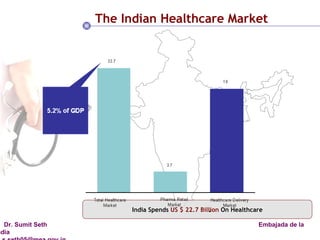
India Spends  US $ 22.7 Billion  On Healthcare * The Indian Healthcare Market
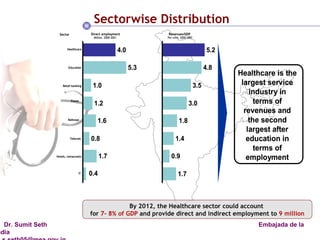
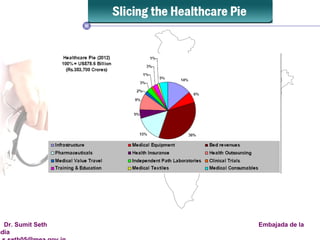
Sectorwise Distribution By 2012, the Healthcare sector could account  for  7- 8% of GDP  and provide direct and indirect employment to  9 million
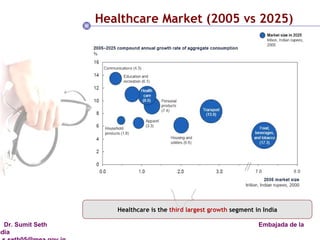
* Healthcare Market (2005 vs 2025) Healthcare is the  third largest growth  segment in India
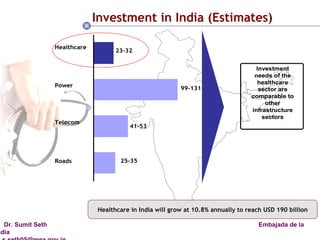
Investment in India (Estimates) Healthcare in India will grow at 10.8% annually to reach USD 190 billion
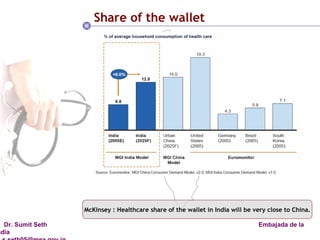
Share of the wallet McKinsey : Healthcare share of the wallet in India will be very close to China.
 
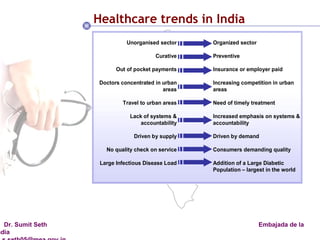
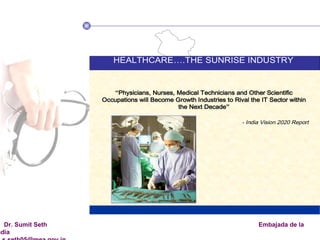
Healthcare trends in India
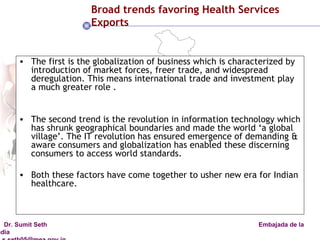
Broad trends favoring Health Services Exports The first is the globalization of business which is characterized by introduction of market forces, freer trade, and widespread deregulation. This means international trade and investment play a much greater role . The second trend is the revolution in information technology which has shrunk geographical boundaries and made the world ‘a global village’. The IT revolution has ensured emergence of demanding & aware consumers and globalization has enabled these discerning consumers to access world standards. Both these factors have come together to usher new era for Indian healthcare.
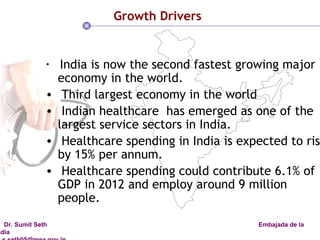
Growth Drivers India is now the second fastest growing major economy in the world. Third largest economy in the world  Indian healthcare  has emerged as one of the largest service sectors in India. Healthcare spending in India is expected to rise by 15% per annum. Healthcare spending could contribute 6.1% of GDP in 2012 and employ around 9 million people.
Factors favouring Export of Health  Services Shift from socialized to private providers Booming economy and High literacy rates Shift to lifestyle-related diseases Easier financing  Increasing life expectancy Recognition by government priority section
Shift from socialized to private providers… The majority of healthcare services in India are provided by the  private sector  Private sector in India is one of the largest in the world:  80 percent of all qualified doctors,  75 percent of dispensaries  60 percent of hospitals in India belong to the private sector.  Government expenditure on healthcare has been on the decline in relative terms and is currently at 0.9% of the GDP.  The average for developing countries as a whole is around 3% of GDP and for high income countries, 5% of GDP.
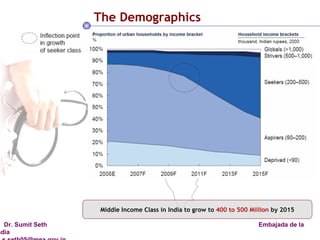
Booming economy and High literacy rates. Capacity to Spend The capacity of the people to pay has increased,  When families move from middle income to rich,the highest growth in spending is recorded in healthcare. The top 33 per cent income earners in India accounted for 75 per cent of total private expenditure on healthcare. The proportion of households in the low –income group has declined significantly and the “Great Indian Middle-class” has come of age. Literacy Per-capita expenditures on healthcare rise with higher education levels.  Households that have higher education levels tend to spend more per illn
The Demographics Middle Income Class in India to grow to  400 to 500 Million  by 2015
  Shift to lifestyle-related diseases The shift in disease profiles from infectious to  lifestyle-related diseases  is expected to raise expenditures per treatment.  Lifestyle-related diseases are typically more expensive to treat than infectious ones.  India’s disease profile is expected to follow the same pattern as in developed economies.  Diseases - cardiovascular, asthma and cancer have become the most important segments Inpatient spending is expected to rise from 39% to nearly 50% \ The share of infectious diseases is expected to decline from 19 per cent in 2004 to 16 percent in
Easier financing in a capital intensive Industry. The Indian healthcare industry has gone through the entire cycle of financing  Government funded socialized system  Privately funded ‘Mom & Pop’ shops (small nursing homes) Non Resident Indian & Foreign Investment funded enterprises  Financial markets .
Increasing life expectancy “ Increase in healthcare spending increases life  Expectancy which cyclically further drives increase in Health Care spending “
Recognition by government as a priority section. The government of India has also identified Healthcare as the priority section for focused attention. Measures taken by the government to stimulate market development in the healthcare sector § Reduction in Import duty on medical equipment § Depreciation Limit on medical equipment increased § Customs duty reduced  § The Government has announced Income tax exemption of the  Income Tax  for the first five years, to hospitals set up in rural areas § US$ 56 million  will be earmarked for HIV/AIDS control programme through  the use of primary health centers, prevention of drug abuse etc.
 
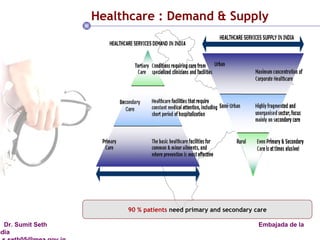
Healthcare : Demand & Supply 90 % patients  need primary and secondary care
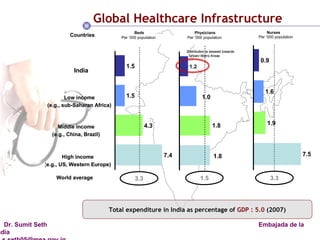
Total expenditure in India as percentage of  GDP : 5.0  (2007) Global Healthcare Infrastructure
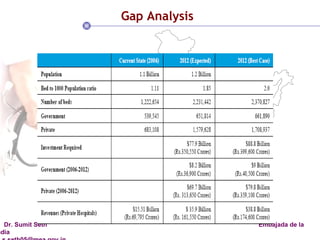
Gap Analysis
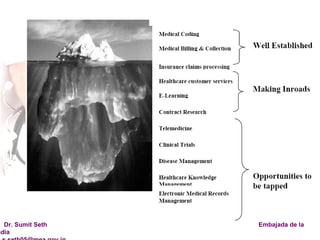
Areas of Opportunity Health services outsourcing Telemedicine Medical value travel Clinical Trials Miscellaneous Health Insurance Medical Equipments etc.
 
 
Why India?- Hub for Health BPO Low cost and reliable high bandwidth communications for both voice and data. The internet technology revolution that enables shared processing of transactions and information across locations and time zones. Very large labor cost arbitrage The availability of highly skilled English speaking workforce in India. The lack of governmental interference  Strong tax incentives
Need for Outsoucing in US, EU .  Spiraling healthcare costs,  Unbearable squeeze on margins  Process inefficiencies Acute talent shortage  Aging population  Cost savings to the tune of 20-30 per cent.
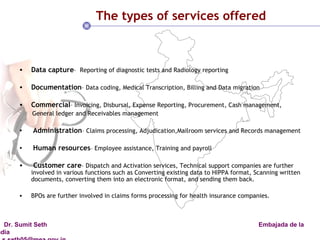
The types of services offered Data capture –  Reporting of diagnostic tests and Radiology reporting Documentation – Data coding, Medical Transcription, Billing and Data migration Commercial – Invoicing, Disbursal, Expense Reporting, Procurement, Cash management, General ledger and Receivables management Administration – Claims processing, Adjudication,Mailroom services and Records management Human resources – Employee assistance, Training and payroll Customer care – Dispatch and Activation services, Technical support companies are further  involved in various functions such as Converting existing data to HIPPA format, Scanning written documents, converting them into an electronic format, and sending them back.  BPOs are further involved in claims forms processing for health insurance companies.
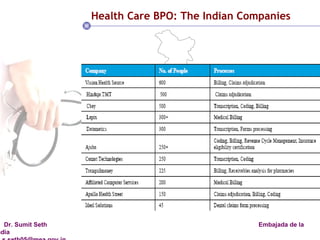
Health Care BPO: The Indian Companies
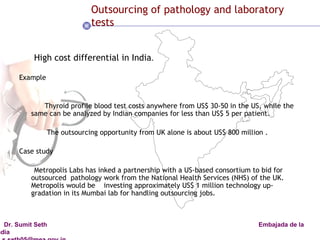
Outsourcing of pathology and laboratory tests High cost differential in India . Example Thyroid profile blood test costs anywhere from US$ 30-50 in the US, while the  same can be analyzed by Indian companies for less than US$ 5 per patient.  The outsourcing opportunity from UK alone is about US$ 800 million .  Case study Metropolis Labs has inked a partnership with a US-based consortium to bid for outsourced  pathology work from the National Health Services (NHS) of the UK.  Metropolis would be  investing approximately US$ 1 million technology up-gradation in its Mumbai lab for handling outsourcing jobs.
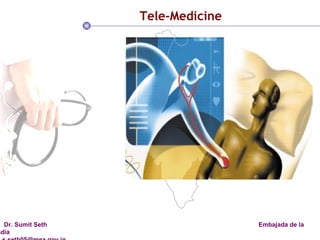
Tele-Medicine
“ Telemedicine today has given the capacity to the ordinary doctors to do extraordinary things”
Telemedicine: The Promise Taking modern healthcare to remote areas  Majority of diseases not requiring surgery conducive to telemedicine Training of medical personnel across the country Last five years price and complexity of this technology  has decreased making T.M economically viable
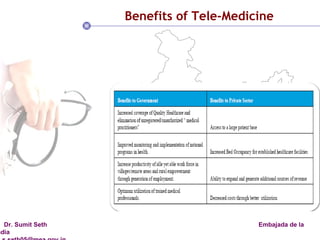
Benefits of Tele-Medicine
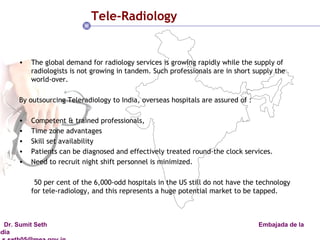
Tele-Radiology The global demand for radiology services is growing rapidly while the supply of radiologists is not growing in tandem. Such professionals are in short supply the world-over.  By outsourcing Teleradiology to India, overseas hospitals are assured of : Competent & trained professionals,  Time zone advantages Skill set availability Patients can be diagnosed and effectively treated round-the clock services.  Need to recruit night shift personnel is minimized.  50 per cent of the 6,000-odd hospitals in the US still do not have the technology for tele-radiology, and this represents a huge potential market to be tapped.
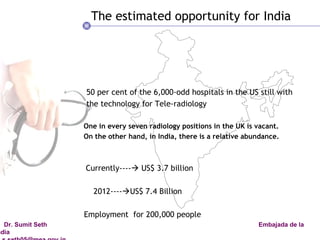
The estimated opportunity for India 50 per cent of the 6,000-odd hospitals in the US still with  the technology for Tele-radiology One in every seven radiology positions in the UK is vacant.  On the other hand, in India, there is a relative abundance.  Currently----   US$ 3.7 billion 2012----  US$ 7.4 Billion  Employment  for 200,000 people
 
 
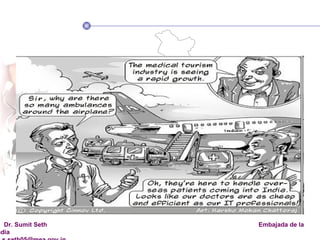
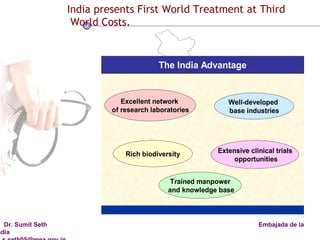
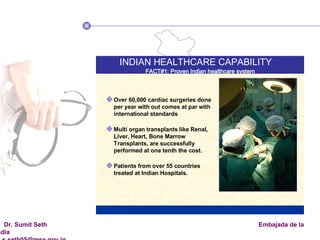
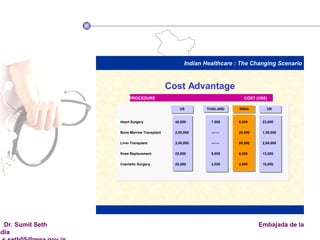
India presents First World Treatment at Third  World Costs.


Medical tourism: High Reward for government Medical value travel pushes up quality of Healthcare in India Tourism & Employment will get an extra boost Win-win situation: as healthcare companies also benefit
 
Oppurtunities… The Clinical trails market with an estimated expenditure of $ 1.27 Bn in 2012 Profit margins of 20-25% , unfolds one of the most gripping chapters of Indian healthcare.
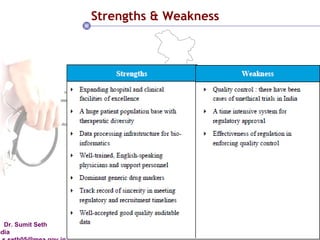
Strengths & Weakness
 
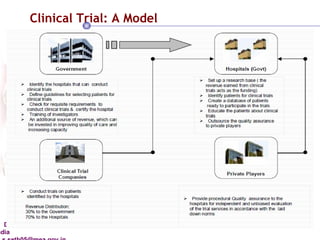
Clinical Trial: A Model
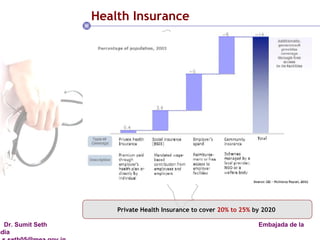
Health Insurance Private Health Insurance to cover  20% to 25%  by 2020
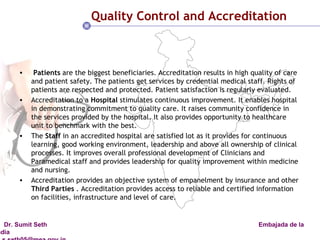
Quality Control and Accreditation  Patients  are the biggest beneficiaries. Accreditation results in high quality of care and patient safety. The patients get services by credential medical staff. Rights of patients are respected and protected. Patient satisfaction is regularly evaluated.  Accreditation to a  Hospital  stimulates continuous improvement. It enables hospital in demonstrating commitment to quality care. It raises community confidence in the services provided by the hospital. It also provides opportunity to healthcare unit to benchmark with the best.  The  Staff  in an accredited hospital are satisfied lot as it provides for continuous learning, good working environment, leadership and above all ownership of clinical processes. It improves overall professional development of Clinicians and Paramedical staff and provides leadership for quality improvement within medicine and nursing.  Accreditation provides an objective system of empanelment by insurance and other  Third Parties  . Accreditation provides access to reliable and certified information on facilities, infrastructure and level of care.
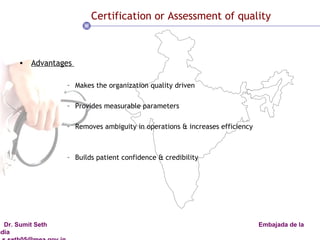
Certification or Assessment of quality Advantages  Makes the organization quality driven Provides measurable parameters Removes ambiguity in operations & increases efficiency Builds patient confidence & credibility
ISO  v/s  NABH Limitation of ISO Certification 1. ISO is more documentation oriented and hence a certification does not  guarantee level of implementation. 2. ISO is a certification where the examinee pays the examiner to get certified.  3.  ISO does not involve the customer
Latest Trend : Health Quality Control NABH (National accreditation board of hospitals) National Accreditation Board for Hospitals & Healthcare Providers (NABH) is a constituent board of Quality Council of India, set up to establish and operate accreditation programme for healthcare organizations. The board while being supported by all stakeholders including industry, consumers, government, have full functional autonomy in its operation.
Latest Trend : Health Quality Control NABH (National accreditation board of hospitals) It is an institutional member of ISQua  It is alsomember of ISQua Accreditation Council. NABH standards for hospitals has been accredited by ISQua.  Accreditation system close to JCI More and more Hospitals are seeking NABH accreditation
 
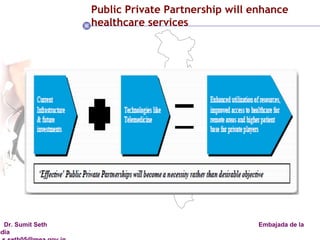
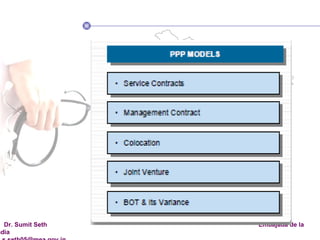
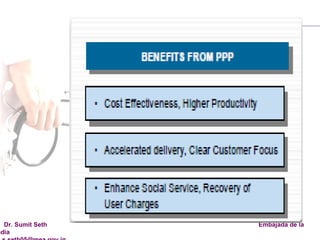
Public Private Partnership will enhance healthcare services
 
 
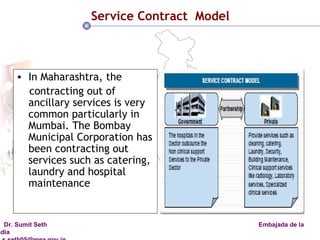
Service Contract  Model In Maharashtra, the contracting out of ancillary services is very common particularly in  Mumbai. The Bombay Municipal Corporation has been contracting out services such as catering, laundry and hospital maintenance
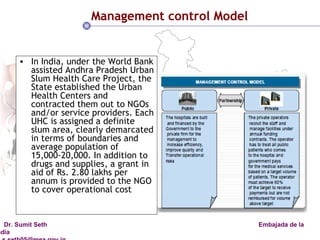
Management control Model In India, under the World Bank assisted Andhra Pradesh Urban Slum Health Care Project, the State established the Urban Health Centers and contracted them out to NGOs and/or service providers. Each UHC is assigned a definite slum area, clearly demarcated in terms of boundaries and average population of 15,000-20,000. In addition to drugs and supplies, a grant in aid of Rs. 2.80 lakhs per annum is provided to the NGO to cover operational cost
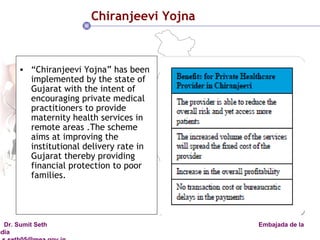
Chiranjeevi Yojna “ Chiranjeevi Yojna” has been implemented by the state of Gujarat with the intent of encouraging private medical practitioners to provide maternity health services in remote areas .The scheme aims at improving the institutional delivery rate in Gujarat thereby providing financial protection to poor families.
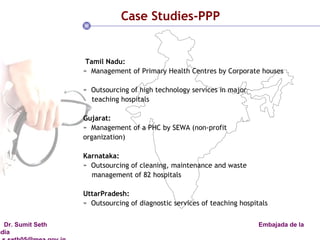
Case Studies-PPP Tamil Nadu:  Management of Primary Health Centres by Corporate houses  Outsourcing of high technology services in major teaching hospitals  Gujarat:  Management of a PHC by SEWA (non-profit organization)  Karnataka:   Outsourcing of cleaning, maintenance and waste management of 82 hospitals UttarPradesh: Outsourcing of diagnostic services of teaching hospitals
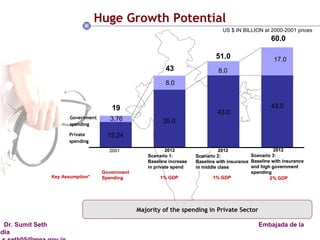
US $ IN BILLION at 2000-2001 prices Huge Growth Potential Majority of the spending in Private Sector
 
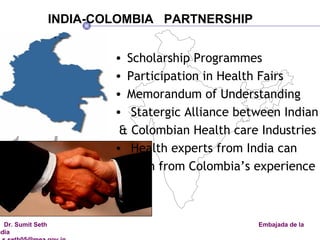
Scholarship Programmes Participation in Health Fairs Memorandum of Understanding  Statergic Alliance between Indian  & Colombian Health care Industries Health experts from India can  learn from Colombia’s experience INDIA-COLOMBIA  PARTNERSHIP
Thank You Sources: MINISTRY OF HEALTH& FAMILY WELFARE FICCI EARNST & YOUNG REPORT, PWC REPORT Dr. Hemant Bakhru,Dr. Kapil Jain,Dr. Ruchi Bhatt

Health Services India

  • 1.
    EXPORT OF HEALTHSERVICES The Indian Experience Dr. Sumit Seth Second Secretary Embassy Of India
  • 2.
    Over-ViewHealth Care Market Health Care Trends-Past, Present & Future Trends Favoring Health Service Exports Medical Infrastructure-Demand-Supply Gap Health Services Export-Opportunity Quality Control & Accreditation-New Trends Public Private Partnership Future of India’s Health Care India-Colombia Partnership
  • 3.
    India Spends US $ 22.7 Billion On Healthcare * The Indian Healthcare Market
  • 4.
    Sectorwise Distribution By2012, the Healthcare sector could account for 7- 8% of GDP and provide direct and indirect employment to 9 million
  • 5.
    * Healthcare Market(2005 vs 2025) Healthcare is the third largest growth segment in India
  • 6.
    Investment in India(Estimates) Healthcare in India will grow at 10.8% annually to reach USD 190 billion
  • 7.
    Share of thewallet McKinsey : Healthcare share of the wallet in India will be very close to China.
  • 8.
  • 9.
  • 10.
    Broad trends favoringHealth Services Exports The first is the globalization of business which is characterized by introduction of market forces, freer trade, and widespread deregulation. This means international trade and investment play a much greater role . The second trend is the revolution in information technology which has shrunk geographical boundaries and made the world ‘a global village’. The IT revolution has ensured emergence of demanding & aware consumers and globalization has enabled these discerning consumers to access world standards. Both these factors have come together to usher new era for Indian healthcare.
  • 11.
    Growth Drivers Indiais now the second fastest growing major economy in the world. Third largest economy in the world Indian healthcare has emerged as one of the largest service sectors in India. Healthcare spending in India is expected to rise by 15% per annum. Healthcare spending could contribute 6.1% of GDP in 2012 and employ around 9 million people.
  • 12.
    Factors favouring Exportof Health Services Shift from socialized to private providers Booming economy and High literacy rates Shift to lifestyle-related diseases Easier financing Increasing life expectancy Recognition by government priority section
  • 13.
    Shift from socializedto private providers… The majority of healthcare services in India are provided by the private sector Private sector in India is one of the largest in the world: 80 percent of all qualified doctors, 75 percent of dispensaries 60 percent of hospitals in India belong to the private sector. Government expenditure on healthcare has been on the decline in relative terms and is currently at 0.9% of the GDP. The average for developing countries as a whole is around 3% of GDP and for high income countries, 5% of GDP.
  • 14.
    Booming economy andHigh literacy rates. Capacity to Spend The capacity of the people to pay has increased, When families move from middle income to rich,the highest growth in spending is recorded in healthcare. The top 33 per cent income earners in India accounted for 75 per cent of total private expenditure on healthcare. The proportion of households in the low –income group has declined significantly and the “Great Indian Middle-class” has come of age. Literacy Per-capita expenditures on healthcare rise with higher education levels. Households that have higher education levels tend to spend more per illn
  • 15.
    The Demographics MiddleIncome Class in India to grow to 400 to 500 Million by 2015
  • 16.
    Shiftto lifestyle-related diseases The shift in disease profiles from infectious to lifestyle-related diseases is expected to raise expenditures per treatment. Lifestyle-related diseases are typically more expensive to treat than infectious ones. India’s disease profile is expected to follow the same pattern as in developed economies. Diseases - cardiovascular, asthma and cancer have become the most important segments Inpatient spending is expected to rise from 39% to nearly 50% \ The share of infectious diseases is expected to decline from 19 per cent in 2004 to 16 percent in
  • 17.
    Easier financing ina capital intensive Industry. The Indian healthcare industry has gone through the entire cycle of financing Government funded socialized system Privately funded ‘Mom & Pop’ shops (small nursing homes) Non Resident Indian & Foreign Investment funded enterprises Financial markets .
  • 18.
    Increasing life expectancy“ Increase in healthcare spending increases life Expectancy which cyclically further drives increase in Health Care spending “
  • 19.
    Recognition by governmentas a priority section. The government of India has also identified Healthcare as the priority section for focused attention. Measures taken by the government to stimulate market development in the healthcare sector § Reduction in Import duty on medical equipment § Depreciation Limit on medical equipment increased § Customs duty reduced § The Government has announced Income tax exemption of the Income Tax for the first five years, to hospitals set up in rural areas § US$ 56 million will be earmarked for HIV/AIDS control programme through the use of primary health centers, prevention of drug abuse etc.
  • 20.
  • 21.
    Healthcare : Demand& Supply 90 % patients need primary and secondary care
  • 22.
    Total expenditure inIndia as percentage of GDP : 5.0 (2007) Global Healthcare Infrastructure
  • 23.
  • 24.
    Areas of OpportunityHealth services outsourcing Telemedicine Medical value travel Clinical Trials Miscellaneous Health Insurance Medical Equipments etc.
  • 25.
  • 26.
  • 27.
    Why India?- Hubfor Health BPO Low cost and reliable high bandwidth communications for both voice and data. The internet technology revolution that enables shared processing of transactions and information across locations and time zones. Very large labor cost arbitrage The availability of highly skilled English speaking workforce in India. The lack of governmental interference Strong tax incentives
  • 28.
    Need for Outsoucingin US, EU . Spiraling healthcare costs, Unbearable squeeze on margins Process inefficiencies Acute talent shortage Aging population Cost savings to the tune of 20-30 per cent.
  • 29.
    The types ofservices offered Data capture – Reporting of diagnostic tests and Radiology reporting Documentation – Data coding, Medical Transcription, Billing and Data migration Commercial – Invoicing, Disbursal, Expense Reporting, Procurement, Cash management, General ledger and Receivables management Administration – Claims processing, Adjudication,Mailroom services and Records management Human resources – Employee assistance, Training and payroll Customer care – Dispatch and Activation services, Technical support companies are further involved in various functions such as Converting existing data to HIPPA format, Scanning written documents, converting them into an electronic format, and sending them back. BPOs are further involved in claims forms processing for health insurance companies.
  • 30.
    Health Care BPO:The Indian Companies
  • 31.
    Outsourcing of pathologyand laboratory tests High cost differential in India . Example Thyroid profile blood test costs anywhere from US$ 30-50 in the US, while the same can be analyzed by Indian companies for less than US$ 5 per patient. The outsourcing opportunity from UK alone is about US$ 800 million . Case study Metropolis Labs has inked a partnership with a US-based consortium to bid for outsourced pathology work from the National Health Services (NHS) of the UK. Metropolis would be investing approximately US$ 1 million technology up-gradation in its Mumbai lab for handling outsourcing jobs.
  • 32.
  • 33.
    “ Telemedicine todayhas given the capacity to the ordinary doctors to do extraordinary things”
  • 34.
    Telemedicine: The PromiseTaking modern healthcare to remote areas Majority of diseases not requiring surgery conducive to telemedicine Training of medical personnel across the country Last five years price and complexity of this technology has decreased making T.M economically viable
  • 35.
  • 36.
    Tele-Radiology The globaldemand for radiology services is growing rapidly while the supply of radiologists is not growing in tandem. Such professionals are in short supply the world-over. By outsourcing Teleradiology to India, overseas hospitals are assured of : Competent & trained professionals, Time zone advantages Skill set availability Patients can be diagnosed and effectively treated round-the clock services. Need to recruit night shift personnel is minimized. 50 per cent of the 6,000-odd hospitals in the US still do not have the technology for tele-radiology, and this represents a huge potential market to be tapped.
  • 37.
    The estimated opportunityfor India 50 per cent of the 6,000-odd hospitals in the US still with the technology for Tele-radiology One in every seven radiology positions in the UK is vacant. On the other hand, in India, there is a relative abundance. Currently----  US$ 3.7 billion 2012----  US$ 7.4 Billion Employment for 200,000 people
  • 38.
  • 39.
  • 40.
    India presents FirstWorld Treatment at Third World Costs.
  • 41.
  • 42.
  • 43.
  • 44.
    Medical tourism: HighReward for government Medical value travel pushes up quality of Healthcare in India Tourism & Employment will get an extra boost Win-win situation: as healthcare companies also benefit
  • 45.
  • 46.
    Oppurtunities… The Clinicaltrails market with an estimated expenditure of $ 1.27 Bn in 2012 Profit margins of 20-25% , unfolds one of the most gripping chapters of Indian healthcare.
  • 47.
  • 48.
  • 49.
  • 50.
    Health Insurance PrivateHealth Insurance to cover 20% to 25% by 2020
  • 51.
    Quality Control andAccreditation Patients are the biggest beneficiaries. Accreditation results in high quality of care and patient safety. The patients get services by credential medical staff. Rights of patients are respected and protected. Patient satisfaction is regularly evaluated. Accreditation to a Hospital stimulates continuous improvement. It enables hospital in demonstrating commitment to quality care. It raises community confidence in the services provided by the hospital. It also provides opportunity to healthcare unit to benchmark with the best. The Staff in an accredited hospital are satisfied lot as it provides for continuous learning, good working environment, leadership and above all ownership of clinical processes. It improves overall professional development of Clinicians and Paramedical staff and provides leadership for quality improvement within medicine and nursing. Accreditation provides an objective system of empanelment by insurance and other Third Parties . Accreditation provides access to reliable and certified information on facilities, infrastructure and level of care.
  • 52.
    Certification or Assessmentof quality Advantages Makes the organization quality driven Provides measurable parameters Removes ambiguity in operations & increases efficiency Builds patient confidence & credibility
  • 53.
    ISO v/s NABH Limitation of ISO Certification 1. ISO is more documentation oriented and hence a certification does not guarantee level of implementation. 2. ISO is a certification where the examinee pays the examiner to get certified. 3. ISO does not involve the customer
  • 54.
    Latest Trend :Health Quality Control NABH (National accreditation board of hospitals) National Accreditation Board for Hospitals & Healthcare Providers (NABH) is a constituent board of Quality Council of India, set up to establish and operate accreditation programme for healthcare organizations. The board while being supported by all stakeholders including industry, consumers, government, have full functional autonomy in its operation.
  • 55.
    Latest Trend :Health Quality Control NABH (National accreditation board of hospitals) It is an institutional member of ISQua It is alsomember of ISQua Accreditation Council. NABH standards for hospitals has been accredited by ISQua. Accreditation system close to JCI More and more Hospitals are seeking NABH accreditation
  • 56.
  • 57.
    Public Private Partnershipwill enhance healthcare services
  • 58.
  • 59.
  • 60.
    Service Contract Model In Maharashtra, the contracting out of ancillary services is very common particularly in Mumbai. The Bombay Municipal Corporation has been contracting out services such as catering, laundry and hospital maintenance
  • 61.
    Management control ModelIn India, under the World Bank assisted Andhra Pradesh Urban Slum Health Care Project, the State established the Urban Health Centers and contracted them out to NGOs and/or service providers. Each UHC is assigned a definite slum area, clearly demarcated in terms of boundaries and average population of 15,000-20,000. In addition to drugs and supplies, a grant in aid of Rs. 2.80 lakhs per annum is provided to the NGO to cover operational cost
  • 62.
    Chiranjeevi Yojna “Chiranjeevi Yojna” has been implemented by the state of Gujarat with the intent of encouraging private medical practitioners to provide maternity health services in remote areas .The scheme aims at improving the institutional delivery rate in Gujarat thereby providing financial protection to poor families.
  • 63.
    Case Studies-PPP TamilNadu: Management of Primary Health Centres by Corporate houses Outsourcing of high technology services in major teaching hospitals Gujarat: Management of a PHC by SEWA (non-profit organization) Karnataka: Outsourcing of cleaning, maintenance and waste management of 82 hospitals UttarPradesh: Outsourcing of diagnostic services of teaching hospitals
  • 64.
    US $ INBILLION at 2000-2001 prices Huge Growth Potential Majority of the spending in Private Sector
  • 65.
  • 66.
    Scholarship Programmes Participationin Health Fairs Memorandum of Understanding Statergic Alliance between Indian & Colombian Health care Industries Health experts from India can learn from Colombia’s experience INDIA-COLOMBIA PARTNERSHIP
  • 67.
    Thank You Sources:MINISTRY OF HEALTH& FAMILY WELFARE FICCI EARNST & YOUNG REPORT, PWC REPORT Dr. Hemant Bakhru,Dr. Kapil Jain,Dr. Ruchi Bhatt