


CONFIDENTIAL AND PROPRIETARY TO THE PARTIES IN DISCUSSION.
Contact:
sales@taurusglocal.net
drgupta@taurusglocal.com
Website:
www.taurusglocal.com
CLOSING
THE LOOP
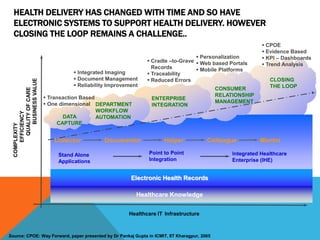
HEALTH DELIVERY HAS CHANGED WITH TIME AND SO HAVE
ELECTRONIC SYSTEMS TO SUPPORT HEALTH DELIVERY. HOWEVER
CLOSING THE LOOP REMAINS A CHALLENGE..
Stand Alone
Applications
Point to Point
Integration
Integrated Healthcare
Enterprise (IHE)
Electronic Health Records
 CPOE
 Evidence Based
 KPI – Dashboards
 Trend Analysis
CONSUMER
RELATIONSHIP
MANAGEMENT
ENTERPRISE
INTEGRATIONDEPARTMENT
WORKFLOW
AUTOMATIONDATA
CAPTURE
Healthcare Knowledge
 Integrated Imaging
 Document Management
 Reliability Improvement
 Cradle –to-Grave
Records
 Traceability
 Reduced Errors
Collector Documentor MentorColleagueHelper
 Personalization
 Web based Portals
 Mobile Platforms
COMPLEXITY
EFFICIENCY
QUALITYOFCARE
BUSINESSVALUE
 Transaction Based
 One dimensional
Healthcare IT Infrastructure
Source: CPOE: Way Forward, paper presented by Dr Pankaj Gupta in ICMIT, IIT Kharagpur, 2005
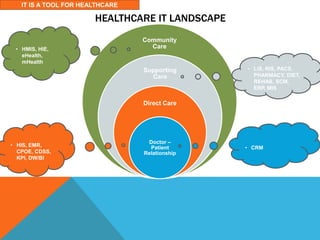
HEALTHCARE IT LANDSCAPE
IT IS A TOOL FOR HEALTHCARE
Community
Care
Supporting
Care
Direct Care
Doctor –
Patient
Relationship
• CRM• HIS, EMR,
CPOE, CDSS,
KPI, DW/BI
• LIS, RIS, PACS,
PHARMACY, DIET,
REHAB, SCM,
ERP, MIS
• HMIS, HIE,
eHealth,
mHealth
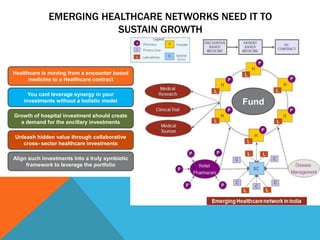
EMERGING HEALTHCARE NETWORKS NEED IT TO
SUSTAIN GROWTH
Healthcare is moving from a encounter based
medicine to a Healthcare contract
You cant leverage synergy in your
investments without a holistic model
Growth of hospital investment should create
a demand for the ancillary investments
Unleash hidden value through collaborative
cross- sector healthcare investments
Align such investments into a truly symbiotic
framework to leverage the portfolio
Fund
Hospital
Research
Medical
Education
5 Star Hotel
Holistic Medicine
for Prevention
and Rehab
Path Lab,
Rad Clinic,
Pharmacy
Broker Direct
Connectivity
to Airport
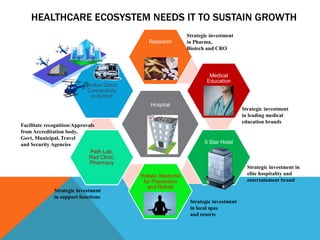
HEALTHCARE ECOSYSTEM NEEDS IT TO SUSTAIN GROWTH
Strategic investment
in support functions
Strategic investment
in Pharma,
Biotech and CRO
Strategic investment
in leading medical
education brands
Strategic investment in
elite hospitality and
entertainment brand
Strategic investment
in local spas
and resorts
Facilitate recognition/Approvals
from Accreditation body,
Govt, Municipal, Travel
and Security Agencies
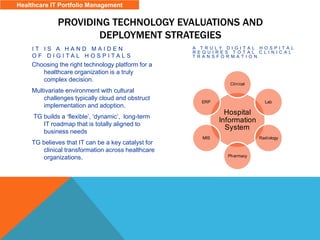
PROVIDING TECHNOLOGY EVALUATIONS AND
DEPLOYMENT STRATEGIES
I T I S A H A N D M A I D E N
O F D I G I T A L H O S P I T A L S
Choosing the right technology platform for a
healthcare organization is a truly
complex decision.
Multivariate environment with cultural
challenges typically cloud and obstruct
implementation and adoption.
TG builds a ‘flexible’, ‘dynamic’, long-term
IT roadmap that is totally aligned to
business needs
TG believes that IT can be a key catalyst for
clinical transformation across healthcare
organizations.
A T R U L Y D I G I T A L H O S P I T A L
R E Q U I R E S T O T A L C L I N I C A L
T R A N S F O R M A T I O N
Hospital
Information
System
Clinical
Lab
Radiology
Pharmacy
MIS
ERP
Healthcare IT Portfolio Management
06 - 11 July 2012
CONFIDENTIAL AND PROPRIETARY TO THE PARTIES IN DISCUSSION.
Contact:
sales@taurusglocal.net
drgupta@taurusglocal.com
Website:
www.taurusglocal.com
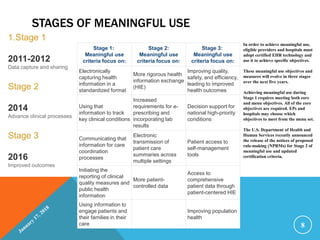
1.Stage 1
2011-2012
Data capture and sharing
Stage 2
2014
Advance clinical processes
Stage 3
2016
Improved outcomes
STAGES OF MEANINGFUL USE
8
Stage 1:
Meaningful use
criteria focus on:
Stage 2:
Meaningful use
criteria focus on:
Stage 3:
Meaningful use
criteria focus on:
Electronically
capturing health
information in a
standardized format
More rigorous health
information exchange
(HIE)
Improving quality,
safety, and efficiency,
leading to improved
health outcomes
Using that
information to track
key clinical conditions
Increased
requirements for e-
prescribing and
incorporating lab
results
Decision support for
national high-priority
conditions
Communicating that
information for care
coordination
processes
Electronic
transmission of
patient care
summaries across
multiple settings
Patient access to
self-management
tools
Initiating the
reporting of clinical
quality measures and
public health
information
More patient-
controlled data
Access to
comprehensive
patient data through
patient-centered HIE
Using information to
engage patients and
their families in their
care
Improving population
health
In order to achieve meaningful use,
eligible providers and hospitals must
adopt certified EHR technology and
use it to achieve specific objectives.
These meaningful use objectives and
measures will evolve in three stages
over the next five years.
Achieving meaningful use during
Stage 1 requires meeting both core
and menu objectives. All of the core
objectives are required. EPs and
hospitals may choose which
objectives to meet from the menu set.
The U.S. Department of Health and
Human Services recently announced
the release of the notices of proposed
rule-making (NPRMs) for Stage 2 of
meaningful use and updated
certification criteria.
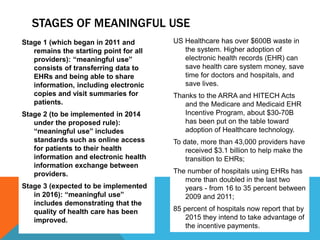
STAGES OF MEANINGFUL USE
Stage 1 (which began in 2011 and
remains the starting point for all
providers): “meaningful use”
consists of transferring data to
EHRs and being able to share
information, including electronic
copies and visit summaries for
patients.
Stage 2 (to be implemented in 2014
under the proposed rule):
“meaningful use” includes
standards such as online access
for patients to their health
information and electronic health
information exchange between
providers.
Stage 3 (expected to be implemented
in 2016): “meaningful use”
includes demonstrating that the
quality of health care has been
improved.
US Healthcare has over $600B waste in
the system. Higher adoption of
electronic health records (EHR) can
save health care system money, save
time for doctors and hospitals, and
save lives.
Thanks to the ARRA and HITECH Acts
and the Medicare and Medicaid EHR
Incentive Program, about $30-70B
has been put on the table toward
adoption of Healthcare technology.
To date, more than 43,000 providers have
received $3.1 billion to help make the
transition to EHRs;
The number of hospitals using EHRs has
more than doubled in the last two
years - from 16 to 35 percent between
2009 and 2011;
85 percent of hospitals now report that by
2015 they intend to take advantage of
the incentive payments.
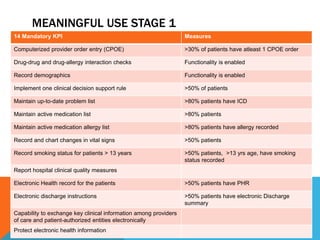
MEANINGFUL USE STAGE 1
14 Mandatory KPI Measures
Computerized provider order entry (CPOE) >30% of patients have atleast 1 CPOE order
Drug-drug and drug-allergy interaction checks Functionality is enabled
Record demographics Functionality is enabled
Implement one clinical decision support rule >50% of patients
Maintain up-to-date problem list >80% patients have ICD
Maintain active medication list >80% patients
Maintain active medication allergy list >80% patients have allergy recorded
Record and chart changes in vital signs >50% patients
Record smoking status for patients > 13 years >50% patients, >13 yrs age, have smoking
status recorded
Report hospital clinical quality measures
Electronic Health record for the patients >50% patients have PHR
Electronic discharge instructions >50% patients have electronic Discharge
summary
Capability to exchange key clinical information among providers
of care and patient-authorized entities electronically
Protect electronic health information
MEANINGFUL USE STAGE 1
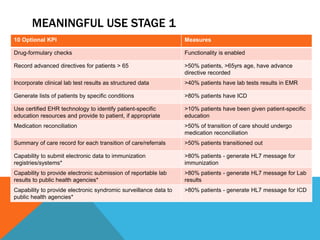
10 Optional KPI Measures
Drug-formulary checks Functionality is enabled
Record advanced directives for patients > 65 >50% patients, >65yrs age, have advance
directive recorded
Incorporate clinical lab test results as structured data >40% patients have lab tests results in EMR
Generate lists of patients by specific conditions >80% patients have ICD
Use certified EHR technology to identify patient-specific
education resources and provide to patient, if appropriate
>10% patients have been given patient-specific
education
Medication reconciliation >50% of transition of care should undergo
medication reconciliation
Summary of care record for each transition of care/referrals >50% patients transitioned out
Capability to submit electronic data to immunization
registries/systems*
>80% patients - generate HL7 message for
immunization
Capability to provide electronic submission of reportable lab
results to public health agencies*
>80% patients - generate HL7 message for Lab
results
Capability to provide electronic syndromic surveillance data to
public health agencies*
>80% patients - generate HL7 message for ICD
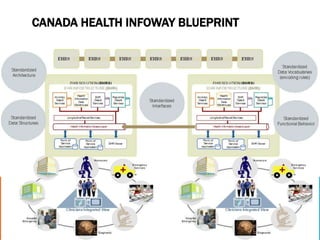
CANADA HEALTH INFOWAY BLUEPRINT
06 - 11 July 2012
CONFIDENTIAL AND PROPRIETARY TO THE PARTIES IN DISCUSSION.
Contact:
sales@taurusglocal.net
drgupta@taurusglocal.com
Website:
www.taurusglocal.com

Health it portfolio

  • 1.
    CONFIDENTIAL AND PROPRIETARYTO THE PARTIES IN DISCUSSION. Contact: sales@taurusglocal.net drgupta@taurusglocal.com Website: www.taurusglocal.com
  • 2.
    CLOSING THE LOOP HEALTH DELIVERYHAS CHANGED WITH TIME AND SO HAVE ELECTRONIC SYSTEMS TO SUPPORT HEALTH DELIVERY. HOWEVER CLOSING THE LOOP REMAINS A CHALLENGE.. Stand Alone Applications Point to Point Integration Integrated Healthcare Enterprise (IHE) Electronic Health Records  CPOE  Evidence Based  KPI – Dashboards  Trend Analysis CONSUMER RELATIONSHIP MANAGEMENT ENTERPRISE INTEGRATIONDEPARTMENT WORKFLOW AUTOMATIONDATA CAPTURE Healthcare Knowledge  Integrated Imaging  Document Management  Reliability Improvement  Cradle –to-Grave Records  Traceability  Reduced Errors Collector Documentor MentorColleagueHelper  Personalization  Web based Portals  Mobile Platforms COMPLEXITY EFFICIENCY QUALITYOFCARE BUSINESSVALUE  Transaction Based  One dimensional Healthcare IT Infrastructure Source: CPOE: Way Forward, paper presented by Dr Pankaj Gupta in ICMIT, IIT Kharagpur, 2005
  • 3.
    HEALTHCARE IT LANDSCAPE ITIS A TOOL FOR HEALTHCARE Community Care Supporting Care Direct Care Doctor – Patient Relationship • CRM• HIS, EMR, CPOE, CDSS, KPI, DW/BI • LIS, RIS, PACS, PHARMACY, DIET, REHAB, SCM, ERP, MIS • HMIS, HIE, eHealth, mHealth
  • 4.
    EMERGING HEALTHCARE NETWORKSNEED IT TO SUSTAIN GROWTH Healthcare is moving from a encounter based medicine to a Healthcare contract You cant leverage synergy in your investments without a holistic model Growth of hospital investment should create a demand for the ancillary investments Unleash hidden value through collaborative cross- sector healthcare investments Align such investments into a truly symbiotic framework to leverage the portfolio Fund
  • 5.
    Hospital Research Medical Education 5 Star Hotel HolisticMedicine for Prevention and Rehab Path Lab, Rad Clinic, Pharmacy Broker Direct Connectivity to Airport HEALTHCARE ECOSYSTEM NEEDS IT TO SUSTAIN GROWTH Strategic investment in support functions Strategic investment in Pharma, Biotech and CRO Strategic investment in leading medical education brands Strategic investment in elite hospitality and entertainment brand Strategic investment in local spas and resorts Facilitate recognition/Approvals from Accreditation body, Govt, Municipal, Travel and Security Agencies
  • 6.
    PROVIDING TECHNOLOGY EVALUATIONSAND DEPLOYMENT STRATEGIES I T I S A H A N D M A I D E N O F D I G I T A L H O S P I T A L S Choosing the right technology platform for a healthcare organization is a truly complex decision. Multivariate environment with cultural challenges typically cloud and obstruct implementation and adoption. TG builds a ‘flexible’, ‘dynamic’, long-term IT roadmap that is totally aligned to business needs TG believes that IT can be a key catalyst for clinical transformation across healthcare organizations. A T R U L Y D I G I T A L H O S P I T A L R E Q U I R E S T O T A L C L I N I C A L T R A N S F O R M A T I O N Hospital Information System Clinical Lab Radiology Pharmacy MIS ERP Healthcare IT Portfolio Management
  • 7.
    06 - 11July 2012 CONFIDENTIAL AND PROPRIETARY TO THE PARTIES IN DISCUSSION. Contact: sales@taurusglocal.net drgupta@taurusglocal.com Website: www.taurusglocal.com
  • 8.
    1.Stage 1 2011-2012 Data captureand sharing Stage 2 2014 Advance clinical processes Stage 3 2016 Improved outcomes STAGES OF MEANINGFUL USE 8 Stage 1: Meaningful use criteria focus on: Stage 2: Meaningful use criteria focus on: Stage 3: Meaningful use criteria focus on: Electronically capturing health information in a standardized format More rigorous health information exchange (HIE) Improving quality, safety, and efficiency, leading to improved health outcomes Using that information to track key clinical conditions Increased requirements for e- prescribing and incorporating lab results Decision support for national high-priority conditions Communicating that information for care coordination processes Electronic transmission of patient care summaries across multiple settings Patient access to self-management tools Initiating the reporting of clinical quality measures and public health information More patient- controlled data Access to comprehensive patient data through patient-centered HIE Using information to engage patients and their families in their care Improving population health In order to achieve meaningful use, eligible providers and hospitals must adopt certified EHR technology and use it to achieve specific objectives. These meaningful use objectives and measures will evolve in three stages over the next five years. Achieving meaningful use during Stage 1 requires meeting both core and menu objectives. All of the core objectives are required. EPs and hospitals may choose which objectives to meet from the menu set. The U.S. Department of Health and Human Services recently announced the release of the notices of proposed rule-making (NPRMs) for Stage 2 of meaningful use and updated certification criteria.
  • 9.
    STAGES OF MEANINGFULUSE Stage 1 (which began in 2011 and remains the starting point for all providers): “meaningful use” consists of transferring data to EHRs and being able to share information, including electronic copies and visit summaries for patients. Stage 2 (to be implemented in 2014 under the proposed rule): “meaningful use” includes standards such as online access for patients to their health information and electronic health information exchange between providers. Stage 3 (expected to be implemented in 2016): “meaningful use” includes demonstrating that the quality of health care has been improved. US Healthcare has over $600B waste in the system. Higher adoption of electronic health records (EHR) can save health care system money, save time for doctors and hospitals, and save lives. Thanks to the ARRA and HITECH Acts and the Medicare and Medicaid EHR Incentive Program, about $30-70B has been put on the table toward adoption of Healthcare technology. To date, more than 43,000 providers have received $3.1 billion to help make the transition to EHRs; The number of hospitals using EHRs has more than doubled in the last two years - from 16 to 35 percent between 2009 and 2011; 85 percent of hospitals now report that by 2015 they intend to take advantage of the incentive payments.
  • 10.
    MEANINGFUL USE STAGE1 14 Mandatory KPI Measures Computerized provider order entry (CPOE) >30% of patients have atleast 1 CPOE order Drug-drug and drug-allergy interaction checks Functionality is enabled Record demographics Functionality is enabled Implement one clinical decision support rule >50% of patients Maintain up-to-date problem list >80% patients have ICD Maintain active medication list >80% patients Maintain active medication allergy list >80% patients have allergy recorded Record and chart changes in vital signs >50% patients Record smoking status for patients > 13 years >50% patients, >13 yrs age, have smoking status recorded Report hospital clinical quality measures Electronic Health record for the patients >50% patients have PHR Electronic discharge instructions >50% patients have electronic Discharge summary Capability to exchange key clinical information among providers of care and patient-authorized entities electronically Protect electronic health information
  • 11.
    MEANINGFUL USE STAGE1 10 Optional KPI Measures Drug-formulary checks Functionality is enabled Record advanced directives for patients > 65 >50% patients, >65yrs age, have advance directive recorded Incorporate clinical lab test results as structured data >40% patients have lab tests results in EMR Generate lists of patients by specific conditions >80% patients have ICD Use certified EHR technology to identify patient-specific education resources and provide to patient, if appropriate >10% patients have been given patient-specific education Medication reconciliation >50% of transition of care should undergo medication reconciliation Summary of care record for each transition of care/referrals >50% patients transitioned out Capability to submit electronic data to immunization registries/systems* >80% patients - generate HL7 message for immunization Capability to provide electronic submission of reportable lab results to public health agencies* >80% patients - generate HL7 message for Lab results Capability to provide electronic syndromic surveillance data to public health agencies* >80% patients - generate HL7 message for ICD
  • 12.
  • 13.
    06 - 11July 2012 CONFIDENTIAL AND PROPRIETARY TO THE PARTIES IN DISCUSSION. Contact: sales@taurusglocal.net drgupta@taurusglocal.com Website: www.taurusglocal.com