



Welcome “ Meaningful Use –  What does it  mean ? Panel Discussion May 19, 2010
Meaningful Use – What Does it  Mean ? Panel Discussion Moderator: Paula M. Zalucki, FACHE President, Salus Strategy Group Panelists: Susan Walker Regional Director, Beacon Partners, Inc. Denise Webb Glass Partner,  Fulbright & Jaworski, LLP         Patricia Johnston, MS, FHIMSS Vice President, Electronic Health Record, Ambulatory and Acute Care   Texas Health Resources
“ Meaningful Use”  Cheat Sheet from  Healthcare Executive  magazine Certification criteria and standards for achieving “meaningful use” of certified health IT products Established through the American Recovery and Reinvestment Act of 2009 (aka the Stimulus Bill) Notice of Proposed Rule Making establishing the Electronic Health Record Incentive Program was finally released in late December 2009
 
Susan Walker Regional Director, Beacon Partners, Inc.
Meaningful Use, It’s Not Just an IT Project  A Roadmap to Organizational Readiness Presented by: Susan Walker Regional Director Date: 05/19/2010
Beacon Partners Leader in Healthcare Consulting Boston – San Francisco – Toronto Privately Held Consulting Services IT Strategy, ARRA, Physician Alignment Implementation, Clinical and Operations services  Modern Healthcare Top 20 healthcare consulting firms
Beacon Partners’ Position Meaningful Use This is part of an evolutionary path
This is not an I.T project- it’s about Organizational Readiness It’s about Developing a patient care, quality and safety strategy supported by I.T. and  doing it right the first time.
Key Components Governance and Communication Physician Alignment Information Technology Considerations Vendor Sustainability Patient Flow Quality HIPAA /HITECH
Governance and Communication C-Suite Support of IT
Common Vision Must be created together to align organizational and IT objectives.  Should point back to strategic planning documents Communicate timelines and milestones toward meaningful use within organization Create “One Voice” to organization
Challenges Political Champions  Supportive environment Organizational Governance Shared goals and objectives Operating rules Physician Alignment Financial Access to capital Sustainable model Technical Considerations Integration with legacy systems Security and privacy Data management Staffing skills assessment
Meaningful Use Check List “Starter Kit” Full Version Available in PDF
Vision Have you discussed your IT strategy with your governing body? Have you developed a strategic plan and roadmap? Have you assessed your facility’s meaningful use? Have you positioned champions for project success? Has your vendor provided you with a sustainability plan that ensures CCHIT certification  beyond the initial rule? Physician alignment:  Who should we be aligned with to move our vision, mission and values forward?
Change Management Develop a robust change management plan Just because incentives are available does not mean physicians will fall in line.  Have you completed a clinical workflow analysis Do you have clinicians as team members and champions?  Plan monthly meetings with executive committee, clinicians and IT for communication and governance .
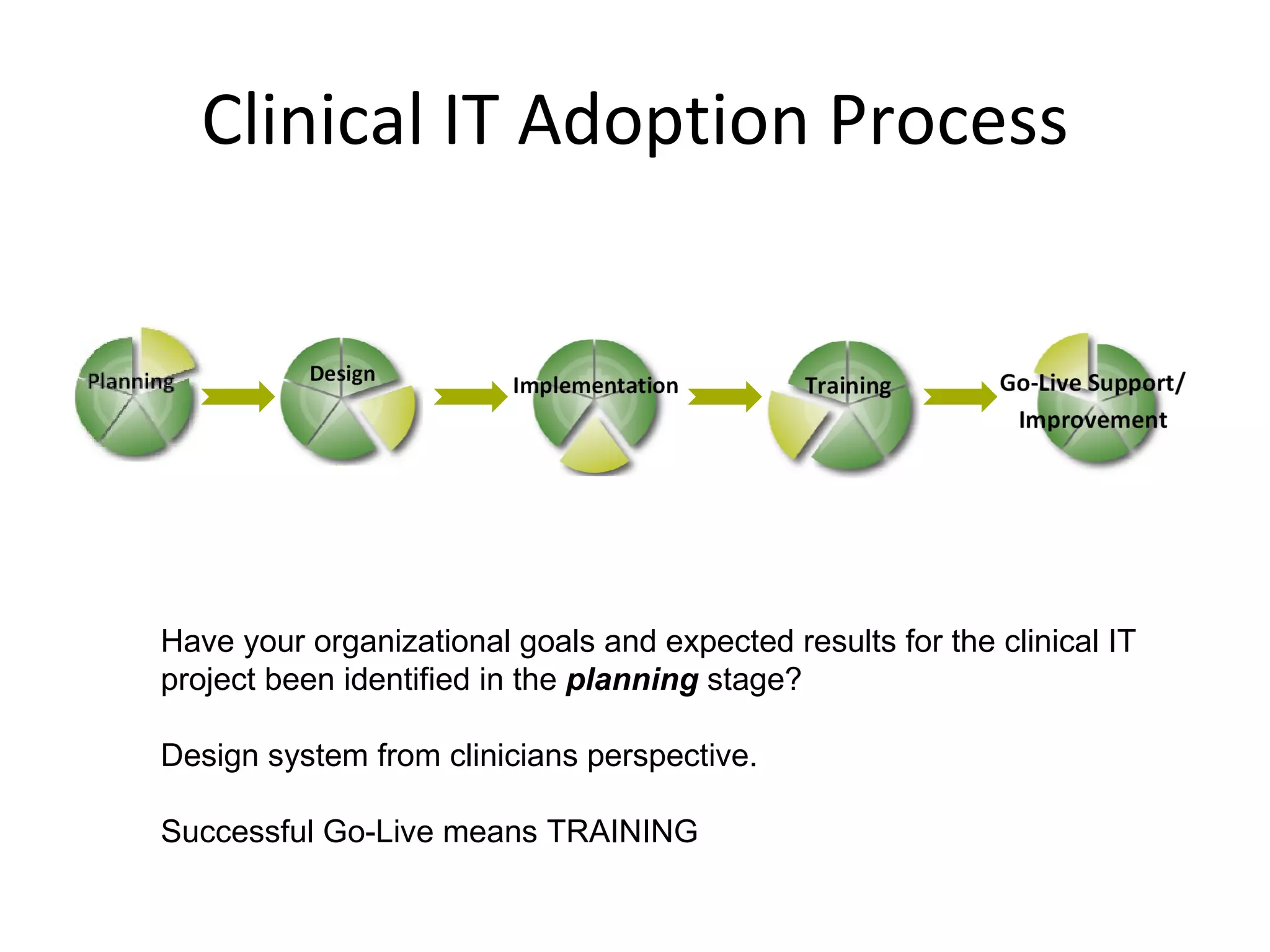
Clinical IT Adoption Process Have your organizational goals and expected results for the clinical IT project been identified in the  planning  stage?  Design system from clinicians perspective. Successful Go-Live means TRAINING
Measurement Have you completed your ARRA financial incentives estimator? Have you matched quality efforts and reporting to federal guidelines? Have you determined your up front ability to fund the EHR project? Have you audited your Security and Privacy policies? Have you assessed future penalties for not adopting?
Lessons Learned Start the process early Lay the foundation with planning Educate the entire team on “One Voice” Understand vendor solutions early on Utilize physician and clinician champions Communicate
Reference Documents MU Analysis and Recommendations Report MU Starter Kit Roadmap Check List Stark Talking Points Contact Susan Walker for electronic copies  [email_address]
Questions & Answers Thank You Susan Walker [email_address]
Denise Webb Glass Partner,  Fulbright & Jaworski, LLP
Legal Issues Associated with Meaningful Use Standards Denise Webb Glass Women’s Healthcare Executive Network May 19, 2010
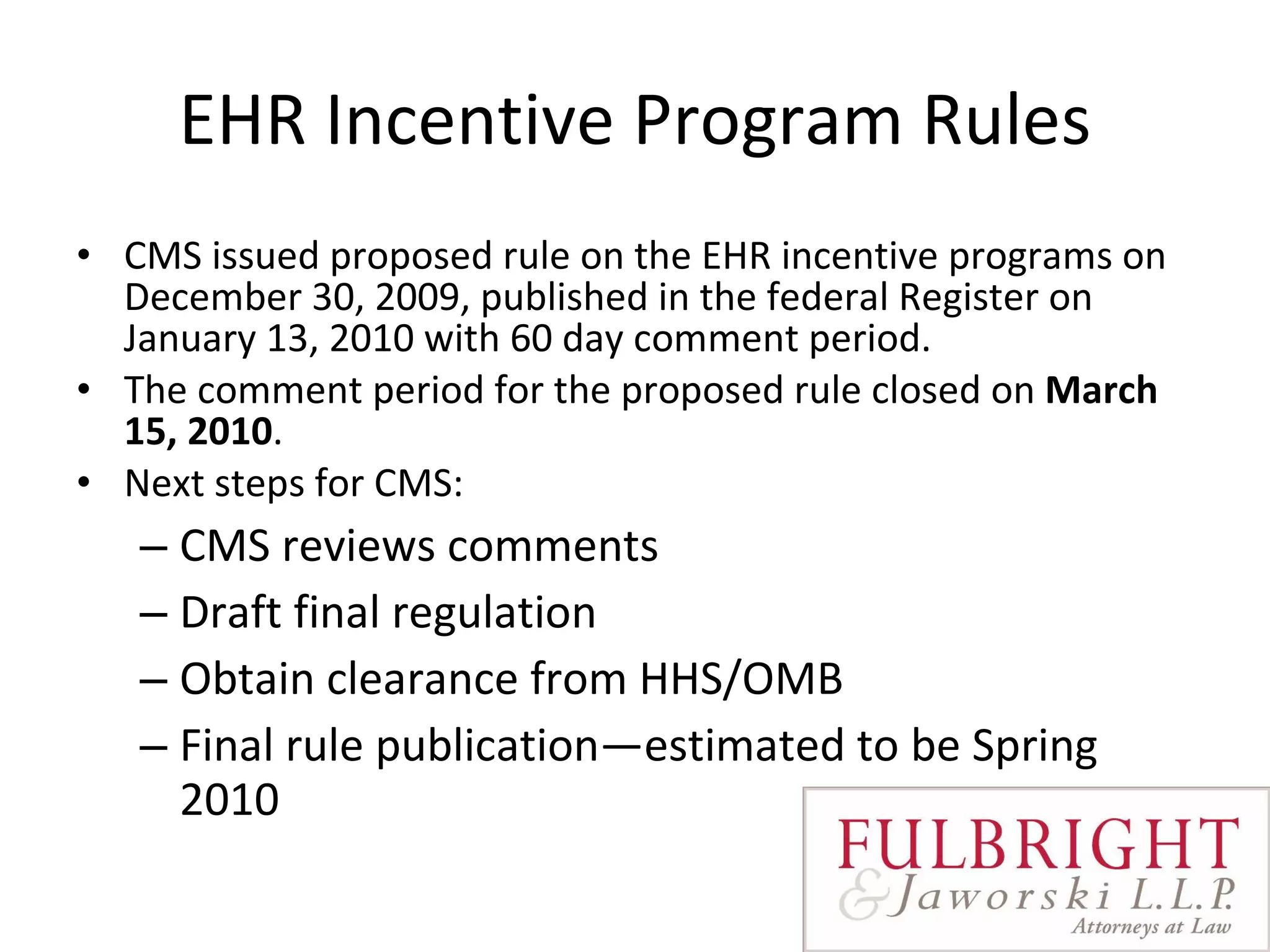
EHR Incentive Program Rules CMS issued proposed rule on the EHR incentive programs on December 30, 2009, published in the federal Register on January 13, 2010 with 60 day comment period.  The comment period for the proposed rule closed on  March 15, 2010 .  Next steps for CMS: CMS reviews comments Draft final regulation Obtain clearance from HHS/OMB Final rule publication—estimated to be Spring 2010
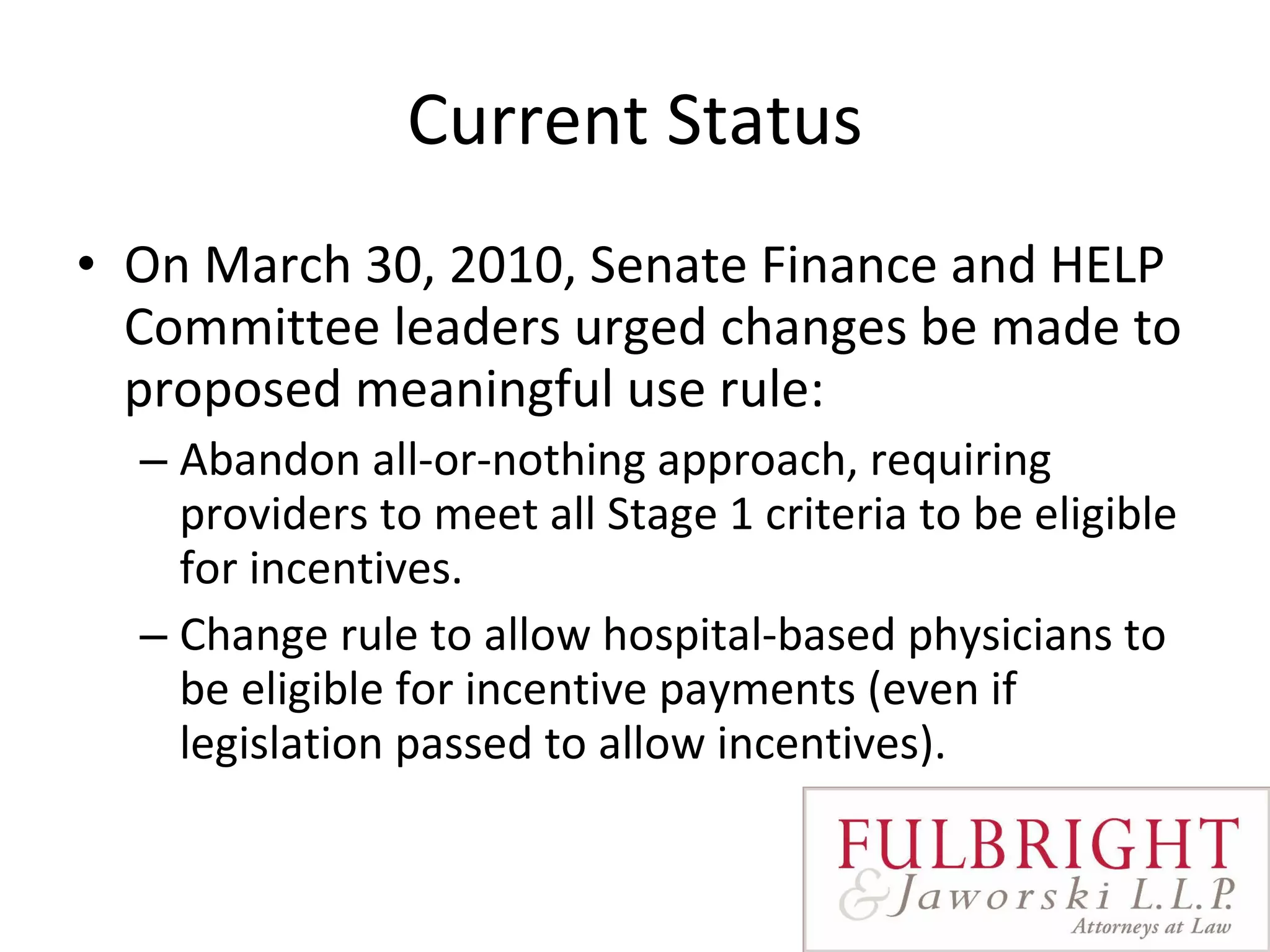
Current Status On March 30, 2010, Senate Finance and HELP Committee leaders urged changes be made to proposed meaningful use rule: Abandon all-or-nothing approach, requiring providers to meet all Stage 1 criteria to be eligible for incentives. Change rule to allow hospital-based physicians to be eligible for incentive payments (even if legislation passed to allow incentives).
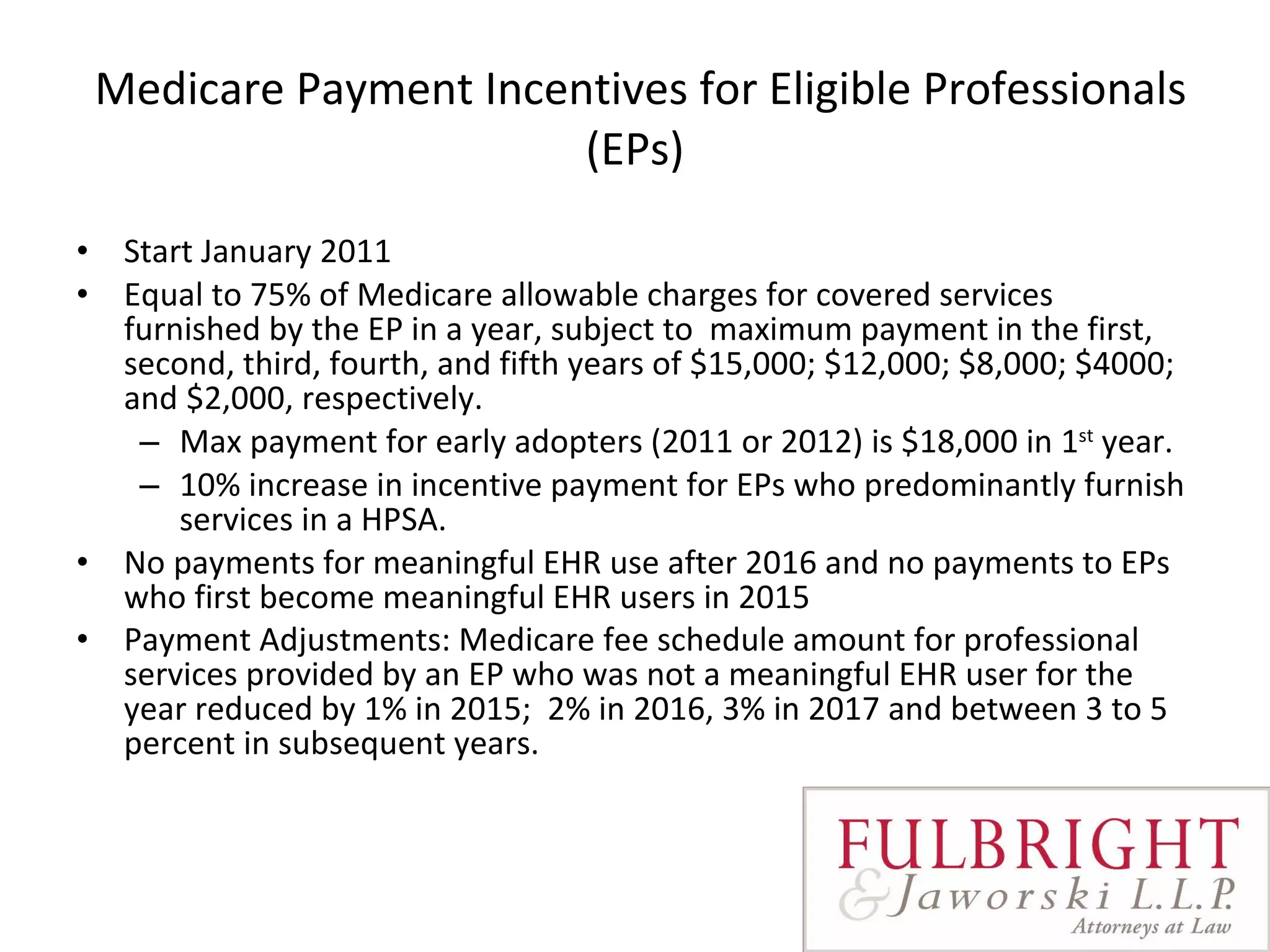
Medicare Payment Incentives for Eligible Professionals (EPs) Start January 2011  Equal to 75% of Medicare allowable charges for covered services furnished by the EP in a year, subject to  maximum payment in the first, second, third, fourth, and fifth years of $15,000; $12,000; $8,000; $4000; and $2,000, respectively.   Max payment for early adopters (2011 or 2012) is $18,000 in 1 st  year.  10% increase in incentive payment for EPs who predominantly furnish services in a HPSA. No payments for meaningful EHR use after 2016 and no payments to EPs who first become meaningful EHR users in 2015  Payment Adjustments: Medicare fee schedule amount for professional services provided by an EP who was not a meaningful EHR user for the year reduced by 1% in 2015;  2% in 2016, 3% in 2017 and between 3 to 5 percent in subsequent years. 
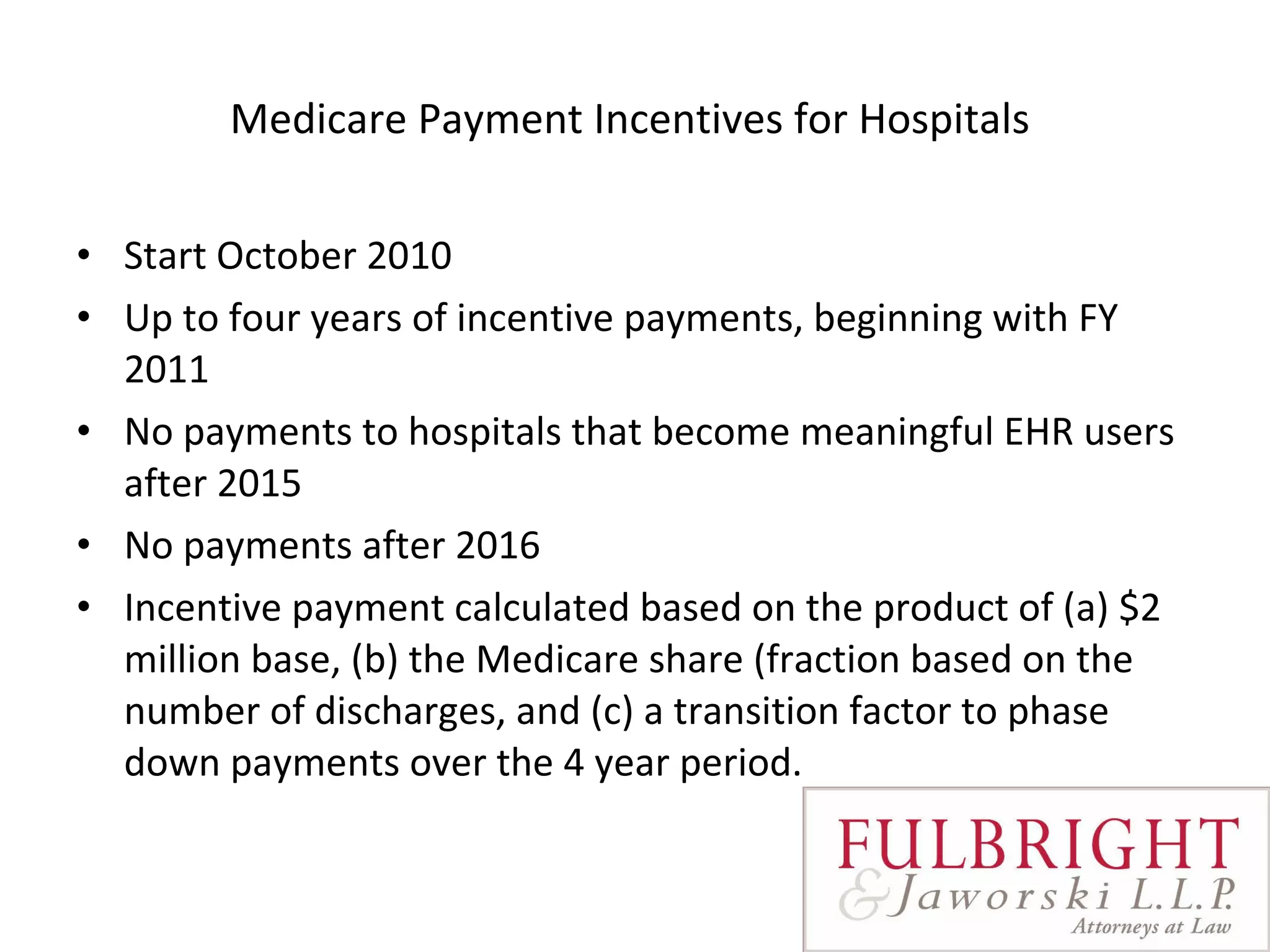
Medicare Payment Incentives for Hospitals  Start October 2010 Up to four years of incentive payments, beginning with FY 2011  No payments to hospitals that become meaningful EHR users after 2015 No payments after 2016 Incentive payment calculated based on the product of (a) $2 million base, (b) the Medicare share (fraction based on the number of discharges, and (c) a transition factor to phase down payments over the 4 year period. 
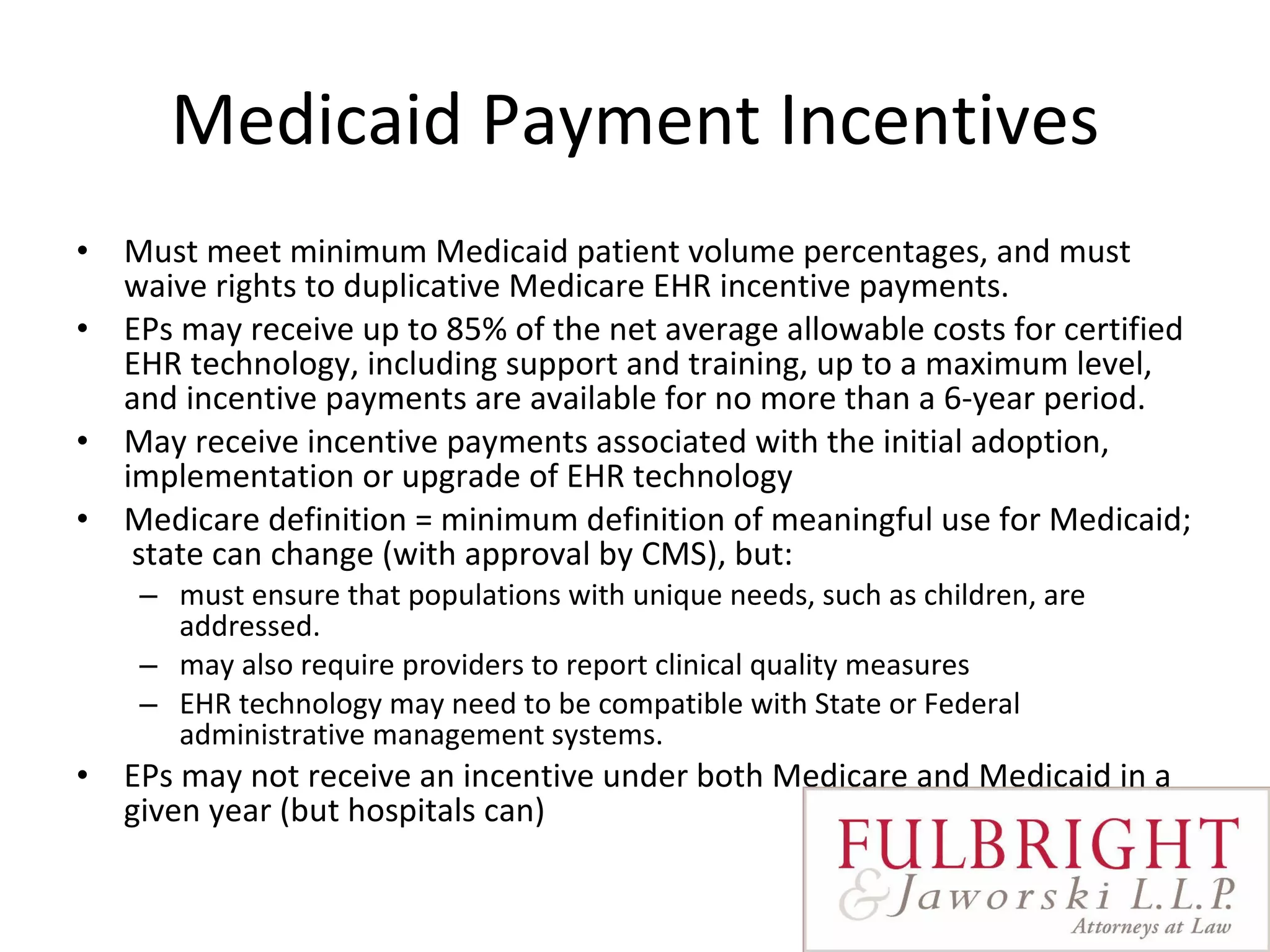
Medicaid Payment Incentives Must meet minimum Medicaid patient volume percentages, and must waive rights to duplicative Medicare EHR incentive payments.   EPs may receive up to 85% of the net average allowable costs for certified EHR technology, including support and training, up to a maximum level, and incentive payments are available for no more than a 6-year period.    May receive incentive payments associated with the initial adoption, implementation or upgrade of EHR technology Medicare definition = minimum definition of meaningful use for Medicaid;  state can change (with approval by CMS), but:  must ensure that populations with unique needs, such as children, are addressed.  may also require providers to report clinical quality measures EHR technology may need to be compatible with State or Federal administrative management systems. EPs may not receive an incentive under both Medicare and Medicaid in a given year (but hospitals can)
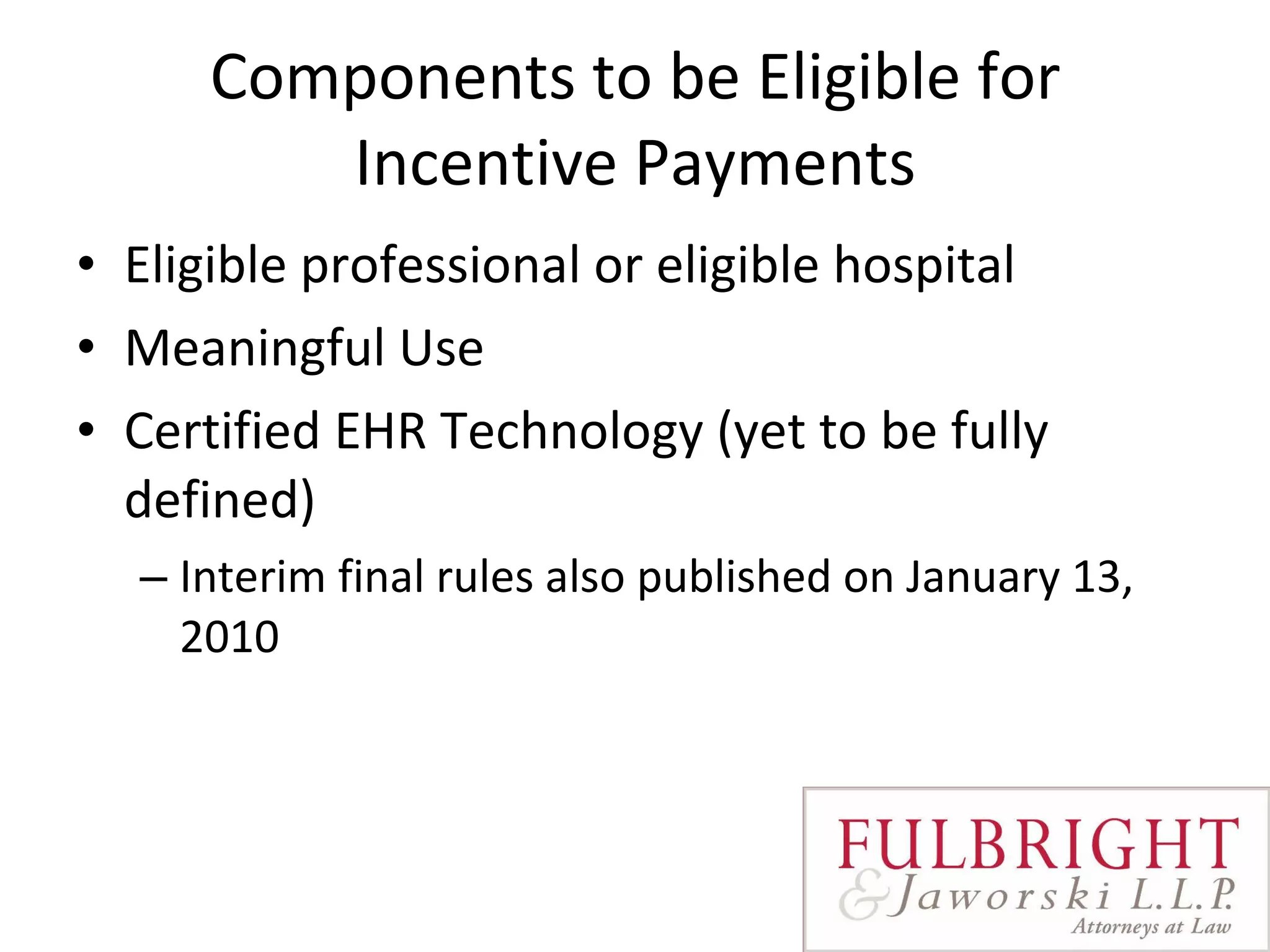
Components to be Eligible for Incentive Payments Eligible professional or eligible hospital Meaningful Use Certified EHR Technology (yet to be fully defined) Interim final rules also published on January 13, 2010
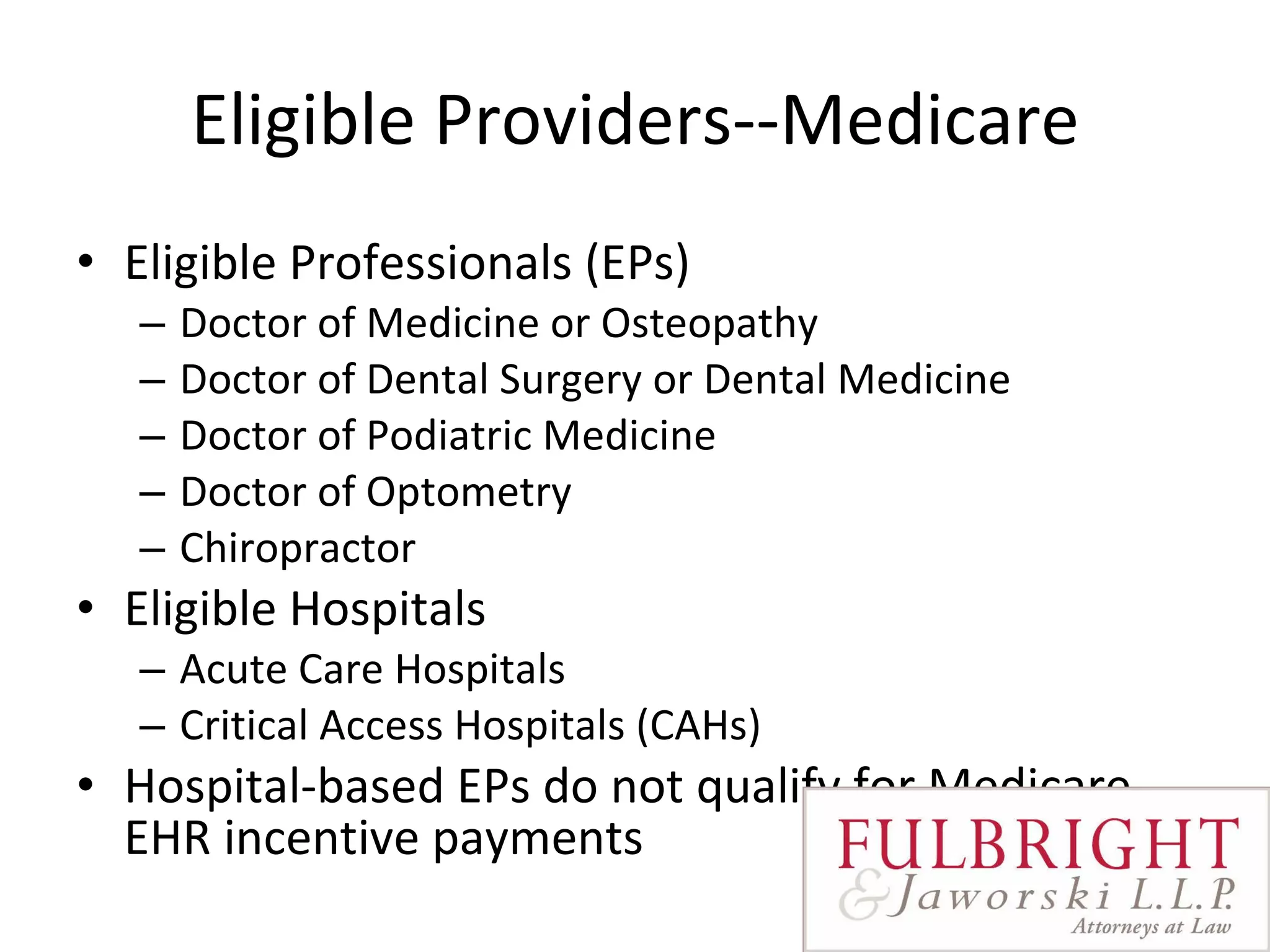
Eligible Providers--Medicare Eligible Professionals (EPs)  Doctor of Medicine or Osteopathy Doctor of Dental Surgery or Dental Medicine Doctor of Podiatric Medicine Doctor of Optometry Chiropractor  Eligible Hospitals Acute Care Hospitals Critical Access Hospitals (CAHs)  Hospital-based EPs do not qualify for Medicare EHR incentive payments
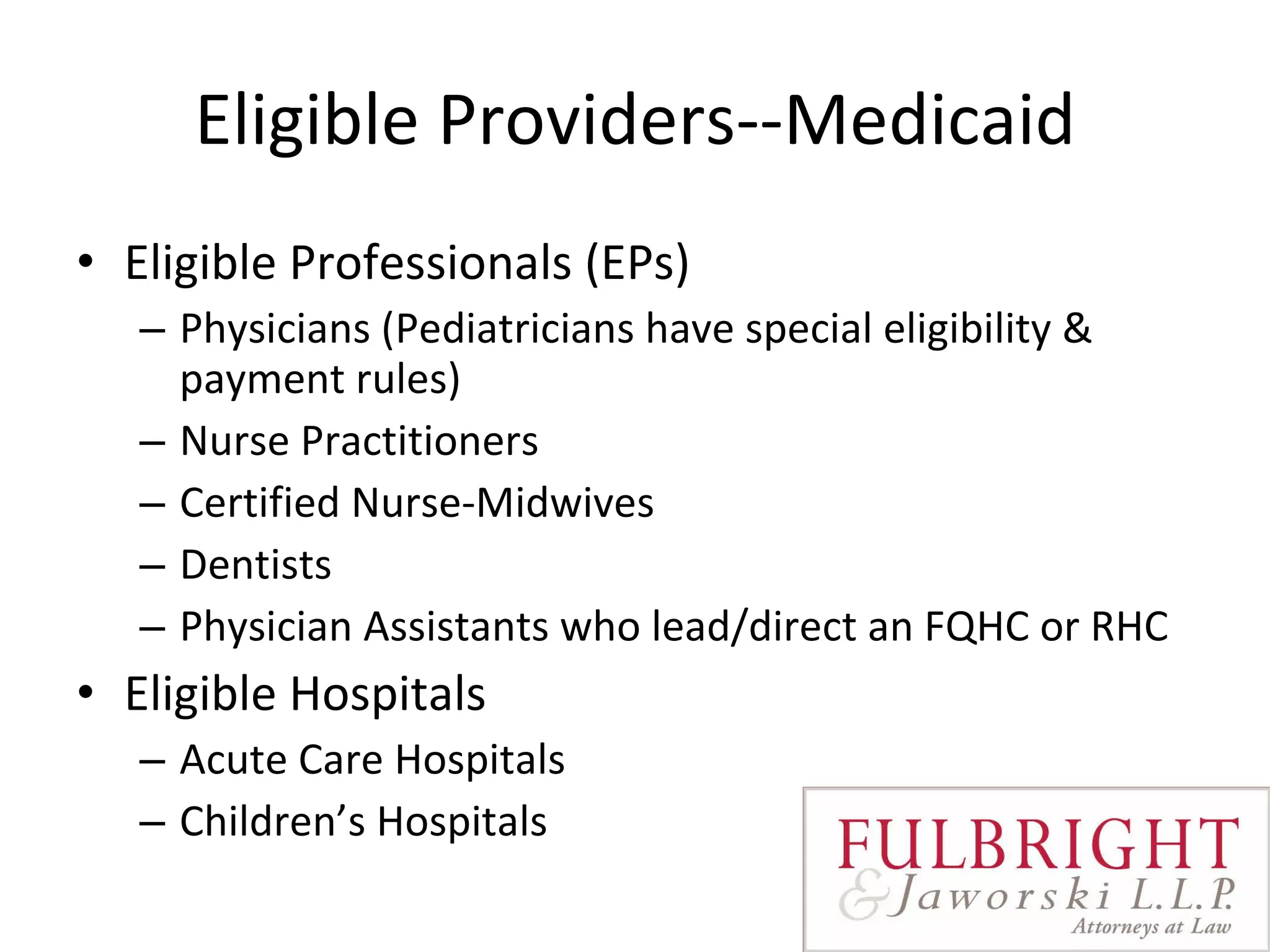
Eligible Providers--Medicaid Eligible Professionals (EPs) Physicians (Pediatricians have special eligibility & payment rules) Nurse Practitioners  Certified Nurse-Midwives  Dentists Physician Assistants who lead/direct an FQHC or RHC Eligible Hospitals Acute Care Hospitals Children’s Hospitals
Meaningful Use—3 components Use of certified EHR in a meaningful manner (ex: e-prescribing) Use of certified EHR for electronic exchange of health information to improve quality of health care Use of certified EHR to submit clinical quality and other measures
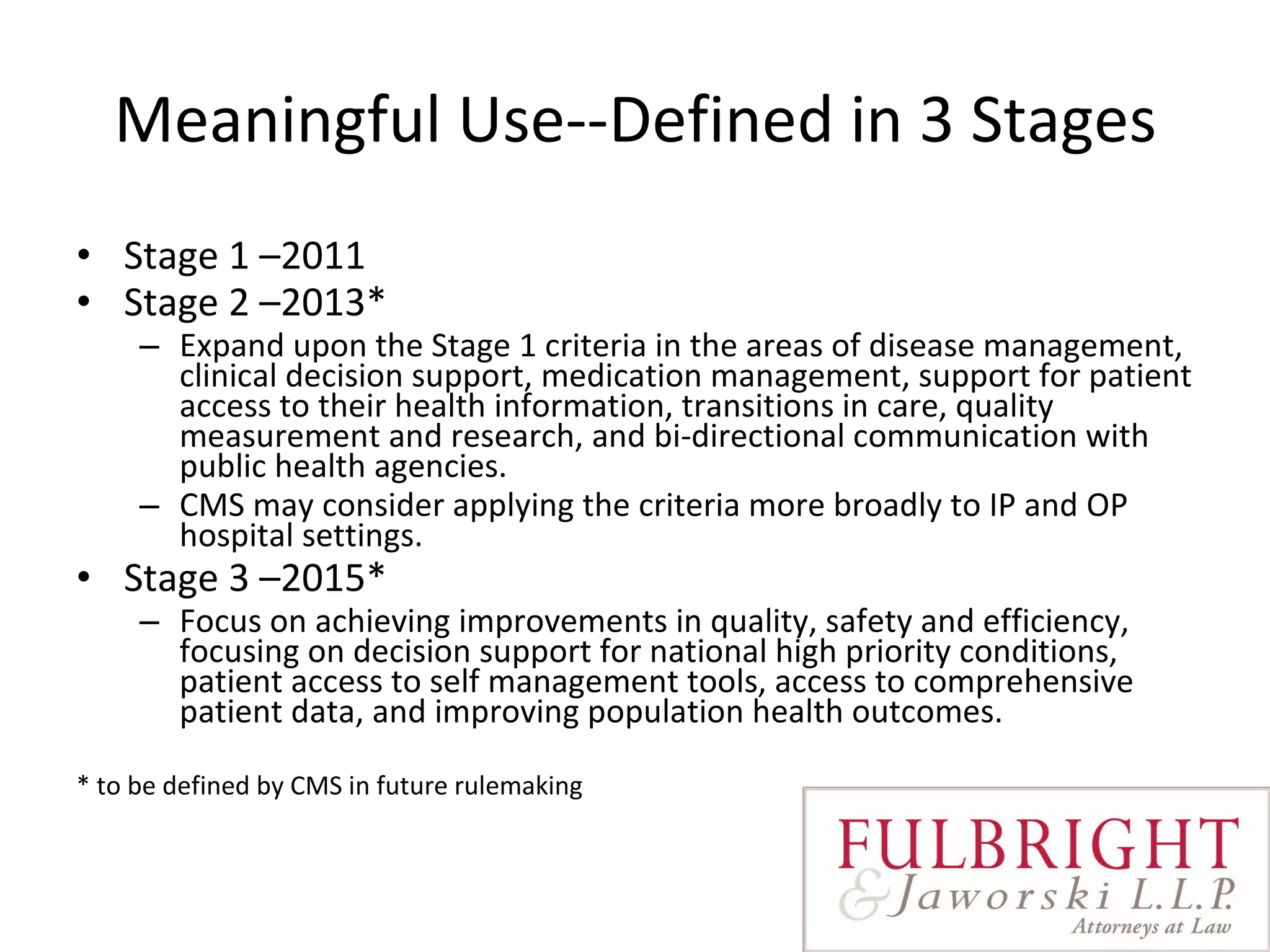
Meaningful Use--Defined in 3 Stages Stage 1 –2011 Stage 2 –2013* Expand upon the Stage 1 criteria in the areas of disease management, clinical decision support, medication management, support for patient access to their health information, transitions in care, quality measurement and research, and bi-directional communication with public health agencies.    CMS may consider applying the criteria more broadly to IP and OP  hospital settings.  Stage 3 –2015* Focus on achieving improvements in quality, safety and efficiency, focusing on decision support for national high priority conditions, patient access to self management tools, access to comprehensive patient data, and improving population health outcomes.  * to be defined by CMS in future rulemaking
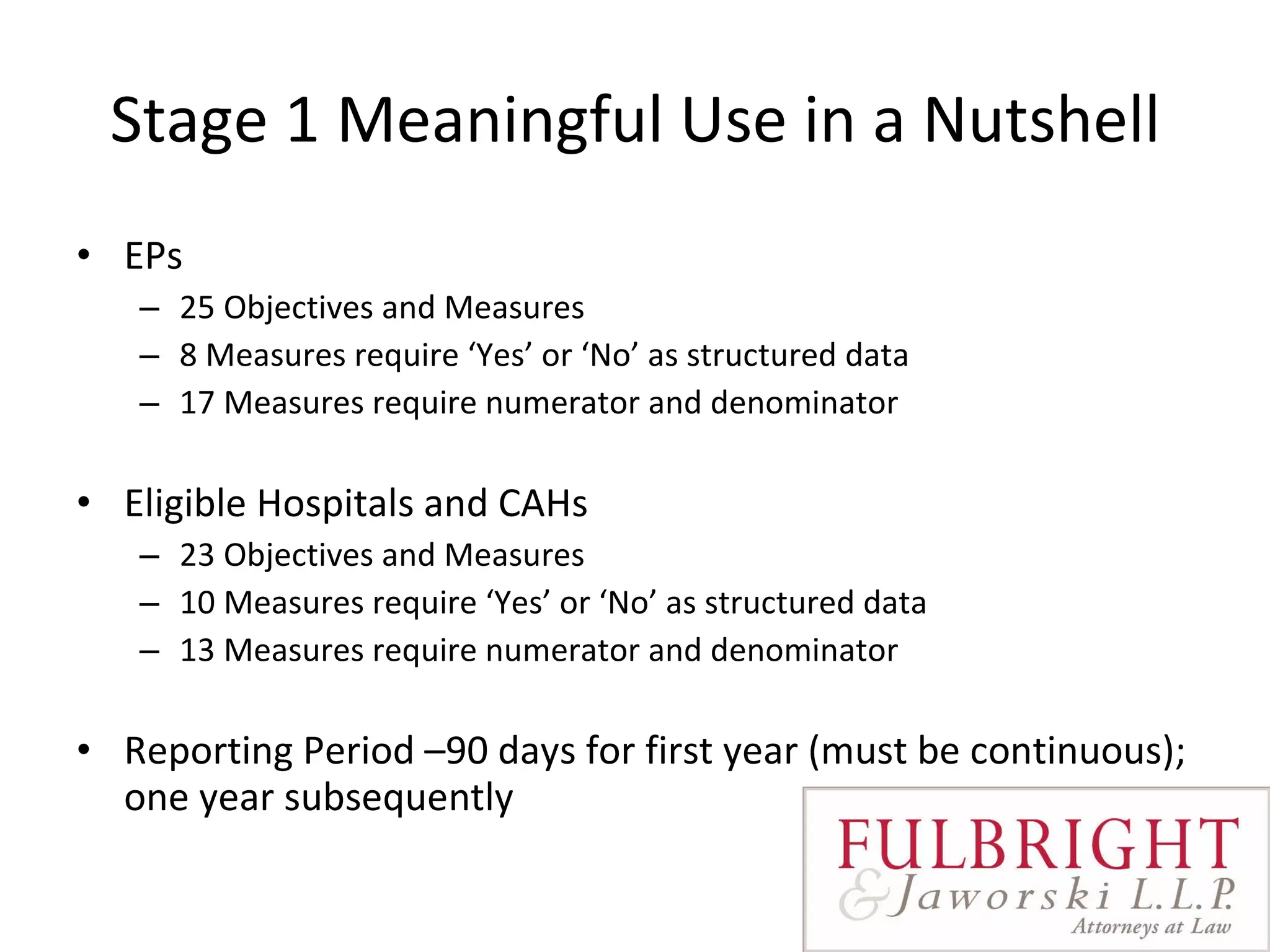
Stage 1 Meaningful Use in a Nutshell EPs 25 Objectives and Measures 8 Measures require ‘Yes’ or ‘No’ as structured data 17 Measures require numerator and denominator Eligible Hospitals and CAHs 23 Objectives and Measures 10 Measures require ‘Yes’ or ‘No’ as structured data 13 Measures require numerator and denominator Reporting Period –90 days for first year (must be continuous); one year subsequently
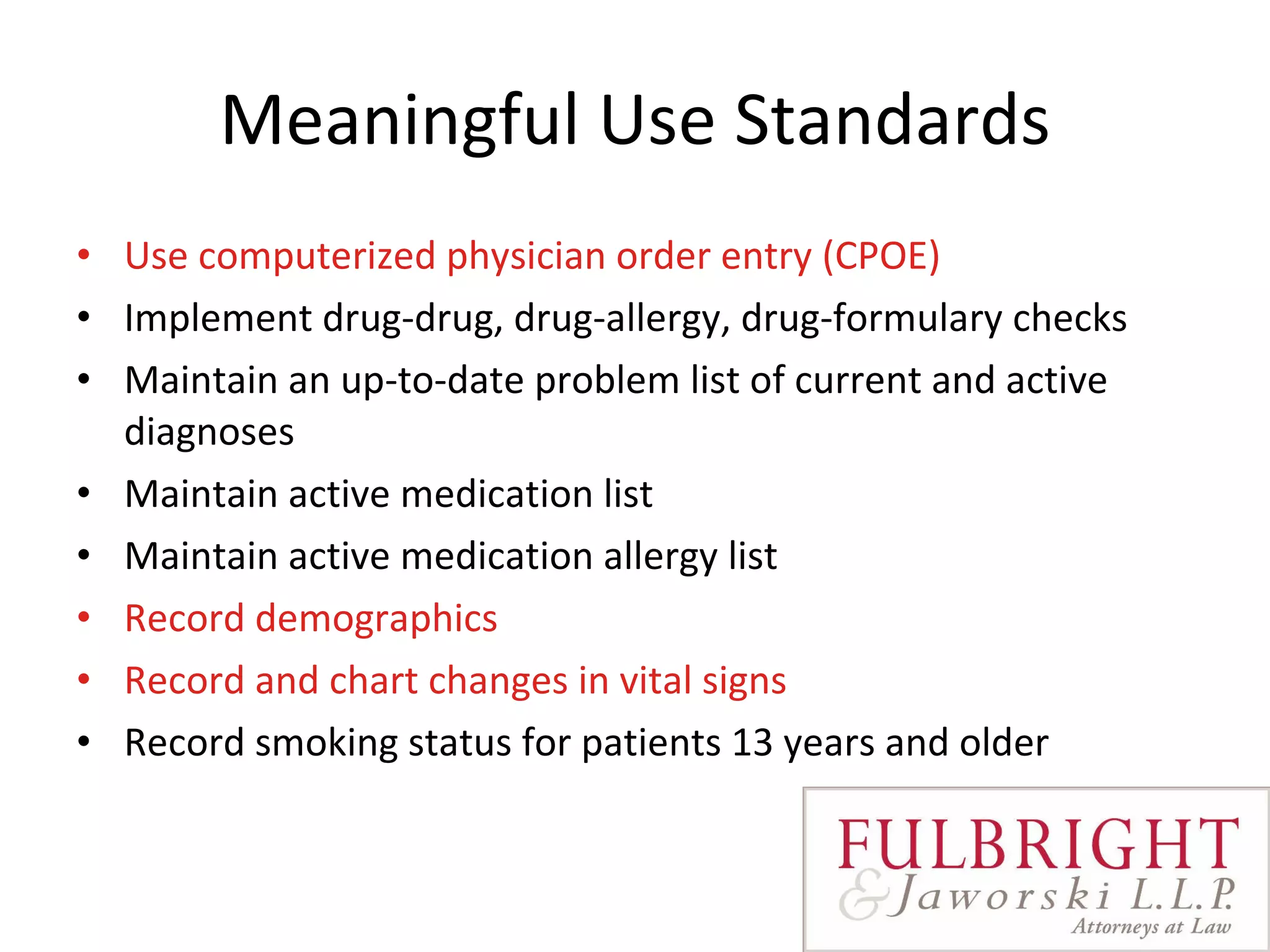
Meaningful Use Standards Use computerized physician order entry (CPOE) Implement drug-drug, drug-allergy, drug-formulary checks Maintain an up-to-date problem list of current and active diagnoses Maintain active medication list Maintain active medication allergy list Record demographics   Record and chart changes in vital signs   Record smoking status for patients 13 years and older
Meaningful Use Standards Incorporate clinical lab-test results into EHR as structured data Generate lists of patients by specific conditions to use for quality improvement, reduction of disparities, and outreach Report ambulatory quality measures to CMS or the States Implement 5 clinical decision support rules relevant to specialty or high clinical priority, including diagnostic test ordering, along with the ability to track compliance with those rules Check insurance eligibility electronically from public and private payers Submit claims electronically to public and private payers
Meaningful Use Standards Provide patients with an electronic copy of their health information upon request Capability to electronically exchange key clinical information among providers of care and patient-authorized entities Perform medication reconciliation at relevant encounters and each transition of care Provide summary care record for each transition of care and referral Capability to submit electronic data to immunization registries and actual submission where required and accepted Capability to provide electronic syndromic surveillance data to public health agencies and actual transmission according to applicable law and practice Protect electronic health information created or maintained by the certified EHR technology through the implementation of appropriate technical capabilities
Legal Issues Arising from Meaningful Use Criteria Meeting 80% threshold for electronic claims submission and electronic  eligibility verification from public and private payers Dependent on payor capabilities Effect if outsource billing & collection or business office functions Calculating incentive payments in the event of a merger or acquisition Physician reassignment of incentive payments Donating EHR software to medical staff Stark exception/Anti-Kickback Statute safe harbor
When You Think   HEALTH CARE, Think Fulbright. TM AUSTIN • BEIJING • DALLAS • DENVER • DUBAI • HONG KONG • HOUSTON • LONDON • LOS ANGELES MINNEAPOLIS • MUNICH • NEW YORK • RIYADH • SAN ANTONIO • ST. LOUIS • WASHINGTON, D.C. www.fulbright.com   •   866-FULBRIGHT [866-385-2744]
Patricia Johnston, MS, FHIMSS Vice President, Electronic Health Record, Ambulatory and Acute Care
Preparing for Meaningful Use: A Provider’s Perspective May 19,  2010
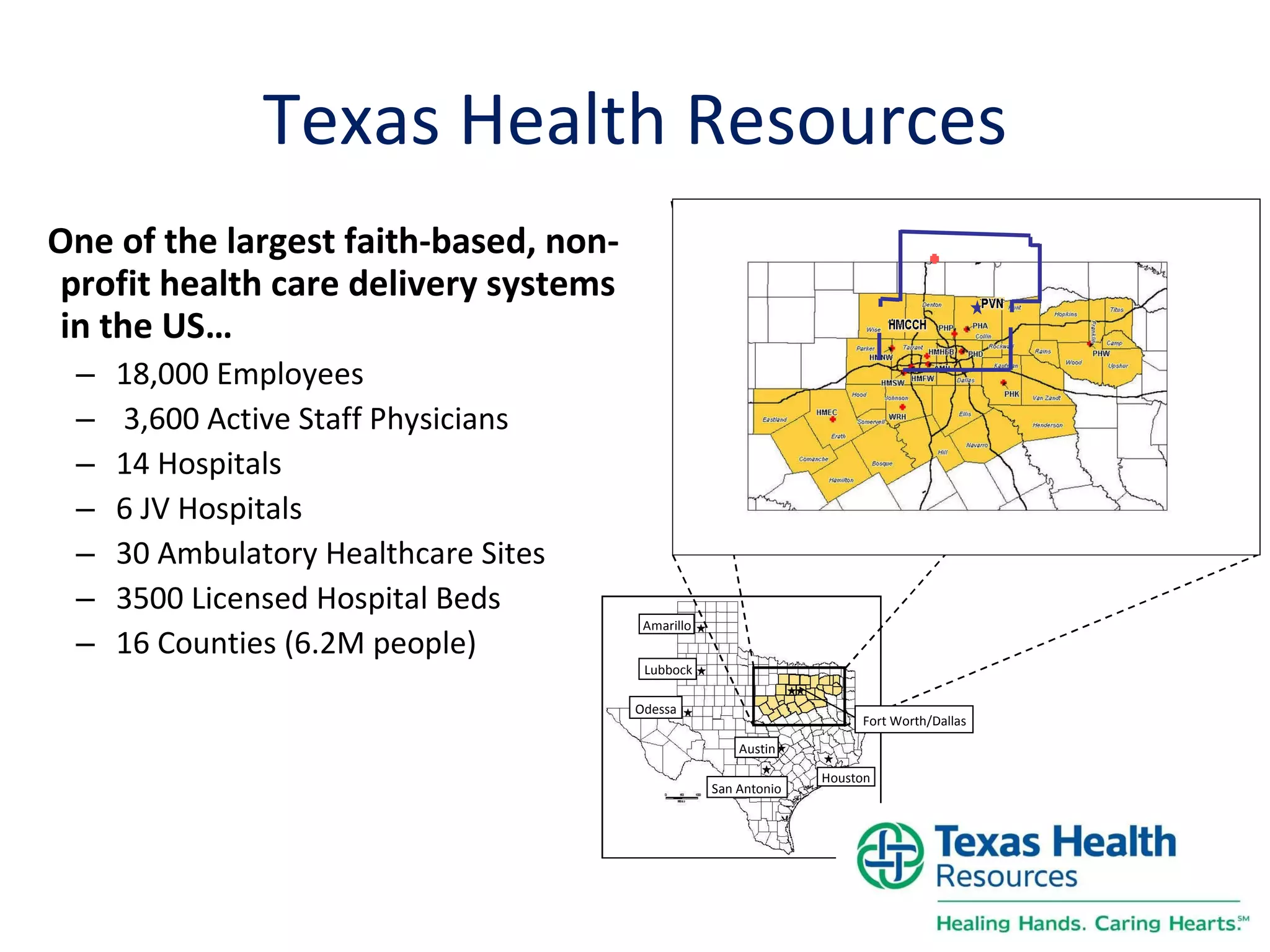
Texas Health Resources One of the largest faith-based, non-profit health care delivery systems in the US… 18,000 Employees 3,600 Active Staff Physicians  14 Hospitals 6 JV Hospitals 30 Ambulatory Healthcare Sites 3500 Licensed Hospital Beds 16 Counties (6.2M people) Odessa Amarillo Lubbock Austin San Antonio Houston Fort Worth/Dallas
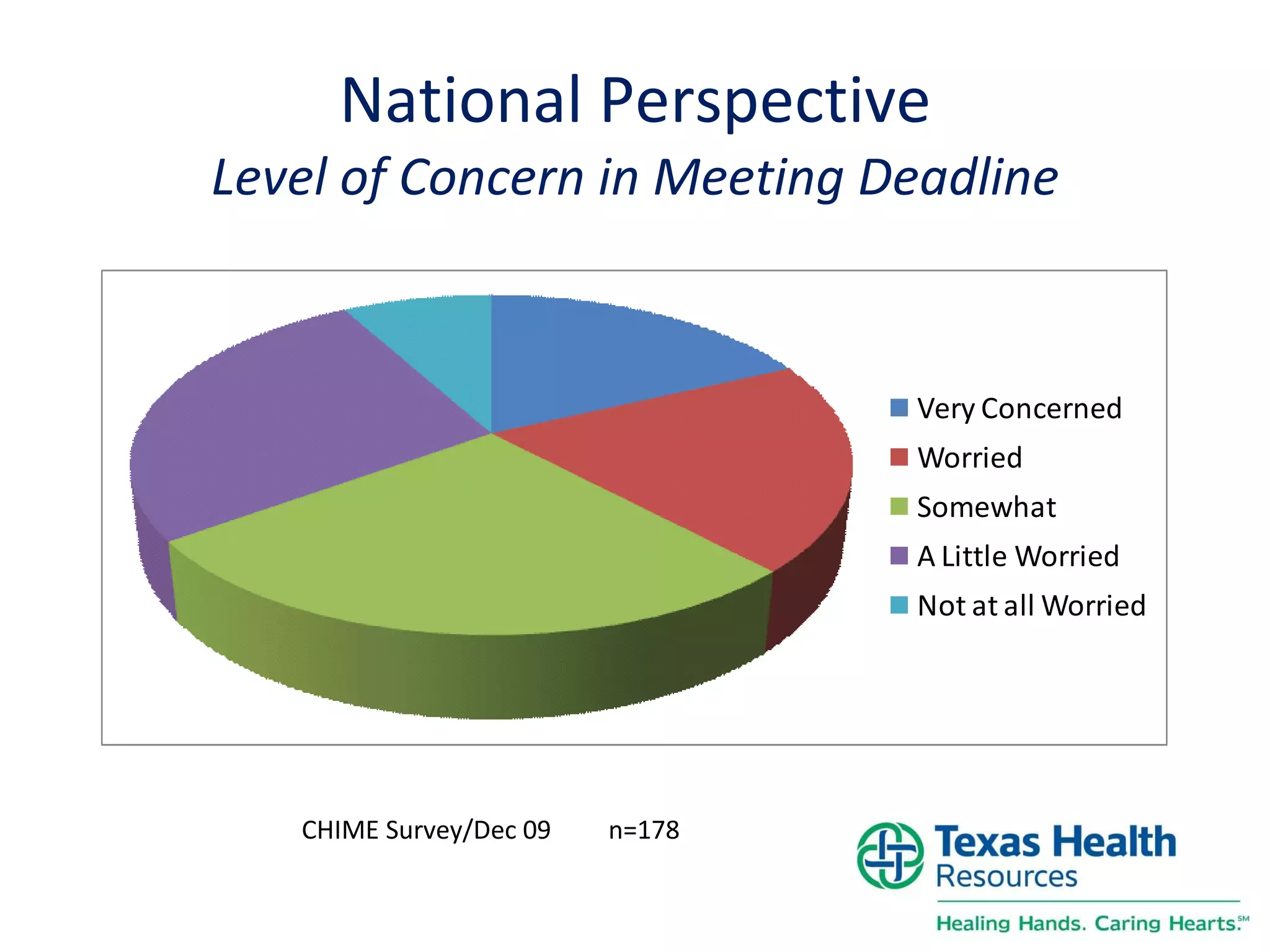
National Perspective Level of Concern in Meeting Deadline CHIME Survey/Dec 09  n=178
National Perspective Top Concerns in Implementing Standards CHIME Survey/Dec 09  n=178
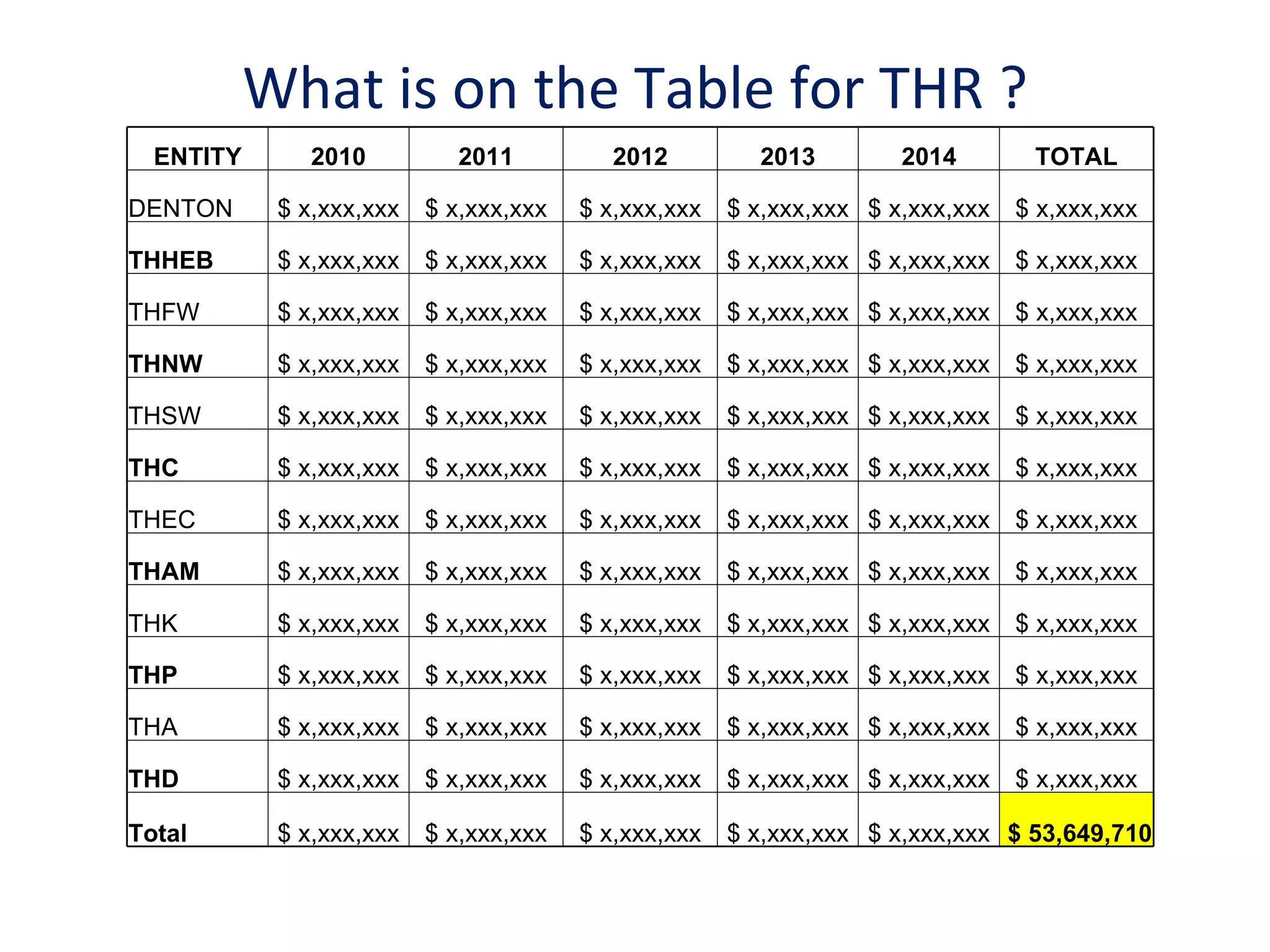
What is on the Table for THR ? ENTITY 2010 2011 2012 2013 2014 TOTAL DENTON $ x,xxx,xxx $ x,xxx,xxx $ x,xxx,xxx $ x,xxx,xxx $ x,xxx,xxx $ x,xxx,xxx THHEB $ x,xxx,xxx $ x,xxx,xxx $ x,xxx,xxx $ x,xxx,xxx $ x,xxx,xxx $ x,xxx,xxx THFW $ x,xxx,xxx $ x,xxx,xxx $ x,xxx,xxx $ x,xxx,xxx $ x,xxx,xxx $ x,xxx,xxx THNW $ x,xxx,xxx $ x,xxx,xxx $ x,xxx,xxx $ x,xxx,xxx $ x,xxx,xxx $ x,xxx,xxx THSW $ x,xxx,xxx $ x,xxx,xxx $ x,xxx,xxx $ x,xxx,xxx $ x,xxx,xxx $ x,xxx,xxx THC $ x,xxx,xxx $ x,xxx,xxx $ x,xxx,xxx $ x,xxx,xxx $ x,xxx,xxx $ x,xxx,xxx THEC $ x,xxx,xxx $ x,xxx,xxx $ x,xxx,xxx $ x,xxx,xxx $ x,xxx,xxx $ x,xxx,xxx THAM $ x,xxx,xxx $ x,xxx,xxx $ x,xxx,xxx $ x,xxx,xxx $ x,xxx,xxx $ x,xxx,xxx THK $ x,xxx,xxx $ x,xxx,xxx $ x,xxx,xxx $ x,xxx,xxx $ x,xxx,xxx $ x,xxx,xxx THP $ x,xxx,xxx $ x,xxx,xxx $ x,xxx,xxx $ x,xxx,xxx $ x,xxx,xxx $ x,xxx,xxx THA $ x,xxx,xxx $ x,xxx,xxx $ x,xxx,xxx $ x,xxx,xxx $ x,xxx,xxx $ x,xxx,xxx THD $ x,xxx,xxx $ x,xxx,xxx $ x,xxx,xxx $ x,xxx,xxx $ x,xxx,xxx $ x,xxx,xxx Total $ x,xxx,xxx $ x,xxx,xxx $ x,xxx,xxx $ x,xxx,xxx $ x,xxx,xxx $ 53,649,710
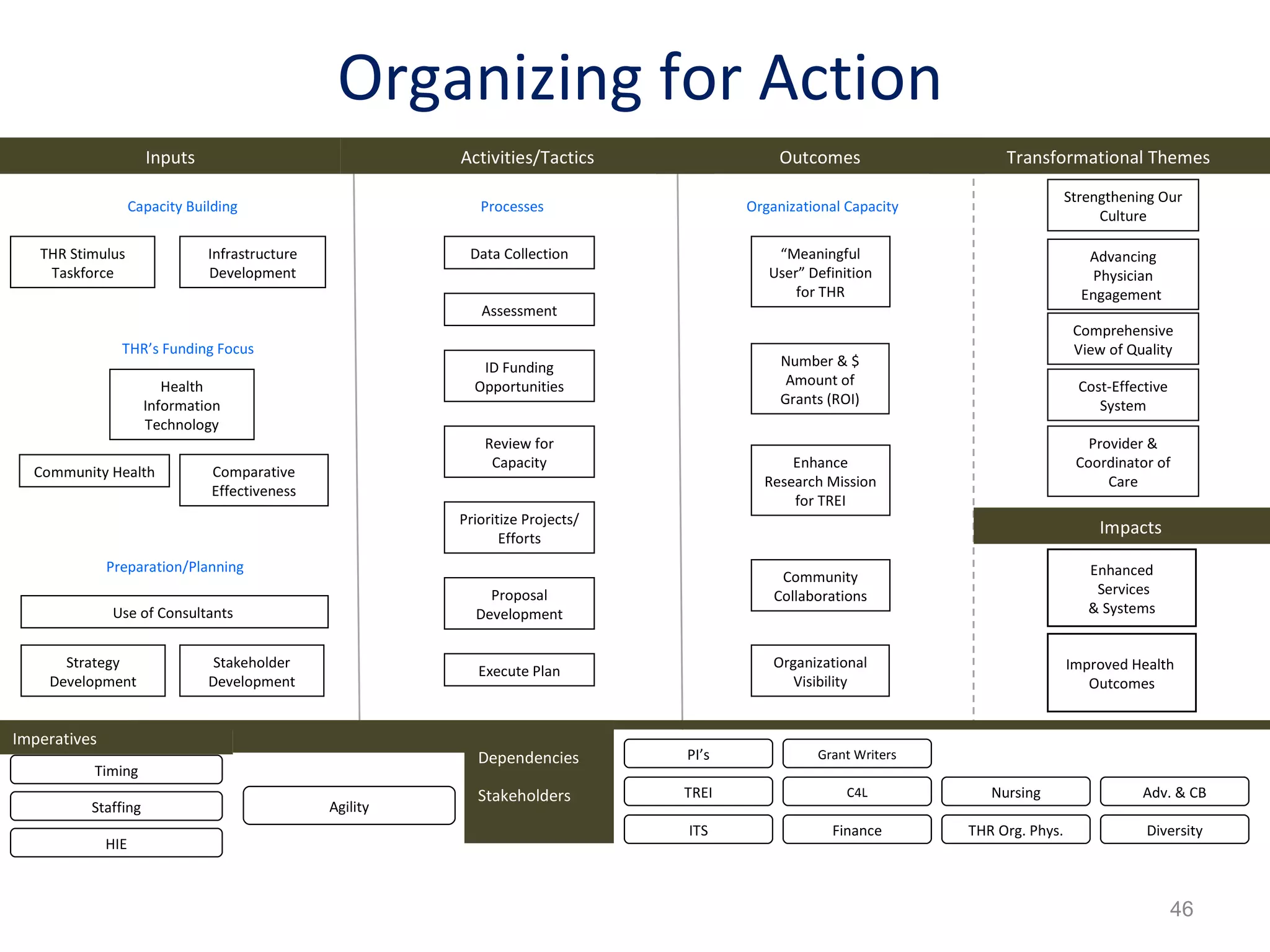
Organizing for Action Infrastructure Development Capacity Building Proposal Development Number & $ Amount of Grants (ROI) “ Meaningful User” Definition for THR Data Collection Strategy Development Use of Consultants  Stakeholder Development Preparation/Planning Assessment Advancing Physician Engagement  Organizational Visibility THR Stimulus Taskforce Community Collaborations Activities/Tactics Outcomes Inputs Timing Staffing HIE PI’s TREI Grant Writers Agility Imperatives Stakeholders Enhanced Services & Systems Improved Health  Outcomes Processes Organizational Capacity Community Health Comparative Effectiveness Prioritize Projects/Efforts ID Funding Opportunities Review for Capacity THR’s Funding Focus ITS Finance THR Org. Phys. Nursing Adv. & CB Dependencies Enhance Research Mission for TREI Cost-Effective System Provider & Coordinator of Care Execute Plan Health Information Technology Comprehensive View of Quality Transformational Themes Impacts Diversity Strengthening Our Culture C4L
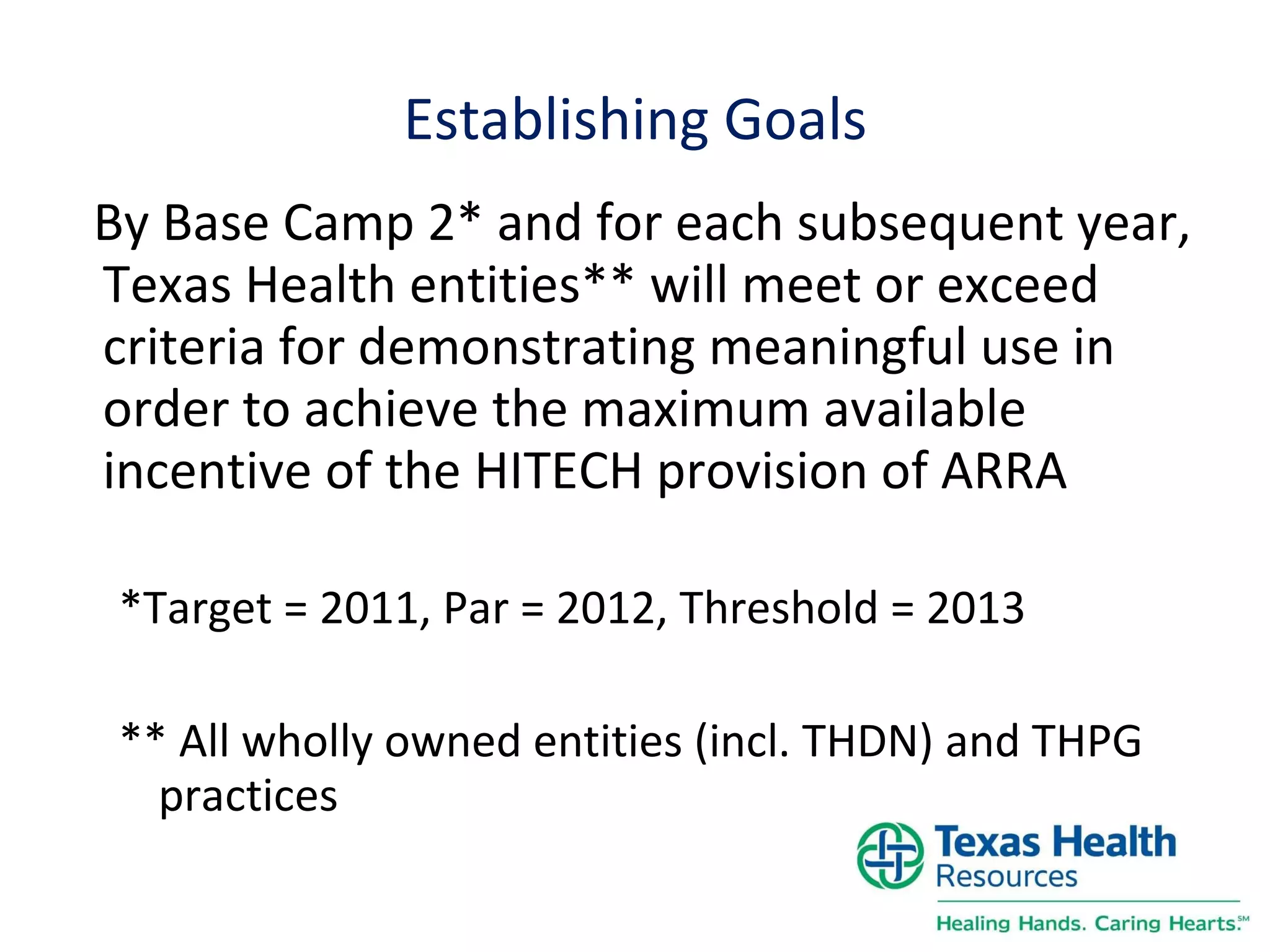
Establishing Goals By Base Camp 2* and for each subsequent year, Texas Health entities** will meet or exceed criteria for demonstrating meaningful use in order to achieve the maximum available incentive of the HITECH provision of ARRA *Target = 2011, Par = 2012, Threshold = 2013 ** All wholly owned entities (incl. THDN) and THPG practices
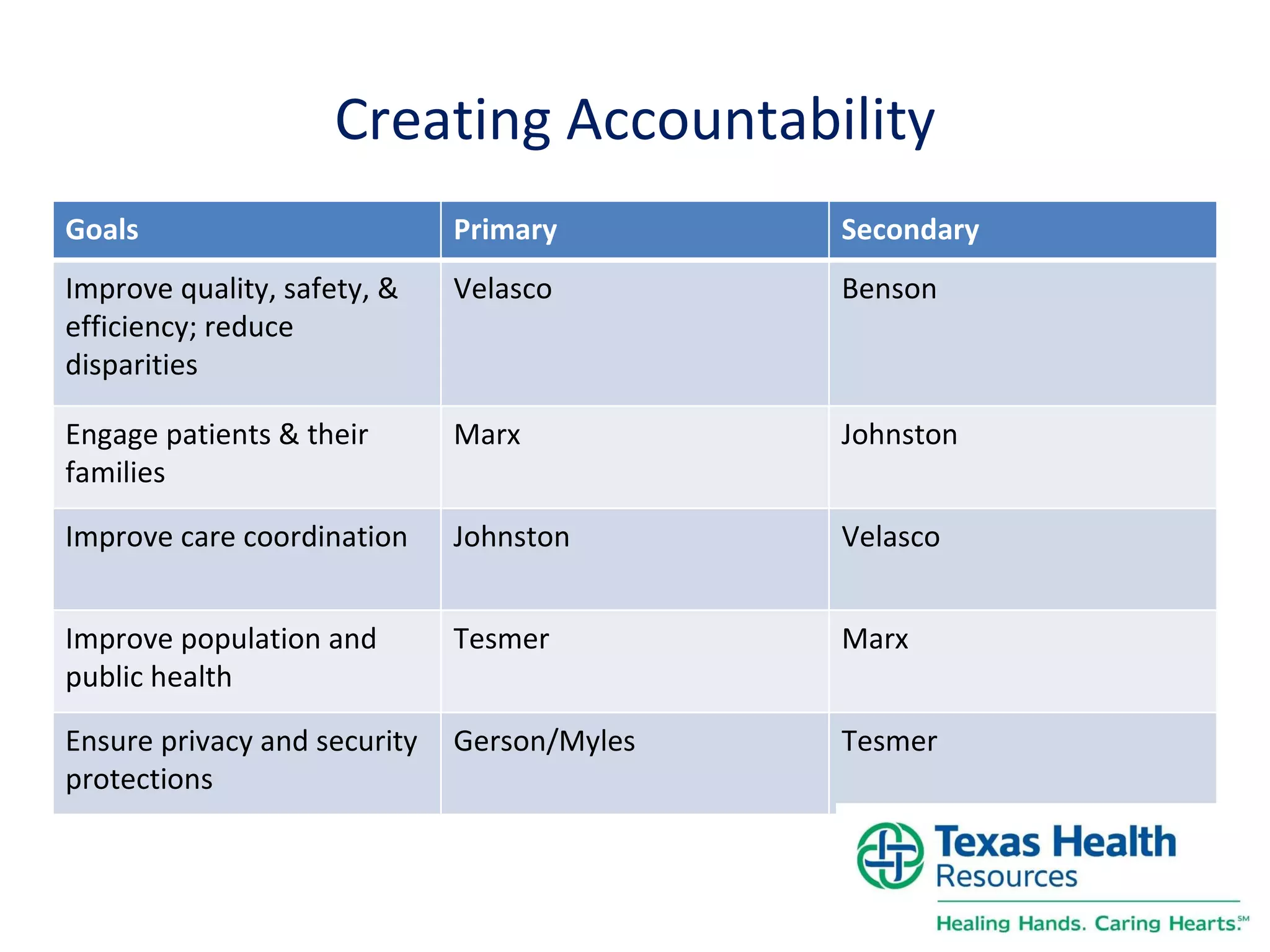
Creating Accountability Goals Primary Secondary Improve quality, safety, & efficiency; reduce disparities Velasco Benson Engage patients & their families Marx Johnston Improve care coordination Johnston Velasco Improve population and public health Tesmer Marx Ensure privacy and security protections Gerson/Myles Tesmer
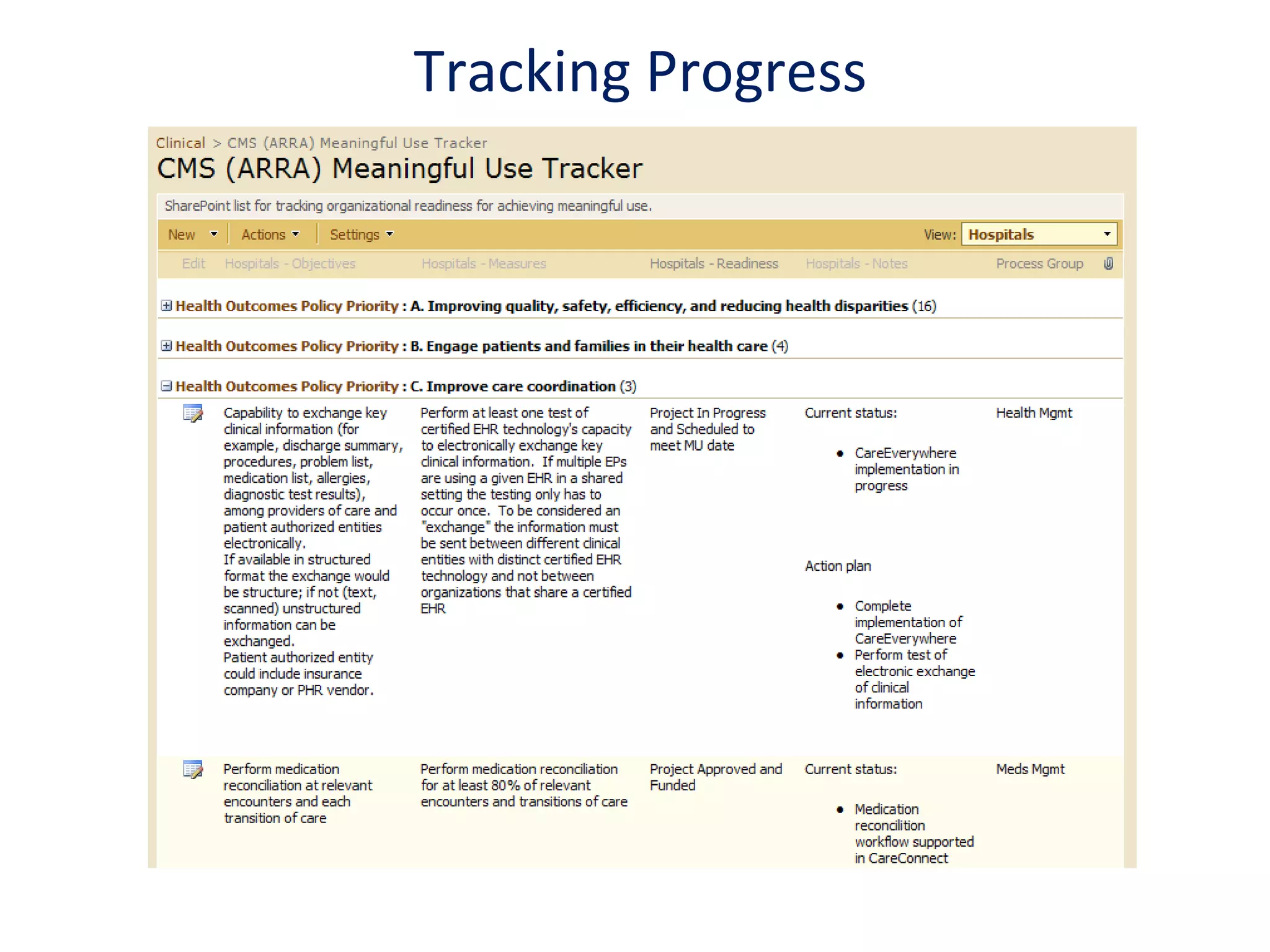
Tracking Progress
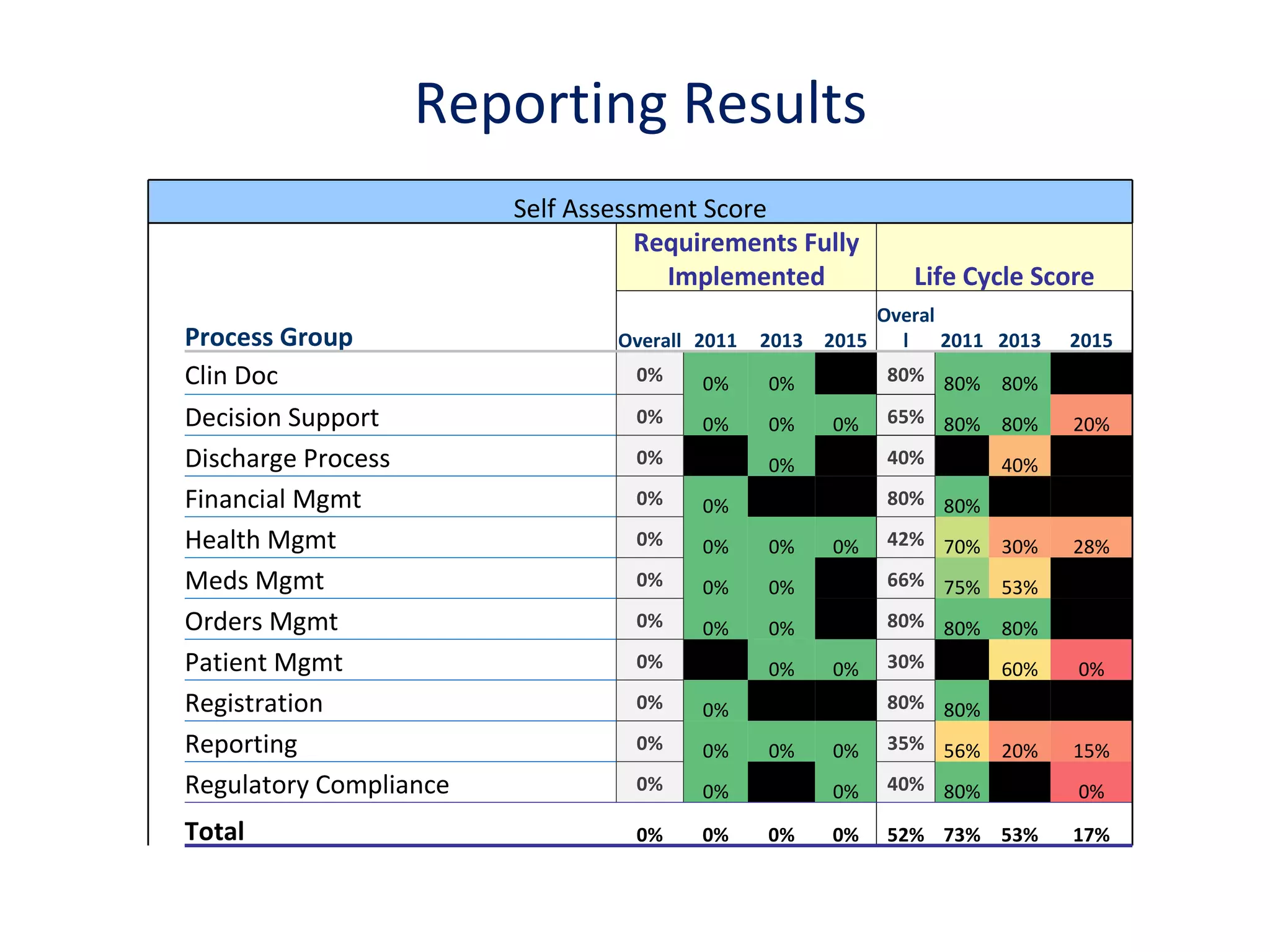
Reporting Results Self Assessment Score   Requirements Fully Implemented Life Cycle Score   Process Group Overall 2011 2013 2015 Overall 2011 2013 2015   Clin Doc 0% 0% 0% NA 80% 80% 80% NA   Decision Support 0% 0% 0% 0% 65% 80% 80% 20%   Discharge Process 0% NA 0% NA 40% NA 40% NA   Financial Mgmt 0% 0% NA NA 80% 80% NA NA   Health Mgmt 0% 0% 0% 0% 42% 70% 30% 28%   Meds Mgmt 0% 0% 0% NA 66% 75% 53% NA   Orders Mgmt 0% 0% 0% NA 80% 80% 80% NA   Patient Mgmt 0% NA 0% 0% 30% NA 60% 0%   Registration 0% 0% NA NA 80% 80% NA NA   Reporting 0% 0% 0% 0% 35% 56% 20% 15%   Regulatory Compliance 0% 0% NA 0% 40% 80% NA 0%   Total 0% 0% 0% 0% 52% 73% 53% 17%
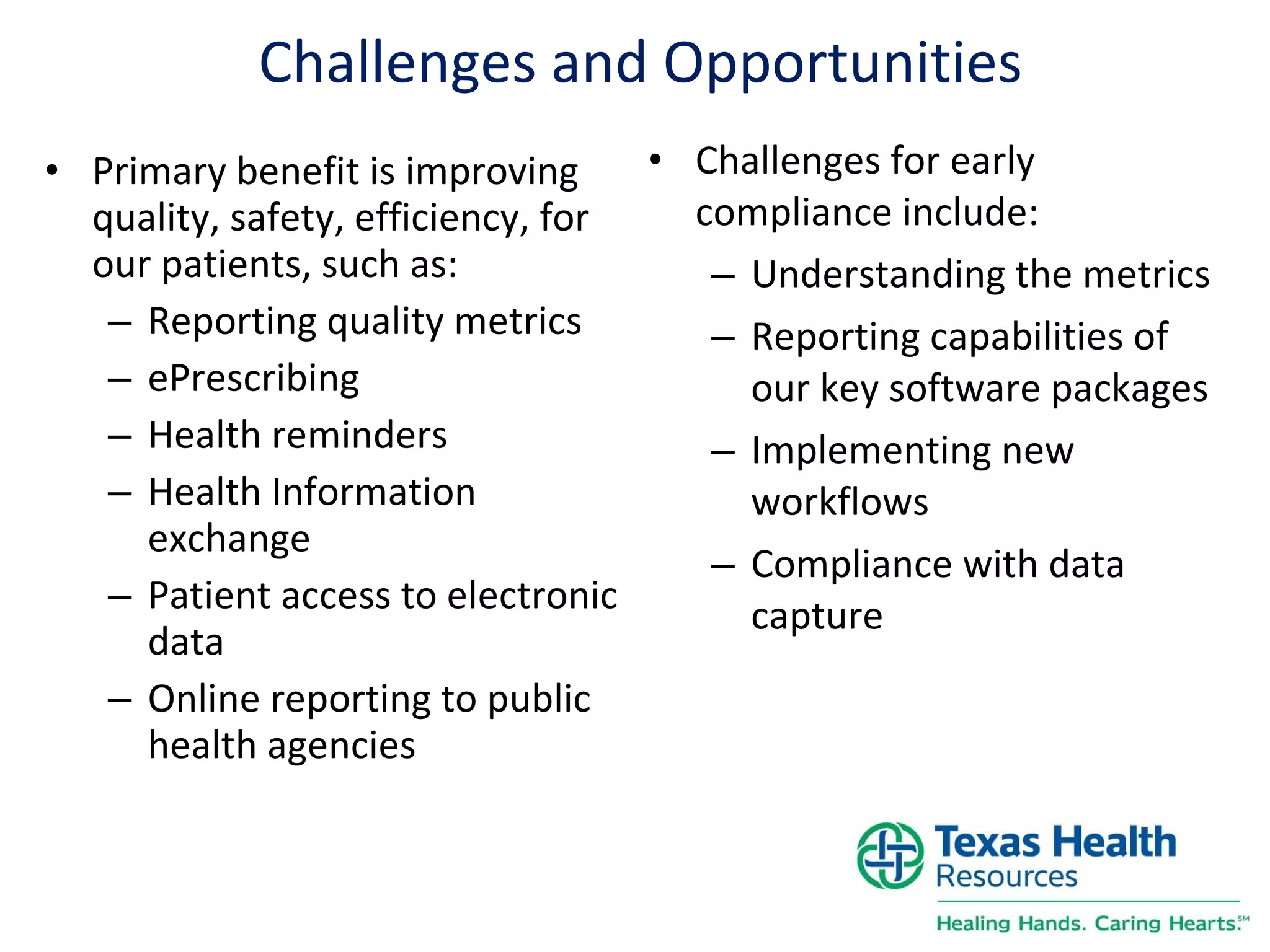
Challenges and Opportunities Primary benefit is improving quality, safety, efficiency, for our patients, such as: Reporting quality metrics ePrescribing Health reminders Health Information exchange Patient access to electronic data Online reporting to public health agencies Challenges for early compliance include: Understanding the metrics Reporting capabilities of our key software packages Implementing new workflows Compliance with data capture
Bottom Line We will be rewarded for doing the right thing!
Discussion and Q&A PatriciaJohnston  PatriciaJohnston@Texashealth.org
Questions for the Panelists

Meaningful Use When 5 19 10

  • 1.
    Welcome “ MeaningfulUse – What does it mean ? Panel Discussion May 19, 2010
  • 2.
    Meaningful Use –What Does it Mean ? Panel Discussion Moderator: Paula M. Zalucki, FACHE President, Salus Strategy Group Panelists: Susan Walker Regional Director, Beacon Partners, Inc. Denise Webb Glass Partner,  Fulbright & Jaworski, LLP         Patricia Johnston, MS, FHIMSS Vice President, Electronic Health Record, Ambulatory and Acute Care Texas Health Resources
  • 3.
    “ Meaningful Use” Cheat Sheet from Healthcare Executive magazine Certification criteria and standards for achieving “meaningful use” of certified health IT products Established through the American Recovery and Reinvestment Act of 2009 (aka the Stimulus Bill) Notice of Proposed Rule Making establishing the Electronic Health Record Incentive Program was finally released in late December 2009
  • 4.
  • 5.
    Susan Walker RegionalDirector, Beacon Partners, Inc.
  • 6.
    Meaningful Use, It’sNot Just an IT Project A Roadmap to Organizational Readiness Presented by: Susan Walker Regional Director Date: 05/19/2010
  • 7.
    Beacon Partners Leaderin Healthcare Consulting Boston – San Francisco – Toronto Privately Held Consulting Services IT Strategy, ARRA, Physician Alignment Implementation, Clinical and Operations services Modern Healthcare Top 20 healthcare consulting firms
  • 8.
    Beacon Partners’ PositionMeaningful Use This is part of an evolutionary path
  • 9.
    This is notan I.T project- it’s about Organizational Readiness It’s about Developing a patient care, quality and safety strategy supported by I.T. and doing it right the first time.
  • 10.
    Key Components Governanceand Communication Physician Alignment Information Technology Considerations Vendor Sustainability Patient Flow Quality HIPAA /HITECH
  • 11.
    Governance and CommunicationC-Suite Support of IT
  • 12.
    Common Vision Mustbe created together to align organizational and IT objectives. Should point back to strategic planning documents Communicate timelines and milestones toward meaningful use within organization Create “One Voice” to organization
  • 13.
    Challenges Political Champions Supportive environment Organizational Governance Shared goals and objectives Operating rules Physician Alignment Financial Access to capital Sustainable model Technical Considerations Integration with legacy systems Security and privacy Data management Staffing skills assessment
  • 14.
    Meaningful Use CheckList “Starter Kit” Full Version Available in PDF
  • 15.
    Vision Have youdiscussed your IT strategy with your governing body? Have you developed a strategic plan and roadmap? Have you assessed your facility’s meaningful use? Have you positioned champions for project success? Has your vendor provided you with a sustainability plan that ensures CCHIT certification beyond the initial rule? Physician alignment: Who should we be aligned with to move our vision, mission and values forward?
  • 16.
    Change Management Developa robust change management plan Just because incentives are available does not mean physicians will fall in line. Have you completed a clinical workflow analysis Do you have clinicians as team members and champions? Plan monthly meetings with executive committee, clinicians and IT for communication and governance .
  • 17.
    Clinical IT AdoptionProcess Have your organizational goals and expected results for the clinical IT project been identified in the planning stage? Design system from clinicians perspective. Successful Go-Live means TRAINING
  • 18.
    Measurement Have youcompleted your ARRA financial incentives estimator? Have you matched quality efforts and reporting to federal guidelines? Have you determined your up front ability to fund the EHR project? Have you audited your Security and Privacy policies? Have you assessed future penalties for not adopting?
  • 19.
    Lessons Learned Startthe process early Lay the foundation with planning Educate the entire team on “One Voice” Understand vendor solutions early on Utilize physician and clinician champions Communicate
  • 20.
    Reference Documents MUAnalysis and Recommendations Report MU Starter Kit Roadmap Check List Stark Talking Points Contact Susan Walker for electronic copies [email_address]
  • 21.
    Questions & AnswersThank You Susan Walker [email_address]
  • 22.
    Denise Webb GlassPartner,  Fulbright & Jaworski, LLP
  • 23.
    Legal Issues Associatedwith Meaningful Use Standards Denise Webb Glass Women’s Healthcare Executive Network May 19, 2010
  • 24.
    EHR Incentive ProgramRules CMS issued proposed rule on the EHR incentive programs on December 30, 2009, published in the federal Register on January 13, 2010 with 60 day comment period. The comment period for the proposed rule closed on March 15, 2010 . Next steps for CMS: CMS reviews comments Draft final regulation Obtain clearance from HHS/OMB Final rule publication—estimated to be Spring 2010
  • 25.
    Current Status OnMarch 30, 2010, Senate Finance and HELP Committee leaders urged changes be made to proposed meaningful use rule: Abandon all-or-nothing approach, requiring providers to meet all Stage 1 criteria to be eligible for incentives. Change rule to allow hospital-based physicians to be eligible for incentive payments (even if legislation passed to allow incentives).
  • 26.
    Medicare Payment Incentivesfor Eligible Professionals (EPs) Start January 2011 Equal to 75% of Medicare allowable charges for covered services furnished by the EP in a year, subject to maximum payment in the first, second, third, fourth, and fifth years of $15,000; $12,000; $8,000; $4000; and $2,000, respectively.  Max payment for early adopters (2011 or 2012) is $18,000 in 1 st year. 10% increase in incentive payment for EPs who predominantly furnish services in a HPSA. No payments for meaningful EHR use after 2016 and no payments to EPs who first become meaningful EHR users in 2015 Payment Adjustments: Medicare fee schedule amount for professional services provided by an EP who was not a meaningful EHR user for the year reduced by 1% in 2015; 2% in 2016, 3% in 2017 and between 3 to 5 percent in subsequent years. 
  • 27.
    Medicare Payment Incentivesfor Hospitals Start October 2010 Up to four years of incentive payments, beginning with FY 2011 No payments to hospitals that become meaningful EHR users after 2015 No payments after 2016 Incentive payment calculated based on the product of (a) $2 million base, (b) the Medicare share (fraction based on the number of discharges, and (c) a transition factor to phase down payments over the 4 year period. 
  • 28.
    Medicaid Payment IncentivesMust meet minimum Medicaid patient volume percentages, and must waive rights to duplicative Medicare EHR incentive payments.  EPs may receive up to 85% of the net average allowable costs for certified EHR technology, including support and training, up to a maximum level, and incentive payments are available for no more than a 6-year period.   May receive incentive payments associated with the initial adoption, implementation or upgrade of EHR technology Medicare definition = minimum definition of meaningful use for Medicaid; state can change (with approval by CMS), but: must ensure that populations with unique needs, such as children, are addressed.  may also require providers to report clinical quality measures EHR technology may need to be compatible with State or Federal administrative management systems. EPs may not receive an incentive under both Medicare and Medicaid in a given year (but hospitals can)
  • 29.
    Components to beEligible for Incentive Payments Eligible professional or eligible hospital Meaningful Use Certified EHR Technology (yet to be fully defined) Interim final rules also published on January 13, 2010
  • 30.
    Eligible Providers--Medicare EligibleProfessionals (EPs) Doctor of Medicine or Osteopathy Doctor of Dental Surgery or Dental Medicine Doctor of Podiatric Medicine Doctor of Optometry Chiropractor Eligible Hospitals Acute Care Hospitals Critical Access Hospitals (CAHs) Hospital-based EPs do not qualify for Medicare EHR incentive payments
  • 31.
    Eligible Providers--Medicaid EligibleProfessionals (EPs) Physicians (Pediatricians have special eligibility & payment rules) Nurse Practitioners Certified Nurse-Midwives Dentists Physician Assistants who lead/direct an FQHC or RHC Eligible Hospitals Acute Care Hospitals Children’s Hospitals
  • 32.
    Meaningful Use—3 componentsUse of certified EHR in a meaningful manner (ex: e-prescribing) Use of certified EHR for electronic exchange of health information to improve quality of health care Use of certified EHR to submit clinical quality and other measures
  • 33.
    Meaningful Use--Defined in3 Stages Stage 1 –2011 Stage 2 –2013* Expand upon the Stage 1 criteria in the areas of disease management, clinical decision support, medication management, support for patient access to their health information, transitions in care, quality measurement and research, and bi-directional communication with public health agencies.    CMS may consider applying the criteria more broadly to IP and OP hospital settings.  Stage 3 –2015* Focus on achieving improvements in quality, safety and efficiency, focusing on decision support for national high priority conditions, patient access to self management tools, access to comprehensive patient data, and improving population health outcomes. * to be defined by CMS in future rulemaking
  • 34.
    Stage 1 MeaningfulUse in a Nutshell EPs 25 Objectives and Measures 8 Measures require ‘Yes’ or ‘No’ as structured data 17 Measures require numerator and denominator Eligible Hospitals and CAHs 23 Objectives and Measures 10 Measures require ‘Yes’ or ‘No’ as structured data 13 Measures require numerator and denominator Reporting Period –90 days for first year (must be continuous); one year subsequently
  • 35.
    Meaningful Use StandardsUse computerized physician order entry (CPOE) Implement drug-drug, drug-allergy, drug-formulary checks Maintain an up-to-date problem list of current and active diagnoses Maintain active medication list Maintain active medication allergy list Record demographics Record and chart changes in vital signs Record smoking status for patients 13 years and older
  • 36.
    Meaningful Use StandardsIncorporate clinical lab-test results into EHR as structured data Generate lists of patients by specific conditions to use for quality improvement, reduction of disparities, and outreach Report ambulatory quality measures to CMS or the States Implement 5 clinical decision support rules relevant to specialty or high clinical priority, including diagnostic test ordering, along with the ability to track compliance with those rules Check insurance eligibility electronically from public and private payers Submit claims electronically to public and private payers
  • 37.
    Meaningful Use StandardsProvide patients with an electronic copy of their health information upon request Capability to electronically exchange key clinical information among providers of care and patient-authorized entities Perform medication reconciliation at relevant encounters and each transition of care Provide summary care record for each transition of care and referral Capability to submit electronic data to immunization registries and actual submission where required and accepted Capability to provide electronic syndromic surveillance data to public health agencies and actual transmission according to applicable law and practice Protect electronic health information created or maintained by the certified EHR technology through the implementation of appropriate technical capabilities
  • 38.
    Legal Issues Arisingfrom Meaningful Use Criteria Meeting 80% threshold for electronic claims submission and electronic eligibility verification from public and private payers Dependent on payor capabilities Effect if outsource billing & collection or business office functions Calculating incentive payments in the event of a merger or acquisition Physician reassignment of incentive payments Donating EHR software to medical staff Stark exception/Anti-Kickback Statute safe harbor
  • 39.
    When You Think HEALTH CARE, Think Fulbright. TM AUSTIN • BEIJING • DALLAS • DENVER • DUBAI • HONG KONG • HOUSTON • LONDON • LOS ANGELES MINNEAPOLIS • MUNICH • NEW YORK • RIYADH • SAN ANTONIO • ST. LOUIS • WASHINGTON, D.C. www.fulbright.com • 866-FULBRIGHT [866-385-2744]
  • 40.
    Patricia Johnston, MS,FHIMSS Vice President, Electronic Health Record, Ambulatory and Acute Care
  • 41.
    Preparing for MeaningfulUse: A Provider’s Perspective May 19, 2010
  • 42.
    Texas Health ResourcesOne of the largest faith-based, non-profit health care delivery systems in the US… 18,000 Employees 3,600 Active Staff Physicians 14 Hospitals 6 JV Hospitals 30 Ambulatory Healthcare Sites 3500 Licensed Hospital Beds 16 Counties (6.2M people) Odessa Amarillo Lubbock Austin San Antonio Houston Fort Worth/Dallas
  • 43.
    National Perspective Levelof Concern in Meeting Deadline CHIME Survey/Dec 09 n=178
  • 44.
    National Perspective TopConcerns in Implementing Standards CHIME Survey/Dec 09 n=178
  • 45.
    What is onthe Table for THR ? ENTITY 2010 2011 2012 2013 2014 TOTAL DENTON $ x,xxx,xxx $ x,xxx,xxx $ x,xxx,xxx $ x,xxx,xxx $ x,xxx,xxx $ x,xxx,xxx THHEB $ x,xxx,xxx $ x,xxx,xxx $ x,xxx,xxx $ x,xxx,xxx $ x,xxx,xxx $ x,xxx,xxx THFW $ x,xxx,xxx $ x,xxx,xxx $ x,xxx,xxx $ x,xxx,xxx $ x,xxx,xxx $ x,xxx,xxx THNW $ x,xxx,xxx $ x,xxx,xxx $ x,xxx,xxx $ x,xxx,xxx $ x,xxx,xxx $ x,xxx,xxx THSW $ x,xxx,xxx $ x,xxx,xxx $ x,xxx,xxx $ x,xxx,xxx $ x,xxx,xxx $ x,xxx,xxx THC $ x,xxx,xxx $ x,xxx,xxx $ x,xxx,xxx $ x,xxx,xxx $ x,xxx,xxx $ x,xxx,xxx THEC $ x,xxx,xxx $ x,xxx,xxx $ x,xxx,xxx $ x,xxx,xxx $ x,xxx,xxx $ x,xxx,xxx THAM $ x,xxx,xxx $ x,xxx,xxx $ x,xxx,xxx $ x,xxx,xxx $ x,xxx,xxx $ x,xxx,xxx THK $ x,xxx,xxx $ x,xxx,xxx $ x,xxx,xxx $ x,xxx,xxx $ x,xxx,xxx $ x,xxx,xxx THP $ x,xxx,xxx $ x,xxx,xxx $ x,xxx,xxx $ x,xxx,xxx $ x,xxx,xxx $ x,xxx,xxx THA $ x,xxx,xxx $ x,xxx,xxx $ x,xxx,xxx $ x,xxx,xxx $ x,xxx,xxx $ x,xxx,xxx THD $ x,xxx,xxx $ x,xxx,xxx $ x,xxx,xxx $ x,xxx,xxx $ x,xxx,xxx $ x,xxx,xxx Total $ x,xxx,xxx $ x,xxx,xxx $ x,xxx,xxx $ x,xxx,xxx $ x,xxx,xxx $ 53,649,710
  • 46.
    Organizing for ActionInfrastructure Development Capacity Building Proposal Development Number & $ Amount of Grants (ROI) “ Meaningful User” Definition for THR Data Collection Strategy Development Use of Consultants Stakeholder Development Preparation/Planning Assessment Advancing Physician Engagement Organizational Visibility THR Stimulus Taskforce Community Collaborations Activities/Tactics Outcomes Inputs Timing Staffing HIE PI’s TREI Grant Writers Agility Imperatives Stakeholders Enhanced Services & Systems Improved Health Outcomes Processes Organizational Capacity Community Health Comparative Effectiveness Prioritize Projects/Efforts ID Funding Opportunities Review for Capacity THR’s Funding Focus ITS Finance THR Org. Phys. Nursing Adv. & CB Dependencies Enhance Research Mission for TREI Cost-Effective System Provider & Coordinator of Care Execute Plan Health Information Technology Comprehensive View of Quality Transformational Themes Impacts Diversity Strengthening Our Culture C4L
  • 47.
    Establishing Goals ByBase Camp 2* and for each subsequent year, Texas Health entities** will meet or exceed criteria for demonstrating meaningful use in order to achieve the maximum available incentive of the HITECH provision of ARRA *Target = 2011, Par = 2012, Threshold = 2013 ** All wholly owned entities (incl. THDN) and THPG practices
  • 48.
    Creating Accountability GoalsPrimary Secondary Improve quality, safety, & efficiency; reduce disparities Velasco Benson Engage patients & their families Marx Johnston Improve care coordination Johnston Velasco Improve population and public health Tesmer Marx Ensure privacy and security protections Gerson/Myles Tesmer
  • 49.
  • 50.
    Reporting Results SelfAssessment Score   Requirements Fully Implemented Life Cycle Score   Process Group Overall 2011 2013 2015 Overall 2011 2013 2015   Clin Doc 0% 0% 0% NA 80% 80% 80% NA   Decision Support 0% 0% 0% 0% 65% 80% 80% 20%   Discharge Process 0% NA 0% NA 40% NA 40% NA   Financial Mgmt 0% 0% NA NA 80% 80% NA NA   Health Mgmt 0% 0% 0% 0% 42% 70% 30% 28%   Meds Mgmt 0% 0% 0% NA 66% 75% 53% NA   Orders Mgmt 0% 0% 0% NA 80% 80% 80% NA   Patient Mgmt 0% NA 0% 0% 30% NA 60% 0%   Registration 0% 0% NA NA 80% 80% NA NA   Reporting 0% 0% 0% 0% 35% 56% 20% 15%   Regulatory Compliance 0% 0% NA 0% 40% 80% NA 0%   Total 0% 0% 0% 0% 52% 73% 53% 17%
  • 51.
    Challenges and OpportunitiesPrimary benefit is improving quality, safety, efficiency, for our patients, such as: Reporting quality metrics ePrescribing Health reminders Health Information exchange Patient access to electronic data Online reporting to public health agencies Challenges for early compliance include: Understanding the metrics Reporting capabilities of our key software packages Implementing new workflows Compliance with data capture
  • 52.
    Bottom Line Wewill be rewarded for doing the right thing!
  • 53.
    Discussion and Q&APatriciaJohnston PatriciaJohnston@Texashealth.org
  • 54.

Editor's Notes

  • #8 As the largest independent healthcare management consulting firm in the country, Beacon Partners is chosen by organizations in the Healthcare Community to provide expertise in the adoption of information technology to improve overall operational and financial performance. With their strategic approach and depth of experience, Beacon Partners is uniquely qualified to help organizations navigate the challenges in healthcare and optimize their potential to deliver the highest possible level of patient care. This proven approach allows healthcare organizations to maximize their Enterprise Yield™ – the alignment of people, processes and technologies – with the important understanding that success depends on the ability to adapt quickly to issues pertaining to clinical transformation, revenue cycle management, interoperability, workflow optimization, EHR implementation and more. As the HITECH portion of the American Recovery and Reinvestment Act (ARRA) of 2009 becomes a priority to healthcare organizations, Beacon Partners’ ARRA expertise helps organizations develop a roadmap that will lead to “meaningful user” status and maximize available incentives. Beacon Partners, the only firm in the industry that provides a satisfaction guarantee, has offices in Boston, San Francisco, and Toronto.