Information Literacy – An NMAHP perspective October 2008 Heather Strachan NMAHP Clinical Lead  Scottish Government [email_address]
Population 5,057,400 Approximately 150,000 NHS staff 06/07 eHealth expenditure £225m (592m $NZ)
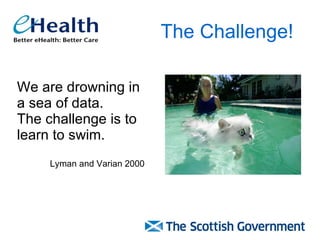
  The Challenge! We are drowning in a sea of data.  The challenge is to learn to swim. Lyman and Varian 2000
Define Information Literacy.  How Information literacy works. Why we need to bother. How eHealth can support. Examples from Scotland Overview
Information? Information is data that are processed to be useful: provide answers to who, what, where and when. Dictionary definition
Information? “ The power of information is in its capacity to reduce uncertainty.” Alan Hyslop, Head of eHealth Strategy, Scottish Government
Information qualities (1) Information must be fit for purpose!
Finagle's Law of Information The information you have is not what you want! The information you want is not what you need! The information you need is not what you can obtain! The information you can obtain costs more than you want to pay! Source: Campbell (Ed), 1957, Publication of Astounding Science Fiction
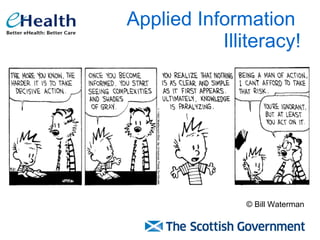
Applied Information  Illiteracy! © Bill Waterman
Literacy? “ The possession of education” “ A person’s knowledge about a particular subject or field” Dictionary
Information qualities (2) Information must be fit for purpose and used for a purpose!
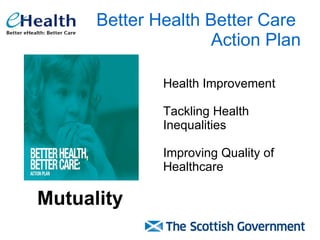
Better Health Better Care   Action Plan Health Improvement Tackling Health Inequalities Improving Quality of Healthcare Mutuality
Culture of Information  Literacy Promotes openness and sharing of  information. Enables learning from mistakes  rather than blame. Supports creativity and innovation. Supports team working. Is clear about its mission and goals.
Information Literacy “ a generic set of skills, values and behaviours which support evidence-based practice, lifelong learning, self-management, social inclusion and service improvement .”  NHS Knowledge Services:  Information Literacy Framework 2008
Too much data! The amount of newly stored information in 2002 was estimated as 5 exabytes of data. This compares with 2-3 exabytes of data  produced in 1999 (and only 12 exabytes for the first 3000 years of the human race). Lynman and Varian, 2003
Too little time! “ Estimates show 5 years after a nursing  student graduates, 50% of the knowledge  acquired will be obsolete”. McCormick 1984 “ Seventeen years, on average, are needed  to fully use study findings in clinical practice.” Balas 2001
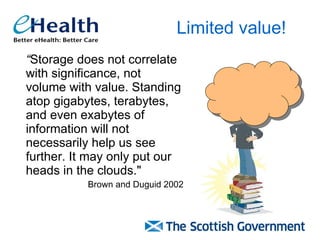
“ Storage does not correlate with significance, not volume with value. Standing atop gigabytes, terabytes, and even exabytes of information will not necessarily help us see further. It may only put our heads in the clouds." Brown and Duguid 2002 Limited value!
Barriers to evidence  based practice The major barrier to using current research  evidence is time, effort and skills needed to access the right information among the massive volumes of research. Cabana et al. 1999
Why does it matter ? “ Knowledge is the enemy of disease. The application of what we know already will have a greater impact on health and disease than any drug or technology likely to be introduced  in the next decade.” Muir Grey MEDINFO 2007
Our Vision for eHealth “ exploiting the power of electronic information to help ensure that patients get the right care, involving the right clinicians, at the right time, to deliver the right outcome” Better eHealth Better Care  NHS Scotland eHealth Strategy 2008 www.ehealth.show.scot.nhs.uk
The eHealth Contribution   make patient care safer and more  effective.  contribute to ‘health literacy’ to support  citizens managed their own health. safeguard confidentiality by handling  patient information securely. enable more efficient use of healthcare  resources .
Six eHealth Strategic  Principles Safeguard confidentiality Continue the eHealth Journey,  Focus on benefits, supported by  technology and change Virtual electronic patient records Technology development,  standardisation and convergence. Collaborative approach to delivery,  drawing on best expertise
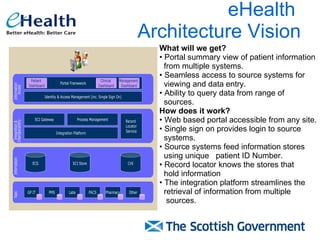
eHealth  Architecture Vision What will we get? Portal summary view of patient information from multiple systems. Seamless access to source systems for viewing and data entry. Ability to query data from range of  sources. How does it work? Web based portal accessible from any site. Single sign on provides login to source  systems. Source systems feed information stores using unique  patient ID Number. Record locator knows the stores that  hold information The integration platform streamlines the  retrieval of information from multiple  sources.
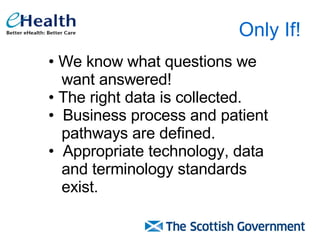
Only If! We know what questions we  want answered! The right data is collected. Business process and patient pathways are defined. Appropriate technology, data and terminology standards  exist.
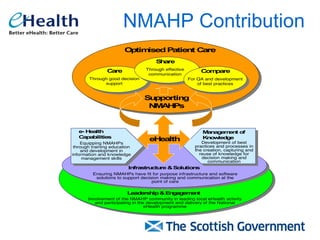
NMAHP Contribution
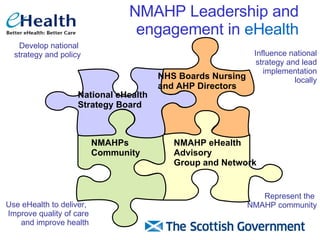
NMAHP Leadership and engagement in  eHealth Use eHealth to deliver,  Improve quality of care and improve health Represent the  NMAHP community Develop national  strategy and policy Influence national strategy and lead implementation locally NHS Boards Nursing  and AHP Directors National eHealth  Strategy Board  NMAHP eHealth  Advisory Group and Network NMAHPs Community
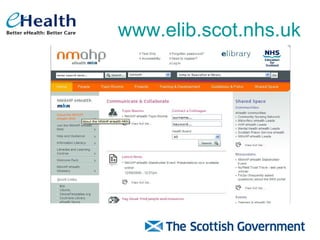
www.elib.scot.nhs.uk
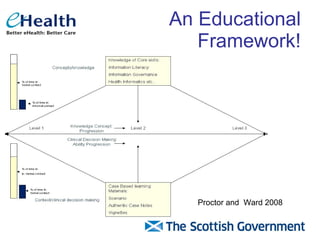
An Educational  Framework! Proctor and  Ward 2008
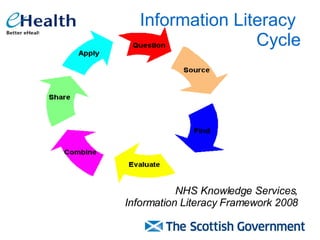
Information Literacy  Cycle NHS Knowledge Services, Information Literacy Framework 2008
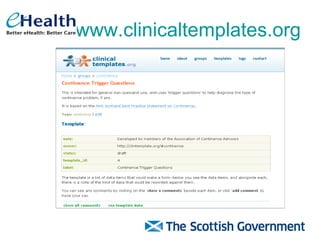
www.clinicaltemplates.org
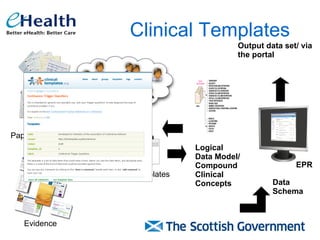
Clinical Templates   Clinical Templates + Paper form Evidence Experts = Logical Data Model/ Compound Clinical Concepts Data Schema Output data set/ via the portal EPR
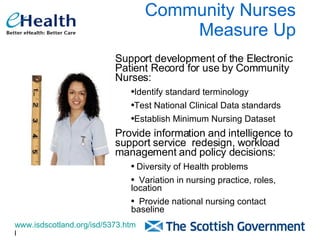
Community Nurses  Measure Up  Support development of the Electronic Patient Record for use by Community Nurses: Identify standard terminology Test National Clinical Data standards Establish Minimum Nursing Dataset Provide information and intelligence to support service  redesign, workload management and policy decisions: Diversity of Health problems Variation in nursing practice, roles, location Provide national nursing contact baseline www.isdscotland.org/isd/5373.htm l
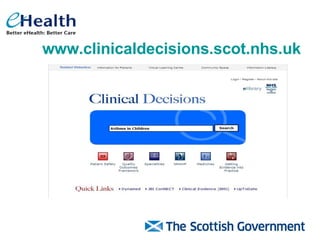
www.clinicaldecisions.scot.nhs.uk
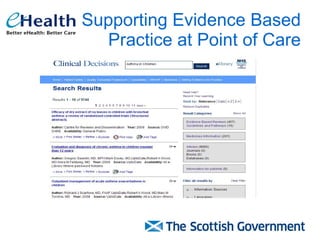
Supporting Evidence Based Practice at Point of Care
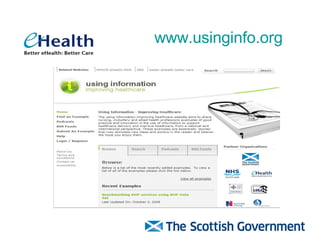
www.usinginfo.org
Key messages Information must be fit for purpose and used for a purpose.  Information is a tool to support organisational learning We must develop confidence and a shared understanding about using information in practice.  eHealth is a journey but we can gain benefits as we travel.
Gaun Yersel! The phrase “Guan Yerself” is used to cheer a person on as they embark on a challenge. It is a vote of confidence and a message that the person has your support!
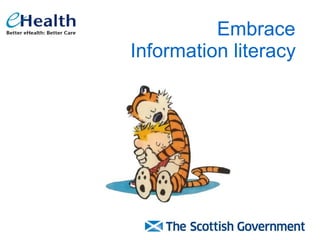
Embrace  Information literacy
 

Information Literacy – An NMAHP perspective

  • 1.
    Information Literacy –An NMAHP perspective October 2008 Heather Strachan NMAHP Clinical Lead Scottish Government [email_address]
  • 2.
    Population 5,057,400 Approximately150,000 NHS staff 06/07 eHealth expenditure £225m (592m $NZ)
  • 3.
    TheChallenge! We are drowning in a sea of data. The challenge is to learn to swim. Lyman and Varian 2000
  • 4.
    Define Information Literacy. How Information literacy works. Why we need to bother. How eHealth can support. Examples from Scotland Overview
  • 5.
    Information? Information isdata that are processed to be useful: provide answers to who, what, where and when. Dictionary definition
  • 6.
    Information? “ Thepower of information is in its capacity to reduce uncertainty.” Alan Hyslop, Head of eHealth Strategy, Scottish Government
  • 7.
    Information qualities (1)Information must be fit for purpose!
  • 8.
    Finagle's Law ofInformation The information you have is not what you want! The information you want is not what you need! The information you need is not what you can obtain! The information you can obtain costs more than you want to pay! Source: Campbell (Ed), 1957, Publication of Astounding Science Fiction
  • 9.
    Applied Information Illiteracy! © Bill Waterman
  • 10.
    Literacy? “ Thepossession of education” “ A person’s knowledge about a particular subject or field” Dictionary
  • 11.
    Information qualities (2)Information must be fit for purpose and used for a purpose!
  • 12.
    Better Health BetterCare Action Plan Health Improvement Tackling Health Inequalities Improving Quality of Healthcare Mutuality
  • 13.
    Culture of Information Literacy Promotes openness and sharing of information. Enables learning from mistakes rather than blame. Supports creativity and innovation. Supports team working. Is clear about its mission and goals.
  • 14.
    Information Literacy “a generic set of skills, values and behaviours which support evidence-based practice, lifelong learning, self-management, social inclusion and service improvement .” NHS Knowledge Services: Information Literacy Framework 2008
  • 15.
    Too much data!The amount of newly stored information in 2002 was estimated as 5 exabytes of data. This compares with 2-3 exabytes of data produced in 1999 (and only 12 exabytes for the first 3000 years of the human race). Lynman and Varian, 2003
  • 16.
    Too little time!“ Estimates show 5 years after a nursing student graduates, 50% of the knowledge acquired will be obsolete”. McCormick 1984 “ Seventeen years, on average, are needed to fully use study findings in clinical practice.” Balas 2001
  • 17.
    “ Storage doesnot correlate with significance, not volume with value. Standing atop gigabytes, terabytes, and even exabytes of information will not necessarily help us see further. It may only put our heads in the clouds." Brown and Duguid 2002 Limited value!
  • 18.
    Barriers to evidence based practice The major barrier to using current research evidence is time, effort and skills needed to access the right information among the massive volumes of research. Cabana et al. 1999
  • 19.
    Why does itmatter ? “ Knowledge is the enemy of disease. The application of what we know already will have a greater impact on health and disease than any drug or technology likely to be introduced in the next decade.” Muir Grey MEDINFO 2007
  • 20.
    Our Vision foreHealth “ exploiting the power of electronic information to help ensure that patients get the right care, involving the right clinicians, at the right time, to deliver the right outcome” Better eHealth Better Care NHS Scotland eHealth Strategy 2008 www.ehealth.show.scot.nhs.uk
  • 21.
    The eHealth Contribution make patient care safer and more effective. contribute to ‘health literacy’ to support citizens managed their own health. safeguard confidentiality by handling patient information securely. enable more efficient use of healthcare resources .
  • 22.
    Six eHealth Strategic Principles Safeguard confidentiality Continue the eHealth Journey, Focus on benefits, supported by technology and change Virtual electronic patient records Technology development, standardisation and convergence. Collaborative approach to delivery, drawing on best expertise
  • 23.
    eHealth ArchitectureVision What will we get? Portal summary view of patient information from multiple systems. Seamless access to source systems for viewing and data entry. Ability to query data from range of sources. How does it work? Web based portal accessible from any site. Single sign on provides login to source systems. Source systems feed information stores using unique patient ID Number. Record locator knows the stores that hold information The integration platform streamlines the retrieval of information from multiple sources.
  • 24.
    Only If! Weknow what questions we want answered! The right data is collected. Business process and patient pathways are defined. Appropriate technology, data and terminology standards exist.
  • 25.
  • 26.
    NMAHP Leadership andengagement in eHealth Use eHealth to deliver, Improve quality of care and improve health Represent the NMAHP community Develop national strategy and policy Influence national strategy and lead implementation locally NHS Boards Nursing and AHP Directors National eHealth Strategy Board NMAHP eHealth Advisory Group and Network NMAHPs Community
  • 27.
  • 28.
    An Educational Framework! Proctor and Ward 2008
  • 29.
    Information Literacy Cycle NHS Knowledge Services, Information Literacy Framework 2008
  • 30.
  • 31.
    Clinical Templates Clinical Templates + Paper form Evidence Experts = Logical Data Model/ Compound Clinical Concepts Data Schema Output data set/ via the portal EPR
  • 32.
    Community Nurses Measure Up Support development of the Electronic Patient Record for use by Community Nurses: Identify standard terminology Test National Clinical Data standards Establish Minimum Nursing Dataset Provide information and intelligence to support service redesign, workload management and policy decisions: Diversity of Health problems Variation in nursing practice, roles, location Provide national nursing contact baseline www.isdscotland.org/isd/5373.htm l
  • 33.
  • 34.
    Supporting Evidence BasedPractice at Point of Care
  • 35.
  • 36.
    Key messages Informationmust be fit for purpose and used for a purpose. Information is a tool to support organisational learning We must develop confidence and a shared understanding about using information in practice. eHealth is a journey but we can gain benefits as we travel.
  • 37.
    Gaun Yersel! Thephrase “Guan Yerself” is used to cheer a person on as they embark on a challenge. It is a vote of confidence and a message that the person has your support!
  • 38.
  • 39.

Editor's Notes

  • #2 I was delighted to be invited to speak at your annual Health Informatics Conference, not least because I enjoyed my last visit to New Zealand some 7 years ago when I attended world congress on Nursing Informatics but because it always a pleasure to take time to listen, question, and share information with colleagues. So I have been practicing my information literacy skills. Now I want to share some information with you about how we are tackling some of the eHealth challenges in Scotland. Just to say NMAHPs stand for Nurses, Midwives and Allied Health Professionals.