Prepared by
DR. NAIF IZZATULLAH ABDULJABBAR
MBBS
MSc of public health
HEALTH INDICATORS
18/04/1442HEALTH INDICATORS2
Contents
Objectives
Introduction
Indicators of Health
Characteristics
Uses
Classification of Indicators of Health
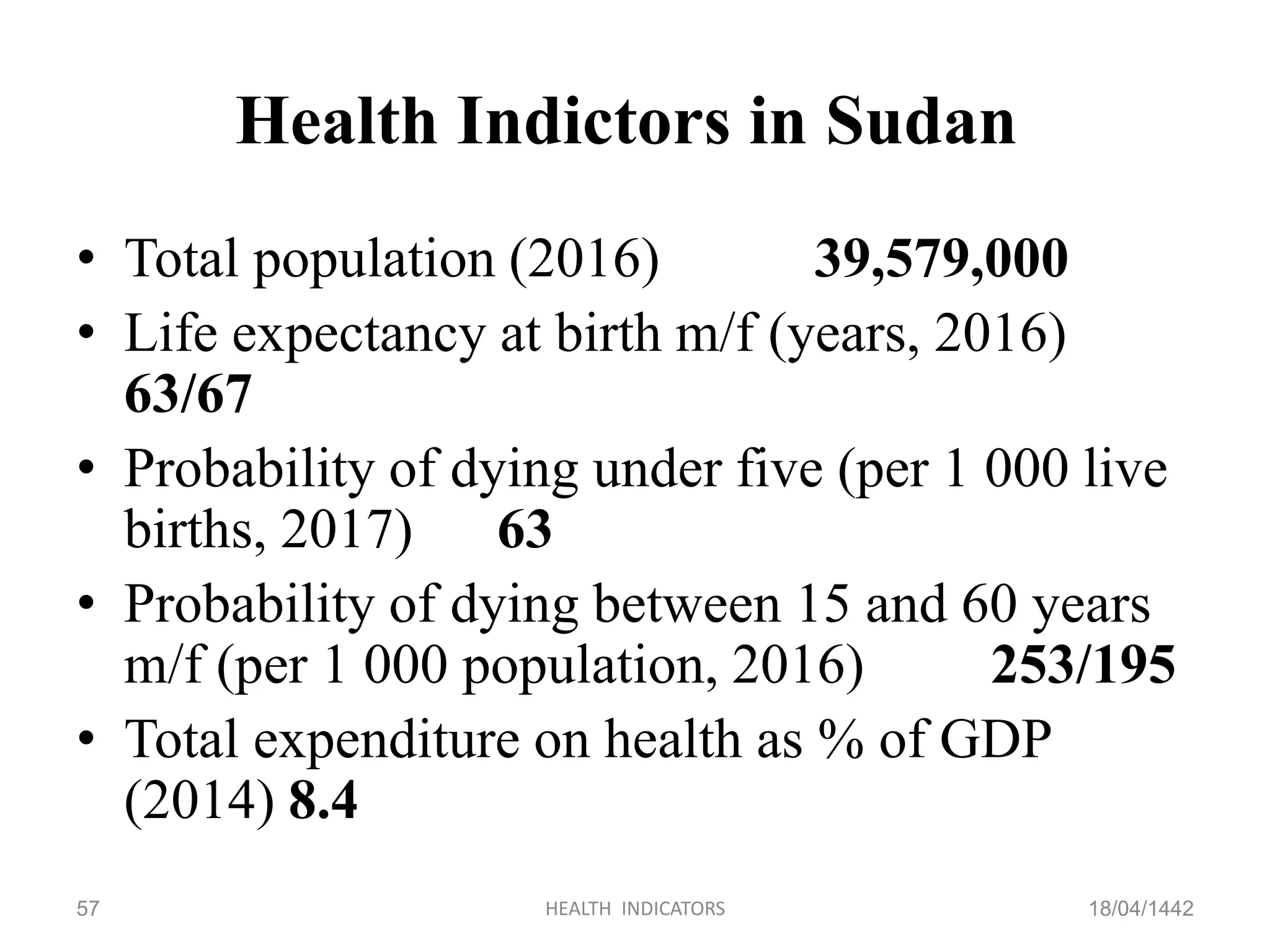
Health indictors in Sudan
References
18/04/1442HEALTH INDICATORS3
Objectives
At the end of the session, participants
should be able to
Define and identify relevant health
indicators
Mention characteristics of good
indicators
Give examples of good indicators
18/04/1442HEALTH INDICATORS4
Introduction
Health is defined as “a state of complete
physical, mental & social wellbeing, and not
merely an absence of disease or infirmity”
(WHO)
This statement has been amplified to include
the ability to lead a “socially and
economically productive life”
18/04/1442HEALTH INDICATORS5
Indicators of Health
Health Indicator or index is a variable,
susceptible to direct measurement, that
reflects the state of health of persons in a
community.
a variable (its value changes)
that measures (objective calculation of
value)…
1. Valid – they should actually measure that
they are supposed to measure
2. Reliable – the results should be the same
when measured by different people in similar
circumstances
3. Sensitive – they should be sensitive to
changes in the situation concerned
18/04/1442HEALTH INDICATORS6
4. Specific – they should reflect changes only in
the situation concerned
5. Feasible – they should have the ability to
obtain data when needed
6. Relevant – they should contribute to the
understanding of the phenomenon of interest
18/04/1442HEALTH INDICATORS7
Continue characteristic
Uses of Indicators of Health
• Measurement the health of the community.
• Description the health of the community.
• Comparison the health of different
communities.
• To assess the health needs
18/04/1442HEALTH INDICATORS8
Cont. Uses of Indicators of Health
• To evaluate the health services
• Planning and allocation of health resources.
• Measurement of health successes.
18/04/1442HEALTH INDICATORS9
Classification of Indicators of Health
• Mortality Indicators
• Morbidity Indicators
• Disability Rates
• Nutritional Status or Nutritional Indicators
• Health Care Delivery Indicators
• Utilization Rates
18/04/1442HEALTH INDICATORS10
Cont. Classification of Indicators of
Health.
• Indicators of Social And Mental Health
• Environmental Indicators
• Socio-economic Indicators
• Health Policy Indicators
• Indicators of Quality of Life
• Other Indicators
18/04/1442HEALTH INDICATORS11
Very important tricks
• Rate: Numerator (a) is a part of denominator
(b) and multiplier is 1000 or 10,000 or 100,000
• Ratio: Numerator (a) is not a part of
denominator (b) and BOTH numerator and
denominator are unrelated
• Proportion: Numerator (a) is a part of
denominator (b) and multiplier is 100
Proportion is always expressed in percentage
(%)
18/04/1442HEALTH INDICATORS12
18/04/1442HEALTH INDICATORS13
Mortality Indicators
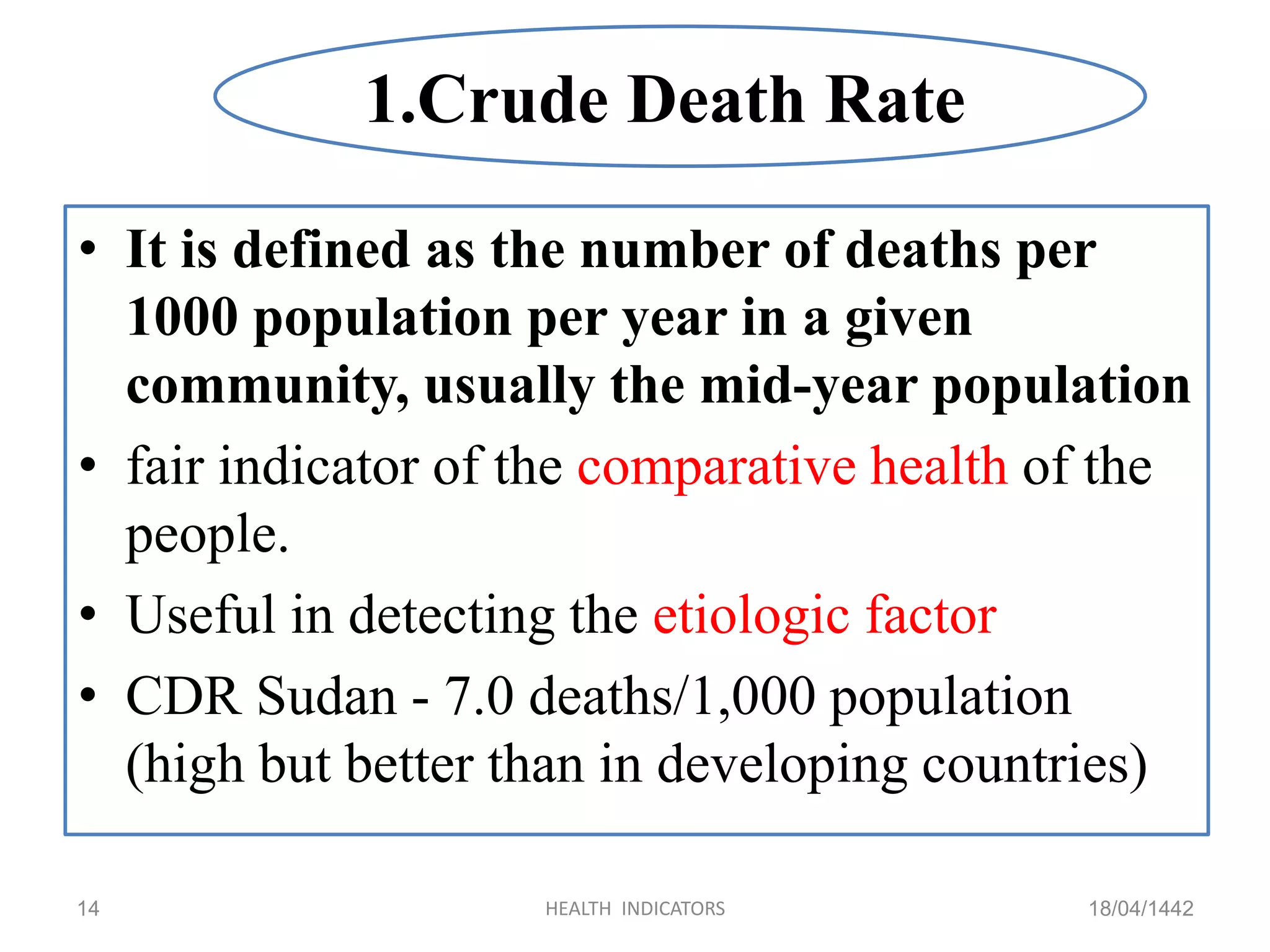
• It is defined as the number of deaths per
1000 population per year in a given
community, usually the mid-year population
• fair indicator of the comparative health of the
people.
• Useful in detecting the etiologic factor
• CDR Sudan - 7.0 deaths/1,000 population
(high but better than in developing countries)
18/04/1442HEALTH INDICATORS14
1.Crude Death Rate
2.Expectation of life
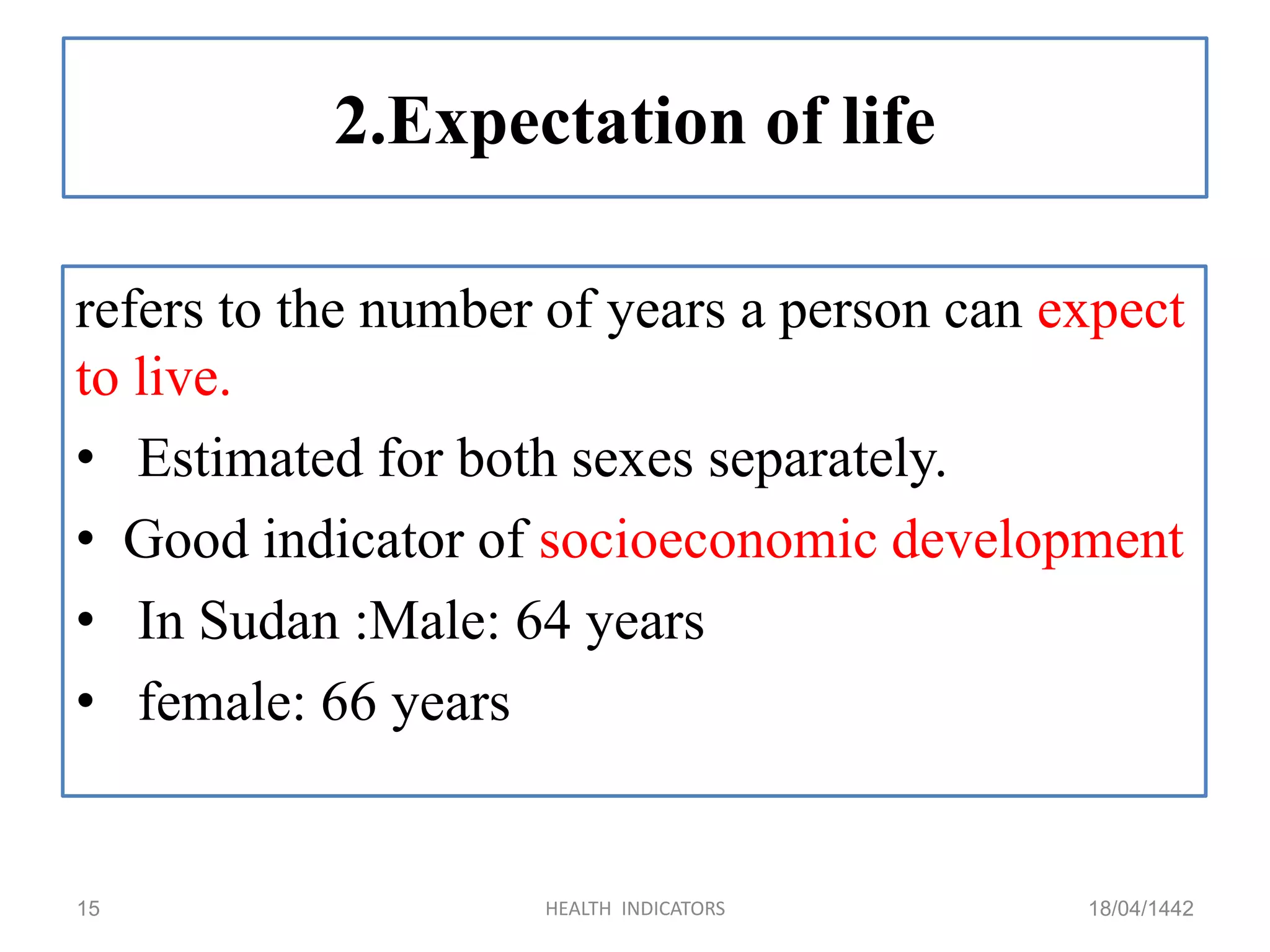
refers to the number of years a person can expect
to live.
• Estimated for both sexes separately.
• Good indicator of socioeconomic development
• In Sudan :Male: 64 years
• female: 66 years
18/04/1442HEALTH INDICATORS15
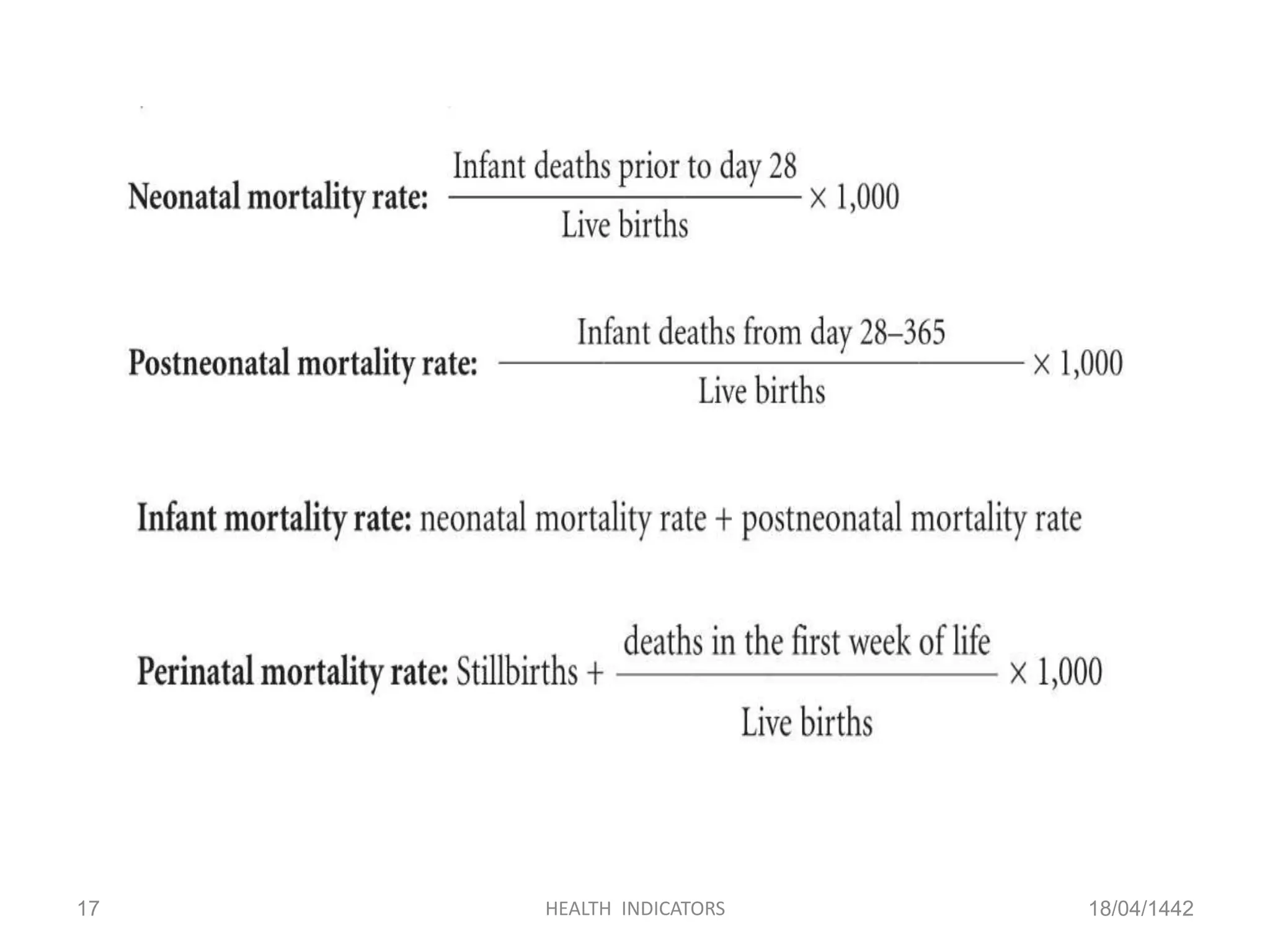
3.Infant mortality rate
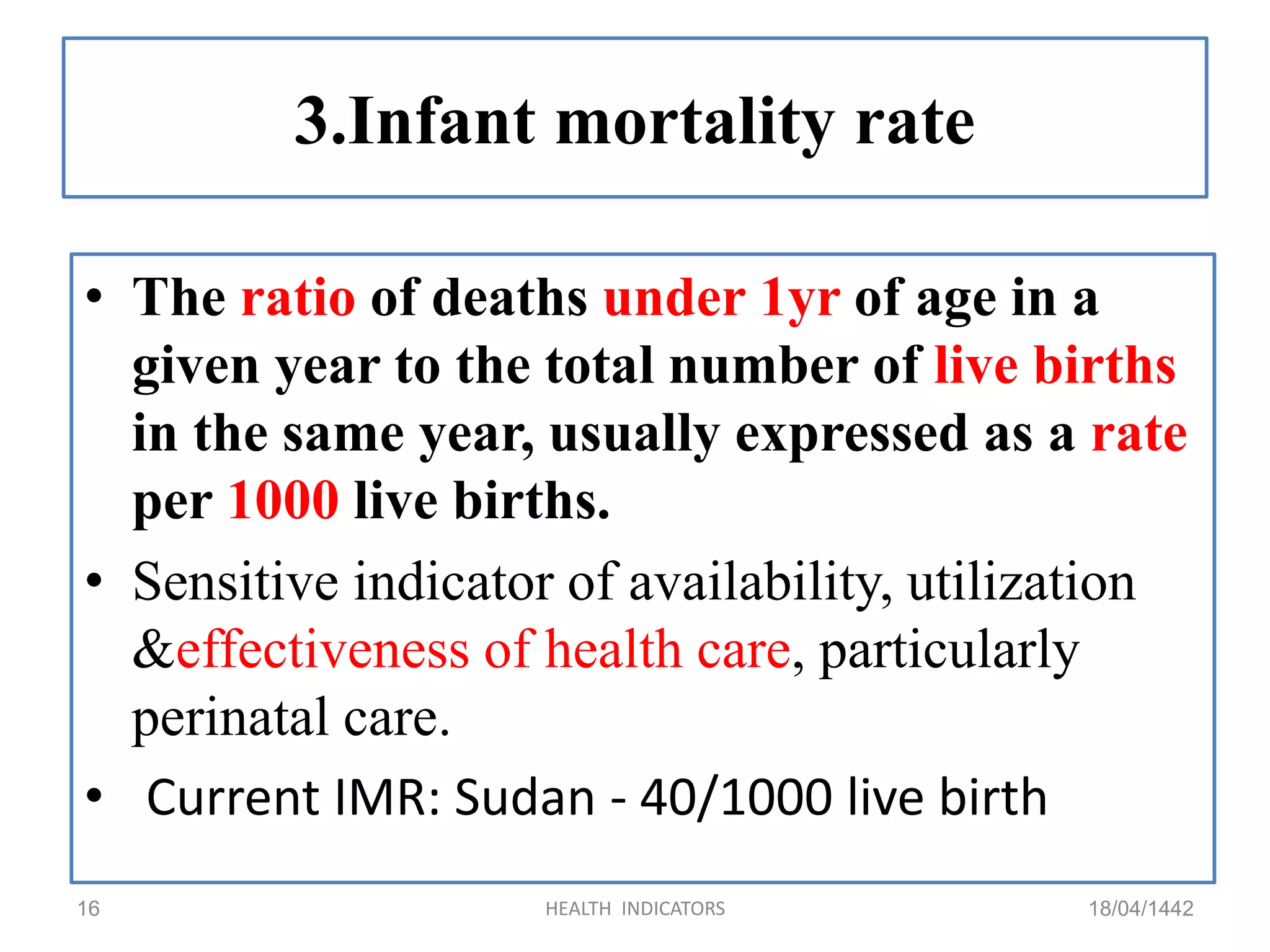
• The ratio of deaths under 1yr of age in a
given year to the total number of live births
in the same year, usually expressed as a rate
per 1000 live births.
• Sensitive indicator of availability, utilization
&effectiveness of health care, particularly
perinatal care.
• Current IMR: Sudan - 40/1000 live birth
18/04/1442HEALTH INDICATORS16
18/04/1442HEALTH INDICATORS17
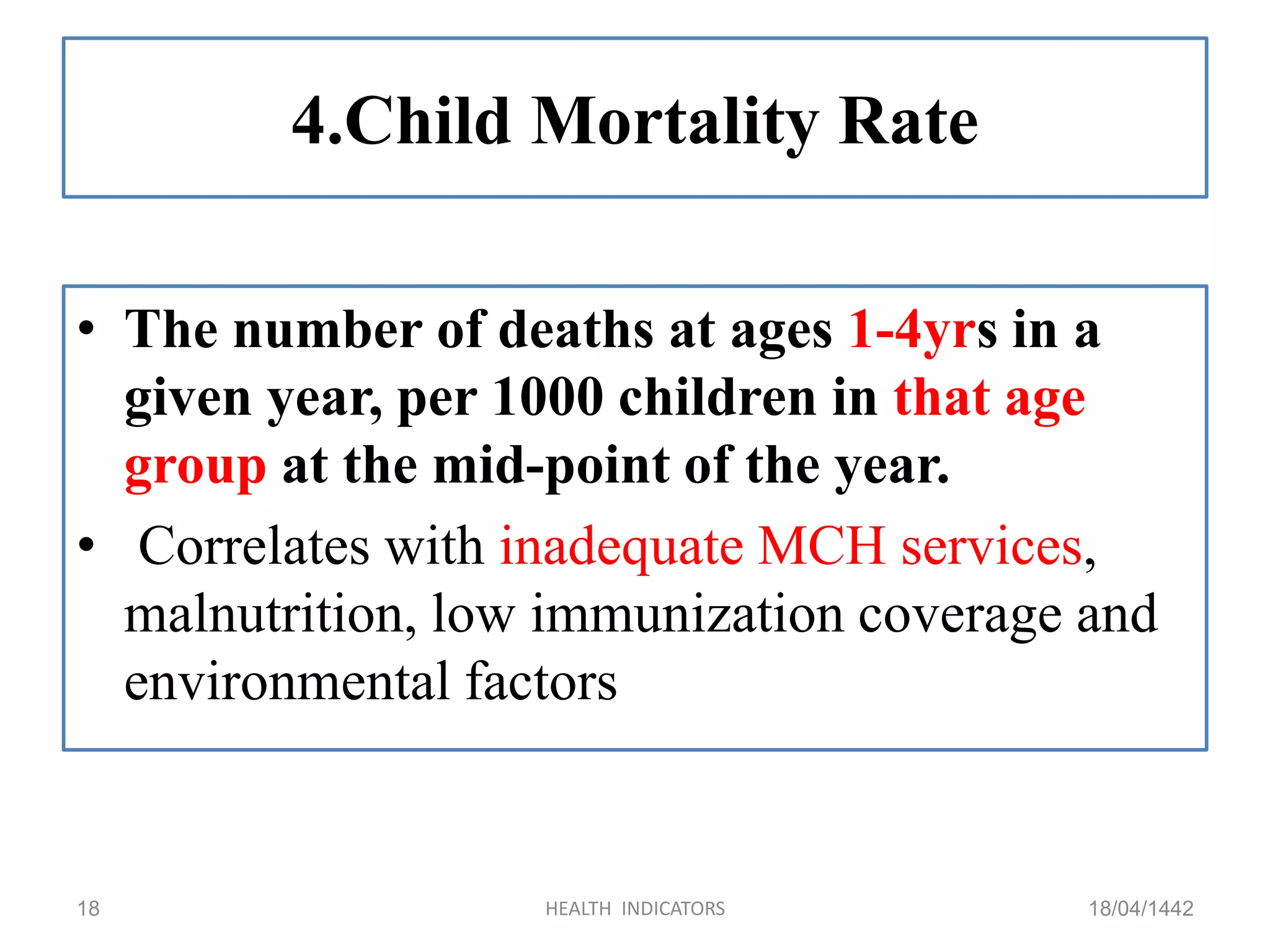
4.Child Mortality Rate
• The number of deaths at ages 1-4yrs in a
given year, per 1000 children in that age
group at the mid-point of the year.
• Correlates with inadequate MCH services,
malnutrition, low immunization coverage and
environmental factors
18/04/1442HEALTH INDICATORS18
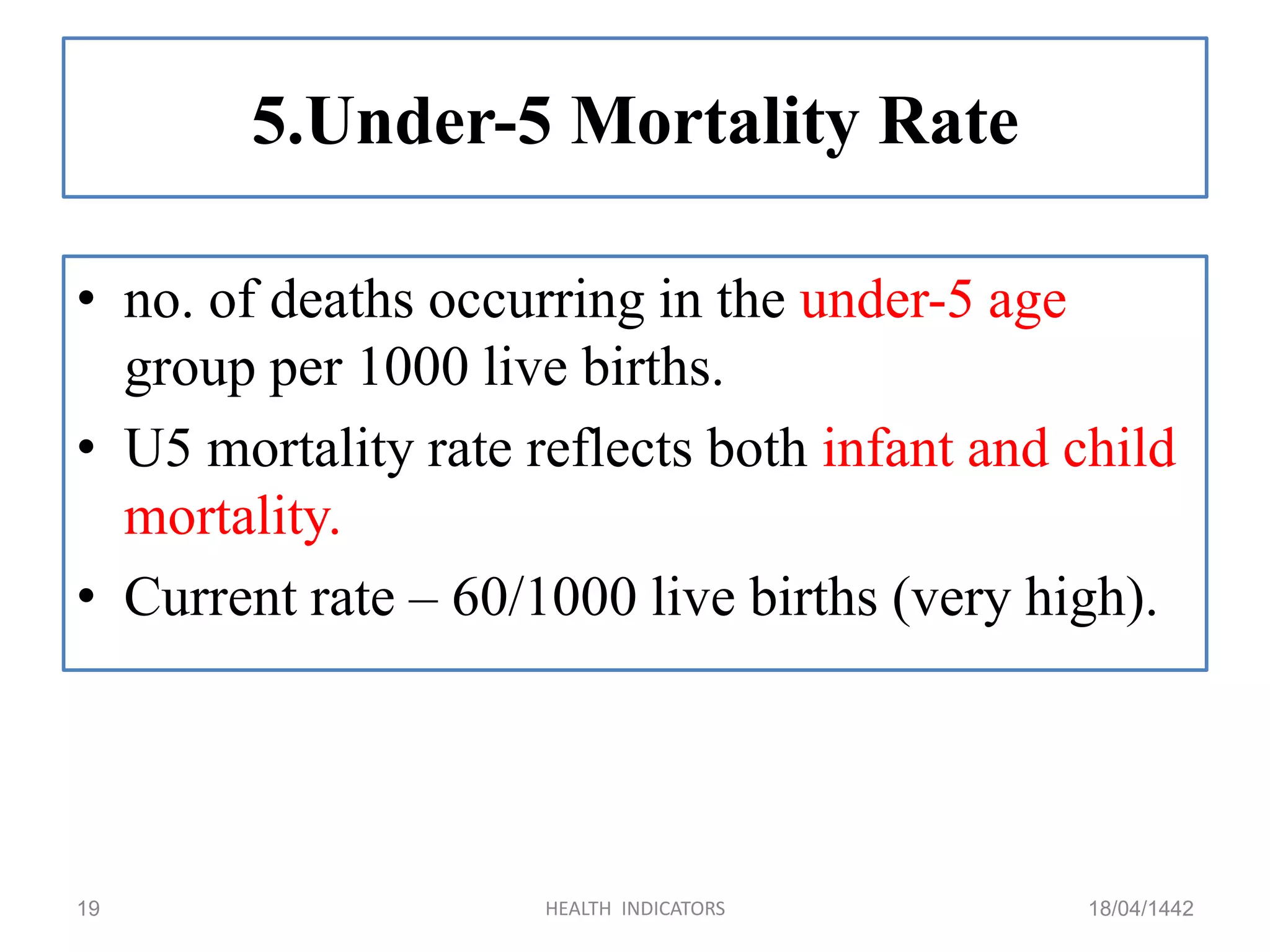
5.Under-5 Mortality Rate
• no. of deaths occurring in the under-5 age
group per 1000 live births.
• U5 mortality rate reflects both infant and child
mortality.
• Current rate – 60/1000 live births (very high).
18/04/1442HEALTH INDICATORS19
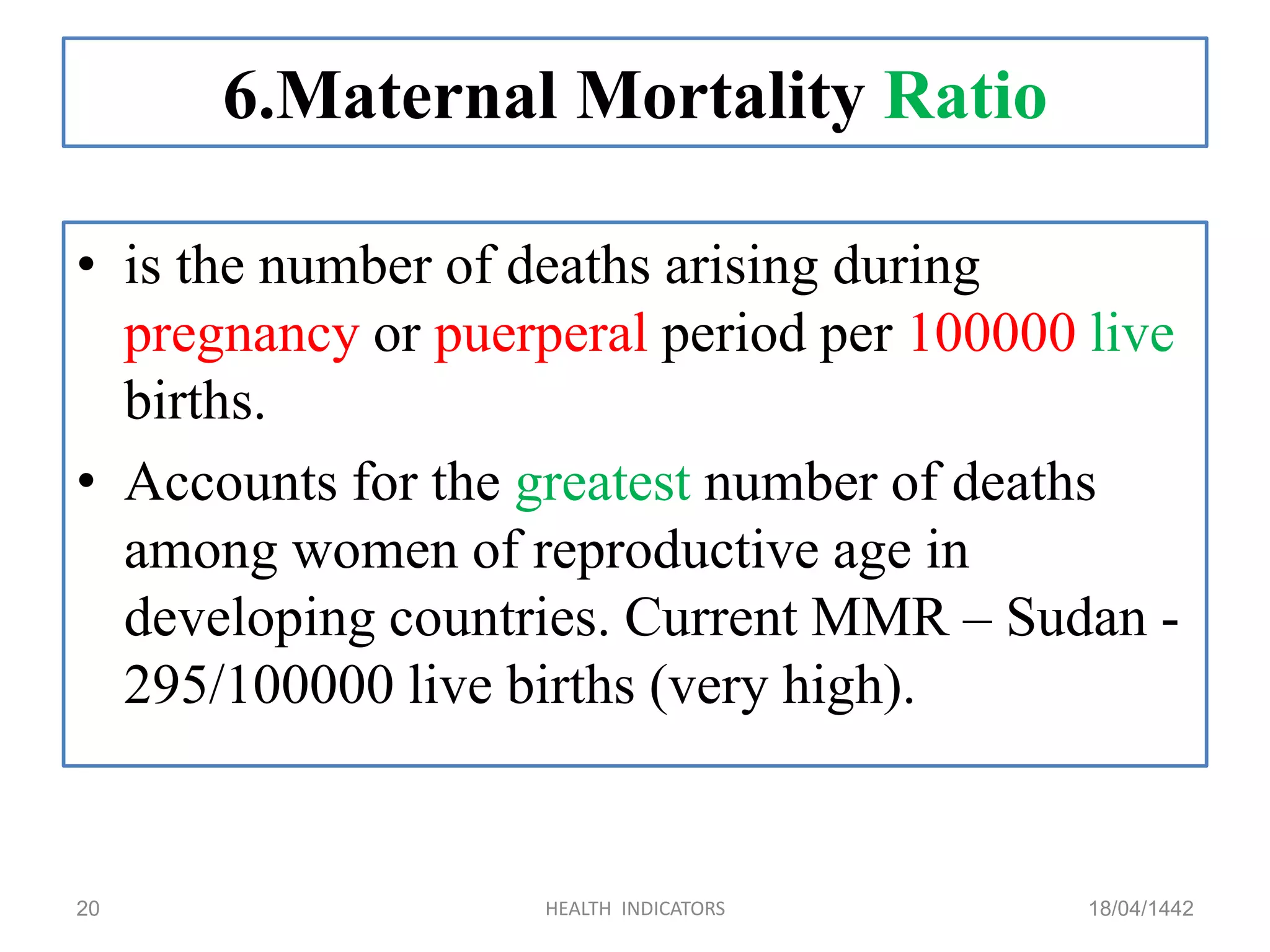
6.Maternal Mortality Ratio
• is the number of deaths arising during
pregnancy or puerperal period per 100000 live
births.
• Accounts for the greatest number of deaths
among women of reproductive age in
developing countries. Current MMR – Sudan -
295/100000 live births (very high).
18/04/1442HEALTH INDICATORS20
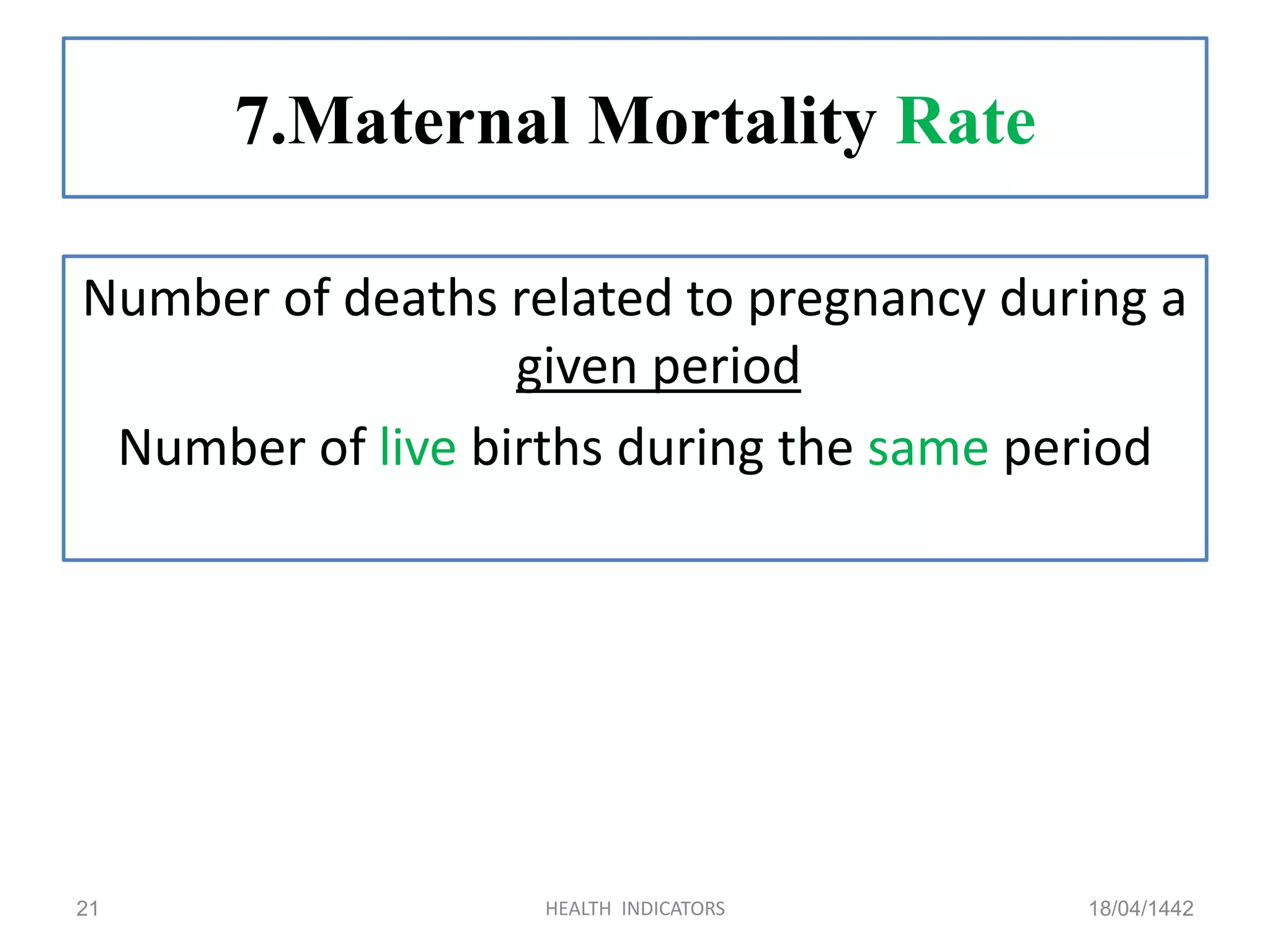
7.Maternal Mortality Rate
Number of deaths related to pregnancy during a
given period
Number of live births during the same period
18/04/1442HEALTH INDICATORS21
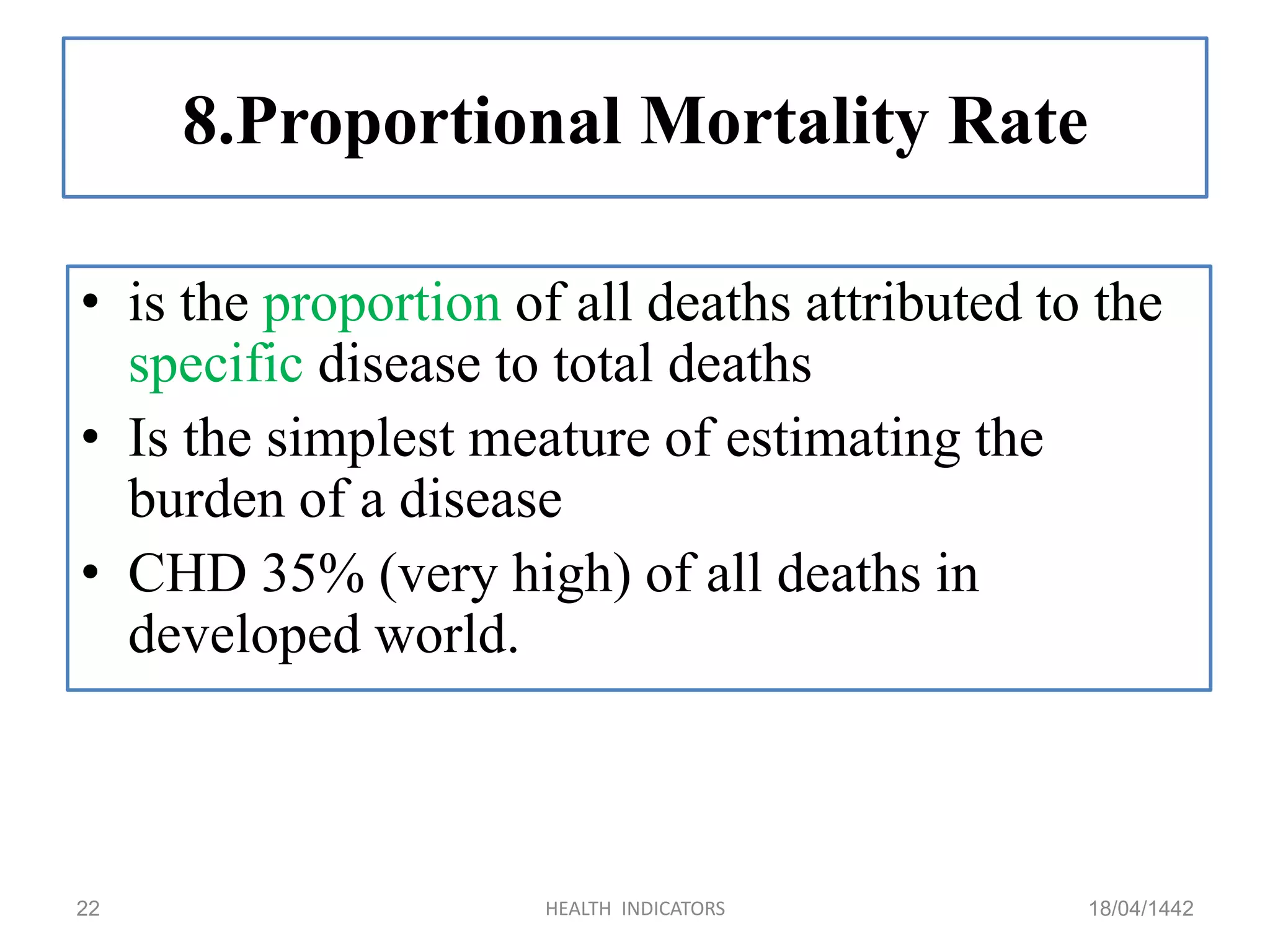
8.Proportional Mortality Rate
• is the proportion of all deaths attributed to the
specific disease to total deaths
• Is the simplest meature of estimating the
burden of a disease
• CHD 35% (very high) of all deaths in
developed world.
18/04/1442HEALTH INDICATORS22
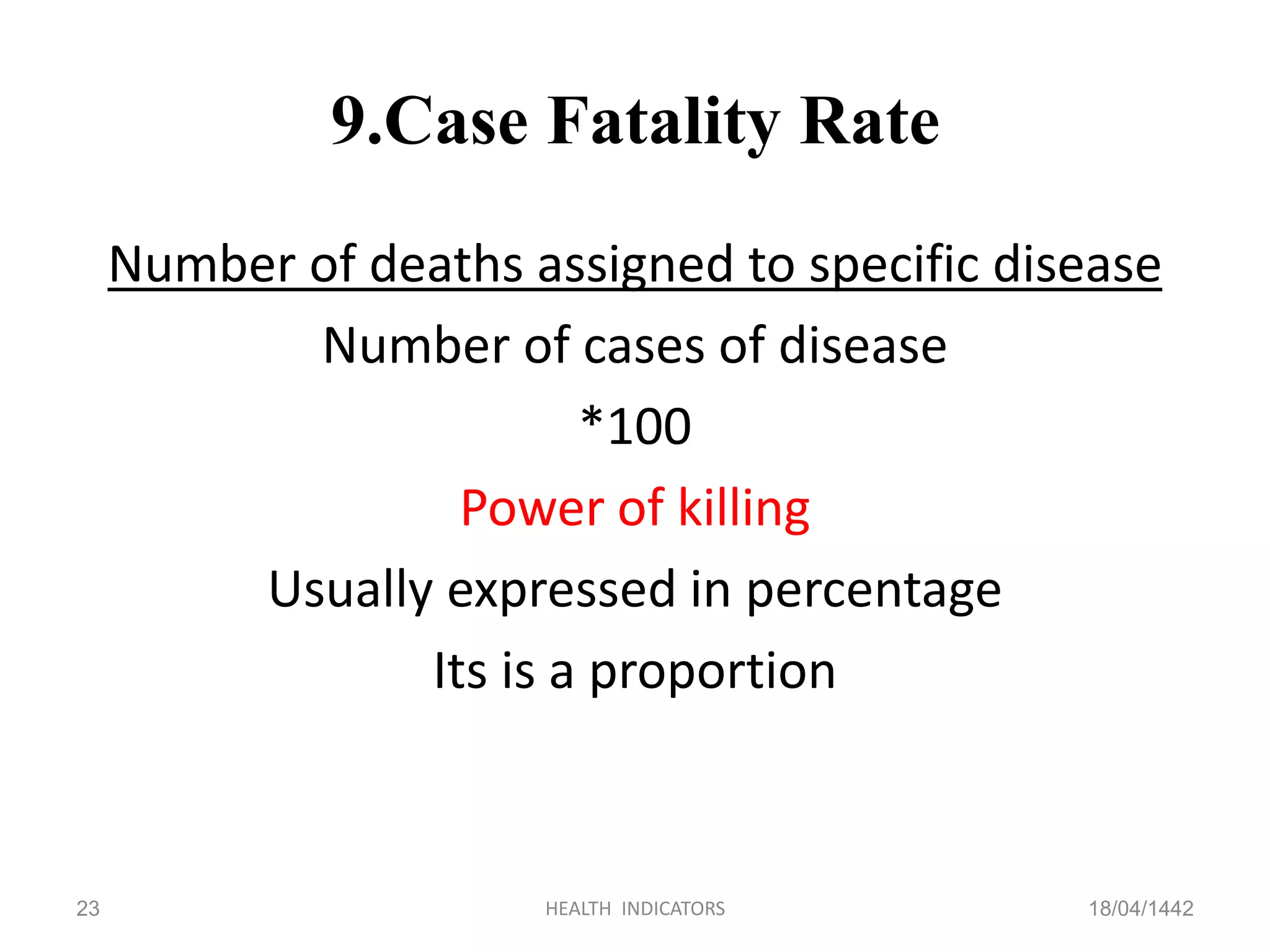
9.Case Fatality Rate
Number of deaths assigned to specific disease
Number of cases of disease
*100
Power of killing
Usually expressed in percentage
Its is a proportion
18/04/1442HEALTH INDICATORS23
18/04/1442HEALTH INDICATORS24
Morbidity
Indicators
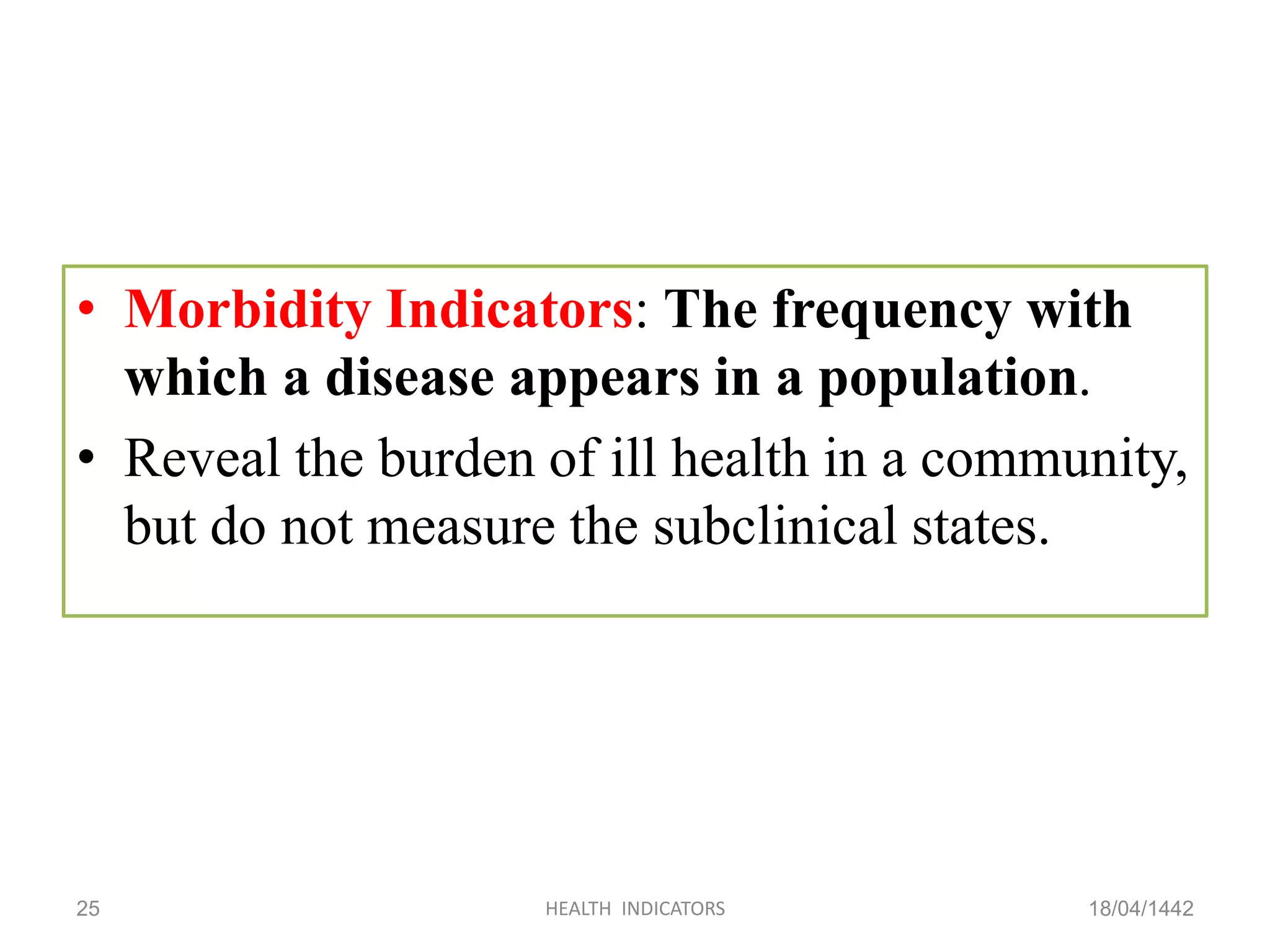
• Morbidity Indicators: The frequency with
which a disease appears in a population.
• Reveal the burden of ill health in a community,
but do not measure the subclinical states.
18/04/1442HEALTH INDICATORS25
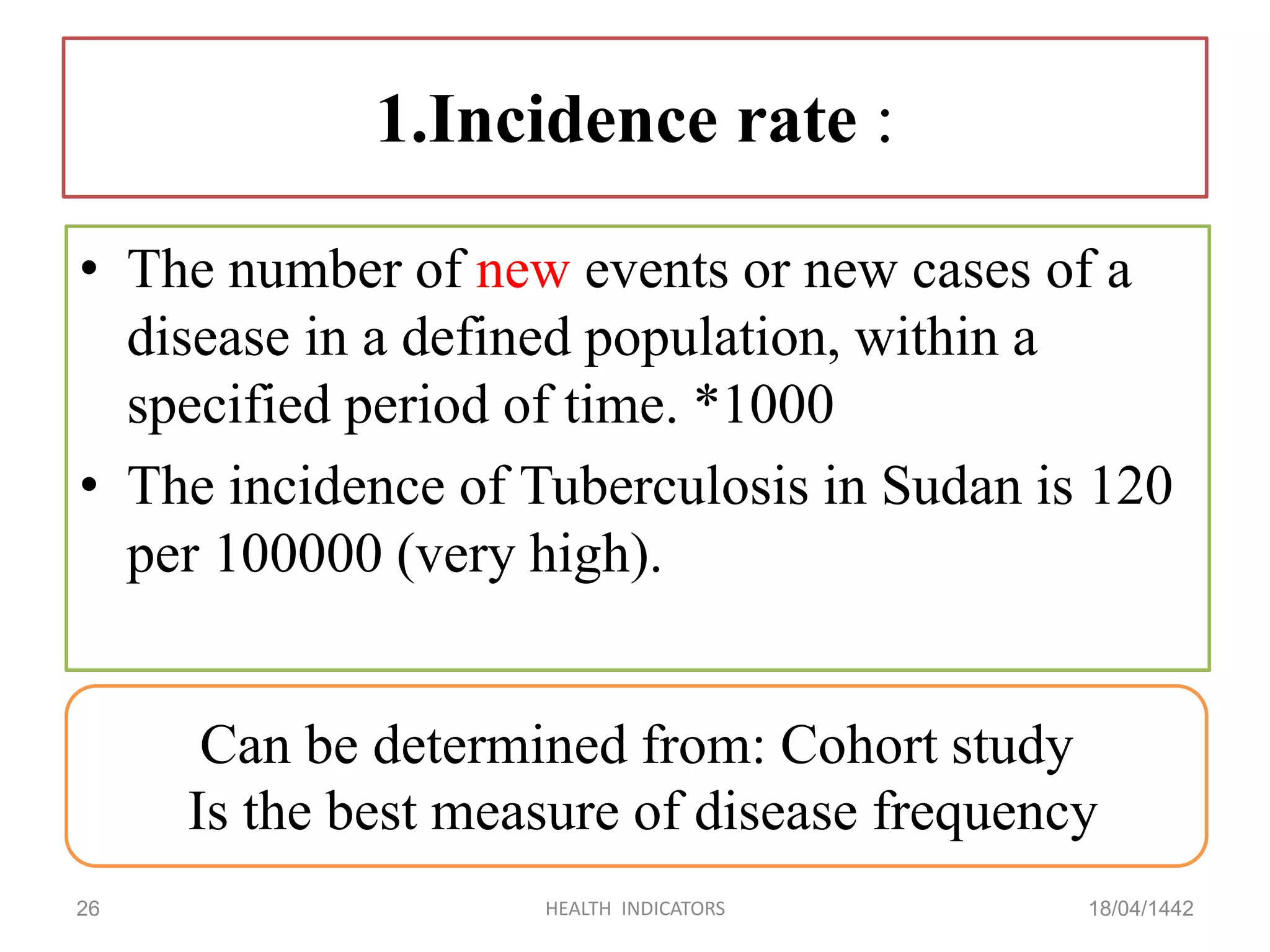
1.Incidence rate :
• The number of new events or new cases of a
disease in a defined population, within a
specified period of time. *1000
• The incidence of Tuberculosis in Sudan is 120
per 100000 (very high).
18/04/1442HEALTH INDICATORS26
Can be determined from: Cohort study
Is the best measure of disease frequency
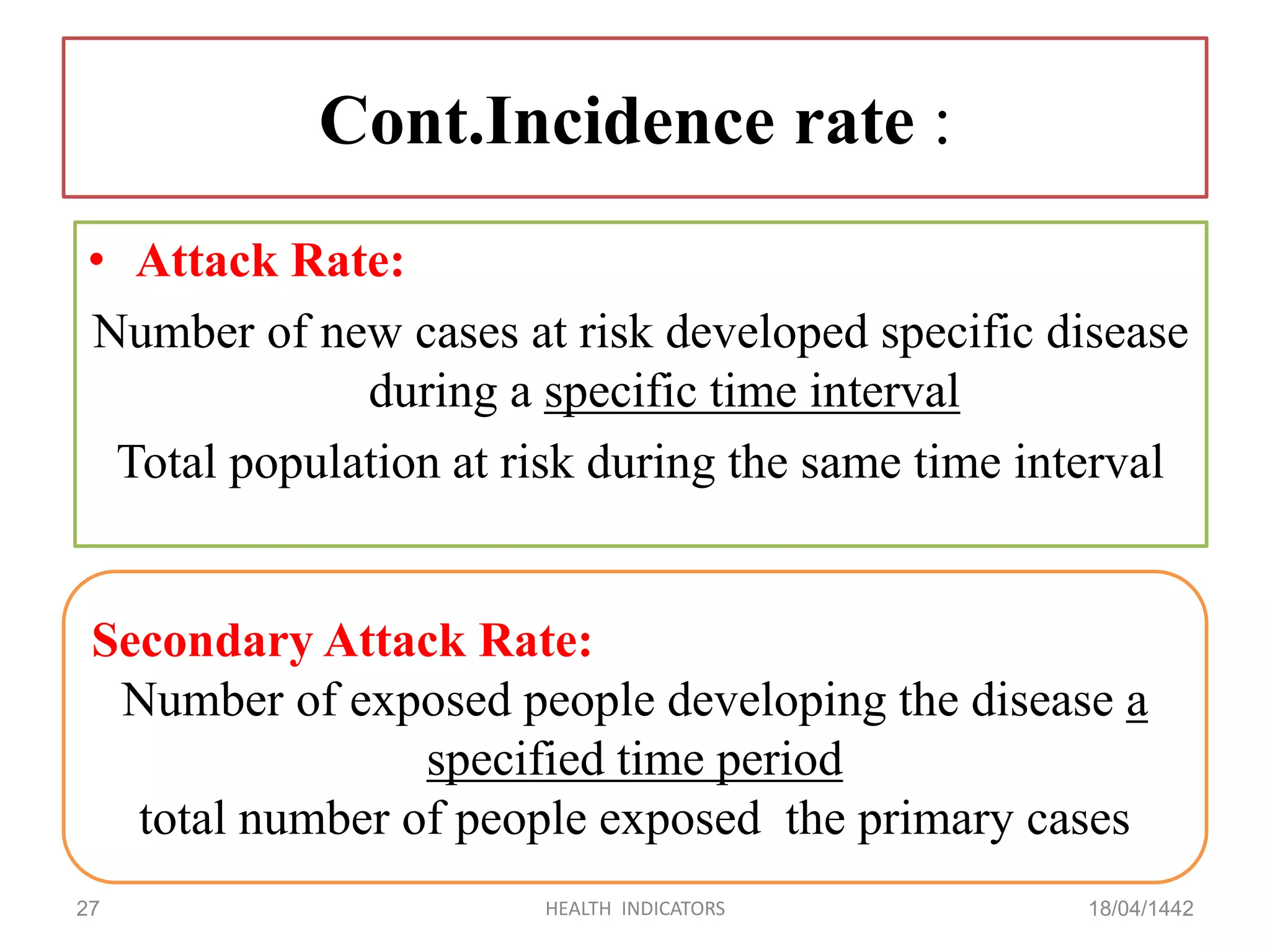
Cont.Incidence rate :
• Attack Rate:
Number of new cases at risk developed specific disease
during a specific time interval
Total population at risk during the same time interval
18/04/1442HEALTH INDICATORS27
Secondary Attack Rate:
Number of exposed people developing the disease a
specified time period
total number of people exposed the primary cases
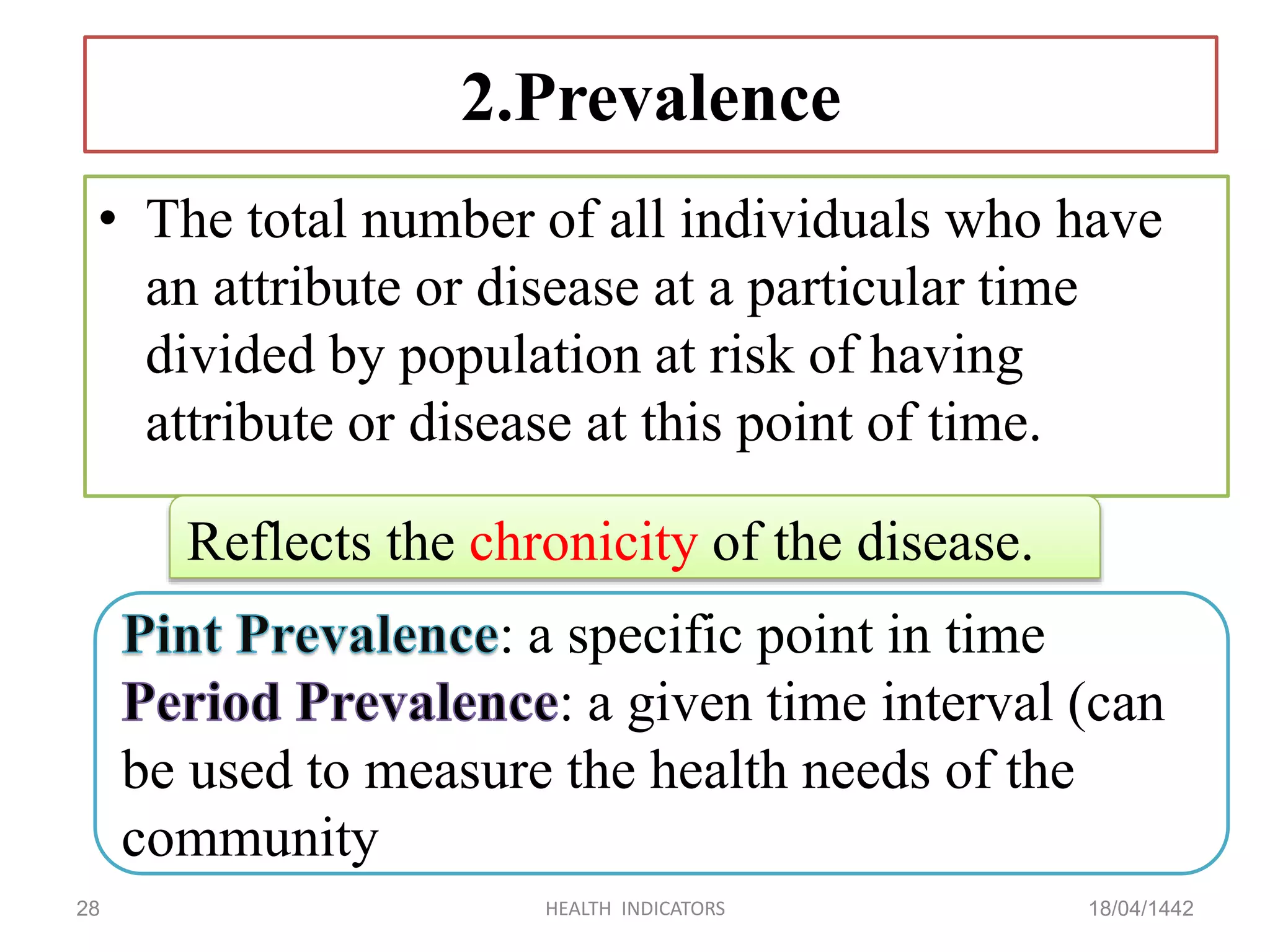
2.Prevalence
• The total number of all individuals who have
an attribute or disease at a particular time
divided by population at risk of having
attribute or disease at this point of time.
18/04/1442HEALTH INDICATORS28
: a specific point in time
: a given time interval (can
be used to measure the health needs of the
community
Reflects the chronicity of the disease.
Cont. Prevalence
• PREVALENCE IS A PROPORTION
• always expressed in percentage
• can be determined from: Cross Sectional Study
• Prevalence : The number of new + old cases.
18/04/1442HEALTH INDICATORS29
other Morbidity Indicators
3. Notification rates : is calculated from the
reporting to public authorities of certain diseases.
4. Admission, Readmission and discharge
rates.
5. Duration of stay in hospital – reflects the
virulence and resistance developed by the
etiological factor
6. Spells of sickness
18/04/1442HEALTH INDICATORS30
18/04/1442HEALTH INDICATORS31
Disability Rates
Sullivan's index
• Sullivan’s Index refers to “expectation of life
free of disability”.
• Life expectancy – duration of disability
18/04/1442HEALTH INDICATORS32
Health Adjusted Life Expectancy
life expectancy at birth but includes an
adjustment for time spent in poor health
Disability Adjusted Life Years.
• DALYs: Disability Adjusted Life Years.
• It is defined as the number of years of healthy
life lost due to all causes whether from
premature mortality or disability.
• DALY = years of life lost(YLL) + years lost to
disability(YLD)
• It is the simplest and the most commonly used
measure to find the burden of disease in a
defined population
18/04/1442HEALTH INDICATORS33
Uses of DALYs
• To assist health service priorities
• To identify the disadvantaged groups
• Measuring the results of health interventions
• Providing comparable measures for planning
& evaluating programmes
• One DALY is one productive lost year of
healthy life
18/04/1442HEALTH INDICATORS34
Quality Adjusted Life Year
• QALY is Quality Adjusted Life Year.
• It is the most commonly used to measure the
cost effectiveness of health interventions .
• It estimates the number of years of life added
by a successful treatment or adjustment for
quality of life.
• Each year in perfect health is assigned a value
of 1.0 down to a value of 0.0 for death.
18/04/1442HEALTH INDICATORS35
Years of potential life lost
• Years of potential life lost (YPLL) or potential
years of life lost through premature (PYLL).
• It is an estimate of the average years a person
would have lived if they had not died
prematurely.
• Reference age is generally 60 years
18/04/1442HEALTH INDICATORS36
18/04/1442HEALTH INDICATORS37
NUTRITIONAL
STATUS
INDICATORS
NUTRITIONAL STATUS
INDICATORS
• Nutritional Status is a positive health indicator.
Newborns are measured for their:
–Birth weight
–Length
–Head circumference
18/04/1442HEALTH INDICATORS38
Continue Nutritional Indicators
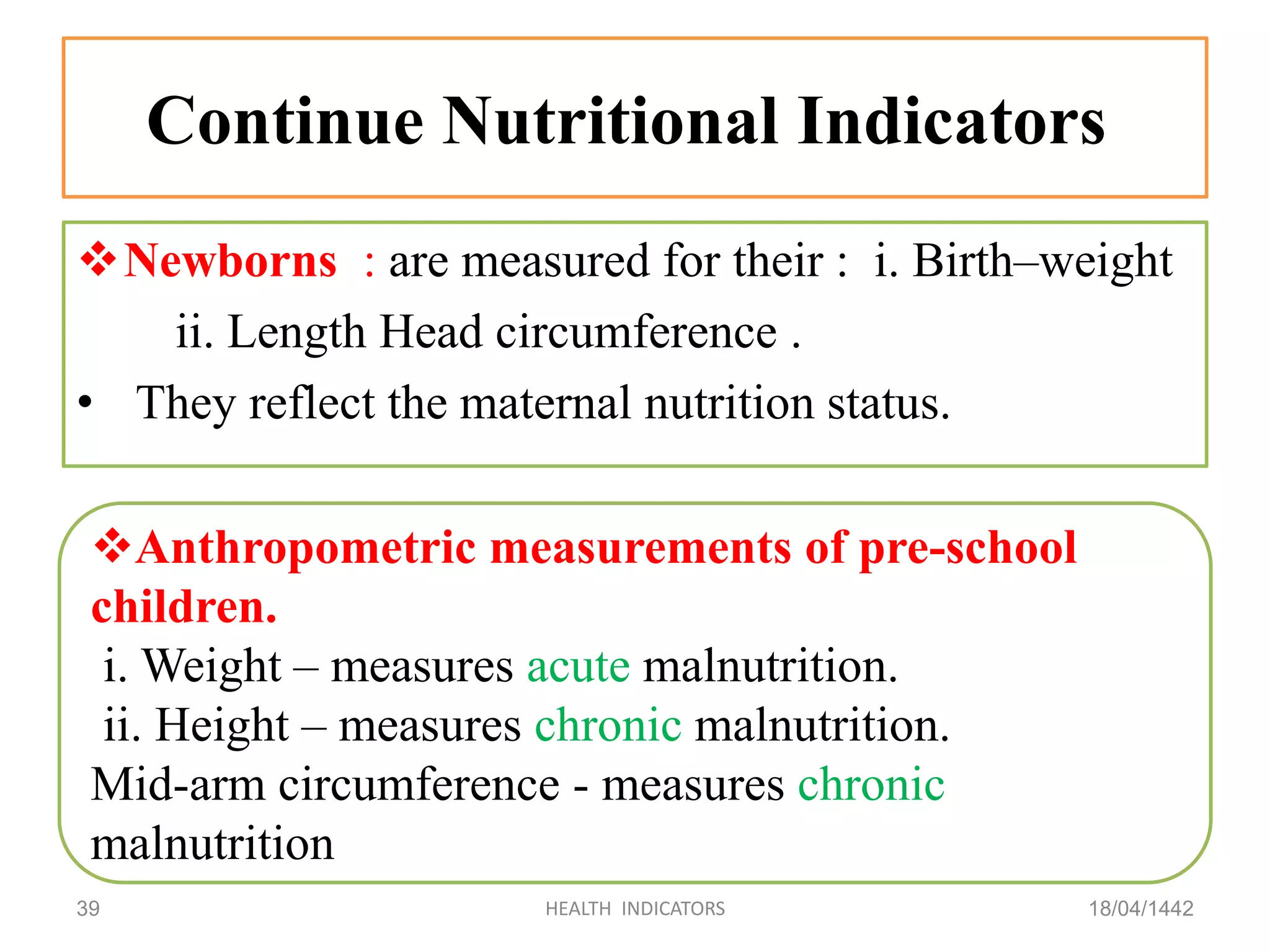
Newborns : are measured for their : i. Birth–weight
ii. Length Head circumference .
• They reflect the maternal nutrition status.
18/04/1442HEALTH INDICATORS39
Anthropometric measurements of pre-school
children.
i. Weight – measures acute malnutrition.
ii. Height – measures chronic malnutrition.
Mid-arm circumference - measures chronic
malnutrition
Cont. nutritional status
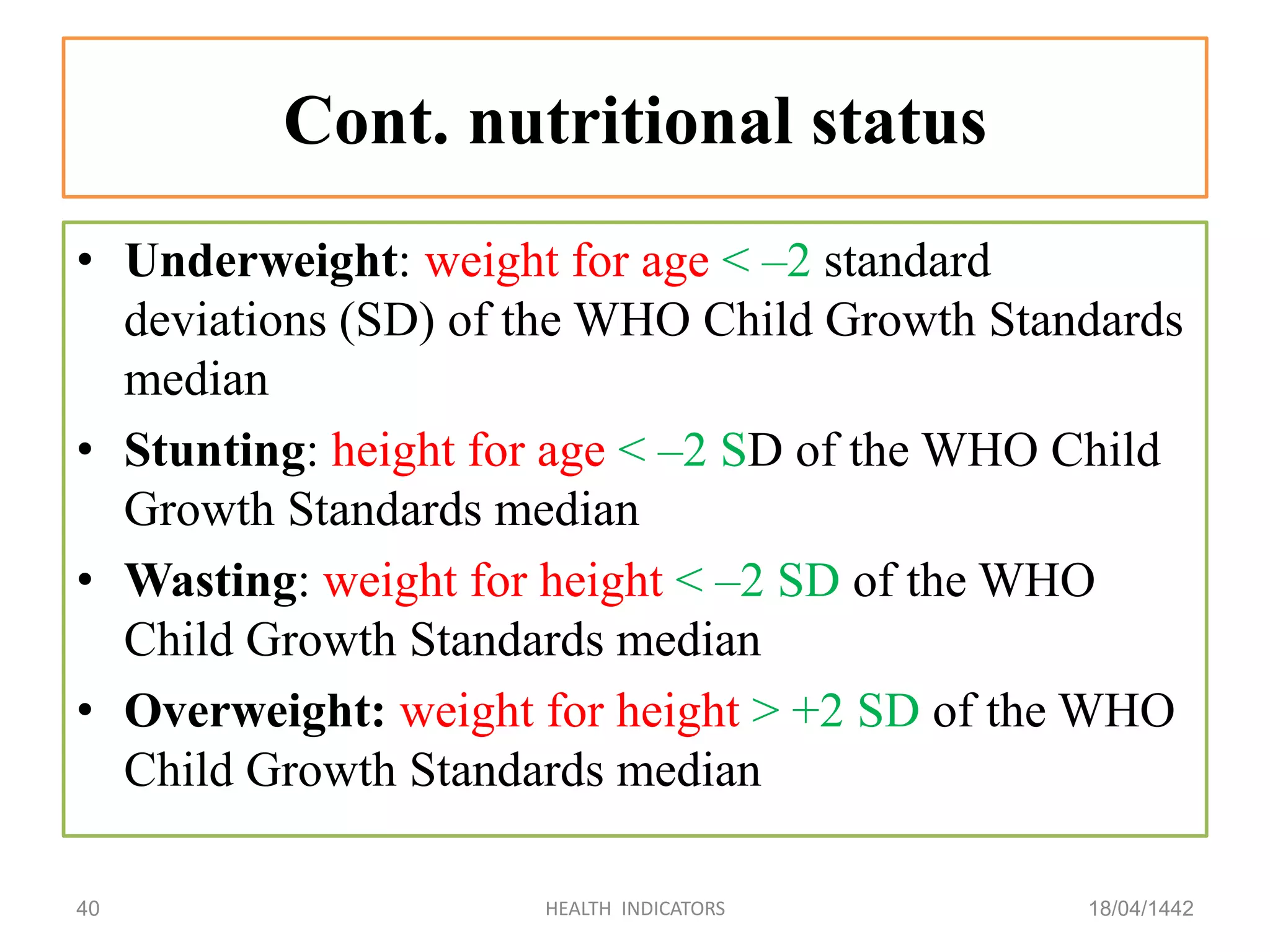
• Underweight: weight for age < –2 standard
deviations (SD) of the WHO Child Growth Standards
median
• Stunting: height for age < –2 SD of the WHO Child
Growth Standards median
• Wasting: weight for height < –2 SD of the WHO
Child Growth Standards median
• Overweight: weight for height > +2 SD of the WHO
Child Growth Standards median
18/04/1442HEALTH INDICATORS40
Cont. nutritional status
• Growth Monitoring of children is done by
measuring weight – for - age, height - for -
age, weight – for - height, head & chest
circumference and mid-arm circumference.
• In adults Underweight, Obesity and Anemia
are generally considered reliable nutritional
indicators.
18/04/1442HEALTH INDICATORS41
18/04/1442HEALTH INDICATORS42
Health Care
Delivery
Indicators
Health Care Delivery Indicators
• These indicators reflect the equity of distribution of health
resources in different parts of the country and of the
provision of health care.
• Doctor-population Ratio
• Nurse-population ratio
• Population-bed Ratio
• Health worker – population
18/04/1442HEALTH INDICATORS43
CONT. Health Care Delivery
Indicators
• The WHO Joint Learning Initiative has
established a threshold of 25 health workers
(doctors, nurses and midwives) per 10,000
population, with a WHO endorsed lower
threshold of 23 workers per 10,000.
18/04/1442HEALTH INDICATORS44
18/04/1442HEALTH INDICATORS45
Utilization Rates
• the proportion of people in need of a service
who actually receive it in a given period.
• It depends on availability & accessibility of
health services and the attitude of an individual
towards health care system.
E.g.
1. Proportion of infants who are fully immunized
2. Proportion of pregnant women who receive
ANC
3. Percentage of population who adopt family
planning
4. Bed occupancy
18/04/1442HEALTH INDICATORS46
18/04/1442HEALTH INDICATORS47
Indicators of
Quality of Life
Physical Quality of Life Index
• Is an attempt to measure the quality of life or well-
being of a country.
 basic literacy rate,
 infant mortality,
 life expectancy
The result is placed on the 0 to 100 scale
18/04/1442HEALTH INDICATORS48
Human Development Index
• Human Development Index
– Longevity (life expectancy at birth)
– Education (mean and expected years of schooling)
– Gross national income (GNI) per capita
• The result is placed on the 0 to 1 scale
18/04/1442HEALTH INDICATORS49
18/04/1442HEALTH INDICATORS50
SOCIOECONOMIC
INDICATORS
• These do not directly measure health but are important in
interpreting health indicators. These are: (HE
FLAGGD)
– Housing – the number of persons per room
– unemployment level
– Literacy rates
– Family zise
– Availability Per capita “calorie”
– GNI (gross national income)
– Growth rate
– Dependency ratio
18/04/1442HEALTH INDICATORS51
Indicators of Social and Mental Health
• These Include rates of suicide, homicide, other
crime, road traffic accident, alcohol and
substance abuse, domestic violence.
18/04/1442HEALTH INDICATORS52
Environmental Indicators
The most important are those measuring the
proportion of population having access to safe
drinking water and sanitation facilities.
18/04/1442HEALTH INDICATORS53
HEALTH POLICY
INDICATORS
The single most important indicator of
political commitment is allocation of
adequate resources.
The relevant indicators are
Proportion of GNP(gross national product)
spent on health services.
Proportion of GNP spent on health related
activities like water supply and sanitation &
housing and nutrition.
18/04/1442HEALTH INDICATORS54
Thank you
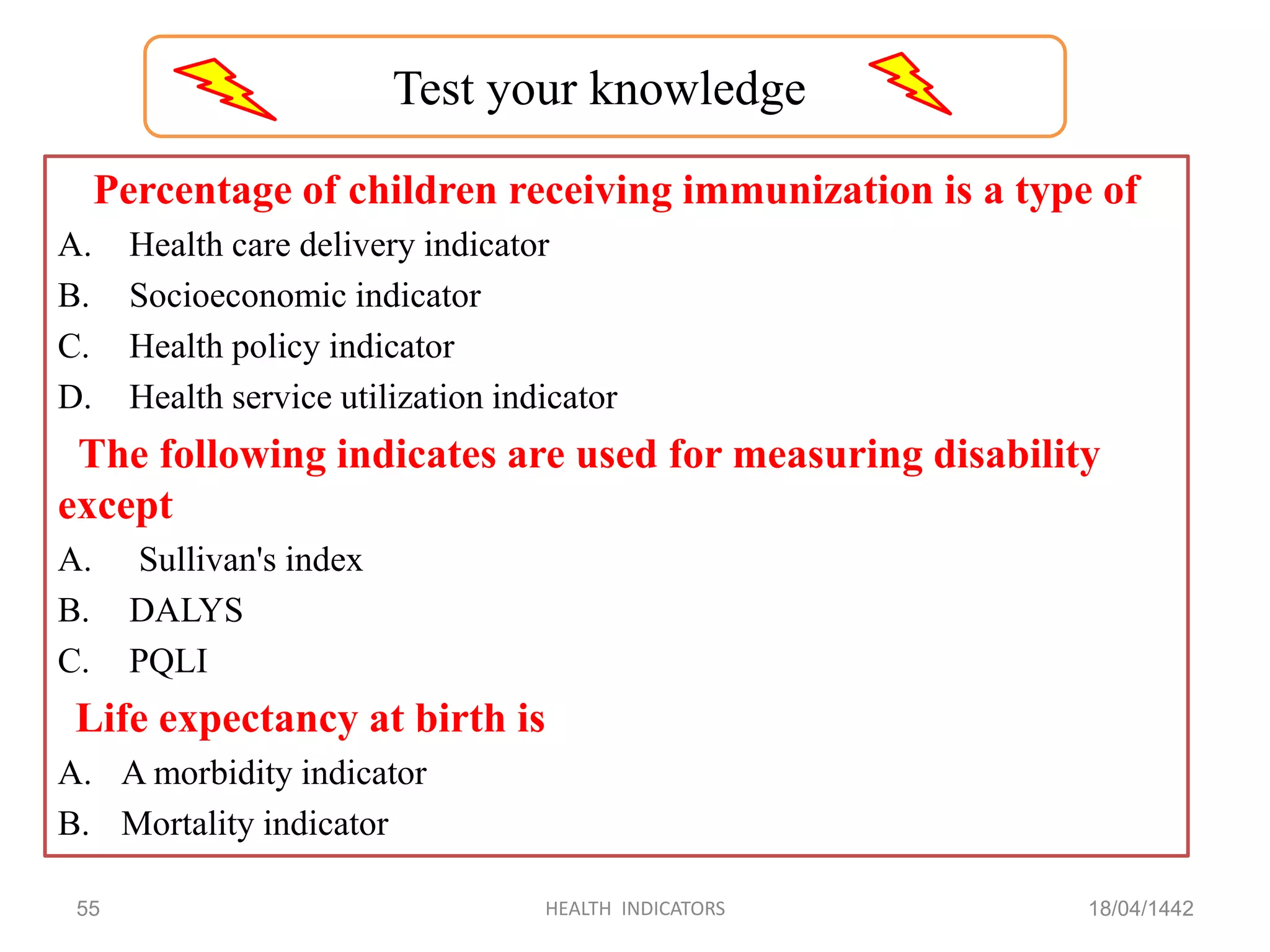
Percentage of children receiving immunization is a type of
A. Health care delivery indicator
B. Socioeconomic indicator
C. Health policy indicator
D. Health service utilization indicator
The following indicates are used for measuring disability
except
A. Sullivan's index
B. DALYS
C. PQLI
Life expectancy at birth is
A. A morbidity indicator
B. Mortality indicator
18/04/1442HEALTH INDICATORS55
Test your knowledge
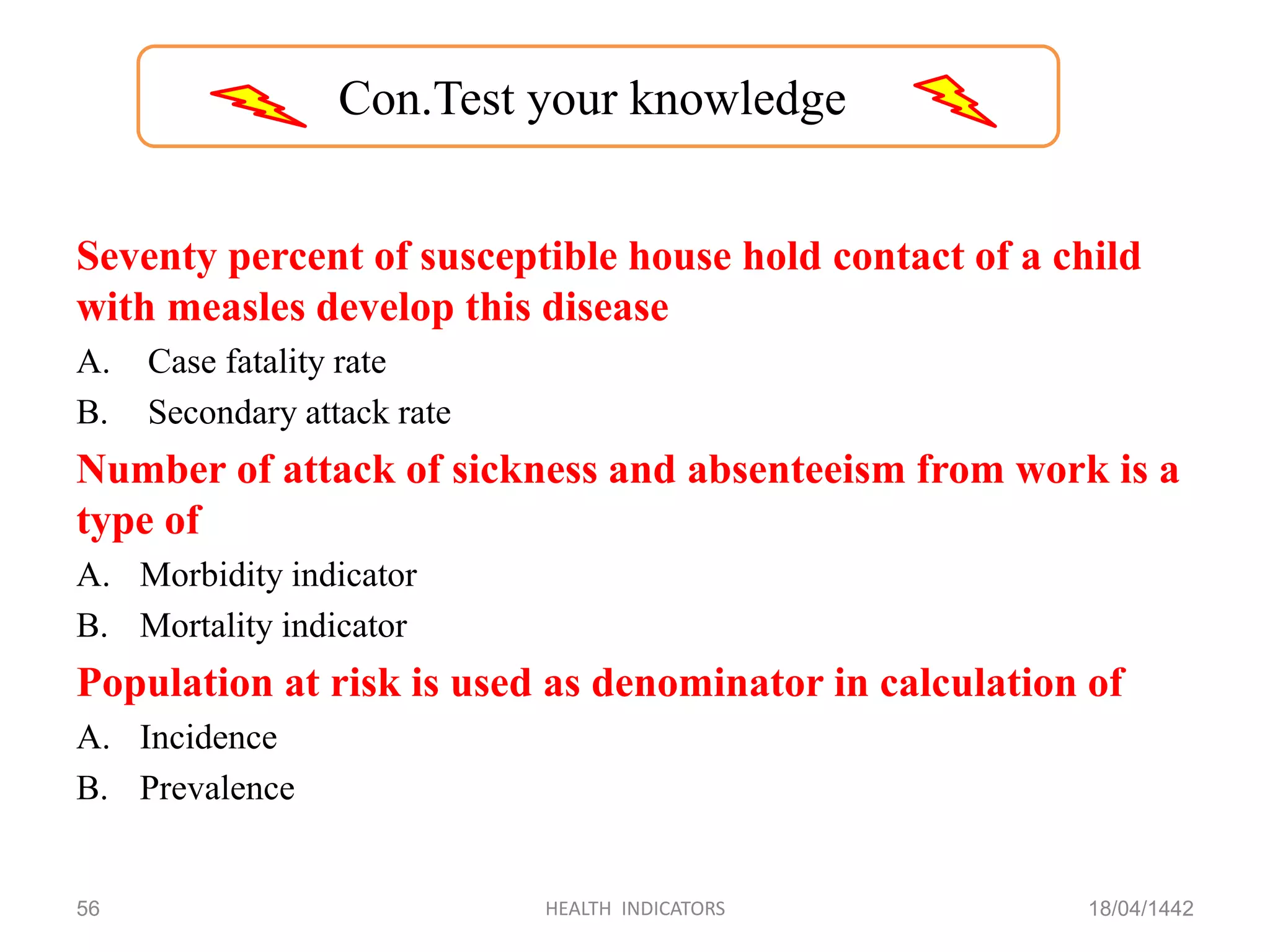
Seventy percent of susceptible house hold contact of a child
with measles develop this disease
A. Case fatality rate
B. Secondary attack rate
Number of attack of sickness and absenteeism from work is a
type of
A. Morbidity indicator
B. Mortality indicator
Population at risk is used as denominator in calculation of
A. Incidence
B. Prevalence
18/04/1442HEALTH INDICATORS56
Con.Test your knowledge
Health Indictors in Sudan
• Total population (2016) 39,579,000
• Life expectancy at birth m/f (years, 2016)
63/67
• Probability of dying under five (per 1 000 live
births, 2017) 63
• Probability of dying between 15 and 60 years
m/f (per 1 000 population, 2016) 253/195
• Total expenditure on health as % of GDP
(2014) 8.4
18/04/1442HEALTH INDICATORS57
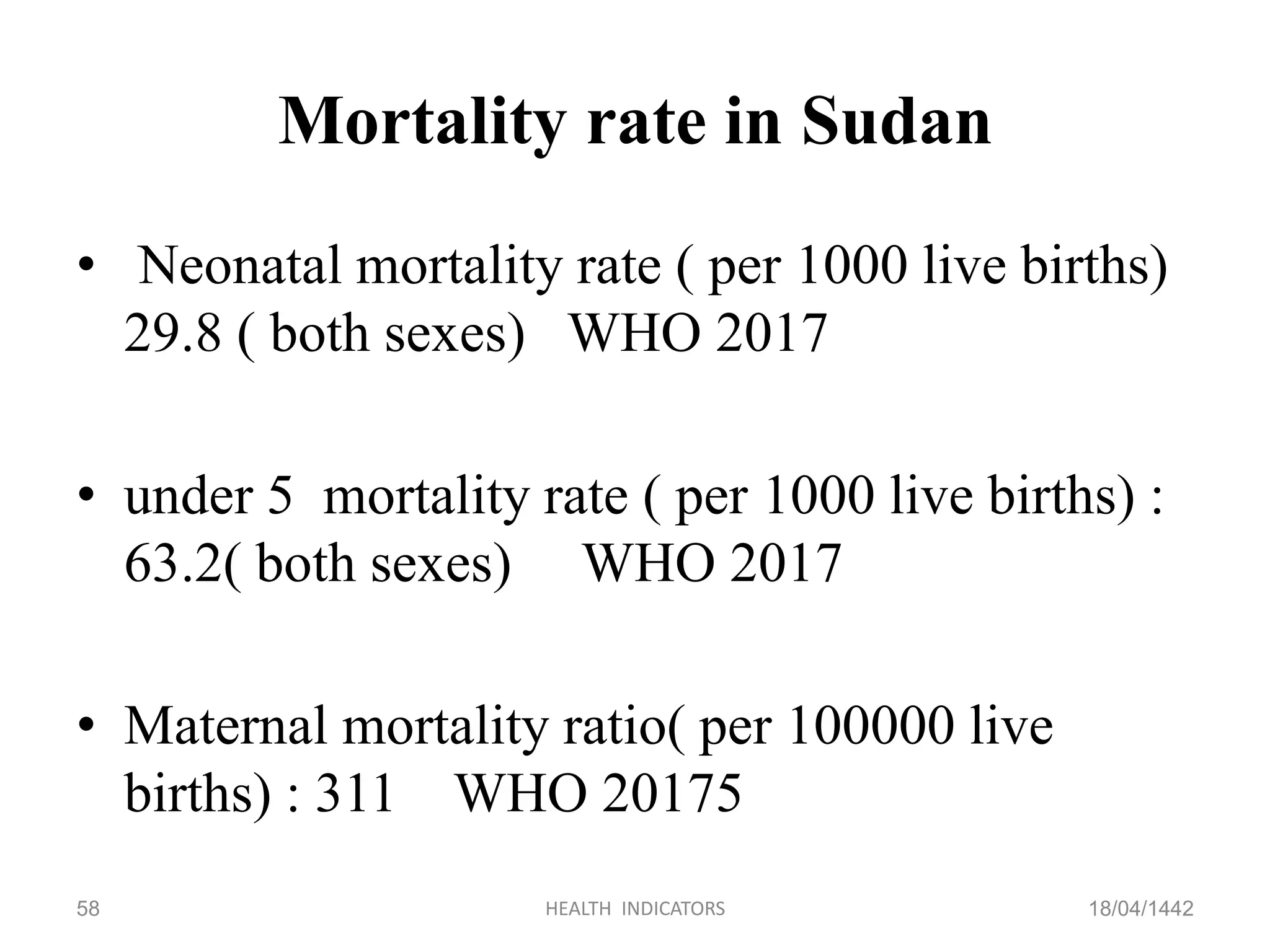
Mortality rate in Sudan
• Neonatal mortality rate ( per 1000 live births)
29.8 ( both sexes) WHO 2017
• under 5 mortality rate ( per 1000 live births) :
63.2( both sexes) WHO 2017
• Maternal mortality ratio( per 100000 live
births) : 311 WHO 20175
18/04/1442HEALTH INDICATORS58
References
• Park K. Textbook of preventive and social
medicine. 21st ed. Jabalpur, India
• health indicators IN SUDAN – WHO
https://apps.who.int/gho/data/node.cco.ki-
SDN?lang=en
• Lecture notes
18/04/1442HEALTH INDICATORS59

Health indicators lecture 2

  • 1.
    Prepared by DR. NAIFIZZATULLAH ABDULJABBAR MBBS MSc of public health HEALTH INDICATORS
  • 2.
    18/04/1442HEALTH INDICATORS2 Contents Objectives Introduction Indicators ofHealth Characteristics Uses Classification of Indicators of Health Health indictors in Sudan References
  • 3.
    18/04/1442HEALTH INDICATORS3 Objectives At theend of the session, participants should be able to Define and identify relevant health indicators Mention characteristics of good indicators Give examples of good indicators
  • 4.
    18/04/1442HEALTH INDICATORS4 Introduction Health isdefined as “a state of complete physical, mental & social wellbeing, and not merely an absence of disease or infirmity” (WHO) This statement has been amplified to include the ability to lead a “socially and economically productive life”
  • 5.
    18/04/1442HEALTH INDICATORS5 Indicators ofHealth Health Indicator or index is a variable, susceptible to direct measurement, that reflects the state of health of persons in a community. a variable (its value changes) that measures (objective calculation of value)…
  • 6.
    1. Valid –they should actually measure that they are supposed to measure 2. Reliable – the results should be the same when measured by different people in similar circumstances 3. Sensitive – they should be sensitive to changes in the situation concerned 18/04/1442HEALTH INDICATORS6
  • 7.
    4. Specific –they should reflect changes only in the situation concerned 5. Feasible – they should have the ability to obtain data when needed 6. Relevant – they should contribute to the understanding of the phenomenon of interest 18/04/1442HEALTH INDICATORS7 Continue characteristic
  • 8.
    Uses of Indicatorsof Health • Measurement the health of the community. • Description the health of the community. • Comparison the health of different communities. • To assess the health needs 18/04/1442HEALTH INDICATORS8
  • 9.
    Cont. Uses ofIndicators of Health • To evaluate the health services • Planning and allocation of health resources. • Measurement of health successes. 18/04/1442HEALTH INDICATORS9
  • 10.
    Classification of Indicatorsof Health • Mortality Indicators • Morbidity Indicators • Disability Rates • Nutritional Status or Nutritional Indicators • Health Care Delivery Indicators • Utilization Rates 18/04/1442HEALTH INDICATORS10
  • 11.
    Cont. Classification ofIndicators of Health. • Indicators of Social And Mental Health • Environmental Indicators • Socio-economic Indicators • Health Policy Indicators • Indicators of Quality of Life • Other Indicators 18/04/1442HEALTH INDICATORS11
  • 12.
    Very important tricks •Rate: Numerator (a) is a part of denominator (b) and multiplier is 1000 or 10,000 or 100,000 • Ratio: Numerator (a) is not a part of denominator (b) and BOTH numerator and denominator are unrelated • Proportion: Numerator (a) is a part of denominator (b) and multiplier is 100 Proportion is always expressed in percentage (%) 18/04/1442HEALTH INDICATORS12
  • 13.
  • 14.
    • It isdefined as the number of deaths per 1000 population per year in a given community, usually the mid-year population • fair indicator of the comparative health of the people. • Useful in detecting the etiologic factor • CDR Sudan - 7.0 deaths/1,000 population (high but better than in developing countries) 18/04/1442HEALTH INDICATORS14 1.Crude Death Rate
  • 15.
    2.Expectation of life refersto the number of years a person can expect to live. • Estimated for both sexes separately. • Good indicator of socioeconomic development • In Sudan :Male: 64 years • female: 66 years 18/04/1442HEALTH INDICATORS15
  • 16.
    3.Infant mortality rate •The ratio of deaths under 1yr of age in a given year to the total number of live births in the same year, usually expressed as a rate per 1000 live births. • Sensitive indicator of availability, utilization &effectiveness of health care, particularly perinatal care. • Current IMR: Sudan - 40/1000 live birth 18/04/1442HEALTH INDICATORS16
  • 17.
  • 18.
    4.Child Mortality Rate •The number of deaths at ages 1-4yrs in a given year, per 1000 children in that age group at the mid-point of the year. • Correlates with inadequate MCH services, malnutrition, low immunization coverage and environmental factors 18/04/1442HEALTH INDICATORS18
  • 19.
    5.Under-5 Mortality Rate •no. of deaths occurring in the under-5 age group per 1000 live births. • U5 mortality rate reflects both infant and child mortality. • Current rate – 60/1000 live births (very high). 18/04/1442HEALTH INDICATORS19
  • 20.
    6.Maternal Mortality Ratio •is the number of deaths arising during pregnancy or puerperal period per 100000 live births. • Accounts for the greatest number of deaths among women of reproductive age in developing countries. Current MMR – Sudan - 295/100000 live births (very high). 18/04/1442HEALTH INDICATORS20
  • 21.
    7.Maternal Mortality Rate Numberof deaths related to pregnancy during a given period Number of live births during the same period 18/04/1442HEALTH INDICATORS21
  • 22.
    8.Proportional Mortality Rate •is the proportion of all deaths attributed to the specific disease to total deaths • Is the simplest meature of estimating the burden of a disease • CHD 35% (very high) of all deaths in developed world. 18/04/1442HEALTH INDICATORS22
  • 23.
    9.Case Fatality Rate Numberof deaths assigned to specific disease Number of cases of disease *100 Power of killing Usually expressed in percentage Its is a proportion 18/04/1442HEALTH INDICATORS23
  • 24.
  • 25.
    • Morbidity Indicators:The frequency with which a disease appears in a population. • Reveal the burden of ill health in a community, but do not measure the subclinical states. 18/04/1442HEALTH INDICATORS25
  • 26.
    1.Incidence rate : •The number of new events or new cases of a disease in a defined population, within a specified period of time. *1000 • The incidence of Tuberculosis in Sudan is 120 per 100000 (very high). 18/04/1442HEALTH INDICATORS26 Can be determined from: Cohort study Is the best measure of disease frequency
  • 27.
    Cont.Incidence rate : •Attack Rate: Number of new cases at risk developed specific disease during a specific time interval Total population at risk during the same time interval 18/04/1442HEALTH INDICATORS27 Secondary Attack Rate: Number of exposed people developing the disease a specified time period total number of people exposed the primary cases
  • 28.
    2.Prevalence • The totalnumber of all individuals who have an attribute or disease at a particular time divided by population at risk of having attribute or disease at this point of time. 18/04/1442HEALTH INDICATORS28 : a specific point in time : a given time interval (can be used to measure the health needs of the community Reflects the chronicity of the disease.
  • 29.
    Cont. Prevalence • PREVALENCEIS A PROPORTION • always expressed in percentage • can be determined from: Cross Sectional Study • Prevalence : The number of new + old cases. 18/04/1442HEALTH INDICATORS29
  • 30.
    other Morbidity Indicators 3.Notification rates : is calculated from the reporting to public authorities of certain diseases. 4. Admission, Readmission and discharge rates. 5. Duration of stay in hospital – reflects the virulence and resistance developed by the etiological factor 6. Spells of sickness 18/04/1442HEALTH INDICATORS30
  • 31.
  • 32.
    Sullivan's index • Sullivan’sIndex refers to “expectation of life free of disability”. • Life expectancy – duration of disability 18/04/1442HEALTH INDICATORS32 Health Adjusted Life Expectancy life expectancy at birth but includes an adjustment for time spent in poor health
  • 33.
    Disability Adjusted LifeYears. • DALYs: Disability Adjusted Life Years. • It is defined as the number of years of healthy life lost due to all causes whether from premature mortality or disability. • DALY = years of life lost(YLL) + years lost to disability(YLD) • It is the simplest and the most commonly used measure to find the burden of disease in a defined population 18/04/1442HEALTH INDICATORS33
  • 34.
    Uses of DALYs •To assist health service priorities • To identify the disadvantaged groups • Measuring the results of health interventions • Providing comparable measures for planning & evaluating programmes • One DALY is one productive lost year of healthy life 18/04/1442HEALTH INDICATORS34
  • 35.
    Quality Adjusted LifeYear • QALY is Quality Adjusted Life Year. • It is the most commonly used to measure the cost effectiveness of health interventions . • It estimates the number of years of life added by a successful treatment or adjustment for quality of life. • Each year in perfect health is assigned a value of 1.0 down to a value of 0.0 for death. 18/04/1442HEALTH INDICATORS35
  • 36.
    Years of potentiallife lost • Years of potential life lost (YPLL) or potential years of life lost through premature (PYLL). • It is an estimate of the average years a person would have lived if they had not died prematurely. • Reference age is generally 60 years 18/04/1442HEALTH INDICATORS36
  • 37.
  • 38.
    NUTRITIONAL STATUS INDICATORS • NutritionalStatus is a positive health indicator. Newborns are measured for their: –Birth weight –Length –Head circumference 18/04/1442HEALTH INDICATORS38
  • 39.
    Continue Nutritional Indicators Newborns: are measured for their : i. Birth–weight ii. Length Head circumference . • They reflect the maternal nutrition status. 18/04/1442HEALTH INDICATORS39 Anthropometric measurements of pre-school children. i. Weight – measures acute malnutrition. ii. Height – measures chronic malnutrition. Mid-arm circumference - measures chronic malnutrition
  • 40.
    Cont. nutritional status •Underweight: weight for age < –2 standard deviations (SD) of the WHO Child Growth Standards median • Stunting: height for age < –2 SD of the WHO Child Growth Standards median • Wasting: weight for height < –2 SD of the WHO Child Growth Standards median • Overweight: weight for height > +2 SD of the WHO Child Growth Standards median 18/04/1442HEALTH INDICATORS40
  • 41.
    Cont. nutritional status •Growth Monitoring of children is done by measuring weight – for - age, height - for - age, weight – for - height, head & chest circumference and mid-arm circumference. • In adults Underweight, Obesity and Anemia are generally considered reliable nutritional indicators. 18/04/1442HEALTH INDICATORS41
  • 42.
  • 43.
    Health Care DeliveryIndicators • These indicators reflect the equity of distribution of health resources in different parts of the country and of the provision of health care. • Doctor-population Ratio • Nurse-population ratio • Population-bed Ratio • Health worker – population 18/04/1442HEALTH INDICATORS43
  • 44.
    CONT. Health CareDelivery Indicators • The WHO Joint Learning Initiative has established a threshold of 25 health workers (doctors, nurses and midwives) per 10,000 population, with a WHO endorsed lower threshold of 23 workers per 10,000. 18/04/1442HEALTH INDICATORS44
  • 45.
  • 46.
    • the proportionof people in need of a service who actually receive it in a given period. • It depends on availability & accessibility of health services and the attitude of an individual towards health care system. E.g. 1. Proportion of infants who are fully immunized 2. Proportion of pregnant women who receive ANC 3. Percentage of population who adopt family planning 4. Bed occupancy 18/04/1442HEALTH INDICATORS46
  • 47.
  • 48.
    Physical Quality ofLife Index • Is an attempt to measure the quality of life or well- being of a country.  basic literacy rate,  infant mortality,  life expectancy The result is placed on the 0 to 100 scale 18/04/1442HEALTH INDICATORS48
  • 49.
    Human Development Index •Human Development Index – Longevity (life expectancy at birth) – Education (mean and expected years of schooling) – Gross national income (GNI) per capita • The result is placed on the 0 to 1 scale 18/04/1442HEALTH INDICATORS49
  • 50.
  • 51.
    • These donot directly measure health but are important in interpreting health indicators. These are: (HE FLAGGD) – Housing – the number of persons per room – unemployment level – Literacy rates – Family zise – Availability Per capita “calorie” – GNI (gross national income) – Growth rate – Dependency ratio 18/04/1442HEALTH INDICATORS51
  • 52.
    Indicators of Socialand Mental Health • These Include rates of suicide, homicide, other crime, road traffic accident, alcohol and substance abuse, domestic violence. 18/04/1442HEALTH INDICATORS52 Environmental Indicators The most important are those measuring the proportion of population having access to safe drinking water and sanitation facilities.
  • 53.
    18/04/1442HEALTH INDICATORS53 HEALTH POLICY INDICATORS Thesingle most important indicator of political commitment is allocation of adequate resources. The relevant indicators are Proportion of GNP(gross national product) spent on health services. Proportion of GNP spent on health related activities like water supply and sanitation & housing and nutrition.
  • 54.
  • 55.
    Percentage of childrenreceiving immunization is a type of A. Health care delivery indicator B. Socioeconomic indicator C. Health policy indicator D. Health service utilization indicator The following indicates are used for measuring disability except A. Sullivan's index B. DALYS C. PQLI Life expectancy at birth is A. A morbidity indicator B. Mortality indicator 18/04/1442HEALTH INDICATORS55 Test your knowledge
  • 56.
    Seventy percent ofsusceptible house hold contact of a child with measles develop this disease A. Case fatality rate B. Secondary attack rate Number of attack of sickness and absenteeism from work is a type of A. Morbidity indicator B. Mortality indicator Population at risk is used as denominator in calculation of A. Incidence B. Prevalence 18/04/1442HEALTH INDICATORS56 Con.Test your knowledge
  • 57.
    Health Indictors inSudan • Total population (2016) 39,579,000 • Life expectancy at birth m/f (years, 2016) 63/67 • Probability of dying under five (per 1 000 live births, 2017) 63 • Probability of dying between 15 and 60 years m/f (per 1 000 population, 2016) 253/195 • Total expenditure on health as % of GDP (2014) 8.4 18/04/1442HEALTH INDICATORS57
  • 58.
    Mortality rate inSudan • Neonatal mortality rate ( per 1000 live births) 29.8 ( both sexes) WHO 2017 • under 5 mortality rate ( per 1000 live births) : 63.2( both sexes) WHO 2017 • Maternal mortality ratio( per 100000 live births) : 311 WHO 20175 18/04/1442HEALTH INDICATORS58
  • 59.
    References • Park K.Textbook of preventive and social medicine. 21st ed. Jabalpur, India • health indicators IN SUDAN – WHO https://apps.who.int/gho/data/node.cco.ki- SDN?lang=en • Lecture notes 18/04/1442HEALTH INDICATORS59