Health Disparities  June 16, 2008 David N. Sundwall, MD Executive Director Utah Department of Health
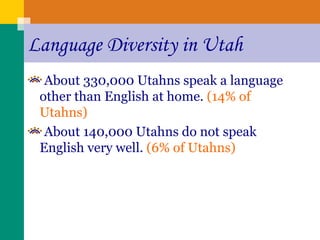
Language Diversity in Utah About 330,000 Utahns speak a language other than English at home.  (14% of Utahns) About 140,000 Utahns do not speak English very well.  (6% of Utahns)
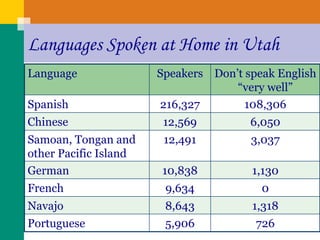
Languages Spoken at Home in Utah 6,050 12,569 Chinese 726 5,906 Portuguese 1,318 8,643 Navajo 0 9,634 French 1,130 10,838 German 3,037 12,491 Samoan, Tongan and other Pacific Island 108,306 216,327 Spanish Don’t speak English “very well” Speakers Language
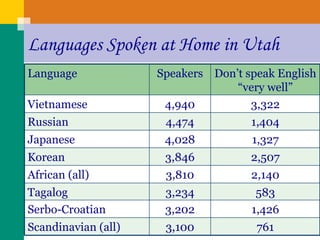
Languages Spoken at Home in Utah 583 3,234 Tagalog 1,426 3,202 Serbo-Croatian 2,507 3,846 Korean 2,140 3,810 African (all) 1,327 4,028 Japanese 1,404 4,474 Russian 761 3,100 Scandinavian (all) 3,322 4,940 Vietnamese Don’t speak English “very well” Speakers Language
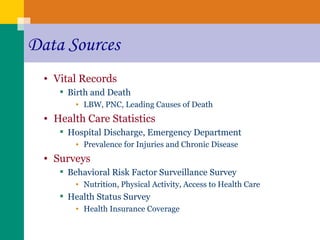
Data Sources Vital Records Birth and Death LBW, PNC, Leading Causes of Death Health Care Statistics Hospital Discharge, Emergency Department Prevalence for Injuries and Chronic Disease Surveys Behavioral Risk Factor Surveillance Survey Nutrition, Physical Activity, Access to Health Care Health Status Survey Health Insurance Coverage
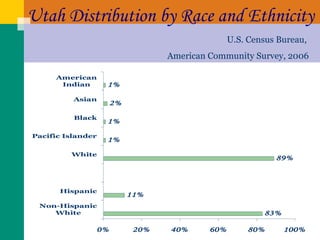
Utah Distribution by Race and Ethnicity U.S. Census Bureau,  American Community Survey, 2006
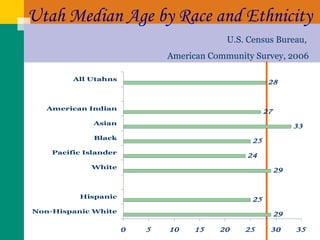
Utah Median Age by Race and Ethnicity U.S. Census Bureau,  American Community Survey, 2006
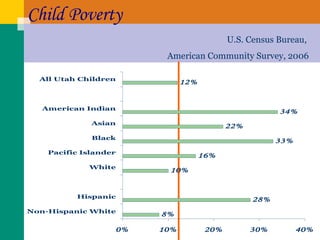
Child Poverty U.S. Census Bureau,  American Community Survey, 2006
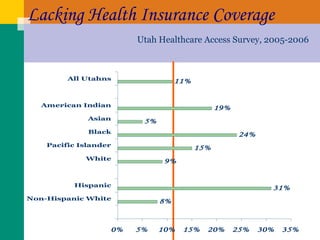
Lacking Health Insurance Coverage Utah Healthcare Access Survey, 2005-2006
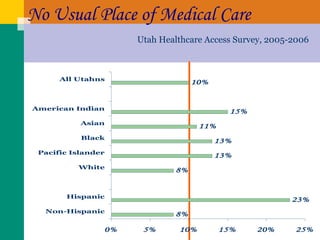
No Usual Place of Medical Care Utah Healthcare Access Survey, 2005-2006
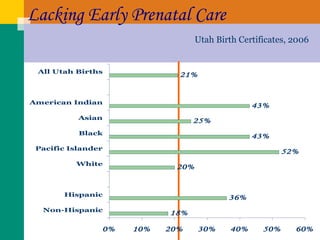
Lacking Early Prenatal Care Utah Birth Certificates, 2006
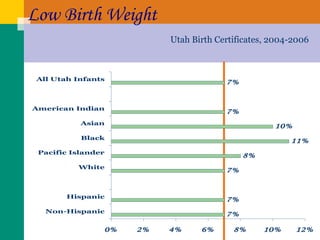
Low Birth Weight  Utah Birth Certificates, 2004-2006
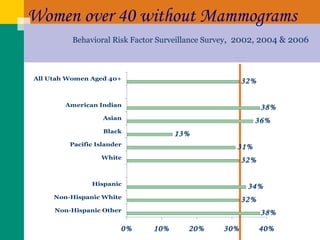
Women over 40 without Mammograms Behavioral Risk Factor Surveillance Survey ,  2002, 2004 & 2006
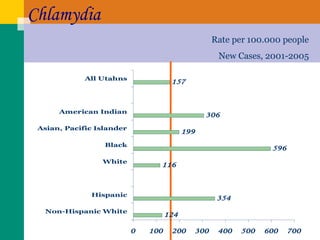
Chlamydia Rate per 100.000 people New Cases, 2001-2005
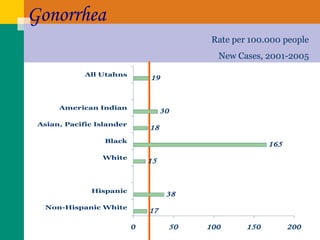
Gonorrhea Rate per 100.000 people New Cases, 2001-2005
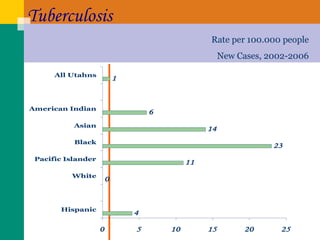
Tuberculosis Rate per 100.000 people New Cases, 2002-2006
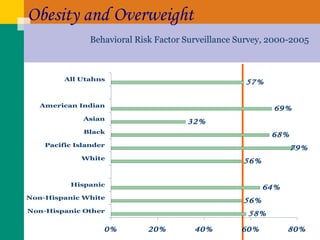
Obesity and Overweight  Behavioral Risk Factor Surveillance Survey, 2000-2005
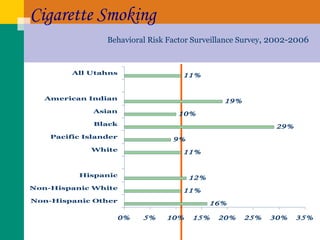
Cigarette Smoking Behavioral Risk Factor Surveillance Survey , 2002-2006
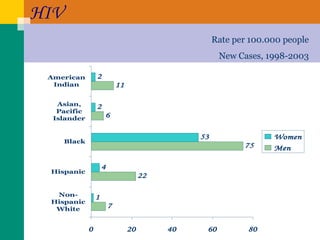
HIV Rate per 100.000 people New Cases, 1998-2003
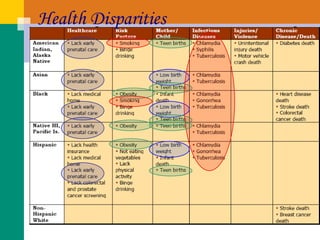
Health Disparities
2008 Qualitative Report : Public Health Messages from Utah’s Racial and Ethnic Minority Populations 2010 Health Status by Race and Ethnicity Report For more information, contact the Utah Department of Health, Center for Multicultural Health Upcoming Data Projects
Addressing Health Disparities Protocols and Standards for Translation and Interpretation Report Online  Multilingual Library : 34 languages and 23 health topics   Utah Health Care Workforce Financial Assistance Program State Primary Care Grant Program for Medically Underserved Populations Grant to support the Multicultural Health Network; mini-grants to organize minority community forums Work Force Diversity Plan for the Utah Department of Health and share with other state agencies Annual Summit on Racial & Ethnic Health Disparities

Health Disparities

  • 1.
    Health Disparities June 16, 2008 David N. Sundwall, MD Executive Director Utah Department of Health
  • 2.
    Language Diversity inUtah About 330,000 Utahns speak a language other than English at home. (14% of Utahns) About 140,000 Utahns do not speak English very well. (6% of Utahns)
  • 3.
    Languages Spoken atHome in Utah 6,050 12,569 Chinese 726 5,906 Portuguese 1,318 8,643 Navajo 0 9,634 French 1,130 10,838 German 3,037 12,491 Samoan, Tongan and other Pacific Island 108,306 216,327 Spanish Don’t speak English “very well” Speakers Language
  • 4.
    Languages Spoken atHome in Utah 583 3,234 Tagalog 1,426 3,202 Serbo-Croatian 2,507 3,846 Korean 2,140 3,810 African (all) 1,327 4,028 Japanese 1,404 4,474 Russian 761 3,100 Scandinavian (all) 3,322 4,940 Vietnamese Don’t speak English “very well” Speakers Language
  • 5.
    Data Sources VitalRecords Birth and Death LBW, PNC, Leading Causes of Death Health Care Statistics Hospital Discharge, Emergency Department Prevalence for Injuries and Chronic Disease Surveys Behavioral Risk Factor Surveillance Survey Nutrition, Physical Activity, Access to Health Care Health Status Survey Health Insurance Coverage
  • 6.
    Utah Distribution byRace and Ethnicity U.S. Census Bureau, American Community Survey, 2006
  • 7.
    Utah Median Ageby Race and Ethnicity U.S. Census Bureau, American Community Survey, 2006
  • 8.
    Child Poverty U.S.Census Bureau, American Community Survey, 2006
  • 9.
    Lacking Health InsuranceCoverage Utah Healthcare Access Survey, 2005-2006
  • 10.
    No Usual Placeof Medical Care Utah Healthcare Access Survey, 2005-2006
  • 11.
    Lacking Early PrenatalCare Utah Birth Certificates, 2006
  • 12.
    Low Birth Weight Utah Birth Certificates, 2004-2006
  • 13.
    Women over 40without Mammograms Behavioral Risk Factor Surveillance Survey , 2002, 2004 & 2006
  • 14.
    Chlamydia Rate per100.000 people New Cases, 2001-2005
  • 15.
    Gonorrhea Rate per100.000 people New Cases, 2001-2005
  • 16.
    Tuberculosis Rate per100.000 people New Cases, 2002-2006
  • 17.
    Obesity and Overweight Behavioral Risk Factor Surveillance Survey, 2000-2005
  • 18.
    Cigarette Smoking BehavioralRisk Factor Surveillance Survey , 2002-2006
  • 19.
    HIV Rate per100.000 people New Cases, 1998-2003
  • 20.
  • 21.
    2008 Qualitative Report: Public Health Messages from Utah’s Racial and Ethnic Minority Populations 2010 Health Status by Race and Ethnicity Report For more information, contact the Utah Department of Health, Center for Multicultural Health Upcoming Data Projects
  • 22.
    Addressing Health DisparitiesProtocols and Standards for Translation and Interpretation Report Online Multilingual Library : 34 languages and 23 health topics Utah Health Care Workforce Financial Assistance Program State Primary Care Grant Program for Medically Underserved Populations Grant to support the Multicultural Health Network; mini-grants to organize minority community forums Work Force Diversity Plan for the Utah Department of Health and share with other state agencies Annual Summit on Racial & Ethnic Health Disparities