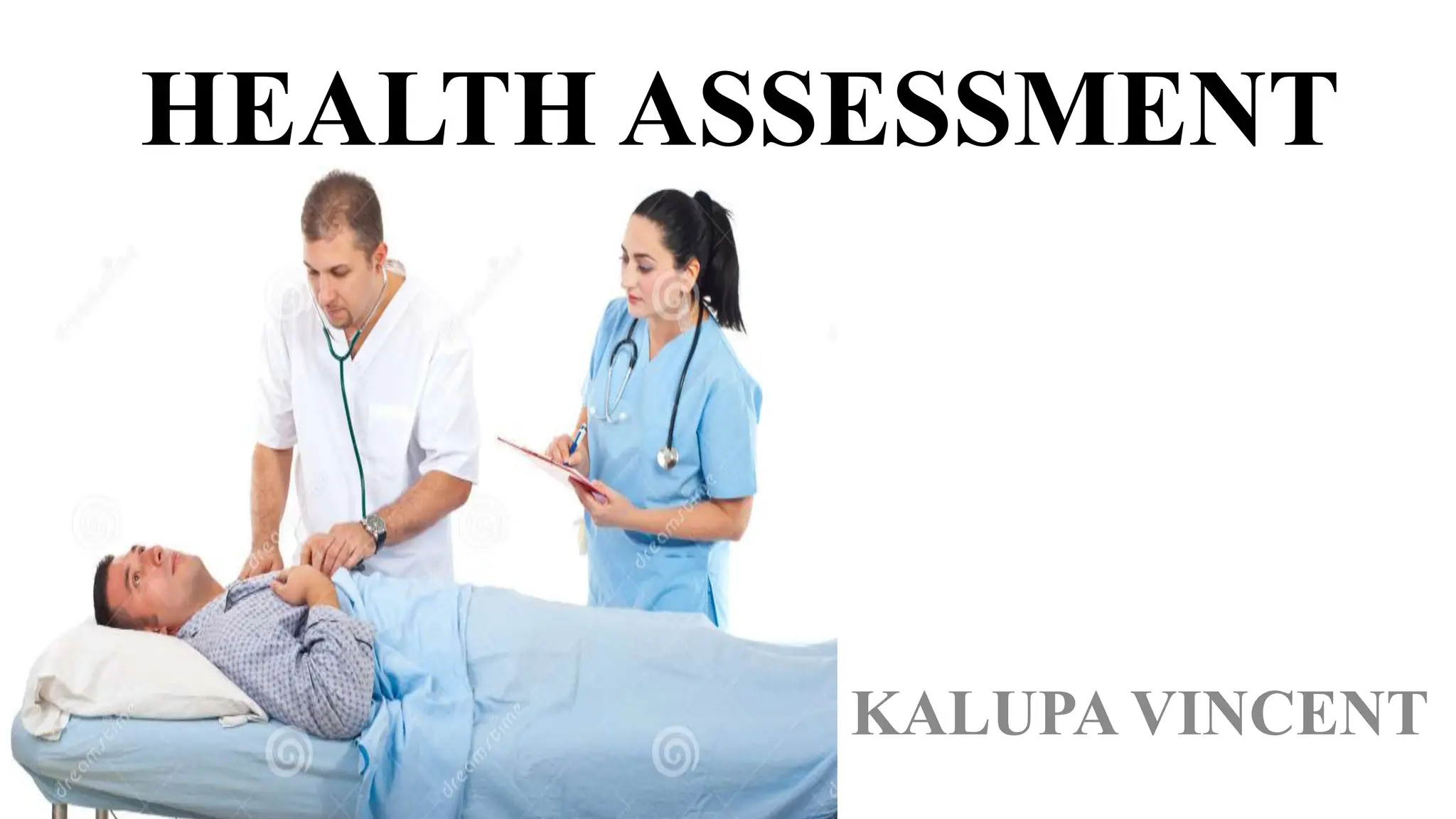
HEALTH ASSESSMENT
KALUPA VINCENT
INTRODUCTION TO HEALTH
ASSESSMENT
Health assessment is a plan that aims to identify
the specific health needs of a person
It aims at addressing the health care needs of
individuals in the health care settings
Health assessment is a comprehensive technique
which aims at detecting health problems early
even before signs and symptoms appear
INTRODUCTION TO HEALTH
ASSESSMENT
It is done to detect illnesses even in persons who
may look and feel well
It evaluates health status of an individual along
the health continuum
It establishes where on the health continuum the
individual is and helps to address health
problems
MAIN OBJECTIVE
At the end of the session, student nurses should
be able to demonstrate an understanding on the
techniques of health assessment in relation to
nursing practice
SPECIFIC OBJECTIVES
At the end of the session, student nurses should
be able;
Explain the process of conducting health
assessment in relation to nursing
What is Health Assessment???
HEALTH ASSESSMENT
Health assessment
This refers to a systematic process of obtaining
correct and complete data or information from
the patient.
It is a plan of care that identifies the specific
needs of an individual and aims at formulating
ways of solving them
HISTORY TAKING
During history taking, the following are the
information collected;
Demographic data e.g. age and sex; address;
marital status
Family history
Social and occupational history
HEALTH ASSESSMENT
Health assessment employs two techniques;
1. History taking
2. Physical examinations
HISTORY TAKING
HISTORY TAKING
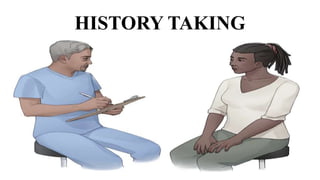
History Taking
This is also referred to as ‘clinical interview’.
It is a planned discussion that is aimed at
establishing the health needs and health problems
of the client.
It is usually conducted before physical
assessment.
HISTORY TAKING
Demographic data
Name of client.
Age
Sex.
Address. (residential)
Marital status
Next of kin.
Religion.
Denomination
Nationality
Tribe.
Occupation
HISTORY TAKING
Presenting complaints
History of presenting illness; history of previous
illnesses
Treatment history
HISTORY TAKING
Presenting complaints
The presenting complaint is simply the
problem, which made the patient seek medical
help.
A nurse kindly ask the patient;
What has brought you to the clinic today?
HISTORY TAKING
The History of the Present Illness
Ask the patient to tell you the story of the illness
from the beginning.
Allow the patient to continue without
interruption.
If the patient is anxious or nervous, you will need
to use tactful encouragement.
HISTORY TAKING
For talkative patients, try to direct their account
of events.
Some patients use medical terminologies without
knowing their meaning; encourage such patients
to tell you what they actually feel to be wrong
Friends/relatives may accompany the patient;
always talk to the patient first
HISTORY TAKING
Symptom analysis
In symptom analysis, it is important to consider
the course or shape of illness, reason for
presentation and finally review of systems
Components of symptom analysis, you may use
this mnemonic OLDCART
HISTORY TAKING
O – Onset of illness
L – Location
D – Duration
C – Characteristics
A – Aggravating factors
R – Relieving factor
T – Treatment
HISTORY TAKING
O.L.D.C.A.R.T
Onset: When did the pain start?
Location: Where is the pain?
Duration: For how long have you been feeling
that pain? When did it start?
HISTORY TAKING
Characteristics: How is the pain? Is it stabbing?
Burning? Pricking? Is it localized or it originates
from a certain body part and moves to other
parts?
Aggravating factor: What worsens the pain? Is
it coughing? Breathing?
Relieving factor: What lessens/reduces the pain?
Treatment: What drugs or treatment are you
receiving?
HISTORY TAKING
The History of Previous Illness
Evaluation of the previous history will help you
to get an insight about the health status of the
patient up until now.
The previous illness history should include;
Operations,
Treatment for the previous illnesses
HISTORY TAKING
The Family History
It is important to evaluate the family history of
your client.
Evaluation of family history will help you to
determine the health of the immediate family
members.
It will also help you to know whether your client
is at risk of developing certain conditions which
run in families.
HISTORY TAKING
Inquire about hereditary disorders in the family.
Ask if there is any family member with similar
symptoms
HISTORY TAKING
The Social History
The patient’s physical and emotional
environment is a greater determinant of health
and illness
One's lifestyle as a huge bearing on their health
and wellness
HISTORY TAKING
Ask your patient questions such as;
What do you do during your spare time?
Type of housing
Do you take alcohol?
Smoke?
Exercise?
Sanitation (water and refuse disposal)
HISTORY TAKING
Occupational History
Certain occupations may predispose to
conditions such as prolonged exposure to
radiation may lead to cancers.
Ask your client whether they have been exposed
to noxious substances at work, number of work
hours, nature of work e.g. director, underground
mine worker
HISTORY TAKING
Menstrual History
Women should be asked about menstruation i.e.
last normal menstrual period, regularity duration,
amount of flow, dysmenorrhea, menstrual
tension, history of taking oral contraception as
some conditions like ectopic pregnancy, uterine
mass are associated with some family planning
methods
HISTORY TAKING
Obstetric History
Data on a woman’s experience of childbirth,
including abortions number of pregnancies,
deliveries whether normal or had complications,
health during pregnancy and whether those
children are alive or they are dead.
What are the Phases of the Nursing
Process???
PHASES OF NURSING PROCESS
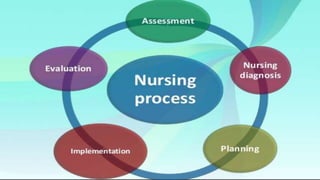
The Nursing Process has five (5) distinct
phases;
1. Assessment
2. Diagnosis
3. Planning
4. Implementation
5. Evaluation
Do you remember A.D.P.I.E???
PHASE 1: ASSESSMENT
ASSESSMENT
It is an art of collection of
comprehensive data pertinent to the
patient’s health or situation.
PHASE 1: ASSESSMENT
This is the first phase of the Nursing Process
and it involves;
1. Collection of data
2. Documentation of data
3. Data organisation
4. Validation of data
5. Analysis of data
PHASE 1: ASSESSMENT
Assessment employs two (2) vital tequiniques,
namely
History taking -collection of subjective data
Physical examination -collection of objective
data
PHASE 1: ASSESSMENT
Objective data
Dyspnea
Pallor
Jaundice
Wheezing
Oedema
Wasting
PHASE 1: ASSESSMENT
Subjective data
For how long have you experienced the
symptoms?
What is the nature of the pain?
What are the exacerbating factors of pain?
What are the relieving factors?
SOURCES OF DATA
The sources of data can be classified into two
(2) broad categories;
Primary data: usually, the patient is the
primary source and usually the best source of
information.
Secondary data: Family and significant others
may provide information about the illness of
their relatives
SOURCES OF DATA
Health Care Team Members
• Physicians and other members of the health
care team can provide information about the
patient illness.
• During nurses’ handover, nurses exchange
information about a client
SOURCES OF DATA
Patient’s medical records
Patient’s health records are kept confidential
however, they can be retrieved as reference in
management of patient’s illness.
Client’s medical records may contain
laboratory and diagnostic test results and
primary treatment plan.
What are the types of Health
Assessments???
TYPES OF HEALTH ASSESSMENT
Basically, they are four (4) types of Health
Assessments, namely;
1. Comprehensive assessment
2. Focused/problem-based assessment
3. Episodic/follow up assessment
4. Screening assessment
COMPREHENSIVE ASSESSMENT
This is usually done on the first contact
and usually is not linked with management
of emergencies.
It involves getting a detailed history and
physical examination as basis of initial
care, like on Antenatal booking and patient
admission in hospital.
PROBLEM BASED ASSESSMENT
This assessment is usually done on emergency
conditions.
Focused assessment aims at quick reveal of
health problems in emergency conditions.
Involves getting history and examination that
is limited or specific problems or complaint,
like a mother who develops PPH after birth
PROBLEM BASED ASSESSMENT
The history and physical examination will
mainly focus on the precise cause of the
complication.
History taking will include reveal of ANC card
for history of PPH.
FOLLOW-UPASSESSMENT
This assessment is done on a subsequent visit
The assessment is done on follow up visit a
previously identified health problem.
This assessment is usually done in
management of chronically ill.
It aims at maintenance and rehabilitation of
health.
SCREENING ASSESSMENT
This is usually a short and inexpensive
examination
It focuses on disease detection, like blood
pressure, blood group checking.
It may be a routine examination but can detect
health problems before they manifests or
develop into complications.
PHASE 2: DIAGNOSIS
DIAGNOSIS
Diagnosis is the recognition of a
particular ailment from symptoms,
physical signs and any test which may
have been performed
PHASE 2: NURSING DIAGNOSIS
This is the second phase of the Nursing
Process
Nursing diagnosis entails that the nurse should
be autonomous in the way they make decisions
about patients health and is entitled to
scrutinise questionable Doctor’s orders
PHASE 2: NURSING DIAGNOSIS
It uses the data collected from history taking
and physical examination to identify actual and
potential health problems of the client.
In making a diagnosis, data collected is
analysed assessment data to determine the
diagnosis
PHASE 2: NURSING DIAGNOSIS
For example: A patient with a medical
diagnosis of diarrhea and projectile vomiting;
the nursing diagnosis may be; Risk for fluid
volume deficit.
The nursing diagnosis provides a basis for
selection of nursing interventions.
PHASE 2: NURSING DIAGNOSIS
Nursing diagnosis can be; Actual or Potential
health problems
An Actual nursing diagnosis must have three
parameters;
1. The problem
2. The possible cause
3. The evidence
PHASE 2: NURSING DIAGNOSIS
Example of an actual problem
Fluid volume deficit related to passage of
loose watery stool and projectile vomiting
evidenced by loss of skin tugor and dry
mucous membranes.
PHASE 2: NURSING DIAGNOSIS
A potential nursing diagnosis must have two
parameters;
1.The potential problem
2.The possible cause
PHASE 2: NURSING DIAGNOSIS
Example of a potential problem
Risk for fluid volume deficit related to
passage of loose watery stool and projectile
vomiting.
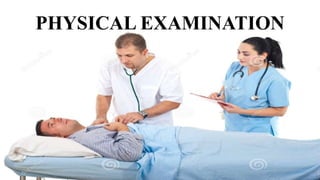
PHYSICAL EXAMINATION
Physical examination
This is a thorough and systematic process
aimed at evaluating objective anatomic
findings through the use of;
Inspection
Palpation
Percussion
Auscultation
PHYSICAL EXAMINATION
A good physical examination requires a
cooperative patient and a quiet, warm and well-
lit room.
Day light is better than artificial light, which
may mask changes in skin colour, for example
Jaundice
PHYSICAL EXAMINATION
Legal implications
A chaperone should be present when a male
nurse is examining a female patient and during
rectal and vaginal examinations, both to
reassure the patient and to protect the nurse
from subsequent accusations of improper
conduct.
PHYSICAL EXAMINATION
Four major techniques are used in performing
the physical examination;
1. Inspection,
2. Palpation,
3. Percussion, and
4. Auscultation
INSPECTION
INSPECTION
Inspection
Inspection is the visual examination of a part or
region of the body to assess normal conditions or
deviations from normal.
Inspection is more than just looking.
INSPECTION
This technique is deliberate, systematic, and
focused.
You are required to compare what you can see
with what are the known, generally visible
characteristics of the body parts being inspected.
INSPECTION
This technique is deliberate, systematic, and
focused.
Some features which can be inspected are;
Skin colour
Asymmetric of body parts
Skin bruises
Eye colour
PALPATION
Palpation
Palpation is the examination of the body with
touch.
During palpation, a nurse can obtain information
related to masses, pulsations, organ enlargement,
tenderness, swelling, muscular spasm or rigidity,
elasticity, vibration of voice sounds, crepitus,
moisture, and differences in texture.
PALPATION
The tips of the fingers are used to palpate lymph
nodes, the dorsa of hands and fingers are used to
assess temperatures, and the palmar surface is
best suited for feeling vibrations.
PALPATION
There are two (2) types of palpation;
1. Light palpation
2. Deep palpation
PALPATION
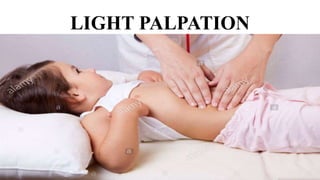
Light Palpation
This type of palpation is employed to assess
superficial structure like;
The skull bones
Skin for swelling and tenderness
Dislocation of superficial bones
Palpation of superficial structures like lymph
nodes
LIGHT PALPATION
PALPATION
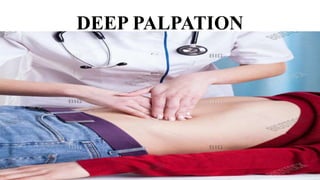
Deep Palpation
This type of palpation is used to assess deep
structures and organs;
The spleen
The stomach
The liver
The uterus
The kidneys
DEEP PALPATION
PERCUSSION
Percussion is an assessment technique involving
the production of sound to obtain information
about the underlying area.
The percussion sound may be produced directly
or indirectly.
Percussion may be direct or indirect
PERCUSSION
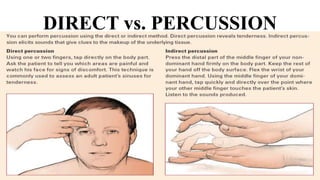
Direct percussion is performed by directly
tapping the body with one or two fingers to
elicit a sound.
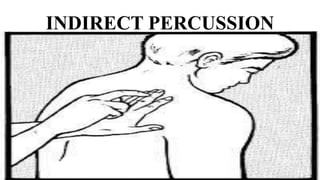
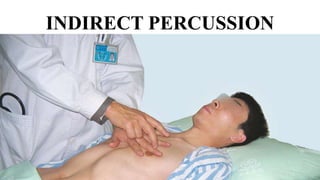
 Indirect or mediated percussion is the more
common technique.
PERCUSSION
The middle finger (pleximeter) of the non-
dominant hand is placed firmly against the
body surface.
The tip of the middle finger of the dominant
hand (plexor) strikes the distal phalanx or the
distal interphalangeal joint of the pleximeter
finger.
PERCUSSION
A relaxed wrist and rapid strike produce the
best sounds.
The sounds and the vibrations produced are
evaluated relative to the underlying structures.
Deviation from an expected sound may
indicate a problem.
PERCUSSION
Deviation from an expected sound may indicate
a problem.
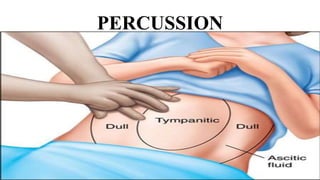
For example, the usual percussion sound in the
right lower quadrant of the abdomen is
tympanic.
Dullness in this area may indicate a problem that
should be investigated.
INDIRECT PERCUSSION
INDIRECT PERCUSSION
PERCUSSION
DIRECT vs. PERCUSSION
AUSCULTATION
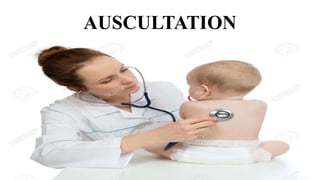
AUSCULTATION
Auscultation
Auscultation is listening to sounds produced
by the body to assess normal conditions and
deviations from normal.
Auscultation is usually indirect, using a
stethoscope to clarify sounds by blocking out
extraneous sounds.
AUSCULTATION
The bell of the stethoscope is more sensitive to
low-pitched sounds.
The diaphragm of the stethoscope is more
sensitive to high-pitched sounds.
Auscultation is particularly useful in
evaluating sounds from the heart, lungs,
abdomen, and vascular system.
PHYSICAL EXAMINATION
Physical assessment techniques are usually
performed in the following sequence:
inspection, palpation, percussion, and
auscultation.
The only exception to this sequence is for the
abdominal examination. In this situation, the
sequence is inspection, auscultation,
percussion, and palpation.
INDIVIDUALASSIGNMENT
Read and make notes on Head-to-Toe
examination of a patient
ANY QUESTIONS!!!
REFERENCE
1. Berkow R. and Beers M.H. (1997), The
Merck Manual of Medical Information,
Home edition, Merck Research Laboratories,
New Jersey.
2. Kumar V., Abul K. and Fauston N. (2007),
Robbins Basic Pathology, 8th edition,
Saunders Elsevier.

Health Assessment.pptx

  • 1.
  • 2.
    INTRODUCTION TO HEALTH ASSESSMENT Healthassessment is a plan that aims to identify the specific health needs of a person It aims at addressing the health care needs of individuals in the health care settings Health assessment is a comprehensive technique which aims at detecting health problems early even before signs and symptoms appear
  • 3.
    INTRODUCTION TO HEALTH ASSESSMENT Itis done to detect illnesses even in persons who may look and feel well It evaluates health status of an individual along the health continuum It establishes where on the health continuum the individual is and helps to address health problems
  • 4.
    MAIN OBJECTIVE At theend of the session, student nurses should be able to demonstrate an understanding on the techniques of health assessment in relation to nursing practice
  • 5.
    SPECIFIC OBJECTIVES At theend of the session, student nurses should be able; Explain the process of conducting health assessment in relation to nursing
  • 6.
    What is HealthAssessment???
  • 7.
    HEALTH ASSESSMENT Health assessment Thisrefers to a systematic process of obtaining correct and complete data or information from the patient. It is a plan of care that identifies the specific needs of an individual and aims at formulating ways of solving them
  • 8.
    HISTORY TAKING During historytaking, the following are the information collected; Demographic data e.g. age and sex; address; marital status Family history Social and occupational history
  • 9.
    HEALTH ASSESSMENT Health assessmentemploys two techniques; 1. History taking 2. Physical examinations
  • 10.
  • 11.
    HISTORY TAKING History Taking Thisis also referred to as ‘clinical interview’. It is a planned discussion that is aimed at establishing the health needs and health problems of the client. It is usually conducted before physical assessment.
  • 12.
    HISTORY TAKING Demographic data Nameof client. Age Sex. Address. (residential) Marital status Next of kin. Religion. Denomination Nationality Tribe. Occupation
  • 13.
    HISTORY TAKING Presenting complaints Historyof presenting illness; history of previous illnesses Treatment history
  • 14.
    HISTORY TAKING Presenting complaints Thepresenting complaint is simply the problem, which made the patient seek medical help. A nurse kindly ask the patient; What has brought you to the clinic today?
  • 15.
    HISTORY TAKING The Historyof the Present Illness Ask the patient to tell you the story of the illness from the beginning. Allow the patient to continue without interruption. If the patient is anxious or nervous, you will need to use tactful encouragement.
  • 16.
    HISTORY TAKING For talkativepatients, try to direct their account of events. Some patients use medical terminologies without knowing their meaning; encourage such patients to tell you what they actually feel to be wrong Friends/relatives may accompany the patient; always talk to the patient first
  • 17.
    HISTORY TAKING Symptom analysis Insymptom analysis, it is important to consider the course or shape of illness, reason for presentation and finally review of systems Components of symptom analysis, you may use this mnemonic OLDCART
  • 18.
    HISTORY TAKING O –Onset of illness L – Location D – Duration C – Characteristics A – Aggravating factors R – Relieving factor T – Treatment
  • 19.
    HISTORY TAKING O.L.D.C.A.R.T Onset: Whendid the pain start? Location: Where is the pain? Duration: For how long have you been feeling that pain? When did it start?
  • 20.
    HISTORY TAKING Characteristics: Howis the pain? Is it stabbing? Burning? Pricking? Is it localized or it originates from a certain body part and moves to other parts? Aggravating factor: What worsens the pain? Is it coughing? Breathing? Relieving factor: What lessens/reduces the pain? Treatment: What drugs or treatment are you receiving?
  • 21.
    HISTORY TAKING The Historyof Previous Illness Evaluation of the previous history will help you to get an insight about the health status of the patient up until now. The previous illness history should include; Operations, Treatment for the previous illnesses
  • 22.
    HISTORY TAKING The FamilyHistory It is important to evaluate the family history of your client. Evaluation of family history will help you to determine the health of the immediate family members. It will also help you to know whether your client is at risk of developing certain conditions which run in families.
  • 23.
    HISTORY TAKING Inquire abouthereditary disorders in the family. Ask if there is any family member with similar symptoms
  • 24.
    HISTORY TAKING The SocialHistory The patient’s physical and emotional environment is a greater determinant of health and illness One's lifestyle as a huge bearing on their health and wellness
  • 25.
    HISTORY TAKING Ask yourpatient questions such as; What do you do during your spare time? Type of housing Do you take alcohol? Smoke? Exercise? Sanitation (water and refuse disposal)
  • 26.
    HISTORY TAKING Occupational History Certainoccupations may predispose to conditions such as prolonged exposure to radiation may lead to cancers. Ask your client whether they have been exposed to noxious substances at work, number of work hours, nature of work e.g. director, underground mine worker
  • 27.
    HISTORY TAKING Menstrual History Womenshould be asked about menstruation i.e. last normal menstrual period, regularity duration, amount of flow, dysmenorrhea, menstrual tension, history of taking oral contraception as some conditions like ectopic pregnancy, uterine mass are associated with some family planning methods
  • 28.
    HISTORY TAKING Obstetric History Dataon a woman’s experience of childbirth, including abortions number of pregnancies, deliveries whether normal or had complications, health during pregnancy and whether those children are alive or they are dead.
  • 29.
    What are thePhases of the Nursing Process???
  • 30.
    PHASES OF NURSINGPROCESS The Nursing Process has five (5) distinct phases; 1. Assessment 2. Diagnosis 3. Planning 4. Implementation 5. Evaluation
  • 31.
    Do you rememberA.D.P.I.E???
  • 33.
  • 34.
    ASSESSMENT It is anart of collection of comprehensive data pertinent to the patient’s health or situation.
  • 35.
    PHASE 1: ASSESSMENT Thisis the first phase of the Nursing Process and it involves; 1. Collection of data 2. Documentation of data 3. Data organisation 4. Validation of data 5. Analysis of data
  • 36.
    PHASE 1: ASSESSMENT Assessmentemploys two (2) vital tequiniques, namely History taking -collection of subjective data Physical examination -collection of objective data
  • 37.
    PHASE 1: ASSESSMENT Objectivedata Dyspnea Pallor Jaundice Wheezing Oedema Wasting
  • 38.
    PHASE 1: ASSESSMENT Subjectivedata For how long have you experienced the symptoms? What is the nature of the pain? What are the exacerbating factors of pain? What are the relieving factors?
  • 39.
    SOURCES OF DATA Thesources of data can be classified into two (2) broad categories; Primary data: usually, the patient is the primary source and usually the best source of information. Secondary data: Family and significant others may provide information about the illness of their relatives
  • 40.
    SOURCES OF DATA HealthCare Team Members • Physicians and other members of the health care team can provide information about the patient illness. • During nurses’ handover, nurses exchange information about a client
  • 41.
    SOURCES OF DATA Patient’smedical records Patient’s health records are kept confidential however, they can be retrieved as reference in management of patient’s illness. Client’s medical records may contain laboratory and diagnostic test results and primary treatment plan.
  • 42.
    What are thetypes of Health Assessments???
  • 43.
    TYPES OF HEALTHASSESSMENT Basically, they are four (4) types of Health Assessments, namely; 1. Comprehensive assessment 2. Focused/problem-based assessment 3. Episodic/follow up assessment 4. Screening assessment
  • 44.
    COMPREHENSIVE ASSESSMENT This isusually done on the first contact and usually is not linked with management of emergencies. It involves getting a detailed history and physical examination as basis of initial care, like on Antenatal booking and patient admission in hospital.
  • 45.
    PROBLEM BASED ASSESSMENT Thisassessment is usually done on emergency conditions. Focused assessment aims at quick reveal of health problems in emergency conditions. Involves getting history and examination that is limited or specific problems or complaint, like a mother who develops PPH after birth
  • 46.
    PROBLEM BASED ASSESSMENT Thehistory and physical examination will mainly focus on the precise cause of the complication. History taking will include reveal of ANC card for history of PPH.
  • 47.
    FOLLOW-UPASSESSMENT This assessment isdone on a subsequent visit The assessment is done on follow up visit a previously identified health problem. This assessment is usually done in management of chronically ill. It aims at maintenance and rehabilitation of health.
  • 48.
    SCREENING ASSESSMENT This isusually a short and inexpensive examination It focuses on disease detection, like blood pressure, blood group checking. It may be a routine examination but can detect health problems before they manifests or develop into complications.
  • 49.
  • 50.
    DIAGNOSIS Diagnosis is therecognition of a particular ailment from symptoms, physical signs and any test which may have been performed
  • 51.
    PHASE 2: NURSINGDIAGNOSIS This is the second phase of the Nursing Process Nursing diagnosis entails that the nurse should be autonomous in the way they make decisions about patients health and is entitled to scrutinise questionable Doctor’s orders
  • 52.
    PHASE 2: NURSINGDIAGNOSIS It uses the data collected from history taking and physical examination to identify actual and potential health problems of the client. In making a diagnosis, data collected is analysed assessment data to determine the diagnosis
  • 53.
    PHASE 2: NURSINGDIAGNOSIS For example: A patient with a medical diagnosis of diarrhea and projectile vomiting; the nursing diagnosis may be; Risk for fluid volume deficit. The nursing diagnosis provides a basis for selection of nursing interventions.
  • 54.
    PHASE 2: NURSINGDIAGNOSIS Nursing diagnosis can be; Actual or Potential health problems An Actual nursing diagnosis must have three parameters; 1. The problem 2. The possible cause 3. The evidence
  • 55.
    PHASE 2: NURSINGDIAGNOSIS Example of an actual problem Fluid volume deficit related to passage of loose watery stool and projectile vomiting evidenced by loss of skin tugor and dry mucous membranes.
  • 56.
    PHASE 2: NURSINGDIAGNOSIS A potential nursing diagnosis must have two parameters; 1.The potential problem 2.The possible cause
  • 57.
    PHASE 2: NURSINGDIAGNOSIS Example of a potential problem Risk for fluid volume deficit related to passage of loose watery stool and projectile vomiting.
  • 58.
  • 59.
    PHYSICAL EXAMINATION Physical examination Thisis a thorough and systematic process aimed at evaluating objective anatomic findings through the use of; Inspection Palpation Percussion Auscultation
  • 60.
    PHYSICAL EXAMINATION A goodphysical examination requires a cooperative patient and a quiet, warm and well- lit room. Day light is better than artificial light, which may mask changes in skin colour, for example Jaundice
  • 61.
    PHYSICAL EXAMINATION Legal implications Achaperone should be present when a male nurse is examining a female patient and during rectal and vaginal examinations, both to reassure the patient and to protect the nurse from subsequent accusations of improper conduct.
  • 62.
    PHYSICAL EXAMINATION Four majortechniques are used in performing the physical examination; 1. Inspection, 2. Palpation, 3. Percussion, and 4. Auscultation
  • 63.
  • 64.
    INSPECTION Inspection Inspection is thevisual examination of a part or region of the body to assess normal conditions or deviations from normal. Inspection is more than just looking.
  • 65.
    INSPECTION This technique isdeliberate, systematic, and focused. You are required to compare what you can see with what are the known, generally visible characteristics of the body parts being inspected.
  • 66.
    INSPECTION This technique isdeliberate, systematic, and focused. Some features which can be inspected are; Skin colour Asymmetric of body parts Skin bruises Eye colour
  • 67.
    PALPATION Palpation Palpation is theexamination of the body with touch. During palpation, a nurse can obtain information related to masses, pulsations, organ enlargement, tenderness, swelling, muscular spasm or rigidity, elasticity, vibration of voice sounds, crepitus, moisture, and differences in texture.
  • 68.
    PALPATION The tips ofthe fingers are used to palpate lymph nodes, the dorsa of hands and fingers are used to assess temperatures, and the palmar surface is best suited for feeling vibrations.
  • 69.
    PALPATION There are two(2) types of palpation; 1. Light palpation 2. Deep palpation
  • 70.
    PALPATION Light Palpation This typeof palpation is employed to assess superficial structure like; The skull bones Skin for swelling and tenderness Dislocation of superficial bones Palpation of superficial structures like lymph nodes
  • 71.
  • 72.
    PALPATION Deep Palpation This typeof palpation is used to assess deep structures and organs; The spleen The stomach The liver The uterus The kidneys
  • 73.
  • 74.
    PERCUSSION Percussion is anassessment technique involving the production of sound to obtain information about the underlying area. The percussion sound may be produced directly or indirectly. Percussion may be direct or indirect
  • 75.
    PERCUSSION Direct percussion isperformed by directly tapping the body with one or two fingers to elicit a sound.  Indirect or mediated percussion is the more common technique.
  • 76.
    PERCUSSION The middle finger(pleximeter) of the non- dominant hand is placed firmly against the body surface. The tip of the middle finger of the dominant hand (plexor) strikes the distal phalanx or the distal interphalangeal joint of the pleximeter finger.
  • 77.
    PERCUSSION A relaxed wristand rapid strike produce the best sounds. The sounds and the vibrations produced are evaluated relative to the underlying structures. Deviation from an expected sound may indicate a problem.
  • 78.
    PERCUSSION Deviation from anexpected sound may indicate a problem. For example, the usual percussion sound in the right lower quadrant of the abdomen is tympanic. Dullness in this area may indicate a problem that should be investigated.
  • 79.
  • 80.
  • 81.
  • 82.
  • 83.
  • 84.
    AUSCULTATION Auscultation Auscultation is listeningto sounds produced by the body to assess normal conditions and deviations from normal. Auscultation is usually indirect, using a stethoscope to clarify sounds by blocking out extraneous sounds.
  • 85.
    AUSCULTATION The bell ofthe stethoscope is more sensitive to low-pitched sounds. The diaphragm of the stethoscope is more sensitive to high-pitched sounds. Auscultation is particularly useful in evaluating sounds from the heart, lungs, abdomen, and vascular system.
  • 86.
    PHYSICAL EXAMINATION Physical assessmenttechniques are usually performed in the following sequence: inspection, palpation, percussion, and auscultation. The only exception to this sequence is for the abdominal examination. In this situation, the sequence is inspection, auscultation, percussion, and palpation.
  • 87.
    INDIVIDUALASSIGNMENT Read and makenotes on Head-to-Toe examination of a patient
  • 88.
  • 89.
    REFERENCE 1. Berkow R.and Beers M.H. (1997), The Merck Manual of Medical Information, Home edition, Merck Research Laboratories, New Jersey. 2. Kumar V., Abul K. and Fauston N. (2007), Robbins Basic Pathology, 8th edition, Saunders Elsevier.