Health Assessment Course
Dr. Lamia Mohamed Nabil Ismail
Ass. Prof. of Nursing Education Department
INTRODUCTION
- Assessment of the patient provides baseline data for the nursing process.
- The nurse gathers information to identify the health status of the
patient “physical and psychosocial needs”.
- Assessments are made initially and continuously throughout patient
care.
- The remaining phases of the nursing process depend on the validity and
completeness of the initial data collection.
2
INTRODUCTION
- While the findings of a health assessment do sometimes contribute to the
identification of a medical diagnosis, the unique focus of a nursing
assessment is on the patient’s responses to actual or potential
problems “Nursing Diagnosis”.
- The purpose of the nursing assessment is to gather information about
the patient’s health so that the nurse can plan individualized care for
the patient.
3
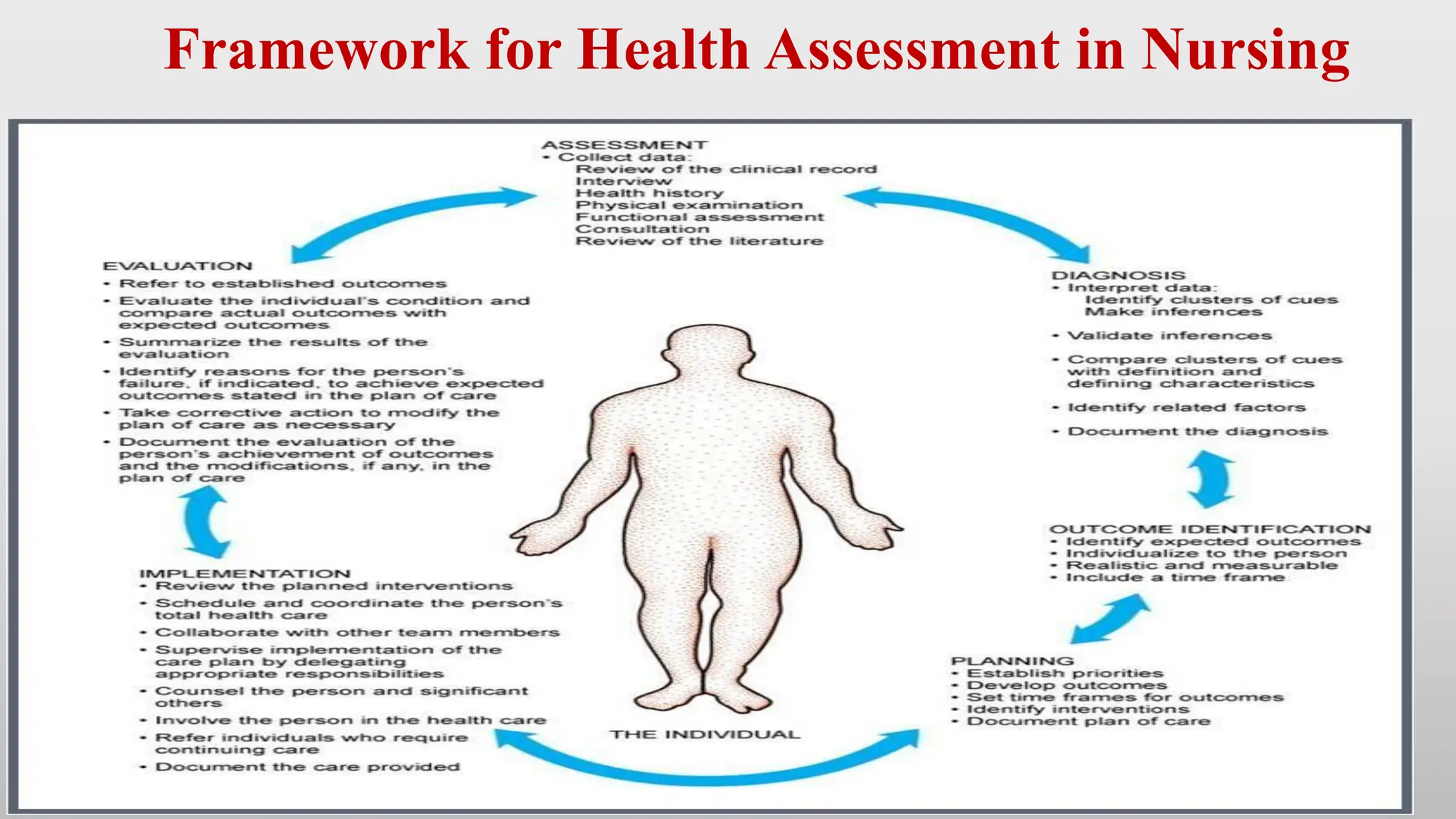
Framework for Health Assessment in Nursing
4
Definition: Health Assessment
Health assessment is an organized systematic
assessment of human body which involves the use of
one’s senses to determine the general physical and
mental conditions of the body by collecting both
subjective and objectives data 5
NURSING PROCESS
COMPONENTS
Health assessment has two
parts:
1. Health History contains
Subjective information.
2. Physical Examination is
Objective data about a
patient’s health status.
7
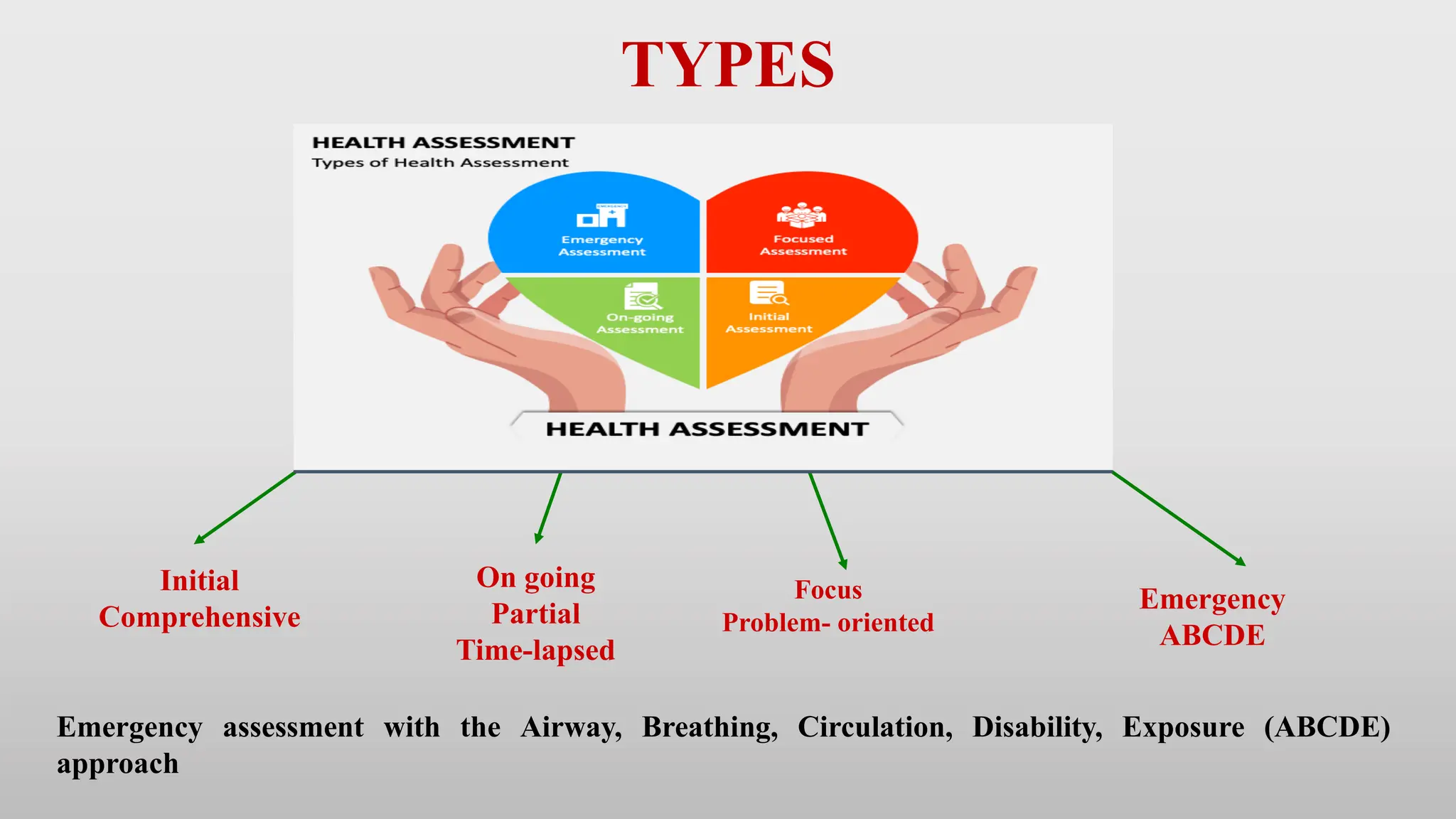
TYPES
On going
Partial
Time-lapsed
Initial
Comprehensive
Emergency
ABCDE
Health Assessment
Emergency assessment with the Airway, Breathing, Circulation, Disability, Exposure (ABCDE)
approach
Focus
Problem- oriented
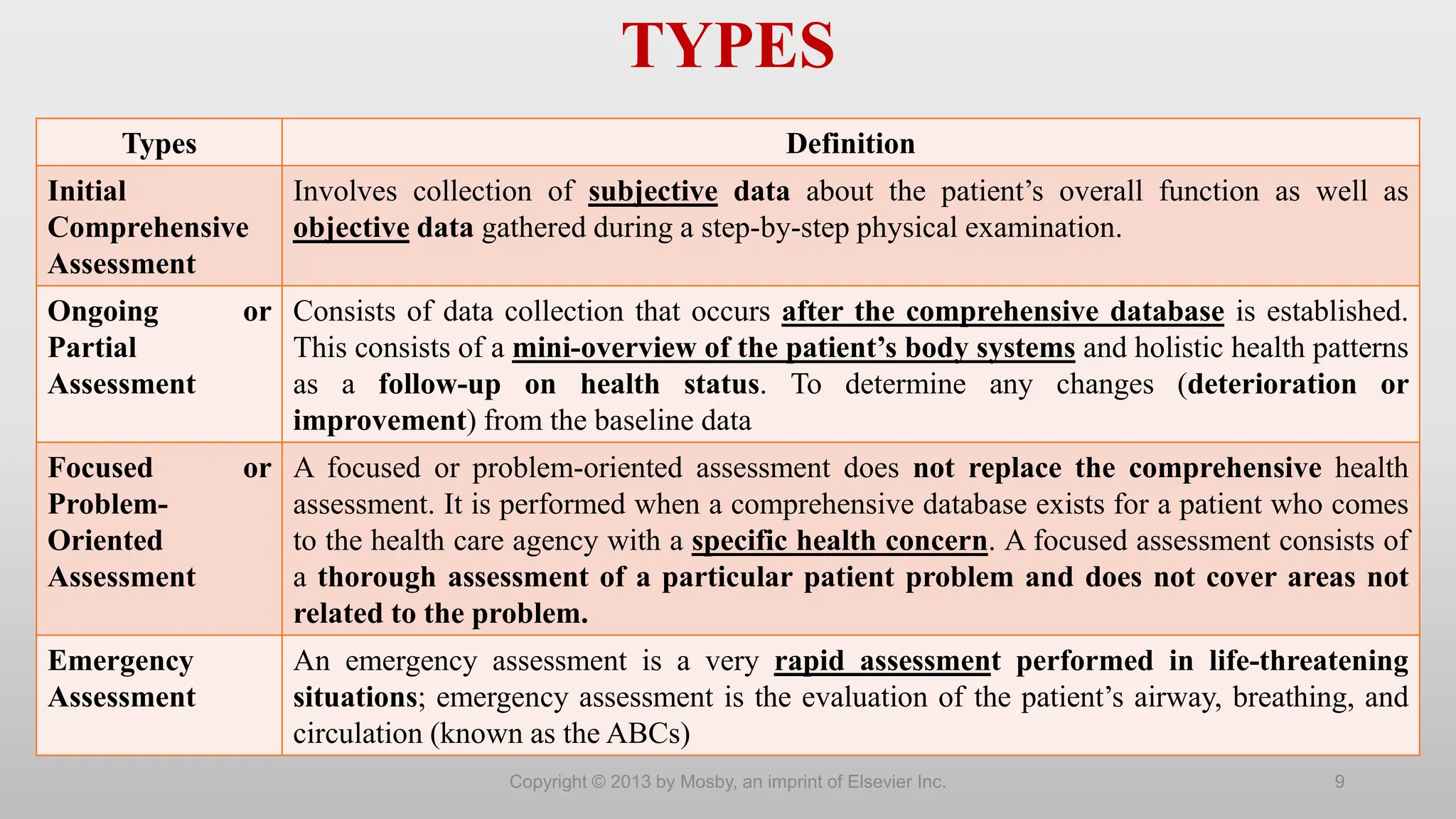
TYPES
Types Definition
Initial
Comprehensive
Assessment
Involves collection of subjective data about the patient’s overall function as well as
objective data gathered during a step-by-step physical examination.
Ongoing or
Partial
Assessment
Consists of data collection that occurs after the comprehensive database is established.
This consists of a mini-overview of the patient’s body systems and holistic health patterns
as a follow-up on health status. To determine any changes (deterioration or
improvement) from the baseline data
Focused or
Problem-
Oriented
Assessment
A focused or problem-oriented assessment does not replace the comprehensive health
assessment. It is performed when a comprehensive database exists for a patient who comes
to the health care agency with a specific health concern. A focused assessment consists of
a thorough assessment of a particular patient problem and does not cover areas not
related to the problem.
Emergency
Assessment
An emergency assessment is a very rapid assessment performed in life-threatening
situations; emergency assessment is the evaluation of the patient’s airway, breathing, and
circulation (known as the ABCs)
Copyright © 2013 by Mosby, an imprint of Elsevier Inc. 9
STEPS
Collection of subjective data “Health History”.
Collection of objective data “Physical Examination”.
Validation of data.
Documentation of data.
INDICATION
On admission.
On discharge.
On follow up.
Health camps.
Before and after diagnostic and therapeutic
procedure.
FACTS
- The chances of overlooking important data are greatly reduced because the
Health Assessment is performed in an organized, systematic manner,
instead of a random manner.
- It provides the foundation for the nursing care plan in which nursing’s
observations play an integral part in assessment, diagnosis, intervention
and evaluation phases.
- The health history and physical examination is the first step in the
nursing process.
- A physical assessment should be adjusted to the patient, based on his
needs.
- The physical examination is an organized systemic process of collecting
objective data through head –to- toe or general systems examination
based upon a health history. 12
CONSIDERATIONS
- Establish a positive nurse/patient rapport to decrease the
stress.
- Explain the purpose for the assessment.
- Obtain an informed, verbal consent for the assessment.
- Ensure confidentiality of all data.
- Communicate special instructions to the patient.
- Provide privacy from unnecessary exposure.
- The data must be factual, not interpretive.
13
A sturdy knowledge base enables you to
look for, rather than merely look at.
14
Web Site
https://www.youtube.com/channel/UC6dUFL1akbA2BdUUI
ERSNJw
References
- Bickly, L.S. (2013). Bates’: Guide to Physical Examination and History
Taking. 11th ed, Lippincott Williams & Wilkins co.
- Jarvis, C. (2012). Physical Examination and Health Assessment, 6th ed.,
Elsevier Saunders.
- Kelley, J.H. (2010). Health Assessment in Nursing. 4th ed., Lippincott
Williams & Wilkins and Wolterers Kluwer Co.
- Weber, Lippincott Williams & Wilkins (2005). Assessment made Incredibly
Easy. 3rd ed, A Wolterers Kluwer Co.
- Weber, J., Kelley, J.H. (1998). Health Assessment in Nursing. 4th ed.,
Lippincott Williams & Wilkins and Wolterers Kluwer Co.
16
Health Assessment Intoduction - Lecture 1.pdf

Health Assessment Intoduction - Lecture 1.pdf

  • 1.
    Health Assessment Course Dr.Lamia Mohamed Nabil Ismail Ass. Prof. of Nursing Education Department
  • 2.
    INTRODUCTION - Assessment ofthe patient provides baseline data for the nursing process. - The nurse gathers information to identify the health status of the patient “physical and psychosocial needs”. - Assessments are made initially and continuously throughout patient care. - The remaining phases of the nursing process depend on the validity and completeness of the initial data collection. 2
  • 3.
    INTRODUCTION - While thefindings of a health assessment do sometimes contribute to the identification of a medical diagnosis, the unique focus of a nursing assessment is on the patient’s responses to actual or potential problems “Nursing Diagnosis”. - The purpose of the nursing assessment is to gather information about the patient’s health so that the nurse can plan individualized care for the patient. 3
  • 4.
    Framework for HealthAssessment in Nursing 4
  • 5.
    Definition: Health Assessment Healthassessment is an organized systematic assessment of human body which involves the use of one’s senses to determine the general physical and mental conditions of the body by collecting both subjective and objectives data 5
  • 6.
  • 7.
    COMPONENTS Health assessment hastwo parts: 1. Health History contains Subjective information. 2. Physical Examination is Objective data about a patient’s health status. 7
  • 8.
    TYPES On going Partial Time-lapsed Initial Comprehensive Emergency ABCDE Health Assessment Emergencyassessment with the Airway, Breathing, Circulation, Disability, Exposure (ABCDE) approach Focus Problem- oriented
  • 9.
    TYPES Types Definition Initial Comprehensive Assessment Involves collectionof subjective data about the patient’s overall function as well as objective data gathered during a step-by-step physical examination. Ongoing or Partial Assessment Consists of data collection that occurs after the comprehensive database is established. This consists of a mini-overview of the patient’s body systems and holistic health patterns as a follow-up on health status. To determine any changes (deterioration or improvement) from the baseline data Focused or Problem- Oriented Assessment A focused or problem-oriented assessment does not replace the comprehensive health assessment. It is performed when a comprehensive database exists for a patient who comes to the health care agency with a specific health concern. A focused assessment consists of a thorough assessment of a particular patient problem and does not cover areas not related to the problem. Emergency Assessment An emergency assessment is a very rapid assessment performed in life-threatening situations; emergency assessment is the evaluation of the patient’s airway, breathing, and circulation (known as the ABCs) Copyright © 2013 by Mosby, an imprint of Elsevier Inc. 9
  • 10.
    STEPS Collection of subjectivedata “Health History”. Collection of objective data “Physical Examination”. Validation of data. Documentation of data.
  • 11.
    INDICATION On admission. On discharge. Onfollow up. Health camps. Before and after diagnostic and therapeutic procedure.
  • 12.
    FACTS - The chancesof overlooking important data are greatly reduced because the Health Assessment is performed in an organized, systematic manner, instead of a random manner. - It provides the foundation for the nursing care plan in which nursing’s observations play an integral part in assessment, diagnosis, intervention and evaluation phases. - The health history and physical examination is the first step in the nursing process. - A physical assessment should be adjusted to the patient, based on his needs. - The physical examination is an organized systemic process of collecting objective data through head –to- toe or general systems examination based upon a health history. 12
  • 13.
    CONSIDERATIONS - Establish apositive nurse/patient rapport to decrease the stress. - Explain the purpose for the assessment. - Obtain an informed, verbal consent for the assessment. - Ensure confidentiality of all data. - Communicate special instructions to the patient. - Provide privacy from unnecessary exposure. - The data must be factual, not interpretive. 13
  • 14.
    A sturdy knowledgebase enables you to look for, rather than merely look at. 14
  • 15.
  • 16.
    References - Bickly, L.S.(2013). Bates’: Guide to Physical Examination and History Taking. 11th ed, Lippincott Williams & Wilkins co. - Jarvis, C. (2012). Physical Examination and Health Assessment, 6th ed., Elsevier Saunders. - Kelley, J.H. (2010). Health Assessment in Nursing. 4th ed., Lippincott Williams & Wilkins and Wolterers Kluwer Co. - Weber, Lippincott Williams & Wilkins (2005). Assessment made Incredibly Easy. 3rd ed, A Wolterers Kluwer Co. - Weber, J., Kelley, J.H. (1998). Health Assessment in Nursing. 4th ed., Lippincott Williams & Wilkins and Wolterers Kluwer Co. 16