Let’s talk about Headless
Commerce
Dr Elvira Bolat
ebolat@bournemouth.ac.uk
@Elvira_Mlady
Learning Outcomes
• Understand E-commerce
• Overview of web-design principles
• Explore all XX-commerce concepts starting with
• Explore the concept of customer lifecycle
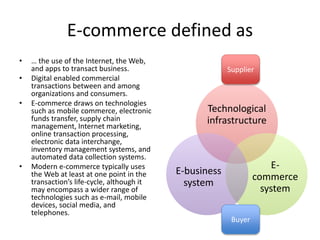
E-commerce defined as
• … the use of the Internet, the Web,
and apps to transact business.
• Digital enabled commercial
transactions between and among
organizations and consumers.
• E-commerce draws on technologies
such as mobile commerce, electronic
funds transfer, supply chain
management, Internet marketing,
online transaction processing,
electronic data interchange,
inventory management systems, and
automated data collection systems.
• Modern e-commerce typically uses
the Web at least at one point in the
transaction’s life-cycle, although it
may encompass a wider range of
technologies such as e-mail, mobile
devices, social media, and
telephones.
Technological
infrastructure
E-
commerce
system
E-business
system
Buyer
Supplier
E-commerce process:
• Customers browse through e-
commerce sites and add the selected
products to virtual shopping cart.
Order can be placed via internet or
phone call.
• Customer will be charged for Order.
• After successful payment, Order is
confirmed for further processing.
• Email containing Ordered product’s
details will be sent to Customer and
Merchant. Further Order is sent to
Warehouse for order fulfillment (i.e.
Amazon).
• After the shipment is ready from
Warehouse, it is picked by Shipping
carrier.
• Shipment is sent to Customer and
Order is completed.
• Post order activities: returns, after
sale service, retention (upselling,
cross-selling)
Alternatives: brick vs./and online stores
(i.e. HKTV mall, Argos)
E-commerce history
1979: Michael Aldrich demonstrates the first
online shopping system.
1981: Thomson Holidays UK is first business-
to-business online shopping system to be
installed.
1995: Jeff Bezos launches Amazon.com. Dell
and Cisco begin to aggressively use Internet
for commercial transactions. eBay is founded
by computer programmer Pierre Omidyar as
Auction Web.
2000: The dot-com bust.
2012: US eCommerce and Online Retail sales
projected to reach $226 billion, an increase of
12 percent over 2011
2012: US eCommerce and Online Retail
holiday sales reach $33.8 billion, up 13
percent.
Types of online business
• Online business that migrated from offline
business:
• E-retailer (Amazon, 1994)
• Online auction (eBay, 1995)
• Online communication (Yahoo, 1995;
Google,1998; Skype,2003)
• Online blog (Blogger, 1999)
• B2B marketplace (Alibaba, 1999)
• Social network (Facebook, 2004)
• E-marketplace: Taobao
Digital Business is about …
• the digital enabling of transactions and
processes within a firm, involving information
systems under the control of the firm.
• E-business applications turns into e-commerce
when an exchange of value occurs.
Diverse theoretical perspectives on e-
commerce
If we assumer that transactions “non-financial transactions”
as well, almost all electronically mediated transactions
(communication) between and among organizations and
consumers should be included in E-commerce definition and
scope!
 A Communication perspective - delivers of information, products or
services or payments.
 A Business process perspective - automation of business transaction
and workflows (i.e. online airline check-in)
 A Service perspective - increase the speed or quality of delivery
 An Online perspective - buying and selling online:
 Buy-side e-commerce (purchasing, sourcing, like Walmart Purchasing)
 Sell-side e-commerce (more relevant to marketing)
A communication perspective
A business process perspective
A service perspective
An online perspective
Different types of sell-side e-
commerce websites
• Services-oriented / relationship building (e.g.
British Gas, Eon)
• Brand-building (e.g. Coca-Cola, Heineken)
• Transactional e-commerce (e.g. Amazon, Net-
a-Porter, Asos)
• Portal or media (e.g. Google, Silicon.com)
• Social networking
Overview
of web-
design
principles
Playfulness: Control
http://www.eddiebauer.com
https://www.mymms.com
+ Participation
• User content creation
• Information sharing
• Participation Intensity
• Incentives provision
• Task creation
www.designbyhumans.com
F-commerce
E-Commerce
T-commerce
S-Commerce
M-commerce
P-commerce
SoLoMo
M-commerce
M-commerce trends
P-commerce
SoLoMo
Social Media:
Social CEOs: 77% of buyers say they are more likely to buy from a company whose CEO
uses social media1.
Social Executives: 94% said C-suite social media participation enhances a brand image.
Employee Trust: 82% of employees say they trust a company more when the CEO and
leadership team communicate via social media.
Consumer Trust: Positive online reviews make 52% of consumers more likely to use a
local business.
Proliferation: 91% of online adults use social media regularly.
Facebook Preference: 80% of users prefer to connect with brands on Facebook.
Commerce and Content:
eCommerce Influence: By 2016, more than half of the dollars spent in US retail will be
influenced by the Web.
Bargain Shopping: 70% of online holiday buyers say they purchased online instead of in
stores because deals online were better.
Magnitude: US eCommerce is expected to reach $278.9B in 2015.
SoLoMo
Local:
Checking In: 16.7 million Americans checked in via services such as Gowalla or
Foursquare in April. That’s 7% of the US mobile phone population.
Location-Aware: 19% of Men and 10% of Women setup their social media accounts to
automatically include location in their posts.
Being Found: 59% of consumers use Google every month to find local businesses.
Mobile:
Proliferation: Global Mobile devices to go from 3.4 Billion in 2010 to 7.9 Billion in 2015.
Influence on Retail: By 2016, $689 Billion will be influenced by mobile retail.
Tablet Time: The average tablet user spends 13.9 hours per week with the device.
Some Kind of Mobile: 88% of adults in the US have a cell phone, 57% have a laptop,
19% own an e-reader, and 19% have a tablet.
Headless commerce
• simply means rethinking the e-commerce
platform as a collection of digital services
supporting commerce rather than a solution for
web e-commerce specifically.
• It is about separating concerns: templating,
presentation and interactive layers of the
customer experience (customer interaction)
should be separate from order management,
payment acquisition, and product information
management systems.
Dash Button orders increased by 70 percent in the past year
and now occur twice per minute.
UX begins with
understanding customer lifecycle and
journey
Customer lifecycle
Your Persona?
Your Persona?
Short exercise: Pick your favorite brand and
conduct a customer journey map for your
interaction with the brand.
Headless Commerce

Headless Commerce

  • 1.
    Let’s talk aboutHeadless Commerce Dr Elvira Bolat ebolat@bournemouth.ac.uk @Elvira_Mlady
  • 3.
    Learning Outcomes • UnderstandE-commerce • Overview of web-design principles • Explore all XX-commerce concepts starting with • Explore the concept of customer lifecycle
  • 4.
    E-commerce defined as •… the use of the Internet, the Web, and apps to transact business. • Digital enabled commercial transactions between and among organizations and consumers. • E-commerce draws on technologies such as mobile commerce, electronic funds transfer, supply chain management, Internet marketing, online transaction processing, electronic data interchange, inventory management systems, and automated data collection systems. • Modern e-commerce typically uses the Web at least at one point in the transaction’s life-cycle, although it may encompass a wider range of technologies such as e-mail, mobile devices, social media, and telephones. Technological infrastructure E- commerce system E-business system Buyer Supplier
  • 5.
    E-commerce process: • Customersbrowse through e- commerce sites and add the selected products to virtual shopping cart. Order can be placed via internet or phone call. • Customer will be charged for Order. • After successful payment, Order is confirmed for further processing. • Email containing Ordered product’s details will be sent to Customer and Merchant. Further Order is sent to Warehouse for order fulfillment (i.e. Amazon). • After the shipment is ready from Warehouse, it is picked by Shipping carrier. • Shipment is sent to Customer and Order is completed. • Post order activities: returns, after sale service, retention (upselling, cross-selling) Alternatives: brick vs./and online stores (i.e. HKTV mall, Argos)
  • 6.
    E-commerce history 1979: MichaelAldrich demonstrates the first online shopping system. 1981: Thomson Holidays UK is first business- to-business online shopping system to be installed. 1995: Jeff Bezos launches Amazon.com. Dell and Cisco begin to aggressively use Internet for commercial transactions. eBay is founded by computer programmer Pierre Omidyar as Auction Web. 2000: The dot-com bust. 2012: US eCommerce and Online Retail sales projected to reach $226 billion, an increase of 12 percent over 2011 2012: US eCommerce and Online Retail holiday sales reach $33.8 billion, up 13 percent.
  • 7.
    Types of onlinebusiness • Online business that migrated from offline business: • E-retailer (Amazon, 1994) • Online auction (eBay, 1995) • Online communication (Yahoo, 1995; Google,1998; Skype,2003) • Online blog (Blogger, 1999) • B2B marketplace (Alibaba, 1999) • Social network (Facebook, 2004) • E-marketplace: Taobao
  • 8.
    Digital Business isabout … • the digital enabling of transactions and processes within a firm, involving information systems under the control of the firm. • E-business applications turns into e-commerce when an exchange of value occurs.
  • 9.
    Diverse theoretical perspectiveson e- commerce If we assumer that transactions “non-financial transactions” as well, almost all electronically mediated transactions (communication) between and among organizations and consumers should be included in E-commerce definition and scope!  A Communication perspective - delivers of information, products or services or payments.  A Business process perspective - automation of business transaction and workflows (i.e. online airline check-in)  A Service perspective - increase the speed or quality of delivery  An Online perspective - buying and selling online:  Buy-side e-commerce (purchasing, sourcing, like Walmart Purchasing)  Sell-side e-commerce (more relevant to marketing)
  • 10.
  • 11.
    A business processperspective
  • 12.
  • 13.
  • 14.
    Different types ofsell-side e- commerce websites • Services-oriented / relationship building (e.g. British Gas, Eon) • Brand-building (e.g. Coca-Cola, Heineken) • Transactional e-commerce (e.g. Amazon, Net- a-Porter, Asos) • Portal or media (e.g. Google, Silicon.com) • Social networking
  • 15.
  • 16.
  • 17.
    + Participation • Usercontent creation • Information sharing • Participation Intensity • Incentives provision • Task creation www.designbyhumans.com
  • 18.
  • 19.
  • 20.
  • 21.
  • 24.
    SoLoMo Social Media: Social CEOs:77% of buyers say they are more likely to buy from a company whose CEO uses social media1. Social Executives: 94% said C-suite social media participation enhances a brand image. Employee Trust: 82% of employees say they trust a company more when the CEO and leadership team communicate via social media. Consumer Trust: Positive online reviews make 52% of consumers more likely to use a local business. Proliferation: 91% of online adults use social media regularly. Facebook Preference: 80% of users prefer to connect with brands on Facebook. Commerce and Content: eCommerce Influence: By 2016, more than half of the dollars spent in US retail will be influenced by the Web. Bargain Shopping: 70% of online holiday buyers say they purchased online instead of in stores because deals online were better. Magnitude: US eCommerce is expected to reach $278.9B in 2015.
  • 25.
    SoLoMo Local: Checking In: 16.7million Americans checked in via services such as Gowalla or Foursquare in April. That’s 7% of the US mobile phone population. Location-Aware: 19% of Men and 10% of Women setup their social media accounts to automatically include location in their posts. Being Found: 59% of consumers use Google every month to find local businesses. Mobile: Proliferation: Global Mobile devices to go from 3.4 Billion in 2010 to 7.9 Billion in 2015. Influence on Retail: By 2016, $689 Billion will be influenced by mobile retail. Tablet Time: The average tablet user spends 13.9 hours per week with the device. Some Kind of Mobile: 88% of adults in the US have a cell phone, 57% have a laptop, 19% own an e-reader, and 19% have a tablet.
  • 26.
    Headless commerce • simplymeans rethinking the e-commerce platform as a collection of digital services supporting commerce rather than a solution for web e-commerce specifically. • It is about separating concerns: templating, presentation and interactive layers of the customer experience (customer interaction) should be separate from order management, payment acquisition, and product information management systems.
  • 27.
    Dash Button ordersincreased by 70 percent in the past year and now occur twice per minute.
  • 28.
    UX begins with understandingcustomer lifecycle and journey
  • 31.
  • 32.
  • 33.
  • 35.
    Short exercise: Pickyour favorite brand and conduct a customer journey map for your interaction with the brand.