Head and Neck
Including Regional
    Lymphatics
      N1037
Head and Neck &
Regional Lymphatics
 Review and locate – The
    Skull (bones of the
  cranium and the face)
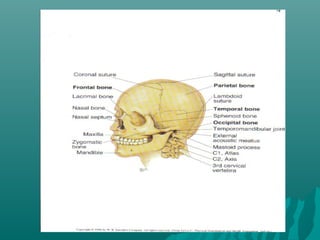
Note the location of the
  CRANIAL BONES
  Frontal, Parietal, Occipital
         & Temporal
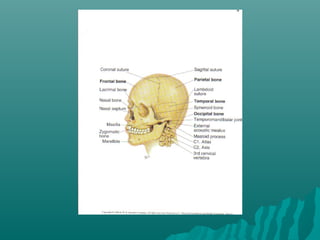
Note the location of the
       sutures.

     Coronal, Sagittal,
         Lambdoid
   Unite adjacent cranial
           bones
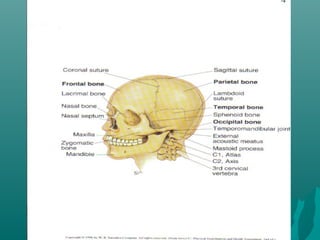
Note facial bones.
  Nasal, Lacrimal, Maxilla,
Sphenoid & Zygomatic bones.

 Mandible (moves up, down,
         sideways)
Head-facial muscles
   Facial expressions are formed by
    facial muscles
   Facial structures should be
    symmetric.
   Facial muscles are innervated by
    cranial nerve VII
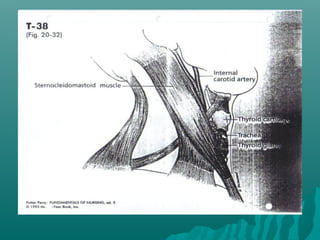
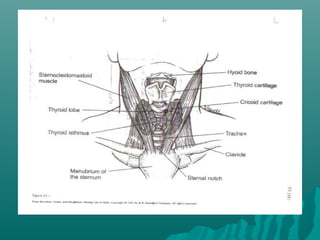
Note major Neck
    muscles.
Sternocleidomastoids and
     trapezii muscles

 (each side of neck form
  2 triangles- anterior &
   posterior cervical )
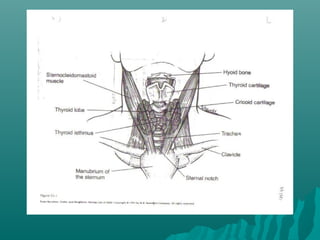
Thyroid gland and
        other landmarks
Thyroid gland - largest endocrine gland
               -secretes T3 & T4 to regulate cellular
                      metabolism
              -flattened butterfly shape structure
              - 2 lateral lobes connected by isthmus
              - isthmus rest on trachea, inferior to
                 the criocoid cartilage (highest point
                                         Adam’s Apple)
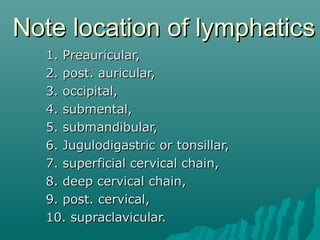
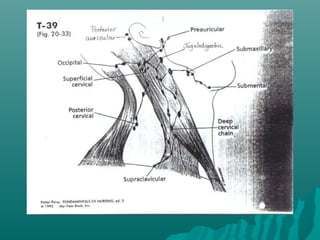
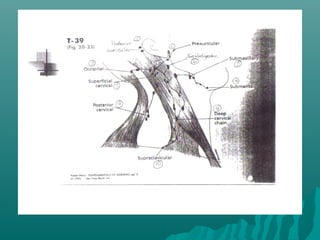
Note location of lymphatics
  1. Preauricular,
  2. post. auricular,
  3. occipital,
  4. submental,
  5. submandibular,
  6. Jugulodigastric or tonsillar,
  7. superficial cervical chain,
  8. deep cervical chain,
  9. post. cervical,
  10. supraclavicular.
Lymph Nodes
 Usuallyless than 1 cm
 round or ovid in shape

 smooth in consistency


 when  enlarged or tender - assess for
 infection or maligancy and the area
 the node drains ( see p322 example)
BLOOD SUPPLY
 Major   arteries to head and neck
  – common carotids bifurcate into
  – internal & external carotids
 Major   veins from head and neck
  – internal an external jugular veins
  – and subclavian veins
Head and Neck &
Regional Lymphatics
     Health History
    Subjective Data
Head and Neck & Regional
      Lymphatics- Health Hx
• facial or neck surgery
• history of headaches or dizziness
• allergies
• Neck pain, limitation of movement

• Lumps or swelling, difficulty
  swallowing or chewing, history of
  smoking
• head injuries
Head: Inspect and
palpate the skull
   Objective Data
Head: Inspect and palpate the
            skull
Size and Shape
 (I)Normocephalic: round, symmetric
  and approximated to body size.
 (P)Shape: symmetric and smooth, no
  tenderness reported.
  –   Use finger pads on scalp & palpate all surfaces
  –   Assess contour, masses, depressions,tenderness
  –   Note deformities lumps and tenderness.
Head: Inspect and palpate the
           scalp
 (I)
    Scalp should be shiny, intact and
 without lesions or masses.
  – Part hair repeatedly and inspect scalp

 (P)palpate with finger pads on the
 scalp for lesions or masses
Head: Inspection of the face
   (I) Symmetry of facial features:
     – Observe facial expression, shape and
       symmetry of nose, eyes, eyebrows, mouth,
       ears
   (I) Shape and features of face
     – Note shape of face
     – Note swelling (edema) , abnormal features,
       disproportionate structures (stroke, Bell’s Palsy
       = cranial nerve 7 damage -facial nerve), and
       involuntary movement (the presence of tics
       -normally none occur)
   (I) Facial expression: emotions
     – Note appropriateness to verbal and nonverbal
Head: Palpate and
      Auscultation of Mandible
Temporal Area
 (P)Temporal artery: above the cheek bone, between
  the eye and the top of ear.
   – Palpate with finger pads for pulse
 (P)Temporomandibular joint: articulates smoothly
  with no limitation, no crepitus, no clicking
   – use index and middle finger to palpate anterior to
     tragus of ear on both sides
   – ask pt to open & close mouth
   – observe smoothness of movement, any discomfort
   – clicking/crepitus could indicate arthritis or
     dislocation
The Neck- Inspect and
      palpate

    Objective Data
The Neck- Inspect and palpate
What position do you ask the client to
 assume while you inspect the neck?

   Head erect and still, sitting up
    straight, head at your eye level
The Neck- Inspect and palpate
Symmetry
 Head position: centered, midline, erect, still

 Symmetry of the Sternocleidomastoid & trapezii
  muscles
 ROM of neck (flexion, lateral rotation, lateral
  bending, extension, test muscle strength:Touch chin
  to chest, ear to shoulder
     Turn head left to right
     Extend head backwards
     Motions should be smooth and controlled.
     resists movement of shoulder shrug and head turn side to
      side
          limited ROM with meningitis, muscle spasm, osteoarthritis
The Neck- Inspect and palpate
   (P) Muscles - should be symmetrical &
    without palpable masses or spasms
    – palpate Sternocleidomastoid and trapezii muscles
      for tenderness, masses, spasms
    – spasms due to infections, trauma, chronic
      inflammation, neoplasm
The Neck- Inspect and palpate
Lymph Nodes
   (P) Lymph nodes - should not be palpable, but
    small discrete , movable nodes are often
    present
     Begin with preauricular lymph nodes and proceed
      in a systematic fashion (1 to 10)
     Use gentle pressure
     Deep cervical chain: tip head toward side
     Supraclavicular Node: hunch shoulders & elbows
      forward
    tender nodes = inflamed due to infection
    firm, non movable nodes may be = malignancy
The Neck- Inspect and palpate
Trachea

 Midline normal (note deviations)
 Palpate for tracheal shift: space
  should be symmetric on both sides.
The Neck- Inspect, palpate,
           auscultate
Thyroid Gland
 inspect for swelling using lamp (ask to
  sip and swallow water)
  – thyroid tissue moves up with swallowing
   observe for goiter - enlarged thyroid
 palpate    -anterior/posterior approaches
  – have pt slightly lower head to relax neck muscles
  – palpate isthmus for nodules, masses, tenderness or
    enlargement while swallowing
  – then displace/stabilize lobe on one side and palpate the
    other side while pt swallows
   gland is smooth, soft, & no tenderness/enlrgmt/masses
The Neck- Inspect, palpate,
         auscultate
 auscultate    lobes for bruit
  – (use bell)
  – no bruit should be present
  bruits indicate blood supply r/t tumor or toxic
    goiter.
Developmental Considerations
Infant/Children
 Skull and fontanels


Pregnant Female
 Cholasma on face = pregnancy mask


Aging Adult
 Temporal arteries twisted and visible
 Rhythmic tremor of head may be present
 Perform ROM slowly to prevent dizziness

Head neck ppt

  • 1.
    Head and Neck IncludingRegional Lymphatics N1037
  • 2.
    Head and Neck& Regional Lymphatics Review and locate – The Skull (bones of the cranium and the face)
  • 3.
    Note the locationof the CRANIAL BONES Frontal, Parietal, Occipital & Temporal
  • 5.
    Note the locationof the sutures. Coronal, Sagittal, Lambdoid Unite adjacent cranial bones
  • 7.
    Note facial bones. Nasal, Lacrimal, Maxilla, Sphenoid & Zygomatic bones. Mandible (moves up, down, sideways)
  • 9.
    Head-facial muscles  Facial expressions are formed by facial muscles  Facial structures should be symmetric.  Facial muscles are innervated by cranial nerve VII
  • 10.
    Note major Neck muscles. Sternocleidomastoids and trapezii muscles (each side of neck form 2 triangles- anterior & posterior cervical )
  • 12.
    Thyroid gland and other landmarks Thyroid gland - largest endocrine gland -secretes T3 & T4 to regulate cellular metabolism -flattened butterfly shape structure - 2 lateral lobes connected by isthmus - isthmus rest on trachea, inferior to the criocoid cartilage (highest point Adam’s Apple)
  • 14.
    Note location oflymphatics 1. Preauricular, 2. post. auricular, 3. occipital, 4. submental, 5. submandibular, 6. Jugulodigastric or tonsillar, 7. superficial cervical chain, 8. deep cervical chain, 9. post. cervical, 10. supraclavicular.
  • 15.
    Lymph Nodes  Usuallylessthan 1 cm  round or ovid in shape  smooth in consistency  when enlarged or tender - assess for infection or maligancy and the area the node drains ( see p322 example)
  • 17.
    BLOOD SUPPLY  Major arteries to head and neck – common carotids bifurcate into – internal & external carotids  Major veins from head and neck – internal an external jugular veins – and subclavian veins
  • 18.
    Head and Neck& Regional Lymphatics Health History Subjective Data
  • 19.
    Head and Neck& Regional Lymphatics- Health Hx • facial or neck surgery • history of headaches or dizziness • allergies • Neck pain, limitation of movement • Lumps or swelling, difficulty swallowing or chewing, history of smoking • head injuries
  • 20.
    Head: Inspect and palpatethe skull Objective Data
  • 21.
    Head: Inspect andpalpate the skull Size and Shape  (I)Normocephalic: round, symmetric and approximated to body size.  (P)Shape: symmetric and smooth, no tenderness reported. – Use finger pads on scalp & palpate all surfaces – Assess contour, masses, depressions,tenderness – Note deformities lumps and tenderness.
  • 22.
    Head: Inspect andpalpate the scalp  (I) Scalp should be shiny, intact and without lesions or masses. – Part hair repeatedly and inspect scalp  (P)palpate with finger pads on the scalp for lesions or masses
  • 23.
    Head: Inspection ofthe face  (I) Symmetry of facial features: – Observe facial expression, shape and symmetry of nose, eyes, eyebrows, mouth, ears  (I) Shape and features of face – Note shape of face – Note swelling (edema) , abnormal features, disproportionate structures (stroke, Bell’s Palsy = cranial nerve 7 damage -facial nerve), and involuntary movement (the presence of tics -normally none occur)  (I) Facial expression: emotions – Note appropriateness to verbal and nonverbal
  • 24.
    Head: Palpate and Auscultation of Mandible Temporal Area  (P)Temporal artery: above the cheek bone, between the eye and the top of ear. – Palpate with finger pads for pulse  (P)Temporomandibular joint: articulates smoothly with no limitation, no crepitus, no clicking – use index and middle finger to palpate anterior to tragus of ear on both sides – ask pt to open & close mouth – observe smoothness of movement, any discomfort – clicking/crepitus could indicate arthritis or dislocation
  • 25.
    The Neck- Inspectand palpate Objective Data
  • 26.
    The Neck- Inspectand palpate What position do you ask the client to assume while you inspect the neck?  Head erect and still, sitting up straight, head at your eye level
  • 27.
    The Neck- Inspectand palpate Symmetry  Head position: centered, midline, erect, still  Symmetry of the Sternocleidomastoid & trapezii muscles  ROM of neck (flexion, lateral rotation, lateral bending, extension, test muscle strength:Touch chin to chest, ear to shoulder  Turn head left to right  Extend head backwards  Motions should be smooth and controlled.  resists movement of shoulder shrug and head turn side to side  limited ROM with meningitis, muscle spasm, osteoarthritis
  • 28.
    The Neck- Inspectand palpate  (P) Muscles - should be symmetrical & without palpable masses or spasms – palpate Sternocleidomastoid and trapezii muscles for tenderness, masses, spasms – spasms due to infections, trauma, chronic inflammation, neoplasm
  • 29.
    The Neck- Inspectand palpate Lymph Nodes  (P) Lymph nodes - should not be palpable, but small discrete , movable nodes are often present  Begin with preauricular lymph nodes and proceed in a systematic fashion (1 to 10)  Use gentle pressure  Deep cervical chain: tip head toward side  Supraclavicular Node: hunch shoulders & elbows forward tender nodes = inflamed due to infection firm, non movable nodes may be = malignancy
  • 31.
    The Neck- Inspectand palpate Trachea  Midline normal (note deviations)  Palpate for tracheal shift: space should be symmetric on both sides.
  • 32.
    The Neck- Inspect,palpate, auscultate Thyroid Gland  inspect for swelling using lamp (ask to sip and swallow water) – thyroid tissue moves up with swallowing  observe for goiter - enlarged thyroid  palpate -anterior/posterior approaches – have pt slightly lower head to relax neck muscles – palpate isthmus for nodules, masses, tenderness or enlargement while swallowing – then displace/stabilize lobe on one side and palpate the other side while pt swallows  gland is smooth, soft, & no tenderness/enlrgmt/masses
  • 33.
    The Neck- Inspect,palpate, auscultate  auscultate lobes for bruit – (use bell) – no bruit should be present bruits indicate blood supply r/t tumor or toxic goiter.
  • 35.
    Developmental Considerations Infant/Children  Skulland fontanels Pregnant Female  Cholasma on face = pregnancy mask Aging Adult  Temporal arteries twisted and visible  Rhythmic tremor of head may be present  Perform ROM slowly to prevent dizziness