Republic of Iraq
Ministry of Higher Education & Scientific Research
Al-Hadi University Collage
Head, Face, and Neck Assessment
Prepared by:
MSc Asmaa Jumaa
Head Examination
:
1- Inspection and Palpation of the Skull:

Normocephalic describes a round, symmetric skull appropriately related to
body size.

The skull normally feels symmetric and smooth. The cranial bones with
normal protrusions are the forehead, the lateral edge of each parietal bone, the
occipital bone, and the mastoid process behind each ear. There is no tenderness
to palpation.

Palpate the temporal artery above the zygomatic (cheek) bone between the
eye and the top of the ear.

Palpate the temporomandibular joints located anterior to each ear as the
person opens the mouth and note normally smooth movement with no
limitation or tenderness.
Lobes of the brain
Temporal and Carotid
artery
Temporomandibular
joints
2- Inspect the Face:
Note the facial expression and its appropriateness to behavior or
reported mood. Anxiety is common in hospitalized or ill
persons
.
Note symmetry of eyebrows, palpebral fissures, nasolabial
folds, and sides of the mouth. Note any abnormal facial
structures (coarse facial features, exophthalmos, and changes in
skin color or pigmentation) or any abnormal swelling. Also note
any involuntary movements (tics) in the facial muscles.
Normally there are none.
Neck Examination
:
1- Inspection and Palpation of the Neck:
A. Symmetry: Head position is in the midline;
accessory neck muscles are symmetric.
B. Range of Motion: Ask the person to touch the chin
to the chest, turn the head to the right and left, try to touch
each ear to the shoulder (without elevating shoulders), and
extend the head backward. Motion is smooth and
controlled.
Neck muscles
C. Lymph Nodes: Using a gentle circular motion of your finger
pads and beginning with the preauricular lymph nodes in front of
the ear, palpate the 10 groups of lymph nodes in a routine order. Be
systematic and thorough. Use gentle pressure because strong
pressure could push the nodes into the neck muscles. It is usually
most efficient to palpate with both hands, comparing the two sides
for the symmetry
.
If any nodes are palpable, note their location, size, shape,
delimitation (discrete or matted together), mobility, consistency,
and tenderness. Cervical nodes often are palpable in healthy people,
although palpability decreases with age. Normal nodes feel
movable, discrete, soft, and non-tender
.
Facial Lymph nodes
D. Thyroid Gland: Position a standing lamp to shine across the
neck to highlight any possible swelling. Supply the person with a
glass of water and first inspect the neck as the person takes a sip
and swallows. Thyroid tissue moves up with a swallow
.
To palpate the thyroid, move behind the person. Ask him or her to
sit up very straight and then bend the head slightly forward and to
the right. This relaxes the neck muscles on the right side. Use the
fingers of your left hand to push the trachea slightly to the right
.
Usually normal adult thyroid is not palpable. If the person has a
long, thin neck, you sometimes can feel the thyroid isthmus over
the tracheal rings. The lateral lobes usually are not palpable; check
them for enlargement, consistency, symmetry, and the presence of
nodules.
E. Other Changes: In older adult
Senile tremors are benign and include head nodding (as if saying yes or no).
If some teeth have been lost, the lower face looks unusually small, with the
mouth sunken in.
The neck may show an increased cervical concave, during the examination
direct the aging person to perform range of motion slowly; he or she may
experience dizziness with side movements.
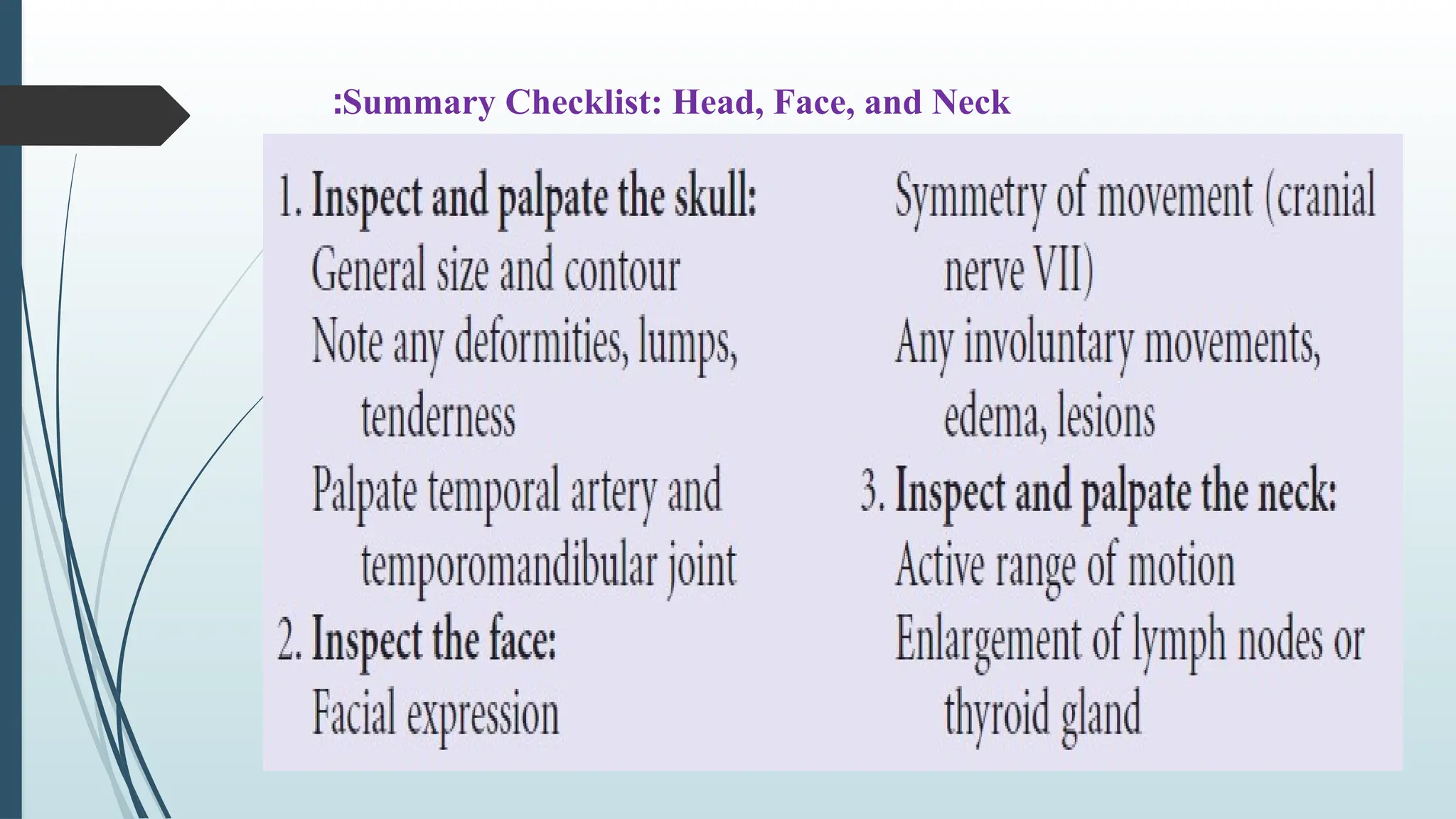
Summary Checklist: Head, Face, and Neck
:
Health assessment Head .face .neck assessment

Health assessment Head .face .neck assessment

  • 1.
    Republic of Iraq Ministryof Higher Education & Scientific Research Al-Hadi University Collage Head, Face, and Neck Assessment Prepared by: MSc Asmaa Jumaa
  • 2.
    Head Examination : 1- Inspectionand Palpation of the Skull:  Normocephalic describes a round, symmetric skull appropriately related to body size.  The skull normally feels symmetric and smooth. The cranial bones with normal protrusions are the forehead, the lateral edge of each parietal bone, the occipital bone, and the mastoid process behind each ear. There is no tenderness to palpation.  Palpate the temporal artery above the zygomatic (cheek) bone between the eye and the top of the ear.  Palpate the temporomandibular joints located anterior to each ear as the person opens the mouth and note normally smooth movement with no limitation or tenderness.
  • 3.
  • 4.
  • 5.
    2- Inspect theFace: Note the facial expression and its appropriateness to behavior or reported mood. Anxiety is common in hospitalized or ill persons . Note symmetry of eyebrows, palpebral fissures, nasolabial folds, and sides of the mouth. Note any abnormal facial structures (coarse facial features, exophthalmos, and changes in skin color or pigmentation) or any abnormal swelling. Also note any involuntary movements (tics) in the facial muscles. Normally there are none.
  • 6.
    Neck Examination : 1- Inspectionand Palpation of the Neck: A. Symmetry: Head position is in the midline; accessory neck muscles are symmetric. B. Range of Motion: Ask the person to touch the chin to the chest, turn the head to the right and left, try to touch each ear to the shoulder (without elevating shoulders), and extend the head backward. Motion is smooth and controlled.
  • 7.
  • 8.
    C. Lymph Nodes:Using a gentle circular motion of your finger pads and beginning with the preauricular lymph nodes in front of the ear, palpate the 10 groups of lymph nodes in a routine order. Be systematic and thorough. Use gentle pressure because strong pressure could push the nodes into the neck muscles. It is usually most efficient to palpate with both hands, comparing the two sides for the symmetry . If any nodes are palpable, note their location, size, shape, delimitation (discrete or matted together), mobility, consistency, and tenderness. Cervical nodes often are palpable in healthy people, although palpability decreases with age. Normal nodes feel movable, discrete, soft, and non-tender .
  • 9.
  • 10.
    D. Thyroid Gland:Position a standing lamp to shine across the neck to highlight any possible swelling. Supply the person with a glass of water and first inspect the neck as the person takes a sip and swallows. Thyroid tissue moves up with a swallow . To palpate the thyroid, move behind the person. Ask him or her to sit up very straight and then bend the head slightly forward and to the right. This relaxes the neck muscles on the right side. Use the fingers of your left hand to push the trachea slightly to the right . Usually normal adult thyroid is not palpable. If the person has a long, thin neck, you sometimes can feel the thyroid isthmus over the tracheal rings. The lateral lobes usually are not palpable; check them for enlargement, consistency, symmetry, and the presence of nodules.
  • 11.
    E. Other Changes:In older adult Senile tremors are benign and include head nodding (as if saying yes or no). If some teeth have been lost, the lower face looks unusually small, with the mouth sunken in. The neck may show an increased cervical concave, during the examination direct the aging person to perform range of motion slowly; he or she may experience dizziness with side movements.
  • 12.
    Summary Checklist: Head,Face, and Neck :