- Large patient cohort prospective study with more than 500 patients and more than 5
years follow up have shown that CyberKnife is equally effective as long coures RT
- SBRT/ CyberKnife is now standard of care treatment for localized prostate cancer
- Outcome of CyberKnife treatment is similar to long course RT
- Side-effect after Cyberknife is less than 1% in prostate cancer
- CyberKnife is safe, out patient, short course treatment in both primary and metastatic
diseases.
- High dose radiation may be effective in many of the ‘radioresistant’ disease.
CyberKnife in prostate cancer
• Most prevalent malignancy in males in western community
• 2nd
MC cause of mortality in the west
• Uncommon in Asians, probably shorter lifespan
• In TMH, constitutes 2.4% of all registered pts in 2000
• In recent years, more early prostate cancer patients are diagnosed
with prostate cancer
• Prostate cancer is slow growing tumour, risk of bone metastasis is
high in ‘high risk’ group patient
Prostate cancer
Risk stratification
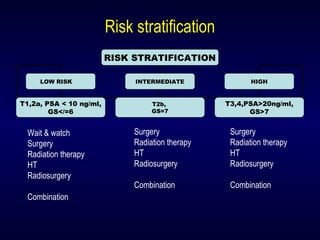
RISK STRATIFICATION
LOW RISK INTERMEDIATE HIGH
T1,2a, PSA < 10 ng/ml,
GS</=6
T2b,
GS=7
T3,4,PSA>20ng/ml,
GS>7
Wait & watch
Surgery
Radiation therapy
HT
Radiosurgery
Combination
Surgery
Radiation therapy
HT
Radiosurgery
Combination
Surgery
Radiation therapy
HT
Radiosurgery
Combination
Radiotherapy
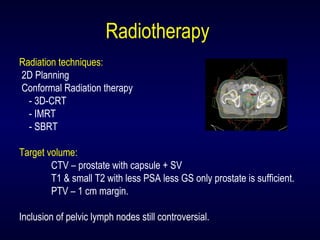
Radiation techniques:
2D Planning
Conformal Radiation therapy
- 3D-CRT
- IMRT
- SBRT
Target volume:
CTV – prostate with capsule + SV
T1 & small T2 with less PSA less GS only prostate is sufficient.
PTV – 1 cm margin.
Inclusion of pelvic lymph nodes still controversial.
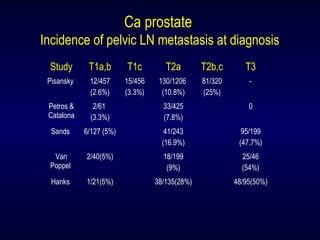
Ca prostate
Incidence of pelvic LN metastasis at diagnosis
Study T1a,b T1c T2a T2b,c T3
Pisansky 12/457
(2.6%)
15/456
(3.3%)
130/1206
(10.8%)
81/320
(25%)
-
Petros &
Catalona
2/61
(3.3%)
33/425
(7.8%)
0
Sands 6/127 (5%) 41/243
(16.9%)
95/199
(47.7%)
Van
Poppel
2/40(5%) 18/199
(9%)
25/46
(54%)
Hanks 1/21(5%) 38/135(28%) 48/95(50%)
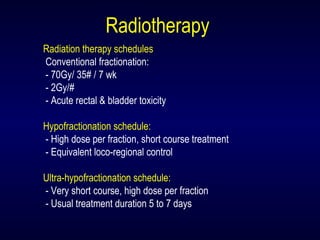
Radiotherapy
Radiation therapy schedules
Conventional fractionation:
- 70Gy/ 35# / 7 wk
- 2Gy/#
- Acute rectal & bladder toxicity
Hypofractionation schedule:
- High dose per fraction, short course treatment
- Equivalent loco-regional control
Ultra-hypofractionation schedule:
- Very short course, high dose per fraction
- Usual treatment duration 5 to 7 days
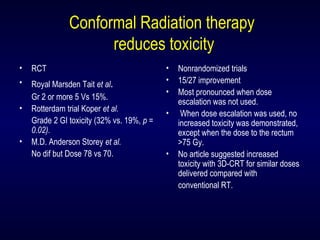
Conformal Radiation therapy
reduces toxicity
• RCT
• Royal Marsden Tait et al.
Gr 2 or more 5 Vs 15%.
• Rotterdam trial Koper et al.
Grade 2 GI toxicity (32% vs. 19%, p =
0.02).
• M.D. Anderson Storey et al.
No dif but Dose 78 vs 70.
• Nonrandomized trials
• 15/27 improvement
• Most pronounced when dose
escalation was not used.
• When dose escalation was used, no
increased toxicity was demonstrated,
except when the dose to the rectum
>75 Gy.
• No article suggested increased
toxicity with 3D-CRT for similar doses
delivered compared with
conventional RT.
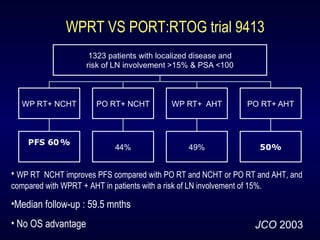
WPRT VS PORT:RTOG trial 9413
• WP RT NCHT improves PFS compared with PO RT and NCHT or PO RT and AHT, and
compared with WPRT + AHT in patients with a risk of LN involvement of 15%.
•Median follow-up : 59.5 mnths
• No OS advantage JCO 2003
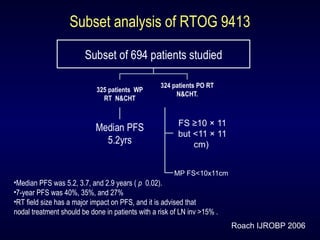
Subset analysis of RTOG 9413
•Median PFS was 5.2, 3.7, and 2.9 years ( p 0.02).
•7-year PFS was 40%, 35%, and 27%
•RT field size has a major impact on PFS, and it is advised that
nodal treatment should be done in patients with a risk of LN inv >15% .
Roach IJROBP 2006
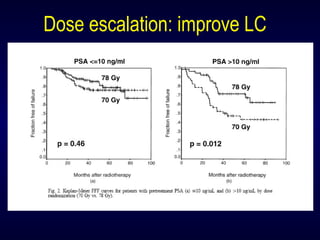
Dose escalation: improve LC
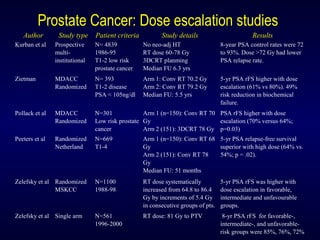
Author Study type Patient criteria Study details Results
Kurban et al Prospective
multi-
institutional
N= 4839
1986-95
T1-2 low risk
prostate cancer
No neo-adj HT
RT dose 60-78 Gy
3DCRT planming
Median FU 6.3 yrs
8-year PSA control rates were 72
to 93%. Dose >72 Gy had lower
PSA relapse rate.
Zietman MDACC
Randomized
N= 393
T1-2 disease
PSA < 105ng/dl
Arm 1: Conv RT 70.2 Gy
Arm 2: Conv RT 79.2 Gy
Median FU: 5.5 yrs
5-yr PSA rFS higher with dose
escalation (61% vs 80%). 49%
risk reduction in biochemical
failure.
Pollack et al MDACC
Randomized
N=301
Low risk prostate
cancer
Arm 1 (n=150): Conv RT 70
Gy
Arm 2 (151): 3DCRT 78 Gy
PSA rFS higher with dose
escalation (70% versus 64%;
p=0.03)
Peeters et al Randomized
Netherland
N=669
T1-4
Arm 1 (n=150): Conv RT 68
Gy
Arm 2 (151): Conv RT 78
Gy
Median FU: 51 months
5-yr PSA relapse-free survival
superior with high dose (64% vs.
54%; p = .02).
Zelefsky et al Randomized
MSKCC
N=1100
1988-98
RT dose systematically
increased from 64.8 to 86.4
Gy by increments of 5.4 Gy
in consecutive groups of pts.
5-yr PSA rFS was higher with
dose escalation in favorable,
intermediate and unfavourable
groups.
Zelefsky et al Single arm N=561
1996-2000
RT dose: 81 Gy to PTV 8-yr PSA rFS for favorable-,
intermediate-, and unfavorable-
risk groups were 85%, 76%, 72%
Prostate Cancer: Dose escalation studies
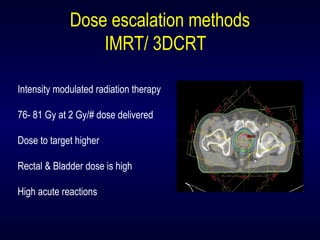
Intensity modulated radiation therapy
76- 81 Gy at 2 Gy/# dose delivered
Dose to target higher
Rectal & Bladder dose is high
High acute reactions
Dose escalation methods
IMRT/ 3DCRT
Toxicities after Radiation therapy
Rectal toxicity
- Telengectasia
- Bleeding
- Bladder toxicity
- Incontinence
- Bleeding
- Thimble bladder
- Urethral stricture
-Erectile dysfunction
- Quality of life
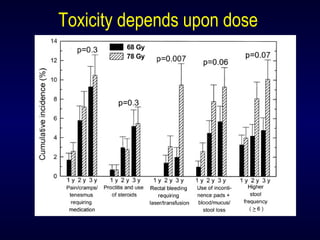
Toxicity depends upon dose
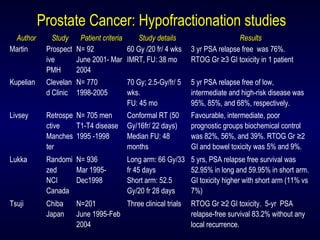
Author Study Patient criteria Study details Results
Martin Prospect
ive
PMH
N= 92
June 2001- Mar
2004
60 Gy /20 fr/ 4 wks
IMRT, FU: 38 mo
3 yr PSA relapse free was 76%.
RTOG Gr ≥3 GI toxicity in 1 patient
Kupelian Clevelan
d Clinic
N= 770
1998-2005
70 Gy; 2.5-Gy/fr/ 5
wks.
FU: 45 mo
5 yr PSA relapse free of low,
intermediate and high-risk disease was
95%, 85%, and 68%, respectively.
Livsey Retrospe
ctive
Manches
ter
N= 705 men
T1-T4 disease
1995 -1998
Conformal RT (50
Gy/16fr/ 22 days)
Median FU: 48
months
Favourable, intermediate, poor
prognostic groups biochemical control
was 82%, 56%, and 39%. RTOG Gr ≥2
GI and bowel toxicity was 5% and 9%.
Lukka Randomi
zed
NCI
Canada
N= 936
Mar 1995-
Dec1998
Long arm: 66 Gy/33
fr 45 days
Short arm: 52.5
Gy/20 fr 28 days
5 yrs, PSA relapse free survival was
52.95% in long and 59.95% in short arm.
GI toxicity higher with short arm (11% vs
7%)
Tsuji Chiba
Japan
N=201
June 1995-Feb
2004
Three clinical trials RTOG Gr ≥2 GI toxicity. 5-yr PSA
relapse-free survival 83.2% without any
local recurrence.
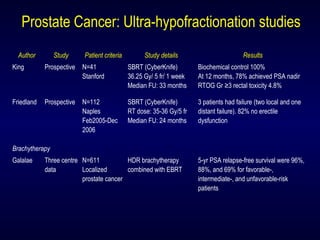
Prostate Cancer: Hypofractionation studies
Author Study Patient criteria Study details Results
King Prospective N=41
Stanford
SBRT (CyberKnife)
36.25 Gy/ 5 fr/ 1 week
Median FU: 33 months
Biochemical control 100%
At 12 months, 78% achieved PSA nadir
RTOG Gr ≥3 rectal toxicity 4.8%
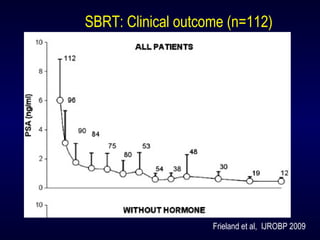
Friedland Prospective N=112
Naples
Feb2005-Dec
2006
SBRT (CyberKnife)
RT dose: 35-36 Gy/5 fr
Median FU: 24 months
3 patients had failure (two local and one
distant failure). 82% no erectile
dysfunction
Brachytherapy
Galalae Three centre
data
N=611
Localized
prostate cancer
HDR brachytherapy
combined with EBRT
5-yr PSA relapse-free survival were 96%,
88%, and 69% for favorable-,
intermediate-, and unfavorable-risk
patients
Prostate Cancer: Ultra-hypofractionation studies
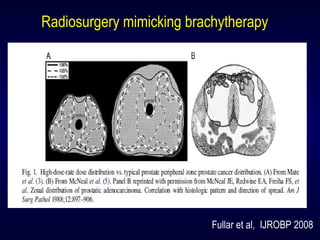
Fullar et al, IJROBP 2008
Radiosurgery mimicking brachytherapy
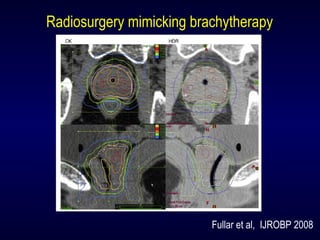
Fullar et al, IJROBP 2008
Radiosurgery mimicking brachytherapy
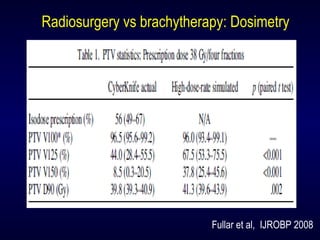
Fullar et al, IJROBP 2008
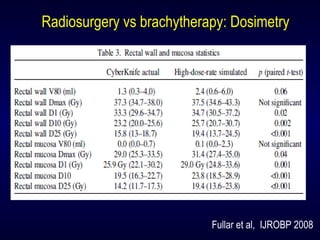
Radiosurgery vs brachytherapy: Dosimetry
Fullar et al, IJROBP 2008
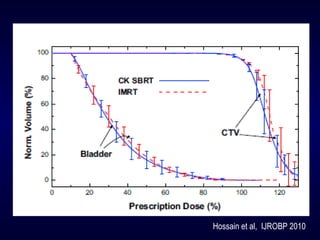
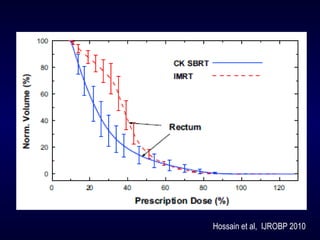
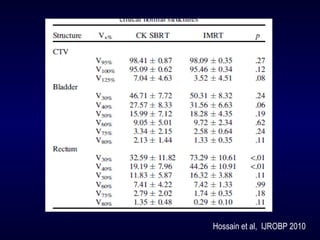
Hossain et al, IJROBP 2010
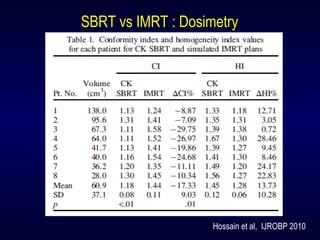
SBRT vs IMRT : Dosimetry
Hossain et al, IJROBP 2010
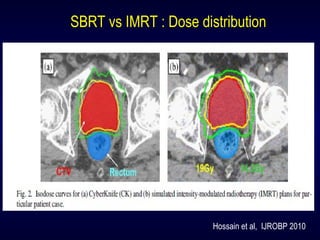
SBRT vs IMRT : Dose distribution
Hossain et al, IJROBP 2010
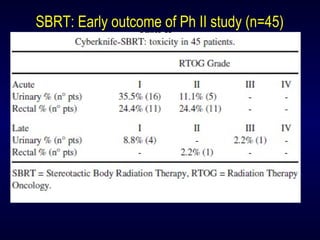
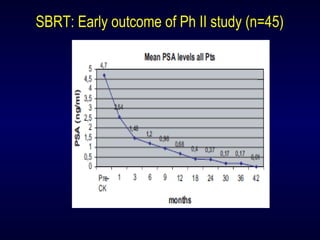
SBRT: Early outcome of Ph II study (n=45)
SBRT: Clinical outcome (n=112)
Frieland et al, IJROBP 2009
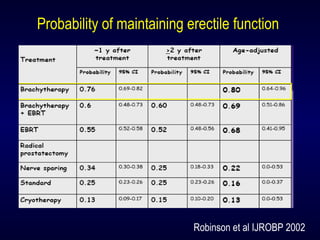
Probability of maintaining erectile function
Robinson et al IJROBP 2002
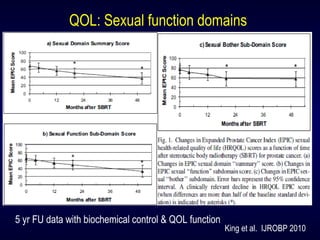
King et al. IJROBP 2010
QOL: Sexual function domains
5 yr FU data with biochemical control & QOL function
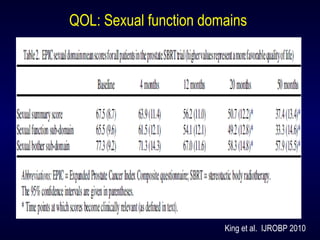
QOL: Sexual function domains
King et al. IJROBP 2010
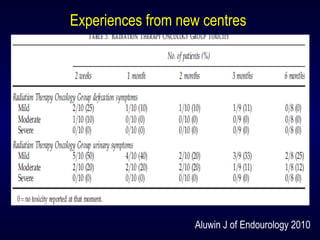
Aluwin J of Endourology 2010
Experiences from new centres
Conclusions
- Large patient cohort prospective study with more than 500 patients and more than 5
years follow up have shown that CyberKnife is equally effective as long coures RT
- SBRT/ CyberKnife is now standard of care treatment for localized prostate cancer
- Outcome of CyberKnife treatment is similar to long course RT
- Side-effect after Cyberknife is less than 1% in prostate cancer
- CyberKnife is safe, out patient, short course treatment in both primary and metastatic
diseases.
- High dose radiation may be effective in many of the ‘radioresistant’ disease.
Thank you
Dr Debnarayan Dutta, MD
CyberKnife Specialist
duttadeb07@gmail.com

Prostate

  • 1.
    - Large patientcohort prospective study with more than 500 patients and more than 5 years follow up have shown that CyberKnife is equally effective as long coures RT - SBRT/ CyberKnife is now standard of care treatment for localized prostate cancer - Outcome of CyberKnife treatment is similar to long course RT - Side-effect after Cyberknife is less than 1% in prostate cancer - CyberKnife is safe, out patient, short course treatment in both primary and metastatic diseases. - High dose radiation may be effective in many of the ‘radioresistant’ disease. CyberKnife in prostate cancer
  • 2.
    • Most prevalentmalignancy in males in western community • 2nd MC cause of mortality in the west • Uncommon in Asians, probably shorter lifespan • In TMH, constitutes 2.4% of all registered pts in 2000 • In recent years, more early prostate cancer patients are diagnosed with prostate cancer • Prostate cancer is slow growing tumour, risk of bone metastasis is high in ‘high risk’ group patient Prostate cancer
  • 3.
    Risk stratification RISK STRATIFICATION LOWRISK INTERMEDIATE HIGH T1,2a, PSA < 10 ng/ml, GS</=6 T2b, GS=7 T3,4,PSA>20ng/ml, GS>7 Wait & watch Surgery Radiation therapy HT Radiosurgery Combination Surgery Radiation therapy HT Radiosurgery Combination Surgery Radiation therapy HT Radiosurgery Combination
  • 4.
    Radiotherapy Radiation techniques: 2D Planning ConformalRadiation therapy - 3D-CRT - IMRT - SBRT Target volume: CTV – prostate with capsule + SV T1 & small T2 with less PSA less GS only prostate is sufficient. PTV – 1 cm margin. Inclusion of pelvic lymph nodes still controversial.
  • 5.
    Ca prostate Incidence ofpelvic LN metastasis at diagnosis Study T1a,b T1c T2a T2b,c T3 Pisansky 12/457 (2.6%) 15/456 (3.3%) 130/1206 (10.8%) 81/320 (25%) - Petros & Catalona 2/61 (3.3%) 33/425 (7.8%) 0 Sands 6/127 (5%) 41/243 (16.9%) 95/199 (47.7%) Van Poppel 2/40(5%) 18/199 (9%) 25/46 (54%) Hanks 1/21(5%) 38/135(28%) 48/95(50%)
  • 6.
    Radiotherapy Radiation therapy schedules Conventionalfractionation: - 70Gy/ 35# / 7 wk - 2Gy/# - Acute rectal & bladder toxicity Hypofractionation schedule: - High dose per fraction, short course treatment - Equivalent loco-regional control Ultra-hypofractionation schedule: - Very short course, high dose per fraction - Usual treatment duration 5 to 7 days
  • 7.
    Conformal Radiation therapy reducestoxicity • RCT • Royal Marsden Tait et al. Gr 2 or more 5 Vs 15%. • Rotterdam trial Koper et al. Grade 2 GI toxicity (32% vs. 19%, p = 0.02). • M.D. Anderson Storey et al. No dif but Dose 78 vs 70. • Nonrandomized trials • 15/27 improvement • Most pronounced when dose escalation was not used. • When dose escalation was used, no increased toxicity was demonstrated, except when the dose to the rectum >75 Gy. • No article suggested increased toxicity with 3D-CRT for similar doses delivered compared with conventional RT.
  • 8.
    WPRT VS PORT:RTOGtrial 9413 • WP RT NCHT improves PFS compared with PO RT and NCHT or PO RT and AHT, and compared with WPRT + AHT in patients with a risk of LN involvement of 15%. •Median follow-up : 59.5 mnths • No OS advantage JCO 2003
  • 9.
    Subset analysis ofRTOG 9413 •Median PFS was 5.2, 3.7, and 2.9 years ( p 0.02). •7-year PFS was 40%, 35%, and 27% •RT field size has a major impact on PFS, and it is advised that nodal treatment should be done in patients with a risk of LN inv >15% . Roach IJROBP 2006
  • 10.
  • 12.
    Author Study typePatient criteria Study details Results Kurban et al Prospective multi- institutional N= 4839 1986-95 T1-2 low risk prostate cancer No neo-adj HT RT dose 60-78 Gy 3DCRT planming Median FU 6.3 yrs 8-year PSA control rates were 72 to 93%. Dose >72 Gy had lower PSA relapse rate. Zietman MDACC Randomized N= 393 T1-2 disease PSA < 105ng/dl Arm 1: Conv RT 70.2 Gy Arm 2: Conv RT 79.2 Gy Median FU: 5.5 yrs 5-yr PSA rFS higher with dose escalation (61% vs 80%). 49% risk reduction in biochemical failure. Pollack et al MDACC Randomized N=301 Low risk prostate cancer Arm 1 (n=150): Conv RT 70 Gy Arm 2 (151): 3DCRT 78 Gy PSA rFS higher with dose escalation (70% versus 64%; p=0.03) Peeters et al Randomized Netherland N=669 T1-4 Arm 1 (n=150): Conv RT 68 Gy Arm 2 (151): Conv RT 78 Gy Median FU: 51 months 5-yr PSA relapse-free survival superior with high dose (64% vs. 54%; p = .02). Zelefsky et al Randomized MSKCC N=1100 1988-98 RT dose systematically increased from 64.8 to 86.4 Gy by increments of 5.4 Gy in consecutive groups of pts. 5-yr PSA rFS was higher with dose escalation in favorable, intermediate and unfavourable groups. Zelefsky et al Single arm N=561 1996-2000 RT dose: 81 Gy to PTV 8-yr PSA rFS for favorable-, intermediate-, and unfavorable- risk groups were 85%, 76%, 72% Prostate Cancer: Dose escalation studies
  • 13.
    Intensity modulated radiationtherapy 76- 81 Gy at 2 Gy/# dose delivered Dose to target higher Rectal & Bladder dose is high High acute reactions Dose escalation methods IMRT/ 3DCRT
  • 14.
    Toxicities after Radiationtherapy Rectal toxicity - Telengectasia - Bleeding - Bladder toxicity - Incontinence - Bleeding - Thimble bladder - Urethral stricture -Erectile dysfunction - Quality of life
  • 15.
  • 16.
    Author Study Patientcriteria Study details Results Martin Prospect ive PMH N= 92 June 2001- Mar 2004 60 Gy /20 fr/ 4 wks IMRT, FU: 38 mo 3 yr PSA relapse free was 76%. RTOG Gr ≥3 GI toxicity in 1 patient Kupelian Clevelan d Clinic N= 770 1998-2005 70 Gy; 2.5-Gy/fr/ 5 wks. FU: 45 mo 5 yr PSA relapse free of low, intermediate and high-risk disease was 95%, 85%, and 68%, respectively. Livsey Retrospe ctive Manches ter N= 705 men T1-T4 disease 1995 -1998 Conformal RT (50 Gy/16fr/ 22 days) Median FU: 48 months Favourable, intermediate, poor prognostic groups biochemical control was 82%, 56%, and 39%. RTOG Gr ≥2 GI and bowel toxicity was 5% and 9%. Lukka Randomi zed NCI Canada N= 936 Mar 1995- Dec1998 Long arm: 66 Gy/33 fr 45 days Short arm: 52.5 Gy/20 fr 28 days 5 yrs, PSA relapse free survival was 52.95% in long and 59.95% in short arm. GI toxicity higher with short arm (11% vs 7%) Tsuji Chiba Japan N=201 June 1995-Feb 2004 Three clinical trials RTOG Gr ≥2 GI toxicity. 5-yr PSA relapse-free survival 83.2% without any local recurrence. Prostate Cancer: Hypofractionation studies
  • 17.
    Author Study Patientcriteria Study details Results King Prospective N=41 Stanford SBRT (CyberKnife) 36.25 Gy/ 5 fr/ 1 week Median FU: 33 months Biochemical control 100% At 12 months, 78% achieved PSA nadir RTOG Gr ≥3 rectal toxicity 4.8% Friedland Prospective N=112 Naples Feb2005-Dec 2006 SBRT (CyberKnife) RT dose: 35-36 Gy/5 fr Median FU: 24 months 3 patients had failure (two local and one distant failure). 82% no erectile dysfunction Brachytherapy Galalae Three centre data N=611 Localized prostate cancer HDR brachytherapy combined with EBRT 5-yr PSA relapse-free survival were 96%, 88%, and 69% for favorable-, intermediate-, and unfavorable-risk patients Prostate Cancer: Ultra-hypofractionation studies
  • 18.
    Fullar et al,IJROBP 2008 Radiosurgery mimicking brachytherapy
  • 19.
    Fullar et al,IJROBP 2008 Radiosurgery mimicking brachytherapy
  • 20.
    Fullar et al,IJROBP 2008 Radiosurgery vs brachytherapy: Dosimetry
  • 21.
    Radiosurgery vs brachytherapy:Dosimetry Fullar et al, IJROBP 2008
  • 22.
    Hossain et al,IJROBP 2010 SBRT vs IMRT : Dosimetry
  • 23.
    Hossain et al,IJROBP 2010 SBRT vs IMRT : Dose distribution
  • 24.
    Hossain et al,IJROBP 2010
  • 25.
    Hossain et al,IJROBP 2010
  • 26.
    Hossain et al,IJROBP 2010
  • 27.
    SBRT: Early outcomeof Ph II study (n=45)
  • 28.
    SBRT: Early outcomeof Ph II study (n=45)
  • 29.
    SBRT: Clinical outcome(n=112) Frieland et al, IJROBP 2009
  • 30.
    Probability of maintainingerectile function Robinson et al IJROBP 2002
  • 31.
    King et al.IJROBP 2010 QOL: Sexual function domains 5 yr FU data with biochemical control & QOL function
  • 32.
    QOL: Sexual functiondomains King et al. IJROBP 2010
  • 33.
    Aluwin J ofEndourology 2010 Experiences from new centres
  • 34.
    Conclusions - Large patientcohort prospective study with more than 500 patients and more than 5 years follow up have shown that CyberKnife is equally effective as long coures RT - SBRT/ CyberKnife is now standard of care treatment for localized prostate cancer - Outcome of CyberKnife treatment is similar to long course RT - Side-effect after Cyberknife is less than 1% in prostate cancer - CyberKnife is safe, out patient, short course treatment in both primary and metastatic diseases. - High dose radiation may be effective in many of the ‘radioresistant’ disease.
  • 35.
    Thank you Dr DebnarayanDutta, MD CyberKnife Specialist duttadeb07@gmail.com