© Competence Centre for Virtual Reality and Cooperative Engineering w. V. – Virtual Dimension Center (VDC)
Dr.-Ing. Dipl.-Kfm. Christoph Runde
Virtual Dimension Center (VDC) Fellbach
Auberlenstr. 13
70736 Fellbach
www.vdc-fellbach.de
Whitepaper
Head Mounted Displays & Data Glasses
Applications and Systems
SummaryApplication fieldsSystem classes Directions of development
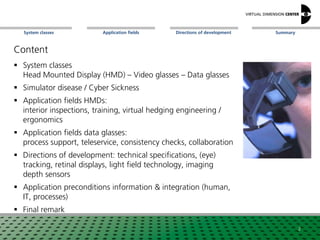
Content
 System classes
Head Mounted Display (HMD) – Video glasses – Data glasses
 Simulator disease / Cyber Sickness
 Application fields HMDs:
interior inspections, training, virtual hedging engineering /
ergonomics
 Application fields data glasses:
process support, teleservice, consistency checks, collaboration
 Directions of development: technical specifications, (eye)
tracking, retinal displays, light field technology, imaging
depth sensors
 Application preconditions information & integration (human,
IT, processes)
 Final remark
2
SummaryApplication fieldsSystem classes Directions of development
Head Mounted Displays (HMDs) – Overview
 1961: first HMD on market
 1965: 3D-tracked HMD by Ivan Sutherland
 Since the 1970s a significant number of HMDs is applied in the military sector (training,
additional display)
Table: Important HMD-
projects since the 1970s
[Quelle: Li, Hua et. al.:
Review and analysis of
avionic helmet-mounted
displays. In : Op-tical
Engineering 52(11),
110901, Novembre2013]
3
System classes
SummaryApplication fieldsSystem classes Directions of development
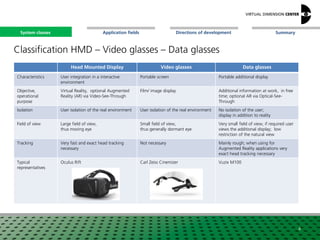
Head Mounted Display Video glasses Data glasses
Characteristics User integration in a interactive
environment
Portable screen Portable additional display
Objective,
operational
purpose
Virtual Reality, optional Augmented
Reality (AR) via Video-See-Through
Film/ image display Additional information at work, in free
time; optional AR via Optical-See-
Through
Isolation User isolation of the real environment User isolation of the real environment No isolation of the user;
display in addition to reality
Field of view Large field of view,
thus moving eye
Small field of view,
thus generally dormant eye
Very small field of view; if required user
views the additional display; low
restriction of the natural view
Tracking Very fast and exact head tracking
necessary
Not necessary Mainly rough; when using for
Augmented Reality applications very
exact head tracking necessary
Typical
representatives
Oculus Rift Carl Zeiss Cinemizer Vuzix M100
Classification HMD – Video glasses – Data glasses
4
System classes
SummaryApplication fieldsSystem classes Directions of development
Advantages of HMDs in comparison to projections
Systemic benefits of HMDs
 Compactness: enclosing VR system in the smallest
physical space
 Price: inexpensive compared to multi-channel
projections
 Isolation and immersion:
User focuses completely on content and task, fades
out reality
 Sense of direction always has to be served (due to
simulator sickness)
 No accommodation conflict:
In the haptic interaction in front of a projection
screen, the user can either focus only on the
projection or only on his hands. HMDs do not have
this problem.
5
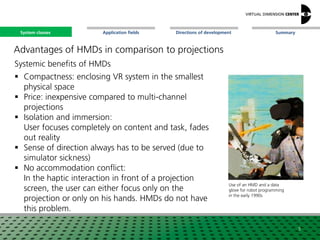
Use of an HMD and a data
glove for robot programming
in the early 1990s
System classes
SummaryApplication fieldsSystem classes Directions of development
Disadvantages of HMDs in comparison to projections
Systemic disadvantages
 Isolation:
o Lack of awareness of the environment leads to
uncertainty
o Lack of self-perception is confusing
 Isolation:
Cooperative working is only possible to a
limited extent
 Acceptance:
Rejection of HMDs as a technical gimmick
6
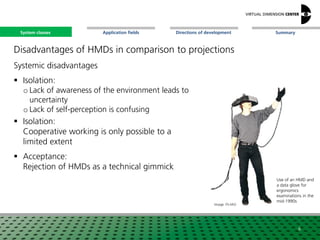
Image: Fh-IAO
Use of an HMD and
a data glove for
ergonomics
examinations in the
mid-1990s
System classes
SummaryApplication fieldsSystem classes Directions of development
Disadvantages of HMDs in comparison to projections
Product inherent disadvantages
 Inadequate ergonomics:
weight, weight distribution, cumbersome to
put on, fit, fixation, hygiene
 Lack of appropriate input systems:
no mouse or keyboard
 Moderate resolution: only upper price
segemnt > 1280 x 1024
 Acceptance: impairment of hairstyle,
cosmetics through fixation
 Fixed image distance
 Probability of cyber sickness /
simulator sickness is high because of the
isolating system
7
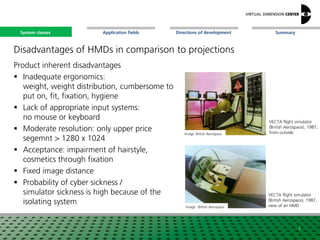
Image: British Aerospace
Image: :British Aerospace
VECTA flight simulator
(British Aerospace), 1987,
from outside
VECTA flight simulator
(British Aerospace), 1987,
view of an HMD
System classes
SummaryApplication fieldsSystem classes Directions of development
Cyber Sickness
Some people experience nausea or headaches in
immersive environments: Why?
 Reason 1: Oculomotor depth criteria
contradict each other:
o Accomodation of the eye:
Focus on the display so that we can see the
image clearly
o Convergence of the eyes on the virtual object
in front of or behind the projection screen
[brain superimposes the images of the eyes on
top of each other]
 contradiction
8
Distant view Close-up view
Image: Tridelity
System classes
SummaryApplication fieldsSystem classes Directions of development
Cyber Sickness
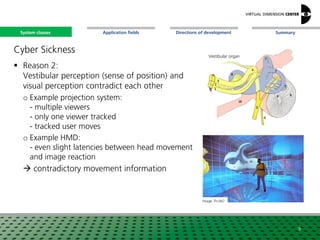
 Reason 2:
Vestibular perception (sense of position) and
visual perception contradict each other
o Example projection system:
- multiple viewers
- only one viewer tracked
- tracked user moves
o Example HMD:
- even slight latencies between head movement
and image reaction
 contradictory movement information
9
Image: Fh-IAO
Vestibular organ
System classes
SummaryApplication fieldsSystem classes Directions of development
Application fields HMDs: Interior inspections
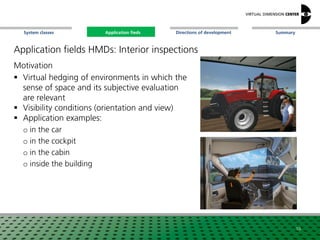
Motivation
 Virtual hedging of environments in which the
sense of space and its subjective evaluation
are relevant
 Visibility conditions (orientation and view)
 Application examples:
o in the car
o in the cockpit
o in the cabin
o inside the building
10
Application fieds
SummaryApplication fieldsSystem classes Directions of development
Application fields HMDs: Interior inspections
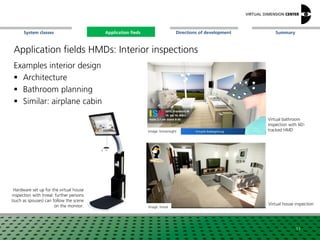
Examples interior design
 Architecture
 Bathroom planning
 Similar: airplane cabin
Image: Immersight
Image: Inreal
Virtual bathroom
inspection with 6D-
tracked HMD
Virtual house inspection
11
Hardware set up for the virtual house
inspection with Inreal: further persons
(such as spouses) can follow the scene
on the monitor.
Application fieds
SummaryApplication fieldsSystem classes Directions of development
Application fields HMDs: Interior inspections
12
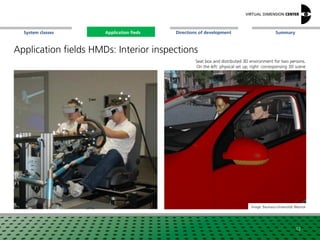
Image: Bauhaus-Universität Weimar
Seat box and distributed 3D environment for two persons.
On the left: physical set up; right: corresponsing 3D scene
Application fieds
SummaryApplication fieldsSystem classes Directions of development
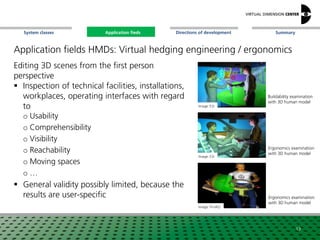
Application fields HMDs: Virtual hedging engineering / ergonomics
Editing 3D scenes from the first person
perspective
 Inspection of technical facilities, installations,
workplaces, operating interfaces with regard
to
o Usability
o Comprehensibility
o Visibility
o Reachability
o Moving spaces
o …
 General validity possibly limited, because the
results are user-specific
Image: ESI
Image: Fh-IAO
Image: ESI
Buildability examination
with 3D human model
Ergonomics examination
with 3D human model
Ergonomics examination
with 3D human model
13
Application fieds
SummaryApplication fieldsSystem classes Directions of development
Application fields HMDs: Training
Motivation
 360° simulation required
 Detailed haptic interaction with a view to your
own hands is relevant (accommodation
conflict in front of Powerwall difficult)
Simulated 360°-
environment for
military training
14
Image: NASA
Training for
maintenance services in
aerospace with a HMD
Image: NPSNET
Image: NIAR
Training of
maintenance
and inspection
activities in
aerospace
Application fieds
SummaryApplication fieldsSystem classes Directions of development
Application fields data glasses
 Data glasses: Natural view is largely not restricted
 In general smaller display surfaces (compared to HMDs)
 In general smaller display resolution (compared to HMDs)
 Mostly different intended use compared to HMDs:
additional display of computer-generated content when staying in
natural environments (e.g. work, leisure time, travel)
 Content often symbolic, pictogram, alphanumeric because of resolution
and size of displays
 Regarding high-end-products AR-applications are possible
 Advantages compared to tablet PCs: hands-free
15
Application fields
SummaryApplication fieldsSystem classes Directions of development
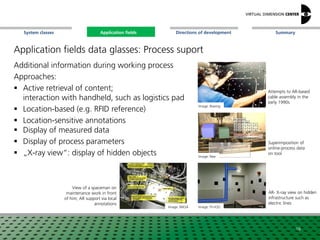
Application fields data glasses: Process suport
Additional information during working process
Approaches:
 Active retrieval of content;
interaction with handheld, such as logistics pad
 Location-based (e.g. RFID reference)
 Location-sensitive annotations
 Display of measured data
 Display of process parameters
 „X-ray view“: display of hidden objects
Image: Boeing
Image: Fh-IGD
Image: Nee
Attempts to AR-based
cable assembly in the
early 1990s
AR- X-ray view on hidden
infrastructure such as
electric lines
Superimposition of
online-process data
on tool
16
Image: NASA
View of a spaceman on
maintenance work in front
of him; AR support via local
annotations
Application fields
SummaryApplication fieldsSystem classes Directions of development
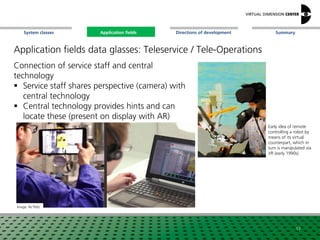
Application fields data glasses: Teleservice / Tele-Operations
Connection of service staff and central
technology
 Service staff shares perspective (camera) with
central technology
 Central technology provides hints and can
locate these (present on display with AR)
Image: Re‘flekt
Early idea of remote
controlling a robot by
means of its virtual
counterpart, which in
turn is manipulated via
VR (early 1990s)
17
Application fields
SummaryApplication fieldsSystem classes Directions of development
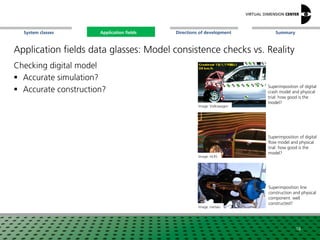
Application fields data glasses: Model consistence checks vs. Reality
Checking digital model
 Accurate simulation?
 Accurate construction?
Image: Volkswagen
Image: metaio
Image: HLRS
Superimposition of digital
crash model and physical
trial: how good is the
model?
Superimposition line
construction and physical
component: well
constructed?
Superimposition of digital
flow model and physical
trial: how good is the
model?
18
Application fields
SummaryApplication fieldsSystem classes Directions of development
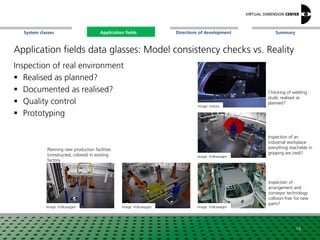
Inspection of real environment
 Realised as planned?
 Documented as realised?
 Quality control
 Prototyping
Image: metaio
Image: Volkswagen
Image: Volkswagen
Checking of welding
studs: realised as
planned?
Inspection of
arrangement and
conveyor technology:
collision-free for new
parts?
Inspection of an
industrial workplace:
everything reachable in
gripping are (red)?
19
Image: VolkswagenImage: Volkswagen
Planning new production facilities
(constructed, colored) in existing
factory
Application fields
Application fields data glasses: Model consistency checks vs. Reality
SummaryApplication fieldsSystem classes Directions of development
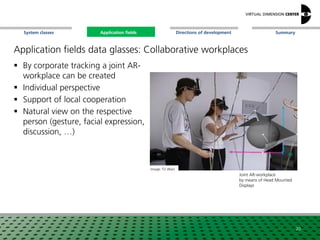
Application fields data glasses: Collaborative workplaces
 By corporate tracking a joint AR-
workplace can be created
 Individual perspective
 Support of local cooperation
 Natural view on the respective
person (gesture, facial expression,
discussion, …)
Image: TU Wien
Joint AR-workplace
by means of Head Mounted
Displays
20
Application fields
SummaryApplication fieldsSystem classes Directions of development
Directions of development: Used display types
 In previous HMDs (until 2012) starting
from SXGA-resolution: main application
of micro displays from only two
manufacturers
 Virtual Retinal Displays (projection on
retina)
 Since 2012: smartphone
displays as an additional image
source
21
Manufacturer micro
displays
Technology
eMagin Corp. OLED
Epson LCD
Forth Dimension Displays fLCOS, ForthDD
Hitachi LCD
Micro Display Corp [business operations discontinued]
Olightek Amoled
Planar Systems [business operations discontinued]
Reflection Technology [business operations discontinued]
Directions of development
OLED (eMagin Corp.)
fLCOS (Forth Dimension
Displays)
Smartphone-Displays
No electronic control
circuits
External LEDs create color Partly very high resolution
Small setup Fast circuit times Affordable because of mass
production
Low current consumption No subpixels Used display technologies:
•Samsung: AMOLED
•Microsoft/ Nokia: Nokia: AMOLED
with Clear-Black-extension
•Apple: LCD with high resolution
•LG: LCD and AMOLED
•HTC: S-LCD by Sony and Samsung
•Sony Ericsson: Technology by Sony
Fast circuit times Good grey values
Real “black”
SummaryApplication fieldsSystem classes Directions of development
22
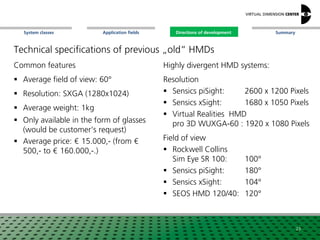
Technical specifications of previous „old“ HMDs
Manufacturer Model
Resolution
horizontal
Resolution
vertical
Angle-
resolution
Field of view
horizontal
Field of
view
vertical
Price Updated Weight Tracking Technology
Carl Zeiss Cinemizer
870 500 1,8 26 15
€ 650,-
with
tracker
2014 200g
Orientation
3DOF
OLED
CyberMind Visette45 SXGA 1280 1024 1,7 36 27 kA 2014 kA no FLCoS
HiRes800 800 600 1,7 22 14 $ 3.800,- 2014 700g no LCD
eMagin X800 3D Visor 800 600 2,4 32 24 kA 2006 no
Z800 3D Visor 800 600 2,4 32 24 $ 1.700,- 2014 230g no OLED
Epson Moverio 960 540 1,4 23 17 € 500,- 2014 244g no LCD
Fifth Dimension
Technologies
5DT HMD 800-40 3D 800 600 2,4 32 24 $ 2.900,- 2014 600 g no OLED
5DT HMD 800-26 3D 800 600 1,6 21 16 $ 2.900,- 2014 600 g no LCoS
iO Display Systems i-glasses PC/SVGA-3D Pro 800 600 1,6 21 16 kA 2006 no kA
Kaiser Electro-Optics Inc. ProView SR80 1280 1024 3,0 63 53 kA 2005 no kA
nVision / NVIS nVisor ST50 1280 1024 1,9 40 30 kA 2014 1050g no OLED
nVisor SX 1280 1024 3,6 76 64 kA 2014 1300g no LCoS
Rockwell Collins ProView VO35 800 600 2,1 28 21 kA 2006 kA no kA
Proview XL50 1024 768 2,3 40 30 kA 2006 kA no kA
ProView XL50 STm 1024 768 2,0 34 26 kA 2006 kA no kA
Sim Eye SR100 1280 1024 4,7 100 50 kA 2006 kA no kA
SaabTech Saab AddVisor 150 1280 1024 1,7 37 28 kA 2004 kA no kA
Sensics piSight 2600 1200 4,2 180 60 kA 2014 1000g no OLED
xSight 1680 1050 3,7 104 65 kA 2014 400g no OLED
SEOS SEOS HMD 120/40 1280 1024 5,6 120 67 kA 2006 kA no kA
Silicon Micro Display ST1080 1920 1080 1,4 45 17 kA kA kA no LCoS
Sony HMZ-T1 1280 720 2,1 45 34 $ 799,- 2014 330g no OLED
HMZ-T2 1280 720 2,1 45 34 $ 894,- 2014 320g no OLED
Trivisio VRvision HMD 800 600 2,5 33 25 kA 2014 300g no AMLCD
Virtual Realities VR2200 1024 768 2,2 38 24 $ 1.300,- 2014 200g no kA
HMD Pro 3D SVGA-42 800 600 2,7 36 23 $ 4.000,- 2014 kA no OLED
HMD Pro 3D SXGA-50 1280 1024 2,0 43 27 $ 8.500,- 2014 kA no OLED
HMD Pro 3D WUXGA-60 1920 1080 1,6 51 32 $ 10.500,- 2014 kA no OLED
Virtual Research Systems V8 640 480 4,7 50 38 kA 2004 kA no kA
VR4 480 240 6,0 48 36 kA 2005 kA no kA
VR1280 1280 1024 2,3 48 36 kA 2014 kA no FLCoS
Directions of development
SummaryApplication fieldsSystem classes Directions of development
Technical specifications of previous „old“ HMDs
Common features
 Average field of view: 60°
 Resolution: SXGA (1280x1024)
 Average weight: 1kg
 Only available in the form of glasses
(would be customer's request)
 Average price: € 15.000,- (from €
500,- to € 160.000,-.)
23
Highly divergent HMD systems:
Resolution
 Sensics piSight: 2600 x 1200 Pixels
 Sensics xSight: 1680 x 1050 Pixels
 Virtual Realities HMD
pro 3D WUXGA-60 : 1920 x 1080 Pixels
Field of view
 Rockwell Collins
Sim Eye SR 100: 100°
 Sensics piSight: 180°
 Sensics xSight: 104°
 SEOS HMD 120/40: 120°
Directions of development
SummaryApplication fieldsSystem classes Directions of development
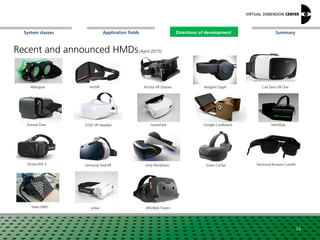
Recent and announced HMDs(April 2015)
24
AntVR Avegant Glyph
Durovis Dive GameFace InfinitEye
Altergaze
Oculus Rift 2 Sulon CortexSony Morpheus Technical Illusions CastAR
VRVANA TotemValve HMD vrAse
Samsung GearVR
Carl Zeiss VR OneArchos VR Glasses
Google CardboardFOVE VR Headset
Directions of development
SummaryApplication fieldsSystem classes Directions of development
25
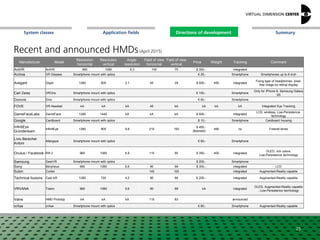
Recent and announced HMDs(April 2015)
Manufacturer Model
Resolution
horizontal
Resolution
vertical
Angle-
resolution
Field of view
horizontal
Field of view
vertical
Price Weight Tracking Comment
AntVR AntVR 960 1080 6,3 100 75 $ 300,- integrated
Archos VR Glasses Smartphone mount with optics € 25,- Smartphone Smartphones up to 6 inch
Avegant Glyph 1280 800 2,1 45 29 $ 500,- 450 integrated
Fixing type of headphones, pixel-
free image by retinal display
Carl Zeiss VROne Smartphone mount with optics € 100,- Smartphone
Only for iPhone 6, Samsung Galaxy
S5
Durovis Dive Smartphone mount with optics € 60,- Smartphone
FOVE VR Headset kA kA kA 45 kA kA kA kA Integrated Eye Tracking
GameFaceLabs GameFace 1280 1440 kA kA kA $ 500,- integrated
LCD, wireless, Low-Persistence-
technology
Google Cardboard Smartphone mount with optics $ 10,- Smartphone Cardboard housing
InfinitEye
Gründerteam
InfinitEye 1280 800 9,8 210 150
$ 450,-
(Bausatz)
490 no Fresnel lense
Liviu Berechet
Antoni
Altergaze Smartphone mount with optics € 60,- Smartphone
Oculus / Facebook Rift 2 960 1080 6,9 110 90 $ 350,- 400 integrated
OLED, rich colors,
Low-Persistence technology
Samsung GearVR Smartphone mount with optics $ 200,- Smartphone
Sony Morpheus 960 1080 5,6 90 68 $ 300,- integrated LCD
Sulon Cortex 140 105 integrated Augmented-Reality capable
Technical Ilusions Cast AR 1280 720 4,2 90 68 $ 200,- integrated Augmented-Reality capable
VRVANA Totem 960 1080 5,6 90 68 kA integrated
OLED, Augmented-Reality capable
, Low-Persistence technology
Valve HMD Prototyp kA kA kA 110 83 announced
vrAse vrAse Smartphone mount with optics € 60,- Smartphone Augmented-Reality capable
Directions of development
SummaryApplication fieldsSystem classes Directions of development
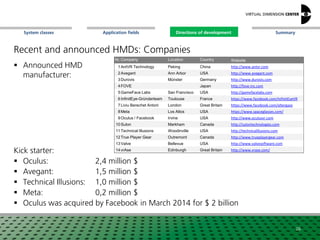
Recent and announced HMDs: Companies
 Announced HMD
manufacturer:
Kick starter:
 Oculus: 2,4 million $
 Avegant: 1,5 million $
 Technical Illusions: 1,0 million $
 Meta: 0,2 million $
 Oculus was acquired by Facebook in March 2014 for $ 2 billion
26
Nr.Company Location Country Website
1AntVR Technology Peking China http://www.antvr.com
2Avegant Ann Arbor USA http://www.avegant.com
3Durovis Münster Germany http://www.durovis.com
4FOVE Japan http://fove-inc.com
5GameFace Labs San Francisco USA http://gamefacelabs.com
6InfinitEye-Gründerteam Toulouse France https://www.facebook.com/InfinitEyeVR
7Liviu Berechet Antoni London Great Britain https://www.facebook.com/altergaze
8Meta Los Altos USA https://www.spaceglasses.com/
9Oculus / Facebook Irvine USA http://www.oculusvr.com
10Sulon Markham Canada http://sulontechnologies.com
11Technical Illusions Woodinville USA http://technicalillusions.com
12True Player Gear Outremont Canada http://www.trueplayergear.com
13Valve Bellevue USA http://www.valvesoftware.com
14vrAse Edinburgh Great Britain http://www.vrase.com/
Directions of development
SummaryApplication fieldsSystem classes Directions of development
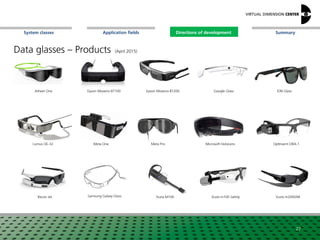
Data glasses – Products (April 2015)
27
Epson Moverio BT100 Google Glass ION Glass
Meta One
Recon Jet
Atheer One
Samsung Galaxy Glass Vuzix m2000ARVuzix m100 SafetyVuzix M100
Epson Moverio BT200
Meta Pro Microsoft HoloLens OptInvent ORA-1Lumus OE-32
Directions of development
SummaryApplication fieldsSystem classes Directions of development
Data glasses – Products (April 2015)
28
Manufacturer Model
Number of
dsiplays
Resolution
horizontal
Resolution
vertical
Angle-
resolution
Field of view
horizontal
Field of view
vertical
Price Weight Tracking Comment
Atheer One 2 1024 768 3,0 52,0 39,0 $ 500,- 70g no 2 x 8MP cameras
Epson Moverio BT100 2 960 540 1,2 18,4 13,8 $ 700,- 240 no LCD, Audio
Epson Moverio BT200 2 960 540 1,2 18,4 13,8 € 700,- 124
Compass, Gyro,
acceleration; GPS in
controller
LCD, Audio
GlassUp eyeGlasses 1 320 240 No information. No information. No information. $ 300,- No information.
Accelerometer,
Compass
Brightness sensor
Google Glass 1 640 360 1,2 12,5 9,4 $ 1500 54g
Acceleration, Gyro,
compass, Eyetracker,
proximity sensor,
position sensor
Audio, LCoS,-Display,
touchpad, microphone,
camera, brightness
sensor
ION Glass 1 Multi-color LED No information.. No information.. No information.. No information. $ 100,- no
Status display for
smartphone
Lumus DK-32 2 1280 720 0,9 20,0 15,0 No information. No information. no Developer module
Lumus DK-40 1 640 480 No information. No information No information. No information. No information. 9DOF-IMU
Camera; developer
module
Lumus OE-32 1 1280 720 1,5 32,0 24,0 No information. 26g no
Only optics module for
developer
Lumus PD-18 1 800 600 1,9 25,6 19,2 No information. 70g no
Only optics module for
developer
Meta One 2 960 540 1,8 28,0 21,0 $ 667 283g 9DOF-IMU
1 depth imaging camera,
2 x RGB-Kamera, Dolby
3D Audio
Meta Pro 2 1280 720 1,5 32,0 24,0 $ 3000 180g 9DOF-IMU
1 x depth imaging
camera, 2 x RGB camera,
Dolby 3D Audio
Microsoft HoloLens Only announcement until now
Optinvent ORA-1 1 640 480 3,6 19,2 14,4 [presales] 80g 9DOF-IMU, GPS Audio
Recon Jet 1 432 240 2,4 17,1 9,6 $ 599 60g
Acceleration, Gyro,
magnetometer, GPS
Audio, altimeter,
barometer, thermometer
Samsung Galaxy Glass Only announcement until now
Vuzix
M100,
M100 Safety
1 432 240 1,8 13,1 7,3 $999 No information.
9DOF-IMU, GPS,
proximity sensor
Camera, brightness
sensor
Vuzix m2000AR 1 1280 720 1,2 26,1 14,7 $6.000 No information. 9DOF-IMU 1 x 5MP camera
Directions of development
SummaryApplication fieldsSystem classes Directions of development
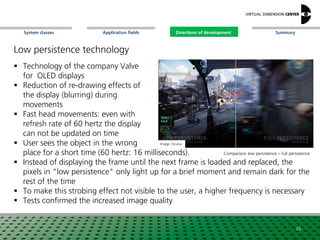
 Technology of the company Valve
for OLED displays
 Reduction of re-drawing effects of
the display (blurring) during
movements
 Fast head movements: even with
refresh rate of 60 hertz the display
can not be updated on time
 User sees the object in the wrong
place for a short time (60 hertz: 16 milliseconds).
 Instead of displaying the frame until the next frame is loaded and replaced, the
pixels in “low persistence" only light up for a brief moment and remain dark for the
rest of the time
 To make this strobing effect not visible to the user, a higher frequency is necessary
 Tests confirmed the increased image quality
Low persistence technology
Image: Oculus
Comparison low persistence – full persistence
29
Directions of development
SummaryApplication fieldsSystem classes Directions of development
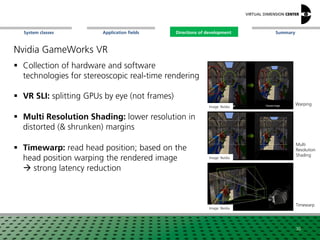
Nvidia GameWorks VR
 Collection of hardware and software
technologies for stereoscopic real-time rendering
 VR SLI: splitting GPUs by eye (not frames)
 Multi Resolution Shading: lower resolution in
distorted (& shrunken) margins
 Timewarp: read head position; based on the
head position warping the rendered image
 strong latency reduction
Image: Nvidia
Image: Nvidia
Warping
Multi
Resolution
Shading
30
Image: Nvidia
Timewarp
Directions of development
SummaryApplication fieldsSystem classes Directions of development
Integrated Tracking: 9-DOF-IMUs
 Miniaturization, increase in precision and price
decline: increase in importance of the inertial
measurement unit (IMU) for tracking
IMU contain the following types of sensors:
 3 orthogonally arranged acceleration sensors
(translation sensors): linear acceleration in the x-,
y-, z- axis; translation by integration done twice
 3 orthogonally arranged rotation rate sensors
(gyroscopic sensors): angular velocity about x-, y-,
z- axis; rotation by one-time integration
 To determine the integration constants, to
improve the accuracy and to correct the drift of
the before mentioned sensors: additional sensors,
e.g. magnetic field sensors (compass sensors) and
GNSS sensors
Image: SEIKO Epson
Image: Sparkfun
IMU V340 by
Fa. SEIKO Epson
IMU Razor by
Fa. Sparkfun
31
Directions of development
SummaryApplication fieldsSystem classes Directions of development
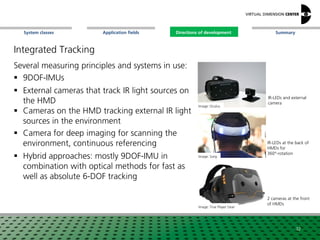
Integrated Tracking
Several measuring principles and systems in use:
 9DOF-IMUs
 External cameras that track IR light sources on
the HMD
 Cameras on the HMD tracking external IR light
sources in the environment
 Camera for deep imaging for scanning the
environment, continuous referencing
 Hybrid approaches: mostly 9DOF-IMU in
combination with optical methods for fast as
well as absolute 6-DOF tracking
Image: Oculus
Image: True Player Gear
Image: Sony
IR-LEDs and external
camera
2 cameras at the front
of HMDs
IR-LEDs at the back of
HMDs for
360°-rotation
32
Directions of development
SummaryApplication fieldsSystem classes Directions of development
33
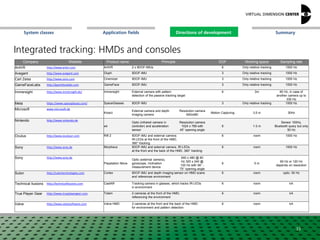
Integrated tracking: HMDs and consoles
Company Website Product name Principle DOF Working space Sampling rate
AntVR http://www.antvr.com AntVR 2 x 9DOF-IMUs 6 Only relative tracking 1000 Hz
Avegant http://www.avegant.com Glyph 9DOF-IMU 3 Only relative tracking 1000 Hz
Carl Zeiss http://www.zeiss.com Cinemizer 9DOF-IMU 3 Only relative tracking 1000 Hz
GameFaceLabs http://gamefacelabs.com GameFace 9DOF-IMU 3 Only relative tracking 1000 Hz
Immersight http://www.immersight.de/ Immersight External camera with pattern
detection of the passive tracking target
6 3m 60 Hz, in case of
another camera up to
330 Hz
Meta https://www.spaceglasses.com/ SpaceGlasses 9DOF-IMU 3 Only relative tracking 1000 Hz
Microsoft www.microsoft.de
Kinect
External camera and depth
imaging camera
Resolution camera
640x480
Motion Capturing 3,5 m 30Hz
Nintendo http://www.nintendo.de
wii
Optic (infrared camera in
controler) and acceleration
sensor
Resolution camera
1024 x 768 with
45° opening angle
6 1-3 m
Sensor 100Hz,
Bluetooth query but only
50 Hz
Oculus http://www.oculusvr.com Rift 2 9DOF-IMU and external camera;
IR-LEDs at the front of the HMD,
360° tracking
6 room 1000 Hz
Sony http://www.sony.de Morpheus 9DOF-IMU and external camera, IR-LEDs
at the front and the back of the HMD, 360° tracking
6 room 1000 Hz
Sony http://www.sony.de
Playstation Move
Optic (external camera),
gyroscope, inclination
measurement device
640 x 480 @ 60
Hz 320 x 240 @
120 Hz with 56° -
75° opening angle
6 5 m
60 Hz or 120 Hz
depends on resolution
Sulon http://sulontechnologies.com Cortex 9DOF-IMU and depth imaging sensor on HMD scans
and references environment
6 room optic: 50 Hz
Technical Ilusions http://technicalillusions.com CastAR Tracking camera in glasses, which tracks IR-LEDs
in environment
6 room kA
True Player Gear http://www.trueplayergear.com Totem 2 cameras at the front of the HMD,
referencing the environment
6 room kA
Valve http://www.valvesoftware.com Valve HMD 2 cameras at the front and the back of the HMD
for environment and pattern detection
6 room kA
Directions of development
SummaryApplication fieldsSystem classes Directions of development
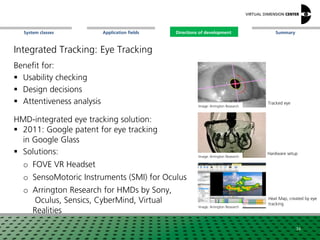
Integrated Tracking: Eye Tracking
Benefit for:
 Usability checking
 Design decisions
 Attentiveness analysis
HMD-integrated eye tracking solution:
 2011: Google patent for eye tracking
in Google Glass
 Solutions:
o FOVE VR Headset
o SensoMotoric Instruments (SMI) for Oculus
o Arrington Research for HMDs by Sony,
Oculus, Sensics, CyberMind, Virtual
Realities
Image: Arrington Research
Tracked eye
Heat Map, created by eye
tracking
Hardware setup
34
Directions of development
SummaryApplication fieldsSystem classes Directions of development
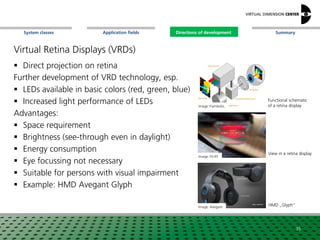
Virtual Retina Displays (VRDs)
 Direct projection on retina
Further development of VRD technology, esp.
 LEDs available in basic colors (red, green, blue)
 Increased light performance of LEDs
Advantages:
 Space requirement
 Brightness (see-through even in daylight)
 Energy consumption
 Eye focussing not necessary
 Suitable for persons with visual impairment
 Example: HMD Avegant Glyph
Image: Fiambolis,
Image: Avegant
Image: Fh-IFF
Functional schematic
of a retina display
HMD „Glyph“
View in a retina display
35
Directions of development
SummaryApplication fieldsSystem classes Directions of development
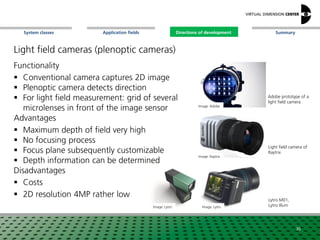
Light field cameras (plenoptic cameras)
Functionality
 Conventional camera captures 2D image
 Plenoptic camera detects direction
 For light field measurement: grid of several
microlenses in front of the image sensor
Advantages
 Maximum depth of field very high
 No focusing process
 Focus plane subsequently customizable
 Depth information can be determined
Disadvantages
 Costs
 2D resolution 4MP rather low
Image: Adobe
Image: Lytro
Image: Raytrix
Adobe prototype of a
light field camera
Lytro M01,
Lytro Illum
Light field camera of
Raytrix
36
Image: Lytro
Directions of development
SummaryApplication fieldsSystem classes Directions of development
37
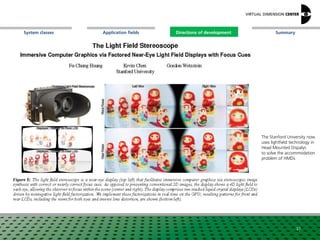
The Stanford University now
uses lightfield technology in
Head Mounted Dispalys
to solve the accommodation
problem of HMDs
Directions of development
SummaryApplication fieldsSystem classes Directions of development
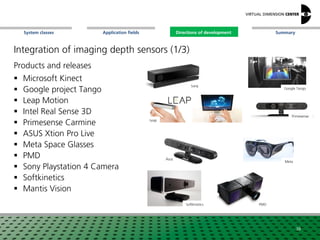
Integration of imaging depth sensors (1/3)
Products and releases
 Microsoft Kinect
 Google project Tango
 Leap Motion
 Intel Real Sense 3D
 Primesense Carmine
 ASUS Xtion Pro Live
 Meta Space Glasses
 PMD
 Sony Playstation 4 Camera
 Softkinetics
 Mantis Vision
Primesense
Meta
PMD
Google Tango
Leap
Asus
Softkinetics
Sony
38
Directions of development
SummaryApplication fieldsSystem classes Directions of development
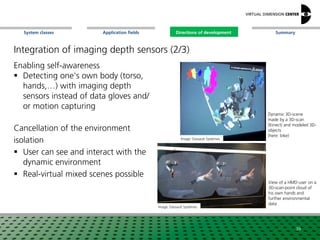
Enabling self-awareness
 Detecting one's own body (torso,
hands,…) with imaging depth
sensors instead of data gloves and/
or motion capturing
Cancellation of the environment
isolation
 User can see and interact with the
dynamic environment
 Real-virtual mixed scenes possible
Image: Dassault Systèmes
Dynamic 3D-scene
made by a 3D-scan
(Kinect) and modeled 3D-
objects
(here: bike)
View of a HMD-user on a
3D-scan-point cloud of
his own hands and
further environmental
data
39
Image: Dassault Systèmes
Directions of development
Integration of imaging depth sensors (2/3)
SummaryApplication fieldsSystem classes Directions of development
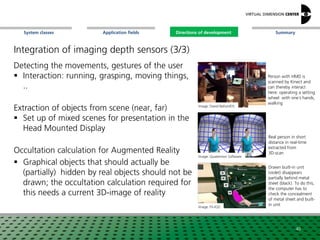
Detecting the movements, gestures of the user
 Interaction: running, grasping, moving things,
..
Extraction of objects from scene (near, far)
 Set up of mixed scenes for presentation in the
Head Mounted Display
Occultation calculation for Augmented Reality
 Graphical objects that should actually be
(partially) hidden by real objects should not be
drawn; the occultation calculation required for
this needs a current 3D-image of reality
Image: David Nahon/DS
Image: Quaternion Software
Person with HMD is
scanned by Kinect and
can thereby interact
Here: operating a setting
wheel with one´s hands,
walking
Real person in short
distance in real-time
extracted from
3D-scan
40
Image: Fh-IGD
Drawn built-in unit
(violet) disappears
partially behind metal
sheet (black). To do this,
the computer has to
check the concealment
of metal sheet and built-
in unit
Directions of development
Integration of imaging depth sensors (3/3)
SummaryApplication fieldsSystem classes Directions of development
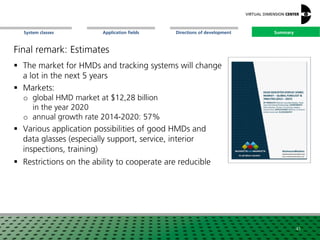
Final remark: Estimates
 The market for HMDs and tracking systems will change
a lot in the next 5 years
 Markets:
o global HMD market at $12,28 billion
in the year 2020
o annual growth rate 2014-2020: 57%
 Various application possibilities of good HMDs and
data glasses (especially support, service, interior
inspections, training)
 Restrictions on the ability to cooperate are reducible
41
ZusammenfassungSummary
SummaryApplication fieldsSystem classes Directions of development
Literature
 Bayer, Michael M.: Introduction to Helmet
Mounted Displays. In: Rash, Clarence E. (Ed.):
Helmet-mounted displays : sensation, perception,
and cognition issues, S. 47-108, U.S. Army
Aeromedical Research Laboratory, 2009
 Bundesanstalt für Arbeitsschutz und
Arbeitsmedizin: Datenbrillen - Aktueller Stand von
Forschung und Umsetzung sowie zukünftiger
Entwicklungsrichtungen. Workshop vom 20. Juni
2011, Dortmund, 2011
 Gross, Frank: Head Mounted Displays für den
professionellen Einsatz: Stand der aktuellen
Produkte am Markt. In: Displaytrends 2013 - Head
Mounted Displays, Datenbrillen & Co, Workshop
am Virtual Dimension Center Fellbach, Fellbach,
14.03.2013
 Li, Hua et. al.: Review and analysis of avionic
helmet-mounted displays. In : Optical Engineering
52(11), 110901, November 2013
42
 N.N.: Head Mounted Display (HMD) Market by
Products (Helmet Mounted, Wearable Glass),
Components (Micro display, Camera, control unit,
Tracker, Accessories), Applications (Defense,
industrial, Video Gaming) & Geography - Global
Analysis and Forecast to 2020, Markets and
Markets, Mai 2014
 N.N.: Global Head-mounted Display Market,
TechNavio, Januar 2013
 N.N.: Head Mounted Display (HMD) Market
Analysis By Product (Helmet Mounted Display,
Wearable Glass), By End-Use (Defense, Consumer),
By Application (Imaging, Security, Tracking, Training
& Simulation) And Segment Forecasts To 2020,
Grand View Research, Oktober 2014
Summary
SummaryApplication fieldsSystem classes Directions of development
Links
 http://www.stereo3d.com/hmd.htm
Bungert, Christoph: HMD/headset/VR-helmet Comparison Chart, abgerufen am 20.6.2014
 http://www.vrbrillen.net
Kovshenin, Konstantin: VR Brillen. Head Mounted Display – Der nächste Quantensprung in
Gaming und Film, abgerufen am 20.6.2014
 http://www.roadtovr.com/head-mounted-display-hmd-vr-headset-comparison/
Road to VR: HMD Comparison. Head Mounted Display (HMD) / VR Headset Comparison
Chart, abgerufen am 20.6.2014
 http://www.vdc-fellbach.de/wissen/vr-hardware/head-mounted-displays
Runde, Christoph: Head Mounted Displays & Datenbrillen, abgerufen am 20.6.2014
 http://www.vrnerds.de/hardvr/96-2/
Uthe, Nico, et al.: VR-Nerds a Virtual Reality Showcase: Head Mounted Displays, abgerufen
am 20.6.2014
43
Summary
SummaryApplication fieldsSystem classes Directions of development
VDC members regarding this topic:
44
Summary
© Competence Centre for Virtual Reality and Cooperative Engineering w. V. – Virtual Dimension Center (VDC)
Thank you very much for your interest!
You are interested in this topic and you are looking for contact persons/ implementation
partners? Please contact us.
Virtual Dimension Center (VDC) Fellbach
Auberlenstraße 13
70736 Fellbach
www.vdc-fellbach.de

Head Mounted Displays & Data Glasses: VDC-Whitepaper

  • 1.
    © Competence Centrefor Virtual Reality and Cooperative Engineering w. V. – Virtual Dimension Center (VDC) Dr.-Ing. Dipl.-Kfm. Christoph Runde Virtual Dimension Center (VDC) Fellbach Auberlenstr. 13 70736 Fellbach www.vdc-fellbach.de Whitepaper Head Mounted Displays & Data Glasses Applications and Systems
  • 2.
    SummaryApplication fieldsSystem classesDirections of development Content  System classes Head Mounted Display (HMD) – Video glasses – Data glasses  Simulator disease / Cyber Sickness  Application fields HMDs: interior inspections, training, virtual hedging engineering / ergonomics  Application fields data glasses: process support, teleservice, consistency checks, collaboration  Directions of development: technical specifications, (eye) tracking, retinal displays, light field technology, imaging depth sensors  Application preconditions information & integration (human, IT, processes)  Final remark 2
  • 3.
    SummaryApplication fieldsSystem classesDirections of development Head Mounted Displays (HMDs) – Overview  1961: first HMD on market  1965: 3D-tracked HMD by Ivan Sutherland  Since the 1970s a significant number of HMDs is applied in the military sector (training, additional display) Table: Important HMD- projects since the 1970s [Quelle: Li, Hua et. al.: Review and analysis of avionic helmet-mounted displays. In : Op-tical Engineering 52(11), 110901, Novembre2013] 3 System classes
  • 4.
    SummaryApplication fieldsSystem classesDirections of development Head Mounted Display Video glasses Data glasses Characteristics User integration in a interactive environment Portable screen Portable additional display Objective, operational purpose Virtual Reality, optional Augmented Reality (AR) via Video-See-Through Film/ image display Additional information at work, in free time; optional AR via Optical-See- Through Isolation User isolation of the real environment User isolation of the real environment No isolation of the user; display in addition to reality Field of view Large field of view, thus moving eye Small field of view, thus generally dormant eye Very small field of view; if required user views the additional display; low restriction of the natural view Tracking Very fast and exact head tracking necessary Not necessary Mainly rough; when using for Augmented Reality applications very exact head tracking necessary Typical representatives Oculus Rift Carl Zeiss Cinemizer Vuzix M100 Classification HMD – Video glasses – Data glasses 4 System classes
  • 5.
    SummaryApplication fieldsSystem classesDirections of development Advantages of HMDs in comparison to projections Systemic benefits of HMDs  Compactness: enclosing VR system in the smallest physical space  Price: inexpensive compared to multi-channel projections  Isolation and immersion: User focuses completely on content and task, fades out reality  Sense of direction always has to be served (due to simulator sickness)  No accommodation conflict: In the haptic interaction in front of a projection screen, the user can either focus only on the projection or only on his hands. HMDs do not have this problem. 5 Use of an HMD and a data glove for robot programming in the early 1990s System classes
  • 6.
    SummaryApplication fieldsSystem classesDirections of development Disadvantages of HMDs in comparison to projections Systemic disadvantages  Isolation: o Lack of awareness of the environment leads to uncertainty o Lack of self-perception is confusing  Isolation: Cooperative working is only possible to a limited extent  Acceptance: Rejection of HMDs as a technical gimmick 6 Image: Fh-IAO Use of an HMD and a data glove for ergonomics examinations in the mid-1990s System classes
  • 7.
    SummaryApplication fieldsSystem classesDirections of development Disadvantages of HMDs in comparison to projections Product inherent disadvantages  Inadequate ergonomics: weight, weight distribution, cumbersome to put on, fit, fixation, hygiene  Lack of appropriate input systems: no mouse or keyboard  Moderate resolution: only upper price segemnt > 1280 x 1024  Acceptance: impairment of hairstyle, cosmetics through fixation  Fixed image distance  Probability of cyber sickness / simulator sickness is high because of the isolating system 7 Image: British Aerospace Image: :British Aerospace VECTA flight simulator (British Aerospace), 1987, from outside VECTA flight simulator (British Aerospace), 1987, view of an HMD System classes
  • 8.
    SummaryApplication fieldsSystem classesDirections of development Cyber Sickness Some people experience nausea or headaches in immersive environments: Why?  Reason 1: Oculomotor depth criteria contradict each other: o Accomodation of the eye: Focus on the display so that we can see the image clearly o Convergence of the eyes on the virtual object in front of or behind the projection screen [brain superimposes the images of the eyes on top of each other]  contradiction 8 Distant view Close-up view Distant view Close-up view Image: Tridelity System classes
  • 9.
    SummaryApplication fieldsSystem classesDirections of development Cyber Sickness  Reason 2: Vestibular perception (sense of position) and visual perception contradict each other o Example projection system: - multiple viewers - only one viewer tracked - tracked user moves o Example HMD: - even slight latencies between head movement and image reaction  contradictory movement information 9 Image: Fh-IAO Vestibular organ System classes
  • 10.
    SummaryApplication fieldsSystem classesDirections of development Application fields HMDs: Interior inspections Motivation  Virtual hedging of environments in which the sense of space and its subjective evaluation are relevant  Visibility conditions (orientation and view)  Application examples: o in the car o in the cockpit o in the cabin o inside the building 10 Application fieds
  • 11.
    SummaryApplication fieldsSystem classesDirections of development Application fields HMDs: Interior inspections Examples interior design  Architecture  Bathroom planning  Similar: airplane cabin Image: Immersight Image: Inreal Virtual bathroom inspection with 6D- tracked HMD Virtual house inspection 11 Hardware set up for the virtual house inspection with Inreal: further persons (such as spouses) can follow the scene on the monitor. Application fieds
  • 12.
    SummaryApplication fieldsSystem classesDirections of development Application fields HMDs: Interior inspections 12 Image: Bauhaus-Universität Weimar Seat box and distributed 3D environment for two persons. On the left: physical set up; right: corresponsing 3D scene Application fieds
  • 13.
    SummaryApplication fieldsSystem classesDirections of development Application fields HMDs: Virtual hedging engineering / ergonomics Editing 3D scenes from the first person perspective  Inspection of technical facilities, installations, workplaces, operating interfaces with regard to o Usability o Comprehensibility o Visibility o Reachability o Moving spaces o …  General validity possibly limited, because the results are user-specific Image: ESI Image: Fh-IAO Image: ESI Buildability examination with 3D human model Ergonomics examination with 3D human model Ergonomics examination with 3D human model 13 Application fieds
  • 14.
    SummaryApplication fieldsSystem classesDirections of development Application fields HMDs: Training Motivation  360° simulation required  Detailed haptic interaction with a view to your own hands is relevant (accommodation conflict in front of Powerwall difficult) Simulated 360°- environment for military training 14 Image: NASA Training for maintenance services in aerospace with a HMD Image: NPSNET Image: NIAR Training of maintenance and inspection activities in aerospace Application fieds
  • 15.
    SummaryApplication fieldsSystem classesDirections of development Application fields data glasses  Data glasses: Natural view is largely not restricted  In general smaller display surfaces (compared to HMDs)  In general smaller display resolution (compared to HMDs)  Mostly different intended use compared to HMDs: additional display of computer-generated content when staying in natural environments (e.g. work, leisure time, travel)  Content often symbolic, pictogram, alphanumeric because of resolution and size of displays  Regarding high-end-products AR-applications are possible  Advantages compared to tablet PCs: hands-free 15 Application fields
  • 16.
    SummaryApplication fieldsSystem classesDirections of development Application fields data glasses: Process suport Additional information during working process Approaches:  Active retrieval of content; interaction with handheld, such as logistics pad  Location-based (e.g. RFID reference)  Location-sensitive annotations  Display of measured data  Display of process parameters  „X-ray view“: display of hidden objects Image: Boeing Image: Fh-IGD Image: Nee Attempts to AR-based cable assembly in the early 1990s AR- X-ray view on hidden infrastructure such as electric lines Superimposition of online-process data on tool 16 Image: NASA View of a spaceman on maintenance work in front of him; AR support via local annotations Application fields
  • 17.
    SummaryApplication fieldsSystem classesDirections of development Application fields data glasses: Teleservice / Tele-Operations Connection of service staff and central technology  Service staff shares perspective (camera) with central technology  Central technology provides hints and can locate these (present on display with AR) Image: Re‘flekt Early idea of remote controlling a robot by means of its virtual counterpart, which in turn is manipulated via VR (early 1990s) 17 Application fields
  • 18.
    SummaryApplication fieldsSystem classesDirections of development Application fields data glasses: Model consistence checks vs. Reality Checking digital model  Accurate simulation?  Accurate construction? Image: Volkswagen Image: metaio Image: HLRS Superimposition of digital crash model and physical trial: how good is the model? Superimposition line construction and physical component: well constructed? Superimposition of digital flow model and physical trial: how good is the model? 18 Application fields
  • 19.
    SummaryApplication fieldsSystem classesDirections of development Inspection of real environment  Realised as planned?  Documented as realised?  Quality control  Prototyping Image: metaio Image: Volkswagen Image: Volkswagen Checking of welding studs: realised as planned? Inspection of arrangement and conveyor technology: collision-free for new parts? Inspection of an industrial workplace: everything reachable in gripping are (red)? 19 Image: VolkswagenImage: Volkswagen Planning new production facilities (constructed, colored) in existing factory Application fields Application fields data glasses: Model consistency checks vs. Reality
  • 20.
    SummaryApplication fieldsSystem classesDirections of development Application fields data glasses: Collaborative workplaces  By corporate tracking a joint AR- workplace can be created  Individual perspective  Support of local cooperation  Natural view on the respective person (gesture, facial expression, discussion, …) Image: TU Wien Joint AR-workplace by means of Head Mounted Displays 20 Application fields
  • 21.
    SummaryApplication fieldsSystem classesDirections of development Directions of development: Used display types  In previous HMDs (until 2012) starting from SXGA-resolution: main application of micro displays from only two manufacturers  Virtual Retinal Displays (projection on retina)  Since 2012: smartphone displays as an additional image source 21 Manufacturer micro displays Technology eMagin Corp. OLED Epson LCD Forth Dimension Displays fLCOS, ForthDD Hitachi LCD Micro Display Corp [business operations discontinued] Olightek Amoled Planar Systems [business operations discontinued] Reflection Technology [business operations discontinued] Directions of development OLED (eMagin Corp.) fLCOS (Forth Dimension Displays) Smartphone-Displays No electronic control circuits External LEDs create color Partly very high resolution Small setup Fast circuit times Affordable because of mass production Low current consumption No subpixels Used display technologies: •Samsung: AMOLED •Microsoft/ Nokia: Nokia: AMOLED with Clear-Black-extension •Apple: LCD with high resolution •LG: LCD and AMOLED •HTC: S-LCD by Sony and Samsung •Sony Ericsson: Technology by Sony Fast circuit times Good grey values Real “black”
  • 22.
    SummaryApplication fieldsSystem classesDirections of development 22 Technical specifications of previous „old“ HMDs Manufacturer Model Resolution horizontal Resolution vertical Angle- resolution Field of view horizontal Field of view vertical Price Updated Weight Tracking Technology Carl Zeiss Cinemizer 870 500 1,8 26 15 € 650,- with tracker 2014 200g Orientation 3DOF OLED CyberMind Visette45 SXGA 1280 1024 1,7 36 27 kA 2014 kA no FLCoS HiRes800 800 600 1,7 22 14 $ 3.800,- 2014 700g no LCD eMagin X800 3D Visor 800 600 2,4 32 24 kA 2006 no Z800 3D Visor 800 600 2,4 32 24 $ 1.700,- 2014 230g no OLED Epson Moverio 960 540 1,4 23 17 € 500,- 2014 244g no LCD Fifth Dimension Technologies 5DT HMD 800-40 3D 800 600 2,4 32 24 $ 2.900,- 2014 600 g no OLED 5DT HMD 800-26 3D 800 600 1,6 21 16 $ 2.900,- 2014 600 g no LCoS iO Display Systems i-glasses PC/SVGA-3D Pro 800 600 1,6 21 16 kA 2006 no kA Kaiser Electro-Optics Inc. ProView SR80 1280 1024 3,0 63 53 kA 2005 no kA nVision / NVIS nVisor ST50 1280 1024 1,9 40 30 kA 2014 1050g no OLED nVisor SX 1280 1024 3,6 76 64 kA 2014 1300g no LCoS Rockwell Collins ProView VO35 800 600 2,1 28 21 kA 2006 kA no kA Proview XL50 1024 768 2,3 40 30 kA 2006 kA no kA ProView XL50 STm 1024 768 2,0 34 26 kA 2006 kA no kA Sim Eye SR100 1280 1024 4,7 100 50 kA 2006 kA no kA SaabTech Saab AddVisor 150 1280 1024 1,7 37 28 kA 2004 kA no kA Sensics piSight 2600 1200 4,2 180 60 kA 2014 1000g no OLED xSight 1680 1050 3,7 104 65 kA 2014 400g no OLED SEOS SEOS HMD 120/40 1280 1024 5,6 120 67 kA 2006 kA no kA Silicon Micro Display ST1080 1920 1080 1,4 45 17 kA kA kA no LCoS Sony HMZ-T1 1280 720 2,1 45 34 $ 799,- 2014 330g no OLED HMZ-T2 1280 720 2,1 45 34 $ 894,- 2014 320g no OLED Trivisio VRvision HMD 800 600 2,5 33 25 kA 2014 300g no AMLCD Virtual Realities VR2200 1024 768 2,2 38 24 $ 1.300,- 2014 200g no kA HMD Pro 3D SVGA-42 800 600 2,7 36 23 $ 4.000,- 2014 kA no OLED HMD Pro 3D SXGA-50 1280 1024 2,0 43 27 $ 8.500,- 2014 kA no OLED HMD Pro 3D WUXGA-60 1920 1080 1,6 51 32 $ 10.500,- 2014 kA no OLED Virtual Research Systems V8 640 480 4,7 50 38 kA 2004 kA no kA VR4 480 240 6,0 48 36 kA 2005 kA no kA VR1280 1280 1024 2,3 48 36 kA 2014 kA no FLCoS Directions of development
  • 23.
    SummaryApplication fieldsSystem classesDirections of development Technical specifications of previous „old“ HMDs Common features  Average field of view: 60°  Resolution: SXGA (1280x1024)  Average weight: 1kg  Only available in the form of glasses (would be customer's request)  Average price: € 15.000,- (from € 500,- to € 160.000,-.) 23 Highly divergent HMD systems: Resolution  Sensics piSight: 2600 x 1200 Pixels  Sensics xSight: 1680 x 1050 Pixels  Virtual Realities HMD pro 3D WUXGA-60 : 1920 x 1080 Pixels Field of view  Rockwell Collins Sim Eye SR 100: 100°  Sensics piSight: 180°  Sensics xSight: 104°  SEOS HMD 120/40: 120° Directions of development
  • 24.
    SummaryApplication fieldsSystem classesDirections of development Recent and announced HMDs(April 2015) 24 AntVR Avegant Glyph Durovis Dive GameFace InfinitEye Altergaze Oculus Rift 2 Sulon CortexSony Morpheus Technical Illusions CastAR VRVANA TotemValve HMD vrAse Samsung GearVR Carl Zeiss VR OneArchos VR Glasses Google CardboardFOVE VR Headset Directions of development
  • 25.
    SummaryApplication fieldsSystem classesDirections of development 25 Recent and announced HMDs(April 2015) Manufacturer Model Resolution horizontal Resolution vertical Angle- resolution Field of view horizontal Field of view vertical Price Weight Tracking Comment AntVR AntVR 960 1080 6,3 100 75 $ 300,- integrated Archos VR Glasses Smartphone mount with optics € 25,- Smartphone Smartphones up to 6 inch Avegant Glyph 1280 800 2,1 45 29 $ 500,- 450 integrated Fixing type of headphones, pixel- free image by retinal display Carl Zeiss VROne Smartphone mount with optics € 100,- Smartphone Only for iPhone 6, Samsung Galaxy S5 Durovis Dive Smartphone mount with optics € 60,- Smartphone FOVE VR Headset kA kA kA 45 kA kA kA kA Integrated Eye Tracking GameFaceLabs GameFace 1280 1440 kA kA kA $ 500,- integrated LCD, wireless, Low-Persistence- technology Google Cardboard Smartphone mount with optics $ 10,- Smartphone Cardboard housing InfinitEye Gründerteam InfinitEye 1280 800 9,8 210 150 $ 450,- (Bausatz) 490 no Fresnel lense Liviu Berechet Antoni Altergaze Smartphone mount with optics € 60,- Smartphone Oculus / Facebook Rift 2 960 1080 6,9 110 90 $ 350,- 400 integrated OLED, rich colors, Low-Persistence technology Samsung GearVR Smartphone mount with optics $ 200,- Smartphone Sony Morpheus 960 1080 5,6 90 68 $ 300,- integrated LCD Sulon Cortex 140 105 integrated Augmented-Reality capable Technical Ilusions Cast AR 1280 720 4,2 90 68 $ 200,- integrated Augmented-Reality capable VRVANA Totem 960 1080 5,6 90 68 kA integrated OLED, Augmented-Reality capable , Low-Persistence technology Valve HMD Prototyp kA kA kA 110 83 announced vrAse vrAse Smartphone mount with optics € 60,- Smartphone Augmented-Reality capable Directions of development
  • 26.
    SummaryApplication fieldsSystem classesDirections of development Recent and announced HMDs: Companies  Announced HMD manufacturer: Kick starter:  Oculus: 2,4 million $  Avegant: 1,5 million $  Technical Illusions: 1,0 million $  Meta: 0,2 million $  Oculus was acquired by Facebook in March 2014 for $ 2 billion 26 Nr.Company Location Country Website 1AntVR Technology Peking China http://www.antvr.com 2Avegant Ann Arbor USA http://www.avegant.com 3Durovis Münster Germany http://www.durovis.com 4FOVE Japan http://fove-inc.com 5GameFace Labs San Francisco USA http://gamefacelabs.com 6InfinitEye-Gründerteam Toulouse France https://www.facebook.com/InfinitEyeVR 7Liviu Berechet Antoni London Great Britain https://www.facebook.com/altergaze 8Meta Los Altos USA https://www.spaceglasses.com/ 9Oculus / Facebook Irvine USA http://www.oculusvr.com 10Sulon Markham Canada http://sulontechnologies.com 11Technical Illusions Woodinville USA http://technicalillusions.com 12True Player Gear Outremont Canada http://www.trueplayergear.com 13Valve Bellevue USA http://www.valvesoftware.com 14vrAse Edinburgh Great Britain http://www.vrase.com/ Directions of development
  • 27.
    SummaryApplication fieldsSystem classesDirections of development Data glasses – Products (April 2015) 27 Epson Moverio BT100 Google Glass ION Glass Meta One Recon Jet Atheer One Samsung Galaxy Glass Vuzix m2000ARVuzix m100 SafetyVuzix M100 Epson Moverio BT200 Meta Pro Microsoft HoloLens OptInvent ORA-1Lumus OE-32 Directions of development
  • 28.
    SummaryApplication fieldsSystem classesDirections of development Data glasses – Products (April 2015) 28 Manufacturer Model Number of dsiplays Resolution horizontal Resolution vertical Angle- resolution Field of view horizontal Field of view vertical Price Weight Tracking Comment Atheer One 2 1024 768 3,0 52,0 39,0 $ 500,- 70g no 2 x 8MP cameras Epson Moverio BT100 2 960 540 1,2 18,4 13,8 $ 700,- 240 no LCD, Audio Epson Moverio BT200 2 960 540 1,2 18,4 13,8 € 700,- 124 Compass, Gyro, acceleration; GPS in controller LCD, Audio GlassUp eyeGlasses 1 320 240 No information. No information. No information. $ 300,- No information. Accelerometer, Compass Brightness sensor Google Glass 1 640 360 1,2 12,5 9,4 $ 1500 54g Acceleration, Gyro, compass, Eyetracker, proximity sensor, position sensor Audio, LCoS,-Display, touchpad, microphone, camera, brightness sensor ION Glass 1 Multi-color LED No information.. No information.. No information.. No information. $ 100,- no Status display for smartphone Lumus DK-32 2 1280 720 0,9 20,0 15,0 No information. No information. no Developer module Lumus DK-40 1 640 480 No information. No information No information. No information. No information. 9DOF-IMU Camera; developer module Lumus OE-32 1 1280 720 1,5 32,0 24,0 No information. 26g no Only optics module for developer Lumus PD-18 1 800 600 1,9 25,6 19,2 No information. 70g no Only optics module for developer Meta One 2 960 540 1,8 28,0 21,0 $ 667 283g 9DOF-IMU 1 depth imaging camera, 2 x RGB-Kamera, Dolby 3D Audio Meta Pro 2 1280 720 1,5 32,0 24,0 $ 3000 180g 9DOF-IMU 1 x depth imaging camera, 2 x RGB camera, Dolby 3D Audio Microsoft HoloLens Only announcement until now Optinvent ORA-1 1 640 480 3,6 19,2 14,4 [presales] 80g 9DOF-IMU, GPS Audio Recon Jet 1 432 240 2,4 17,1 9,6 $ 599 60g Acceleration, Gyro, magnetometer, GPS Audio, altimeter, barometer, thermometer Samsung Galaxy Glass Only announcement until now Vuzix M100, M100 Safety 1 432 240 1,8 13,1 7,3 $999 No information. 9DOF-IMU, GPS, proximity sensor Camera, brightness sensor Vuzix m2000AR 1 1280 720 1,2 26,1 14,7 $6.000 No information. 9DOF-IMU 1 x 5MP camera Directions of development
  • 29.
    SummaryApplication fieldsSystem classesDirections of development  Technology of the company Valve for OLED displays  Reduction of re-drawing effects of the display (blurring) during movements  Fast head movements: even with refresh rate of 60 hertz the display can not be updated on time  User sees the object in the wrong place for a short time (60 hertz: 16 milliseconds).  Instead of displaying the frame until the next frame is loaded and replaced, the pixels in “low persistence" only light up for a brief moment and remain dark for the rest of the time  To make this strobing effect not visible to the user, a higher frequency is necessary  Tests confirmed the increased image quality Low persistence technology Image: Oculus Comparison low persistence – full persistence 29 Directions of development
  • 30.
    SummaryApplication fieldsSystem classesDirections of development Nvidia GameWorks VR  Collection of hardware and software technologies for stereoscopic real-time rendering  VR SLI: splitting GPUs by eye (not frames)  Multi Resolution Shading: lower resolution in distorted (& shrunken) margins  Timewarp: read head position; based on the head position warping the rendered image  strong latency reduction Image: Nvidia Image: Nvidia Warping Multi Resolution Shading 30 Image: Nvidia Timewarp Directions of development
  • 31.
    SummaryApplication fieldsSystem classesDirections of development Integrated Tracking: 9-DOF-IMUs  Miniaturization, increase in precision and price decline: increase in importance of the inertial measurement unit (IMU) for tracking IMU contain the following types of sensors:  3 orthogonally arranged acceleration sensors (translation sensors): linear acceleration in the x-, y-, z- axis; translation by integration done twice  3 orthogonally arranged rotation rate sensors (gyroscopic sensors): angular velocity about x-, y-, z- axis; rotation by one-time integration  To determine the integration constants, to improve the accuracy and to correct the drift of the before mentioned sensors: additional sensors, e.g. magnetic field sensors (compass sensors) and GNSS sensors Image: SEIKO Epson Image: Sparkfun IMU V340 by Fa. SEIKO Epson IMU Razor by Fa. Sparkfun 31 Directions of development
  • 32.
    SummaryApplication fieldsSystem classesDirections of development Integrated Tracking Several measuring principles and systems in use:  9DOF-IMUs  External cameras that track IR light sources on the HMD  Cameras on the HMD tracking external IR light sources in the environment  Camera for deep imaging for scanning the environment, continuous referencing  Hybrid approaches: mostly 9DOF-IMU in combination with optical methods for fast as well as absolute 6-DOF tracking Image: Oculus Image: True Player Gear Image: Sony IR-LEDs and external camera 2 cameras at the front of HMDs IR-LEDs at the back of HMDs for 360°-rotation 32 Directions of development
  • 33.
    SummaryApplication fieldsSystem classesDirections of development 33 Integrated tracking: HMDs and consoles Company Website Product name Principle DOF Working space Sampling rate AntVR http://www.antvr.com AntVR 2 x 9DOF-IMUs 6 Only relative tracking 1000 Hz Avegant http://www.avegant.com Glyph 9DOF-IMU 3 Only relative tracking 1000 Hz Carl Zeiss http://www.zeiss.com Cinemizer 9DOF-IMU 3 Only relative tracking 1000 Hz GameFaceLabs http://gamefacelabs.com GameFace 9DOF-IMU 3 Only relative tracking 1000 Hz Immersight http://www.immersight.de/ Immersight External camera with pattern detection of the passive tracking target 6 3m 60 Hz, in case of another camera up to 330 Hz Meta https://www.spaceglasses.com/ SpaceGlasses 9DOF-IMU 3 Only relative tracking 1000 Hz Microsoft www.microsoft.de Kinect External camera and depth imaging camera Resolution camera 640x480 Motion Capturing 3,5 m 30Hz Nintendo http://www.nintendo.de wii Optic (infrared camera in controler) and acceleration sensor Resolution camera 1024 x 768 with 45° opening angle 6 1-3 m Sensor 100Hz, Bluetooth query but only 50 Hz Oculus http://www.oculusvr.com Rift 2 9DOF-IMU and external camera; IR-LEDs at the front of the HMD, 360° tracking 6 room 1000 Hz Sony http://www.sony.de Morpheus 9DOF-IMU and external camera, IR-LEDs at the front and the back of the HMD, 360° tracking 6 room 1000 Hz Sony http://www.sony.de Playstation Move Optic (external camera), gyroscope, inclination measurement device 640 x 480 @ 60 Hz 320 x 240 @ 120 Hz with 56° - 75° opening angle 6 5 m 60 Hz or 120 Hz depends on resolution Sulon http://sulontechnologies.com Cortex 9DOF-IMU and depth imaging sensor on HMD scans and references environment 6 room optic: 50 Hz Technical Ilusions http://technicalillusions.com CastAR Tracking camera in glasses, which tracks IR-LEDs in environment 6 room kA True Player Gear http://www.trueplayergear.com Totem 2 cameras at the front of the HMD, referencing the environment 6 room kA Valve http://www.valvesoftware.com Valve HMD 2 cameras at the front and the back of the HMD for environment and pattern detection 6 room kA Directions of development
  • 34.
    SummaryApplication fieldsSystem classesDirections of development Integrated Tracking: Eye Tracking Benefit for:  Usability checking  Design decisions  Attentiveness analysis HMD-integrated eye tracking solution:  2011: Google patent for eye tracking in Google Glass  Solutions: o FOVE VR Headset o SensoMotoric Instruments (SMI) for Oculus o Arrington Research for HMDs by Sony, Oculus, Sensics, CyberMind, Virtual Realities Image: Arrington Research Image: Arrington Research Image: Arrington Research Tracked eye Heat Map, created by eye tracking Hardware setup 34 Directions of development
  • 35.
    SummaryApplication fieldsSystem classesDirections of development Virtual Retina Displays (VRDs)  Direct projection on retina Further development of VRD technology, esp.  LEDs available in basic colors (red, green, blue)  Increased light performance of LEDs Advantages:  Space requirement  Brightness (see-through even in daylight)  Energy consumption  Eye focussing not necessary  Suitable for persons with visual impairment  Example: HMD Avegant Glyph Image: Fiambolis, Image: Avegant Image: Fh-IFF Functional schematic of a retina display HMD „Glyph“ View in a retina display 35 Directions of development
  • 36.
    SummaryApplication fieldsSystem classesDirections of development Light field cameras (plenoptic cameras) Functionality  Conventional camera captures 2D image  Plenoptic camera detects direction  For light field measurement: grid of several microlenses in front of the image sensor Advantages  Maximum depth of field very high  No focusing process  Focus plane subsequently customizable  Depth information can be determined Disadvantages  Costs  2D resolution 4MP rather low Image: Adobe Image: Lytro Image: Raytrix Adobe prototype of a light field camera Lytro M01, Lytro Illum Light field camera of Raytrix 36 Image: Lytro Directions of development
  • 37.
    SummaryApplication fieldsSystem classesDirections of development 37 The Stanford University now uses lightfield technology in Head Mounted Dispalys to solve the accommodation problem of HMDs Directions of development
  • 38.
    SummaryApplication fieldsSystem classesDirections of development Integration of imaging depth sensors (1/3) Products and releases  Microsoft Kinect  Google project Tango  Leap Motion  Intel Real Sense 3D  Primesense Carmine  ASUS Xtion Pro Live  Meta Space Glasses  PMD  Sony Playstation 4 Camera  Softkinetics  Mantis Vision Primesense Meta PMD Google Tango Leap Asus Softkinetics Sony 38 Directions of development
  • 39.
    SummaryApplication fieldsSystem classesDirections of development Enabling self-awareness  Detecting one's own body (torso, hands,…) with imaging depth sensors instead of data gloves and/ or motion capturing Cancellation of the environment isolation  User can see and interact with the dynamic environment  Real-virtual mixed scenes possible Image: Dassault Systèmes Dynamic 3D-scene made by a 3D-scan (Kinect) and modeled 3D- objects (here: bike) View of a HMD-user on a 3D-scan-point cloud of his own hands and further environmental data 39 Image: Dassault Systèmes Directions of development Integration of imaging depth sensors (2/3)
  • 40.
    SummaryApplication fieldsSystem classesDirections of development Detecting the movements, gestures of the user  Interaction: running, grasping, moving things, .. Extraction of objects from scene (near, far)  Set up of mixed scenes for presentation in the Head Mounted Display Occultation calculation for Augmented Reality  Graphical objects that should actually be (partially) hidden by real objects should not be drawn; the occultation calculation required for this needs a current 3D-image of reality Image: David Nahon/DS Image: Quaternion Software Person with HMD is scanned by Kinect and can thereby interact Here: operating a setting wheel with one´s hands, walking Real person in short distance in real-time extracted from 3D-scan 40 Image: Fh-IGD Drawn built-in unit (violet) disappears partially behind metal sheet (black). To do this, the computer has to check the concealment of metal sheet and built- in unit Directions of development Integration of imaging depth sensors (3/3)
  • 41.
    SummaryApplication fieldsSystem classesDirections of development Final remark: Estimates  The market for HMDs and tracking systems will change a lot in the next 5 years  Markets: o global HMD market at $12,28 billion in the year 2020 o annual growth rate 2014-2020: 57%  Various application possibilities of good HMDs and data glasses (especially support, service, interior inspections, training)  Restrictions on the ability to cooperate are reducible 41 ZusammenfassungSummary
  • 42.
    SummaryApplication fieldsSystem classesDirections of development Literature  Bayer, Michael M.: Introduction to Helmet Mounted Displays. In: Rash, Clarence E. (Ed.): Helmet-mounted displays : sensation, perception, and cognition issues, S. 47-108, U.S. Army Aeromedical Research Laboratory, 2009  Bundesanstalt für Arbeitsschutz und Arbeitsmedizin: Datenbrillen - Aktueller Stand von Forschung und Umsetzung sowie zukünftiger Entwicklungsrichtungen. Workshop vom 20. Juni 2011, Dortmund, 2011  Gross, Frank: Head Mounted Displays für den professionellen Einsatz: Stand der aktuellen Produkte am Markt. In: Displaytrends 2013 - Head Mounted Displays, Datenbrillen & Co, Workshop am Virtual Dimension Center Fellbach, Fellbach, 14.03.2013  Li, Hua et. al.: Review and analysis of avionic helmet-mounted displays. In : Optical Engineering 52(11), 110901, November 2013 42  N.N.: Head Mounted Display (HMD) Market by Products (Helmet Mounted, Wearable Glass), Components (Micro display, Camera, control unit, Tracker, Accessories), Applications (Defense, industrial, Video Gaming) & Geography - Global Analysis and Forecast to 2020, Markets and Markets, Mai 2014  N.N.: Global Head-mounted Display Market, TechNavio, Januar 2013  N.N.: Head Mounted Display (HMD) Market Analysis By Product (Helmet Mounted Display, Wearable Glass), By End-Use (Defense, Consumer), By Application (Imaging, Security, Tracking, Training & Simulation) And Segment Forecasts To 2020, Grand View Research, Oktober 2014 Summary
  • 43.
    SummaryApplication fieldsSystem classesDirections of development Links  http://www.stereo3d.com/hmd.htm Bungert, Christoph: HMD/headset/VR-helmet Comparison Chart, abgerufen am 20.6.2014  http://www.vrbrillen.net Kovshenin, Konstantin: VR Brillen. Head Mounted Display – Der nächste Quantensprung in Gaming und Film, abgerufen am 20.6.2014  http://www.roadtovr.com/head-mounted-display-hmd-vr-headset-comparison/ Road to VR: HMD Comparison. Head Mounted Display (HMD) / VR Headset Comparison Chart, abgerufen am 20.6.2014  http://www.vdc-fellbach.de/wissen/vr-hardware/head-mounted-displays Runde, Christoph: Head Mounted Displays & Datenbrillen, abgerufen am 20.6.2014  http://www.vrnerds.de/hardvr/96-2/ Uthe, Nico, et al.: VR-Nerds a Virtual Reality Showcase: Head Mounted Displays, abgerufen am 20.6.2014 43 Summary
  • 44.
    SummaryApplication fieldsSystem classesDirections of development VDC members regarding this topic: 44 Summary
  • 45.
    © Competence Centrefor Virtual Reality and Cooperative Engineering w. V. – Virtual Dimension Center (VDC) Thank you very much for your interest! You are interested in this topic and you are looking for contact persons/ implementation partners? Please contact us. Virtual Dimension Center (VDC) Fellbach Auberlenstraße 13 70736 Fellbach www.vdc-fellbach.de