HDFC Bank Ltd. 
SECTION-I 
S.V Institute of Management, Kadi 
1
HDFC Bank Ltd. 
RESERCH METHODOLOGY 
1. RESERCH OBJECTIVE: 
1. To understand the basic functional areas and their respective functions. 
2. To evaluate the company’s performance in over all industry growth. 
3. To measure individual functional area in bank’s performance. 
4. The effect of various political, social, economical and technological factors. 
2. RESERCH METHODOLOGY: 
Source of Data: 
The data collected for the study was primary in nature as well as secondary data 
Research Instrument: 
Research tools were in depth interview of company employees. 
Sample Unit: 
Data collection from various departmental heads including Managers and 
executives. 
Sampling procedure: 
Non-probability judgment sample was selected for accurate information. 
Contact method: 
Here we have conducted personal interview for data collection. 
SECTION-II 
S.V Institute of Management, Kadi 
2
HDFC Bank Ltd. 
SECTOR PROFILE 
1. History of Indian banking 
A bank is a financial institution that provides banking and other financial services. By 
the term bank is generally understood an institution that holds a Banking Licenses. 
Banking licenses are granted by financial supervision authorities and provide rights to 
conduct the most fundamental banking services such as accepting deposits and making 
loans. There are also financial institutions that provide certain banking services without 
meeting the legal definition of a bank, a so-called Non-bank. Banks are a subset of the 
financial services industry. 
The word bank is derived from the Italian banca, which is derived from German and 
means bench. The terms bankrupt and "broke" are similarly derived from banca rotta, 
which refers to an out of business bank, having its bench physically broken. 
Moneylenders in Northern Italy originally did business in open areas, or big open rooms, 
with each lender working from his own bench or table. 
Typically, a bank generates profits from transaction fees on financial services or the 
interest spread on resources it holds in trust for clients while paying them interest on the 
asset. Development of banking industry in India followed below stated steps. 
Ø Banking in India has its origin as early as the Vedic period. It is believed that the 
transition from money lending to banking must have occurred even before Manu, 
the great Hindu Jurist, who has devoted a section of his work to deposits and 
advances and laid down rules relating to rates of interest. 
Ø Banking in India has an early origin where the indigenous bankers played a very 
important role in lending money and financing foreign trade and commerce. 
During the days of the East India Company, was the turn of the agency houses to 
carry on the banking business. The General Bank of India was first Joint Stock 
Bank to be established in the year 1786. The others which followed were the 
Bank Hindustan and the Bengal Bank. 
Ø In the first half of the 19th century the East India Company established three 
S.V Institute of Management, Kadi 
3
HDFC Bank Ltd. 
banks; the Bank of Bengal in 1809, the Bank of Bombay in 1840 and the Bank of 
Madras in 1843. These three banks also known as Presidency banks were 
amalgamated in 1920 and a new bank, the Imperial Bank of India was established 
in 1921. With the passing of the State Bank of India Act in 1955 the undertaking 
of the Imperial Bank of India was taken by the newly constituted State Bank of 
India. 
Ø The Reserve Bank of India which is the Central Bank was created in 1935 by 
passing Reserve Bank of India Act, 1934 which was followed up with the 
Banking Regulations in 1949. These acts bestowed Reserve Bank of India (RBI) 
with wide ranging powers for licensing, supervision and control of banks. 
Considering the proliferation of weak banks, RBI compulsorily merged many of 
them with stronger banks in 1969. 
Ø The three decades after nationalization saw a phenomenal expansion in the 
geographical coverage and financial spread of the banking system in the country. 
As certain rigidities and weaknesses were found to have developed in the system, 
during the late eighties the Government of India felt that these had to be addressed 
to enable the financial system to play its role in ushering in a more efficient and 
competitive economy. Accordingly, a high-level committee was set up on 14 
August 1991 to examine all aspects relating to the structure, organization, 
functions and procedures of the financial system. Based on the recommendations 
of the Committee (Chairman: Shri M. Narasimham), a comprehensive reform of 
the banking system was introduced in 1992-93. The objective of the reform 
measures was to ensure that the balance sheets of banks reflected their actual 
financial health. One of the important measures related to income recognition, 
asset classification and provisioning by banks, on the basis of objective criteria 
was laid down by the Reserve Bank. The introduction of capital adequacy norms 
in line with international standards has been another important measure of the 
reforms process. 
S.V Institute of Management, Kadi 
4
HDFC Bank Ltd. 
1. Comprises balance of expired loans, compensation and other bonds such as 
National Rural Development Bonds and Capital Investment Bonds. Annuity 
certificates are excluded. 
2. These represent mainly non- negotiable non- interest bearing securities issued 
to International Financial Institutions like International Monetary Fund, 
International Bank for Reconstruction and Development and Asian 
Development Bank. 
3. At book value. 
4. Comprises accruals under Small Savings Scheme, Provident Funds, Special 
Deposits of Non- Government 
Ø In the post-nationalization era, no new private sector banks were allowed to be 
set up. However, in 1993, in recognition of the need to introduce greater 
competition which could lead to higher productivity and efficiency of the 
banking system, new private sector banks were allowed to be set up in the Indian 
banking system. These new banks had to satisfy among others, the following 
minimum requirements: 
(i) It should be registered as a public limited company; 
(ii) The minimum paid-up capital should be Rs 100 crore; 
(iii) The shares should be listed on the stock exchange; 
(iv) The headquarters of the bank should be preferably located in a centre 
which does not have the headquarters of any other bank; and 
(v) The bank will be subject to prudential norms in respect of banking 
operations, accounting and other policies as laid down by the RBI. It will have to 
achieve capital adequacy of eight per cent from the very beginning. 
Ø A high level Committee, under the Chairmanship of Shri M. Narasimham, was 
constituted by the Government of India in December 1997 to review the record of 
implementation of financial system reforms recommended by the CFS in 1991 
and chart the reforms necessary in the years ahead to make the banking system 
stronger and better equipped to compete effectively in international economic 
environment. The Committee has submitted its report to the Government in April 
S.V Institute of Management, Kadi 
5
HDFC Bank Ltd. 
1998. Some of the recommendations of the Committee, on prudential accounting 
norms, particularly in the areas of Capital Adequacy Ratio, Classification of 
Government guaranteed advances, provisioning requirements on standard 
advances and more disclosures in the Balance Sheets of banks have been accepted 
and implemented. The other recommendations are under consideration. 
Ø The banking industry in India is in a midst of transformation, thanks to the 
economic liberalization of the country, which has changed business environment 
in the country. During the pre-liberalization period, the industry was merely 
focusing on deposit mobilization and branch expansion. But with liberalization, it 
found many of its advances under the non-performing assets (NPA) list. More 
importantly, the sector has become very competitive with the entry of many 
foreign and private sector banks. The face of banking is changing rapidly. There 
is no doubt that banking sector reforms have improved the profitability, 
productivity and efficiency of banks, but in the days ahead banks will have to 
prepare themselves to face new challenges. 
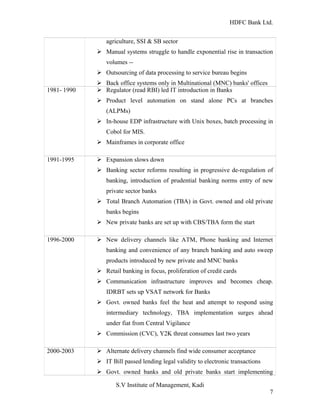
Indian Banking: Key Developments 
1969 Ø Government acquires ownership in major banks 
Ø Almost all banking operations in manual mode 
Ø Some banks had Unit record Machines of IBM for IBR & Pay roll 
1970- 1980 Ø Unprecedented expansion in geographical coverage, staff, 
business & transaction volumes and directed lending to 
S.V Institute of Management, Kadi 
6
HDFC Bank Ltd. 
agriculture, SSI & SB sector 
Ø Manual systems struggle to handle exponential rise in transaction 
volumes -- 
Ø Outsourcing of data processing to service bureau begins 
Ø Back office systems only in Multinational (MNC) banks' offices 
1981- 1990 Ø Regulator (read RBI) led IT introduction in Banks 
Ø Product level automation on stand alone PCs at branches 
(ALPMs) 
Ø In-house EDP infrastructure with Unix boxes, batch processing in 
Cobol for MIS. 
Ø Mainframes in corporate office 
1991-1995 Ø Expansion slows down 
Ø Banking sector reforms resulting in progressive de-regulation of 
banking, introduction of prudential banking norms entry of new 
private sector banks 
Ø Total Branch Automation (TBA) in Govt. owned and old private 
banks begins 
Ø New private banks are set up with CBS/TBA form the start 
1996-2000 Ø New delivery channels like ATM, Phone banking and Internet 
banking and convenience of any branch banking and auto sweep 
products introduced by new private and MNC banks 
Ø Retail banking in focus, proliferation of credit cards 
Ø Communication infrastructure improves and becomes cheap. 
IDRBT sets up VSAT network for Banks 
Ø Govt. owned banks feel the heat and attempt to respond using 
intermediary technology, TBA implementation surges ahead 
under fiat from Central Vigilance 
Ø Commission (CVC), Y2K threat consumes last two years 
2000-2003 Ø Alternate delivery channels find wide consumer acceptance 
Ø IT Bill passed lending legal validity to electronic transactions 
Ø Govt. owned banks and old private banks start implementing 
S.V Institute of Management, Kadi 
7
HDFC Bank Ltd. 
CBSs, but initial attempts face problems 
Ø Banks enter insurance business launch debit cards 
(Source: M.Y.KHAN, “INDIAN FINANCIAL SYSYEM”,3rd edition Publication by 
TATA McGraw hill) 
2. CURRENT SCENARIO 
The banking industry in India is in a midst of transformation, thanks to the economic 
liberalization of the country, which has changed business environment in the country. 
During the pre-liberalization period, the industry was merely focusing on deposit 
mobilization and branch expansion. But with liberalization, it found many of its advances 
under the non-performing assets (NPA) list. More importantly, the sector has become 
very competitive with the entry of many foreign and private sector banks. The face of 
banking is changing rapidly. There is no doubt that banking sector reforms have 
improved the profitability, productivity and efficiency of banks, but in the days ahead 
banks will have to prepare themselves to face new challenges. 
S.V Institute of Management, Kadi 
8
HDFC Bank Ltd. 
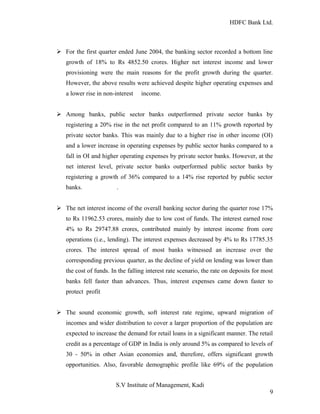
Ø For the first quarter ended June 2004, the banking sector recorded a bottom line 
growth of 18% to Rs 4852.50 crores. Higher net interest income and lower 
provisioning were the main reasons for the profit growth during the quarter. 
However, the above results were achieved despite higher operating expenses and 
a lower rise in non-interest income. 
Ø Among banks, public sector banks outperformed private sector banks by 
registering a 20% rise in the net profit compared to an 11% growth reported by 
private sector banks. This was mainly due to a higher rise in other income (OI) 
and a lower increase in operating expenses by public sector banks compared to a 
fall in OI and higher operating expenses by private sector banks. However, at the 
net interest level, private sector banks outperformed public sector banks by 
registering a growth of 36% compared to a 14% rise reported by public sector 
banks. . 
Ø The net interest income of the overall banking sector during the quarter rose 17% 
to Rs 11962.53 crores, mainly due to low cost of funds. The interest earned rose 
4% to Rs 29747.88 crores, contributed mainly by interest income from core 
operations (i.e., lending). The interest expenses decreased by 4% to Rs 17785.35 
crores. The interest spread of most banks witnessed an increase over the 
corresponding previous quarter, as the decline of yield on lending was lower than 
the cost of funds. In the falling interest rate scenario, the rate on deposits for most 
banks fell faster than advances. Thus, interest expenses came down faster to 
protect profit 
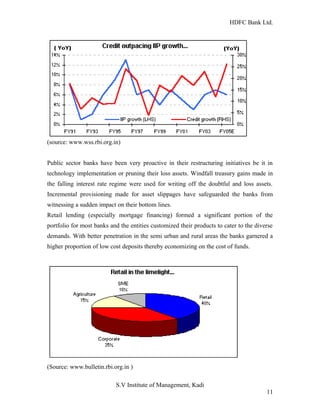
Ø The sound economic growth, soft interest rate regime, upward migration of 
incomes and wider distribution to cover a larger proportion of the population are 
expected to increase the demand for retail loans in a significant manner. The retail 
credit as a percentage of GDP in India is only around 5% as compared to levels of 
30 - 50% in other Asian economies and, therefore, offers significant growth 
opportunities. Also, favorable demographic profile like 69% of the population 
S.V Institute of Management, Kadi 
9
HDFC Bank Ltd. 
estimated to be under 35 years and an increase in upper middle/high income 
households are to be the main drivers for retail credit. In the medium term, 
stronger demand for credit from the corporate sector is also expected consequent 
to the resurgence of this sector. Earlier, banks were seeing lower credit off take 
from corporate because of weak business sentiments and lower credit requirement 
due to improved operational efficiency 
Ø Also, most banks are aggressively augmenting their fee incomes and have 
embarked upon cross selling of products. They are also focusing on fuller 
utilization of their IT investments such as ATMs by entering into sharing 
arrangement with other banks to earn extra OI. Many banks are hopeful of 
effecting significant NPA recoveries due to the Securitization Act. Recoveries 
from NPAs, which have been provided for, add to OI. 
Ø The banking sector is poised to grow in line with the growth of the economy. 
However, there are concerns that directed focus on lending to agriculture and SSI 
sector may increase NPAs of banks. Further, volatility and a sharp fall in g-sec 
prices may lead to trading losses or even depreciation provision for some banks, 
going forward. 
Banking 
With the economic growth picking up pace and the investment cycle on the way to 
recovery, the banking sector has witnessed a transformation in its vital role of 
intermediating between the demand and supply of funds. The revived credit off take (both 
from the food and non food segments) and structural reforms have paved the way for a 
change in the dynamics of the sector itself. Besides gearing up for the compliance with 
Basel accord, the sector is also looking forward to consolidation and investments on the 
FDI front. 
S.V Institute of Management, Kadi 
10
HDFC Bank Ltd. 
(source: www.wss.rbi.org.in) 
Public sector banks have been very proactive in their restructuring initiatives be it in 
technology implementation or pruning their loss assets. Windfall treasury gains made in 
the falling interest rate regime were used for writing off the doubtful and loss assets. 
Incremental provisioning made for asset slippages have safeguarded the banks from 
witnessing a sudden impact on their bottom lines. 
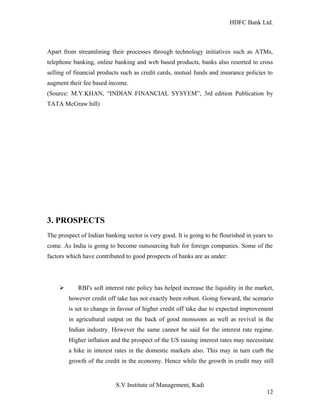
Retail lending (especially mortgage financing) formed a significant portion of the 
portfolio for most banks and the entities customized their products to cater to the diverse 
demands. With better penetration in the semi urban and rural areas the banks garnered a 
higher proportion of low cost deposits thereby economizing on the cost of funds. 
(Source: www.bulletin.rbi.org.in ) 
S.V Institute of Management, Kadi 
11
HDFC Bank Ltd. 
Apart from streamlining their processes through technology initiatives such as ATMs, 
telephone banking, online banking and web based products, banks also resorted to cross 
selling of financial products such as credit cards, mutual funds and insurance policies to 
augment their fee based income. 
(Source: M.Y.KHAN, “INDIAN FINANCIAL SYSYEM”, 3rd edition Publication by 
TATA McGraw hill) 
3. PROSPECTS 
The prospect of Indian banking sector is very good. It is going to be flourished in years to 
come. As India is going to become outsourcing hub for foreign companies. Some of the 
factors which have contributed to good prospects of banks are as under: 
Ø RBI's soft interest rate policy has helped increase the liquidity in the market, 
however credit off take has not exactly been robust. Going forward, the scenario 
is set to change in favour of higher credit off take due to expected improvement 
in agricultural output on the back of good monsoons as well as revival in the 
Indian industry. However the same cannot be said for the interest rate regime. 
Higher inflation and the prospect of the US raising interest rates may necessitate 
a hike in interest rates in the domestic markets also. This may in turn curb the 
growth of the credit in the economy. Hence while the growth in credit may still 
S.V Institute of Management, Kadi 
12
HDFC Bank Ltd. 
be robust, a higher interest rate scenario may however limit the potential. 
Ø While the new law regarding securitization and foreclosure of assets may 
take a while to bear any large benefits, currently the benefits of increased 
power in the hands of the lender are making the borrowers to come to the 
negotiating table. FY04 saw a scenario where the borrowers were forced to 
negotiate with the lenders, which consequently led to the borrowers returning 
some of the dues to the lenders. Going forward the new law will bring about 
greater accountability within the system and ensure that borrowers do not 
take undue advantage of the system. Already an asset reconstruction 
company has been set up by SBI in partnership with other institutions like 
ICICI Bank and IDBI. If properly implemented, this new law may lead to 
significant benefits for the banking sector as a whole. 
Ø Currently the banking sector in the country is strongly fragmented and hence 
with further policy changes taking place in the sector, consolidation is likely 
to take place at a faster rate. However this is subject to the removal of the 
ceiling on voting rights will ensure that private sector and foreign banks will 
be in a much better position to carry out acquisitions in the banking sector. A 
hike in FDI capital limits in the sector would further go a long way in the 
process of consolidation. 
Ø In terms of credit growth, going forward. India's core sector is witnessing a 
revival of sorts. The manufacturing sector especially led by steel and cement 
industries has shown significant improvement in FY04. We expect the trend 
to continue. Hence as corporate growth picks up lending too is likely to see 
an up tick. Retail credit off-take is expected to remain strong going forward 
with the housing finance industry, the main contributor to credit off-take 
from this segment, expected to grow between 20%-25% in the next 3-4 years. 
(Source: Magazine, Banking Finance April-2005, page: 22-27) 
S.V Institute of Management, Kadi 
13
HDFC Bank Ltd. 
4. STRUCTURE OF INDIAN BANKING INDUSTRY 
Organized banking was active in India since the establishment of the General Bank of 
India in 1786. After independence, the Reserve Bank of India (RBI) was established as 
the central bank and in 1955, the Imperial Bank of India, the biggest bank at the time, 
was taken over by the government to form state-owned State Bank of India (SBI). RBI 
had undertaken an exercise to merge weak banks to strong banks and the total number of 
banks thus reduced from 566 in 1951 to 85 in 1969. 
With the objective of reaching out to masses and meeting the credit needs of all sections 
of people, the government nationalized 14 large banks in 1969 followed by another 6 
banks in 1980. This period saw enormous growth in the number of branches and the 
banks’ branch network became wide enough to reach the weakest sections of the society 
in a vast country like India. Sib’s network of 9033 domestic branches and 48 overseas 
offices is considered to be one of the largest for any bank in the world. 
The economic reforms unleashed by the government in early nineties included banking 
sector too, to a significant extent. Entry of new private sector banks was permitted under 
specific guidelines issued by RBI. A number of liberalization and de-regulation measures 
aimed at consolidation, efficiency, productivity, asset quality, capital adequacy and 
S.V Institute of Management, Kadi 
14
HDFC Bank Ltd. 
profitability have been introduced by the RBI to bring Indian banks in line with 
International best practices. With a view to giving the state-owned banks operational 
flexibility and functional autonomy, partial privatization has been authorized as a first 
step, enabling them to dilute the stake of the government to 51 per cent. The government 
further proposed, in the Union Budget for the financial year 2000-01, to reduce its 
holding in nationalized banks to a minimum of 33 per cent on a case by case basis. 
The banking system can be broadly classified as organized and unorganized banking 
system. The unorganized banking system comprises of moneylenders, indigenous 
bankers, lending pawnbrokers, landlords, traders, etc. Whereas the organized banking 
system comprises of Scheduled Banks and Non-Scheduled Banks that are permitted by 
RBI to undertake banking business. 
4.1. Types of Banks 
A. Scheduled Banks 
Scheduled commercial banks are those that come under the purview of the Second 
Schedule of Reserve Bank of India (RBI) Act, 1934. The banks that are included 
under this schedule are those that satisfy the criteria laid down vide section 42 (6 of 
the Act). 
1. The bank is dealing in banking business in India only. 
2. The paid up capital and total funds of the bank should not be less than five lakh 
rupees. 
3. It should convince RBI that its activities would not be against the interest of 
investors. 
4. The bank must be: 
(a) State cooperative bank, or 
(b) A company according to the definition of the companies Act1956, or 
(c) An institution notified by the central government, or 
(d) A corporation or a company incorporated by or under any law in force in 
any place outside India. 
Thus, 
S.V Institute of Management, Kadi 
15
HDFC Bank Ltd. 
(I) Indian Commercial Banks 
(II) Foreign Commercial Banks, and 
(iii) State Cooperative Banks fulfilling the above condition are considered 
as scheduled banks. 
Moreover under the RBI Act section 42, the Central Government has 
declared the following banks as scheduled banks. 
(i) State Bank of India and its seven subsidiary banks, 
(ii) Twenty nationalized banks, and 
(iii) Urban Banks. 
In June 1980 there were 149 scheduled banks which included 
(i) Public Sector Banks 
(ii) Private sector Banks, 
(iii) Foreign Exchange Banks and 
(iv) State Cooperative Banks. 
A bank which wants to register its name as scheduled bank has to apply to the Central 
Government. On receiving such application, the central government orders RBI to 
investigate the banks’ accounts. If RBI gives favorable reports, the central government 
sanctions its proposal, and the bank is listed under schedule annexure II and is considered 
as a scheduled bank. 
Some co-operative banks come under the category of scheduled commercial banks 
though not all co-operative banks. 
Ø PUBLIC SECTOR BANKS 
Public sector banks are those in which the Government of India or the RBI is a 
majority shareholder. These banks include the State Bank of India (SBI) and its 
subsidiaries, other nationalized banks, and Regional Rural Banks (RRBs). Over 
70% of the aggregate branches in India are those of the public sector banks. Some 
of the leading banks in this segment include Allahabad Bank, Canara Bank, Bank 
of Maharashtra, Central Bank of India, Indian Overseas Bank, State Bank of 
S.V Institute of Management, Kadi 
16
HDFC Bank Ltd. 
India, State Bank of Patiala, State Bank of Bikaner and Jaipur, State Bank of 
Travancore, Bank of Baroda, Bank of India, Oriental Bank of Commerce, UCO 
Bank, Union Bank of India, Dena Bank and Corporation Bank. 
Ø PRIVATE SECTOR BANKS 
Private Banks are essentially comprised of two types: 
Old banks and New banks 
The old private sector banks comprise those, which were operating before 
Banking Nationalization Act was passed in 1969. On account of their small size, 
and regional operations, these banks were not nationalized. These banks face 
intense rivalry from the new private banks and the foreign banks. The banks that 
are included in this segment include: Bank of Madura Ltd. (now a part of ICICI 
Bank), Bharat Overseas Bank Ltd., Bank of Rajasthan, Karnataka Bank Ltd., Lord 
Krishna Bank Ltd., The Catholic Syrian Bank Ltd., The Dhanalakshmi Bank Ltd., 
The Federal Bank Ltd., The Jammu & Kashmir Bank Ltd., The Karur Vysya 
Bank Ltd., The Lakshmi Vilas Bank Ltd., The Nedungadi Bank Ltd. and Vysya 
Bank. 
The new private sector banks were established when the Banking Regulation Act 
was amended in 1993. Financial institutions promoted several of these banks. 
After the initial licenses, the RBI has granted no more licenses. These banks are 
gearing up to face the foreign banks by focusing on service and technology. 
Currently, these banks are on an expansion spree, spreading into semi-urban areas 
and satellite towns. The leading banks that are included in this segment include 
Bank of Punjab Ltd., Centurion Bank Ltd., Global Trust Bank Ltd., HDFC Bank 
Ltd., ICICI Banking Corporation Ltd., IDBI Bank Ltd., IndusInd Bank Ltd. and 
UTI Bank Ltd. 
Ø Co-operative Banks 
S.V Institute of Management, Kadi 
17
HDFC Bank Ltd. 
Co-operative banks act as substitutes for moneylenders, and offer timely and 
adequate short-term and long-term institutional credit at reasonable rates of 
interest. Co-operative banks are relatively similar in terms of functions to the 
other banks except for the following: 
a) They are organized and managed on the principal of co-operation, self-help, 
And mutual help. 
b) They operate under the rule of "one member, one vote". 
c) Operate on "no profit, no loss" basis. 
d) Co-operative bank conducts all the main banking functions of deposit 
mobilization, supply of credit and provision of remittance facilities. Co-operative 
banks offer limited banking products and are functionally 
specialists in agriculture-related products, and even in providing housing 
loans of late. Urban Co-operative Banks offer working capital loans and term 
loans as well. 
e) Co-operative banks primarily operate in the agriculture and rural sector. 
However, UCBs, SCBs, and CCBs function in semi urban, urban, and 
metropolitan areas too 
f) Co-operative banks are probably the first government sponsored, 
government-supported, and government-subsidized financial agency in India. 
They get financial and other aid from the Reserve Bank of India NABARD, 
central government and state governments. They are the "most favored" 
banking sector with risk of nationalization. 
g) Co-operative banks normally concentrate on "high revenue" niche retail 
segments. 
Ø Development Banks 
Development banks are primarily intended to encourage industrial development 
by providing adequate flow of funds to industrial projects. In other words, these 
institutions undertake the responsibility of aiding all-round development in the 
country’s economy by promoting new industrial projects, and providing financial 
S.V Institute of Management, Kadi 
18
HDFC Bank Ltd. 
assistance for the expansion, diversification, and up gradation of the existing 
units. Development Banks may be classified as All India development banks and 
Regional development banks. While All India development banks include 
Industrial Development Bank of India and Industrial Finance Corporation of 
India, examples of Regional development banks include State Financial 
Corporation and State Industrial Development Corporation. 
BB Non-scheduled Banks: 
The banks, which are not included in the second schedule of RBI Act, 1934, are 
known as non-scheduled banks. Such banks total share capital is less than five 
lakh. These banks are not governed according to the RBI Act and they receive no 
benefits from the RBI. These banks have no place in the list of recognized banks 
of the RBI. These banks are not much trusted by the people and they do not get 
handsome deposits. Since 1951 the numbers of such banks have been gradually 
decreasing. In 1979 there were only five non-scheduled banks. 
Generally now days we found many cooperative banks which are belongs to the 
non-schedule co-operative banks. Following are the types of non-schedule banks 
they are work like the schedule banks but here difference in its status and it not 
having the status of the schedule banks. 
a. Deposits Banks 
b. Cooperative Banks 
c. Central Banks 
d. Exchange Banks 
e. Investment or Industrial Banks 
f. Land Development Banks 
g. Savings Banks 
(a) Deposits Banks: 
Generally, banks which provide short-term loans to business and industrial units and 
which mobilize savings of people as deposits are called deposit banks. Deposit banks 
accept deposits from people, and provide short-term advances. They provide 
overdraft and cash credit facilities to merchants. To meet the long-term requirement 
S.V Institute of Management, Kadi 
19
HDFC Bank Ltd. 
of industrial units is not possible for these banks. They accept three types of deposits-saving 
bank deposits, fixed deposits and current account deposits. They accept these 
deposits which are payable on demand or on short notice, and provide funds to 
trading and commercial units for short durations. 
(b) Cooperative Banks 
Cooperative banks meet the short-term financial needs of farmers. Agriculturists, 
petty farmers and artisans organize themselves on cooperative principles and form 
cooperative societies and banks. Cooperative banks raise funds through various 
means, besides receiving all kinds of deposits to make them available as lendable 
funds to its members. In India developed cooperative banks supply finance for 
agriculture and non-agriculture activities. 
(c) Central Banks 
A central bank is a special institution which controls and regulates the entire banking 
structure of country. It also strives to maintain monetary stability of the country. 
Central bank is also known as the apex bank of a country. Since it functions in the 
best interest of the country and making profits is unknown to it, it is entrusted the 
right it issue currency notes. No other bank is allowed this right. It operates in close 
cooperation with the government of implementing economic policies, thereby 
promoting economic development. 
(d) Exchange Banks: 
There is a difference in financing of foreign trade and financing of internal trade. 
Generally a person carrying on international trade requires foreign currencies to meet 
his obligation. It is here that exchange banks play the role of financing the dealer for 
setting transactions involved in foreign trade, there are specialized banks for 
exchange business. In India, there is an Export-Import Bank (EXIM). 
(e) Investment or Industrial Banks: 
Investment banks provide long-term credit to industries. They raise their funds by 
way of share capital, debentures, and long-term deposits from the public. They also 
S.V Institute of Management, Kadi 
20
HDFC Bank Ltd. 
raise funds by the issue of bonds for business operations and government agencies. 
Usually they underwrite fresh issue of shares and debentures of companies. Such 
banks also buy the entire issue of new securities of public limited companies and try 
to get them subscribed at a higher price by the public. 
(f) Land Development Banks: 
Land development banks were earlier known as land mortgage banks. In India, there 
is limited number of such banks. There are special institutions providing long-term 
loans to agricultures and farmers. They provide loans on security of land and other 
immovable properties. They supply long-term funds for periods exceeding six years. 
Agriculturists and farmers need such funds for making permanent improvements to 
land and for buying farming machinery and equipment. 
(g) Savings Banks: 
Savings Banks are specialized institutions, which encourage general public to save 
something from their earnings. In other words such banks pool the small savings of 
middle and lower income sections of society. They are the banks in the true sense of 
the term and their main aim is to promote and collect of the public. Not only the 
depositors are given interest, but also they are allowed to withdraw in times of need. 
The numbers of withdrawal are, however, restricted. Separate savings banks are 
organized in various nations. The government can also run a savings bank. In India 
the postal department runs the postal saving bank all over the country. It is very 
popular in rural areas where no branches where no branches of established 
commercial bank operate. In urban areas, commercial bank handles savings business 
S.V Institute of Management, Kadi 
21
HDFC Bank Ltd. 
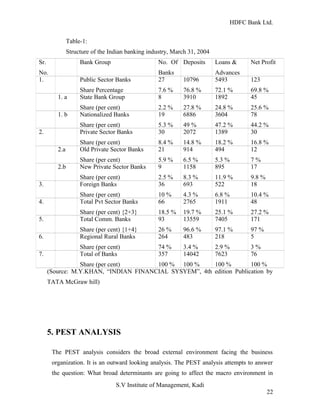
Table-1: 
Structure of the Indian banking industry, March 31, 2004 
Sr. 
No. 
Bank Group No. Of 
Banks 
Deposits Loans & 
Advances 
Net Profit 
1. Public Sector Banks 
Share Percentage 
27 
7.6 % 
10796 
76.8 % 
5493 
72.1 % 
123 
69.8 % 
1. a State Bank Group 
Share (per cent) 
8 
2.2 % 
3910 
27.8 % 
1892 
24.8 % 
45 
25.6 % 
1. b Nationalized Banks 
Share (per cent) 
19 
5.3 % 
6886 
49 % 
3604 
47.2 % 
78 
44.2 % 
2. Private Sector Banks 
Share (per cent) 
30 
8.4 % 
2072 
14.8 % 
1389 
18.2 % 
30 
16.8 % 
2.a Old Private Sector Banks 
Share (per cent) 
21 
5.9 % 
914 
6.5 % 
494 
5.3 % 
12 
7 % 
2.b New Private Sector Banks 
Share (per cent) 
9 
2.5 % 
1158 
8.3 % 
895 
11.9 % 
17 
9.8 % 
3. Foreign Banks 
Share (per cent) 
36 
10 % 
693 
4.3 % 
522 
6.8 % 
18 
10.4 % 
4. Total Pvt Sector Banks 
Share (per cent) {2+3} 
66 
18.5 % 
2765 
19.7 % 
1911 
25.1 % 
48 
27.2 % 
5. Total Comm. Banks 
Share (per cent) {1+4} 
93 
26 % 
13559 
96.6 % 
7405 
97.1 % 
171 
97 % 
6. Regional Rural Banks 
Share (per cent) 
264 
74 % 
483 
3.4 % 
218 
2.9 % 
5 
3 % 
7. Total of Banks 
Share (per cent) 
357 
100 % 
14042 
100 % 
7623 
100 % 
76 
100 % 
(Source: M.Y.KHAN, “INDIAN FINANCIAL SYSYEM”, 4th edition Publication by 
TATA McGraw hill) 
5. PEST ANALYSIS 
The PEST analysis considers the broad external environment facing the business 
organization. It is an outward looking analysis. The PEST analysis attempts to answer 
the question: What broad determinants are going to affect the macro environment in 
S.V Institute of Management, Kadi 
22
HDFC Bank Ltd. 
which the firm will be competing, over the next five (or more) years? The PEST 
analysis is so-called, because it is an acronym for the four categories into which the 
analyst will try and include all of the relevant factors and trends: Political, Economic, 
Social, and Technological. 
Like any model, the PEST model is a simplification; the choice of Political, Economic, 
Social, and Technological factors may strike you as arbitrary. You may be right. 
However, these categories are as adequate as any in attempting to put a form to the 
myriad trends, developments, events and causations that will assist or hinder the firm as 
it attempts to breach the Gap between where its is now, and where it ultimately wants to 
be. 
. 
Political-legal factors 
1. Government policy and budget: 
S.V Institute of Management, Kadi 
23
HDFC Bank Ltd. 
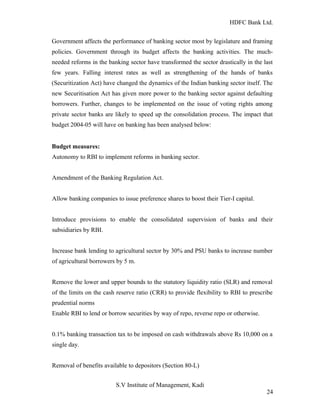
Government affects the performance of banking sector most by legislature and framing 
policies. Government through its budget affects the banking activities. The much-needed 
reforms in the banking sector have transformed the sector drastically in the last 
few years. Falling interest rates as well as strengthening of the hands of banks 
(Securitization Act) have changed the dynamics of the Indian banking sector itself. The 
new Securitisation Act has given more power to the banking sector against defaulting 
borrowers. Further, changes to be implemented on the issue of voting rights among 
private sector banks are likely to speed up the consolidation process. The impact that 
budget 2004-05 will have on banking has been analysed below: 
Budget measures: 
Autonomy to RBI to implement reforms in banking sector. 
Amendment of the Banking Regulation Act. 
Allow banking companies to issue preference shares to boost their Tier-I capital. 
Introduce provisions to enable the consolidated supervision of banks and their 
subsidiaries by RBI. 
Increase bank lending to agricultural sector by 30% and PSU banks to increase number 
of agricultural borrowers by 5 m. 
Remove the lower and upper bounds to the statutory liquidity ratio (SLR) and removal 
of the limits on the cash reserve ratio (CRR) to provide flexibility to RBI to prescribe 
prudential norms 
Enable RBI to lend or borrow securities by way of repo, reverse repo or otherwise. 
0.1% banking transaction tax to be imposed on cash withdrawals above Rs 10,000 on a 
single day. 
Removal of benefits available to depositors (Section 80-L) 
S.V Institute of Management, Kadi 
24
HDFC Bank Ltd. 
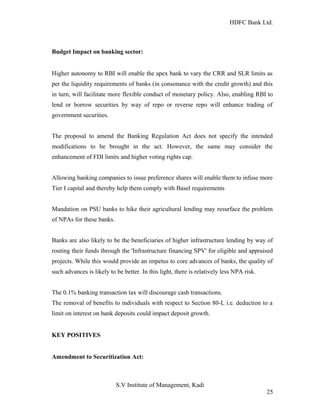
Budget Impact on banking sector: 
Higher autonomy to RBI will enable the apex bank to vary the CRR and SLR limits as 
per the liquidity requirements of banks (in consonance with the credit growth) and this 
in turn, will facilitate more flexible conduct of monetary policy. Also, enabling RBI to 
lend or borrow securities by way of repo or reverse repo will enhance trading of 
government securities. 
The proposal to amend the Banking Regulation Act does not specify the intended 
modifications to be brought in the act. However, the same may consider the 
enhancement of FDI limits and higher voting rights cap. 
Allowing banking companies to issue preference shares will enable them to infuse more 
Tier I capital and thereby help them comply with Basel requirements 
Mandation on PSU banks to hike their agricultural lending may resurface the problem 
of NPAs for these banks. 
Banks are also likely to be the beneficiaries of higher infrastructure lending by way of 
routing their funds through the 'Infrastructure financing SPV' for eligible and appraised 
projects. While this would provide an impetus to core advances of banks, the quality of 
such advances is likely to be better. In this light, there is relatively less NPA risk. 
The 0.1% banking transaction tax will discourage cash transactions. 
The removal of benefits to individuals with respect to Section 80-L i.e. deduction to a 
limit on interest on bank deposits could impact deposit growth. 
KEY POSITIVES 
Amendment to Securitization Act: 
S.V Institute of Management, Kadi 
25
HDFC Bank Ltd. 
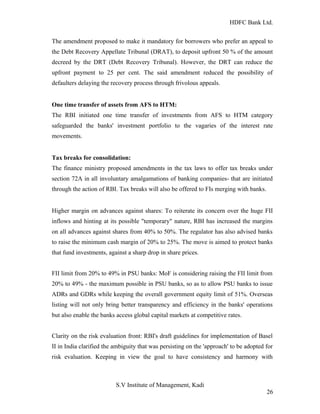
The amendment proposed to make it mandatory for borrowers who prefer an appeal to 
the Debt Recovery Appellate Tribunal (DRAT), to deposit upfront 50 % of the amount 
decreed by the DRT (Debt Recovery Tribunal). However, the DRT can reduce the 
upfront payment to 25 per cent. The said amendment reduced the possibility of 
defaulters delaying the recovery process through frivolous appeals. 
One time transfer of assets from AFS to HTM: 
The RBI initiated one time transfer of investments from AFS to HTM category 
safeguarded the banks' investment portfolio to the vagaries of the interest rate 
movements. 
Tax breaks for consolidation: 
The finance ministry proposed amendments in the tax laws to offer tax breaks under 
section 72A in all involuntary amalgamations of banking companies- that are initiated 
through the action of RBI. Tax breaks will also be offered to FIs merging with banks. 
Higher margin on advances against shares: To reiterate its concern over the huge FII 
inflows and hinting at its possible "temporary" nature, RBI has increased the margins 
on all advances against shares from 40% to 50%. The regulator has also advised banks 
to raise the minimum cash margin of 20% to 25%. The move is aimed to protect banks 
that fund investments, against a sharp drop in share prices. 
FII limit from 20% to 49% in PSU banks: MoF is considering raising the FII limit from 
20% to 49% - the maximum possible in PSU banks, so as to allow PSU banks to issue 
ADRs and GDRs while keeping the overall government equity limit of 51%. Overseas 
listing will not only bring better transparency and efficiency in the banks' operations 
but also enable the banks access global capital markets at competitive rates. 
Clarity on the risk evaluation front: RBI's draft guidelines for implementation of Basel 
II in India clarified the ambiguity that was persisting on the 'approach' to be adopted for 
risk evaluation. Keeping in view the goal to have consistency and harmony with 
S.V Institute of Management, Kadi 
26
HDFC Bank Ltd. 
international standards, the RBI decided that all banks in India should adopt ' 
standardized approach' for credit risk and 'basic indicator approach' for operational risk. 
KEY NEGATIVES 
Liquidity crunch: 
The SEBI dictate that Mutual funds will not to be allowed to invest in bank deposits 
might create liquidity crunch for the banks in the short term, forcing them to accept 
deposits at higher rates and paring their interest margins. 
Hike in wages: 
The 8th bipartite wage settlement that paved the way for 13.25% hike in wages has 
caused accumulation of huge arrears to the tune of Rs 66 bn to be paid to the bank 
employees across the industry. The hike in wages was more than what the banks had 
expected and provisioned for and therefore the entities will have to provide for them in 
the coming quarters. 
Interest rate dampener: 
The interest rate movement in the short term is likely to be with an upward bias. 
Although a marginal hike will not trigger any sensitivity, an upward movement in 
inflation, leading to a parallel rise in interest rates may put the current credit growth on 
hold. 
Impediments in sectoral reforms: The hike in the FDI cap in private banking sector to 
74% and a revision in the voting rights to make it commensurate with equity holding 
were expected to bring sea changes in the Indian banking scenario. However, 
opposition from Left and resultant cautious approach from the North Block may 
hamper the reforms to materializing in the near term 
(Source: www.personalfn.com, www.equitymaster.com) 
S.V Institute of Management, Kadi 
27
HDFC Bank Ltd. 
Economic factors 
Economic factors show the way in which economy is moving. How these all affect the 
industry should be analyzed. Economic factors such as Interest rates, inflation rates, 
unemployment rates, gross national product, sectoral growth rate of agriculture, 
industry infrastructure, level of disposable income, availability of credits affect each 
industry. 
S.V Institute of Management, Kadi 
28
HDFC Bank Ltd. 
1. GDP: 
Gross domestic product (GDP) is the measure of national income. Its trend shows the 
actual picture of country’s economy. It is a measure of wealth and health of economy. 
India is one of the fastest growing economies in world today. Everybody is looking at 
India. It’s GDP is higher than most countries in the world. 
Source: CMIE 
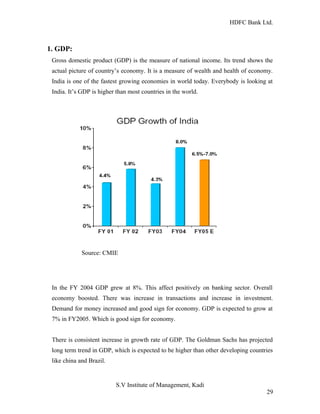
In the FY 2004 GDP grew at 8%. This affect positively on banking sector. Overall 
economy boosted. There was increase in transactions and increase in investment. 
Demand for money increased and good sign for economy. GDP is expected to grow at 
7% in FY2005. Which is good sign for economy. 
There is consistent increase in growth rate of GDP. The Goldman Sachs has projected 
long term trend in GDP, which is expected to be higher than other developing countries 
like china and Brazil. 
S.V Institute of Management, Kadi 
29
HDFC Bank Ltd. 
2. Inflation 
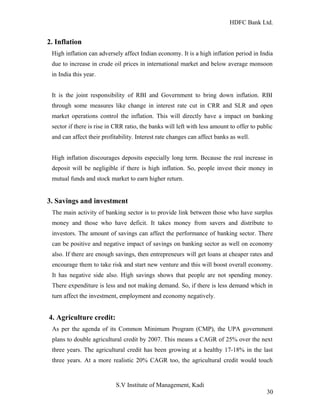
High inflation can adversely affect Indian economy. It is a high inflation period in India 
due to increase in crude oil prices in international market and below average monsoon 
in India this year. 
It is the joint responsibility of RBI and Government to bring down inflation. RBI 
through some measures like change in interest rate cut in CRR and SLR and open 
market operations control the inflation. This will directly have a impact on banking 
sector if there is rise in CRR ratio, the banks will left with less amount to offer to public 
and can affect their profitability. Interest rate changes can affect banks as well. 
High inflation discourages deposits especially long term. Because the real increase in 
deposit will be negligible if there is high inflation. So, people invest their money in 
mutual funds and stock market to earn higher return. 
3. Savings and investment 
The main activity of banking sector is to provide link between those who have surplus 
money and those who have deficit. It takes money from savers and distribute to 
investors. The amount of savings can affect the performance of banking sector. There 
can be positive and negative impact of savings on banking sector as well on economy 
also. If there are enough savings, then entrepreneurs will get loans at cheaper rates and 
encourage them to take risk and start new venture and this will boost overall economy. 
It has negative side also. High savings shows that people are not spending money. 
There expenditure is less and not making demand. So, if there is less demand which in 
turn affect the investment, employment and economy negatively. 
4. Agriculture credit: 
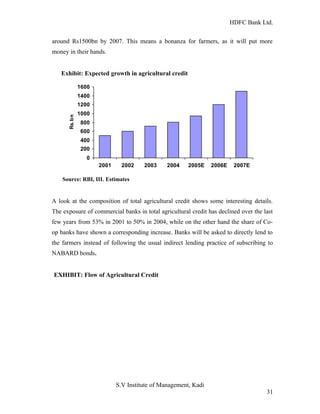
As per the agenda of its Common Minimum Program (CMP), the UPA government 
plans to double agricultural credit by 2007. This means a CAGR of 25% over the next 
three years. The agricultural credit has been growing at a healthy 17-18% in the last 
three years. At a more realistic 20% CAGR too, the agricultural credit would touch 
S.V Institute of Management, Kadi 
30
HDFC Bank Ltd. 
around Rs1500bn by 2007. This means a bonanza for farmers, as it will put more 
money in their hands. 
Exhibit: Expected growth in agricultural credit 
1600 
1400 
1200 
1000 
800 
600 
400 
200 
0 
2001 2002 2003 2004 2005E 2006E 2007E 
Rs.bn 
Source: RBI, IIL Estimates 
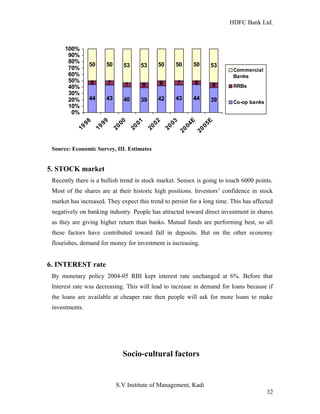
A look at the composition of total agricultural credit shows some interesting details. 
The exposure of commercial banks in total agricultural credit has declined over the last 
few years from 53% in 2001 to 50% in 2004, while on the other hand the share of Co-op 
banks have shown a corresponding increase. Banks will be asked to directly lend to 
the farmers instead of following the usual indirect lending practice of subscribing to 
NABARD bonds. 
EXHIBIT: Flow of Agricultural Credit 
S.V Institute of Management, Kadi 
31
HDFC Bank Ltd. 
50 50 53 53 50 50 50 53 
6 7 7 8 8 7 6 8 
44 43 40 39 42 43 44 39 
100% 
90% 
80% 
70% 
60% 
50% 
40% 
30% 
20% 
10% 
0% 
20 04E 
20 05E 
19 98 
19 99 
20 00 
20 01 
20 02 
20 03 
Commercial 
Banks 
RRBs 
Co-op banks 
Source: Economic Survey, IIL Estimates 
5. STOCK market 
Recently there is a bullish trend in stock market. Sensex is going to touch 6000 points. 
Most of the shares are at their historic high positions. Investors’ confidence in stock 
market has increased. They expect this trend to persist for a long time. This has affected 
negatively on banking industry. People has attracted toward direct investment in shares 
as they are giving higher return than banks. Mutual funds are performing best, so all 
these factors have contributed toward fall in deposits. But on the other economy 
flourishes, demand for money for investment is increasing. 
6. INTEREST rate 
By monetary policy 2004-05 RBI kept interest rate unchanged at 6%. Before that 
Interest rate was decreasing. This will lead to increase in demand for loans because if 
the loans are available at cheaper rate then people will ask for more loans to make 
investments. 
Socio-cultural factors 
S.V Institute of Management, Kadi 
32
HDFC Bank Ltd. 
Socio-cultural factors also affect the business. They show way in which people behave 
in country. Socio-cultural factors like taboos, customs, traditions, tastes, preferences, 
buying and consumption habit of the people, their language, beliefs and values affect 
the business. Banking industry is also operates under these social environment and it is 
also affected by this factors. These factors are changing continuously. People’s life 
style, their behaviour, consumption pattern etc. is changing and also creating 
opportunities and threat for banking industry. There are some socio-cultural factors that 
affect banking in India have been analyzed below: 
1. TRADITIONAL mahajan pratha 
Before the birth of the banks, people of India were used to borrow money from local 
moneylenders, shahukars, mahajan and shroffs. They were used to charge higher 
interest and also mortgage land and house. Farmers were exploited by these shahukars. 
But farmers need money. So, they did not have any choice other than going to 
shahukars and borrow money from them in spite of exploitation by these people. But 
after emergence of banks attitude of people was changed. 
Traditional mahajan pratha still exist in India especially in rural areas. This affects the 
banking sector. Rural people afraid to go to banks to borrow money instead they prefer 
to borrow from shahukars with whom they have relationships from the time of their 
fore fathers. Banking infrastructure is also week in some interior areas of India. So, this 
is reason it still exist. 
2. SHIFT towards nuclear family 
Attitude of people of India is changing. Now, younger generation wants to remain 
separate from their parents after they get married. Joint families are breaking-up. There 
are many reasons behind that. But banking sector is positively affected by this trend. A 
family need home, consumer durables like freeze, washing machine, television, bike, 
car etc. so, they demand for these products and borrow from banks. Recently there is a 
boost in housing finance and vehicle loans. As they do not have money they go for 
installments. So, banks satisfy nuclear families wants. 
S.V Institute of Management, Kadi 
33
HDFC Bank Ltd. 
3. CHANGE in life style 
Life style of people of India is changing rapidly. They are demanding high-class 
products. They have become more advanced. People want everything car, mobile etc. 
what their forefather had dreamed of. Now teenagers also have mobile and vehicle. 
Even middle class people also want to have well furnished home, television, mobile, 
vehicle and this has opened opportunities for banking sector to tap this change. Every 
thing is available on installment so it has become easy to purchase anything even if you 
do not have lump sum. 
4. LITERACY rate 
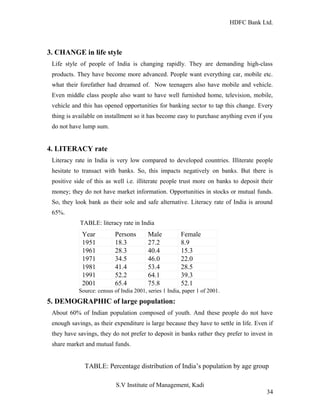
Literacy rate in India is very low compared to developed countries. Illiterate people 
hesitate to transact with banks. So, this impacts negatively on banks. But there is 
positive side of this as well i.e. illiterate people trust more on banks to deposit their 
money; they do not have market information. Opportunities in stocks or mutual funds. 
So, they look bank as their sole and safe alternative. Literacy rate of India is around 
65%. 
TABLE: literacy rate in India 
Year Persons Male Female 
1951 18.3 27.2 8.9 
1961 28.3 40.4 15.3 
1971 34.5 46.0 22.0 
1981 41.4 53.4 28.5 
1991 52.2 64.1 39.3 
2001 65.4 75.8 52.1 
Source: census of India 2001, series 1 India, paper 1 of 2001. 
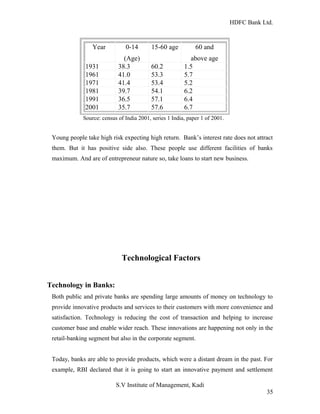
5. DEMOGRAPHIC of large population: 
About 60% of Indian population composed of youth. And these people do not have 
enough savings, as their expenditure is large because they have to settle in life. Even if 
they have savings, they do not prefer to deposit in banks rather they prefer to invest in 
share market and mutual funds. 
TABLE: Percentage distribution of India’s population by age group 
S.V Institute of Management, Kadi 
34
HDFC Bank Ltd. 
Year 0-14 
(Age) 
15-60 age 60 and 
above age 
1931 38.3 60.2 1.5 
1961 41.0 53.3 5.7 
1971 41.4 53.4 5.2 
1981 39.7 54.1 6.2 
1991 36.5 57.1 6.4 
2001 35.7 57.6 6.7 
Source: census of India 2001, series 1 India, paper 1 of 2001. 
Young people take high risk expecting high return. Bank’s interest rate does not attract 
them. But it has positive side also. These people use different facilities of banks 
maximum. And are of entrepreneur nature so, take loans to start new business. 
Technological Factors 
Technology in Banks: 
Both public and private banks are spending large amounts of money on technology to 
provide innovative products and services to their customers with more convenience and 
satisfaction. Technology is reducing the cost of transaction and helping to increase 
customer base and enable wider reach. These innovations are happening not only in the 
retail-banking segment but also in the corporate segment. 
Today, banks are able to provide products, which were a distant dream in the past. For 
example, RBI declared that it is going to start an innovative payment and settlement 
S.V Institute of Management, Kadi 
35
HDFC Bank Ltd. 
system named Real Time Gross Settlement, which will make the banking, services 
faster and more efficient for the customers. Funds transfer between banks under the 
system will be on real time basis. 
Technology is changing the way banks interface with their customers, resulting in 
increased customer base for the banks. The customer need not go to a branch for a 
transaction; he can do it via Internet, mobile phone or even the landline. 
Ø Core Banking Solution 
Core banking solution is the buzzword today and every bank is trying to adopt it. 
It is a centralized banking platform through which a bank can control its entire 
operation. The adoption of core banking solution will help banks to roll out new 
products and services. 
Ø ATMs 
China has around 65,000 installed ATMs and the global average is of two or three 
ATMs per branch. Compared to these figures, India is far behind with an installed 
ATMs base of around 10,000. Though banks plan to invest heavily in new ATMs 
in the coming two to three years, it is expected that there will be only around 
17,000 ATMs by the end of 2004. 
Cost per transaction at an ATM is much less than a transaction at the branch and it 
can be reduced by as much as 50% of the cost at a branch. 
Ø Internet 
While Internet banking is in place for the last four years in India, it has just started 
showing signs of picking up. Today, banks in India are in the process of Web-enabling 
their services in order to offer Internet banking to their customers. 
Through Internet, banks can provide their services in a cost-effective manner. 
Internet Banking has numerous benefits like greater reach to customers, quicker 
time to market, ability to introduce new products and services quickly and 
successfully, ability to understand its customer’s needs, greater customer loyalty 
etc. 
S.V Institute of Management, Kadi 
36
HDFC Bank Ltd. 
6. Porter's Five Forces Model of Competition 
The nature of competition in an industry in large part determines the content of 
strategy, especially business-level strategy. Based as it is on the fundamental 
economics of the industry, the very profit potential of an industry is determined 
by competitive interactions. Where these interactions are intense, profits tend to 
be whittled away by the activities of competing. Where they are mild and 
competitors appear docile, profit potential tends to be high. Yet a full 
understanding of the elements of competition within an industry is easy to 
overlook and often difficult to comprehend. 
Porter has identified five basic forces that collectively describe the state of competition 
in an industry: 
S.V Institute of Management, Kadi 
37
HDFC Bank Ltd. 
1. The intensity of rivalry among competitors 
2. The threat of new entrants to the market 
3. The amount of bargaining power possessed by the 
firm's/industry's suppliers 
4. The amount of bargaining power possessed by the 
firm's/industry's customers 
5. The extent that substitute products present a threat to a 
firm's/industry's products 
These forces assist in identifying the presence or absence of potential high returns. The 
weaker are Porter's five forces, the greater is the opportunity for firms in an industry to 
experience superior profitability. More generally, understanding how these forces affect 
competition within an industry allows the strategist to identify the most advantageous 
strategic position. 
The actors within an industry on whom these forces exert pressure are, respectively, the 
industry's competing firms themselves, potential new entrants to the industry's markets, 
suppliers (vendors), customers, and makers of substitute products. 
Obviously, the starting point for conducting an analysis of the five forces of 
competition is to identify all the competitors, potential new entrants, major suppliers, 
the demographics of customers, and makers of and nature of substitute products. 
Competitors would not only have to be identified, but various distinguishing data about 
the industry would also have to be specified. For each competitor this data would 
include market share, product line differences/similarities, market segments served, 
price/quality relationships represented by products, growth/decline trends, financial 
strength differences, and any other information that will help describe the industry. 
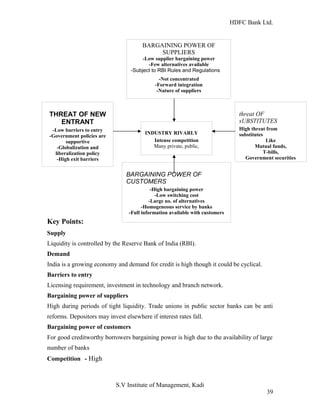
Porter’s FIVE-FORCE analysis for Indian banking industry 
S.V Institute of Management, Kadi 
38
HDFC Bank Ltd. 
Key Points: 
Supply 
Liquidity is controlled by the Reserve Bank of India (RBI). 
Demand 
India is a growing economy and demand for credit is high though it could be cyclical. 
Barriers to entry 
Licensing requirement, investment in technology and branch network. 
Bargaining power of suppliers 
High during periods of tight liquidity. Trade unions in public sector banks can be anti 
reforms. Depositors may invest elsewhere if interest rates fall. 
Bargaining power of customers 
For good creditworthy borrowers bargaining power is high due to the availability of large 
number of banks 
Competition - High 
S.V Institute of Management, Kadi 
39 
BARGAINING POWER OF 
SUPPLIERS 
-Low supplier bargaining power 
-Few alternatives available 
-Subject to RBI Rules and Regulations 
-Not concentrated 
-Forward integration 
-Nature of suppliers 
THREAT OF NEW 
ENTRANT 
-Low barriers to entry 
-Government policies are 
supportive 
-Globalization and 
liberalization policy 
-High exit barriers 
INDUSTRY RIVARLY 
Intense competition 
Many private, public, 
Co-operative, foreign banks 
BARGAINING POWER OF 
CUSTOMERS 
-High bargaining power 
-Low switching cost 
-Large no. of alternatives 
-Homogeneous service by banks 
-Full information available with customers 
threat OF 
sUBSTITUTES 
High threat from 
substitutes 
Like 
Mutual funds, 
T-bills, 
Government securities
HDFC Bank Ltd. 
There are public sector banks, private sector and foreign banks along with non banking 
finance companies competing in similar business lines. 
RIVALRY AMONG THE INDUSTRY 
Rivalry in banking industry is very high. There are so many private, public, co-operative 
and non-financial institutions operating in the industry. They are fighting for 
same customers. Due to government liberalization and globalization policy, banking 
sector became open for everybody. So, newer and newer private and foreign firms are 
opening their branches in India. This has intensified the competition. The no. of factors 
have contributed to increase rivalry those are: 
1. A large no. Of banks 
There are so many banks and non-financial institutions fighting for same pie, which has 
intensified competition. 
2. High market growth rate 
S.V Institute of Management, Kadi 
40
HDFC Bank Ltd. 
India is seen as one of the biggest market place and growth rate in Indian banking 
industry is also very high. This has ignited the competition. 
3. Low switching cost 
Customer switching cost is very low. They can easily switch from one bank to another 
bank and very little loyalty exists. 
4. In differentiate services 
Almost every bank provides similar services. No differentiation exists. Every bank tries 
to copy each other services and technology, which increases the level of competition. 
5. High fixed cost 
6. High exit barrier 
High exist barriers humiliate banks to earn profit and retain customers by providing 
world-class services. 
7. Low government regulations: 
There are low regulation exist to start a new business due LPG policy adopted by 
India. So, sector is open for everybody. 
S.V Institute of Management, Kadi 
41
HDFC Bank Ltd. 
BARGAINING POWER OF SUPPLIERS 
Suppliers of banks are depositors. These are those people who have excess money and 
prefer regular income and safety. In banking industry Suppliers have low bargaining 
power. Following are the reasons for low bargaining power of suppliers. 
1. Nature of suppliers 
Suppliers of banks are generally those people who prefer low risk and those who need 
regular income and safety as well. Bank is best place for them to deposit their surplus 
money. They believe that banks are very safe than other investment alternatives. So, 
they do not consider other alternatives very seriously, which lower their bargaining 
power. 
2. Few alternatives 
Suppliers are risk averters and want regular income. So, they have few alternatives 
available with them to invest like Treasury bills, government bonds. So, few 
alternatives lower their bargaining power. 
S.V Institute of Management, Kadi 
42
HDFC Bank Ltd. 
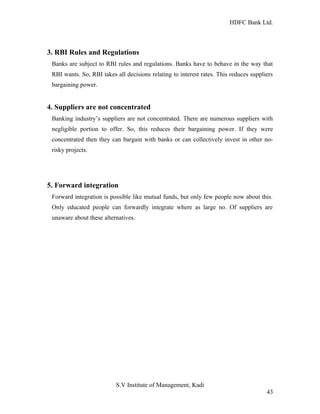
3. RBI Rules and Regulations 
Banks are subject to RBI rules and regulations. Banks have to behave in the way that 
RBI wants. So, RBI takes all decisions relating to interest rates. This reduces suppliers 
bargaining power. 
4. Suppliers are not concentrated 
Banking industry’s suppliers are not concentrated. There are numerous suppliers with 
negligible portion to offer. So, this reduces their bargaining power. If they were 
concentrated then they can bargain with banks or can collectively invest in other no-risky 
projects. 
5. Forward integration 
Forward integration is possible like mutual funds, but only few people now about this. 
Only educated people can forwardly integrate where as large no. Of suppliers are 
unaware about these alternatives. 
S.V Institute of Management, Kadi 
43
HDFC Bank Ltd. 
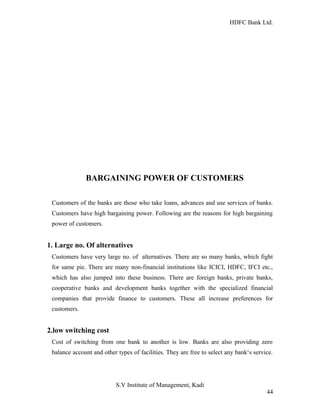
BARGAINING POWER OF CUSTOMERS 
Customers of the banks are those who take loans, advances and use services of banks. 
Customers have high bargaining power. Following are the reasons for high bargaining 
power of customers. 
1. Large no. Of alternatives 
Customers have very large no. of alternatives. There are so many banks, which fight 
for same pie. There are many non-financial institutions like ICICI, HDFC, IFCI etc., 
which has also jumped into these business. There are foreign banks, private banks, 
cooperative banks and development banks together with the specialized financial 
companies that provide finance to customers. These all increase preferences for 
customers. 
2.low switching cost 
Cost of switching from one bank to another is low. Banks are also providing zero 
balance account and other types of facilities. They are free to select any bank‘s service. 
S.V Institute of Management, Kadi 
44
HDFC Bank Ltd. 
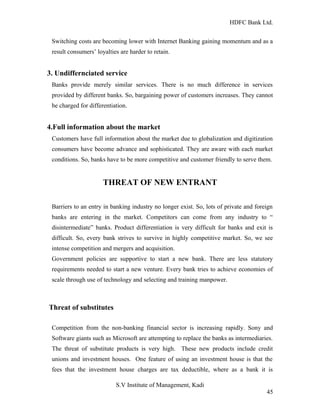
Switching costs are becoming lower with Internet Banking gaining momentum and as a 
result consumers’ loyalties are harder to retain. 
3. Undiffernciated service 
Banks provide merely similar services. There is no much difference in services 
provided by different banks. So, bargaining power of customers increases. They cannot 
be charged for differentiation. 
4.Full information about the market 
Customers have full information about the market due to globalization and digitization 
consumers have become advance and sophisticated. They are aware with each market 
conditions. So, banks have to be more competitive and customer friendly to serve them. 
THREAT OF NEW ENTRANT 
Barriers to an entry in banking industry no longer exist. So, lots of private and foreign 
banks are entering in the market. Competitors can come from any industry to “ 
disintermediate” banks. Product differentiation is very difficult for banks and exit is 
difficult. So, every bank strives to survive in highly competitive market. So, we see 
intense competition and mergers and acquisition. 
Government policies are supportive to start a new bank. There are less statutory 
requirements needed to start a new venture. Every bank tries to achieve economies of 
scale through use of technology and selecting and training manpower. 
Threat of substitutes 
Competition from the non-banking financial sector is increasing rapidly. Sony and 
Software giants such as Microsoft are attempting to replace the banks as intermediaries. 
The threat of substitute products is very high. These new products include credit 
unions and investment houses. One feature of using an investment house is that the 
fees that the investment house charges are tax deductible, where as a bank it is 
S.V Institute of Management, Kadi 
45
HDFC Bank Ltd. 
considered a personal expense, which are not tax deductible. The rate of return with 
using investment houses is greater than a bank. There are other substitutes as well for 
banks like mutual funds, stocks (shares), government securities, debentures, gold, real 
estate etc. so, there is a high threat fro substitute. 
S.V Institute of Management, Kadi 
46
HDFC Bank Ltd. 
Conclusion: 
Indian banking sector is one of the highly competitive sectors where high growth rate and 
high degree of competition exist. Low entry barriers and high exit barriers ignites 
competition in this industry. Every bank strives to survive in the shadow of these barriers. 
There are so many substitutes available with customers and they have high bargaining 
power where as suppliers i.e. depositors have low power in their hands. 
S.V Institute of Management, Kadi 
47
HDFC Bank Ltd. 
SECTION-III 
S.V Institute of Management, Kadi 
48
HDFC Bank Ltd. 
ABOUT HDFC BANK’S PROFILE 
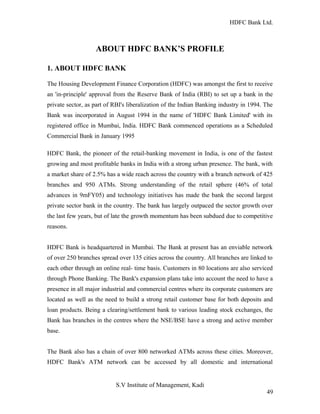
1. ABOUT HDFC BANK 
The Housing Development Finance Corporation (HDFC) was amongst the first to receive 
an 'in-principle' approval from the Reserve Bank of India (RBI) to set up a bank in the 
private sector, as part of RBI's liberalization of the Indian Banking industry in 1994. The 
Bank was incorporated in August 1994 in the name of 'HDFC Bank Limited' with its 
registered office in Mumbai, India. HDFC Bank commenced operations as a Scheduled 
Commercial Bank in January 1995 
HDFC Bank, the pioneer of the retail-banking movement in India, is one of the fastest 
growing and most profitable banks in India with a strong urban presence. The bank, with 
a market share of 2.5% has a wide reach across the country with a branch network of 425 
branches and 950 ATMs. Strong understanding of the retail sphere (46% of total 
advances in 9mFY05) and technology initiatives has made the bank the second largest 
private sector bank in the country. The bank has largely outpaced the sector growth over 
the last few years, but of late the growth momentum has been subdued due to competitive 
reasons. 
HDFC Bank is headquartered in Mumbai. The Bank at present has an enviable network 
of over 250 branches spread over 135 cities across the country. All branches are linked to 
each other through an online real- time basis. Customers in 80 locations are also serviced 
through Phone Banking. The Bank's expansion plans take into account the need to have a 
presence in all major industrial and commercial centres where its corporate customers are 
located as well as the need to build a strong retail customer base for both deposits and 
loan products. Being a clearing/settlement bank to various leading stock exchanges, the 
Bank has branches in the centres where the NSE/BSE have a strong and active member 
base. 
The Bank also has a chain of over 800 networked ATMs across these cities. Moreover, 
HDFC Bank's ATM network can be accessed by all domestic and international 
S.V Institute of Management, Kadi 
49
HDFC Bank Ltd. 
Visa/MasterCard, Visa Electron/Maestro, Plus/Cirrus and American Express 
credit/charge cardholders. 
HDFC Bank operates in a highly automated environment in terms of information 
technology and communication systems. All the bank's branches have connectivity which 
enables the bank to offer speedy funds transfer facilities to its customers. Multi-branch 
access is also provided to retail customers through the branch network and Automated 
Teller Machines (ATMs). 
The Bank has made substantial efforts and investments in acquiring the best technology 
available internationally to build the infrastructure required for a world-class bank. In 
terms of software, the Corporate Banking business is supported by Flexcube, while the 
Retail Banking business by Finware, both from i-flex Solutions Ltd. The systems are 
open, scalable and web-enabled. 
The Bank has prioritized its engagement in technology and the internet as one of its key 
goals and has already made significant progress in web- enabling its core businesses. In 
each of its businesses, the Bank has succeeded in leveraging its market position, expertise 
and technology to create a competitive advantage and build market share. 
The Bank has received recognition both nationally and internationally for 'The Best Bank' 
on various parameters in publications like Euro money and Finance Asia. 
The Bank's IT department has a total staff strength of 120 (approx.), with a mix of 
functional and technical specialists. The project managers for new IT initiatives are 
designated both from this group and from businesses. Almost all the project development 
and application maintenance activities are outsourced to IT vendors. 
2. History of the Bank 
S.V Institute of Management, Kadi 
50
HDFC Bank Ltd. 
HDFC was incorporated in 1977 with the primary objective of meeting a social need – 
that of promoting home ownership by providing long-term finance to households for their 
housing needs. HDFC was promoted with an initial share capital of Rs. 100 million. 
Against the milieu of rapid urbanization and a changing socio-economic scenario, the 
demand for housing has grown explosively. The importance of the housing sector in the 
economy can be illustrated by a few key statistics. According to the National Building 
Organisation (NBO), the total demand for housing is estimated at 2 million units per year 
and the total housing shortfall is estimated to be 19.4 million units, of which 12.76 
million units is from rural areas and 6.64 million units from urban areas. The housing 
industry is the second largest employment generator in the country. It is estimated that 
the budgeted 2 million units would lead to the creation of an additional 10 million man-years 
of direct employment and another 15 million man-years of indirect employment. 
MILE STONES 
Ø Acquired TimesBank in merger from Times Of India Group (5 – 6% present 
holding) 
Ø in 2000. 
Ø ·HDFC owns only 24.4%, rest owned by public and private equity investors JP 
Morgan Chase (5 -6%). 
Ø ·Large Foreign Insitutional Investors (in India) including Putnam, etc. (big vote in 
Ø Indian equity markets) – 10-11% 
Ø ·W arburg Pincus has a significant holding in HDFC (its promoter 
Having identified housing as a priority area in the Ninth Five Year Plan (1997-2002), the 
National Housing Policy has envisaged an investment target of Rs. 1,500 billion for this 
sector. In order to achieve this investment target, the Government needs to make low cost 
funds easily available and enforce legal and regulatory reforms. 
Mission 
S.V Institute of Management, Kadi 
51
HDFC Bank Ltd. 
HDFC Bank's mission is to be a world-class Indian Bank. The Bank's aim is to build 
sound customer franchises across distinct businesses so as to be the preferred provider of 
banking services in the segments that the bank operates in and to achieve healthy growth 
in profitability, consistent with the bank's risk appetite. The bank is committed to 
maintain the highest level of ethical standards, professional integrity and regulatory 
compliance. HDFC Bank's business philosophy is based on four core values: Operational 
Excellence, Customer Focus, Product Leadership and People. 
(source: Annual report-2004-05) 
GOAL AND OBJECTIVES 
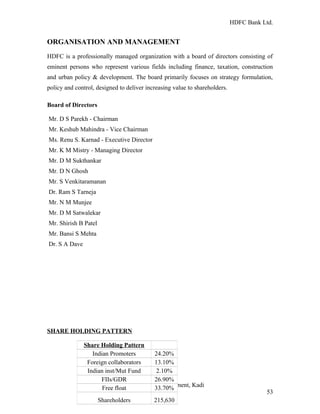
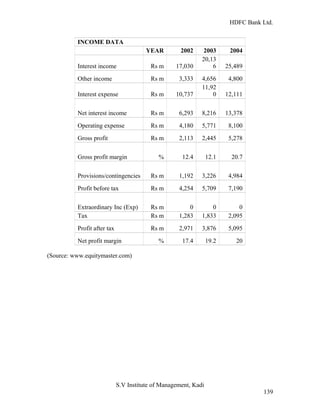
Business Objectives 
The primary objective of HDFC is to enhance residential housing stock in the country 
through the provision of housing finance in a systematic and professional manner, and to 
promote home ownership. Another objective is to increase the flow of resources to the 
housing sector by integrating the housing finance sector with the overall domestic 
financial markets. 
Organizational Goals 
HDFC’s main goals are as follows: 
Ø Develop close relationships with individual households, 
Ø Maintain its position as the premier housing finance institution in the country, 
Ø Transform ideas into viable and creative solutions, 
Ø Provide consistently high returns to shareholders, and 
Ø To grow through diversification by leveraging off the existing client base. 
3. INFORMATION ABOUT BOARD OF DIRECTORS AND 
BOARD COMMITTEE 
S.V Institute of Management, Kadi 
52
HDFC Bank Ltd. 
ORGANISATION AND MANAGEMENT 
HDFC is a professionally managed organization with a board of directors consisting of 
eminent persons who represent various fields including finance, taxation, construction 
and urban policy & development. The board primarily focuses on strategy formulation, 
policy and control, designed to deliver increasing value to shareholders. 
Board of Directors 
Mr. D S Parekh - Chairman 
Mr. Keshub Mahindra - Vice Chairman 
Ms. Renu S. Karnad - Executive Director 
Mr. K M Mistry - Managing Director 
Mr. D M Sukthankar 
Mr. D N Ghosh 
Mr. S Venkitaramanan 
Dr. Ram S Tarneja 
Mr. N M Munjee 
Mr. D M Satwalekar 
Mr. Shirish B Patel 
Mr. Bansi S Mehta 
Dr. S A Dave 
SHARE HOLDING PATTERN 
S.V Institute of Management, Kadi 
53 
Share Holding Pattern 
Indian Promoters 24.20% 
Foreign collaborators 13.10% 
Indian inst/Mut Fund 2.10% 
FIIs/GDR 26.90% 
Free float 33.70% 
Shareholders 215,630
HDFC Bank Ltd. 
HDFC has a staff strength of 1029, which includes professionals from the fields of 
finance, law, accountancy, engineering and marketing. Click here for details of Senior 
Management 
(Source: Annual report 2004-05) 
S.V Institute of Management, Kadi 
54
HDFC Bank Ltd. 
4. ORGANIZATION CHART OF FINANCE FUNCTION IN 
BANK 
Chairman 
Vice Chairman 
Executive Director 
Managing Director 
Senior General Manager 
Chief Financial General Manager 
Accounting and Officer and Treasurer 
Taxation Group 
Assistant Financial Account Manager 
Officer 
Assistant 
ORGANISATION STRUCTURE OF BRANCH 
S.V Institute of Management, Kadi 
55
HDFC Bank Ltd. 
Branch Manager 
Personal Banker Teller Authorizer Clearinghouse Sales 
Authorizer Executive 
Personal Banker Teller 
Functions 
Branch manager 
Ø Require approval from BM for transaction more than 50,000 RS. 
Ø organising coordinating and motivating employees in the organization. 
Ø Develop his territory. 
Personal Banker authorizer 
Ø After his approval, all the applications collect and checked by PB, Executives go for 
further process to branch manager. 
Ø -Daily stock (welcome kit, debit pin number, cheque book, and debit card) requires 
approval of PB authorizer. 
Personal Banker 
Ø Maintain contacts with walk-in customers, existing customers and provide 
satisfactory service to them. 
Ø Handle all the complaint of the customers and resolve it. 
Ø Maintain daily stock reports and take approval from the PB authorizer. 
Teller Authorizer 
Ø He gives approval to all types cheques and DDs by checking all the details and 
validity of it. 
Ø At the end of the day all the cash on hand in the bank require signature of him. 
Ø Report of cash loading in ATM is to be submitted to him. He is responsible for it. 
S.V Institute of Management, Kadi 
56
HDFC Bank Ltd. 
Teller 
Ø Maintain daily transactions of cheque withdrawal, cheque deposits, cash withdrawal 
cash deposit, fund transfer and DD etc. 
Ø Check the validity of all the above transactions. 
Clearinghouse 
Ø All the cheques are being transferred to this department and it checks the sign, 
balance amount in his/ her a/c, date of issuing. 
Ø It also maintains the transaction with other branches and banks. 
Ø DRF forms are being handled by this department. 
Sales Executive 
Ø Generate new inquiries by cold calling and tele marketing. 
Ø Handle existing and new customers. 
Ø Maintain customer relation ships. 
5. PRODUCTS OF HDFC BANK 
1. Savings Account 
S.V Institute of Management, Kadi 
57
HDFC Bank Ltd. 
It is a unique savings account in India, which helps you withdraw or deposit cash through 
wide network of branches and ATMs across India. 
Features 
Ø Comforts of free Phone Banking, Mobile Banking and NetBanking from practically 
anywhere, anytime with your savings account. 
Ø International Debit Card to shop at over 80 lakh establishments in 140 countries. Pay 
your electricity, mobile phone and telephone bills through the phone, Internet or the 
ATM with the unique BillPay Facility. All this is yours for a minimum balance of just 
Rs. 5000/-. 
e-Age Advantages 
HDFC Bank uses state-of-the-art technology to give you an array of value-added 
services. 
Use this convenient facility to pay your electricity, phone and mobile phone bills with a 
single call, mouse click or from any of HDFC Banks ATMs. The bill amount for all 
services you have registered for is presented online. 
ATM facility 
User can access their account with International Debit card, 24 hours a day, 365 days a 
year from ATMs spread across India." Withdraw cash form over 1000 ATMs in India & 
over 5.3 lakh ATMs across the globe. 
Inter-city and inter-branch banking 
You can conveniently bank across the counter at any of our 467 branches across the 
country, absolutely FREE, for transactions up to Rs. 50,000/- per day. For transactions 
over this limit, you incur nominal charges. 3.50% interest per annum* credited to your 
account, at quarterly intervals. 
S.V Institute of Management, Kadi 
58
HDFC Bank Ltd. 
Fund Transfers & Demand Drafts 
Free Funds transfers to another HDFC Bank account in any city/branch. Demand draft 
available at nominal charges 
Safe deposit lockers in different sizes, for your valuables and important documents in 
select cities. 
Sweep-In Account 
With the Sweep-In facility, you can automatically transfer funds from your Fixed Deposit 
to your Savings Account whenever needed. 
Super Saver Account 
You can transfer a part of your Fixed Deposit funds into your Savings Account without 
breaking the Fixed Deposit or losing interest on it. 
Requirement for new account 
Resident Individual (sole or joint account), Minor below 18 yrs. 
(sole account), a Hindu Undivided Family, a Trust, an Association, a Club or a Society. 
If you are a Foreign National residing in India, you may temporarily open a Savings 
Account by attaching an undertaking (QA 22 form), stating sources of credit and a copy 
of your Residence Permit. 
All you need to do is deposit Rs. 5000/- and maintain the same as average quarterly 
balance. 
Fees 
You can open your Savings Account with a minimum deposit of only Rs. 5,000/-. * 
S.V Institute of Management, Kadi 
59
HDFC Bank Ltd. 
Alternatively, you automatically gain access to a zero balance Savings Account, when 
you open a Fixed Deposit for Rs. 50,000/-. When you select this option, you are not 
charged a service fee, even if you are unable to maintain an average balance of Rs. 
5,000/-.* your minimum average quarterly balance maintained must be Rs. 5,000/-. If 
you’re minimum average quarterly balance is less than Rs. 5,000/- a service charge of Rs. 
750/- will be levied per quarter. 
2. Current account 
The Advantages 
You can access your account anytime and anywhere, to withdraw cash, deposit 
cash/cheques, make balance inquiries or ask for mini-statements, or make a cheque book 
request. 
Useful inter-city banking 
Safe & convenient intra-city banking 
3. Sweep-In Account 
Need cash urgently? 
With the Sweep-In Facility you can automatically transfer funds from your Fixed Deposit 
to your Current Account whenever needed 
Attractive rates for inter-city/inter-branch transactions. 
Your funds will be transferred at Rs.1.50/- per Rs.1000/-. The minimum charge is Rs. 
50/-. You can also deposit or withdraw cash for an additional charge of Rs. 2.50/- per Rs. 
1000/- (on full amount, if amount is more than Rs. 50,000) at branches other than the 
branch where you have opened your account. 
Acceptance of cash at the home branch is as per branch's discretion 
S.V Institute of Management, Kadi 
60
HDFC Bank Ltd. 
Safe deposit locker available in select cities and branches for valuables and important 
documents. 
Free personalized cheque book of 50 leaves for enhanced security. Rs. 2/- per leaf is 
charged for subsequent cheque books. 
For banking services that complement your business, open a Regular Current Account 
with HDFC Bank right away. 
Fees 
All you need is to maintain an average balance of Rs.10,000/- per quarter. (Non-maintenance 
of this balance entails a nominal charge of Rs. 750/-) 
4. Demat Account 
Mutilated certificates, lost certificates, postal delays and counterfeit shares are a thing of 
the past. Enter a world of safe, secure and convenient buying, selling and transacting 
without suffering endless paperwork and delays. Convert your securities to electronic 
format with the HDFC Bank Demat Account. It's as easy as opening a bank account. 
HDFC Bank provides online access to your Demat Account, so that you can check your 
holding using the NetBanking facility. 
The advantages of opening a demat account 
Ø Shorter settlements thereby enhancing liquidity 
Ø No stamp duties on transfer of securities held in demat form. 
Ø No concept of Market Lots. 
Ø Change of name, address, dividend mandate, registration of power of attorney, 
transmission etc. can be effected across companies held in demat form by a single 
instruction to the DP. 
S.V Institute of Management, Kadi 
61
HDFC Bank Ltd. 
Features of Demat Account: 
Ø Dematerialization of Securities 
Ø Settlement of Securities traded on the exchange as well as off market transactions 
Ø Pledging and Hypothecation of Dematerialized Securities 
Ø Electronic credit in public issue 
Ø Receipt of non-cash benefits in electronic form 
Ø T + 2 Settlements 
Ø From April 1, 2003, SEBI has made T+2 settlements mandatory when you buy or sell 
shares. 
Ø Demat Account with HDFC Bank; link it to a trading and savings account to do 
online trading with any of the e-brokers empanelled with us for the facility. 
Check out the many advantages you benefit from: 
Ø Personalized instruction book 
Ø Free Demat Account 
Ø Access to your Demat Account over the Internet 
Ø Competitive rates 
Ø Depository gateway for e-broking 
HDFC Bank offers a convenient service that enables to settle trades faster. 
HDFC Bank will: 
Verify the signature of all the account holders. 
Verify the names in the demat account and the certificates. 
Forward the certificates to the Registrar/Company for further processing/credit in 
your account. 
Once you get a credit in the account, the scrip will be reflected as free balance in your 
demat account statement. 
S.V Institute of Management, Kadi 
62
HDFC Bank Ltd. 
5. Private Banking 
Private Banking is a comprehensive and exclusive service, offered by HDFC Bank, to 
select high net worth individuals and institutions. The service is provided by an advisory 
team specialized in financial and investment services. These experienced professionals 
put together unbiased and objective guidance based on strong research and in-depth 
analysis of financial instruments taking into account your financial goals and 
requirements. 
An experienced Relationship Manager serves as your one-point contact, for your 
complete banking and investment needs and requirements. 
6. Car loans 
Car Loan - New Car Loans 
HDFC Bank's Car Loans Scheme is the most convenient way to get a loan for your new 
dream car. 
Advantages of our New Car Loans Services 
Ø Speedy processing - within 48 hours. 
Ø Covers the widest range of cars and multi-utility vehicles in India. 
Ø Whatever the car you choose, we finance you, for up to 90% of its invoice value. 
Ø Flexible repayment options - 12 to 60 month period. 
Ø Attractive car loan plans. 
Ø Among the lowest interest rates. 
Ø Stress-free documentation. 
Ø Prepayment - prepay the loan anytime after 6 months at a small charge. 
Ø Special rates for HDFC Bank account holders. 
Where and how can you apply? 
S.V Institute of Management, Kadi 
63
HDFC Bank Ltd. 
Applying for a New Car Loans is absolutely simple. Just fill the online Apply form and 
representative get in touch with you shortly. 
Phone Banking service is also available. 
Criteria 
Ø For salaried individuals: 
Minimum age of Applicant: 21 years 
Maximum age of Applicant at loan maturity: 58 years 
Minimum employment: 1 year in current employment and minimum 2 years of 
employment 
Minimum Annual Income: Rs 100000 net annual income 
Telephone: Must at residence 
Ø For self employed: 
Minimum age of Applicant: 21 years 
Maximum age of Applicant at loan maturity: 65 years 
Minimum employment: At least 3 years in business 
Minimum Annual Income: Net profit Rs. 60000 p.a for standard cars and Rs.100000 p a 
for mid-sized and premium cars 
Telephone: Must at residence 
Ø For partnership firms: 
Minimum Income: Net profit Rs. 60000 p.a for standard cars and Rs.100000 p a for mid-sized 
and premium cars 
Minimum turnover: Turnover Rs 4.5 lacs 
Telephone: One phone at least at business and at residence of the loan executing partner 
Ø For private limited company: 
Minimum Income: Net profit Rs. 60000 p.a for standard cars and Rs.100000 p a for mid-sized 
and premium cars 
Minimum turnover: Turnover Rs 4.5 lacs 
S.V Institute of Management, Kadi 
64
HDFC Bank Ltd. 
Telephone: One phone at least at business premises 
Ø For public limited company: 
Minimum Income: Net profit Rs. 60000 p.a for standard cars and Rs.100000 p a for mid-sized 
and premium cars 
Minimum turnover: Turnover Rs 4.5 lacs 
Telephone: One phone at least at business premises 
DOCUMENTATION 
Ø For salaried individuals: 
Proof of Identity: - Passport copy, PAN Card, Voters Id car, driving license (Laminated, 
Recent, Legible) 
Income Proof: - Latest salary slip with form 16. 
Address Proof: - Ration card/Driving license/Voters card/passport copy/telephone bill/ 
electricity bill/Life insurance policy PAN Card. 
Bank Statement: - Not mandatory 
Ø For self employed: 
Proof of Identity: - Passport copy, PAN Card, Voters Id car, driving license (Laminated, 
Recent, Legible) 
Income Proof: - Latest ITR 
Address Proof: - Ration card/Driving license/Voters card/passport copy/telephone bill/ 
electricity bill/Life insurance policy PAN Card. 
Bank Statement: - Waived for small cars, for mid - sized and premium cars if income is 
greater than Rs 1.5 lacs then bank statement requirement can be waived. 
Ø For partnership firms: 
Proof of Identity: - NA 
Income Proof: - Audited balance sheet, Profit & loss Account for latest two years and the 
latest 2 years IT returns of the company 
Address Proof: - Telephone Bill/Electricity Bill/Shop & Establishment Act certificate/SSI 
registered certificate/Sales Tax certificate 
S.V Institute of Management, Kadi 
65
HDFC Bank Ltd. 
Bank Statement: - Waived for small cars, for mid - sized and premium cars if income is 
greater than Rs 1.5 lacs then bank statement requirement can be waived. 
Ø For private limited company: 
Proof of Identity: - NA 
Income Proof: - Audited balance sheet, Profit & loss Account for latest two years and the 
latest 2 years IT returns of the company 
Address Proof: - Telephone Bill/Electricity Bill/Shop & Establishment Act certificate/SSI 
registered certificate/Sales Tax certificate 
Bank Statement: - NA 
Ø For public limited company: 
Proof of Identity: - NA 
Income Proof: - Audited balance sheet, Profit & loss Account for latest two years 
Address Proof: - Telephone Bill/Electricity Bill/Shop & Establishment Act certificate/SSI 
registered certificate/Sales Tax certificate 
Bank Statement: - NA 
7. Personal Loans 
A wedding in the family. Maybe your house needs renovation. Or your daughter has 
obtained admission to a medical college. These are moments in life when you may need a 
helping hand. That's when you can rely on HDFC Bank Personal Loan. We offer all kind 
of personal loan meeting your personal requirements in India. 
The procedures are simple, documentation is minimal and approval is quick. 
Advantages of our Personal Loan Services 
Speedy loan approval 
Flexibility to borrow Rs 25,000/- to 10, 00,000/- depending on your needs. 
Convenience of service at your doorstep. 
Repayment options of 12 to 48 months to suit your wallet. 
S.V Institute of Management, Kadi 
66
HDFC Bank Ltd. 
One of the lowest interest rates. 
No guarantor/security/collateral required. 
And if you are an HDFC Bank account holder, we have special rates for you. 
8. Home loans 
Buying a property requires a complete knowledge of real estate and in today's complex 
financial market it is difficult to choose the appropriate home loan company. HDFC Bank 
brings home loans at your doorstep. With over 25 years of experience of our parent 
company HDFC Ltd. and their dedicated team of experts offering a complete package to 
meet your housing finance needs, and ever eager to guide you with a basket of value 
added products and services. 
The benefits of availing a loan from HDFC 
Ø Option to choose your loan as Fixed Rate or Floating Rate 
Ø Option to structure your loan as Partly Fixed or Partly Floating. 
Ø In-house scrutiny of Property documents for your complete peace of mind 
Ø Option to choose flexible repayment option to suit your individual needs 
Ø Option to apply for a loan from the comfort of your office or residence. 
9. Credit cards 
To help you keep up with the changing times, HDFC Bank offers the finest payment 
solutions, from Debit Cards to Credit Cards, all internationally valid. 
Specifically, the HDFC Bank Credit Cards are available as two variants, the HDFC Bank 
International Silver Card and the HDFC Bank International Gold Card 
From the best insurance package to the most powerful Rewards Program and the most 
attractive discount schemes, you will find everything you would naturally expect from 
HDFC bank. 
o International Gold Card 
S.V Institute of Management, Kadi 
67
HDFC Bank Ltd. 
o International Silver Card 
o Health Plus International Credit Card 
o E-Seva International Silver Card 
International gold card 
Introducing the HDFC Bank International Gold Credit Card, customized to suit your 
conveniences and make your lifestyle a truly cherish able golden experience. 
FEATURES 
Recognized the World Over 
The HDFC Bank International Gold Card is accepted at over 18 million VISA Merchant 
Establishments around the world, including 110,000 Merchant Establishments in India. 
Cash Advance 
In a situation where you need cash, just step into any one of our ATMs or VISA Member 
ATMs and withdraw cash up to 40% of your credit limit at a very nominal charge (Please 
refer to the Schedule of charges). 
Revolving credit facility 
Financial flexibility for managing your finances. The revolving credit gives you the 
flexibility to handle credit card bills, depending on what your resources are for that 
month. This feature allows you to pay a minimum amount, which is 5% (subject to a 
minimum amount of Rs.200) of your total bill amount or any higher amount whichever is 
convenient for you. You can then carry forward the balance to a better financial month, 
for which you pay a charge of 2.95% per month. 
Interest Free Credit Period 
Your Card now gets you the highest Free Credit Period of up to 55 days from the date of 
purchase (subject to the submission of the charge by the Merchant). Subsequently, if you 
carry forward your outstanding balance you just pay a nominal interest of 2.95% p.m. 
Comprehensive Insurance 
S.V Institute of Management, Kadi 
68
HDFC Bank Ltd. 
Provide insurance covers against the various risks you might face. What's special is that 
the Add-on Card member gets all the insurance covers with the same amounts as the 
Primary Card member. 
Accidental Death: 
In case of death in an air accident your nominated next of kin will receive a 
compensation of Rs.25,00,000. And in case of death in a rail or road accident, your 
nominated next of kin will receive a compensation of Rs.3,00,000. 
Hospitalization expenses due to an accident: 
This unique feature ensures that your hospital bills won't leave you feeling sick. Let's say 
that you are injured in an accident and need to be hospitalized. We will cover your 
hospital expenses up to Rs.50,000 
Purchase Protection: 
All purchases made on your Card are automatically insured against any loss or damage 
due to burglary or fire. This insurance is valued up to a sum of Rs.50,000 and for a period 
of 180 days from the date of purchase. 
Household Insurance: 
As a HDFC Bank Gold Cardmember, you will be covered against fire and burglary of 
your household contents up to Rs.75,000. 
Travel Made Easy 
Your Card offers you a host of travel-related benefits so that you can travel with ease and 
comfort. 
Air Ticketing: 
You can get a discount of 3.5% on domestic and 5.5% on international air tickets and 
have the tickets delivered at your doorstep. All you have to do is call our authorized 
travel agent and have them delivered at your doorstep*. 
Rail Ticketing: 
S.V Institute of Management, Kadi 
69
HDFC Bank Ltd. 
Our tie-ups with an authorized travel agent(s) across the country ensure that the tickets 
are delivered at your doorstep.* (subject to their availability). 
Global Travel Related Insurance 
To ensure a hassle free travel, a host of travel-related insurance covers are provided on 
your card. 
Loss of Baggage 
Post the arrival of your flight, if your checked-in baggage is reported lost/ misplaced, you 
would be reimbursed up to Rs.60,000 for international flights and up to Rs.20,000 for 
domestic flights. 
Loss of Air Ticket: 
If you happen to lose your international Air ticket during international travel, you would 
be reimbursed expenses incurred in obtaining a new ticket up to Rs.10,000. 
Delayed Flight 
If your flight gets delayed beyond 12 hours from its scheduled departure time, you would 
be reimbursed up to Rs.15,000 for international flights and up to Rs.5000 for domestic 
flights. 
Late Baggage Arrival 
You would be reimbursed up to Rs. 10,000 if your checked-in baggage is delayed by over 
3 hours in case of international flights and over 6 hours in case of connecting domestic 
flights. For domestic air travel you would be reimbursed up to Rs.5,000 if your checked-in 
baggage is delayed by over 12 hours. 
Loss of Passport 
During international travel, if you happen to lose your Passport/ Visa, you would be 
reimbursed expenses incurred in obtaining a new Passport/ Visa subject to a limit of 
Rs.25,000. 
Hijacking 
S.V Institute of Management, Kadi 
70
HDFC Bank Ltd. 
In an unfortunate event of your flight getting Hijacked, you would be eligible to claim 
upto Rs.300,000 @ Rs.12,500 per hour for international and connecting domestic flights 
and upto Rs.1,50,000 @ Rs.6,250 per hour for domestic flights. 
Note: The Hijacking cover is applicable upto a maximum period of 24 hours post 12 
hours of hijacking. 
All the travel-related covers applicable to international flights will apply to connecting 
domestic flights also. Insurance covers are not provided by HDFC Bank. 
Exclusions/Limitations are applicable as per policies issued by the Insurance companies 
with whom the Bank is tied up. 
International Business Travelers' Club (IBTC) Membership 
As our privileged customer, you shall now get a free International Business Travelers' 
Club (IBTC) Blue Card membership which gets you discounts upto 50% at over 5500 
star hotels worldwide and upto 25% on rentals of Hertz Rent-a-Car at over 7500 locations 
worldwide. 
Exclusive Airport Lounge Facilities 
As our esteemed Card member, you will now have access to Domestic and International 
Airport lounges of Oberoi at Mumbai, Kolkata and Chennai*, Welcome group at Delhi 
and Taj at Chennai** and you can enjoy the world- renowned services offered by these 
lounges. You can also enjoy complimentary refreshments so that your wait is a 
comfortable one. To enjoy the above facilities, you would have your Gold Card imprinted 
for zero value at the reception desk as a record of your visit. 
Lost Card Liability 
If you happen to lose your Card, don't panic. 
Bank immediately blocks all transactions on your Card and delivers a new Card to you 
free of cost. 
Rewards Program 
S.V Institute of Management, Kadi 
71
HDFC Bank Ltd. 
Enjoy the benefits of our exciting Rewards Programme. You will earn 2 Rewards Points 
for every Rs.100 spent on your Card. You can accumulate these Rewards Points for a 
maximum of 18 months and redeem them for exciting gifts and offers, as soon as you 
accumulate 1000 points. Please note that cash advances and other fee charges do not 
qualify for the Rewards programme. 
Utility Bill Payments Made Easy 
Paying your insurance premium and electricity /telephone/mobile bills can become easy. 
Just give us a call at our 24-hour Customer Call Center and request a Demand Draft for 
the utility bill that you want. These payments will be deducted from your available cash 
limit and will attract interest from the date of request. 
Balance transfer option 
If you have any other credit card and wish to transfer their balances to your HDFC Bank 
International Gold Card, those balances will attract a special interest rate of only 1.25% 
p.m. for a period of six months from the transfer date. The outstanding amount 
transferred can be upto 75% of your HDFC Bank International Gold Card Credit Limit. 
International silver card 
The HDFC Bank International Silver Credit Card offers you the best features a card can 
provide along with the conveniences offered by a bank. Be it low interest balance transfer 
facility or comprehensive insurance cover, each of its features will help you manage your 
finances better and leave you free to live a better life. 
Balance Transfer at a lower interest rate 
Most cards charge interest at the rate of 2.95% per month. Transfer the same balance to 
HDFC Bank's credit card and you will pay interest at the rate of only 1.65% per month. 
For existing customers of HDFC Bank, we offer a special rate of 1.45% per month for 6 
months. Why pay more when you have another way out? 
S.V Institute of Management, Kadi 
72
HDFC Bank Ltd. 
Hassle-free travel 
Travel bookings were never so easy. Dreams of a quiet family vacation are often ruined 
by hassles of travel bookings. Now with the HDFC Bank International Silver Card, book 
your train and air tickets from the comfort of your home or office. 
Train Bookings 
Forget those long queues at railway ticket counters and enjoy the convenience of booking 
train tickets from your home. Our tie-up with SITA Travels for booking of train tickets, 
will ensure that you can now get train tickets delivered to you at your home. Nominal 
cost for delivery is charged. 
Airline bookings 
Avail a 3.5% discount on domestic and 5.5% discount on international travel as a valued 
HDFC Bank card holder. 
Utility bill payments made easy 
Bill Payments were never so easy. Call our 24-hour Customer Call center and request a 
Pay Order / Demand Draft to be sent to you. Pay your insurance premium, electricity / 
telephone / mobile bills using this service. 
Repaying loyalty with interest 
This feature is unique to our card and has been designed as a token of appreciation for the 
extended use of our card. The longer you are with us, the lesser you have to pay. So on 
renewal, we reduce the interest rate on your outstanding amount from 2.95% per month 
to 2.75% per month. 
Add on Cards 
S.V Institute of Management, Kadi 
73
HDFC Bank Ltd. 
Get up to 3 supplementary cards for your spouse, parents, siblings (own brother/sister), 
son and/or daughter (over 18 years) and allow them to enjoy the many benefits of a 
HDFC Bank International Silver Credit Card. 
Earn 2 reward points for every Rs. 100 charged to your card. Save these points and 
redeem them for exciting gifts and offers. What's more - you can save these reward points 
up to 18 months. 
Privilege Pricing on Loans 
As a HDFC Bank International Silver Credit Card holder you get loans from the bank at 
special rates. The rate discount offered is as follows: 
Loan Discount Offered 
Personal Loans 1 % 
Car Loans 0.5 % 
Used Car Loans 0.5 % 
Protecting you through insurance 
The HDFC Bank International Silver Credit Card offers the most comprehensive 
insurance cover at no additional cost! Besides insuring your life against death due to an 
accident it also protects you in the event of hospitalization. 
In case of death in an accident 
If the card holder loses his life in an air accident, the nominated next of kin will receive a 
compensation of Rs. 4 lakh. In case this happens in a rail or road accident, the nominated 
kin will receive a compensation of Rs. 2 lakh. 
Hospitalization expenses due to an accident 
In case the cardholder is injured in an accident, hospitalization expenses will be covered 
up to a maximum of Rs. 25,000. 
S.V Institute of Management, Kadi 
74
HDFC Bank Ltd. 
Purchase protection: 
All purchases made on the card are automatically insured against any loss or damage due 
to burglary or fire. This insurance is valued up to a sum of Rs. 25,000 and is applicable 
for a 90-day period from the date of purchase. 
10. Net banking 
Online Banking / Internet Banking 
Now up-to-the second access anytime anywhere! 
While many banks offer online banking or internet banking facilities, most of them do 
not offer up-to-the-second account information. Which means that if a cheque issued by 
you has been debited from your account in the morning, your account status will not 
reflect this when you log-in to your account in the afternoon. That's because, the account 
is updated at the end of each day and not instantaneously. 
HDFC Bank Online is a pioneer with regards to online banking or internet banking 
services in India and has contributed immensely to changing the face of banking in India. 
With Net Banking, you can not only view your account balance but also open a Fixed 
Deposit, transfer funds, pay your electricity, telephone or mobile phone bills and much 
more. Run through our interactive Net Banking demo to learn more about its various 
online banking or internet banking features. Also you can now register for this service 
over the phone! Call our Phone Banking numbers in your city and use your TIN 
(Telephone Identification Number) to register right away! These services have made 
banking online in India a pleasure. 
And now, we are proud to introduce for the first time in India a new, powerful feature for 
our Net Banking customers - One View. With One View you can view not only your 
S.V Institute of Management, Kadi 
75
HDFC Bank Ltd. 
HDFC Bank accounts but also your ICICI Bank, Citibank, HSBC, Standard Chartered 
Bank, Global Trust Bank accounts, Citibank credit cards and HDFC Bank Demat 
accounts. So you can actually view six banks at the same time on one screen! What's 
more the service is absolutely FREE! Click here to learn more about One View. 
E-Age Advantages 
Real-time, online banking 
Net Banking is anytime, anywhere, real-time, online banking. Real-time means instant 
up-to-the-second account transactions displayed on the Internet. HDFC Bank is among 
the first in India to enable such high-tech connectivity. 
Facility to view all your online accounts on one screen 
This is a powerful feature for our Net Banking customers being introduced for first time 
in India - One View. With One View you can view not only your HDFC Bank accounts 
but also your ICICI Bank and Citibank accounts at the same time on one screen! You can 
also use this service to view multiple HDFC Bank accounts on one screen. This FREE 
service is available only to HDFC Bank customers who are registered for Net Banking. 
To see the info of other banks through One View you need to be registered for Internet 
Banking with those banks. Click here to learn more about One View. 
Security 
Net Banking uses 128-bit encryption Secure Socket Layer (SSL) technology, one of the 
most secure forms of transacting and the highest level of security commercially available 
on the Internet. The site authenticity and security is certified by Version, an independent 
international authority. 
Up-to-the-second account balance/statement inquiry 
Request for a new Fixed Deposit, make a Fixed Deposit inquiry or even make a TDS 
inquiry on your Fixed Deposits. 
S.V Institute of Management, Kadi 
76
HDFC Bank Ltd. 
Request for a cheque book, enquire about the status of a cheque issued or stop cheque 
payment request in an emergency. 
Request for Demand Draft this will be delivered to your mailing address. 
Free Online Third-Party Transfer facility instantly transfers funds between your accounts 
and to a third party who has an account with the bank. 
Convenience of paying your utility bills 
Pay your mobile phone, electricity and telephone bills through the Internet using the Bill 
Pay facility. 
Demat on the NET helps you view your Demat Account, account holdings, transactions 
in the account company-wise, and get details regarding pay-in, pay-out dates, etc. 
Features 
1. Credit card Payment Pay your HDFC Bank Credit card dues through this option. 
2. Statement Download You can download your account statement onto your PC for the 
period of 5 months from the given date. 
3. Change Customer profile you can update your mailing address and all your 
communication from bank will go to this new address. 
4. Funds Transfer funds between your accounts, even if they are in different 
branches/cities. You can also transfer funds to any person having an HDFC Bank account 
anytime, anywhere, using our Third Party Funds Transfer option. To avail of TPT 
facility, you have to sign the declaration form, which is available on the Net or at any of 
our branches. 
5 Fixed Deposit Inquiries 
Access details of your Fixed Deposit Account such as Principal Balance, Term of 
Deposit, Rate of Interest, Maturity Date, Maturity Amount and Instructions for Payment. 
6 Demand Draft* Request 
S.V Institute of Management, Kadi 
77
HDFC Bank Ltd. 
Issue a DD from your account at special rates. Just select the account to be debited from 
and give us details of the amount, location and beneficiary. We will even have the 
Demand Draft couriered to you at your mailing address. (DDs will be issued only where 
the bank has a branch or has an arrangement with a local bank). 
8. Demand Draft Request at Beneficiary's address 
Net Banking offers a new facility to all its customers. Issue a Demand Draft on the 
Beneficiary's name and address of your choice. Just select the account to be debited from 
and give us the details of the amount and beneficiary's name & address where you want 
the Demand Draft to be delivered. The Demand Drafts would only be delivered within 
India. (DDs will be issued only where the Bank has a branch or has an arrangement with 
a local Bank). 
Note: 1) This facility is only open to users who have registered for Third Party Transfer 
(TPT). 
9. TDS Inquiry 
Access information on Tax Deducted at Source for all your deposits for the current or 
previous financial year. 
10. Stop Payment Request 
Request Stop Payment on a cheque or series of cheques online by just entering the 
cheque number and the reason for stopping payment. 
11. Cheque Status Inquiry 
View the status of a specific cheque issued on any of your accounts. 
12. Cheque Book Request 
Request for a new cheque book online. Your cheque book will be couriered to the address 
on our records. 
13. Account Balance Inquiry 
S.V Institute of Management, Kadi 
78
HDFC Bank Ltd. 
Check your savings or current account balance, including information regarding 
Uncleared Funds, Ledger Balances, Overdraft Limits and Sweep-In Amounts. 
14. Account Statement Inquiry 
View all the transactions on your account for either the current period (i.e. from date of 
last statement mailed to you), or a specific period determined by you. You can also 
request your statement via mail (mailing address will be as per bank records). 
15. Customer Support 
You can use this option to communicate with the Bank for requests, instructions and 
queries. 
16. Demat on the NET 
If you also hold a Demat Account with us, you can now access your account online. 
Through Demat on the Internet, you can see your holdings as on the close of the last 
business day. View your transactions for the last 7 days. Check the status of the shares 
submitted for Demat in the last one month. We also provide you with an ISIN search and 
a calendar to know the various settlement details on various exchanges. 
17. Direct Pay 
An option exclusively for HDFC Bank NetBanking customers, which allows online 
purchases in a safe and secure environment. Shop online at websites, which offer our 
Direct Pay facility, such as Sify.com, Fabmart.com, VSNL.com and many more. Through 
Direct Pay, your account would be debited and the merchant's/ website's account gets 
credited instantaneously. 
18. BillPay 
Pay your mobile phone, electricity and telephone bills through the Internet using the 
BillPay facility. 
19. Security 
S.V Institute of Management, Kadi 
79
HDFC Bank Ltd. 
With NetBanking, you can carry out all your banking and shopping transactions safely 
and with total confidentiality. The entire system is secured, using the whole gamut of 
security architecture including firewalls, filtering routers, 128-bit encryption and digital 
certification. So you are absolutely sure that all your online transactions are safe and 
protected. 
New Fixed Deposit Request/DD Request will be processed only during banking hours on 
the next working day. 
You can enjoy NetBanking for FREE. Moreover, we have special discounted rates for 
Stop Cheque Payment instructions and Demand Draft requests made through 
NetBanking. 
11. NRI SERVICES 
NRI Banking Services 
One Indian bank is keeping pace with global banking and staying in tune with your 
changing needs - HDFC Bank. 
Advantages of HDFC Bank's NRI Banking Services: 
Quick and easy Funds transfer options - 
Quickremit - Speedy online money transfer from USA to India in over 600 locations. 
India Link - A fast and efficient way to remit funds through exchange houses in the Gulf. 
Investment Services - 
Investment Advisory Services - A dedicated team of Advisors offer professional advice 
on a range of financial instruments in line with your asset allocation. 
Portfolio Investment Scheme - You can trade on recognized Indian stock exchanges 
under the Portfolio Investment Scheme (PIS) through designated branches of HDFC 
bank. 
S.V Institute of Management, Kadi 
80
HDFC Bank Ltd. 
E-Age Advantages - 
Free Email Alerts - You can receive regular updates on your bank account via email. 
Bill Pay facility - You can pay your Indian utility bills from the convenience of your 
home, through Phone Banking, Net Banking or the ATM. 
As per the finance (No 2) Act 2004, all fees & charges mentioned in the Tariffs, Charges 
or Fees Brochures will attract Service Tax @10% & Education Cess @2% of the service 
tax amount effective 10th September 2004. The same will appear as separate debits in the 
statements. 
(Source: HDFC Bank’s Brochure) 
S.V Institute of Management, Kadi 
81
HDFC Bank Ltd. 
SECTION- IV 
S.V Institute of Management, Kadi 
82
HDFC Bank Ltd. 
DEPARTMENTWISE STUDY 
11 FINANCE DEPARTMENT 
1.1. INTRODUCTION OF FINANCE DEPARTMENT 
In this modern era it is very easy to know how much important the finance is in the 
business. As current position of the market is totally different from ancient where it was 
very easy to get the finance. But now a days it is not so, it is very difficult task to raise 
funds from market. As today people are facing lot of problem and have less confidence 
on the market so it is difficult to raise fund without proper planning. 
For the bank as it is a Financial Institution we can consider finance as lifeblood of this 
business. The company should manage to get sufficient finance. The company should 
use to keep proper planning for the finance of its own and also of the large no. of 
depositors who are there with the bank. We can define financial management as a task of 
acquisition and utilization of funds needed in the business in a manner so that 
organizations goal can be achieved. In HDFC Bank, its chief Financial Officer and 
Treasurer manage the finance. Due to proper policies and separate management the 
company can have proper operation of finance. 
1.2. ORGANIZATION OF FINANCIAL ACTIVITIES OF BANK 
S.V Institute of Management, Kadi 
83
HDFC Bank Ltd. 
For the bank finance itself is the product now it is not an easy task to manage this 
finance. As bank has to keep watch on the deposits of its millions of customers and also 
it has to manage its own large financial base. As in recent it is popular “No finance no 
business”, for the bank “Finance itself is business”. There are different types of 
organizational structure such as group organization, line organization, line and staff 
organization. HDFC Bank has line of authority and line of authority is vertical i.e. 
authority passes from top to bottom and responsibility passes from bottom to top level 
management. 
As HDFC Bank is very big company and it has large cliental base so it is very difficult 
and complicated to manage its finance in proper way. There we need of concrete and 
proper policies to have proper management of it. Because of big size of the bank one 
cannot manage all the accounts of it alone. So, company has to appoint many different 
persons so that there is proper maintenance of the funds of different persons is possible. 
1.3. CAPITAL STRUCTURE OF BANK 
S.V Institute of Management, Kadi 
84
HDFC Bank Ltd. 
Capital structure of a company refers to the make up of its capitalization. A capital 
structure means the total sum of both own and borrowed capital. Capitalization and 
capital structure are two different problems. Capitalization refers to the total amount of 
long-term capital and capital structure refers to the proportionate relationship among 
various sources of fund. Capital structure concern with type of funds. Each firm should 
select that type of capital structure, which can help it in achieving the desired objectives 
of financial management. So it will be differ from firm to firm. 
From the schedules, which are attached with this section, we can see that HDFC Bank 
has adopted a flexible capital structure. In case of share capital it has issued 2 types of 
share capital i.e. Equity Shares and Preference Shares. Then in case of Reserve and 
Surplus the company has different and variety of reserve and surplus. And also in case of 
borrowings, company has borrowed from various sources also from outside India the 
company has taken certain amount. As HDFC Bank is popular at International level so 
its easy for this bank to go for borrowing from outside India. 
If we talking about new public issue than too bank can have good response from market 
but as per the current financial position of the bank is sound so it does not need more 
finance. 
1.4. INFORMATION ABOUT FIXED ASSETS 
The fixed assets are type of assets that are expected to provide service for more than one 
year, usually for several years. The fixed assets can either be tangible or intangible. It is 
S.V Institute of Management, Kadi 
85
HDFC Bank Ltd. 
a type of asset, which is more permanent in business. While taking decision about big 
company or organization we should think of long time period. So it is necessary to study 
fixed asset composition. Although the banker very generally regard working capital 
section of balance sheet as for more important than fixed assets. Even then banker 
making term loan repayable over a period of years finds his interest in the fixed asset 
also. The schedule showing various fixed assets of the company can be seen with this 
section. 
We can see return on fixed assets as follows. 
RETURN ON FIXED ASSETS = EARNING AFTER INTEREST AND TAXES/ 
FIXED ASSETS 
Particulars 2004 (in %) 2003 (in %) 2002 (in %) 
Return on Fixed Assets 82.59 73.33 80.06 
From above calculation we can see that ROFA of the company is showing volatility as in 
the year 2002, ROFA was 80.06% which reduced to 73.33% in 2003 and again increased 
in the year 2004 to 82.59%. This implies that company is not having steady growth in 
ROFA because company has employed more assets in 2003 but they were not able to 
earn the same percentage increase compared to percentage increase in fixed assets. 
DIVIDENDS PAY OUT RATIO: 
The dividend pay out ratio of the company shows negative trend. This implies that 
company may be having some long vision of expansion programs as they are retaining 
more of the profit with them. As the dividend pay out was only 19.6 % in the year 2004 
which was 23.7 and 21.8 % in 2002 and 2003 respectively. No doubt company’s EPS has 
increased in the year 2004 to 3.5 per share from 3.0 per share. This may be due to 
increase in profit of the company. 
Balance sheet 
S.V Institute of Management, Kadi 
86
HDFC Bank Ltd. 
Balance sheet of the year ended 2004 (in crore) 
BALANCE SHEET DATA 
YEAR 2002 2003 2004 
Advances Rs m 68,137 117,549 177,445 
Deposits Rs m 176,538 223,761 304,089 
Credit/Deposit ratio X 38.6 52.5 58.4 
Yield on advances % 9.2 6.6 6.2 
Cost of deposits % 5.2 4.8 3.4 
Net Interest Margin % 2.8 2.9 3.3 
Net fixed assets Rs m 3,711 5,286 6,169 
Share capital Rs m 2,814 2,821 2,848 
Free reserves Rs m 11,685 13,832 15,310 
Net worth Rs m 19,423 22,448 26,919 
Borrowings Rs m 18,230 22,847 29,078 
Investments Rs m 120,040 133,881 192,568 
Total assets Rs m 237,874 304,241 423,070 
Debt/equity ratio X 11.1 12.6 14.7 
Return on assets % 1.2 1.3 1.2 
Return on equity % 15.3 17.3 18.9 
Capital adequacy ratio % 13.9 11.1 11.7 
Net NPAs % 0.5 0.4 0.2 
Balance sheet data of the year ended 2004 
BALANCE SHEET DATA 
YEAR 2002 2003 2004 
Advances Rs m 68,137 117,549 177,445 
Deposits Rs m 176,538 223,761 304,089 
Credit/Deposit ratio x 38.6 52.5 58.4 
Yield on advances % 9.2 6.6 6.2 
Cost of deposits % 5.2 4.8 3.4 
S.V Institute of Management, Kadi 
87
HDFC Bank Ltd. 
Net Interest Margin % 2.8 2.9 3.3 
Net fixed assets Rs m 3,711 5,286 6,169 
Share capital Rs m 2,814 2,821 2,848 
Free reserves Rs m 11,685 13,832 15,310 
Net worth Rs m 19,423 22,448 26,919 
Borrowings Rs m 18,230 22,847 29,078 
Investments Rs m 120,040 133,881 192,568 
Total assets Rs m 237,874 304,241 423,070 
Debt/equity ratio x 11.1 12.6 14.7 
Return on assets % 1.2 1.3 1.2 
Return on equity % 15.3 17.3 18.9 
Capital adequacy ratio % 13.9 11.1 11.7 
Net NPAs % 0.5 0.4 0.2 
S.V Institute of Management, Kadi 
88
HDFC Bank Ltd. 
FINACIAL SUMMARY 
Year Ending (YOY) 31/03/2002 31/03/2003 31/03/2004 
Interest Income Rs m 17,030 20,136 25,489 
Interest Income Growth % - 18.2 26.6 
Net Interest Income Rs m 6,293 8,216 13,378 
Net Interest Margin % 2.8 2.9 3.3 
Gross profit margin % 12.4 12.1 20.7 
PAT Rs m 2,971 3,876 5,095 
PAT Growth % - 30.5 31.4 
Dividend per share Rs 2.5 3 3.5 
Dividend payout % 23.7 21.8 19.6 
RoA % 1.2 1.3 1.2 
RoNW % 15.8 17.8 19.4 
Net NPAs % 0.5 0.4 0.2 
Mkt Capitalization Rs m 61,901 62,756 90,278 
Mkt Cap / Sales x 4.1 3.6 4.5 
1.5. FINANCIAL ANALYSIS 
S.V Institute of Management, Kadi 
89
HDFC Bank Ltd. 
HDFC Bank Q4 rides on retail, net up 31%, payout set at 45% 
Ø HDFC Bank has posted a handsome 30.8 per cent growth YoY on its bottom-line 
for 4QFY05. Net Income from operations has grown 30.2 per cent during the 
quarter and 21.4 per cent for FY 05. Net Interest Income has grown 42.5 per cent. 
The bank has clocked an operating margin of 21.3 per cent which is marginally 
lower than the 21.6 per cent posted in the comparable period l last year. Rise 
in interest expense (15.8 per cent), and operating expenses has depressed the 
margin. Growth in other income jumped 56.7 per cent to add to the bottom line. 
Fee-based revenues grew 88 per cent YoY. 
Ø HDFC Bank has raised capital during the fourth quarter in the form of ADS issue 
at a price of US $39.3 per ADS. With a receipt of US$291 mn through this route 
the net worth of the bank increased by Rs.12.7 bn. Each ADS represented 3 equity 
shares. 
Ø Banks have been focusing on retail segment for growth and HDFC is no exception. 
The retail loan book for the bank has grown by 58 per cent year over during 
the fourth quarter, pushing up the annual growth to 40 per cent. Growth in whole 
sale assets remained at 16 per cent with no change. Standalone contribution of the 
retail assets to the bottom line has grown 134 per centYOY during FY05, as 
against the contribution of wholesale assets with a growth of only 54.9 per cent. 
Ø The net profit margin for 4QFY05 at 23.2 per cent remains more or less 
unchanged from the 23.3 per cent posted in the same period last year. 
Ø The bank has a franchise of 467 branches and 1,147 ATMs. Retails segment has 
accounted for 46 per cent of the total advances. The bank is the second largest 
private sector bank in the country. 
Ø It is the increase in the branch network and increase in the number of ATMs that 
has added to the other expenses which have gone up by 16 per cent during the 
quarter. On an annual basis though the operating expenses have remained stable at 
44.7 per cent in FY 05 as compared to 44.6 per cent in FY 04. 
S.V Institute of Management, Kadi 
90
HDFC Bank Ltd. 
Ø Asset quality remains consistent with net NPA to advances being sustained at 0.2 
per cent. Provisioning grew 49 per cent YOY during the fourth quarter. The capital 
adequacy ratio of the bank stands at 12.2 per cent. 
Source: IRIS (14 April 2005) 
HDFC BANK EXPECTS STRONG FY06 CREDIT GROWTH 
Ø HDFC Bank is confident that its business is sufficiently diversified, so that 
drawbacks in certain sectors like treasury operations will be compensated for by 
growth in credit growth 
Ø HDFC Bank came out with an impressive set of fourth quarter numbers today, 
with net profits up more than 30%. Paresh Sukhtankar, CFO of HDFC Bank, is 
reluctant to give a guidance for FY06, but is confident that the bank is sufficiently 
diversified, so that drawbacks in certain sectors like treasury operations will be 
compensated for by growth in credit growth. 
Ø The bank's net interest margins are strong at around 3.8%, and Sukhtankar says, it 
will carry on with its infrastructure expansion with the funds generated from its 
recent overseas issue. HDFC Bank's 'other income' category' has also seen a good 
spurt. 
Ø On whether HDFC Bank can maintain 25-30% profit growth in FY06 as well: 
Ø On a full year basis, on the loan side, both retail and wholesale have grown at a 
pretty healthy rate. Retail has grown at a marginally faster rate of 47%, as against 
41% on the corporate loan side. 
(Exclusive CNBC-TV18 interview with Paresh Sukhtankar, CFO of HDFC Bank) 
ON THE BANK'S NET INTEREST MARGINS: 
S.V Institute of Management, Kadi 
91
HDFC Bank Ltd. 
Ø For the last few quarters, company has seen that the net interest margins are at 
around 3.8-3.9%. That is because of a combination of movements and spreads, a 
bit of expansion and some contractions in retail and wholesale products, but over-all 
because the proportion in the loan book has increased. You tend to have slightly 
higher margins there. The over-all net interest rate margins have been roughly 
stable, or improved marginally from 3.8-3.9% this financial year. 
Ø HDFC Bank's plans to use the proceeds from its recent overseas issue, and 
whether any of that will be rolled out this year. 
From the bank's point of view, capital rising is really more to support the risk 
assets that you put up in terms of the investments and loans you put on. So the 
capital was to support the capital adequacy, which had come down and which we 
wanted to move up to support the kind of loan growth we are seeing. In actual 
terms of roll-out of investments, as far as infrastructure goes, we added 150 
branches in the year ended March 2005, and at this point of time we maintain our 
growth rate in terms of expansion of branches. That roll-out of infrastructure 
would continue. 
TREND OF INTEREST RATES, GOING AHEAD, AND HDFC 
BANK'S STAND 
There is a dichotomy, where you have strong credit growth that has not yet responded to 
the higher lending rates per se, and also there has been some pressure in terms of 
increasing rates on fixed deposits. A number of banks in the system have increased fixed 
deposit rates at the year end. Company has tried to manage our over-all deposit cost by 
pushing more of the transaction deposits, which is the savings and the current accounts, 
where naturally the rates tend to be lower. It is a lot more difficult, because it requires 
you to acquire more customers. But as far as fixed deposits are concerned, I think 
company has seen the rates in the system go up, and if the over-all asset yields continue 
to go up then both deposit and loan rates might move up hopefully in parallel. 
S.V Institute of Management, Kadi 
92
HDFC Bank Ltd. 
HDFC BANK'S POSITION IN TREASURY OPERATIONS 
PROFITABILITY, IN TANDEM WITH THE TREND IN INTEREST 
RATES: 
The good thing about our financials is that, company has not been too dependent on bond 
gains or treasury profits to drive out revenues. Our revenue streams typically depend 
more on our core customer franchises, that is, both retail and wholesale, so to that extent 
higher investment yields or securities yields do not affect us as much. On the other hand, 
our lending and deposit operations would depend on whether these interest rates move in 
parallel or there is a basic risk in these. 
HDFC BANK'S SPURT IN EARNINGS FROM THE 'OTHER 
INCOMES' SEGMENT: 
Clearly, the fastest growing piece of our other income has been fees and commissions, 
which are driven by several sources, but one of them is the fees that we earn on third 
party products like mutual funds, insurance and so on. A fair portion of that comes from 
our advisory business, as well as the rest of our distribution through our branches. Apart 
from that, company has our cards business, our cash management and depository 
business; so there are various businesses that generate those fees, and clearly the fee 
growth has helped us drive other income growth at a time when profits from the sale of 
investments or bond games has not been there. 
HDFC Bank's Q4FY05 net is up 30.79% at Rs 202.37 crores (Rs 2.02 billion), against Rs 
154.72 crores (Rs 1.54 billion). Meanwhile, it's FY05 net is up 30.63% at Rs 665.56 
crores (Rs 6.65 billion), against Rs 509.50 crores (Rs 5.09 billion) last year. 
Its net interest income is up 42.43% at Rs 513.58 crore (Rs 5.13 billion), against last 
year's Rs 360.57 crore (Rs 3.6 billion). Revenue from wholesale banking is up 16.35% 
from Rs 443.89 crore (Rs 4.43 billion) to Rs 516.47 crore (Rs 5.16 billion); revenue from 
retail banking is up 58.31% from Rs 664.08 crore (Rs 6.64 billion) to Rs 1051.32 crore 
S.V Institute of Management, Kadi 
93
HDFC Bank Ltd. 
0.51 billion); revenue from treasury is down 24.53% from Rs 133.4 crore (Rs 1.33 
billion) to Rs 100.68 crore (Rs 1 billion). 
The bank's Q4FY05 capital adequacy ratio is up from 11.66% to 12.2% YoY. It has also 
announced a final dividend of Rs 4.50 per share. 
(http://economictimes.indiatimes.com/articleshow/1076944.cms) 
Highlight of the financial Performance 
Ø Buoyed by higher earnings on retail loans and fee income, HDFC Bank has reported a 
30.8% rise in net profit to Rs 202.4 crore in the fourth quarter ended March 31 ‘05 
against Rs 154.7 crore in the year-ago period. 
Ø In FY05, the bank reported a net profit of Rs 666.6 crore, a growth of 30.6%, over Rs 
509.5 crore in the previous fiscal. The bank’s board has recommended a dividend of 
45%. 
Ø The HDFC Bank share price ended marginally higher at Rs 558.55 against the 
previous close of Rs 558.35. It opened firmer at Rs 569, and touched an intra-day 
high of Rs 573. 
Ø “Company has been successful in maintaining our earnings because our revenue 
streams are diversified,” said Paresh Sukhtankar, country head — credit and market 
risk. 
Ø Mr. Sukhtankar said that of the Rs 651 crore of other income for the whole year, Rs 
605 crore was by way of fees and commissions on banking transactions. The bank 
had taken a knock of Rs 65 crore by moving government securities to the held-to-maturity 
category. As a result, the bank was insulated from depreciation risk future 
interest rate hikes. 
S.V Institute of Management, Kadi 
94
HDFC Bank Ltd. 
Ø Gross income during the quarter grew 35% to Rs 1,087.3 crore from Rs 806.3 crore in 
the previous year. During FY05, the gross income rose marginally to Rs 3,744.8 crore 
from Rs 3,029 crore. 
Ø The growth in the bank’s profit was aided by a significant growth in retail revenues. It 
reported 58.3% growth in retail revenues to Rs 1051.3 crore during the fourth quarter 
against Rs 664.1 crore in the previous year. 
Ø Retail profits grew 117.8% to Rs 159 crore, compared with Rs 73 crore in the 
previous year. However, it suffered a 25% dip in treasury revenues to Rs 100.7 crore 
from Rs 133.4 crore. The bank suffered a treasury loss of Rs 12.7 crore from Rs 43.5 
crore in the previous year. 
Ø During the quarter, net interest income grew 42.4% to Rs 513.6 crore. Interest income 
rose by 30.2% to Rs 867.2 crore from Rs 665.8 crore. Other income rose by 56.6% to 
Rs 220 crore from Rs 140.5 crore. 
Ø Other income includes commissions of Rs 176.8 crore (Rs 100 crore), profit on sale 
of investments Rs 20.5 crore (loss of Rs 8.2 crore) and foreign exchange and 
derivatives Rs 25.5 crore (Rs 48 crore). 
Ø Operating expenses rose by 51.7% to Rs 328.7 crore compared with Rs 216.7 crore. 
Operating profit rose by 42.4% to Rs 404.9 crore from Rs 284.3 crore. 
Ø During FY05, the bank’s gross balance sheet size grew 21.6% to Rs 51,429 crore. 
Gross deposits rose by 19.6% to Rs 36,354 crore from Rs 30,409 crore. 
Ø Net advances rose by 44.1% to Rs 25,566 crore (Rs 17,741 crore) in the previous 
year. 
(TIMES NEWS NETWORK WEDNESDAY, APRIL 13, 2005 ) 
S.V Institute of Management, Kadi 
95
HDFC Bank Ltd. 
11 HUMAN RESOURCE DEPARTMENT 
2.1 Human Resource Department for Over All HDFC 
People had played a critical role in HDFC’s success. Their skills and commitment 
had proved to be one of HDFC’s most important assets. Yet, in its desire to develop 
S.V Institute of Management, Kadi 
96
HDFC Bank Ltd. 
human resources, HDFC consciously discouraged 'stars'. As a matter of policy, the 
company did not recruit fresh MBAs from the top-rated schools-the favorite hunting 
ground for most financial services companies in India. By doing so, HDFC avoided 
the baggage that typically came along-ego, jealousies, and an aggressively 
competitive environment. HDFC hired people from the next-tier institutions who 
tended to have more subdued personalities and were able to work jointly with 
others. The management had a firm belief that the efficiencies and synergy of 
harmonious team-based operations far outweighed the cost of ignoring the best 
intellectuals. 
HDFC invested in augmenting the knowledge and skills of its frontline staff with a 
focus on customers. A programme on ‘Creating Value for HDFC Customers’ was 
designed and offered to all frontline staff. 
The HDFC School, an initiative that began in 2001, provided insights to frontline 
staff, into the operations of HDFC, its products and processes and was facilitated by 
senior line managers. The HDFC Intranet supported self-paced learning for newcomers 
as well as existing employees. The Intranet contained up to date information on 
products, processes, policies and procedures and the general business environment. 
Line managers were trained in the art of facilitation and the latest principles and 
methods of experiential learning. Other training programmes included managerial 
skills, effective recovery techniques, sharing of best practices and self-motivation for 
the recoveries staff and team building programmes for branches/departments. 
While HDFC’s salaries were not very high, the company had attempted to take care of 
its 
employees in many ways. Renu Karnad explained, “Our monetary rewards, our 
salaries 
( Jayakar, Roshni , “HDFC’s Construction Overdrive – Interview,” Business Today, 7 
April 2000.) 
a 
re very much in the middle. But you know what we did, again going back 10 years,… 
S.V Institute of Management, Kadi 
97
HDFC Bank Ltd. 
we decided let us not look at monthly monetary rewards. Let us look at wealth 
creation. And I think we have very successfully done that for our employees. Much 
before the time, when ESOPs became fashion, we had reserved some of the 
shares for our employees….. Similarly when the ESOPs started in 2000, we again 
had an employee stock option progamme where employees were given stock options. 
Since the company is doing well, our shares are doing well; our people have a lot of 
wealth. People who have been with HDFC for 10 years and above, own homes if not 
second homes. Most of them have their own vehicles. It is amazing, even a peon in HDFC 
owns a car “14 
HDFC had been careful while increasing its headcount. Between 1991 and 1997, 
HDFC 
had quadrupled its loan assets while increasing its employee count only marginally 
from 
724 to 794. The company had 1,151 employees as on March 31, 2003 (previous 
year 
1,029). Despite a booming market for finance personnel, HDFC had consistently enjoyed 
extremely low employee turnover. No senior manager had left the company for 
many years. HDFC believed the low attrition rate was due to a combination of factors: 
Ø An informal atmosphere had been carefully cultivated by senior management. 
Deepak Parekh frequently walked through the offices in shirtsleeves. He often 
answered a ringing phone in an empty office and left a message for the person 
concerned. 
Ø Under HDFC’s open-door policy, virtually any one could walk into the office of the 
chairman, managing director, executive directors or a general manager to raise 
their concerns and have them addressed. 
Ø Tenure was given a lot of respect in the company. 
Ø HDFC normally did not hire laterals. There was a shared belief that lateral hires 
might not fit as well into the culture of the company. 
Ø As the business was growing at over 25 per cent per annum, there were 
significant advancement opportunities for most employees. 
S.V Institute of Management, Kadi 
98
HDFC Bank Ltd. 
Ø The company had a transparent performance appraisal process. For officers, the 
form consisted of six sections: (i) Self-assessment, (ii) Appraisal of overall 
performance, (iii) Appraisal of personal attributes, (iv) Objectives for the 
following year, (v) Comments by appraiser (includes commentary on self-appraisal 
as well as achievement of objectives and promotability), and (vi) 
Development and training needs focus. Each officer was aware of and involved in all 
the sections of the appraisal except (v). 
Ø Free sharing of information through a regular and active communication 
programme. There were many internal communication organs. The full-time 
directors made it a point to address all employees at various locations of the 
company on a regular basis. 
Ø There were few status symbols accorded to senior managers. They drove fairly 
ordinary cars, were not particularly well paid by industry standards and sat in 
relatively small, cramped offices. 
Ø The people did not see themselves as employees or the company as an employer 
The company belonged to them as much as they belonged to the company. They 
viewed HDFC as an extended family. 
HDFC had a no-firing policy except in cases of fraud and deception. This sense of 
belonging and security resulted in a very high level of loyalty and 
commitment. After a major fire in the company's main office in Mumbai, the 
ground floor was gutted. So, while some employees sacrificed their personal time to 
re-group and re-equip the office, others sat on the pavement outside the building 
to handle customer enquiries. 
Ø Training and development were given great importance. Management had set up 
a specialised housing finance training centre at Lonavala. All employees rotated 
through the training centre on a regular basis and had ample opportunities for 
personal development. In addition, the company reimbursed each employee for the 
cost of two professional qualifications. This process of training and 
development, along with a commitment to merit and reluctance to hire laterals, 
created some unique opportunities. For example, a manager (deposits) in the head 
office had joined the company as a stenographer in 1981. In India, very few other 
companies offered such opportunities. 
S.V Institute of Management, Kadi 
99
HDFC Bank Ltd. 
Ø No politics. The 'no-star' policy of the company described earlier led to a 
very open environment, with very little overt politicking. 
Renu Karnad mentioned, “We all work with no fear……You can walk into any 
remote office of HDFC and you will see people will be working late. Nobody is 
breathing down their necks to find out were they there or were they not there. So 
people work without fear and when you work without fear I think that itself is a great 
motivation for you to stick 
Employees Stock Option Scheme 
At the twenty-second Annual General Meeting held on July 9, 1999, HDFC 
approved the issue of stock options in respect of 60,00,000 equity shares of Rs. 
10 each to the directors and employees of the Corporation, under an ESOS. 
Out of 60,00,000 stock options approved for issue, the Compensation Committee 
of Directors of the Corporation, at its meeting held on December 15, 1999, granted 
40,00,000 stock options to the directors and employees under an Employees Stock 
Option Scheme —1999 (ESOS 
1999). The balance options along with the la psed options, in all aggregating to 
21,09,088 options were granted by the Compensation Committee at the meeting held 
on October 17, 2002 under a new scheme viz. Employees Stock Option Scheme – 
2002 (ESOS 2002). 
Under ESOS 2002, options in respect of 8,29,984 equity shares were granted to 43 
senior management employees, then in the grades of deputy general manager, 
general manager and whole -time director and under ESOS 1999, options in respect 
of 17,99,995 equity shares were granted to 35 senior management employees. 
Under ESOS 2002, the number of shares in respect of which the options were 
granted to these employees (excluding those away on deputation) ranged from 7,260 
to 1,00,000 as compared to 15,649 to 
2,00,000 under ESOS 1999. No employee was granted options either in excess of 1% 
of the issued capital of the Corporation or in excess of 5% of the total grant. 
Source. www.hdfc.com (CNBC Interview) 
2.2. Human Resource Department For HDFC Bank 
S.V Institute of Management, Kadi 
100
HDFC Bank Ltd. 
At HDFC Bank Ltd, has separate Human Resource Department which handles all the 
activities related to the Human Resource. 
2.3. Organization chart of Human Resource Department 
Head of North Gujarat Zone 
HR Manager 
Branch Manager 
1111 Responsibilities of Human Resource Department. 
Ø HRD maintain daily attendance record through branch manager via E-mail. 
Ø Take decisions for approval regarding leave notes. 
Ø He takes the decision related to the recruitment, selection and training of the 
candidates. He talks to the consultant related to the recruitment of the qualified 
candidates. He also does screening of the candidates, shortlist the candidate and takes 
the first round of the interview. 
Ø He maintains the database of the candidates to come for an interview. He also 
maintains personal file of each employee. He also completes the joining formalities of 
each new employee. 
Ø They are taking surprising visit in every branch and collect information about 
employees. 
Ø He is responsible for the monthly salary of the employees as per their attendants and 
passing to the Branch Manager. 
1111 Human Resource planning 
S.V Institute of Management, Kadi 
101
HDFC Bank Ltd. 
This is handled by doing the planning at the beginning of every year. At the end of the 
year, the Human Resource department from each Branch receives the requirement for the 
person for whole year. Then the planning of recruitment and training is done by training 
manager and recruiting manager which is approved from Head of HR Department. 
2.6. Recruitment 
Recruitment is a process of searching for prospective candidates for the given job in the 
industry. As we know it is very important for an industrial concerns to have efficient and 
effective personnel with right quality and at right time and at right place available 
whenever they are needed. Every organization needs employee time by time because of 
promotion or retirement of an employee. For this purpose an organization need to search 
for the right candidate. And so it needs to encourage this type of right candidates 
whenever they require. 
Sources of Recruitment 
· Personal data of candidates and data bank maintain by the 
HR department. 
· Campus Recruitment. 
· Company’s own website. 
· Placement consultants. 
· Advertisement in the news papers like Times of India, 
Gujarat Samachar. 
· Employee reference. 
Recruitment Process 
2.7. Selection 
S.V Institute of Management, Kadi 
102 
Applicant 
pool 
Profile 
Check 
Shortlist Screening Interview
HDFC Bank Ltd. 
Ø Selection is the process of taking individuals out of the pool of job applicants with 
requisite qualifications and competence to fill jobs in the organization. It is define as 
the process of differentiating between applicants in order to identify and hire those 
with a greater likelihood of success in a job. 
Ø Selection is based on probation base, they are taking experienced person for 6 
month’s probation and for fresher the probation period is 1 year. 
Ø While the selection of the senior level post, is taken by head office at Mumbai. 
2.8. Training and Development 
Ø Training aims at increasing the aptitudes, skills and abilities of workers to perform 
specific job. It makes employees more effective and skillful. In present dynamic 
world of business training is more important there is an ever present need for training 
men. So that new and changed techniques may be adopted. A new and changed 
technique may be taken as an advantages and improvement affected in the old 
methods. 
Ø Training is learning experience that seeks relatively permanent change in an 
individual that will improve his/her ability to perform on the job. 
Ø They provide “on the job” training to their employees in the branch as they select 
these employees for selling various products of bank by direct marketing. Whenever 
they select new candidates for any post, they use to give them on the job work. 
Ø In case of sales persons to distribute their various products, in the beginning the 
person has to work under the observation of his senior then the have to go in market 
to have their own experience. 
Ø The time for training program for the candidate is depends up on the relevant position 
of his work area. They also provide training related to customer care and 
communication. 
2.9. Performance Appraisal 
Ø An organization’s goals can be achieve only when people put in their best efforts. 
Performance appraisal may be understood as the assessment of an individual’s 
performance in a systematic way. It is define as the systematic evaluation of the 
S.V Institute of Management, Kadi 
103
HDFC Bank Ltd. 
individual with respect to his/her performance on the job and his/her potential for 
development. 
Ø To appraise the performance of the employee they have developed a credit system on 
the basis of the given target to the employee. After appraising the performance of the 
employee they put the grade of each employee in the following grade criteria. 
2.10. Employee Remuneration and Incentive Payments 
Ø Remuneration is the compensation an employee receives in return for his/her 
contribution to the organization. Remuneration occupies an important place in the life 
of an employee. 
Ø At HDFC, remuneration of an employee comprises – wages and salary, incentives. 
· Wages and Salary 
Ø A part from various incentives and benefits, the personnel are compensated only in 
terms of wages and salaries. A proper compensation in terms of this is necessary for 
motivation employees for their continuous 
Ø improved performance. For all this, it is required that wages and salaries are 
provided well by organization. 
Ø Wages and salary refers to the establishment and implementation of sound policies 
and practices of employee’s compensation. A wage and salary is the remuneration 
paid for the service of labor in production periodically to an employee. The bank is in 
service industry so the salary is given on monthly basis. They use to hire certain 
salesman on commission base and they are provided their salaries on commission 
base. While other permanent staff are being given monthly salaries. As HDFC bank is 
reputed bank in market the pay scale are as per the standard. 
Ø Sales executives (coax) are being given salary of 6000 to 8000 per month. While 
sales officer’s salary ranges from 15000 to 18000 per month. HDFC bank is also 
giving attractive incentives as per the target. The salary of branch manager is around 
35000 per month. 
· Incentive 
S.V Institute of Management, Kadi 
104
HDFC Bank Ltd. 
In HDFC, employees get incentives on the basis of the target given to each employee 
and their area of work. They have developed the incentive structure for the employees 
on the basis of point system. All the employees get the incentive in the form cash 
reward. 
2.11. Employees benefit 
The employees of HDFC automatically become HDFC bank salary account Holders 
with special benefit and privileges and receive instant salary credit. The benefit 
include international debit card, corporate card with individual liability (CCIL), 
access to phone banking and internet banking, demat accounts, and host of other 
services to complement their savings account. Here are some of the features of 
HDFC Bank’s salary account. 
2.12. Motivation 
Motivation is willingness to do something conditioned by this action’s ability to satisfy 
some need. Motivation is given by the responsible person, like branch manager or team 
manager for better performance in the department. 
2.13. Disputes and their resolution 
Disputes are common in organization. In practice, disputes mainly relate to the target 
only because if any employee is not achieving target he/she will not eligible for incentive 
which creates frustration among them. 
Every employee is free to talk to the head of the particular department if they have any 
problem related to the job. Firstly, the problem is solved by the head of the particular 
department and if the problem does not solved by the head of that department then it is 
addressed to the HR Manager. 
11 MARKETING DEPARTMENT 
S.V Institute of Management, Kadi 
105
HDFC Bank Ltd. 
3.1. INTRODUCTION OF MARKETING ACTIVITY BY BANK 
As we know today in this competitive era marketing plays an important role for any 
business to be with the market. As each and every small business should know skill of 
marketing as it is one of the most important part of management. So for every company it 
is important to have separate marketing department. We can define marketing as an 
activity of satisfying human need by process of exchanging goods and services from 
producer to consumers. The success of organization depends upon the marketing activity. 
Marketing involves activities related to the products. The activity which are done to 
satisfy customer need in better way, it includes activities such advertising, publicity, 
marketing research, distribution of products and services, sales promotion efforts etc. in 
HDFC Bank marketing of its product is done by the different officers who are handling 
that products. Here different services are allotted to different persons and they do 
marketing of those products as per their requirement. 
3.2. ORGANIZATION OF MARKETING ACTIVITIES 
Marketing department consist of different persons with their unique position. Each and 
every company has its own marketing department. Marketing organization is consisting 
of people, activity, authority, responsibility and relationship for the purpose achieving 
marketing objectives. 
HDFC Bank has several branch. Here HDFC Bank has its own marketing department at 
its main office but in branch the various officers do the marketing activity, which are 
handling different products in the branch. It is mixture of line and staff organization. 
The main authority is lying with branch manager only. Various officers have to take his 
permission to carry out the various activities in these regards. 
Simple Organization Chart of Marketing Activity. 
We can see from the chart that in each department of the branch there is one senior 
officer. The departments are allotted as per different products types. So each senior 
S.V Institute of Management, Kadi 
106
HDFC Bank Ltd. 
officer had appointed one Customer Advisory Team officer who handles different types 
of salesmen. Other activities to support different product promotion also handled by 
them. 
3.3. MARKET SEGMENTATION BY BANK 
Market segmentation is important for the proper concentration on various customer 
classes. Market segmentation is the process where the total heterogeneous market is 
divided into various segments, which consist of customers of same nature. It is generally 
based on modern marketing concept. It gives special emphasis on the demand of the 
market. In this modern era it is necessary to have special market, which is useful to 
provide, the customer better services. As bank products are important for each and every 
person so they use to keep their watch on all different customer base. Through market 
segmentation sellers try to identify those who are most likely to buy their goods and 
services. There are different basis to segment the market vise, 
Ø Geographic market segmentation, 
Ø Demographic market segmentation, 
Ø Psycho-graphic market segmentation and 
Ø Behavioral market segmentation. 
In HDFC Bank use to segment market on basis of their products. Means they use to 
divide market as per the customers capacity of buying various services of the branch. 
They use to serve customer after taken into a/c their needs and their capacity of investing 
or deposit money in the bank. In case of Investment and Services department they use to 
concentrate on senior citizens and on the higher middle class families as the products 
related to investment in different scheme for wealth maximization. 
3.4. CHANNELS OF DISTRIBUTION USED BY BRANCH 
As banking sector in today’s modern era is very competitive one. The customer needs 
the services at cheaper rate and at very faster way. The various banking product should 
S.V Institute of Management, Kadi 
107
HDFC Bank Ltd. 
be available to the people easy way. The main function of distribution channel is to find 
out appropriate ways through which goods make available to the markets. 
Mainly HDFC use to market their product directly means they use to appoint temporary 
salesman team to facilitate various customers. In HDFC Bank they have around 278 
branches and extension counters and around 1000 ATM’s centers and Internet banking. 
These facilities help the bank to reach at various customers easily. Also HDFC Bank has 
recently receiving RBI approval to set up around 60 additional branches across the 
country including 8 new branches in Gujarat. 
Thus, HDFC Bank has strong network of distribution channels, which help it to reach at 
the various customers, so they can easily access their money easily whenever they want 
and whenever they want. The ATM’s are open for 24 hours a day. 
(Source: www.hdfcbank.com/Companies/marketingsupport.htm) 
S.V Institute of Management, Kadi 
108
HDFC Bank Ltd. 
SECTION- V 
STRATEGIC ANALYSIS 
1. Market Analysis 
Indian banking, a conservative club with exclusive membership, was forced to open its 
doors to some new members in the id-’90s. These new members—the private banks, 
helped by the winds of liberalization—changed the face of banking as we knew it, 
forever. 
S.V Institute of Management, Kadi 
109
HDFC Bank Ltd. 
STATE OF THE MARKET 
17.5 State Banks 
75.3 
7.2 
Foreign Banks 
Indian Private 
Banks 
Share of Indian Bank’s Total Assets March 2004 
Source: RBI BULLETIN 2004 
Earlier, the banking sector had just two types of players. On the one hand, there were the 
foreign banks, which were choosy and decided who to accept as a customer. At the other 
extreme were the public sector banks which catered to the masses but which were 
seriously found wanting in terms of products and services. Then there were the old 
private sector banks and co-operative banks, but they were mainly community-oriented. 
A large number of middle-class customers, though a tolerant lot, were looking for a 
change. This was the scenario when the new private banks stepped into the picture in 
1995, HDFC Bank being the first. 
When HDFC Bank entered the scene, market shares were skewed heavily in favor of 
public sector banks. They held 86.19 per cent of the deposits, with the foreign banks 
holding 7.14 per cent and the old private banks holding 6.67 per cent share. 
Thanks then the public sector banks did not believe in pursuing customers, preferring 
instead to wait for them to come to the banks. Given the width of distribution, most 
customers had virtually no choice. Foreign banks, meanwhile, concentrated primarily on 
the large metros and the immediate vicinity of their branches. While most foreign banks 
were happy waiting for their customers to come to the branches, some American banks 
S.V Institute of Management, Kadi 
110
HDFC Bank Ltd. 
had begun developing Direct Sales Agents to go to the customer’s doorstep and solicit 
deposits. 
Evolving Indian customer 
While the banking industry was in a state of flux, the customers were evolving too. With 
liberalization and the entry of international brands into the country, customer 
expectations had begun to change in terms of quality and service. The media boom and 
the advent of several satellite channels changed attitudes further. Indians had begun to 
travel internationally either on work or for leisure and had become more discerning. No 
longer were they willing to wait in long queues or tolerate condescending behavior. This 
change began to reflect itself in terms of expectations from banks too. Players would be 
benchmarked against global standards, while services would be compared to the best of 
other industries as well. There seemed to be an opportunity for a bank that served 
customers well at a reasonable price 
Consumer Behavior Analysis 
Research conducted amongst customers of foreign and public sector banks revealed the 
following. Customers perceived banks to be trustees of the money they had deposited 
with them. However, when they dealt with public sector banks, they felt the bank staff 
behaved like they were doing them a favor. On the other extreme, the foreign banks 
seemed to emerge as fair-weather friends who dealt with them with clinical efficiency. 
2. ACTUAL CONSUMER STATEMENTS OF DISSATISFACTION 
WITH BOTH SEGMENTS ARE DETAILED BELOW 
Reasons for dissatisfaction with public sector banks 
· It looks like a railway platform. No one like to stand the rush and noise. 
· Nobody cares whether a customer’s work is done or not. 
· The whole attitude is that of a government employee. 
· The whole bank is a mess with people shouting and files all over. 
· Their standard is to give cash in five minutes. It always takes 30 minutes. 
S.V Institute of Management, Kadi 
111
HDFC Bank Ltd. 
· They do not treat you as a customer, more like a beggar. 
Reasons for dissatisfaction with foreign banks 
· The required minimum balance is very much high. 
· The whole atmosphere is artificial. 
· They look for posh people. 
· They charge you for everything. 
· They talk to you nicely but you know that it is unnatural. 
· They are trained. Their smiles are synthetic. 
Consumer perception of the HDFC Brand 
The favorable image that the parent company has amongst the burgeoning middle class, 
having disbursed housing loans for over two decades, also helped greatly. 
Associations with HDFC 
· Consumers connected emotionally with the brand, as it had helped them buy 
homes 
· While they had lent money, they treated consumers with grace, trust and 
professional service 
3. Acquisition Strategies 
An effective Acquisition Strategy is based on acquiring profitable 
customers at a low cost and is based on an effective business plan that 
covers a host of activities: 
These are the marketing strategies which must require sustaining in the market and we 
can say these are the hygienic factors for the company. Following strategies are merely 
measures to improve operational effectiveness. 
S.V Institute of Management, Kadi 
112
HDFC Bank Ltd. 
· Customer segmentation 
· Value proposition 
· Pricing Strategy 
· Distribution Strategy 
· Technology Strategy 
· Product range Strategy 
· Choice of Channels for servicing as an Acquisition Strategy 
· People as an Acquisition Strategy 
· Data Management Strategy 
· Cross-Selling Strategy 
· Micro Marketing Strategy 
· Alliances as an Acquisition Strategy 
· Internet as an Acquisition Strategy 
· Mergers an Acquisition Strategy 
Customer segmentation 
Research revealed that there were basically two types of customers: those who were 
willing to pay for service and those who weren’t. These customers lay in two buckets, 
either with public sector banks or foreign banks. What was revealing was that there were 
several customers who were willing to pay for service but currently banked with public 
sector banks, as they had no choice. This was the market that appealed to HDFC Bank 
and was consciously targeted for conversion with success. Those customers who were 
unwilling to pay for service with public sector banks and those who associated with 
foreign banks for the status attached to them were not targeted as it would have been a 
waste of resources. 
Value proposition as an Acquisition Strategy 
Addressing the need gap, HDFC Bank decided to offer ‘international levels of service at 
a reasonable price’. This proposition was relevant to a vast and statistically significant 
S.V Institute of Management, Kadi 
113
HDFC Bank Ltd. 
middle-class market. Given the fact that this was what the market was waiting for, it met 
with great success and helped make acquisition an easier task, as it addressed consumer 
needs. 
Pricing Strategy 
In 1995 there were only two pricing points for consumers. One could choose between a 
foreign bank with an opening balance of Rs 10,000 and upwards or a public sector bank 
at Rs 500, with polarized levels of service. HDFC Bank decided to offer international 
levels of service and technology at Rs 5,000, thus suddenly growing the market as a huge 
chunk of public sector bank customers who were willing to pay for service found an 
alternative. 
Distribution Strategy 
It is also important to know where your most important markets are, and thus focus on 
those for best results. RBI data (July 2003), for example, shows that the top 10 cities 
account for 38 per cent of the all-India market in deposits. It therefore enables us to 
concentrate on getting maximum market share in those markets by offering a wide range 
of products and services. Once the top ten centers were covered, focus was shifted to the 
next 20 cities. This focus on the top 30 cities covered 49 per cent of the deposit market. 
HDFC bank also consciously decided to have a ‘Centralized Processing Unit (CPU)’ that 
took care of all back-office functions and thus left branches to concentrate on selling. 
This allowed the bank to set up smaller branches at a lower cost 
Technology as an Acquisition Strategy 
‘Harnessing enabling technology to provide convenience and quality service through 
multiple channels at value for money price points’ has been the bank’s mission from 
inception. To this end the bank invested in open systems and a scalable architecture that 
allowed it to ramp up easily and handle the rapidly growing volume of customers, apart 
from reducing costs. 
Product range as an Acquisition Strategy 
S.V Institute of Management, Kadi 
114
HDFC Bank Ltd. 
A complete range of products, from a basic savings account to value-added services, 
loans, NRI and depository services, enables the bank to straddle the full product spectrum 
that fulfills any financial need. Thus HDFC bank provides a customer the choice to start a 
relationship with several options. 
Ø Products Value-added services 
Ø Savings Accounts Internet Banking 
Ø Current Accounts Phone Banking, Mobile Banking, ATMs 
Ø Loans cars, Personal, LAS 
Ø Demat International Debit Card 
Ø NRI Services Bill Payment through channels 
Choice of Channels for servicing as an Acquisition Strategy 
HDFC Bank offers multiple channels to customers to access their bank. There are 
customers who prefer to deal with the bank by coming to branches...and it has 126 of 
them in 46 cities. There are others who prefer to bank from electronic channels like 
ATMs, phone, Internet or even the mobile. This choice helps in acquiring customers with 
varying behavior patterns. 
Value propositions as an Acquisition Strategy 
Different segments have different needs, and to offer a value proposition those appeals to 
each of these segments, the bank has launched various products. Younger, tech-savvy 
customers who are comfortable with direct banking channels like ATM, mobile phone, 
Internet and debit card can open a Freedom Account with just Rs. 1,000. Those who seek 
the familiarity of branch banking can avail of the basic savings account at Rs. 5,000. 
While High Net worth Customers (HNW) are invited by the bank to start a relationship 
through the Preferred Account when their relationship size exceeds Rs. 5 lakh. 
People as a Differentiation Strategy 
S.V Institute of Management, Kadi 
115
HDFC Bank Ltd. 
While one may talk of technology, access channels and products, one simply cannot 
ignore the human element. A human face and personal relationships are still imperative 
for growth. Therefore, getting the right kind of people at the right positions becomes 
crucial. At HDFC Bank, there are people who understand servicing, and our front-office 
staff belongs to various service sectors such as travel, hospitality, credit cards, etc. 
Data Management as an Acquisition Strategy 
To enable the bank to understand the customer and consequently service him better, 
company has invested huge amounts to implement a data-warehousing and data-mining 
solution. This helps company to analyze customer behavior and thus develop relevant 
products and services for prospects. 
Cross-Selling Strategy 
With a wide network and multiple channel access, customers deal with the bank in 
several ways. Each interaction is an opportunity to cross-sell another product. After all, 
historically it has always been cheaper to sell to an existing customer than to acquire a 
new one. More banks are also leveraging routine communication such as account 
statements to carry marketing messages and cross-sell products while driving down 
communication costs. 
Micro Marketing Strategy 
Given the nature of the banking sector, customers always operate in a micro market 
which revolves around their residence. As bank branches are spread across the city, each 
branch vies for customers with competition in the surrounding area. This also varies 
within a city and most certainly between larger metros and smaller metros due to the 
difference in competitive presence, service benchmarks and customer expectations. 
Acquiring customers requires different propositions and consequently every branch needs 
to draw up its own marketing plan. There also needs to be tight co-ordination of all sales 
channels — DSAs, phone, DM, Mass media etc, for greater efficiency and optimum 
results. 
Alliances as an Acquisition Strategy 
S.V Institute of Management, Kadi 
116
HDFC Bank Ltd. 
Several corporate focus on the same type of customer even though they may not be 
competing in the same business category. For example an ISP, a car manufacturer, a 
cellular services provider, or a computer seller may be targeting the same sector 
customer. There is great merit in leveraging customer bases and making joint offers to 
customer bases and acquiring them. 
Internet as an Acquisition Strategy 
While one may talk of various strategies and products etc. one needs to be alert to the 
changes that the Internet is bringing about. It has already challenged established 
paradigms, and will also force company to change their thinking. The medium obviously 
affords a wide reach and it is a boon, especially in reaching out to our NRI customers. 
Also, the interactivity of the medium offers an opportunity to have a one-to-one dialogue 
with the customers and get their feedback instantaneously. As and when web cams 
become a norm in most homes, one can also envision a virtual relationship manager (like 
Anna Nova the virtual web caster). 
Mergers an Acquisition Strategy 
However, finally, organic growth has its limitations. Toady’s dynamic environment is 
forcing organizations to grow and reap the benefits of economies of scale at speeds 
hitherto unheard of. HDFC Bank set the tone for another first in the banking industry by 
acquiring Times Bank and overnight grew its customer base by over 3 lakh in 38 
branches. With this precedent, mergers might just become the norm for rapid growth and 
customer acquisition in the banking industry. 
Conclusion 
Liberalization has really changed the banking industry. It is no longer enough for banks 
to just manage money efficiently; they also have to manage customers, who now have a 
wide choice of alternatives. 
The future promises to be even more exciting, interesting and challenging, thanks to 
technology. The realization of the fact that the above measures do not provide any 
S.V Institute of Management, Kadi 
117
HDFC Bank Ltd. 
distinctive advantages. These are what are typically called by organizational behaviorists 
as ‘hygiene factors’. 
(Source: Philip Kotler, “Marketing 
Management”, 11th edition, Pearson education Asia Publication.) 
No longer will banks, or any large organization, treat customers as a group and segment 
them into just some demographic and psychographic profiles. The Internet has enabled us 
to talk to each customer as an individual, with different needs and requirements. Products 
will need to be developed to meet those needs, and services will become the crucial 
differentiator. For years, customers were part of the banks’ Fixed Assets; now they have 
moved into the Current Assets category, and it will be a task keeping them there. 
DO THESE STRATEGIES YIELD ANY SUSTAINABLE 
COMPETITIVE ADVANTAGE? 
Most of the public sector banks have focused their efforts on the above strategies and a 
cursory glance at the management reports in any of the latest Annual Reports of these 
banks would reveal lengthy discussions of the improvements achieved on these fronts. 
However, the key question to be asked is whether these strategies provide any sustainable 
competitive advantage? 
It is easy to observe that most of the above strategies can be categorized as measures to 
improve operational efficiencies and effectiveness. Most of the above can be replicated 
by any competitor with adequate capital at its disposal. They are me-too strategies. The 
only advantage is the time required by the competitor to implement them, which too does 
not yield any long-term advantage. While all these measures to improve operational 
efficiencies are certainly necessary to survive the competition, they are by no means 
sufficient. These are what are typically called by organizational behaviorists as ‘hygiene 
factors’. 
The realization of the fact that the above measures do not provide any distinctive 
advantages is reinforced by the recent announcements by many banks to share their ATM 
networks. On February 10, 2004, the largest public sector bank SBI and two of its largest 
private sector competitors HDFC Bank and UTI Bank announced plans to share their 
ATM networks for the combined benefit of all their customers. In fact, if the ATM 
S.V Institute of Management, Kadi 
118
HDFC Bank Ltd. 
networks did not provide any distinct strategic advantage it raises a key question as to 
whether these banks should have outsourced the whole networks to a third party in the 
first place. 
Competing on Valuable Resources 
Here one question may arise in everyone’s mind and that is if the above strategies are 
merely measures to improve operational effectiveness, then what strategies should banks 
follow to gain a sustainable competitive advantage? 
The current thinking in Strategy Research advocates those strategies that generate 
valuable resources to the firm. Every bank has a collection of physical and intangible 
assets and capabilities that it has developed over a period of time. These can be broadly 
termed as ‘resources’ and each company’s or bank’s unique stock of resources is the 
basis for its competitive advantage. For example, possession of a wide network of 
interconnected branches is a resource for a bank. A resource is termed ‘valuable’, if it 
possesses some characteristics, which we will elaborate later, that make it very difficult 
or impossible for competitors to acquire. Possessing such valuable resources lends a bank 
a sustainable competitive advantage because it becomes very hard or sometimes 
impossible for competing banks to acquire similar resources. Hence successful strategies 
are those that enable banks to acquire such valuable resources which cannot be competed 
away. Following are the characteristics of a resource that make it valuable. 
4. The Characteristics of a Resource That Make It Valuable 
INIMITABILITY: 
Is the resource easy or hard to copy? Possessing a resource that competitors can easily 
copy generates only temporary advantage. One of the ways in which a resource becomes 
inimitable is due to physical uniqueness. For example, the physical location of a branch 
of a public sector bank in the heart of the financial centre of Nariman Point in Mumbai is 
a unique resource that cannot be replicated. Another example of an inimitable resource is 
a strong brand name. Even if a competitor spends billions of rupees, it will find it difficult 
to acquire the trust and brand equity that customers associate with, say for example, SBI. 
S.V Institute of Management, Kadi 
119
HDFC Bank Ltd. 
SCARCITY: 
For the resource to be valuable it should be scarce or rare. A prime example of such 
resources is the Human Resources. The best quality manpower is very limited in number 
and is scarcely available. For a service industry such as banking where human resources 
form a significant source of value addition, possession of excellent quality manpower 
generates a key competitive advantage. 
DURABILITY: 
In today’s world of increasing dynamism, the durability of a resource becomes a valuable 
characteristic. How quickly does a resource depreciate? The longer a resource can last, 
the more valuable it will be. For example, technological superiority is not a durable 
resource because new technologies are becoming available at a rapid pace. Brand equity, 
on the other hand, is an example of a resource that is durable. 
SUPERIORITY: 
The resources need to be evaluated relative to competitors. Whose resource is really 
better? Many banks may assert that their customer service standards are the best. But 
banks have to conduct an honest assessment of whether their customer service standards 
are so distinct and superior to competitors that it can qualify to be a valuable resource. 
CHOOSING THE STRATEGIES THAT MATTER 
Hence, in addition to pursuing strategies that keep them up-to-date on operating 
efficiencies, public sector banks have to pursue strategies that generate inimitable, scarce, 
durable and superior resources. It is not possible to propose a generic list of best 
resources that are applicable to all banks because no two banks are alike and each bank 
may possess its own stock of unique and valuable resources. Each bank has to conduct a 
detailed internal assessment to identify what are its unique assets and capabilities that can 
serve as valuable resources. 
Two choices for consideration are brand image and a wide network of branches. In 
multiple customer surveys, the brand recollection and positive image of SBI has come out 
to be so strong that it is comparable to many well-known consumer brands. This is a 
valuable resource that SBI could continuously nurture and build into a strong competitive 
S.V Institute of Management, Kadi 
120
HDFC Bank Ltd. 
advantage. Many other older banks such as Bank of Baroda, Bank of India, Indian Bank 
etc., which are currently bigger than many private sector banks may find themselves 
rapidly losing market share if they do not invest in building strong brands. 
Another resource that is potentially valuable is the wide network of branches that public 
sector banks possess. For example, SBI, Bank of India and Indian Bank have a network 
of 9033, 2550 and 1377 branches respectively, compared to HDFC Bank’s 278 branches. 
While the large branch networks of older banks are currently being looked at as a 
liability, they can be potentially a very valuable resource. It will take many, many years 
for any of the private sector banks to build such a wide-spread network. It is possible for 
the older banks to try and find ways to leverage on their branch network in rural areas in 
ways that a new bank will find difficult to match. 
A winning strategy has to be unique and different. Each bank can find its own set of 
valuable resources that can be the foundation for winning strategies. 
Written by Mudit Saxena – Head of Retail 
Marketing HDFC Bank 
(Source: www.etstrategicmarketing.com) 
ADVERTISING OUTLOOK IN BANKING SECTOR: 
No longer a recluse in the world of advertising, Indian financial services are out there in 
full force to grab customer attention offering rosy policies and even rosier dreams. On the 
other hand, what the agency 'wallas' have to keep in mind is to refrain from making any 
tall claims in the ads they churn out for these financial bodies... which in turn leaves them 
with a very limited milieu to work on. And what with all the clutter, one can hardly 
differentiate one ad from the other these days as far as this particular sector is concerned. 
So what is the solution? As always, the clichéd word "different" springs to mind. 
And different it is... The recently launched ad campaigns across the media for HDFC 
Bank has sure caught on with people. When one thinks about the banks which advertise 
in the media, the first (and maybe only) name that comes to mind is that of ICICI and its 
larger than life brand ambassador - Amitabh Bachchan. Well, nothing as flamboyant as 
S.V Institute of Management, Kadi 
121
HDFC Bank Ltd. 
that in the case of HDFC; though whatever has been done has been noticed, to say the 
least! 
The 'Don't Wait' hoardings of HDFC Bank seen all over the city 
With a 360 degrees approach in advertising which covers television, radio, print and 
outdoor; HDFC's ads with the tag line "We understand your world;" conceptualized by 
Euro RSCG are surely making their presence felt. The message is clear and the consumer 
connect is ubiquitous. 
ADVERTISING SRATEGY 
With so many financial services in the fray and all of whom advertise extensively, HDFC 
makes a deliberate effort to differentiate itself from the rest. The bank's key strength lies 
in their ability to consistently deliver a superior banking product. Not one to swagger 
unlike some banks which announce products first and then figure out how to deliver 
them, HDFC Bank believes in investing money in ensuring that the product is perfect. 
That is one of the reasons behind its success and profitability. 
HDFC Bank ad campaign: 
How Different from Competitors is the main goal of the company while making the ad. 
S.V Institute of Management, Kadi 
122
HDFC Bank Ltd. 
The campaign is-'We understand your world' 
(Posted on 21 February 2004) 
AGENCY: Euro RSCG 
· Chief strategic officer and executive director: Suman Srivastava 
· Concept: Deven Sansare, Ashok Karnik (Vice president & creative director) 
· Art Director: Kapil Sawant 
· Film Director: Mahesh Mathai (Highlight Films) 
· Outdoor pictures: Suresh Natarajan 
· Account Managers: Vikas Kumar (associate VP), Rishi Sharma 
(Account group head), Aparimita Basu (account executive) 
TARGET CUSTOMER: 
The youth who is eager to settle down in life and the target customers are in the age 
group of 24 to 30 years segment. 
Media and Media strategy: 
HDFC has adopted 360 degrees approach in advertising which covers television, 
radio, print and outdoor. Also company has adopted wide coverage strategy with 
maximum rich to the prospect customers. 
While earlier, most financial services ads revolve around the aged; in the various 
versions of the HDFC TVC (television commercial) there is a clear indication of 
targeting the youth who is eager to settle down in life. Thus indicating a clear 
marketing thrust by HDFC towards the youth - the 24 to 30 years segment. The 
reason behind it is that, "Banking is a habit that forms early in life. To that extent 
all banks focus on the youth and young professionals. This is not a new thrust 
from HDFC Bank, but the trend has been there for a while now." 
(Source: www.exchange4media.com) 
S.V Institute of Management, Kadi 
123
HDFC Bank Ltd. 
SECTION- VI 
S.V Institute of Management, Kadi 
124
HDFC Bank Ltd. 
1. SWOT ANALYSIS OF HDFC BANK 
1. STRENGTHS 
Ø Blue chip – excellent management and processes 
Ø Cutting edge technology, at least by Indian standards 
Ø Lowest funding costs 
Ø Best access among Indian banks to capital markets 
Ø CRISIL assigns AAA rating to HDFC bank on 4/11/2005 which indicates sound 
position in the sector. 
Ø Very low beta 
Ø HDFC’S distribution network is the biggest strength of the company. 
Ø HDFC bank is giving low interest rate on housing finance than other private 
banks. 
Ø In private sector banking, HDFC bank has the highest number of branches in 
semi-urban area. 
Ø The bank has connection with SWIFT international network for easy transfer of 
money. 
Ø HDFC has strong management to operate its function. 
2. WEAKNESS 
Ø Scale, some state banks a re larger – much larger though sitting targets right now 
Ø The company has large amount of non-performing loans. 
Ø The bank has less concentration in rural areas. 
Ø HDFC bank is taking higher charges on Demand draft, fund Transfer in regular 
current a/c than other nationalize bank. 
Ø HDFC bank is not accepting cash deposit from third-party. 
3. OPPORTUNITY 
Ø Fast growing Indian economy and massive rise of middle class 
S.V Institute of Management, Kadi 
125
HDFC Bank Ltd. 
Ø Rapid expansion of distribution network and retail offerings 
Ø Merger with HDFC – some MoUs for products are in place; others emerging 
Ø Low beta 
Ø Low valuation 
Ø Depreciating dollar 
Ø The polarized banking scenario, with a large unfulfilled need gap, a bank that 
offered the best of both worlds had a ready and waiting market. 
Ø Company also has opportunity from the dissatisfaction of the customers of public 
sector bank and foreign bank. 
Ø Company gets benefit by minimizing the remedies of both private bank and 
foreign bank. 
4. THREATS 
Ø The 0.1% banking transaction tax will discourage cash 
transactions. 
Ø Due to government liberalization and globalization policy, 
banking sector became open for everybody. So, newer and newer 
private and foreign firms are opening their branches in India. 
This has intensified the competition 
Ø Liquidity in co operative banks also make problem for the private 
banks. 
Ø Miracle restructuring of state banks. Either that or they “go nuts” 
in trying to compete 
Ø Indian Economic growth peters off. 
S.V Institute of Management, Kadi 
126
HDFC Bank Ltd. 
2. BCG MATRIX 
HIGH 
0 
LOW 
HIGH 0 LOW 
State Banks (75.3%) Private Banks (17.5%) Co operative banks 
Ø Here square symbol in BCG matrix indicates the position of private bank and 
HDFC bank ltd comes under this so bank should have to increase its branches 
and ATM centers so it facilitates to increase its customer base. 
Ø From above graph we can say that HDFC Bank is build phase and the banking sector 
is in growing stage. Bank should have to reduce dividend pay out ratio so that it will 
increase retain earning and it will help bank to further expansion of the bank in semi-urban 
and rural areas. 
3. GE MODELS 
S.V Institute of Management, Kadi 
127 
STARS QUATION MARKS 
CASH COW DOGS
HDFC Bank Ltd. 
Business Strength 
Strong Average Weak 
Industry 
Attractiveness 
High Invest Invest Hold 
Medium Invest Hold Divest 
Low Hold Divest Divest 
From the above GE Model we can say that the strategy can be determine with 
main two aspects. First the industry attractiveness and second the business 
strength. In the case of HDFC Bank, we can say that they have very good 
industry strength. Further the industry Attractiveness is too much high. So 
according to the GE Model the appropriate strategy for the HDFC Bank is the 
INVEST Strategy. As both the business requires to Invest. 
4. THE SEVEN-SS MODEL 
S.V Institute of Management, Kadi 
128
HDFC Bank Ltd. 
http://www.1000ventures.com/business_guide/mgmt_inex_7s.html#Systems 
WHAT IS 7-S MODEL? 
The Seven-Ss is a framework for analyzing organizations and their effectiveness. It looks 
at the seven key elements that make the organizations successful, or not: strategy; 
structure; systems; style; skills; staff; and shared values. 
7-S MODEL - a Systemic Approach to Improving Organizations 
S.V Institute of Management, Kadi 
129
HDFC Bank Ltd. 
The 7-S model is a tool for managerial analysis and action that provides a structure with 
which to consider a company as a whole, so that the organization's problems may be 
diagnosed and a strategy may be developed and implemented. 
The 7-S diagram illustrates the multiplicity interconnectedness of elements that define an 
organization's ability to change. This model helps to change manager's thinking about 
how companies could be improved. It says that it is not just a matter of devising a new 
strategy and following it through. Nor is it a matter of setting up new systems and letting 
them generate improvements. 
To be effective, .organization must have a high degree of fit, or internal alignment among 
all the seven Ss. Each S must be consistent with and reinforce the other Ss. All Ss are 
interrelated, so a change in one has a ripple effect on all the others. It is impossible to 
make progress on one without making progress on all. Thus, to improve your 
organization, you have to master systems thinking and pay attention to all of the seven 
elements at the same time. There is no starting point or implied hierarchy - different 
factors may drive the business in any one organization. 
I. Strategy – 
Ø As bank is challenger in the sector by obtaining 2nd position, it uses the frontal 
attack strategy with the use of low price package, claver advertising campaign ,and 
distribution to attack on the ICICI Bank. 
Ø At present bank is attacking the leader by using claver advertising and targeting the 
newly married couple that defenses its position. 
Ø HDFC is also attacking the low performance players cooperative banks , nationalized 
banks and foreign banks by point out the weak position of them and served the 
customers that services with most efficiently. 
Ø Flank Attack: HDFC is using this strategy by considering the two strategic 
dimension-geographical and segmental. As semi-urban and rural areas are not 
covered by the ICICI Bank , it is the point where HDFC Bank can attack to make its 
position. Also bank has choosen the evolving potential newly married couple to 
target. 
S.V Institute of Management, Kadi 
130
HDFC Bank Ltd. 
The route that the organization has chosen for its future growth; a plan an organization 
formulates to gain a sustainable competitive advantage. As we have seen company has 
not just adopted hygiene factors like micro market, cross selling data management etc. 
but also adopted competitive strategies on valuable resources. Thus Bank has also 
adopted the specific strategies to attack the leader as well as follower in the banking 
sector. 
II. Structure – 
The framework in which the activities of the organization's members are coordinated. 
The four basic structural forms are the functional form, divisional structure, matrix 
structure, and network structure .HDFC bank is following network structure in which the 
branch manager of Kadi is directly report to head of north Gujarat zone Mathew 
Abraham. All the employees of the Kadi branch are directly reporting to the branch 
manager of Kadi. 
III. Systems – 
The formal and informal procedures, including innovation systems, compensation 
systems, management information systems, and capital allocation systems, that govern 
everyday activity. 
IV. Style – 
The leadership approach of top management and the organization's overall operating 
approach are very systematic. Also the way in which the organization's employees 
present themselves to the outside world, to suppliers and customers. HDFC has sister 
consultancy HBL GLOBAL PVT LTD for marketing and ADFC is for clearing house. 
The coax of the bank comes in contact to the customers by cold calling, tele marketing. 
V. Skills – 
What the company does best; the distinctive capabilities and competencies that reside in 
the organization. HDFC Bank has good brand image in the customer’s mind and also has 
unique physical evidence compare to others in Kadi. 
S.V Institute of Management, Kadi 
131
HDFC Bank Ltd. 
VI. Staff – 
The organization's human resources; refers to how people are developed, trained, 
socialized, integrated, motivated, and how their carriers are managed. Bank generally 
recruits skilled employees and also gives training to them. Also it gives good incentive to 
their employees and have good growth prospect in the organization. The employee turn 
over ratio is very less which indicate good image amongst the employees. 
VII. Shared values – 
Shared values are what engender trust and link an organization together. Shared values 
are also the identity by which an organization is known throughout its business areas. 
These values must be stated as both corporate objectives and individual values. 
Most employees, especially knowledge workers, need to know who you are and what you 
are and what you're about. Talented people are looking for a "values fit" with their 
employees. The fundamental ideas around which a business is built; the things that 
influence a group to work 
5. FINDINGS & SUGGESTION 
Findings 
S.V Institute of Management, Kadi 
132
HDFC Bank Ltd. 
Ø The Housing Development Finance Corporation (HDFC) was amongst the first to 
receive an 'in-principle' approval from the Reserve Bank of India (RBI) to set up a 
bank in the private sector, as part of RBI's liberalization of the Indian Banking 
industry in 1994. 
Ø HDFC Bank, the pioneer of the retail-banking movement in India, is one of the fastest 
growing and most profitable banks in India with a strong urban presence. The bank, 
with a market share of 2.5% has a wide reach across the country with a branch 
network of 425 branches and 950 ATMs. Strong understanding of the retail sphere 
(46% of total advances in 9mFY05) and technology initiatives has made the bank the 
second largest private sector bank in the country. 
Ø The bank has largely outpaced the sector growth over the last few years, but of late 
the growth momentum has been subdued due to competitive reasons. 
Ø Rapid expansion of distribution network and retail offerings 
As Indian economy is rising and massive power of middle class family is also 
increased, HDFC bank is going to expand its distribution network and retail offering 
in semi-urban areas. 
Ø The polarized banking scenario, with a large unfulfilled need gap, a bank that offered 
the best of both worlds had a ready and waiting market. 
Ø Bank also has opportunity from the dissatisfaction of the customers of public sector 
bank and foreign bank and gets benefit by minimizing the remedies of both private 
bank and foreign bank. 
Ø The 0.1% banking transaction tax will discourage cash transactions. 
Ø Due to government liberalization and globalization policy, banking sector became 
open for everybody. So, newer and newer private and foreign firms are opening their 
branches in India. This has intensified the competition 
Ø Liquidity in co operative banks also make problem for the private banks. 
S.V Institute of Management, Kadi 
133
HDFC Bank Ltd. 
Ø The merger of bank with chubb insurance has also lead to improve its corporate 
image as a universal bank. 
Ø The bank has formulated a strong international strategy on the basis of their presence 
in the areas of information technology, investment banking and banking products. 
Ø The positioning of the bank in present is in Home loans and good brand image 
amongst Indians. 
Ø The bank has appointed HBL Global pvt Ltd. and DSA (Direct selling Agents) to 
market its different products and services. 
Ø As per the charges the bank has bit high charges as compared to government and 
other banks. 
SUGGESTIONS 
Ø Its marketing people should be through with knowledge of the product and their 
features, which will lead to attract more and more number of investors. 
S.V Institute of Management, Kadi 
134
HDFC Bank Ltd. 
Ø The number of ATM centers should be increased so that it would be stand as assets 
for them at the time when they require the attention of the investors. 
Ø To make focus on the rural side because there is lot of potential in this part where 
much of concentration is not made rather then having a full flagged branch bank has 
to develop its mobile branch like that of the other government banks so as to expand 
its area towards villages and towns. It focuses only on the areas, which are flourished 
with or where there is abundant of money, here they are lacking behind because per 
the experience now a days in rural areas also there is lot of potential for this type of 
bank. 
Ø In case of charges they should have competitive charges as compared to that of other 
banks so that the investors who all are forwarding themselves towards other bank will 
divert their mind and will happily invest with HDFC. 
Ø In marketing mix especially the promotion part should be developed like opening 
balance of the account should be less than two thousand five hundred i.e. it should be 
between thousand to two thousand and they should have to consider the charges of 
750 Rs and try to reduce it. 
Ø Bank should have to give cash pick up , cash delivery and cheque pick up to and 
from the customers which can also increase their customer base. 
Ø HDFC bank is not accepting cash deposit from third-party but this facility is provided 
by other banks like UTI etc. Bank should have to provide this facility. 
Ø HDFC bank takes charges on transaction of cash which deposit to other branches of 
it. So bank should have to eliminate these charges as it is not taken by other banks. 
S.V Institute of Management, Kadi 
135
HDFC Bank Ltd. 
SECTION- VII 
S.V Institute of Management, Kadi 
136
HDFC Bank Ltd. 
BIBLIOGRAPHY 
BOOKS 
Ø M.Y.KHAN, “INDIAN FINANCIAL SYSYEM”, 3rd edition Publication by TATA 
McGraw hill. 
Ø Ashwathappa, “Personnel Management”, 3rd edition. 
Ø Philip Kotler, “Marketing Management”, 11th edition, Pearson education Asia 
Publication. 
Ø Walker, Boyed, Mullins, Larrenche, “Marketing Strategy”, 4th edition, Tata McGraw 
hill publications. 
Ø Thompson and Stickland, “Strategic Management” 13th edition, Tata McGraw-Hill 
publications. 
Ø Ravi Shankar, “Service Marketing” 1st edition, Tata McGraw-Hill publications. 
MAGAZINE 
Ø Banking finance, Editor R.G Agrawal and Associates, March 2005 
NEWSPAPERS 
Ø Business standard 
Ø Economics times 
WEBSITES 
Ø www.hdfc.com 
Ø www.HDFCBANK.COM 
Ø www.personalfn.com 
Ø www.equitymaster.com 
Ø www.indiainfoline.com 
Ø www.1000ventures.com/business_guide 
Ø search engine - www.Google.com 
Ø Search engine - www.ultavista.com 
ANNEXURE 
S.V Institute of Management, Kadi 
137
HDFC Bank Ltd. 
EQUITY SHARE DATA 
EQUITY SHARE DATA 
Year ending 2002 2003 2004 
High Rs 248 258 404 
Low Rs 192 187 230 
Income per share Rs 60.5 71.4 89.5 
Earnings per share Rs 10.6 13.7 17.9 
Cash flow per share Rs 25.7 29.3 36.2 
Dividends per share Rs 2.5 3 3.5 
Avg Dividend yield % 1.1 1.3 1.1 
Book value per share Rs 69 79.6 94.5 
Shares outstanding (eoy) m 281.37 282.05 284.79 
Bonus/Rights/Conversions ADS - ESOS 
Avg Price / Income ratio x 3.6 3.1 3.5 
Avg P/E ratio x 20.8 16.2 17.7 
Avg P/CF ratio x 14.9 8.8 9 
Avg Price/Bookvalue ratio x 3.2 2.8 3.4 
Dividend payout % 23.7 21.8 19.6 
Avg Mkt Cap Rs m 61,901 62,756 90,278 
No. of employees `000 4 5 6 
Total wages & salary Rs m 1,092 1,520 2,041 
4,202.9 
Avg. income/employee Rs Th 4,551.00 
0 4,493.00 
Avg. wages/employee Rs Th 291.8 317.3 359.8 
Avg. net profit/employee Rs Th 475.4 135.7 19.6 
(Source: www.equitymaster.com) 
INCOME DATA 
S.V Institute of Management, Kadi 
138
HDFC Bank Ltd. 
INCOME DATA 
YEAR 2002 2003 2004 
Interest income Rs m 17,030 
20,13 
6 25,489 
Other income Rs m 3,333 4,656 4,800 
11,92 
Interest expense Rs m 10,737 
0 12,111 
Net interest income Rs m 6,293 8,216 13,378 
Operating expense Rs m 4,180 5,771 8,100 
Gross profit Rs m 2,113 2,445 5,278 
Gross profit margin % 12.4 12.1 20.7 
Provisions/contingencies Rs m 1,192 3,226 4,984 
Profit before tax Rs m 4,254 5,709 7,190 
Extraordinary Inc (Exp) Rs m 0 0 0 
Tax Rs m 1,283 1,833 2,095 
Profit after tax Rs m 2,971 3,876 5,095 
Net profit margin % 17.4 19.2 20 
(Source: www.equitymaster.com) 
S.V Institute of Management, Kadi 
139

Hdfc bank

  • 1.
    HDFC Bank Ltd. SECTION-I S.V Institute of Management, Kadi 1
  • 2.
    HDFC Bank Ltd. RESERCH METHODOLOGY 1. RESERCH OBJECTIVE: 1. To understand the basic functional areas and their respective functions. 2. To evaluate the company’s performance in over all industry growth. 3. To measure individual functional area in bank’s performance. 4. The effect of various political, social, economical and technological factors. 2. RESERCH METHODOLOGY: Source of Data: The data collected for the study was primary in nature as well as secondary data Research Instrument: Research tools were in depth interview of company employees. Sample Unit: Data collection from various departmental heads including Managers and executives. Sampling procedure: Non-probability judgment sample was selected for accurate information. Contact method: Here we have conducted personal interview for data collection. SECTION-II S.V Institute of Management, Kadi 2
  • 3.
    HDFC Bank Ltd. SECTOR PROFILE 1. History of Indian banking A bank is a financial institution that provides banking and other financial services. By the term bank is generally understood an institution that holds a Banking Licenses. Banking licenses are granted by financial supervision authorities and provide rights to conduct the most fundamental banking services such as accepting deposits and making loans. There are also financial institutions that provide certain banking services without meeting the legal definition of a bank, a so-called Non-bank. Banks are a subset of the financial services industry. The word bank is derived from the Italian banca, which is derived from German and means bench. The terms bankrupt and "broke" are similarly derived from banca rotta, which refers to an out of business bank, having its bench physically broken. Moneylenders in Northern Italy originally did business in open areas, or big open rooms, with each lender working from his own bench or table. Typically, a bank generates profits from transaction fees on financial services or the interest spread on resources it holds in trust for clients while paying them interest on the asset. Development of banking industry in India followed below stated steps. Ø Banking in India has its origin as early as the Vedic period. It is believed that the transition from money lending to banking must have occurred even before Manu, the great Hindu Jurist, who has devoted a section of his work to deposits and advances and laid down rules relating to rates of interest. Ø Banking in India has an early origin where the indigenous bankers played a very important role in lending money and financing foreign trade and commerce. During the days of the East India Company, was the turn of the agency houses to carry on the banking business. The General Bank of India was first Joint Stock Bank to be established in the year 1786. The others which followed were the Bank Hindustan and the Bengal Bank. Ø In the first half of the 19th century the East India Company established three S.V Institute of Management, Kadi 3
  • 4.
    HDFC Bank Ltd. banks; the Bank of Bengal in 1809, the Bank of Bombay in 1840 and the Bank of Madras in 1843. These three banks also known as Presidency banks were amalgamated in 1920 and a new bank, the Imperial Bank of India was established in 1921. With the passing of the State Bank of India Act in 1955 the undertaking of the Imperial Bank of India was taken by the newly constituted State Bank of India. Ø The Reserve Bank of India which is the Central Bank was created in 1935 by passing Reserve Bank of India Act, 1934 which was followed up with the Banking Regulations in 1949. These acts bestowed Reserve Bank of India (RBI) with wide ranging powers for licensing, supervision and control of banks. Considering the proliferation of weak banks, RBI compulsorily merged many of them with stronger banks in 1969. Ø The three decades after nationalization saw a phenomenal expansion in the geographical coverage and financial spread of the banking system in the country. As certain rigidities and weaknesses were found to have developed in the system, during the late eighties the Government of India felt that these had to be addressed to enable the financial system to play its role in ushering in a more efficient and competitive economy. Accordingly, a high-level committee was set up on 14 August 1991 to examine all aspects relating to the structure, organization, functions and procedures of the financial system. Based on the recommendations of the Committee (Chairman: Shri M. Narasimham), a comprehensive reform of the banking system was introduced in 1992-93. The objective of the reform measures was to ensure that the balance sheets of banks reflected their actual financial health. One of the important measures related to income recognition, asset classification and provisioning by banks, on the basis of objective criteria was laid down by the Reserve Bank. The introduction of capital adequacy norms in line with international standards has been another important measure of the reforms process. S.V Institute of Management, Kadi 4
  • 5.
    HDFC Bank Ltd. 1. Comprises balance of expired loans, compensation and other bonds such as National Rural Development Bonds and Capital Investment Bonds. Annuity certificates are excluded. 2. These represent mainly non- negotiable non- interest bearing securities issued to International Financial Institutions like International Monetary Fund, International Bank for Reconstruction and Development and Asian Development Bank. 3. At book value. 4. Comprises accruals under Small Savings Scheme, Provident Funds, Special Deposits of Non- Government Ø In the post-nationalization era, no new private sector banks were allowed to be set up. However, in 1993, in recognition of the need to introduce greater competition which could lead to higher productivity and efficiency of the banking system, new private sector banks were allowed to be set up in the Indian banking system. These new banks had to satisfy among others, the following minimum requirements: (i) It should be registered as a public limited company; (ii) The minimum paid-up capital should be Rs 100 crore; (iii) The shares should be listed on the stock exchange; (iv) The headquarters of the bank should be preferably located in a centre which does not have the headquarters of any other bank; and (v) The bank will be subject to prudential norms in respect of banking operations, accounting and other policies as laid down by the RBI. It will have to achieve capital adequacy of eight per cent from the very beginning. Ø A high level Committee, under the Chairmanship of Shri M. Narasimham, was constituted by the Government of India in December 1997 to review the record of implementation of financial system reforms recommended by the CFS in 1991 and chart the reforms necessary in the years ahead to make the banking system stronger and better equipped to compete effectively in international economic environment. The Committee has submitted its report to the Government in April S.V Institute of Management, Kadi 5
  • 6.
    HDFC Bank Ltd. 1998. Some of the recommendations of the Committee, on prudential accounting norms, particularly in the areas of Capital Adequacy Ratio, Classification of Government guaranteed advances, provisioning requirements on standard advances and more disclosures in the Balance Sheets of banks have been accepted and implemented. The other recommendations are under consideration. Ø The banking industry in India is in a midst of transformation, thanks to the economic liberalization of the country, which has changed business environment in the country. During the pre-liberalization period, the industry was merely focusing on deposit mobilization and branch expansion. But with liberalization, it found many of its advances under the non-performing assets (NPA) list. More importantly, the sector has become very competitive with the entry of many foreign and private sector banks. The face of banking is changing rapidly. There is no doubt that banking sector reforms have improved the profitability, productivity and efficiency of banks, but in the days ahead banks will have to prepare themselves to face new challenges. Indian Banking: Key Developments 1969 Ø Government acquires ownership in major banks Ø Almost all banking operations in manual mode Ø Some banks had Unit record Machines of IBM for IBR & Pay roll 1970- 1980 Ø Unprecedented expansion in geographical coverage, staff, business & transaction volumes and directed lending to S.V Institute of Management, Kadi 6
  • 7.
    HDFC Bank Ltd. agriculture, SSI & SB sector Ø Manual systems struggle to handle exponential rise in transaction volumes -- Ø Outsourcing of data processing to service bureau begins Ø Back office systems only in Multinational (MNC) banks' offices 1981- 1990 Ø Regulator (read RBI) led IT introduction in Banks Ø Product level automation on stand alone PCs at branches (ALPMs) Ø In-house EDP infrastructure with Unix boxes, batch processing in Cobol for MIS. Ø Mainframes in corporate office 1991-1995 Ø Expansion slows down Ø Banking sector reforms resulting in progressive de-regulation of banking, introduction of prudential banking norms entry of new private sector banks Ø Total Branch Automation (TBA) in Govt. owned and old private banks begins Ø New private banks are set up with CBS/TBA form the start 1996-2000 Ø New delivery channels like ATM, Phone banking and Internet banking and convenience of any branch banking and auto sweep products introduced by new private and MNC banks Ø Retail banking in focus, proliferation of credit cards Ø Communication infrastructure improves and becomes cheap. IDRBT sets up VSAT network for Banks Ø Govt. owned banks feel the heat and attempt to respond using intermediary technology, TBA implementation surges ahead under fiat from Central Vigilance Ø Commission (CVC), Y2K threat consumes last two years 2000-2003 Ø Alternate delivery channels find wide consumer acceptance Ø IT Bill passed lending legal validity to electronic transactions Ø Govt. owned banks and old private banks start implementing S.V Institute of Management, Kadi 7
  • 8.
    HDFC Bank Ltd. CBSs, but initial attempts face problems Ø Banks enter insurance business launch debit cards (Source: M.Y.KHAN, “INDIAN FINANCIAL SYSYEM”,3rd edition Publication by TATA McGraw hill) 2. CURRENT SCENARIO The banking industry in India is in a midst of transformation, thanks to the economic liberalization of the country, which has changed business environment in the country. During the pre-liberalization period, the industry was merely focusing on deposit mobilization and branch expansion. But with liberalization, it found many of its advances under the non-performing assets (NPA) list. More importantly, the sector has become very competitive with the entry of many foreign and private sector banks. The face of banking is changing rapidly. There is no doubt that banking sector reforms have improved the profitability, productivity and efficiency of banks, but in the days ahead banks will have to prepare themselves to face new challenges. S.V Institute of Management, Kadi 8
  • 9.
    HDFC Bank Ltd. Ø For the first quarter ended June 2004, the banking sector recorded a bottom line growth of 18% to Rs 4852.50 crores. Higher net interest income and lower provisioning were the main reasons for the profit growth during the quarter. However, the above results were achieved despite higher operating expenses and a lower rise in non-interest income. Ø Among banks, public sector banks outperformed private sector banks by registering a 20% rise in the net profit compared to an 11% growth reported by private sector banks. This was mainly due to a higher rise in other income (OI) and a lower increase in operating expenses by public sector banks compared to a fall in OI and higher operating expenses by private sector banks. However, at the net interest level, private sector banks outperformed public sector banks by registering a growth of 36% compared to a 14% rise reported by public sector banks. . Ø The net interest income of the overall banking sector during the quarter rose 17% to Rs 11962.53 crores, mainly due to low cost of funds. The interest earned rose 4% to Rs 29747.88 crores, contributed mainly by interest income from core operations (i.e., lending). The interest expenses decreased by 4% to Rs 17785.35 crores. The interest spread of most banks witnessed an increase over the corresponding previous quarter, as the decline of yield on lending was lower than the cost of funds. In the falling interest rate scenario, the rate on deposits for most banks fell faster than advances. Thus, interest expenses came down faster to protect profit Ø The sound economic growth, soft interest rate regime, upward migration of incomes and wider distribution to cover a larger proportion of the population are expected to increase the demand for retail loans in a significant manner. The retail credit as a percentage of GDP in India is only around 5% as compared to levels of 30 - 50% in other Asian economies and, therefore, offers significant growth opportunities. Also, favorable demographic profile like 69% of the population S.V Institute of Management, Kadi 9
  • 10.
    HDFC Bank Ltd. estimated to be under 35 years and an increase in upper middle/high income households are to be the main drivers for retail credit. In the medium term, stronger demand for credit from the corporate sector is also expected consequent to the resurgence of this sector. Earlier, banks were seeing lower credit off take from corporate because of weak business sentiments and lower credit requirement due to improved operational efficiency Ø Also, most banks are aggressively augmenting their fee incomes and have embarked upon cross selling of products. They are also focusing on fuller utilization of their IT investments such as ATMs by entering into sharing arrangement with other banks to earn extra OI. Many banks are hopeful of effecting significant NPA recoveries due to the Securitization Act. Recoveries from NPAs, which have been provided for, add to OI. Ø The banking sector is poised to grow in line with the growth of the economy. However, there are concerns that directed focus on lending to agriculture and SSI sector may increase NPAs of banks. Further, volatility and a sharp fall in g-sec prices may lead to trading losses or even depreciation provision for some banks, going forward. Banking With the economic growth picking up pace and the investment cycle on the way to recovery, the banking sector has witnessed a transformation in its vital role of intermediating between the demand and supply of funds. The revived credit off take (both from the food and non food segments) and structural reforms have paved the way for a change in the dynamics of the sector itself. Besides gearing up for the compliance with Basel accord, the sector is also looking forward to consolidation and investments on the FDI front. S.V Institute of Management, Kadi 10
  • 11.
    HDFC Bank Ltd. (source: www.wss.rbi.org.in) Public sector banks have been very proactive in their restructuring initiatives be it in technology implementation or pruning their loss assets. Windfall treasury gains made in the falling interest rate regime were used for writing off the doubtful and loss assets. Incremental provisioning made for asset slippages have safeguarded the banks from witnessing a sudden impact on their bottom lines. Retail lending (especially mortgage financing) formed a significant portion of the portfolio for most banks and the entities customized their products to cater to the diverse demands. With better penetration in the semi urban and rural areas the banks garnered a higher proportion of low cost deposits thereby economizing on the cost of funds. (Source: www.bulletin.rbi.org.in ) S.V Institute of Management, Kadi 11
  • 12.
    HDFC Bank Ltd. Apart from streamlining their processes through technology initiatives such as ATMs, telephone banking, online banking and web based products, banks also resorted to cross selling of financial products such as credit cards, mutual funds and insurance policies to augment their fee based income. (Source: M.Y.KHAN, “INDIAN FINANCIAL SYSYEM”, 3rd edition Publication by TATA McGraw hill) 3. PROSPECTS The prospect of Indian banking sector is very good. It is going to be flourished in years to come. As India is going to become outsourcing hub for foreign companies. Some of the factors which have contributed to good prospects of banks are as under: Ø RBI's soft interest rate policy has helped increase the liquidity in the market, however credit off take has not exactly been robust. Going forward, the scenario is set to change in favour of higher credit off take due to expected improvement in agricultural output on the back of good monsoons as well as revival in the Indian industry. However the same cannot be said for the interest rate regime. Higher inflation and the prospect of the US raising interest rates may necessitate a hike in interest rates in the domestic markets also. This may in turn curb the growth of the credit in the economy. Hence while the growth in credit may still S.V Institute of Management, Kadi 12
  • 13.
    HDFC Bank Ltd. be robust, a higher interest rate scenario may however limit the potential. Ø While the new law regarding securitization and foreclosure of assets may take a while to bear any large benefits, currently the benefits of increased power in the hands of the lender are making the borrowers to come to the negotiating table. FY04 saw a scenario where the borrowers were forced to negotiate with the lenders, which consequently led to the borrowers returning some of the dues to the lenders. Going forward the new law will bring about greater accountability within the system and ensure that borrowers do not take undue advantage of the system. Already an asset reconstruction company has been set up by SBI in partnership with other institutions like ICICI Bank and IDBI. If properly implemented, this new law may lead to significant benefits for the banking sector as a whole. Ø Currently the banking sector in the country is strongly fragmented and hence with further policy changes taking place in the sector, consolidation is likely to take place at a faster rate. However this is subject to the removal of the ceiling on voting rights will ensure that private sector and foreign banks will be in a much better position to carry out acquisitions in the banking sector. A hike in FDI capital limits in the sector would further go a long way in the process of consolidation. Ø In terms of credit growth, going forward. India's core sector is witnessing a revival of sorts. The manufacturing sector especially led by steel and cement industries has shown significant improvement in FY04. We expect the trend to continue. Hence as corporate growth picks up lending too is likely to see an up tick. Retail credit off-take is expected to remain strong going forward with the housing finance industry, the main contributor to credit off-take from this segment, expected to grow between 20%-25% in the next 3-4 years. (Source: Magazine, Banking Finance April-2005, page: 22-27) S.V Institute of Management, Kadi 13
  • 14.
    HDFC Bank Ltd. 4. STRUCTURE OF INDIAN BANKING INDUSTRY Organized banking was active in India since the establishment of the General Bank of India in 1786. After independence, the Reserve Bank of India (RBI) was established as the central bank and in 1955, the Imperial Bank of India, the biggest bank at the time, was taken over by the government to form state-owned State Bank of India (SBI). RBI had undertaken an exercise to merge weak banks to strong banks and the total number of banks thus reduced from 566 in 1951 to 85 in 1969. With the objective of reaching out to masses and meeting the credit needs of all sections of people, the government nationalized 14 large banks in 1969 followed by another 6 banks in 1980. This period saw enormous growth in the number of branches and the banks’ branch network became wide enough to reach the weakest sections of the society in a vast country like India. Sib’s network of 9033 domestic branches and 48 overseas offices is considered to be one of the largest for any bank in the world. The economic reforms unleashed by the government in early nineties included banking sector too, to a significant extent. Entry of new private sector banks was permitted under specific guidelines issued by RBI. A number of liberalization and de-regulation measures aimed at consolidation, efficiency, productivity, asset quality, capital adequacy and S.V Institute of Management, Kadi 14
  • 15.
    HDFC Bank Ltd. profitability have been introduced by the RBI to bring Indian banks in line with International best practices. With a view to giving the state-owned banks operational flexibility and functional autonomy, partial privatization has been authorized as a first step, enabling them to dilute the stake of the government to 51 per cent. The government further proposed, in the Union Budget for the financial year 2000-01, to reduce its holding in nationalized banks to a minimum of 33 per cent on a case by case basis. The banking system can be broadly classified as organized and unorganized banking system. The unorganized banking system comprises of moneylenders, indigenous bankers, lending pawnbrokers, landlords, traders, etc. Whereas the organized banking system comprises of Scheduled Banks and Non-Scheduled Banks that are permitted by RBI to undertake banking business. 4.1. Types of Banks A. Scheduled Banks Scheduled commercial banks are those that come under the purview of the Second Schedule of Reserve Bank of India (RBI) Act, 1934. The banks that are included under this schedule are those that satisfy the criteria laid down vide section 42 (6 of the Act). 1. The bank is dealing in banking business in India only. 2. The paid up capital and total funds of the bank should not be less than five lakh rupees. 3. It should convince RBI that its activities would not be against the interest of investors. 4. The bank must be: (a) State cooperative bank, or (b) A company according to the definition of the companies Act1956, or (c) An institution notified by the central government, or (d) A corporation or a company incorporated by or under any law in force in any place outside India. Thus, S.V Institute of Management, Kadi 15
  • 16.
    HDFC Bank Ltd. (I) Indian Commercial Banks (II) Foreign Commercial Banks, and (iii) State Cooperative Banks fulfilling the above condition are considered as scheduled banks. Moreover under the RBI Act section 42, the Central Government has declared the following banks as scheduled banks. (i) State Bank of India and its seven subsidiary banks, (ii) Twenty nationalized banks, and (iii) Urban Banks. In June 1980 there were 149 scheduled banks which included (i) Public Sector Banks (ii) Private sector Banks, (iii) Foreign Exchange Banks and (iv) State Cooperative Banks. A bank which wants to register its name as scheduled bank has to apply to the Central Government. On receiving such application, the central government orders RBI to investigate the banks’ accounts. If RBI gives favorable reports, the central government sanctions its proposal, and the bank is listed under schedule annexure II and is considered as a scheduled bank. Some co-operative banks come under the category of scheduled commercial banks though not all co-operative banks. Ø PUBLIC SECTOR BANKS Public sector banks are those in which the Government of India or the RBI is a majority shareholder. These banks include the State Bank of India (SBI) and its subsidiaries, other nationalized banks, and Regional Rural Banks (RRBs). Over 70% of the aggregate branches in India are those of the public sector banks. Some of the leading banks in this segment include Allahabad Bank, Canara Bank, Bank of Maharashtra, Central Bank of India, Indian Overseas Bank, State Bank of S.V Institute of Management, Kadi 16
  • 17.
    HDFC Bank Ltd. India, State Bank of Patiala, State Bank of Bikaner and Jaipur, State Bank of Travancore, Bank of Baroda, Bank of India, Oriental Bank of Commerce, UCO Bank, Union Bank of India, Dena Bank and Corporation Bank. Ø PRIVATE SECTOR BANKS Private Banks are essentially comprised of two types: Old banks and New banks The old private sector banks comprise those, which were operating before Banking Nationalization Act was passed in 1969. On account of their small size, and regional operations, these banks were not nationalized. These banks face intense rivalry from the new private banks and the foreign banks. The banks that are included in this segment include: Bank of Madura Ltd. (now a part of ICICI Bank), Bharat Overseas Bank Ltd., Bank of Rajasthan, Karnataka Bank Ltd., Lord Krishna Bank Ltd., The Catholic Syrian Bank Ltd., The Dhanalakshmi Bank Ltd., The Federal Bank Ltd., The Jammu & Kashmir Bank Ltd., The Karur Vysya Bank Ltd., The Lakshmi Vilas Bank Ltd., The Nedungadi Bank Ltd. and Vysya Bank. The new private sector banks were established when the Banking Regulation Act was amended in 1993. Financial institutions promoted several of these banks. After the initial licenses, the RBI has granted no more licenses. These banks are gearing up to face the foreign banks by focusing on service and technology. Currently, these banks are on an expansion spree, spreading into semi-urban areas and satellite towns. The leading banks that are included in this segment include Bank of Punjab Ltd., Centurion Bank Ltd., Global Trust Bank Ltd., HDFC Bank Ltd., ICICI Banking Corporation Ltd., IDBI Bank Ltd., IndusInd Bank Ltd. and UTI Bank Ltd. Ø Co-operative Banks S.V Institute of Management, Kadi 17
  • 18.
    HDFC Bank Ltd. Co-operative banks act as substitutes for moneylenders, and offer timely and adequate short-term and long-term institutional credit at reasonable rates of interest. Co-operative banks are relatively similar in terms of functions to the other banks except for the following: a) They are organized and managed on the principal of co-operation, self-help, And mutual help. b) They operate under the rule of "one member, one vote". c) Operate on "no profit, no loss" basis. d) Co-operative bank conducts all the main banking functions of deposit mobilization, supply of credit and provision of remittance facilities. Co-operative banks offer limited banking products and are functionally specialists in agriculture-related products, and even in providing housing loans of late. Urban Co-operative Banks offer working capital loans and term loans as well. e) Co-operative banks primarily operate in the agriculture and rural sector. However, UCBs, SCBs, and CCBs function in semi urban, urban, and metropolitan areas too f) Co-operative banks are probably the first government sponsored, government-supported, and government-subsidized financial agency in India. They get financial and other aid from the Reserve Bank of India NABARD, central government and state governments. They are the "most favored" banking sector with risk of nationalization. g) Co-operative banks normally concentrate on "high revenue" niche retail segments. Ø Development Banks Development banks are primarily intended to encourage industrial development by providing adequate flow of funds to industrial projects. In other words, these institutions undertake the responsibility of aiding all-round development in the country’s economy by promoting new industrial projects, and providing financial S.V Institute of Management, Kadi 18
  • 19.
    HDFC Bank Ltd. assistance for the expansion, diversification, and up gradation of the existing units. Development Banks may be classified as All India development banks and Regional development banks. While All India development banks include Industrial Development Bank of India and Industrial Finance Corporation of India, examples of Regional development banks include State Financial Corporation and State Industrial Development Corporation. BB Non-scheduled Banks: The banks, which are not included in the second schedule of RBI Act, 1934, are known as non-scheduled banks. Such banks total share capital is less than five lakh. These banks are not governed according to the RBI Act and they receive no benefits from the RBI. These banks have no place in the list of recognized banks of the RBI. These banks are not much trusted by the people and they do not get handsome deposits. Since 1951 the numbers of such banks have been gradually decreasing. In 1979 there were only five non-scheduled banks. Generally now days we found many cooperative banks which are belongs to the non-schedule co-operative banks. Following are the types of non-schedule banks they are work like the schedule banks but here difference in its status and it not having the status of the schedule banks. a. Deposits Banks b. Cooperative Banks c. Central Banks d. Exchange Banks e. Investment or Industrial Banks f. Land Development Banks g. Savings Banks (a) Deposits Banks: Generally, banks which provide short-term loans to business and industrial units and which mobilize savings of people as deposits are called deposit banks. Deposit banks accept deposits from people, and provide short-term advances. They provide overdraft and cash credit facilities to merchants. To meet the long-term requirement S.V Institute of Management, Kadi 19
  • 20.
    HDFC Bank Ltd. of industrial units is not possible for these banks. They accept three types of deposits-saving bank deposits, fixed deposits and current account deposits. They accept these deposits which are payable on demand or on short notice, and provide funds to trading and commercial units for short durations. (b) Cooperative Banks Cooperative banks meet the short-term financial needs of farmers. Agriculturists, petty farmers and artisans organize themselves on cooperative principles and form cooperative societies and banks. Cooperative banks raise funds through various means, besides receiving all kinds of deposits to make them available as lendable funds to its members. In India developed cooperative banks supply finance for agriculture and non-agriculture activities. (c) Central Banks A central bank is a special institution which controls and regulates the entire banking structure of country. It also strives to maintain monetary stability of the country. Central bank is also known as the apex bank of a country. Since it functions in the best interest of the country and making profits is unknown to it, it is entrusted the right it issue currency notes. No other bank is allowed this right. It operates in close cooperation with the government of implementing economic policies, thereby promoting economic development. (d) Exchange Banks: There is a difference in financing of foreign trade and financing of internal trade. Generally a person carrying on international trade requires foreign currencies to meet his obligation. It is here that exchange banks play the role of financing the dealer for setting transactions involved in foreign trade, there are specialized banks for exchange business. In India, there is an Export-Import Bank (EXIM). (e) Investment or Industrial Banks: Investment banks provide long-term credit to industries. They raise their funds by way of share capital, debentures, and long-term deposits from the public. They also S.V Institute of Management, Kadi 20
  • 21.
    HDFC Bank Ltd. raise funds by the issue of bonds for business operations and government agencies. Usually they underwrite fresh issue of shares and debentures of companies. Such banks also buy the entire issue of new securities of public limited companies and try to get them subscribed at a higher price by the public. (f) Land Development Banks: Land development banks were earlier known as land mortgage banks. In India, there is limited number of such banks. There are special institutions providing long-term loans to agricultures and farmers. They provide loans on security of land and other immovable properties. They supply long-term funds for periods exceeding six years. Agriculturists and farmers need such funds for making permanent improvements to land and for buying farming machinery and equipment. (g) Savings Banks: Savings Banks are specialized institutions, which encourage general public to save something from their earnings. In other words such banks pool the small savings of middle and lower income sections of society. They are the banks in the true sense of the term and their main aim is to promote and collect of the public. Not only the depositors are given interest, but also they are allowed to withdraw in times of need. The numbers of withdrawal are, however, restricted. Separate savings banks are organized in various nations. The government can also run a savings bank. In India the postal department runs the postal saving bank all over the country. It is very popular in rural areas where no branches where no branches of established commercial bank operate. In urban areas, commercial bank handles savings business S.V Institute of Management, Kadi 21
  • 22.
    HDFC Bank Ltd. Table-1: Structure of the Indian banking industry, March 31, 2004 Sr. No. Bank Group No. Of Banks Deposits Loans & Advances Net Profit 1. Public Sector Banks Share Percentage 27 7.6 % 10796 76.8 % 5493 72.1 % 123 69.8 % 1. a State Bank Group Share (per cent) 8 2.2 % 3910 27.8 % 1892 24.8 % 45 25.6 % 1. b Nationalized Banks Share (per cent) 19 5.3 % 6886 49 % 3604 47.2 % 78 44.2 % 2. Private Sector Banks Share (per cent) 30 8.4 % 2072 14.8 % 1389 18.2 % 30 16.8 % 2.a Old Private Sector Banks Share (per cent) 21 5.9 % 914 6.5 % 494 5.3 % 12 7 % 2.b New Private Sector Banks Share (per cent) 9 2.5 % 1158 8.3 % 895 11.9 % 17 9.8 % 3. Foreign Banks Share (per cent) 36 10 % 693 4.3 % 522 6.8 % 18 10.4 % 4. Total Pvt Sector Banks Share (per cent) {2+3} 66 18.5 % 2765 19.7 % 1911 25.1 % 48 27.2 % 5. Total Comm. Banks Share (per cent) {1+4} 93 26 % 13559 96.6 % 7405 97.1 % 171 97 % 6. Regional Rural Banks Share (per cent) 264 74 % 483 3.4 % 218 2.9 % 5 3 % 7. Total of Banks Share (per cent) 357 100 % 14042 100 % 7623 100 % 76 100 % (Source: M.Y.KHAN, “INDIAN FINANCIAL SYSYEM”, 4th edition Publication by TATA McGraw hill) 5. PEST ANALYSIS The PEST analysis considers the broad external environment facing the business organization. It is an outward looking analysis. The PEST analysis attempts to answer the question: What broad determinants are going to affect the macro environment in S.V Institute of Management, Kadi 22
  • 23.
    HDFC Bank Ltd. which the firm will be competing, over the next five (or more) years? The PEST analysis is so-called, because it is an acronym for the four categories into which the analyst will try and include all of the relevant factors and trends: Political, Economic, Social, and Technological. Like any model, the PEST model is a simplification; the choice of Political, Economic, Social, and Technological factors may strike you as arbitrary. You may be right. However, these categories are as adequate as any in attempting to put a form to the myriad trends, developments, events and causations that will assist or hinder the firm as it attempts to breach the Gap between where its is now, and where it ultimately wants to be. . Political-legal factors 1. Government policy and budget: S.V Institute of Management, Kadi 23
  • 24.
    HDFC Bank Ltd. Government affects the performance of banking sector most by legislature and framing policies. Government through its budget affects the banking activities. The much-needed reforms in the banking sector have transformed the sector drastically in the last few years. Falling interest rates as well as strengthening of the hands of banks (Securitization Act) have changed the dynamics of the Indian banking sector itself. The new Securitisation Act has given more power to the banking sector against defaulting borrowers. Further, changes to be implemented on the issue of voting rights among private sector banks are likely to speed up the consolidation process. The impact that budget 2004-05 will have on banking has been analysed below: Budget measures: Autonomy to RBI to implement reforms in banking sector. Amendment of the Banking Regulation Act. Allow banking companies to issue preference shares to boost their Tier-I capital. Introduce provisions to enable the consolidated supervision of banks and their subsidiaries by RBI. Increase bank lending to agricultural sector by 30% and PSU banks to increase number of agricultural borrowers by 5 m. Remove the lower and upper bounds to the statutory liquidity ratio (SLR) and removal of the limits on the cash reserve ratio (CRR) to provide flexibility to RBI to prescribe prudential norms Enable RBI to lend or borrow securities by way of repo, reverse repo or otherwise. 0.1% banking transaction tax to be imposed on cash withdrawals above Rs 10,000 on a single day. Removal of benefits available to depositors (Section 80-L) S.V Institute of Management, Kadi 24
  • 25.
    HDFC Bank Ltd. Budget Impact on banking sector: Higher autonomy to RBI will enable the apex bank to vary the CRR and SLR limits as per the liquidity requirements of banks (in consonance with the credit growth) and this in turn, will facilitate more flexible conduct of monetary policy. Also, enabling RBI to lend or borrow securities by way of repo or reverse repo will enhance trading of government securities. The proposal to amend the Banking Regulation Act does not specify the intended modifications to be brought in the act. However, the same may consider the enhancement of FDI limits and higher voting rights cap. Allowing banking companies to issue preference shares will enable them to infuse more Tier I capital and thereby help them comply with Basel requirements Mandation on PSU banks to hike their agricultural lending may resurface the problem of NPAs for these banks. Banks are also likely to be the beneficiaries of higher infrastructure lending by way of routing their funds through the 'Infrastructure financing SPV' for eligible and appraised projects. While this would provide an impetus to core advances of banks, the quality of such advances is likely to be better. In this light, there is relatively less NPA risk. The 0.1% banking transaction tax will discourage cash transactions. The removal of benefits to individuals with respect to Section 80-L i.e. deduction to a limit on interest on bank deposits could impact deposit growth. KEY POSITIVES Amendment to Securitization Act: S.V Institute of Management, Kadi 25
  • 26.
    HDFC Bank Ltd. The amendment proposed to make it mandatory for borrowers who prefer an appeal to the Debt Recovery Appellate Tribunal (DRAT), to deposit upfront 50 % of the amount decreed by the DRT (Debt Recovery Tribunal). However, the DRT can reduce the upfront payment to 25 per cent. The said amendment reduced the possibility of defaulters delaying the recovery process through frivolous appeals. One time transfer of assets from AFS to HTM: The RBI initiated one time transfer of investments from AFS to HTM category safeguarded the banks' investment portfolio to the vagaries of the interest rate movements. Tax breaks for consolidation: The finance ministry proposed amendments in the tax laws to offer tax breaks under section 72A in all involuntary amalgamations of banking companies- that are initiated through the action of RBI. Tax breaks will also be offered to FIs merging with banks. Higher margin on advances against shares: To reiterate its concern over the huge FII inflows and hinting at its possible "temporary" nature, RBI has increased the margins on all advances against shares from 40% to 50%. The regulator has also advised banks to raise the minimum cash margin of 20% to 25%. The move is aimed to protect banks that fund investments, against a sharp drop in share prices. FII limit from 20% to 49% in PSU banks: MoF is considering raising the FII limit from 20% to 49% - the maximum possible in PSU banks, so as to allow PSU banks to issue ADRs and GDRs while keeping the overall government equity limit of 51%. Overseas listing will not only bring better transparency and efficiency in the banks' operations but also enable the banks access global capital markets at competitive rates. Clarity on the risk evaluation front: RBI's draft guidelines for implementation of Basel II in India clarified the ambiguity that was persisting on the 'approach' to be adopted for risk evaluation. Keeping in view the goal to have consistency and harmony with S.V Institute of Management, Kadi 26
  • 27.
    HDFC Bank Ltd. international standards, the RBI decided that all banks in India should adopt ' standardized approach' for credit risk and 'basic indicator approach' for operational risk. KEY NEGATIVES Liquidity crunch: The SEBI dictate that Mutual funds will not to be allowed to invest in bank deposits might create liquidity crunch for the banks in the short term, forcing them to accept deposits at higher rates and paring their interest margins. Hike in wages: The 8th bipartite wage settlement that paved the way for 13.25% hike in wages has caused accumulation of huge arrears to the tune of Rs 66 bn to be paid to the bank employees across the industry. The hike in wages was more than what the banks had expected and provisioned for and therefore the entities will have to provide for them in the coming quarters. Interest rate dampener: The interest rate movement in the short term is likely to be with an upward bias. Although a marginal hike will not trigger any sensitivity, an upward movement in inflation, leading to a parallel rise in interest rates may put the current credit growth on hold. Impediments in sectoral reforms: The hike in the FDI cap in private banking sector to 74% and a revision in the voting rights to make it commensurate with equity holding were expected to bring sea changes in the Indian banking scenario. However, opposition from Left and resultant cautious approach from the North Block may hamper the reforms to materializing in the near term (Source: www.personalfn.com, www.equitymaster.com) S.V Institute of Management, Kadi 27
  • 28.
    HDFC Bank Ltd. Economic factors Economic factors show the way in which economy is moving. How these all affect the industry should be analyzed. Economic factors such as Interest rates, inflation rates, unemployment rates, gross national product, sectoral growth rate of agriculture, industry infrastructure, level of disposable income, availability of credits affect each industry. S.V Institute of Management, Kadi 28
  • 29.
    HDFC Bank Ltd. 1. GDP: Gross domestic product (GDP) is the measure of national income. Its trend shows the actual picture of country’s economy. It is a measure of wealth and health of economy. India is one of the fastest growing economies in world today. Everybody is looking at India. It’s GDP is higher than most countries in the world. Source: CMIE In the FY 2004 GDP grew at 8%. This affect positively on banking sector. Overall economy boosted. There was increase in transactions and increase in investment. Demand for money increased and good sign for economy. GDP is expected to grow at 7% in FY2005. Which is good sign for economy. There is consistent increase in growth rate of GDP. The Goldman Sachs has projected long term trend in GDP, which is expected to be higher than other developing countries like china and Brazil. S.V Institute of Management, Kadi 29
  • 30.
    HDFC Bank Ltd. 2. Inflation High inflation can adversely affect Indian economy. It is a high inflation period in India due to increase in crude oil prices in international market and below average monsoon in India this year. It is the joint responsibility of RBI and Government to bring down inflation. RBI through some measures like change in interest rate cut in CRR and SLR and open market operations control the inflation. This will directly have a impact on banking sector if there is rise in CRR ratio, the banks will left with less amount to offer to public and can affect their profitability. Interest rate changes can affect banks as well. High inflation discourages deposits especially long term. Because the real increase in deposit will be negligible if there is high inflation. So, people invest their money in mutual funds and stock market to earn higher return. 3. Savings and investment The main activity of banking sector is to provide link between those who have surplus money and those who have deficit. It takes money from savers and distribute to investors. The amount of savings can affect the performance of banking sector. There can be positive and negative impact of savings on banking sector as well on economy also. If there are enough savings, then entrepreneurs will get loans at cheaper rates and encourage them to take risk and start new venture and this will boost overall economy. It has negative side also. High savings shows that people are not spending money. There expenditure is less and not making demand. So, if there is less demand which in turn affect the investment, employment and economy negatively. 4. Agriculture credit: As per the agenda of its Common Minimum Program (CMP), the UPA government plans to double agricultural credit by 2007. This means a CAGR of 25% over the next three years. The agricultural credit has been growing at a healthy 17-18% in the last three years. At a more realistic 20% CAGR too, the agricultural credit would touch S.V Institute of Management, Kadi 30
  • 31.
    HDFC Bank Ltd. around Rs1500bn by 2007. This means a bonanza for farmers, as it will put more money in their hands. Exhibit: Expected growth in agricultural credit 1600 1400 1200 1000 800 600 400 200 0 2001 2002 2003 2004 2005E 2006E 2007E Rs.bn Source: RBI, IIL Estimates A look at the composition of total agricultural credit shows some interesting details. The exposure of commercial banks in total agricultural credit has declined over the last few years from 53% in 2001 to 50% in 2004, while on the other hand the share of Co-op banks have shown a corresponding increase. Banks will be asked to directly lend to the farmers instead of following the usual indirect lending practice of subscribing to NABARD bonds. EXHIBIT: Flow of Agricultural Credit S.V Institute of Management, Kadi 31
  • 32.
    HDFC Bank Ltd. 50 50 53 53 50 50 50 53 6 7 7 8 8 7 6 8 44 43 40 39 42 43 44 39 100% 90% 80% 70% 60% 50% 40% 30% 20% 10% 0% 20 04E 20 05E 19 98 19 99 20 00 20 01 20 02 20 03 Commercial Banks RRBs Co-op banks Source: Economic Survey, IIL Estimates 5. STOCK market Recently there is a bullish trend in stock market. Sensex is going to touch 6000 points. Most of the shares are at their historic high positions. Investors’ confidence in stock market has increased. They expect this trend to persist for a long time. This has affected negatively on banking industry. People has attracted toward direct investment in shares as they are giving higher return than banks. Mutual funds are performing best, so all these factors have contributed toward fall in deposits. But on the other economy flourishes, demand for money for investment is increasing. 6. INTEREST rate By monetary policy 2004-05 RBI kept interest rate unchanged at 6%. Before that Interest rate was decreasing. This will lead to increase in demand for loans because if the loans are available at cheaper rate then people will ask for more loans to make investments. Socio-cultural factors S.V Institute of Management, Kadi 32
  • 33.
    HDFC Bank Ltd. Socio-cultural factors also affect the business. They show way in which people behave in country. Socio-cultural factors like taboos, customs, traditions, tastes, preferences, buying and consumption habit of the people, their language, beliefs and values affect the business. Banking industry is also operates under these social environment and it is also affected by this factors. These factors are changing continuously. People’s life style, their behaviour, consumption pattern etc. is changing and also creating opportunities and threat for banking industry. There are some socio-cultural factors that affect banking in India have been analyzed below: 1. TRADITIONAL mahajan pratha Before the birth of the banks, people of India were used to borrow money from local moneylenders, shahukars, mahajan and shroffs. They were used to charge higher interest and also mortgage land and house. Farmers were exploited by these shahukars. But farmers need money. So, they did not have any choice other than going to shahukars and borrow money from them in spite of exploitation by these people. But after emergence of banks attitude of people was changed. Traditional mahajan pratha still exist in India especially in rural areas. This affects the banking sector. Rural people afraid to go to banks to borrow money instead they prefer to borrow from shahukars with whom they have relationships from the time of their fore fathers. Banking infrastructure is also week in some interior areas of India. So, this is reason it still exist. 2. SHIFT towards nuclear family Attitude of people of India is changing. Now, younger generation wants to remain separate from their parents after they get married. Joint families are breaking-up. There are many reasons behind that. But banking sector is positively affected by this trend. A family need home, consumer durables like freeze, washing machine, television, bike, car etc. so, they demand for these products and borrow from banks. Recently there is a boost in housing finance and vehicle loans. As they do not have money they go for installments. So, banks satisfy nuclear families wants. S.V Institute of Management, Kadi 33
  • 34.
    HDFC Bank Ltd. 3. CHANGE in life style Life style of people of India is changing rapidly. They are demanding high-class products. They have become more advanced. People want everything car, mobile etc. what their forefather had dreamed of. Now teenagers also have mobile and vehicle. Even middle class people also want to have well furnished home, television, mobile, vehicle and this has opened opportunities for banking sector to tap this change. Every thing is available on installment so it has become easy to purchase anything even if you do not have lump sum. 4. LITERACY rate Literacy rate in India is very low compared to developed countries. Illiterate people hesitate to transact with banks. So, this impacts negatively on banks. But there is positive side of this as well i.e. illiterate people trust more on banks to deposit their money; they do not have market information. Opportunities in stocks or mutual funds. So, they look bank as their sole and safe alternative. Literacy rate of India is around 65%. TABLE: literacy rate in India Year Persons Male Female 1951 18.3 27.2 8.9 1961 28.3 40.4 15.3 1971 34.5 46.0 22.0 1981 41.4 53.4 28.5 1991 52.2 64.1 39.3 2001 65.4 75.8 52.1 Source: census of India 2001, series 1 India, paper 1 of 2001. 5. DEMOGRAPHIC of large population: About 60% of Indian population composed of youth. And these people do not have enough savings, as their expenditure is large because they have to settle in life. Even if they have savings, they do not prefer to deposit in banks rather they prefer to invest in share market and mutual funds. TABLE: Percentage distribution of India’s population by age group S.V Institute of Management, Kadi 34
  • 35.
    HDFC Bank Ltd. Year 0-14 (Age) 15-60 age 60 and above age 1931 38.3 60.2 1.5 1961 41.0 53.3 5.7 1971 41.4 53.4 5.2 1981 39.7 54.1 6.2 1991 36.5 57.1 6.4 2001 35.7 57.6 6.7 Source: census of India 2001, series 1 India, paper 1 of 2001. Young people take high risk expecting high return. Bank’s interest rate does not attract them. But it has positive side also. These people use different facilities of banks maximum. And are of entrepreneur nature so, take loans to start new business. Technological Factors Technology in Banks: Both public and private banks are spending large amounts of money on technology to provide innovative products and services to their customers with more convenience and satisfaction. Technology is reducing the cost of transaction and helping to increase customer base and enable wider reach. These innovations are happening not only in the retail-banking segment but also in the corporate segment. Today, banks are able to provide products, which were a distant dream in the past. For example, RBI declared that it is going to start an innovative payment and settlement S.V Institute of Management, Kadi 35
  • 36.
    HDFC Bank Ltd. system named Real Time Gross Settlement, which will make the banking, services faster and more efficient for the customers. Funds transfer between banks under the system will be on real time basis. Technology is changing the way banks interface with their customers, resulting in increased customer base for the banks. The customer need not go to a branch for a transaction; he can do it via Internet, mobile phone or even the landline. Ø Core Banking Solution Core banking solution is the buzzword today and every bank is trying to adopt it. It is a centralized banking platform through which a bank can control its entire operation. The adoption of core banking solution will help banks to roll out new products and services. Ø ATMs China has around 65,000 installed ATMs and the global average is of two or three ATMs per branch. Compared to these figures, India is far behind with an installed ATMs base of around 10,000. Though banks plan to invest heavily in new ATMs in the coming two to three years, it is expected that there will be only around 17,000 ATMs by the end of 2004. Cost per transaction at an ATM is much less than a transaction at the branch and it can be reduced by as much as 50% of the cost at a branch. Ø Internet While Internet banking is in place for the last four years in India, it has just started showing signs of picking up. Today, banks in India are in the process of Web-enabling their services in order to offer Internet banking to their customers. Through Internet, banks can provide their services in a cost-effective manner. Internet Banking has numerous benefits like greater reach to customers, quicker time to market, ability to introduce new products and services quickly and successfully, ability to understand its customer’s needs, greater customer loyalty etc. S.V Institute of Management, Kadi 36
  • 37.
    HDFC Bank Ltd. 6. Porter's Five Forces Model of Competition The nature of competition in an industry in large part determines the content of strategy, especially business-level strategy. Based as it is on the fundamental economics of the industry, the very profit potential of an industry is determined by competitive interactions. Where these interactions are intense, profits tend to be whittled away by the activities of competing. Where they are mild and competitors appear docile, profit potential tends to be high. Yet a full understanding of the elements of competition within an industry is easy to overlook and often difficult to comprehend. Porter has identified five basic forces that collectively describe the state of competition in an industry: S.V Institute of Management, Kadi 37
  • 38.
    HDFC Bank Ltd. 1. The intensity of rivalry among competitors 2. The threat of new entrants to the market 3. The amount of bargaining power possessed by the firm's/industry's suppliers 4. The amount of bargaining power possessed by the firm's/industry's customers 5. The extent that substitute products present a threat to a firm's/industry's products These forces assist in identifying the presence or absence of potential high returns. The weaker are Porter's five forces, the greater is the opportunity for firms in an industry to experience superior profitability. More generally, understanding how these forces affect competition within an industry allows the strategist to identify the most advantageous strategic position. The actors within an industry on whom these forces exert pressure are, respectively, the industry's competing firms themselves, potential new entrants to the industry's markets, suppliers (vendors), customers, and makers of substitute products. Obviously, the starting point for conducting an analysis of the five forces of competition is to identify all the competitors, potential new entrants, major suppliers, the demographics of customers, and makers of and nature of substitute products. Competitors would not only have to be identified, but various distinguishing data about the industry would also have to be specified. For each competitor this data would include market share, product line differences/similarities, market segments served, price/quality relationships represented by products, growth/decline trends, financial strength differences, and any other information that will help describe the industry. Porter’s FIVE-FORCE analysis for Indian banking industry S.V Institute of Management, Kadi 38
  • 39.
    HDFC Bank Ltd. Key Points: Supply Liquidity is controlled by the Reserve Bank of India (RBI). Demand India is a growing economy and demand for credit is high though it could be cyclical. Barriers to entry Licensing requirement, investment in technology and branch network. Bargaining power of suppliers High during periods of tight liquidity. Trade unions in public sector banks can be anti reforms. Depositors may invest elsewhere if interest rates fall. Bargaining power of customers For good creditworthy borrowers bargaining power is high due to the availability of large number of banks Competition - High S.V Institute of Management, Kadi 39 BARGAINING POWER OF SUPPLIERS -Low supplier bargaining power -Few alternatives available -Subject to RBI Rules and Regulations -Not concentrated -Forward integration -Nature of suppliers THREAT OF NEW ENTRANT -Low barriers to entry -Government policies are supportive -Globalization and liberalization policy -High exit barriers INDUSTRY RIVARLY Intense competition Many private, public, Co-operative, foreign banks BARGAINING POWER OF CUSTOMERS -High bargaining power -Low switching cost -Large no. of alternatives -Homogeneous service by banks -Full information available with customers threat OF sUBSTITUTES High threat from substitutes Like Mutual funds, T-bills, Government securities
  • 40.
    HDFC Bank Ltd. There are public sector banks, private sector and foreign banks along with non banking finance companies competing in similar business lines. RIVALRY AMONG THE INDUSTRY Rivalry in banking industry is very high. There are so many private, public, co-operative and non-financial institutions operating in the industry. They are fighting for same customers. Due to government liberalization and globalization policy, banking sector became open for everybody. So, newer and newer private and foreign firms are opening their branches in India. This has intensified the competition. The no. of factors have contributed to increase rivalry those are: 1. A large no. Of banks There are so many banks and non-financial institutions fighting for same pie, which has intensified competition. 2. High market growth rate S.V Institute of Management, Kadi 40
  • 41.
    HDFC Bank Ltd. India is seen as one of the biggest market place and growth rate in Indian banking industry is also very high. This has ignited the competition. 3. Low switching cost Customer switching cost is very low. They can easily switch from one bank to another bank and very little loyalty exists. 4. In differentiate services Almost every bank provides similar services. No differentiation exists. Every bank tries to copy each other services and technology, which increases the level of competition. 5. High fixed cost 6. High exit barrier High exist barriers humiliate banks to earn profit and retain customers by providing world-class services. 7. Low government regulations: There are low regulation exist to start a new business due LPG policy adopted by India. So, sector is open for everybody. S.V Institute of Management, Kadi 41
  • 42.
    HDFC Bank Ltd. BARGAINING POWER OF SUPPLIERS Suppliers of banks are depositors. These are those people who have excess money and prefer regular income and safety. In banking industry Suppliers have low bargaining power. Following are the reasons for low bargaining power of suppliers. 1. Nature of suppliers Suppliers of banks are generally those people who prefer low risk and those who need regular income and safety as well. Bank is best place for them to deposit their surplus money. They believe that banks are very safe than other investment alternatives. So, they do not consider other alternatives very seriously, which lower their bargaining power. 2. Few alternatives Suppliers are risk averters and want regular income. So, they have few alternatives available with them to invest like Treasury bills, government bonds. So, few alternatives lower their bargaining power. S.V Institute of Management, Kadi 42
  • 43.
    HDFC Bank Ltd. 3. RBI Rules and Regulations Banks are subject to RBI rules and regulations. Banks have to behave in the way that RBI wants. So, RBI takes all decisions relating to interest rates. This reduces suppliers bargaining power. 4. Suppliers are not concentrated Banking industry’s suppliers are not concentrated. There are numerous suppliers with negligible portion to offer. So, this reduces their bargaining power. If they were concentrated then they can bargain with banks or can collectively invest in other no-risky projects. 5. Forward integration Forward integration is possible like mutual funds, but only few people now about this. Only educated people can forwardly integrate where as large no. Of suppliers are unaware about these alternatives. S.V Institute of Management, Kadi 43
  • 44.
    HDFC Bank Ltd. BARGAINING POWER OF CUSTOMERS Customers of the banks are those who take loans, advances and use services of banks. Customers have high bargaining power. Following are the reasons for high bargaining power of customers. 1. Large no. Of alternatives Customers have very large no. of alternatives. There are so many banks, which fight for same pie. There are many non-financial institutions like ICICI, HDFC, IFCI etc., which has also jumped into these business. There are foreign banks, private banks, cooperative banks and development banks together with the specialized financial companies that provide finance to customers. These all increase preferences for customers. 2.low switching cost Cost of switching from one bank to another is low. Banks are also providing zero balance account and other types of facilities. They are free to select any bank‘s service. S.V Institute of Management, Kadi 44
  • 45.
    HDFC Bank Ltd. Switching costs are becoming lower with Internet Banking gaining momentum and as a result consumers’ loyalties are harder to retain. 3. Undiffernciated service Banks provide merely similar services. There is no much difference in services provided by different banks. So, bargaining power of customers increases. They cannot be charged for differentiation. 4.Full information about the market Customers have full information about the market due to globalization and digitization consumers have become advance and sophisticated. They are aware with each market conditions. So, banks have to be more competitive and customer friendly to serve them. THREAT OF NEW ENTRANT Barriers to an entry in banking industry no longer exist. So, lots of private and foreign banks are entering in the market. Competitors can come from any industry to “ disintermediate” banks. Product differentiation is very difficult for banks and exit is difficult. So, every bank strives to survive in highly competitive market. So, we see intense competition and mergers and acquisition. Government policies are supportive to start a new bank. There are less statutory requirements needed to start a new venture. Every bank tries to achieve economies of scale through use of technology and selecting and training manpower. Threat of substitutes Competition from the non-banking financial sector is increasing rapidly. Sony and Software giants such as Microsoft are attempting to replace the banks as intermediaries. The threat of substitute products is very high. These new products include credit unions and investment houses. One feature of using an investment house is that the fees that the investment house charges are tax deductible, where as a bank it is S.V Institute of Management, Kadi 45
  • 46.
    HDFC Bank Ltd. considered a personal expense, which are not tax deductible. The rate of return with using investment houses is greater than a bank. There are other substitutes as well for banks like mutual funds, stocks (shares), government securities, debentures, gold, real estate etc. so, there is a high threat fro substitute. S.V Institute of Management, Kadi 46
  • 47.
    HDFC Bank Ltd. Conclusion: Indian banking sector is one of the highly competitive sectors where high growth rate and high degree of competition exist. Low entry barriers and high exit barriers ignites competition in this industry. Every bank strives to survive in the shadow of these barriers. There are so many substitutes available with customers and they have high bargaining power where as suppliers i.e. depositors have low power in their hands. S.V Institute of Management, Kadi 47
  • 48.
    HDFC Bank Ltd. SECTION-III S.V Institute of Management, Kadi 48
  • 49.
    HDFC Bank Ltd. ABOUT HDFC BANK’S PROFILE 1. ABOUT HDFC BANK The Housing Development Finance Corporation (HDFC) was amongst the first to receive an 'in-principle' approval from the Reserve Bank of India (RBI) to set up a bank in the private sector, as part of RBI's liberalization of the Indian Banking industry in 1994. The Bank was incorporated in August 1994 in the name of 'HDFC Bank Limited' with its registered office in Mumbai, India. HDFC Bank commenced operations as a Scheduled Commercial Bank in January 1995 HDFC Bank, the pioneer of the retail-banking movement in India, is one of the fastest growing and most profitable banks in India with a strong urban presence. The bank, with a market share of 2.5% has a wide reach across the country with a branch network of 425 branches and 950 ATMs. Strong understanding of the retail sphere (46% of total advances in 9mFY05) and technology initiatives has made the bank the second largest private sector bank in the country. The bank has largely outpaced the sector growth over the last few years, but of late the growth momentum has been subdued due to competitive reasons. HDFC Bank is headquartered in Mumbai. The Bank at present has an enviable network of over 250 branches spread over 135 cities across the country. All branches are linked to each other through an online real- time basis. Customers in 80 locations are also serviced through Phone Banking. The Bank's expansion plans take into account the need to have a presence in all major industrial and commercial centres where its corporate customers are located as well as the need to build a strong retail customer base for both deposits and loan products. Being a clearing/settlement bank to various leading stock exchanges, the Bank has branches in the centres where the NSE/BSE have a strong and active member base. The Bank also has a chain of over 800 networked ATMs across these cities. Moreover, HDFC Bank's ATM network can be accessed by all domestic and international S.V Institute of Management, Kadi 49
  • 50.
    HDFC Bank Ltd. Visa/MasterCard, Visa Electron/Maestro, Plus/Cirrus and American Express credit/charge cardholders. HDFC Bank operates in a highly automated environment in terms of information technology and communication systems. All the bank's branches have connectivity which enables the bank to offer speedy funds transfer facilities to its customers. Multi-branch access is also provided to retail customers through the branch network and Automated Teller Machines (ATMs). The Bank has made substantial efforts and investments in acquiring the best technology available internationally to build the infrastructure required for a world-class bank. In terms of software, the Corporate Banking business is supported by Flexcube, while the Retail Banking business by Finware, both from i-flex Solutions Ltd. The systems are open, scalable and web-enabled. The Bank has prioritized its engagement in technology and the internet as one of its key goals and has already made significant progress in web- enabling its core businesses. In each of its businesses, the Bank has succeeded in leveraging its market position, expertise and technology to create a competitive advantage and build market share. The Bank has received recognition both nationally and internationally for 'The Best Bank' on various parameters in publications like Euro money and Finance Asia. The Bank's IT department has a total staff strength of 120 (approx.), with a mix of functional and technical specialists. The project managers for new IT initiatives are designated both from this group and from businesses. Almost all the project development and application maintenance activities are outsourced to IT vendors. 2. History of the Bank S.V Institute of Management, Kadi 50
  • 51.
    HDFC Bank Ltd. HDFC was incorporated in 1977 with the primary objective of meeting a social need – that of promoting home ownership by providing long-term finance to households for their housing needs. HDFC was promoted with an initial share capital of Rs. 100 million. Against the milieu of rapid urbanization and a changing socio-economic scenario, the demand for housing has grown explosively. The importance of the housing sector in the economy can be illustrated by a few key statistics. According to the National Building Organisation (NBO), the total demand for housing is estimated at 2 million units per year and the total housing shortfall is estimated to be 19.4 million units, of which 12.76 million units is from rural areas and 6.64 million units from urban areas. The housing industry is the second largest employment generator in the country. It is estimated that the budgeted 2 million units would lead to the creation of an additional 10 million man-years of direct employment and another 15 million man-years of indirect employment. MILE STONES Ø Acquired TimesBank in merger from Times Of India Group (5 – 6% present holding) Ø in 2000. Ø ·HDFC owns only 24.4%, rest owned by public and private equity investors JP Morgan Chase (5 -6%). Ø ·Large Foreign Insitutional Investors (in India) including Putnam, etc. (big vote in Ø Indian equity markets) – 10-11% Ø ·W arburg Pincus has a significant holding in HDFC (its promoter Having identified housing as a priority area in the Ninth Five Year Plan (1997-2002), the National Housing Policy has envisaged an investment target of Rs. 1,500 billion for this sector. In order to achieve this investment target, the Government needs to make low cost funds easily available and enforce legal and regulatory reforms. Mission S.V Institute of Management, Kadi 51
  • 52.
    HDFC Bank Ltd. HDFC Bank's mission is to be a world-class Indian Bank. The Bank's aim is to build sound customer franchises across distinct businesses so as to be the preferred provider of banking services in the segments that the bank operates in and to achieve healthy growth in profitability, consistent with the bank's risk appetite. The bank is committed to maintain the highest level of ethical standards, professional integrity and regulatory compliance. HDFC Bank's business philosophy is based on four core values: Operational Excellence, Customer Focus, Product Leadership and People. (source: Annual report-2004-05) GOAL AND OBJECTIVES Business Objectives The primary objective of HDFC is to enhance residential housing stock in the country through the provision of housing finance in a systematic and professional manner, and to promote home ownership. Another objective is to increase the flow of resources to the housing sector by integrating the housing finance sector with the overall domestic financial markets. Organizational Goals HDFC’s main goals are as follows: Ø Develop close relationships with individual households, Ø Maintain its position as the premier housing finance institution in the country, Ø Transform ideas into viable and creative solutions, Ø Provide consistently high returns to shareholders, and Ø To grow through diversification by leveraging off the existing client base. 3. INFORMATION ABOUT BOARD OF DIRECTORS AND BOARD COMMITTEE S.V Institute of Management, Kadi 52
  • 53.
    HDFC Bank Ltd. ORGANISATION AND MANAGEMENT HDFC is a professionally managed organization with a board of directors consisting of eminent persons who represent various fields including finance, taxation, construction and urban policy & development. The board primarily focuses on strategy formulation, policy and control, designed to deliver increasing value to shareholders. Board of Directors Mr. D S Parekh - Chairman Mr. Keshub Mahindra - Vice Chairman Ms. Renu S. Karnad - Executive Director Mr. K M Mistry - Managing Director Mr. D M Sukthankar Mr. D N Ghosh Mr. S Venkitaramanan Dr. Ram S Tarneja Mr. N M Munjee Mr. D M Satwalekar Mr. Shirish B Patel Mr. Bansi S Mehta Dr. S A Dave SHARE HOLDING PATTERN S.V Institute of Management, Kadi 53 Share Holding Pattern Indian Promoters 24.20% Foreign collaborators 13.10% Indian inst/Mut Fund 2.10% FIIs/GDR 26.90% Free float 33.70% Shareholders 215,630
  • 54.
    HDFC Bank Ltd. HDFC has a staff strength of 1029, which includes professionals from the fields of finance, law, accountancy, engineering and marketing. Click here for details of Senior Management (Source: Annual report 2004-05) S.V Institute of Management, Kadi 54
  • 55.
    HDFC Bank Ltd. 4. ORGANIZATION CHART OF FINANCE FUNCTION IN BANK Chairman Vice Chairman Executive Director Managing Director Senior General Manager Chief Financial General Manager Accounting and Officer and Treasurer Taxation Group Assistant Financial Account Manager Officer Assistant ORGANISATION STRUCTURE OF BRANCH S.V Institute of Management, Kadi 55
  • 56.
    HDFC Bank Ltd. Branch Manager Personal Banker Teller Authorizer Clearinghouse Sales Authorizer Executive Personal Banker Teller Functions Branch manager Ø Require approval from BM for transaction more than 50,000 RS. Ø organising coordinating and motivating employees in the organization. Ø Develop his territory. Personal Banker authorizer Ø After his approval, all the applications collect and checked by PB, Executives go for further process to branch manager. Ø -Daily stock (welcome kit, debit pin number, cheque book, and debit card) requires approval of PB authorizer. Personal Banker Ø Maintain contacts with walk-in customers, existing customers and provide satisfactory service to them. Ø Handle all the complaint of the customers and resolve it. Ø Maintain daily stock reports and take approval from the PB authorizer. Teller Authorizer Ø He gives approval to all types cheques and DDs by checking all the details and validity of it. Ø At the end of the day all the cash on hand in the bank require signature of him. Ø Report of cash loading in ATM is to be submitted to him. He is responsible for it. S.V Institute of Management, Kadi 56
  • 57.
    HDFC Bank Ltd. Teller Ø Maintain daily transactions of cheque withdrawal, cheque deposits, cash withdrawal cash deposit, fund transfer and DD etc. Ø Check the validity of all the above transactions. Clearinghouse Ø All the cheques are being transferred to this department and it checks the sign, balance amount in his/ her a/c, date of issuing. Ø It also maintains the transaction with other branches and banks. Ø DRF forms are being handled by this department. Sales Executive Ø Generate new inquiries by cold calling and tele marketing. Ø Handle existing and new customers. Ø Maintain customer relation ships. 5. PRODUCTS OF HDFC BANK 1. Savings Account S.V Institute of Management, Kadi 57
  • 58.
    HDFC Bank Ltd. It is a unique savings account in India, which helps you withdraw or deposit cash through wide network of branches and ATMs across India. Features Ø Comforts of free Phone Banking, Mobile Banking and NetBanking from practically anywhere, anytime with your savings account. Ø International Debit Card to shop at over 80 lakh establishments in 140 countries. Pay your electricity, mobile phone and telephone bills through the phone, Internet or the ATM with the unique BillPay Facility. All this is yours for a minimum balance of just Rs. 5000/-. e-Age Advantages HDFC Bank uses state-of-the-art technology to give you an array of value-added services. Use this convenient facility to pay your electricity, phone and mobile phone bills with a single call, mouse click or from any of HDFC Banks ATMs. The bill amount for all services you have registered for is presented online. ATM facility User can access their account with International Debit card, 24 hours a day, 365 days a year from ATMs spread across India." Withdraw cash form over 1000 ATMs in India & over 5.3 lakh ATMs across the globe. Inter-city and inter-branch banking You can conveniently bank across the counter at any of our 467 branches across the country, absolutely FREE, for transactions up to Rs. 50,000/- per day. For transactions over this limit, you incur nominal charges. 3.50% interest per annum* credited to your account, at quarterly intervals. S.V Institute of Management, Kadi 58
  • 59.
    HDFC Bank Ltd. Fund Transfers & Demand Drafts Free Funds transfers to another HDFC Bank account in any city/branch. Demand draft available at nominal charges Safe deposit lockers in different sizes, for your valuables and important documents in select cities. Sweep-In Account With the Sweep-In facility, you can automatically transfer funds from your Fixed Deposit to your Savings Account whenever needed. Super Saver Account You can transfer a part of your Fixed Deposit funds into your Savings Account without breaking the Fixed Deposit or losing interest on it. Requirement for new account Resident Individual (sole or joint account), Minor below 18 yrs. (sole account), a Hindu Undivided Family, a Trust, an Association, a Club or a Society. If you are a Foreign National residing in India, you may temporarily open a Savings Account by attaching an undertaking (QA 22 form), stating sources of credit and a copy of your Residence Permit. All you need to do is deposit Rs. 5000/- and maintain the same as average quarterly balance. Fees You can open your Savings Account with a minimum deposit of only Rs. 5,000/-. * S.V Institute of Management, Kadi 59
  • 60.
    HDFC Bank Ltd. Alternatively, you automatically gain access to a zero balance Savings Account, when you open a Fixed Deposit for Rs. 50,000/-. When you select this option, you are not charged a service fee, even if you are unable to maintain an average balance of Rs. 5,000/-.* your minimum average quarterly balance maintained must be Rs. 5,000/-. If you’re minimum average quarterly balance is less than Rs. 5,000/- a service charge of Rs. 750/- will be levied per quarter. 2. Current account The Advantages You can access your account anytime and anywhere, to withdraw cash, deposit cash/cheques, make balance inquiries or ask for mini-statements, or make a cheque book request. Useful inter-city banking Safe & convenient intra-city banking 3. Sweep-In Account Need cash urgently? With the Sweep-In Facility you can automatically transfer funds from your Fixed Deposit to your Current Account whenever needed Attractive rates for inter-city/inter-branch transactions. Your funds will be transferred at Rs.1.50/- per Rs.1000/-. The minimum charge is Rs. 50/-. You can also deposit or withdraw cash for an additional charge of Rs. 2.50/- per Rs. 1000/- (on full amount, if amount is more than Rs. 50,000) at branches other than the branch where you have opened your account. Acceptance of cash at the home branch is as per branch's discretion S.V Institute of Management, Kadi 60
  • 61.
    HDFC Bank Ltd. Safe deposit locker available in select cities and branches for valuables and important documents. Free personalized cheque book of 50 leaves for enhanced security. Rs. 2/- per leaf is charged for subsequent cheque books. For banking services that complement your business, open a Regular Current Account with HDFC Bank right away. Fees All you need is to maintain an average balance of Rs.10,000/- per quarter. (Non-maintenance of this balance entails a nominal charge of Rs. 750/-) 4. Demat Account Mutilated certificates, lost certificates, postal delays and counterfeit shares are a thing of the past. Enter a world of safe, secure and convenient buying, selling and transacting without suffering endless paperwork and delays. Convert your securities to electronic format with the HDFC Bank Demat Account. It's as easy as opening a bank account. HDFC Bank provides online access to your Demat Account, so that you can check your holding using the NetBanking facility. The advantages of opening a demat account Ø Shorter settlements thereby enhancing liquidity Ø No stamp duties on transfer of securities held in demat form. Ø No concept of Market Lots. Ø Change of name, address, dividend mandate, registration of power of attorney, transmission etc. can be effected across companies held in demat form by a single instruction to the DP. S.V Institute of Management, Kadi 61
  • 62.
    HDFC Bank Ltd. Features of Demat Account: Ø Dematerialization of Securities Ø Settlement of Securities traded on the exchange as well as off market transactions Ø Pledging and Hypothecation of Dematerialized Securities Ø Electronic credit in public issue Ø Receipt of non-cash benefits in electronic form Ø T + 2 Settlements Ø From April 1, 2003, SEBI has made T+2 settlements mandatory when you buy or sell shares. Ø Demat Account with HDFC Bank; link it to a trading and savings account to do online trading with any of the e-brokers empanelled with us for the facility. Check out the many advantages you benefit from: Ø Personalized instruction book Ø Free Demat Account Ø Access to your Demat Account over the Internet Ø Competitive rates Ø Depository gateway for e-broking HDFC Bank offers a convenient service that enables to settle trades faster. HDFC Bank will: Verify the signature of all the account holders. Verify the names in the demat account and the certificates. Forward the certificates to the Registrar/Company for further processing/credit in your account. Once you get a credit in the account, the scrip will be reflected as free balance in your demat account statement. S.V Institute of Management, Kadi 62
  • 63.
    HDFC Bank Ltd. 5. Private Banking Private Banking is a comprehensive and exclusive service, offered by HDFC Bank, to select high net worth individuals and institutions. The service is provided by an advisory team specialized in financial and investment services. These experienced professionals put together unbiased and objective guidance based on strong research and in-depth analysis of financial instruments taking into account your financial goals and requirements. An experienced Relationship Manager serves as your one-point contact, for your complete banking and investment needs and requirements. 6. Car loans Car Loan - New Car Loans HDFC Bank's Car Loans Scheme is the most convenient way to get a loan for your new dream car. Advantages of our New Car Loans Services Ø Speedy processing - within 48 hours. Ø Covers the widest range of cars and multi-utility vehicles in India. Ø Whatever the car you choose, we finance you, for up to 90% of its invoice value. Ø Flexible repayment options - 12 to 60 month period. Ø Attractive car loan plans. Ø Among the lowest interest rates. Ø Stress-free documentation. Ø Prepayment - prepay the loan anytime after 6 months at a small charge. Ø Special rates for HDFC Bank account holders. Where and how can you apply? S.V Institute of Management, Kadi 63
  • 64.
    HDFC Bank Ltd. Applying for a New Car Loans is absolutely simple. Just fill the online Apply form and representative get in touch with you shortly. Phone Banking service is also available. Criteria Ø For salaried individuals: Minimum age of Applicant: 21 years Maximum age of Applicant at loan maturity: 58 years Minimum employment: 1 year in current employment and minimum 2 years of employment Minimum Annual Income: Rs 100000 net annual income Telephone: Must at residence Ø For self employed: Minimum age of Applicant: 21 years Maximum age of Applicant at loan maturity: 65 years Minimum employment: At least 3 years in business Minimum Annual Income: Net profit Rs. 60000 p.a for standard cars and Rs.100000 p a for mid-sized and premium cars Telephone: Must at residence Ø For partnership firms: Minimum Income: Net profit Rs. 60000 p.a for standard cars and Rs.100000 p a for mid-sized and premium cars Minimum turnover: Turnover Rs 4.5 lacs Telephone: One phone at least at business and at residence of the loan executing partner Ø For private limited company: Minimum Income: Net profit Rs. 60000 p.a for standard cars and Rs.100000 p a for mid-sized and premium cars Minimum turnover: Turnover Rs 4.5 lacs S.V Institute of Management, Kadi 64
  • 65.
    HDFC Bank Ltd. Telephone: One phone at least at business premises Ø For public limited company: Minimum Income: Net profit Rs. 60000 p.a for standard cars and Rs.100000 p a for mid-sized and premium cars Minimum turnover: Turnover Rs 4.5 lacs Telephone: One phone at least at business premises DOCUMENTATION Ø For salaried individuals: Proof of Identity: - Passport copy, PAN Card, Voters Id car, driving license (Laminated, Recent, Legible) Income Proof: - Latest salary slip with form 16. Address Proof: - Ration card/Driving license/Voters card/passport copy/telephone bill/ electricity bill/Life insurance policy PAN Card. Bank Statement: - Not mandatory Ø For self employed: Proof of Identity: - Passport copy, PAN Card, Voters Id car, driving license (Laminated, Recent, Legible) Income Proof: - Latest ITR Address Proof: - Ration card/Driving license/Voters card/passport copy/telephone bill/ electricity bill/Life insurance policy PAN Card. Bank Statement: - Waived for small cars, for mid - sized and premium cars if income is greater than Rs 1.5 lacs then bank statement requirement can be waived. Ø For partnership firms: Proof of Identity: - NA Income Proof: - Audited balance sheet, Profit & loss Account for latest two years and the latest 2 years IT returns of the company Address Proof: - Telephone Bill/Electricity Bill/Shop & Establishment Act certificate/SSI registered certificate/Sales Tax certificate S.V Institute of Management, Kadi 65
  • 66.
    HDFC Bank Ltd. Bank Statement: - Waived for small cars, for mid - sized and premium cars if income is greater than Rs 1.5 lacs then bank statement requirement can be waived. Ø For private limited company: Proof of Identity: - NA Income Proof: - Audited balance sheet, Profit & loss Account for latest two years and the latest 2 years IT returns of the company Address Proof: - Telephone Bill/Electricity Bill/Shop & Establishment Act certificate/SSI registered certificate/Sales Tax certificate Bank Statement: - NA Ø For public limited company: Proof of Identity: - NA Income Proof: - Audited balance sheet, Profit & loss Account for latest two years Address Proof: - Telephone Bill/Electricity Bill/Shop & Establishment Act certificate/SSI registered certificate/Sales Tax certificate Bank Statement: - NA 7. Personal Loans A wedding in the family. Maybe your house needs renovation. Or your daughter has obtained admission to a medical college. These are moments in life when you may need a helping hand. That's when you can rely on HDFC Bank Personal Loan. We offer all kind of personal loan meeting your personal requirements in India. The procedures are simple, documentation is minimal and approval is quick. Advantages of our Personal Loan Services Speedy loan approval Flexibility to borrow Rs 25,000/- to 10, 00,000/- depending on your needs. Convenience of service at your doorstep. Repayment options of 12 to 48 months to suit your wallet. S.V Institute of Management, Kadi 66
  • 67.
    HDFC Bank Ltd. One of the lowest interest rates. No guarantor/security/collateral required. And if you are an HDFC Bank account holder, we have special rates for you. 8. Home loans Buying a property requires a complete knowledge of real estate and in today's complex financial market it is difficult to choose the appropriate home loan company. HDFC Bank brings home loans at your doorstep. With over 25 years of experience of our parent company HDFC Ltd. and their dedicated team of experts offering a complete package to meet your housing finance needs, and ever eager to guide you with a basket of value added products and services. The benefits of availing a loan from HDFC Ø Option to choose your loan as Fixed Rate or Floating Rate Ø Option to structure your loan as Partly Fixed or Partly Floating. Ø In-house scrutiny of Property documents for your complete peace of mind Ø Option to choose flexible repayment option to suit your individual needs Ø Option to apply for a loan from the comfort of your office or residence. 9. Credit cards To help you keep up with the changing times, HDFC Bank offers the finest payment solutions, from Debit Cards to Credit Cards, all internationally valid. Specifically, the HDFC Bank Credit Cards are available as two variants, the HDFC Bank International Silver Card and the HDFC Bank International Gold Card From the best insurance package to the most powerful Rewards Program and the most attractive discount schemes, you will find everything you would naturally expect from HDFC bank. o International Gold Card S.V Institute of Management, Kadi 67
  • 68.
    HDFC Bank Ltd. o International Silver Card o Health Plus International Credit Card o E-Seva International Silver Card International gold card Introducing the HDFC Bank International Gold Credit Card, customized to suit your conveniences and make your lifestyle a truly cherish able golden experience. FEATURES Recognized the World Over The HDFC Bank International Gold Card is accepted at over 18 million VISA Merchant Establishments around the world, including 110,000 Merchant Establishments in India. Cash Advance In a situation where you need cash, just step into any one of our ATMs or VISA Member ATMs and withdraw cash up to 40% of your credit limit at a very nominal charge (Please refer to the Schedule of charges). Revolving credit facility Financial flexibility for managing your finances. The revolving credit gives you the flexibility to handle credit card bills, depending on what your resources are for that month. This feature allows you to pay a minimum amount, which is 5% (subject to a minimum amount of Rs.200) of your total bill amount or any higher amount whichever is convenient for you. You can then carry forward the balance to a better financial month, for which you pay a charge of 2.95% per month. Interest Free Credit Period Your Card now gets you the highest Free Credit Period of up to 55 days from the date of purchase (subject to the submission of the charge by the Merchant). Subsequently, if you carry forward your outstanding balance you just pay a nominal interest of 2.95% p.m. Comprehensive Insurance S.V Institute of Management, Kadi 68
  • 69.
    HDFC Bank Ltd. Provide insurance covers against the various risks you might face. What's special is that the Add-on Card member gets all the insurance covers with the same amounts as the Primary Card member. Accidental Death: In case of death in an air accident your nominated next of kin will receive a compensation of Rs.25,00,000. And in case of death in a rail or road accident, your nominated next of kin will receive a compensation of Rs.3,00,000. Hospitalization expenses due to an accident: This unique feature ensures that your hospital bills won't leave you feeling sick. Let's say that you are injured in an accident and need to be hospitalized. We will cover your hospital expenses up to Rs.50,000 Purchase Protection: All purchases made on your Card are automatically insured against any loss or damage due to burglary or fire. This insurance is valued up to a sum of Rs.50,000 and for a period of 180 days from the date of purchase. Household Insurance: As a HDFC Bank Gold Cardmember, you will be covered against fire and burglary of your household contents up to Rs.75,000. Travel Made Easy Your Card offers you a host of travel-related benefits so that you can travel with ease and comfort. Air Ticketing: You can get a discount of 3.5% on domestic and 5.5% on international air tickets and have the tickets delivered at your doorstep. All you have to do is call our authorized travel agent and have them delivered at your doorstep*. Rail Ticketing: S.V Institute of Management, Kadi 69
  • 70.
    HDFC Bank Ltd. Our tie-ups with an authorized travel agent(s) across the country ensure that the tickets are delivered at your doorstep.* (subject to their availability). Global Travel Related Insurance To ensure a hassle free travel, a host of travel-related insurance covers are provided on your card. Loss of Baggage Post the arrival of your flight, if your checked-in baggage is reported lost/ misplaced, you would be reimbursed up to Rs.60,000 for international flights and up to Rs.20,000 for domestic flights. Loss of Air Ticket: If you happen to lose your international Air ticket during international travel, you would be reimbursed expenses incurred in obtaining a new ticket up to Rs.10,000. Delayed Flight If your flight gets delayed beyond 12 hours from its scheduled departure time, you would be reimbursed up to Rs.15,000 for international flights and up to Rs.5000 for domestic flights. Late Baggage Arrival You would be reimbursed up to Rs. 10,000 if your checked-in baggage is delayed by over 3 hours in case of international flights and over 6 hours in case of connecting domestic flights. For domestic air travel you would be reimbursed up to Rs.5,000 if your checked-in baggage is delayed by over 12 hours. Loss of Passport During international travel, if you happen to lose your Passport/ Visa, you would be reimbursed expenses incurred in obtaining a new Passport/ Visa subject to a limit of Rs.25,000. Hijacking S.V Institute of Management, Kadi 70
  • 71.
    HDFC Bank Ltd. In an unfortunate event of your flight getting Hijacked, you would be eligible to claim upto Rs.300,000 @ Rs.12,500 per hour for international and connecting domestic flights and upto Rs.1,50,000 @ Rs.6,250 per hour for domestic flights. Note: The Hijacking cover is applicable upto a maximum period of 24 hours post 12 hours of hijacking. All the travel-related covers applicable to international flights will apply to connecting domestic flights also. Insurance covers are not provided by HDFC Bank. Exclusions/Limitations are applicable as per policies issued by the Insurance companies with whom the Bank is tied up. International Business Travelers' Club (IBTC) Membership As our privileged customer, you shall now get a free International Business Travelers' Club (IBTC) Blue Card membership which gets you discounts upto 50% at over 5500 star hotels worldwide and upto 25% on rentals of Hertz Rent-a-Car at over 7500 locations worldwide. Exclusive Airport Lounge Facilities As our esteemed Card member, you will now have access to Domestic and International Airport lounges of Oberoi at Mumbai, Kolkata and Chennai*, Welcome group at Delhi and Taj at Chennai** and you can enjoy the world- renowned services offered by these lounges. You can also enjoy complimentary refreshments so that your wait is a comfortable one. To enjoy the above facilities, you would have your Gold Card imprinted for zero value at the reception desk as a record of your visit. Lost Card Liability If you happen to lose your Card, don't panic. Bank immediately blocks all transactions on your Card and delivers a new Card to you free of cost. Rewards Program S.V Institute of Management, Kadi 71
  • 72.
    HDFC Bank Ltd. Enjoy the benefits of our exciting Rewards Programme. You will earn 2 Rewards Points for every Rs.100 spent on your Card. You can accumulate these Rewards Points for a maximum of 18 months and redeem them for exciting gifts and offers, as soon as you accumulate 1000 points. Please note that cash advances and other fee charges do not qualify for the Rewards programme. Utility Bill Payments Made Easy Paying your insurance premium and electricity /telephone/mobile bills can become easy. Just give us a call at our 24-hour Customer Call Center and request a Demand Draft for the utility bill that you want. These payments will be deducted from your available cash limit and will attract interest from the date of request. Balance transfer option If you have any other credit card and wish to transfer their balances to your HDFC Bank International Gold Card, those balances will attract a special interest rate of only 1.25% p.m. for a period of six months from the transfer date. The outstanding amount transferred can be upto 75% of your HDFC Bank International Gold Card Credit Limit. International silver card The HDFC Bank International Silver Credit Card offers you the best features a card can provide along with the conveniences offered by a bank. Be it low interest balance transfer facility or comprehensive insurance cover, each of its features will help you manage your finances better and leave you free to live a better life. Balance Transfer at a lower interest rate Most cards charge interest at the rate of 2.95% per month. Transfer the same balance to HDFC Bank's credit card and you will pay interest at the rate of only 1.65% per month. For existing customers of HDFC Bank, we offer a special rate of 1.45% per month for 6 months. Why pay more when you have another way out? S.V Institute of Management, Kadi 72
  • 73.
    HDFC Bank Ltd. Hassle-free travel Travel bookings were never so easy. Dreams of a quiet family vacation are often ruined by hassles of travel bookings. Now with the HDFC Bank International Silver Card, book your train and air tickets from the comfort of your home or office. Train Bookings Forget those long queues at railway ticket counters and enjoy the convenience of booking train tickets from your home. Our tie-up with SITA Travels for booking of train tickets, will ensure that you can now get train tickets delivered to you at your home. Nominal cost for delivery is charged. Airline bookings Avail a 3.5% discount on domestic and 5.5% discount on international travel as a valued HDFC Bank card holder. Utility bill payments made easy Bill Payments were never so easy. Call our 24-hour Customer Call center and request a Pay Order / Demand Draft to be sent to you. Pay your insurance premium, electricity / telephone / mobile bills using this service. Repaying loyalty with interest This feature is unique to our card and has been designed as a token of appreciation for the extended use of our card. The longer you are with us, the lesser you have to pay. So on renewal, we reduce the interest rate on your outstanding amount from 2.95% per month to 2.75% per month. Add on Cards S.V Institute of Management, Kadi 73
  • 74.
    HDFC Bank Ltd. Get up to 3 supplementary cards for your spouse, parents, siblings (own brother/sister), son and/or daughter (over 18 years) and allow them to enjoy the many benefits of a HDFC Bank International Silver Credit Card. Earn 2 reward points for every Rs. 100 charged to your card. Save these points and redeem them for exciting gifts and offers. What's more - you can save these reward points up to 18 months. Privilege Pricing on Loans As a HDFC Bank International Silver Credit Card holder you get loans from the bank at special rates. The rate discount offered is as follows: Loan Discount Offered Personal Loans 1 % Car Loans 0.5 % Used Car Loans 0.5 % Protecting you through insurance The HDFC Bank International Silver Credit Card offers the most comprehensive insurance cover at no additional cost! Besides insuring your life against death due to an accident it also protects you in the event of hospitalization. In case of death in an accident If the card holder loses his life in an air accident, the nominated next of kin will receive a compensation of Rs. 4 lakh. In case this happens in a rail or road accident, the nominated kin will receive a compensation of Rs. 2 lakh. Hospitalization expenses due to an accident In case the cardholder is injured in an accident, hospitalization expenses will be covered up to a maximum of Rs. 25,000. S.V Institute of Management, Kadi 74
  • 75.
    HDFC Bank Ltd. Purchase protection: All purchases made on the card are automatically insured against any loss or damage due to burglary or fire. This insurance is valued up to a sum of Rs. 25,000 and is applicable for a 90-day period from the date of purchase. 10. Net banking Online Banking / Internet Banking Now up-to-the second access anytime anywhere! While many banks offer online banking or internet banking facilities, most of them do not offer up-to-the-second account information. Which means that if a cheque issued by you has been debited from your account in the morning, your account status will not reflect this when you log-in to your account in the afternoon. That's because, the account is updated at the end of each day and not instantaneously. HDFC Bank Online is a pioneer with regards to online banking or internet banking services in India and has contributed immensely to changing the face of banking in India. With Net Banking, you can not only view your account balance but also open a Fixed Deposit, transfer funds, pay your electricity, telephone or mobile phone bills and much more. Run through our interactive Net Banking demo to learn more about its various online banking or internet banking features. Also you can now register for this service over the phone! Call our Phone Banking numbers in your city and use your TIN (Telephone Identification Number) to register right away! These services have made banking online in India a pleasure. And now, we are proud to introduce for the first time in India a new, powerful feature for our Net Banking customers - One View. With One View you can view not only your S.V Institute of Management, Kadi 75
  • 76.
    HDFC Bank Ltd. HDFC Bank accounts but also your ICICI Bank, Citibank, HSBC, Standard Chartered Bank, Global Trust Bank accounts, Citibank credit cards and HDFC Bank Demat accounts. So you can actually view six banks at the same time on one screen! What's more the service is absolutely FREE! Click here to learn more about One View. E-Age Advantages Real-time, online banking Net Banking is anytime, anywhere, real-time, online banking. Real-time means instant up-to-the-second account transactions displayed on the Internet. HDFC Bank is among the first in India to enable such high-tech connectivity. Facility to view all your online accounts on one screen This is a powerful feature for our Net Banking customers being introduced for first time in India - One View. With One View you can view not only your HDFC Bank accounts but also your ICICI Bank and Citibank accounts at the same time on one screen! You can also use this service to view multiple HDFC Bank accounts on one screen. This FREE service is available only to HDFC Bank customers who are registered for Net Banking. To see the info of other banks through One View you need to be registered for Internet Banking with those banks. Click here to learn more about One View. Security Net Banking uses 128-bit encryption Secure Socket Layer (SSL) technology, one of the most secure forms of transacting and the highest level of security commercially available on the Internet. The site authenticity and security is certified by Version, an independent international authority. Up-to-the-second account balance/statement inquiry Request for a new Fixed Deposit, make a Fixed Deposit inquiry or even make a TDS inquiry on your Fixed Deposits. S.V Institute of Management, Kadi 76
  • 77.
    HDFC Bank Ltd. Request for a cheque book, enquire about the status of a cheque issued or stop cheque payment request in an emergency. Request for Demand Draft this will be delivered to your mailing address. Free Online Third-Party Transfer facility instantly transfers funds between your accounts and to a third party who has an account with the bank. Convenience of paying your utility bills Pay your mobile phone, electricity and telephone bills through the Internet using the Bill Pay facility. Demat on the NET helps you view your Demat Account, account holdings, transactions in the account company-wise, and get details regarding pay-in, pay-out dates, etc. Features 1. Credit card Payment Pay your HDFC Bank Credit card dues through this option. 2. Statement Download You can download your account statement onto your PC for the period of 5 months from the given date. 3. Change Customer profile you can update your mailing address and all your communication from bank will go to this new address. 4. Funds Transfer funds between your accounts, even if they are in different branches/cities. You can also transfer funds to any person having an HDFC Bank account anytime, anywhere, using our Third Party Funds Transfer option. To avail of TPT facility, you have to sign the declaration form, which is available on the Net or at any of our branches. 5 Fixed Deposit Inquiries Access details of your Fixed Deposit Account such as Principal Balance, Term of Deposit, Rate of Interest, Maturity Date, Maturity Amount and Instructions for Payment. 6 Demand Draft* Request S.V Institute of Management, Kadi 77
  • 78.
    HDFC Bank Ltd. Issue a DD from your account at special rates. Just select the account to be debited from and give us details of the amount, location and beneficiary. We will even have the Demand Draft couriered to you at your mailing address. (DDs will be issued only where the bank has a branch or has an arrangement with a local bank). 8. Demand Draft Request at Beneficiary's address Net Banking offers a new facility to all its customers. Issue a Demand Draft on the Beneficiary's name and address of your choice. Just select the account to be debited from and give us the details of the amount and beneficiary's name & address where you want the Demand Draft to be delivered. The Demand Drafts would only be delivered within India. (DDs will be issued only where the Bank has a branch or has an arrangement with a local Bank). Note: 1) This facility is only open to users who have registered for Third Party Transfer (TPT). 9. TDS Inquiry Access information on Tax Deducted at Source for all your deposits for the current or previous financial year. 10. Stop Payment Request Request Stop Payment on a cheque or series of cheques online by just entering the cheque number and the reason for stopping payment. 11. Cheque Status Inquiry View the status of a specific cheque issued on any of your accounts. 12. Cheque Book Request Request for a new cheque book online. Your cheque book will be couriered to the address on our records. 13. Account Balance Inquiry S.V Institute of Management, Kadi 78
  • 79.
    HDFC Bank Ltd. Check your savings or current account balance, including information regarding Uncleared Funds, Ledger Balances, Overdraft Limits and Sweep-In Amounts. 14. Account Statement Inquiry View all the transactions on your account for either the current period (i.e. from date of last statement mailed to you), or a specific period determined by you. You can also request your statement via mail (mailing address will be as per bank records). 15. Customer Support You can use this option to communicate with the Bank for requests, instructions and queries. 16. Demat on the NET If you also hold a Demat Account with us, you can now access your account online. Through Demat on the Internet, you can see your holdings as on the close of the last business day. View your transactions for the last 7 days. Check the status of the shares submitted for Demat in the last one month. We also provide you with an ISIN search and a calendar to know the various settlement details on various exchanges. 17. Direct Pay An option exclusively for HDFC Bank NetBanking customers, which allows online purchases in a safe and secure environment. Shop online at websites, which offer our Direct Pay facility, such as Sify.com, Fabmart.com, VSNL.com and many more. Through Direct Pay, your account would be debited and the merchant's/ website's account gets credited instantaneously. 18. BillPay Pay your mobile phone, electricity and telephone bills through the Internet using the BillPay facility. 19. Security S.V Institute of Management, Kadi 79
  • 80.
    HDFC Bank Ltd. With NetBanking, you can carry out all your banking and shopping transactions safely and with total confidentiality. The entire system is secured, using the whole gamut of security architecture including firewalls, filtering routers, 128-bit encryption and digital certification. So you are absolutely sure that all your online transactions are safe and protected. New Fixed Deposit Request/DD Request will be processed only during banking hours on the next working day. You can enjoy NetBanking for FREE. Moreover, we have special discounted rates for Stop Cheque Payment instructions and Demand Draft requests made through NetBanking. 11. NRI SERVICES NRI Banking Services One Indian bank is keeping pace with global banking and staying in tune with your changing needs - HDFC Bank. Advantages of HDFC Bank's NRI Banking Services: Quick and easy Funds transfer options - Quickremit - Speedy online money transfer from USA to India in over 600 locations. India Link - A fast and efficient way to remit funds through exchange houses in the Gulf. Investment Services - Investment Advisory Services - A dedicated team of Advisors offer professional advice on a range of financial instruments in line with your asset allocation. Portfolio Investment Scheme - You can trade on recognized Indian stock exchanges under the Portfolio Investment Scheme (PIS) through designated branches of HDFC bank. S.V Institute of Management, Kadi 80
  • 81.
    HDFC Bank Ltd. E-Age Advantages - Free Email Alerts - You can receive regular updates on your bank account via email. Bill Pay facility - You can pay your Indian utility bills from the convenience of your home, through Phone Banking, Net Banking or the ATM. As per the finance (No 2) Act 2004, all fees & charges mentioned in the Tariffs, Charges or Fees Brochures will attract Service Tax @10% & Education Cess @2% of the service tax amount effective 10th September 2004. The same will appear as separate debits in the statements. (Source: HDFC Bank’s Brochure) S.V Institute of Management, Kadi 81
  • 82.
    HDFC Bank Ltd. SECTION- IV S.V Institute of Management, Kadi 82
  • 83.
    HDFC Bank Ltd. DEPARTMENTWISE STUDY 11 FINANCE DEPARTMENT 1.1. INTRODUCTION OF FINANCE DEPARTMENT In this modern era it is very easy to know how much important the finance is in the business. As current position of the market is totally different from ancient where it was very easy to get the finance. But now a days it is not so, it is very difficult task to raise funds from market. As today people are facing lot of problem and have less confidence on the market so it is difficult to raise fund without proper planning. For the bank as it is a Financial Institution we can consider finance as lifeblood of this business. The company should manage to get sufficient finance. The company should use to keep proper planning for the finance of its own and also of the large no. of depositors who are there with the bank. We can define financial management as a task of acquisition and utilization of funds needed in the business in a manner so that organizations goal can be achieved. In HDFC Bank, its chief Financial Officer and Treasurer manage the finance. Due to proper policies and separate management the company can have proper operation of finance. 1.2. ORGANIZATION OF FINANCIAL ACTIVITIES OF BANK S.V Institute of Management, Kadi 83
  • 84.
    HDFC Bank Ltd. For the bank finance itself is the product now it is not an easy task to manage this finance. As bank has to keep watch on the deposits of its millions of customers and also it has to manage its own large financial base. As in recent it is popular “No finance no business”, for the bank “Finance itself is business”. There are different types of organizational structure such as group organization, line organization, line and staff organization. HDFC Bank has line of authority and line of authority is vertical i.e. authority passes from top to bottom and responsibility passes from bottom to top level management. As HDFC Bank is very big company and it has large cliental base so it is very difficult and complicated to manage its finance in proper way. There we need of concrete and proper policies to have proper management of it. Because of big size of the bank one cannot manage all the accounts of it alone. So, company has to appoint many different persons so that there is proper maintenance of the funds of different persons is possible. 1.3. CAPITAL STRUCTURE OF BANK S.V Institute of Management, Kadi 84
  • 85.
    HDFC Bank Ltd. Capital structure of a company refers to the make up of its capitalization. A capital structure means the total sum of both own and borrowed capital. Capitalization and capital structure are two different problems. Capitalization refers to the total amount of long-term capital and capital structure refers to the proportionate relationship among various sources of fund. Capital structure concern with type of funds. Each firm should select that type of capital structure, which can help it in achieving the desired objectives of financial management. So it will be differ from firm to firm. From the schedules, which are attached with this section, we can see that HDFC Bank has adopted a flexible capital structure. In case of share capital it has issued 2 types of share capital i.e. Equity Shares and Preference Shares. Then in case of Reserve and Surplus the company has different and variety of reserve and surplus. And also in case of borrowings, company has borrowed from various sources also from outside India the company has taken certain amount. As HDFC Bank is popular at International level so its easy for this bank to go for borrowing from outside India. If we talking about new public issue than too bank can have good response from market but as per the current financial position of the bank is sound so it does not need more finance. 1.4. INFORMATION ABOUT FIXED ASSETS The fixed assets are type of assets that are expected to provide service for more than one year, usually for several years. The fixed assets can either be tangible or intangible. It is S.V Institute of Management, Kadi 85
  • 86.
    HDFC Bank Ltd. a type of asset, which is more permanent in business. While taking decision about big company or organization we should think of long time period. So it is necessary to study fixed asset composition. Although the banker very generally regard working capital section of balance sheet as for more important than fixed assets. Even then banker making term loan repayable over a period of years finds his interest in the fixed asset also. The schedule showing various fixed assets of the company can be seen with this section. We can see return on fixed assets as follows. RETURN ON FIXED ASSETS = EARNING AFTER INTEREST AND TAXES/ FIXED ASSETS Particulars 2004 (in %) 2003 (in %) 2002 (in %) Return on Fixed Assets 82.59 73.33 80.06 From above calculation we can see that ROFA of the company is showing volatility as in the year 2002, ROFA was 80.06% which reduced to 73.33% in 2003 and again increased in the year 2004 to 82.59%. This implies that company is not having steady growth in ROFA because company has employed more assets in 2003 but they were not able to earn the same percentage increase compared to percentage increase in fixed assets. DIVIDENDS PAY OUT RATIO: The dividend pay out ratio of the company shows negative trend. This implies that company may be having some long vision of expansion programs as they are retaining more of the profit with them. As the dividend pay out was only 19.6 % in the year 2004 which was 23.7 and 21.8 % in 2002 and 2003 respectively. No doubt company’s EPS has increased in the year 2004 to 3.5 per share from 3.0 per share. This may be due to increase in profit of the company. Balance sheet S.V Institute of Management, Kadi 86
  • 87.
    HDFC Bank Ltd. Balance sheet of the year ended 2004 (in crore) BALANCE SHEET DATA YEAR 2002 2003 2004 Advances Rs m 68,137 117,549 177,445 Deposits Rs m 176,538 223,761 304,089 Credit/Deposit ratio X 38.6 52.5 58.4 Yield on advances % 9.2 6.6 6.2 Cost of deposits % 5.2 4.8 3.4 Net Interest Margin % 2.8 2.9 3.3 Net fixed assets Rs m 3,711 5,286 6,169 Share capital Rs m 2,814 2,821 2,848 Free reserves Rs m 11,685 13,832 15,310 Net worth Rs m 19,423 22,448 26,919 Borrowings Rs m 18,230 22,847 29,078 Investments Rs m 120,040 133,881 192,568 Total assets Rs m 237,874 304,241 423,070 Debt/equity ratio X 11.1 12.6 14.7 Return on assets % 1.2 1.3 1.2 Return on equity % 15.3 17.3 18.9 Capital adequacy ratio % 13.9 11.1 11.7 Net NPAs % 0.5 0.4 0.2 Balance sheet data of the year ended 2004 BALANCE SHEET DATA YEAR 2002 2003 2004 Advances Rs m 68,137 117,549 177,445 Deposits Rs m 176,538 223,761 304,089 Credit/Deposit ratio x 38.6 52.5 58.4 Yield on advances % 9.2 6.6 6.2 Cost of deposits % 5.2 4.8 3.4 S.V Institute of Management, Kadi 87
  • 88.
    HDFC Bank Ltd. Net Interest Margin % 2.8 2.9 3.3 Net fixed assets Rs m 3,711 5,286 6,169 Share capital Rs m 2,814 2,821 2,848 Free reserves Rs m 11,685 13,832 15,310 Net worth Rs m 19,423 22,448 26,919 Borrowings Rs m 18,230 22,847 29,078 Investments Rs m 120,040 133,881 192,568 Total assets Rs m 237,874 304,241 423,070 Debt/equity ratio x 11.1 12.6 14.7 Return on assets % 1.2 1.3 1.2 Return on equity % 15.3 17.3 18.9 Capital adequacy ratio % 13.9 11.1 11.7 Net NPAs % 0.5 0.4 0.2 S.V Institute of Management, Kadi 88
  • 89.
    HDFC Bank Ltd. FINACIAL SUMMARY Year Ending (YOY) 31/03/2002 31/03/2003 31/03/2004 Interest Income Rs m 17,030 20,136 25,489 Interest Income Growth % - 18.2 26.6 Net Interest Income Rs m 6,293 8,216 13,378 Net Interest Margin % 2.8 2.9 3.3 Gross profit margin % 12.4 12.1 20.7 PAT Rs m 2,971 3,876 5,095 PAT Growth % - 30.5 31.4 Dividend per share Rs 2.5 3 3.5 Dividend payout % 23.7 21.8 19.6 RoA % 1.2 1.3 1.2 RoNW % 15.8 17.8 19.4 Net NPAs % 0.5 0.4 0.2 Mkt Capitalization Rs m 61,901 62,756 90,278 Mkt Cap / Sales x 4.1 3.6 4.5 1.5. FINANCIAL ANALYSIS S.V Institute of Management, Kadi 89
  • 90.
    HDFC Bank Ltd. HDFC Bank Q4 rides on retail, net up 31%, payout set at 45% Ø HDFC Bank has posted a handsome 30.8 per cent growth YoY on its bottom-line for 4QFY05. Net Income from operations has grown 30.2 per cent during the quarter and 21.4 per cent for FY 05. Net Interest Income has grown 42.5 per cent. The bank has clocked an operating margin of 21.3 per cent which is marginally lower than the 21.6 per cent posted in the comparable period l last year. Rise in interest expense (15.8 per cent), and operating expenses has depressed the margin. Growth in other income jumped 56.7 per cent to add to the bottom line. Fee-based revenues grew 88 per cent YoY. Ø HDFC Bank has raised capital during the fourth quarter in the form of ADS issue at a price of US $39.3 per ADS. With a receipt of US$291 mn through this route the net worth of the bank increased by Rs.12.7 bn. Each ADS represented 3 equity shares. Ø Banks have been focusing on retail segment for growth and HDFC is no exception. The retail loan book for the bank has grown by 58 per cent year over during the fourth quarter, pushing up the annual growth to 40 per cent. Growth in whole sale assets remained at 16 per cent with no change. Standalone contribution of the retail assets to the bottom line has grown 134 per centYOY during FY05, as against the contribution of wholesale assets with a growth of only 54.9 per cent. Ø The net profit margin for 4QFY05 at 23.2 per cent remains more or less unchanged from the 23.3 per cent posted in the same period last year. Ø The bank has a franchise of 467 branches and 1,147 ATMs. Retails segment has accounted for 46 per cent of the total advances. The bank is the second largest private sector bank in the country. Ø It is the increase in the branch network and increase in the number of ATMs that has added to the other expenses which have gone up by 16 per cent during the quarter. On an annual basis though the operating expenses have remained stable at 44.7 per cent in FY 05 as compared to 44.6 per cent in FY 04. S.V Institute of Management, Kadi 90
  • 91.
    HDFC Bank Ltd. Ø Asset quality remains consistent with net NPA to advances being sustained at 0.2 per cent. Provisioning grew 49 per cent YOY during the fourth quarter. The capital adequacy ratio of the bank stands at 12.2 per cent. Source: IRIS (14 April 2005) HDFC BANK EXPECTS STRONG FY06 CREDIT GROWTH Ø HDFC Bank is confident that its business is sufficiently diversified, so that drawbacks in certain sectors like treasury operations will be compensated for by growth in credit growth Ø HDFC Bank came out with an impressive set of fourth quarter numbers today, with net profits up more than 30%. Paresh Sukhtankar, CFO of HDFC Bank, is reluctant to give a guidance for FY06, but is confident that the bank is sufficiently diversified, so that drawbacks in certain sectors like treasury operations will be compensated for by growth in credit growth. Ø The bank's net interest margins are strong at around 3.8%, and Sukhtankar says, it will carry on with its infrastructure expansion with the funds generated from its recent overseas issue. HDFC Bank's 'other income' category' has also seen a good spurt. Ø On whether HDFC Bank can maintain 25-30% profit growth in FY06 as well: Ø On a full year basis, on the loan side, both retail and wholesale have grown at a pretty healthy rate. Retail has grown at a marginally faster rate of 47%, as against 41% on the corporate loan side. (Exclusive CNBC-TV18 interview with Paresh Sukhtankar, CFO of HDFC Bank) ON THE BANK'S NET INTEREST MARGINS: S.V Institute of Management, Kadi 91
  • 92.
    HDFC Bank Ltd. Ø For the last few quarters, company has seen that the net interest margins are at around 3.8-3.9%. That is because of a combination of movements and spreads, a bit of expansion and some contractions in retail and wholesale products, but over-all because the proportion in the loan book has increased. You tend to have slightly higher margins there. The over-all net interest rate margins have been roughly stable, or improved marginally from 3.8-3.9% this financial year. Ø HDFC Bank's plans to use the proceeds from its recent overseas issue, and whether any of that will be rolled out this year. From the bank's point of view, capital rising is really more to support the risk assets that you put up in terms of the investments and loans you put on. So the capital was to support the capital adequacy, which had come down and which we wanted to move up to support the kind of loan growth we are seeing. In actual terms of roll-out of investments, as far as infrastructure goes, we added 150 branches in the year ended March 2005, and at this point of time we maintain our growth rate in terms of expansion of branches. That roll-out of infrastructure would continue. TREND OF INTEREST RATES, GOING AHEAD, AND HDFC BANK'S STAND There is a dichotomy, where you have strong credit growth that has not yet responded to the higher lending rates per se, and also there has been some pressure in terms of increasing rates on fixed deposits. A number of banks in the system have increased fixed deposit rates at the year end. Company has tried to manage our over-all deposit cost by pushing more of the transaction deposits, which is the savings and the current accounts, where naturally the rates tend to be lower. It is a lot more difficult, because it requires you to acquire more customers. But as far as fixed deposits are concerned, I think company has seen the rates in the system go up, and if the over-all asset yields continue to go up then both deposit and loan rates might move up hopefully in parallel. S.V Institute of Management, Kadi 92
  • 93.
    HDFC Bank Ltd. HDFC BANK'S POSITION IN TREASURY OPERATIONS PROFITABILITY, IN TANDEM WITH THE TREND IN INTEREST RATES: The good thing about our financials is that, company has not been too dependent on bond gains or treasury profits to drive out revenues. Our revenue streams typically depend more on our core customer franchises, that is, both retail and wholesale, so to that extent higher investment yields or securities yields do not affect us as much. On the other hand, our lending and deposit operations would depend on whether these interest rates move in parallel or there is a basic risk in these. HDFC BANK'S SPURT IN EARNINGS FROM THE 'OTHER INCOMES' SEGMENT: Clearly, the fastest growing piece of our other income has been fees and commissions, which are driven by several sources, but one of them is the fees that we earn on third party products like mutual funds, insurance and so on. A fair portion of that comes from our advisory business, as well as the rest of our distribution through our branches. Apart from that, company has our cards business, our cash management and depository business; so there are various businesses that generate those fees, and clearly the fee growth has helped us drive other income growth at a time when profits from the sale of investments or bond games has not been there. HDFC Bank's Q4FY05 net is up 30.79% at Rs 202.37 crores (Rs 2.02 billion), against Rs 154.72 crores (Rs 1.54 billion). Meanwhile, it's FY05 net is up 30.63% at Rs 665.56 crores (Rs 6.65 billion), against Rs 509.50 crores (Rs 5.09 billion) last year. Its net interest income is up 42.43% at Rs 513.58 crore (Rs 5.13 billion), against last year's Rs 360.57 crore (Rs 3.6 billion). Revenue from wholesale banking is up 16.35% from Rs 443.89 crore (Rs 4.43 billion) to Rs 516.47 crore (Rs 5.16 billion); revenue from retail banking is up 58.31% from Rs 664.08 crore (Rs 6.64 billion) to Rs 1051.32 crore S.V Institute of Management, Kadi 93
  • 94.
    HDFC Bank Ltd. 0.51 billion); revenue from treasury is down 24.53% from Rs 133.4 crore (Rs 1.33 billion) to Rs 100.68 crore (Rs 1 billion). The bank's Q4FY05 capital adequacy ratio is up from 11.66% to 12.2% YoY. It has also announced a final dividend of Rs 4.50 per share. (http://economictimes.indiatimes.com/articleshow/1076944.cms) Highlight of the financial Performance Ø Buoyed by higher earnings on retail loans and fee income, HDFC Bank has reported a 30.8% rise in net profit to Rs 202.4 crore in the fourth quarter ended March 31 ‘05 against Rs 154.7 crore in the year-ago period. Ø In FY05, the bank reported a net profit of Rs 666.6 crore, a growth of 30.6%, over Rs 509.5 crore in the previous fiscal. The bank’s board has recommended a dividend of 45%. Ø The HDFC Bank share price ended marginally higher at Rs 558.55 against the previous close of Rs 558.35. It opened firmer at Rs 569, and touched an intra-day high of Rs 573. Ø “Company has been successful in maintaining our earnings because our revenue streams are diversified,” said Paresh Sukhtankar, country head — credit and market risk. Ø Mr. Sukhtankar said that of the Rs 651 crore of other income for the whole year, Rs 605 crore was by way of fees and commissions on banking transactions. The bank had taken a knock of Rs 65 crore by moving government securities to the held-to-maturity category. As a result, the bank was insulated from depreciation risk future interest rate hikes. S.V Institute of Management, Kadi 94
  • 95.
    HDFC Bank Ltd. Ø Gross income during the quarter grew 35% to Rs 1,087.3 crore from Rs 806.3 crore in the previous year. During FY05, the gross income rose marginally to Rs 3,744.8 crore from Rs 3,029 crore. Ø The growth in the bank’s profit was aided by a significant growth in retail revenues. It reported 58.3% growth in retail revenues to Rs 1051.3 crore during the fourth quarter against Rs 664.1 crore in the previous year. Ø Retail profits grew 117.8% to Rs 159 crore, compared with Rs 73 crore in the previous year. However, it suffered a 25% dip in treasury revenues to Rs 100.7 crore from Rs 133.4 crore. The bank suffered a treasury loss of Rs 12.7 crore from Rs 43.5 crore in the previous year. Ø During the quarter, net interest income grew 42.4% to Rs 513.6 crore. Interest income rose by 30.2% to Rs 867.2 crore from Rs 665.8 crore. Other income rose by 56.6% to Rs 220 crore from Rs 140.5 crore. Ø Other income includes commissions of Rs 176.8 crore (Rs 100 crore), profit on sale of investments Rs 20.5 crore (loss of Rs 8.2 crore) and foreign exchange and derivatives Rs 25.5 crore (Rs 48 crore). Ø Operating expenses rose by 51.7% to Rs 328.7 crore compared with Rs 216.7 crore. Operating profit rose by 42.4% to Rs 404.9 crore from Rs 284.3 crore. Ø During FY05, the bank’s gross balance sheet size grew 21.6% to Rs 51,429 crore. Gross deposits rose by 19.6% to Rs 36,354 crore from Rs 30,409 crore. Ø Net advances rose by 44.1% to Rs 25,566 crore (Rs 17,741 crore) in the previous year. (TIMES NEWS NETWORK WEDNESDAY, APRIL 13, 2005 ) S.V Institute of Management, Kadi 95
  • 96.
    HDFC Bank Ltd. 11 HUMAN RESOURCE DEPARTMENT 2.1 Human Resource Department for Over All HDFC People had played a critical role in HDFC’s success. Their skills and commitment had proved to be one of HDFC’s most important assets. Yet, in its desire to develop S.V Institute of Management, Kadi 96
  • 97.
    HDFC Bank Ltd. human resources, HDFC consciously discouraged 'stars'. As a matter of policy, the company did not recruit fresh MBAs from the top-rated schools-the favorite hunting ground for most financial services companies in India. By doing so, HDFC avoided the baggage that typically came along-ego, jealousies, and an aggressively competitive environment. HDFC hired people from the next-tier institutions who tended to have more subdued personalities and were able to work jointly with others. The management had a firm belief that the efficiencies and synergy of harmonious team-based operations far outweighed the cost of ignoring the best intellectuals. HDFC invested in augmenting the knowledge and skills of its frontline staff with a focus on customers. A programme on ‘Creating Value for HDFC Customers’ was designed and offered to all frontline staff. The HDFC School, an initiative that began in 2001, provided insights to frontline staff, into the operations of HDFC, its products and processes and was facilitated by senior line managers. The HDFC Intranet supported self-paced learning for newcomers as well as existing employees. The Intranet contained up to date information on products, processes, policies and procedures and the general business environment. Line managers were trained in the art of facilitation and the latest principles and methods of experiential learning. Other training programmes included managerial skills, effective recovery techniques, sharing of best practices and self-motivation for the recoveries staff and team building programmes for branches/departments. While HDFC’s salaries were not very high, the company had attempted to take care of its employees in many ways. Renu Karnad explained, “Our monetary rewards, our salaries ( Jayakar, Roshni , “HDFC’s Construction Overdrive – Interview,” Business Today, 7 April 2000.) a re very much in the middle. But you know what we did, again going back 10 years,… S.V Institute of Management, Kadi 97
  • 98.
    HDFC Bank Ltd. we decided let us not look at monthly monetary rewards. Let us look at wealth creation. And I think we have very successfully done that for our employees. Much before the time, when ESOPs became fashion, we had reserved some of the shares for our employees….. Similarly when the ESOPs started in 2000, we again had an employee stock option progamme where employees were given stock options. Since the company is doing well, our shares are doing well; our people have a lot of wealth. People who have been with HDFC for 10 years and above, own homes if not second homes. Most of them have their own vehicles. It is amazing, even a peon in HDFC owns a car “14 HDFC had been careful while increasing its headcount. Between 1991 and 1997, HDFC had quadrupled its loan assets while increasing its employee count only marginally from 724 to 794. The company had 1,151 employees as on March 31, 2003 (previous year 1,029). Despite a booming market for finance personnel, HDFC had consistently enjoyed extremely low employee turnover. No senior manager had left the company for many years. HDFC believed the low attrition rate was due to a combination of factors: Ø An informal atmosphere had been carefully cultivated by senior management. Deepak Parekh frequently walked through the offices in shirtsleeves. He often answered a ringing phone in an empty office and left a message for the person concerned. Ø Under HDFC’s open-door policy, virtually any one could walk into the office of the chairman, managing director, executive directors or a general manager to raise their concerns and have them addressed. Ø Tenure was given a lot of respect in the company. Ø HDFC normally did not hire laterals. There was a shared belief that lateral hires might not fit as well into the culture of the company. Ø As the business was growing at over 25 per cent per annum, there were significant advancement opportunities for most employees. S.V Institute of Management, Kadi 98
  • 99.
    HDFC Bank Ltd. Ø The company had a transparent performance appraisal process. For officers, the form consisted of six sections: (i) Self-assessment, (ii) Appraisal of overall performance, (iii) Appraisal of personal attributes, (iv) Objectives for the following year, (v) Comments by appraiser (includes commentary on self-appraisal as well as achievement of objectives and promotability), and (vi) Development and training needs focus. Each officer was aware of and involved in all the sections of the appraisal except (v). Ø Free sharing of information through a regular and active communication programme. There were many internal communication organs. The full-time directors made it a point to address all employees at various locations of the company on a regular basis. Ø There were few status symbols accorded to senior managers. They drove fairly ordinary cars, were not particularly well paid by industry standards and sat in relatively small, cramped offices. Ø The people did not see themselves as employees or the company as an employer The company belonged to them as much as they belonged to the company. They viewed HDFC as an extended family. HDFC had a no-firing policy except in cases of fraud and deception. This sense of belonging and security resulted in a very high level of loyalty and commitment. After a major fire in the company's main office in Mumbai, the ground floor was gutted. So, while some employees sacrificed their personal time to re-group and re-equip the office, others sat on the pavement outside the building to handle customer enquiries. Ø Training and development were given great importance. Management had set up a specialised housing finance training centre at Lonavala. All employees rotated through the training centre on a regular basis and had ample opportunities for personal development. In addition, the company reimbursed each employee for the cost of two professional qualifications. This process of training and development, along with a commitment to merit and reluctance to hire laterals, created some unique opportunities. For example, a manager (deposits) in the head office had joined the company as a stenographer in 1981. In India, very few other companies offered such opportunities. S.V Institute of Management, Kadi 99
  • 100.
    HDFC Bank Ltd. Ø No politics. The 'no-star' policy of the company described earlier led to a very open environment, with very little overt politicking. Renu Karnad mentioned, “We all work with no fear……You can walk into any remote office of HDFC and you will see people will be working late. Nobody is breathing down their necks to find out were they there or were they not there. So people work without fear and when you work without fear I think that itself is a great motivation for you to stick Employees Stock Option Scheme At the twenty-second Annual General Meeting held on July 9, 1999, HDFC approved the issue of stock options in respect of 60,00,000 equity shares of Rs. 10 each to the directors and employees of the Corporation, under an ESOS. Out of 60,00,000 stock options approved for issue, the Compensation Committee of Directors of the Corporation, at its meeting held on December 15, 1999, granted 40,00,000 stock options to the directors and employees under an Employees Stock Option Scheme —1999 (ESOS 1999). The balance options along with the la psed options, in all aggregating to 21,09,088 options were granted by the Compensation Committee at the meeting held on October 17, 2002 under a new scheme viz. Employees Stock Option Scheme – 2002 (ESOS 2002). Under ESOS 2002, options in respect of 8,29,984 equity shares were granted to 43 senior management employees, then in the grades of deputy general manager, general manager and whole -time director and under ESOS 1999, options in respect of 17,99,995 equity shares were granted to 35 senior management employees. Under ESOS 2002, the number of shares in respect of which the options were granted to these employees (excluding those away on deputation) ranged from 7,260 to 1,00,000 as compared to 15,649 to 2,00,000 under ESOS 1999. No employee was granted options either in excess of 1% of the issued capital of the Corporation or in excess of 5% of the total grant. Source. www.hdfc.com (CNBC Interview) 2.2. Human Resource Department For HDFC Bank S.V Institute of Management, Kadi 100
  • 101.
    HDFC Bank Ltd. At HDFC Bank Ltd, has separate Human Resource Department which handles all the activities related to the Human Resource. 2.3. Organization chart of Human Resource Department Head of North Gujarat Zone HR Manager Branch Manager 1111 Responsibilities of Human Resource Department. Ø HRD maintain daily attendance record through branch manager via E-mail. Ø Take decisions for approval regarding leave notes. Ø He takes the decision related to the recruitment, selection and training of the candidates. He talks to the consultant related to the recruitment of the qualified candidates. He also does screening of the candidates, shortlist the candidate and takes the first round of the interview. Ø He maintains the database of the candidates to come for an interview. He also maintains personal file of each employee. He also completes the joining formalities of each new employee. Ø They are taking surprising visit in every branch and collect information about employees. Ø He is responsible for the monthly salary of the employees as per their attendants and passing to the Branch Manager. 1111 Human Resource planning S.V Institute of Management, Kadi 101
  • 102.
    HDFC Bank Ltd. This is handled by doing the planning at the beginning of every year. At the end of the year, the Human Resource department from each Branch receives the requirement for the person for whole year. Then the planning of recruitment and training is done by training manager and recruiting manager which is approved from Head of HR Department. 2.6. Recruitment Recruitment is a process of searching for prospective candidates for the given job in the industry. As we know it is very important for an industrial concerns to have efficient and effective personnel with right quality and at right time and at right place available whenever they are needed. Every organization needs employee time by time because of promotion or retirement of an employee. For this purpose an organization need to search for the right candidate. And so it needs to encourage this type of right candidates whenever they require. Sources of Recruitment · Personal data of candidates and data bank maintain by the HR department. · Campus Recruitment. · Company’s own website. · Placement consultants. · Advertisement in the news papers like Times of India, Gujarat Samachar. · Employee reference. Recruitment Process 2.7. Selection S.V Institute of Management, Kadi 102 Applicant pool Profile Check Shortlist Screening Interview
  • 103.
    HDFC Bank Ltd. Ø Selection is the process of taking individuals out of the pool of job applicants with requisite qualifications and competence to fill jobs in the organization. It is define as the process of differentiating between applicants in order to identify and hire those with a greater likelihood of success in a job. Ø Selection is based on probation base, they are taking experienced person for 6 month’s probation and for fresher the probation period is 1 year. Ø While the selection of the senior level post, is taken by head office at Mumbai. 2.8. Training and Development Ø Training aims at increasing the aptitudes, skills and abilities of workers to perform specific job. It makes employees more effective and skillful. In present dynamic world of business training is more important there is an ever present need for training men. So that new and changed techniques may be adopted. A new and changed technique may be taken as an advantages and improvement affected in the old methods. Ø Training is learning experience that seeks relatively permanent change in an individual that will improve his/her ability to perform on the job. Ø They provide “on the job” training to their employees in the branch as they select these employees for selling various products of bank by direct marketing. Whenever they select new candidates for any post, they use to give them on the job work. Ø In case of sales persons to distribute their various products, in the beginning the person has to work under the observation of his senior then the have to go in market to have their own experience. Ø The time for training program for the candidate is depends up on the relevant position of his work area. They also provide training related to customer care and communication. 2.9. Performance Appraisal Ø An organization’s goals can be achieve only when people put in their best efforts. Performance appraisal may be understood as the assessment of an individual’s performance in a systematic way. It is define as the systematic evaluation of the S.V Institute of Management, Kadi 103
  • 104.
    HDFC Bank Ltd. individual with respect to his/her performance on the job and his/her potential for development. Ø To appraise the performance of the employee they have developed a credit system on the basis of the given target to the employee. After appraising the performance of the employee they put the grade of each employee in the following grade criteria. 2.10. Employee Remuneration and Incentive Payments Ø Remuneration is the compensation an employee receives in return for his/her contribution to the organization. Remuneration occupies an important place in the life of an employee. Ø At HDFC, remuneration of an employee comprises – wages and salary, incentives. · Wages and Salary Ø A part from various incentives and benefits, the personnel are compensated only in terms of wages and salaries. A proper compensation in terms of this is necessary for motivation employees for their continuous Ø improved performance. For all this, it is required that wages and salaries are provided well by organization. Ø Wages and salary refers to the establishment and implementation of sound policies and practices of employee’s compensation. A wage and salary is the remuneration paid for the service of labor in production periodically to an employee. The bank is in service industry so the salary is given on monthly basis. They use to hire certain salesman on commission base and they are provided their salaries on commission base. While other permanent staff are being given monthly salaries. As HDFC bank is reputed bank in market the pay scale are as per the standard. Ø Sales executives (coax) are being given salary of 6000 to 8000 per month. While sales officer’s salary ranges from 15000 to 18000 per month. HDFC bank is also giving attractive incentives as per the target. The salary of branch manager is around 35000 per month. · Incentive S.V Institute of Management, Kadi 104
  • 105.
    HDFC Bank Ltd. In HDFC, employees get incentives on the basis of the target given to each employee and their area of work. They have developed the incentive structure for the employees on the basis of point system. All the employees get the incentive in the form cash reward. 2.11. Employees benefit The employees of HDFC automatically become HDFC bank salary account Holders with special benefit and privileges and receive instant salary credit. The benefit include international debit card, corporate card with individual liability (CCIL), access to phone banking and internet banking, demat accounts, and host of other services to complement their savings account. Here are some of the features of HDFC Bank’s salary account. 2.12. Motivation Motivation is willingness to do something conditioned by this action’s ability to satisfy some need. Motivation is given by the responsible person, like branch manager or team manager for better performance in the department. 2.13. Disputes and their resolution Disputes are common in organization. In practice, disputes mainly relate to the target only because if any employee is not achieving target he/she will not eligible for incentive which creates frustration among them. Every employee is free to talk to the head of the particular department if they have any problem related to the job. Firstly, the problem is solved by the head of the particular department and if the problem does not solved by the head of that department then it is addressed to the HR Manager. 11 MARKETING DEPARTMENT S.V Institute of Management, Kadi 105
  • 106.
    HDFC Bank Ltd. 3.1. INTRODUCTION OF MARKETING ACTIVITY BY BANK As we know today in this competitive era marketing plays an important role for any business to be with the market. As each and every small business should know skill of marketing as it is one of the most important part of management. So for every company it is important to have separate marketing department. We can define marketing as an activity of satisfying human need by process of exchanging goods and services from producer to consumers. The success of organization depends upon the marketing activity. Marketing involves activities related to the products. The activity which are done to satisfy customer need in better way, it includes activities such advertising, publicity, marketing research, distribution of products and services, sales promotion efforts etc. in HDFC Bank marketing of its product is done by the different officers who are handling that products. Here different services are allotted to different persons and they do marketing of those products as per their requirement. 3.2. ORGANIZATION OF MARKETING ACTIVITIES Marketing department consist of different persons with their unique position. Each and every company has its own marketing department. Marketing organization is consisting of people, activity, authority, responsibility and relationship for the purpose achieving marketing objectives. HDFC Bank has several branch. Here HDFC Bank has its own marketing department at its main office but in branch the various officers do the marketing activity, which are handling different products in the branch. It is mixture of line and staff organization. The main authority is lying with branch manager only. Various officers have to take his permission to carry out the various activities in these regards. Simple Organization Chart of Marketing Activity. We can see from the chart that in each department of the branch there is one senior officer. The departments are allotted as per different products types. So each senior S.V Institute of Management, Kadi 106
  • 107.
    HDFC Bank Ltd. officer had appointed one Customer Advisory Team officer who handles different types of salesmen. Other activities to support different product promotion also handled by them. 3.3. MARKET SEGMENTATION BY BANK Market segmentation is important for the proper concentration on various customer classes. Market segmentation is the process where the total heterogeneous market is divided into various segments, which consist of customers of same nature. It is generally based on modern marketing concept. It gives special emphasis on the demand of the market. In this modern era it is necessary to have special market, which is useful to provide, the customer better services. As bank products are important for each and every person so they use to keep their watch on all different customer base. Through market segmentation sellers try to identify those who are most likely to buy their goods and services. There are different basis to segment the market vise, Ø Geographic market segmentation, Ø Demographic market segmentation, Ø Psycho-graphic market segmentation and Ø Behavioral market segmentation. In HDFC Bank use to segment market on basis of their products. Means they use to divide market as per the customers capacity of buying various services of the branch. They use to serve customer after taken into a/c their needs and their capacity of investing or deposit money in the bank. In case of Investment and Services department they use to concentrate on senior citizens and on the higher middle class families as the products related to investment in different scheme for wealth maximization. 3.4. CHANNELS OF DISTRIBUTION USED BY BRANCH As banking sector in today’s modern era is very competitive one. The customer needs the services at cheaper rate and at very faster way. The various banking product should S.V Institute of Management, Kadi 107
  • 108.
    HDFC Bank Ltd. be available to the people easy way. The main function of distribution channel is to find out appropriate ways through which goods make available to the markets. Mainly HDFC use to market their product directly means they use to appoint temporary salesman team to facilitate various customers. In HDFC Bank they have around 278 branches and extension counters and around 1000 ATM’s centers and Internet banking. These facilities help the bank to reach at various customers easily. Also HDFC Bank has recently receiving RBI approval to set up around 60 additional branches across the country including 8 new branches in Gujarat. Thus, HDFC Bank has strong network of distribution channels, which help it to reach at the various customers, so they can easily access their money easily whenever they want and whenever they want. The ATM’s are open for 24 hours a day. (Source: www.hdfcbank.com/Companies/marketingsupport.htm) S.V Institute of Management, Kadi 108
  • 109.
    HDFC Bank Ltd. SECTION- V STRATEGIC ANALYSIS 1. Market Analysis Indian banking, a conservative club with exclusive membership, was forced to open its doors to some new members in the id-’90s. These new members—the private banks, helped by the winds of liberalization—changed the face of banking as we knew it, forever. S.V Institute of Management, Kadi 109
  • 110.
    HDFC Bank Ltd. STATE OF THE MARKET 17.5 State Banks 75.3 7.2 Foreign Banks Indian Private Banks Share of Indian Bank’s Total Assets March 2004 Source: RBI BULLETIN 2004 Earlier, the banking sector had just two types of players. On the one hand, there were the foreign banks, which were choosy and decided who to accept as a customer. At the other extreme were the public sector banks which catered to the masses but which were seriously found wanting in terms of products and services. Then there were the old private sector banks and co-operative banks, but they were mainly community-oriented. A large number of middle-class customers, though a tolerant lot, were looking for a change. This was the scenario when the new private banks stepped into the picture in 1995, HDFC Bank being the first. When HDFC Bank entered the scene, market shares were skewed heavily in favor of public sector banks. They held 86.19 per cent of the deposits, with the foreign banks holding 7.14 per cent and the old private banks holding 6.67 per cent share. Thanks then the public sector banks did not believe in pursuing customers, preferring instead to wait for them to come to the banks. Given the width of distribution, most customers had virtually no choice. Foreign banks, meanwhile, concentrated primarily on the large metros and the immediate vicinity of their branches. While most foreign banks were happy waiting for their customers to come to the branches, some American banks S.V Institute of Management, Kadi 110
  • 111.
    HDFC Bank Ltd. had begun developing Direct Sales Agents to go to the customer’s doorstep and solicit deposits. Evolving Indian customer While the banking industry was in a state of flux, the customers were evolving too. With liberalization and the entry of international brands into the country, customer expectations had begun to change in terms of quality and service. The media boom and the advent of several satellite channels changed attitudes further. Indians had begun to travel internationally either on work or for leisure and had become more discerning. No longer were they willing to wait in long queues or tolerate condescending behavior. This change began to reflect itself in terms of expectations from banks too. Players would be benchmarked against global standards, while services would be compared to the best of other industries as well. There seemed to be an opportunity for a bank that served customers well at a reasonable price Consumer Behavior Analysis Research conducted amongst customers of foreign and public sector banks revealed the following. Customers perceived banks to be trustees of the money they had deposited with them. However, when they dealt with public sector banks, they felt the bank staff behaved like they were doing them a favor. On the other extreme, the foreign banks seemed to emerge as fair-weather friends who dealt with them with clinical efficiency. 2. ACTUAL CONSUMER STATEMENTS OF DISSATISFACTION WITH BOTH SEGMENTS ARE DETAILED BELOW Reasons for dissatisfaction with public sector banks · It looks like a railway platform. No one like to stand the rush and noise. · Nobody cares whether a customer’s work is done or not. · The whole attitude is that of a government employee. · The whole bank is a mess with people shouting and files all over. · Their standard is to give cash in five minutes. It always takes 30 minutes. S.V Institute of Management, Kadi 111

  • 112.
    HDFC Bank Ltd. · They do not treat you as a customer, more like a beggar. Reasons for dissatisfaction with foreign banks · The required minimum balance is very much high. · The whole atmosphere is artificial. · They look for posh people. · They charge you for everything. · They talk to you nicely but you know that it is unnatural. · They are trained. Their smiles are synthetic. Consumer perception of the HDFC Brand The favorable image that the parent company has amongst the burgeoning middle class, having disbursed housing loans for over two decades, also helped greatly. Associations with HDFC · Consumers connected emotionally with the brand, as it had helped them buy homes · While they had lent money, they treated consumers with grace, trust and professional service 3. Acquisition Strategies An effective Acquisition Strategy is based on acquiring profitable customers at a low cost and is based on an effective business plan that covers a host of activities: These are the marketing strategies which must require sustaining in the market and we can say these are the hygienic factors for the company. Following strategies are merely measures to improve operational effectiveness. S.V Institute of Management, Kadi 112

  • 113.
    HDFC Bank Ltd. · Customer segmentation · Value proposition · Pricing Strategy · Distribution Strategy · Technology Strategy · Product range Strategy · Choice of Channels for servicing as an Acquisition Strategy · People as an Acquisition Strategy · Data Management Strategy · Cross-Selling Strategy · Micro Marketing Strategy · Alliances as an Acquisition Strategy · Internet as an Acquisition Strategy · Mergers an Acquisition Strategy Customer segmentation Research revealed that there were basically two types of customers: those who were willing to pay for service and those who weren’t. These customers lay in two buckets, either with public sector banks or foreign banks. What was revealing was that there were several customers who were willing to pay for service but currently banked with public sector banks, as they had no choice. This was the market that appealed to HDFC Bank and was consciously targeted for conversion with success. Those customers who were unwilling to pay for service with public sector banks and those who associated with foreign banks for the status attached to them were not targeted as it would have been a waste of resources. Value proposition as an Acquisition Strategy Addressing the need gap, HDFC Bank decided to offer ‘international levels of service at a reasonable price’. This proposition was relevant to a vast and statistically significant S.V Institute of Management, Kadi 113
  • 114.
    HDFC Bank Ltd. middle-class market. Given the fact that this was what the market was waiting for, it met with great success and helped make acquisition an easier task, as it addressed consumer needs. Pricing Strategy In 1995 there were only two pricing points for consumers. One could choose between a foreign bank with an opening balance of Rs 10,000 and upwards or a public sector bank at Rs 500, with polarized levels of service. HDFC Bank decided to offer international levels of service and technology at Rs 5,000, thus suddenly growing the market as a huge chunk of public sector bank customers who were willing to pay for service found an alternative. Distribution Strategy It is also important to know where your most important markets are, and thus focus on those for best results. RBI data (July 2003), for example, shows that the top 10 cities account for 38 per cent of the all-India market in deposits. It therefore enables us to concentrate on getting maximum market share in those markets by offering a wide range of products and services. Once the top ten centers were covered, focus was shifted to the next 20 cities. This focus on the top 30 cities covered 49 per cent of the deposit market. HDFC bank also consciously decided to have a ‘Centralized Processing Unit (CPU)’ that took care of all back-office functions and thus left branches to concentrate on selling. This allowed the bank to set up smaller branches at a lower cost Technology as an Acquisition Strategy ‘Harnessing enabling technology to provide convenience and quality service through multiple channels at value for money price points’ has been the bank’s mission from inception. To this end the bank invested in open systems and a scalable architecture that allowed it to ramp up easily and handle the rapidly growing volume of customers, apart from reducing costs. Product range as an Acquisition Strategy S.V Institute of Management, Kadi 114
  • 115.
    HDFC Bank Ltd. A complete range of products, from a basic savings account to value-added services, loans, NRI and depository services, enables the bank to straddle the full product spectrum that fulfills any financial need. Thus HDFC bank provides a customer the choice to start a relationship with several options. Ø Products Value-added services Ø Savings Accounts Internet Banking Ø Current Accounts Phone Banking, Mobile Banking, ATMs Ø Loans cars, Personal, LAS Ø Demat International Debit Card Ø NRI Services Bill Payment through channels Choice of Channels for servicing as an Acquisition Strategy HDFC Bank offers multiple channels to customers to access their bank. There are customers who prefer to deal with the bank by coming to branches...and it has 126 of them in 46 cities. There are others who prefer to bank from electronic channels like ATMs, phone, Internet or even the mobile. This choice helps in acquiring customers with varying behavior patterns. Value propositions as an Acquisition Strategy Different segments have different needs, and to offer a value proposition those appeals to each of these segments, the bank has launched various products. Younger, tech-savvy customers who are comfortable with direct banking channels like ATM, mobile phone, Internet and debit card can open a Freedom Account with just Rs. 1,000. Those who seek the familiarity of branch banking can avail of the basic savings account at Rs. 5,000. While High Net worth Customers (HNW) are invited by the bank to start a relationship through the Preferred Account when their relationship size exceeds Rs. 5 lakh. People as a Differentiation Strategy S.V Institute of Management, Kadi 115
  • 116.
    HDFC Bank Ltd. While one may talk of technology, access channels and products, one simply cannot ignore the human element. A human face and personal relationships are still imperative for growth. Therefore, getting the right kind of people at the right positions becomes crucial. At HDFC Bank, there are people who understand servicing, and our front-office staff belongs to various service sectors such as travel, hospitality, credit cards, etc. Data Management as an Acquisition Strategy To enable the bank to understand the customer and consequently service him better, company has invested huge amounts to implement a data-warehousing and data-mining solution. This helps company to analyze customer behavior and thus develop relevant products and services for prospects. Cross-Selling Strategy With a wide network and multiple channel access, customers deal with the bank in several ways. Each interaction is an opportunity to cross-sell another product. After all, historically it has always been cheaper to sell to an existing customer than to acquire a new one. More banks are also leveraging routine communication such as account statements to carry marketing messages and cross-sell products while driving down communication costs. Micro Marketing Strategy Given the nature of the banking sector, customers always operate in a micro market which revolves around their residence. As bank branches are spread across the city, each branch vies for customers with competition in the surrounding area. This also varies within a city and most certainly between larger metros and smaller metros due to the difference in competitive presence, service benchmarks and customer expectations. Acquiring customers requires different propositions and consequently every branch needs to draw up its own marketing plan. There also needs to be tight co-ordination of all sales channels — DSAs, phone, DM, Mass media etc, for greater efficiency and optimum results. Alliances as an Acquisition Strategy S.V Institute of Management, Kadi 116
  • 117.
    HDFC Bank Ltd. Several corporate focus on the same type of customer even though they may not be competing in the same business category. For example an ISP, a car manufacturer, a cellular services provider, or a computer seller may be targeting the same sector customer. There is great merit in leveraging customer bases and making joint offers to customer bases and acquiring them. Internet as an Acquisition Strategy While one may talk of various strategies and products etc. one needs to be alert to the changes that the Internet is bringing about. It has already challenged established paradigms, and will also force company to change their thinking. The medium obviously affords a wide reach and it is a boon, especially in reaching out to our NRI customers. Also, the interactivity of the medium offers an opportunity to have a one-to-one dialogue with the customers and get their feedback instantaneously. As and when web cams become a norm in most homes, one can also envision a virtual relationship manager (like Anna Nova the virtual web caster). Mergers an Acquisition Strategy However, finally, organic growth has its limitations. Toady’s dynamic environment is forcing organizations to grow and reap the benefits of economies of scale at speeds hitherto unheard of. HDFC Bank set the tone for another first in the banking industry by acquiring Times Bank and overnight grew its customer base by over 3 lakh in 38 branches. With this precedent, mergers might just become the norm for rapid growth and customer acquisition in the banking industry. Conclusion Liberalization has really changed the banking industry. It is no longer enough for banks to just manage money efficiently; they also have to manage customers, who now have a wide choice of alternatives. The future promises to be even more exciting, interesting and challenging, thanks to technology. The realization of the fact that the above measures do not provide any S.V Institute of Management, Kadi 117
  • 118.
    HDFC Bank Ltd. distinctive advantages. These are what are typically called by organizational behaviorists as ‘hygiene factors’. (Source: Philip Kotler, “Marketing Management”, 11th edition, Pearson education Asia Publication.) No longer will banks, or any large organization, treat customers as a group and segment them into just some demographic and psychographic profiles. The Internet has enabled us to talk to each customer as an individual, with different needs and requirements. Products will need to be developed to meet those needs, and services will become the crucial differentiator. For years, customers were part of the banks’ Fixed Assets; now they have moved into the Current Assets category, and it will be a task keeping them there. DO THESE STRATEGIES YIELD ANY SUSTAINABLE COMPETITIVE ADVANTAGE? Most of the public sector banks have focused their efforts on the above strategies and a cursory glance at the management reports in any of the latest Annual Reports of these banks would reveal lengthy discussions of the improvements achieved on these fronts. However, the key question to be asked is whether these strategies provide any sustainable competitive advantage? It is easy to observe that most of the above strategies can be categorized as measures to improve operational efficiencies and effectiveness. Most of the above can be replicated by any competitor with adequate capital at its disposal. They are me-too strategies. The only advantage is the time required by the competitor to implement them, which too does not yield any long-term advantage. While all these measures to improve operational efficiencies are certainly necessary to survive the competition, they are by no means sufficient. These are what are typically called by organizational behaviorists as ‘hygiene factors’. The realization of the fact that the above measures do not provide any distinctive advantages is reinforced by the recent announcements by many banks to share their ATM networks. On February 10, 2004, the largest public sector bank SBI and two of its largest private sector competitors HDFC Bank and UTI Bank announced plans to share their ATM networks for the combined benefit of all their customers. In fact, if the ATM S.V Institute of Management, Kadi 118
  • 119.
    HDFC Bank Ltd. networks did not provide any distinct strategic advantage it raises a key question as to whether these banks should have outsourced the whole networks to a third party in the first place. Competing on Valuable Resources Here one question may arise in everyone’s mind and that is if the above strategies are merely measures to improve operational effectiveness, then what strategies should banks follow to gain a sustainable competitive advantage? The current thinking in Strategy Research advocates those strategies that generate valuable resources to the firm. Every bank has a collection of physical and intangible assets and capabilities that it has developed over a period of time. These can be broadly termed as ‘resources’ and each company’s or bank’s unique stock of resources is the basis for its competitive advantage. For example, possession of a wide network of interconnected branches is a resource for a bank. A resource is termed ‘valuable’, if it possesses some characteristics, which we will elaborate later, that make it very difficult or impossible for competitors to acquire. Possessing such valuable resources lends a bank a sustainable competitive advantage because it becomes very hard or sometimes impossible for competing banks to acquire similar resources. Hence successful strategies are those that enable banks to acquire such valuable resources which cannot be competed away. Following are the characteristics of a resource that make it valuable. 4. The Characteristics of a Resource That Make It Valuable INIMITABILITY: Is the resource easy or hard to copy? Possessing a resource that competitors can easily copy generates only temporary advantage. One of the ways in which a resource becomes inimitable is due to physical uniqueness. For example, the physical location of a branch of a public sector bank in the heart of the financial centre of Nariman Point in Mumbai is a unique resource that cannot be replicated. Another example of an inimitable resource is a strong brand name. Even if a competitor spends billions of rupees, it will find it difficult to acquire the trust and brand equity that customers associate with, say for example, SBI. S.V Institute of Management, Kadi 119
  • 120.
    HDFC Bank Ltd. SCARCITY: For the resource to be valuable it should be scarce or rare. A prime example of such resources is the Human Resources. The best quality manpower is very limited in number and is scarcely available. For a service industry such as banking where human resources form a significant source of value addition, possession of excellent quality manpower generates a key competitive advantage. DURABILITY: In today’s world of increasing dynamism, the durability of a resource becomes a valuable characteristic. How quickly does a resource depreciate? The longer a resource can last, the more valuable it will be. For example, technological superiority is not a durable resource because new technologies are becoming available at a rapid pace. Brand equity, on the other hand, is an example of a resource that is durable. SUPERIORITY: The resources need to be evaluated relative to competitors. Whose resource is really better? Many banks may assert that their customer service standards are the best. But banks have to conduct an honest assessment of whether their customer service standards are so distinct and superior to competitors that it can qualify to be a valuable resource. CHOOSING THE STRATEGIES THAT MATTER Hence, in addition to pursuing strategies that keep them up-to-date on operating efficiencies, public sector banks have to pursue strategies that generate inimitable, scarce, durable and superior resources. It is not possible to propose a generic list of best resources that are applicable to all banks because no two banks are alike and each bank may possess its own stock of unique and valuable resources. Each bank has to conduct a detailed internal assessment to identify what are its unique assets and capabilities that can serve as valuable resources. Two choices for consideration are brand image and a wide network of branches. In multiple customer surveys, the brand recollection and positive image of SBI has come out to be so strong that it is comparable to many well-known consumer brands. This is a valuable resource that SBI could continuously nurture and build into a strong competitive S.V Institute of Management, Kadi 120
  • 121.
    HDFC Bank Ltd. advantage. Many other older banks such as Bank of Baroda, Bank of India, Indian Bank etc., which are currently bigger than many private sector banks may find themselves rapidly losing market share if they do not invest in building strong brands. Another resource that is potentially valuable is the wide network of branches that public sector banks possess. For example, SBI, Bank of India and Indian Bank have a network of 9033, 2550 and 1377 branches respectively, compared to HDFC Bank’s 278 branches. While the large branch networks of older banks are currently being looked at as a liability, they can be potentially a very valuable resource. It will take many, many years for any of the private sector banks to build such a wide-spread network. It is possible for the older banks to try and find ways to leverage on their branch network in rural areas in ways that a new bank will find difficult to match. A winning strategy has to be unique and different. Each bank can find its own set of valuable resources that can be the foundation for winning strategies. Written by Mudit Saxena – Head of Retail Marketing HDFC Bank (Source: www.etstrategicmarketing.com) ADVERTISING OUTLOOK IN BANKING SECTOR: No longer a recluse in the world of advertising, Indian financial services are out there in full force to grab customer attention offering rosy policies and even rosier dreams. On the other hand, what the agency 'wallas' have to keep in mind is to refrain from making any tall claims in the ads they churn out for these financial bodies... which in turn leaves them with a very limited milieu to work on. And what with all the clutter, one can hardly differentiate one ad from the other these days as far as this particular sector is concerned. So what is the solution? As always, the clichéd word "different" springs to mind. And different it is... The recently launched ad campaigns across the media for HDFC Bank has sure caught on with people. When one thinks about the banks which advertise in the media, the first (and maybe only) name that comes to mind is that of ICICI and its larger than life brand ambassador - Amitabh Bachchan. Well, nothing as flamboyant as S.V Institute of Management, Kadi 121
  • 122.
    HDFC Bank Ltd. that in the case of HDFC; though whatever has been done has been noticed, to say the least! The 'Don't Wait' hoardings of HDFC Bank seen all over the city With a 360 degrees approach in advertising which covers television, radio, print and outdoor; HDFC's ads with the tag line "We understand your world;" conceptualized by Euro RSCG are surely making their presence felt. The message is clear and the consumer connect is ubiquitous. ADVERTISING SRATEGY With so many financial services in the fray and all of whom advertise extensively, HDFC makes a deliberate effort to differentiate itself from the rest. The bank's key strength lies in their ability to consistently deliver a superior banking product. Not one to swagger unlike some banks which announce products first and then figure out how to deliver them, HDFC Bank believes in investing money in ensuring that the product is perfect. That is one of the reasons behind its success and profitability. HDFC Bank ad campaign: How Different from Competitors is the main goal of the company while making the ad. S.V Institute of Management, Kadi 122
  • 123.
    HDFC Bank Ltd. The campaign is-'We understand your world' (Posted on 21 February 2004) AGENCY: Euro RSCG · Chief strategic officer and executive director: Suman Srivastava · Concept: Deven Sansare, Ashok Karnik (Vice president & creative director) · Art Director: Kapil Sawant · Film Director: Mahesh Mathai (Highlight Films) · Outdoor pictures: Suresh Natarajan · Account Managers: Vikas Kumar (associate VP), Rishi Sharma (Account group head), Aparimita Basu (account executive) TARGET CUSTOMER: The youth who is eager to settle down in life and the target customers are in the age group of 24 to 30 years segment. Media and Media strategy: HDFC has adopted 360 degrees approach in advertising which covers television, radio, print and outdoor. Also company has adopted wide coverage strategy with maximum rich to the prospect customers. While earlier, most financial services ads revolve around the aged; in the various versions of the HDFC TVC (television commercial) there is a clear indication of targeting the youth who is eager to settle down in life. Thus indicating a clear marketing thrust by HDFC towards the youth - the 24 to 30 years segment. The reason behind it is that, "Banking is a habit that forms early in life. To that extent all banks focus on the youth and young professionals. This is not a new thrust from HDFC Bank, but the trend has been there for a while now." (Source: www.exchange4media.com) S.V Institute of Management, Kadi 123
  • 124.
    HDFC Bank Ltd. SECTION- VI S.V Institute of Management, Kadi 124
  • 125.
    HDFC Bank Ltd. 1. SWOT ANALYSIS OF HDFC BANK 1. STRENGTHS Ø Blue chip – excellent management and processes Ø Cutting edge technology, at least by Indian standards Ø Lowest funding costs Ø Best access among Indian banks to capital markets Ø CRISIL assigns AAA rating to HDFC bank on 4/11/2005 which indicates sound position in the sector. Ø Very low beta Ø HDFC’S distribution network is the biggest strength of the company. Ø HDFC bank is giving low interest rate on housing finance than other private banks. Ø In private sector banking, HDFC bank has the highest number of branches in semi-urban area. Ø The bank has connection with SWIFT international network for easy transfer of money. Ø HDFC has strong management to operate its function. 2. WEAKNESS Ø Scale, some state banks a re larger – much larger though sitting targets right now Ø The company has large amount of non-performing loans. Ø The bank has less concentration in rural areas. Ø HDFC bank is taking higher charges on Demand draft, fund Transfer in regular current a/c than other nationalize bank. Ø HDFC bank is not accepting cash deposit from third-party. 3. OPPORTUNITY Ø Fast growing Indian economy and massive rise of middle class S.V Institute of Management, Kadi 125
  • 126.
    HDFC Bank Ltd. Ø Rapid expansion of distribution network and retail offerings Ø Merger with HDFC – some MoUs for products are in place; others emerging Ø Low beta Ø Low valuation Ø Depreciating dollar Ø The polarized banking scenario, with a large unfulfilled need gap, a bank that offered the best of both worlds had a ready and waiting market. Ø Company also has opportunity from the dissatisfaction of the customers of public sector bank and foreign bank. Ø Company gets benefit by minimizing the remedies of both private bank and foreign bank. 4. THREATS Ø The 0.1% banking transaction tax will discourage cash transactions. Ø Due to government liberalization and globalization policy, banking sector became open for everybody. So, newer and newer private and foreign firms are opening their branches in India. This has intensified the competition Ø Liquidity in co operative banks also make problem for the private banks. Ø Miracle restructuring of state banks. Either that or they “go nuts” in trying to compete Ø Indian Economic growth peters off. S.V Institute of Management, Kadi 126
  • 127.
    HDFC Bank Ltd. 2. BCG MATRIX HIGH 0 LOW HIGH 0 LOW State Banks (75.3%) Private Banks (17.5%) Co operative banks Ø Here square symbol in BCG matrix indicates the position of private bank and HDFC bank ltd comes under this so bank should have to increase its branches and ATM centers so it facilitates to increase its customer base. Ø From above graph we can say that HDFC Bank is build phase and the banking sector is in growing stage. Bank should have to reduce dividend pay out ratio so that it will increase retain earning and it will help bank to further expansion of the bank in semi-urban and rural areas. 3. GE MODELS S.V Institute of Management, Kadi 127 STARS QUATION MARKS CASH COW DOGS
  • 128.
    HDFC Bank Ltd. Business Strength Strong Average Weak Industry Attractiveness High Invest Invest Hold Medium Invest Hold Divest Low Hold Divest Divest From the above GE Model we can say that the strategy can be determine with main two aspects. First the industry attractiveness and second the business strength. In the case of HDFC Bank, we can say that they have very good industry strength. Further the industry Attractiveness is too much high. So according to the GE Model the appropriate strategy for the HDFC Bank is the INVEST Strategy. As both the business requires to Invest. 4. THE SEVEN-SS MODEL S.V Institute of Management, Kadi 128
  • 129.
    HDFC Bank Ltd. http://www.1000ventures.com/business_guide/mgmt_inex_7s.html#Systems WHAT IS 7-S MODEL? The Seven-Ss is a framework for analyzing organizations and their effectiveness. It looks at the seven key elements that make the organizations successful, or not: strategy; structure; systems; style; skills; staff; and shared values. 7-S MODEL - a Systemic Approach to Improving Organizations S.V Institute of Management, Kadi 129
  • 130.
    HDFC Bank Ltd. The 7-S model is a tool for managerial analysis and action that provides a structure with which to consider a company as a whole, so that the organization's problems may be diagnosed and a strategy may be developed and implemented. The 7-S diagram illustrates the multiplicity interconnectedness of elements that define an organization's ability to change. This model helps to change manager's thinking about how companies could be improved. It says that it is not just a matter of devising a new strategy and following it through. Nor is it a matter of setting up new systems and letting them generate improvements. To be effective, .organization must have a high degree of fit, or internal alignment among all the seven Ss. Each S must be consistent with and reinforce the other Ss. All Ss are interrelated, so a change in one has a ripple effect on all the others. It is impossible to make progress on one without making progress on all. Thus, to improve your organization, you have to master systems thinking and pay attention to all of the seven elements at the same time. There is no starting point or implied hierarchy - different factors may drive the business in any one organization. I. Strategy – Ø As bank is challenger in the sector by obtaining 2nd position, it uses the frontal attack strategy with the use of low price package, claver advertising campaign ,and distribution to attack on the ICICI Bank. Ø At present bank is attacking the leader by using claver advertising and targeting the newly married couple that defenses its position. Ø HDFC is also attacking the low performance players cooperative banks , nationalized banks and foreign banks by point out the weak position of them and served the customers that services with most efficiently. Ø Flank Attack: HDFC is using this strategy by considering the two strategic dimension-geographical and segmental. As semi-urban and rural areas are not covered by the ICICI Bank , it is the point where HDFC Bank can attack to make its position. Also bank has choosen the evolving potential newly married couple to target. S.V Institute of Management, Kadi 130
  • 131.
    HDFC Bank Ltd. The route that the organization has chosen for its future growth; a plan an organization formulates to gain a sustainable competitive advantage. As we have seen company has not just adopted hygiene factors like micro market, cross selling data management etc. but also adopted competitive strategies on valuable resources. Thus Bank has also adopted the specific strategies to attack the leader as well as follower in the banking sector. II. Structure – The framework in which the activities of the organization's members are coordinated. The four basic structural forms are the functional form, divisional structure, matrix structure, and network structure .HDFC bank is following network structure in which the branch manager of Kadi is directly report to head of north Gujarat zone Mathew Abraham. All the employees of the Kadi branch are directly reporting to the branch manager of Kadi. III. Systems – The formal and informal procedures, including innovation systems, compensation systems, management information systems, and capital allocation systems, that govern everyday activity. IV. Style – The leadership approach of top management and the organization's overall operating approach are very systematic. Also the way in which the organization's employees present themselves to the outside world, to suppliers and customers. HDFC has sister consultancy HBL GLOBAL PVT LTD for marketing and ADFC is for clearing house. The coax of the bank comes in contact to the customers by cold calling, tele marketing. V. Skills – What the company does best; the distinctive capabilities and competencies that reside in the organization. HDFC Bank has good brand image in the customer’s mind and also has unique physical evidence compare to others in Kadi. S.V Institute of Management, Kadi 131
  • 132.
    HDFC Bank Ltd. VI. Staff – The organization's human resources; refers to how people are developed, trained, socialized, integrated, motivated, and how their carriers are managed. Bank generally recruits skilled employees and also gives training to them. Also it gives good incentive to their employees and have good growth prospect in the organization. The employee turn over ratio is very less which indicate good image amongst the employees. VII. Shared values – Shared values are what engender trust and link an organization together. Shared values are also the identity by which an organization is known throughout its business areas. These values must be stated as both corporate objectives and individual values. Most employees, especially knowledge workers, need to know who you are and what you are and what you're about. Talented people are looking for a "values fit" with their employees. The fundamental ideas around which a business is built; the things that influence a group to work 5. FINDINGS & SUGGESTION Findings S.V Institute of Management, Kadi 132
  • 133.
    HDFC Bank Ltd. Ø The Housing Development Finance Corporation (HDFC) was amongst the first to receive an 'in-principle' approval from the Reserve Bank of India (RBI) to set up a bank in the private sector, as part of RBI's liberalization of the Indian Banking industry in 1994. Ø HDFC Bank, the pioneer of the retail-banking movement in India, is one of the fastest growing and most profitable banks in India with a strong urban presence. The bank, with a market share of 2.5% has a wide reach across the country with a branch network of 425 branches and 950 ATMs. Strong understanding of the retail sphere (46% of total advances in 9mFY05) and technology initiatives has made the bank the second largest private sector bank in the country. Ø The bank has largely outpaced the sector growth over the last few years, but of late the growth momentum has been subdued due to competitive reasons. Ø Rapid expansion of distribution network and retail offerings As Indian economy is rising and massive power of middle class family is also increased, HDFC bank is going to expand its distribution network and retail offering in semi-urban areas. Ø The polarized banking scenario, with a large unfulfilled need gap, a bank that offered the best of both worlds had a ready and waiting market. Ø Bank also has opportunity from the dissatisfaction of the customers of public sector bank and foreign bank and gets benefit by minimizing the remedies of both private bank and foreign bank. Ø The 0.1% banking transaction tax will discourage cash transactions. Ø Due to government liberalization and globalization policy, banking sector became open for everybody. So, newer and newer private and foreign firms are opening their branches in India. This has intensified the competition Ø Liquidity in co operative banks also make problem for the private banks. S.V Institute of Management, Kadi 133
  • 134.
    HDFC Bank Ltd. Ø The merger of bank with chubb insurance has also lead to improve its corporate image as a universal bank. Ø The bank has formulated a strong international strategy on the basis of their presence in the areas of information technology, investment banking and banking products. Ø The positioning of the bank in present is in Home loans and good brand image amongst Indians. Ø The bank has appointed HBL Global pvt Ltd. and DSA (Direct selling Agents) to market its different products and services. Ø As per the charges the bank has bit high charges as compared to government and other banks. SUGGESTIONS Ø Its marketing people should be through with knowledge of the product and their features, which will lead to attract more and more number of investors. S.V Institute of Management, Kadi 134
  • 135.
    HDFC Bank Ltd. Ø The number of ATM centers should be increased so that it would be stand as assets for them at the time when they require the attention of the investors. Ø To make focus on the rural side because there is lot of potential in this part where much of concentration is not made rather then having a full flagged branch bank has to develop its mobile branch like that of the other government banks so as to expand its area towards villages and towns. It focuses only on the areas, which are flourished with or where there is abundant of money, here they are lacking behind because per the experience now a days in rural areas also there is lot of potential for this type of bank. Ø In case of charges they should have competitive charges as compared to that of other banks so that the investors who all are forwarding themselves towards other bank will divert their mind and will happily invest with HDFC. Ø In marketing mix especially the promotion part should be developed like opening balance of the account should be less than two thousand five hundred i.e. it should be between thousand to two thousand and they should have to consider the charges of 750 Rs and try to reduce it. Ø Bank should have to give cash pick up , cash delivery and cheque pick up to and from the customers which can also increase their customer base. Ø HDFC bank is not accepting cash deposit from third-party but this facility is provided by other banks like UTI etc. Bank should have to provide this facility. Ø HDFC bank takes charges on transaction of cash which deposit to other branches of it. So bank should have to eliminate these charges as it is not taken by other banks. S.V Institute of Management, Kadi 135
  • 136.
    HDFC Bank Ltd. SECTION- VII S.V Institute of Management, Kadi 136
  • 137.
    HDFC Bank Ltd. BIBLIOGRAPHY BOOKS Ø M.Y.KHAN, “INDIAN FINANCIAL SYSYEM”, 3rd edition Publication by TATA McGraw hill. Ø Ashwathappa, “Personnel Management”, 3rd edition. Ø Philip Kotler, “Marketing Management”, 11th edition, Pearson education Asia Publication. Ø Walker, Boyed, Mullins, Larrenche, “Marketing Strategy”, 4th edition, Tata McGraw hill publications. Ø Thompson and Stickland, “Strategic Management” 13th edition, Tata McGraw-Hill publications. Ø Ravi Shankar, “Service Marketing” 1st edition, Tata McGraw-Hill publications. MAGAZINE Ø Banking finance, Editor R.G Agrawal and Associates, March 2005 NEWSPAPERS Ø Business standard Ø Economics times WEBSITES Ø www.hdfc.com Ø www.HDFCBANK.COM Ø www.personalfn.com Ø www.equitymaster.com Ø www.indiainfoline.com Ø www.1000ventures.com/business_guide Ø search engine - www.Google.com Ø Search engine - www.ultavista.com ANNEXURE S.V Institute of Management, Kadi 137
  • 138.
    HDFC Bank Ltd. EQUITY SHARE DATA EQUITY SHARE DATA Year ending 2002 2003 2004 High Rs 248 258 404 Low Rs 192 187 230 Income per share Rs 60.5 71.4 89.5 Earnings per share Rs 10.6 13.7 17.9 Cash flow per share Rs 25.7 29.3 36.2 Dividends per share Rs 2.5 3 3.5 Avg Dividend yield % 1.1 1.3 1.1 Book value per share Rs 69 79.6 94.5 Shares outstanding (eoy) m 281.37 282.05 284.79 Bonus/Rights/Conversions ADS - ESOS Avg Price / Income ratio x 3.6 3.1 3.5 Avg P/E ratio x 20.8 16.2 17.7 Avg P/CF ratio x 14.9 8.8 9 Avg Price/Bookvalue ratio x 3.2 2.8 3.4 Dividend payout % 23.7 21.8 19.6 Avg Mkt Cap Rs m 61,901 62,756 90,278 No. of employees `000 4 5 6 Total wages & salary Rs m 1,092 1,520 2,041 4,202.9 Avg. income/employee Rs Th 4,551.00 0 4,493.00 Avg. wages/employee Rs Th 291.8 317.3 359.8 Avg. net profit/employee Rs Th 475.4 135.7 19.6 (Source: www.equitymaster.com) INCOME DATA S.V Institute of Management, Kadi 138
  • 139.
    HDFC Bank Ltd. INCOME DATA YEAR 2002 2003 2004 Interest income Rs m 17,030 20,13 6 25,489 Other income Rs m 3,333 4,656 4,800 11,92 Interest expense Rs m 10,737 0 12,111 Net interest income Rs m 6,293 8,216 13,378 Operating expense Rs m 4,180 5,771 8,100 Gross profit Rs m 2,113 2,445 5,278 Gross profit margin % 12.4 12.1 20.7 Provisions/contingencies Rs m 1,192 3,226 4,984 Profit before tax Rs m 4,254 5,709 7,190 Extraordinary Inc (Exp) Rs m 0 0 0 Tax Rs m 1,283 1,833 2,095 Profit after tax Rs m 2,971 3,876 5,095 Net profit margin % 17.4 19.2 20 (Source: www.equitymaster.com) S.V Institute of Management, Kadi 139