HCS321
CHILDREN AND PARENTS OR FAMILIES,
WORKING FOR CHANGE
Agenda
 Statistical data on families
 What do children need?
 Connected realities around child welfare
 What works?
 Authority of the welfare system
 Current approaches and what works
 Practice Dilemmas
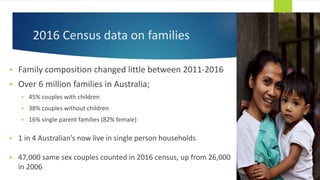
2016 Census data on families
 Family composition changed little between 2011-2016
 Over 6 million families in Australia;
 45% couples with children
 38% couples without children
 16% single parent families (82% female)
 1 in 4 Australian’s now live in single person households
 47,000 same sex couples counted in 2016 census, up from 26,000
in 2006
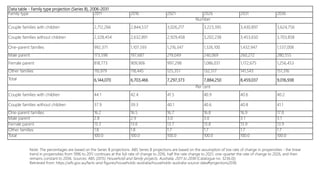
Data table - Family type projection (Series B), 2006-2031
Family type 2011 2016 2021 2026 2031 2036
Number
Couple families with children 2,712,266 2,844,537 3,026,217 3,223,395 3,430,897 3,624,756
Couple families without children 2,328,454 2,632,891 2,929,458 3,202,238 3,453,650 3,703,858
One-parent families 992,371 1,107,593 1,216,347 1,326,100 1,432,947 1,537,008
Male parent 173,598 197,687 219,049 240,069 260,272 280,555
Female parent 818,773 909,906 997,298 1,086,031 1,172,675 1,256,453
Other families 110,979 118,445 125,351 132,517 141,543 151,316
Total 6,144,070 6,703,466 7,297,373 7,884,250 8,459,037 9,016,938
Per cent
Couple families with children 44.1 42.4 41.5 40.9 40.6 40.2
Couple families without children 37.9 39.3 40.1 40.6 40.8 41.1
One-parent families 16.2 16.5 16.7 16.8 16.9 17.0
Male parent 2.8 2.9 3.0 3.0 3.1 3.1
Female parent 13.3 13.6 13.7 13.8 13.9 13.9
Other families 1.8 1.8 1.7 1.7 1.7 1.7
Total 100.0 100.0 100.0 100.0 100.0 100.0
Note: The percentages are based on the Series B projections. ABS Series B projections are based on the assumption of low rate of change in propensities - the linear
trend in propensities from 1996 to 2011 continues at the full rate of change to 2016, half the rate change to 2021, one-quarter the rate of change to 2026, and then
remains constant to 2036. Sources: ABS (2015) Household and family projects, Australia, 2011 to 2036 (Catalogue no. 3236.0))
Retrieved from: https://aifs.gov.au/facts-and-figures/households-australia/households-australia-source-data#projections2036
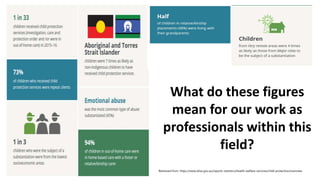
What do these figures
mean for our work as
professionals within this
field?
Retrieved from: https://www.aihw.gov.au/reports-statistics/health-welfare-services/child-protection/overview
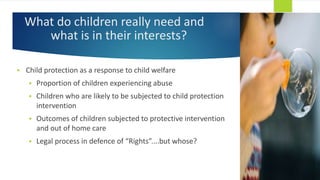
What do children really need and
what is in their interests?
 Child protection as a response to child welfare
 Proportion of children experiencing abuse
 Children who are likely to be subjected to child protection
intervention
 Outcomes of children subjected to protective intervention
and out of home care
 Legal process in defence of “Rights”....but whose?
Contested realities around child
and family welfare
 Legal - Social
 Rights vs. Needs
 Social - Medical
 Capacities vs. Harms
 Moral-Structural
 Responsibilities vs. Resources
 Examples
 The investment in early childhood development (moral –
structural)
 The concern with youth mental health (Legal-Social-Medical-
Moral-Structural)
The authority of the welfare system
as a Carer or Custodian
Moral or Judicial Guardians
 The State reserves the moral right to say who can best
look after children
 The law is explicit about the best interests of the child
being the primary factor in attributing responsibility for
care
 But the State is itself a deeply flawed provider of care,
AND
 The law is wary to interdict parental interest.
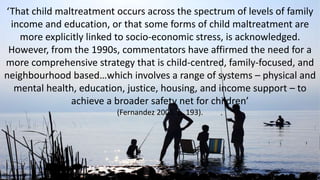
‘That child maltreatment occurs across the spectrum of levels of family
income and education, or that some forms of child maltreatment are
more explicitly linked to socio-economic stress, is acknowledged.
However, from the 1990s, commentators have affirmed the need for a
more comprehensive strategy that is child-centred, family-focused, and
neighbourhood based…which involves a range of systems – physical and
mental health, education, justice, housing, and income support – to
achieve a broader safety net for children’
(Fernandez 2005, p. 193).
Current Approaches
 Early Intervention
 Prevention
 Population health models
 Aim to deliver positive and sustainable outcomes for
children and families in disadvantaged communities
 Primary focus is children 0-12 years and their families.
 Organisations are funded to meet community needs,
building on community strengths, organisations’
networks and resources
 Services aim to increase child safety and wellbeing,
especially where circumstances impact adversely on
parenting capacity.
Retrieved from: https://www.dss.gov.au/our-responsibilities/families-and-children/programs-services/family-support-
program/family-and-children-s-services/program-guidelines-and-related-information/part-c-communities-for-children
What works in child welfare?
 Role clarification
 Collaborative problem solving
 Pro-social modelling and reinforcement
 The worker/client relationship
Trotter (2004)
Practice Dilemmas
 Parental rights
 Overprotection
 Abusive family
 Deficits discourse
 Cultural difference
 State responsibility
 Under-protection (child abuse/death inquiries)
 Abusive state
 Cultural imperialism
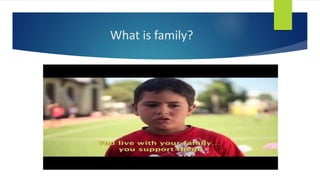
What is family?

HCS321 201830

  • 1.
    HCS321 CHILDREN AND PARENTSOR FAMILIES, WORKING FOR CHANGE
  • 2.
    Agenda  Statistical dataon families  What do children need?  Connected realities around child welfare  What works?  Authority of the welfare system  Current approaches and what works  Practice Dilemmas
  • 3.
    2016 Census dataon families  Family composition changed little between 2011-2016  Over 6 million families in Australia;  45% couples with children  38% couples without children  16% single parent families (82% female)  1 in 4 Australian’s now live in single person households  47,000 same sex couples counted in 2016 census, up from 26,000 in 2006
  • 4.
    Data table -Family type projection (Series B), 2006-2031 Family type 2011 2016 2021 2026 2031 2036 Number Couple families with children 2,712,266 2,844,537 3,026,217 3,223,395 3,430,897 3,624,756 Couple families without children 2,328,454 2,632,891 2,929,458 3,202,238 3,453,650 3,703,858 One-parent families 992,371 1,107,593 1,216,347 1,326,100 1,432,947 1,537,008 Male parent 173,598 197,687 219,049 240,069 260,272 280,555 Female parent 818,773 909,906 997,298 1,086,031 1,172,675 1,256,453 Other families 110,979 118,445 125,351 132,517 141,543 151,316 Total 6,144,070 6,703,466 7,297,373 7,884,250 8,459,037 9,016,938 Per cent Couple families with children 44.1 42.4 41.5 40.9 40.6 40.2 Couple families without children 37.9 39.3 40.1 40.6 40.8 41.1 One-parent families 16.2 16.5 16.7 16.8 16.9 17.0 Male parent 2.8 2.9 3.0 3.0 3.1 3.1 Female parent 13.3 13.6 13.7 13.8 13.9 13.9 Other families 1.8 1.8 1.7 1.7 1.7 1.7 Total 100.0 100.0 100.0 100.0 100.0 100.0 Note: The percentages are based on the Series B projections. ABS Series B projections are based on the assumption of low rate of change in propensities - the linear trend in propensities from 1996 to 2011 continues at the full rate of change to 2016, half the rate change to 2021, one-quarter the rate of change to 2026, and then remains constant to 2036. Sources: ABS (2015) Household and family projects, Australia, 2011 to 2036 (Catalogue no. 3236.0)) Retrieved from: https://aifs.gov.au/facts-and-figures/households-australia/households-australia-source-data#projections2036
  • 5.
    What do thesefigures mean for our work as professionals within this field? Retrieved from: https://www.aihw.gov.au/reports-statistics/health-welfare-services/child-protection/overview
  • 6.
    What do childrenreally need and what is in their interests?  Child protection as a response to child welfare  Proportion of children experiencing abuse  Children who are likely to be subjected to child protection intervention  Outcomes of children subjected to protective intervention and out of home care  Legal process in defence of “Rights”....but whose?
  • 7.
    Contested realities aroundchild and family welfare  Legal - Social  Rights vs. Needs  Social - Medical  Capacities vs. Harms  Moral-Structural  Responsibilities vs. Resources  Examples  The investment in early childhood development (moral – structural)  The concern with youth mental health (Legal-Social-Medical- Moral-Structural)
  • 8.
    The authority ofthe welfare system as a Carer or Custodian Moral or Judicial Guardians  The State reserves the moral right to say who can best look after children  The law is explicit about the best interests of the child being the primary factor in attributing responsibility for care  But the State is itself a deeply flawed provider of care, AND  The law is wary to interdict parental interest.
  • 9.
    ‘That child maltreatmentoccurs across the spectrum of levels of family income and education, or that some forms of child maltreatment are more explicitly linked to socio-economic stress, is acknowledged. However, from the 1990s, commentators have affirmed the need for a more comprehensive strategy that is child-centred, family-focused, and neighbourhood based…which involves a range of systems – physical and mental health, education, justice, housing, and income support – to achieve a broader safety net for children’ (Fernandez 2005, p. 193).
  • 10.
    Current Approaches  EarlyIntervention  Prevention  Population health models
  • 11.
     Aim todeliver positive and sustainable outcomes for children and families in disadvantaged communities  Primary focus is children 0-12 years and their families.  Organisations are funded to meet community needs, building on community strengths, organisations’ networks and resources  Services aim to increase child safety and wellbeing, especially where circumstances impact adversely on parenting capacity. Retrieved from: https://www.dss.gov.au/our-responsibilities/families-and-children/programs-services/family-support- program/family-and-children-s-services/program-guidelines-and-related-information/part-c-communities-for-children
  • 12.
    What works inchild welfare?  Role clarification  Collaborative problem solving  Pro-social modelling and reinforcement  The worker/client relationship Trotter (2004)
  • 13.
    Practice Dilemmas  Parentalrights  Overprotection  Abusive family  Deficits discourse  Cultural difference  State responsibility  Under-protection (child abuse/death inquiries)  Abusive state  Cultural imperialism
  • 14.