
Family Group Conferences
An Alternative Model for Child
Protection in the UK
Kate Parkinson, Lecturer in Social
Work
Hello and Welcome!
• Lecturer and social work practitioner
• Background in children and families social
work
• Particular interests in strengths based
approaches to practice particularly Family
Group Conferences
• Manager of FGC service and facilitated over
400 FGCs in a 5 year period
Background and Context
• 2014 – 59 serious case reviews published (NSPCC)
• 58 referred to 81 children
• 3 consistent messages:
- Insufficient information sharing between
professionals
- The family not engaging with the safeguarding
process
- The child getting lost at the centre of the process
Background and Context
• Munro Review of Child Protection (2011)
• Featherstone, White and Morris (2014) Re –
Imagining child protection: Towards humane
Social Work with Families
• Context is ripe for an overhaul of child
protection systems and processes
• Increasing research and evidence base for the
efficacy of Family Group Conferences
What are Family Group Conferences?
(FGCs)
• Originated in New Zealand in the late 1980s
• A response to the disproportionate number of
Maori children who were in the care system at
that time
• Enshrined in Legislation in New Zealand –
Children, Young Person’s and their Families Act
1989
• Brought over to the UK in the late 1980s by
the Family Rights Group
What is a Family Group Conference?
• A family led decision making meeting
• The family are asked to develop a plan for the
care or protection of a child or young person
in their family (families are the experts!!)
• Support of an independent co-ordinator
• Social worker attends and other professionals
are invited by the family
• Held in a neutral venue, refreshments
provided, transport costs met etc etc
What is a Family Group Conference?
• It is a process with a number of different
stages:
1). Preparation Stage
2). Information Sharing Stage
3). Private Family Time
4). Agreeing the plan
5). Reviewing the plan
The child at the centre of the process!
• Children attend FGCs
• Children are offered the support of an
advocate at a FGC
• The social work and other professional
reports are child friendly and jargon free!
• The environment is child friendly
The Legislative and Policy Context for
FGCs
• The Children Act 1989 and 2004 – working in
partnership with families and involving children
and families in decision making processes
• Working Together Guidelines from 2001 onwards
‘Effective safeguarding systems are child centred.
Failings in safeguarding systems are too often the
result of losing sight of the needs and views of the
children within them, or placing the interests of
adults ahead of the needs of children’. (DOH, p.9)
The Legislative and Policy Context for
FGCs
• Emphasis on working in partnership with
parents but not losing the child at the centre
of the process
• Public Law Outline 2008 and updated 2013
• Pre proceedings stage, LAs must determine
that there are no family/kinship alternatives
to LA care
Some fears about FGCs
• Not all service users have a family network or
one that is safe
• A family will not be able to come up with a
plan
• The family will argue and fight with each other
• What if a family ask for resources that we
cannot provide?
• How much will it cost to hold a FGC?
FGCS Work!!
• Several Outcome studies internationally
• Morris (1996) suggested that FGCs had
been subjected to a larger degree of
scrutiny than other child welfare models
– why??
• The use of FGCs internationally impacts
on evaluation methods and comparing
like for like
FGCS Work!!
Connolly (1994) research on the initial
impact of the intro of FGCs in NZ found
that:
- FGCS resulted in plans being made in the
vast majority of cases
- Fewer children being removed from their
families
FGCS Work!!
Pakura (2003) in her review of FGCs 13 years on
found exactly the same:
- Most families developed practical plans that
were agreed
- Fewer children and young people were taken
away from their families
- Care and protection arrangements were seen
as being better for children
FGCS Work!!
• Crow and Marsh (1997) – national research:
- FGCs succeeded in involving the extended
family
- Had good outcomes for children
- The vast majority of families plans were
agreed
- Reduced the demand for expensive state
services e.g. care of children and court
proceedings
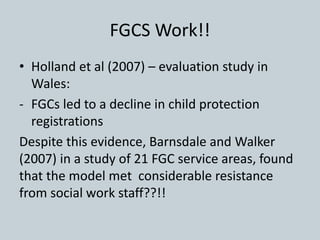
FGCS Work!!
• Holland et al (2007) – evaluation study in
Wales:
- FGCs led to a decline in child protection
registrations
Despite this evidence, Barnsdale and Walker
(2007) in a study of 21 FGC service areas, found
that the model met considerable resistance
from social work staff??!!
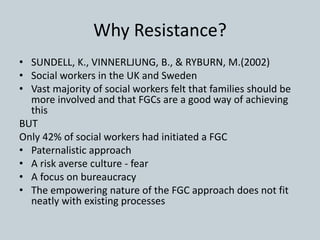
Why Resistance?
• SUNDELL, K., VINNERLJUNG, B., & RYBURN, M.(2002)
• Social workers in the UK and Sweden
• Vast majority of social workers felt that families should be
more involved and that FGCs are a good way of achieving
this
BUT
Only 42% of social workers had initiated a FGC
• Paternalistic approach
• A risk averse culture - fear
• A focus on bureaucracy
• The empowering nature of the FGC approach does not fit
neatly with existing processes
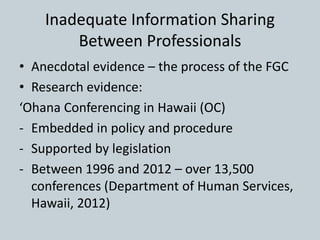
Inadequate Information Sharing
Between Professionals
• Anecdotal evidence – the process of the FGC
• Research evidence:
‘Ohana Conferencing in Hawaii (OC)
- Embedded in policy and procedure
- Supported by legislation
- Between 1996 and 2012 – over 13,500
conferences (Department of Human Services,
Hawaii, 2012)
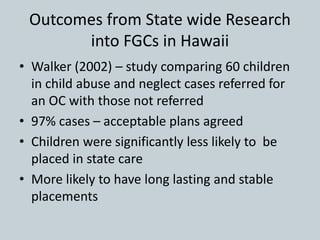
Outcomes from State wide Research
into FGCs in Hawaii
• Walker (2002) – study comparing 60 children
in child abuse and neglect cases referred for
an OC with those not referred
• 97% cases – acceptable plans agreed
• Children were significantly less likely to be
placed in state care
• More likely to have long lasting and stable
placements
Research in Hawaii
• Litchfield et al (2003) study between 2001 and
2003 – 871 participants representing the
conferences of 196 families:
- 99% of families not being reported for harm
within a year of the conference
- Two thirds of cases – children remained within
the care of their families
- 82% of participants felt that the OC model helped
the family and professionals to work together to
meet the best interests of children.
Professional Collaboration
• Professional collaboration increased as a result of FGCs
• Professionals reported:
- More readily sharing information with each other as
well as the family
- Feeling more empowered to share information during
a FGC and less constrained by bureaucracy
- Having a greater understanding of their colleagues
roles and responsibilities
- Feeling that the FGC was not a child protective led
meeting only and that their contribution was just as
important
Families not Engaging with The Process
• Key finding from several serious case reviews – families not
engaging – close the case!!
• Resistant families – what does that mean??
• Child protection processes are disempowering and
professionalised (Corby, Millar and Young, 1996, Hayes, 2008
Hall and Slembrouck 2010)
• Children’s Commissioner for England Report (2010) - family
perspectives on safeguarding services – engaging with
resistant families:
- Family focussed services
- A more informal approach
- Listening to family members
- Recommends FGCs
Research Findings
• Studies show that families are more willing to
participate in FGCs than child protection
conferences (Lupton et al, 1995, Crow and Marsh,
1997, Smith and Hennessy, 1998).
• Brady and Miller (2009) evaluation of the
Tipperary FWC service – 71% of FWCs reported
families engaging better with services and there
being improved communication between families
and professionals.
Children at the Centre of the Process
• Munro Report Recommendations (2011) – children and young people need to be involved more readily in
child protection conferences
• National Children’s Bureau (2011) Involved By Right – advocacy for children in child protection conferences
• Childrens Commissioner Report (2011) – 26 children interviewed
• Twelve out of nineteen children who answered said that the social worker saw them on their own and
older children were more likely than younger children to be seen alone.
• Some children had trusting relationships with their social workers and said that it was important to be
honest or nothing would change.
• Some children reported having minimal relationship with social workers, seeing them rarely or only at
meetings.
• Some children found it difficult to talk to their social workers because they felt pressured by the social
worker asking questions, or said that the social worker twisted what they said.
• Few children saw reports or assessments and it was rare for the young person to have a chance to discuss
the report with the social worker.
• Ten of the children attended meetings. Some of those who did not go wanted to attend. Only a small
minority of children were aware of different ways their views could be given to the meeting.
Children at the Centre of the Process
• Bell, M. and Wilson, K. (2006) - children’s views
of FGCs
• Research into 20 families
• Over all:
- Children valued the experience of being
consulted, of being listened to and welcome the
experience of having the opportunity to make
decisions with their families away from social
care.
• Something about children being visible
Conclusions
• FGCs offer a credible alternative to existing
child protection processes
• The evidence suggests that FGCs can meet the
3 major failings identified in serious case
reviews published last year
• The culture is ripe for change – Strengths
bases approaches widely seen as best practice
• Any Questions?
Contact Details
Kate Parkinson
k.p.parkinson@salford.ac.uk
0161 260 5645
References
• Bell, M and Wilson, K (2006) Children’s Views of Family Group Conferences. British
Journal of Social Work, 36, 671 – 681.
• Brady B & Millar M 2009. Barnardos family welfare conference service South
Tipperary: Evaluation report. The Child and Family Research Centre: Galway.
http://childandfamilyresearch.ie/sites/www.childandfamilyresearch.ie/files/barnar
dos_family_welfare_ conference_service_south_tipperary_evaluation_report.pdf
• Evans, C. A (2001) The Public Law Outline and Family Group Conferences in
Childcare Practice. Child Care in Practice, Vol. 17, No. 1
• Featherstone, B., White, S. and Morris, K. (2014) Re-imagining child protection:
Towards humane social work with families, Policy Press.
• Connelly, M. and McKenzie, M. (1994) Effective Participatory Practice: Family
Group Conferencing in Child Protection, Aldine Transaction.
• Corby, M., Millar, M. and Young, L. (1996) Parental Participation in Child
• Protection Work: Rethinking the Rhetoric, Br. J. Social Wk. (1996) 26, 475-492
References
• Cossar, J., Brandon, M. and Jordan, P. (2011) ‘Don’t Make Assumptions’, Children’s and Young
People’s Views on the child protection system and messages for Change, Office of the
Children’s Commissioner
• Department of Human Services, State of Hawaii (2012) Family Connections Hawaii, Final
Report,
• Gallagher, F. and Jasper, M. (2003) Health Visitors experiences of Family Group Conferences
in relation to child protection planning: a phenomenological study, Journal of Nursing
Management, pp. 377- 386.
• Hall, C. and Slembrouk, S. (2010) Parent participation in social work meetings – the case of
child protection conferences, European Journal of Social Work, pp.143-160.
• Hayes, D. (2008) Investigated or Supported? The Social Work Response to Non Child
Protection Referrals: Perspectives from Files, Fieldworkers and Families, Unpublished
• Holland, S., Quinn Aziz, A. and Robinson, A. (2007) The Development of an All-Wales
Evaluation Tool for Family Group Conferences: Final Research Report,Cardiff, Cardiff
University.
• Jelicic, H., Gibb, J., La Valle, I. and Payne, L. (2013) Involved by Right: The voice of the child in
the child protection conferences, National Children’s Bureau
References
• Litchfield, M., Gatowski, S., & Dobbin, S. (2003). Improving outcomes for
families: Results from an evaluation of Miami’s family decision making
program. Protecting Children, 18 (1-2), 48-51.
• Lupton et al. (1995) Family Planning? An Evaluation of the Family Group
Conference Model (Report No. 31) , SSRIU, Portsmouth: University of
Portsmouth.
• Marsh, P. and Crow, G. (1997) Family Group Conferences in Child (Working
Together For Children, Young People And Their Families), John Wiley &
Sons
• Morris, K. and Tunnard, J. (eds.) (1996) Family group conferences :
messages from UK practice and research, Family Rights Group.
• Munro, E. (2011) The Munro Review of Child Protection: Final Report A
child-centred system, Department of Health
References
• Pakura, S. (2003) A Review of the Family Group Conference 13 years
on, Social Work Review, Vol.15, Part 3; pp.3-7.
• Smith L and Hennessey J (1998) Making a Difference: Essex family
group conference project; research findings and practice issues,
Chelmsford, Essex County Council Social Services Department
• Sundell, K., Vinnerljung, B. and Ryburn, M. (2001) Social Workers’
attitudes towards family group conferences in Sweden and the UK,
Child and Family Social Work, Vol. 6, Issue 4; pp.327.
• The Children’s Commissioner (2010) Family perspectives on
safeguarding and on relationships with children’s services, Office of
the Children’s Commissioner
• Walker, L. (2005), A Cohort Study of ‘Ohana Conferencing in Child
Abuse and Neglect Cases, American Humane Society, Protecting
Children,19:4.

Family Group Conferences: An alternative Model for Child Protection in the UK

  • 1.
    Family Group Conferences AnAlternative Model for Child Protection in the UK Kate Parkinson, Lecturer in Social Work
  • 2.
    Hello and Welcome! •Lecturer and social work practitioner • Background in children and families social work • Particular interests in strengths based approaches to practice particularly Family Group Conferences • Manager of FGC service and facilitated over 400 FGCs in a 5 year period
  • 3.
    Background and Context •2014 – 59 serious case reviews published (NSPCC) • 58 referred to 81 children • 3 consistent messages: - Insufficient information sharing between professionals - The family not engaging with the safeguarding process - The child getting lost at the centre of the process
  • 4.
    Background and Context •Munro Review of Child Protection (2011) • Featherstone, White and Morris (2014) Re – Imagining child protection: Towards humane Social Work with Families • Context is ripe for an overhaul of child protection systems and processes • Increasing research and evidence base for the efficacy of Family Group Conferences
  • 5.
    What are FamilyGroup Conferences? (FGCs) • Originated in New Zealand in the late 1980s • A response to the disproportionate number of Maori children who were in the care system at that time • Enshrined in Legislation in New Zealand – Children, Young Person’s and their Families Act 1989 • Brought over to the UK in the late 1980s by the Family Rights Group
  • 6.
    What is aFamily Group Conference? • A family led decision making meeting • The family are asked to develop a plan for the care or protection of a child or young person in their family (families are the experts!!) • Support of an independent co-ordinator • Social worker attends and other professionals are invited by the family • Held in a neutral venue, refreshments provided, transport costs met etc etc
  • 7.
    What is aFamily Group Conference? • It is a process with a number of different stages: 1). Preparation Stage 2). Information Sharing Stage 3). Private Family Time 4). Agreeing the plan 5). Reviewing the plan
  • 8.
    The child atthe centre of the process! • Children attend FGCs • Children are offered the support of an advocate at a FGC • The social work and other professional reports are child friendly and jargon free! • The environment is child friendly
  • 9.
    The Legislative andPolicy Context for FGCs • The Children Act 1989 and 2004 – working in partnership with families and involving children and families in decision making processes • Working Together Guidelines from 2001 onwards ‘Effective safeguarding systems are child centred. Failings in safeguarding systems are too often the result of losing sight of the needs and views of the children within them, or placing the interests of adults ahead of the needs of children’. (DOH, p.9)
  • 10.
    The Legislative andPolicy Context for FGCs • Emphasis on working in partnership with parents but not losing the child at the centre of the process • Public Law Outline 2008 and updated 2013 • Pre proceedings stage, LAs must determine that there are no family/kinship alternatives to LA care
  • 11.
    Some fears aboutFGCs • Not all service users have a family network or one that is safe • A family will not be able to come up with a plan • The family will argue and fight with each other • What if a family ask for resources that we cannot provide? • How much will it cost to hold a FGC?
  • 12.
    FGCS Work!! • SeveralOutcome studies internationally • Morris (1996) suggested that FGCs had been subjected to a larger degree of scrutiny than other child welfare models – why?? • The use of FGCs internationally impacts on evaluation methods and comparing like for like
  • 13.
    FGCS Work!! Connolly (1994)research on the initial impact of the intro of FGCs in NZ found that: - FGCS resulted in plans being made in the vast majority of cases - Fewer children being removed from their families
  • 14.
    FGCS Work!! Pakura (2003)in her review of FGCs 13 years on found exactly the same: - Most families developed practical plans that were agreed - Fewer children and young people were taken away from their families - Care and protection arrangements were seen as being better for children
  • 15.
    FGCS Work!! • Crowand Marsh (1997) – national research: - FGCs succeeded in involving the extended family - Had good outcomes for children - The vast majority of families plans were agreed - Reduced the demand for expensive state services e.g. care of children and court proceedings
  • 16.
    FGCS Work!! • Hollandet al (2007) – evaluation study in Wales: - FGCs led to a decline in child protection registrations Despite this evidence, Barnsdale and Walker (2007) in a study of 21 FGC service areas, found that the model met considerable resistance from social work staff??!!
  • 17.
    Why Resistance? • SUNDELL,K., VINNERLJUNG, B., & RYBURN, M.(2002) • Social workers in the UK and Sweden • Vast majority of social workers felt that families should be more involved and that FGCs are a good way of achieving this BUT Only 42% of social workers had initiated a FGC • Paternalistic approach • A risk averse culture - fear • A focus on bureaucracy • The empowering nature of the FGC approach does not fit neatly with existing processes
  • 18.
    Inadequate Information Sharing BetweenProfessionals • Anecdotal evidence – the process of the FGC • Research evidence: ‘Ohana Conferencing in Hawaii (OC) - Embedded in policy and procedure - Supported by legislation - Between 1996 and 2012 – over 13,500 conferences (Department of Human Services, Hawaii, 2012)
  • 19.
    Outcomes from Statewide Research into FGCs in Hawaii • Walker (2002) – study comparing 60 children in child abuse and neglect cases referred for an OC with those not referred • 97% cases – acceptable plans agreed • Children were significantly less likely to be placed in state care • More likely to have long lasting and stable placements
  • 20.
    Research in Hawaii •Litchfield et al (2003) study between 2001 and 2003 – 871 participants representing the conferences of 196 families: - 99% of families not being reported for harm within a year of the conference - Two thirds of cases – children remained within the care of their families - 82% of participants felt that the OC model helped the family and professionals to work together to meet the best interests of children.
  • 21.
    Professional Collaboration • Professionalcollaboration increased as a result of FGCs • Professionals reported: - More readily sharing information with each other as well as the family - Feeling more empowered to share information during a FGC and less constrained by bureaucracy - Having a greater understanding of their colleagues roles and responsibilities - Feeling that the FGC was not a child protective led meeting only and that their contribution was just as important
  • 22.
    Families not Engagingwith The Process • Key finding from several serious case reviews – families not engaging – close the case!! • Resistant families – what does that mean?? • Child protection processes are disempowering and professionalised (Corby, Millar and Young, 1996, Hayes, 2008 Hall and Slembrouck 2010) • Children’s Commissioner for England Report (2010) - family perspectives on safeguarding services – engaging with resistant families: - Family focussed services - A more informal approach - Listening to family members - Recommends FGCs
  • 23.
    Research Findings • Studiesshow that families are more willing to participate in FGCs than child protection conferences (Lupton et al, 1995, Crow and Marsh, 1997, Smith and Hennessy, 1998). • Brady and Miller (2009) evaluation of the Tipperary FWC service – 71% of FWCs reported families engaging better with services and there being improved communication between families and professionals.
  • 24.
    Children at theCentre of the Process • Munro Report Recommendations (2011) – children and young people need to be involved more readily in child protection conferences • National Children’s Bureau (2011) Involved By Right – advocacy for children in child protection conferences • Childrens Commissioner Report (2011) – 26 children interviewed • Twelve out of nineteen children who answered said that the social worker saw them on their own and older children were more likely than younger children to be seen alone. • Some children had trusting relationships with their social workers and said that it was important to be honest or nothing would change. • Some children reported having minimal relationship with social workers, seeing them rarely or only at meetings. • Some children found it difficult to talk to their social workers because they felt pressured by the social worker asking questions, or said that the social worker twisted what they said. • Few children saw reports or assessments and it was rare for the young person to have a chance to discuss the report with the social worker. • Ten of the children attended meetings. Some of those who did not go wanted to attend. Only a small minority of children were aware of different ways their views could be given to the meeting.
  • 25.
    Children at theCentre of the Process • Bell, M. and Wilson, K. (2006) - children’s views of FGCs • Research into 20 families • Over all: - Children valued the experience of being consulted, of being listened to and welcome the experience of having the opportunity to make decisions with their families away from social care. • Something about children being visible
  • 26.
    Conclusions • FGCs offera credible alternative to existing child protection processes • The evidence suggests that FGCs can meet the 3 major failings identified in serious case reviews published last year • The culture is ripe for change – Strengths bases approaches widely seen as best practice • Any Questions?
  • 27.
  • 28.
    References • Bell, Mand Wilson, K (2006) Children’s Views of Family Group Conferences. British Journal of Social Work, 36, 671 – 681. • Brady B & Millar M 2009. Barnardos family welfare conference service South Tipperary: Evaluation report. The Child and Family Research Centre: Galway. http://childandfamilyresearch.ie/sites/www.childandfamilyresearch.ie/files/barnar dos_family_welfare_ conference_service_south_tipperary_evaluation_report.pdf • Evans, C. A (2001) The Public Law Outline and Family Group Conferences in Childcare Practice. Child Care in Practice, Vol. 17, No. 1 • Featherstone, B., White, S. and Morris, K. (2014) Re-imagining child protection: Towards humane social work with families, Policy Press. • Connelly, M. and McKenzie, M. (1994) Effective Participatory Practice: Family Group Conferencing in Child Protection, Aldine Transaction. • Corby, M., Millar, M. and Young, L. (1996) Parental Participation in Child • Protection Work: Rethinking the Rhetoric, Br. J. Social Wk. (1996) 26, 475-492
  • 29.
    References • Cossar, J.,Brandon, M. and Jordan, P. (2011) ‘Don’t Make Assumptions’, Children’s and Young People’s Views on the child protection system and messages for Change, Office of the Children’s Commissioner • Department of Human Services, State of Hawaii (2012) Family Connections Hawaii, Final Report, • Gallagher, F. and Jasper, M. (2003) Health Visitors experiences of Family Group Conferences in relation to child protection planning: a phenomenological study, Journal of Nursing Management, pp. 377- 386. • Hall, C. and Slembrouk, S. (2010) Parent participation in social work meetings – the case of child protection conferences, European Journal of Social Work, pp.143-160. • Hayes, D. (2008) Investigated or Supported? The Social Work Response to Non Child Protection Referrals: Perspectives from Files, Fieldworkers and Families, Unpublished • Holland, S., Quinn Aziz, A. and Robinson, A. (2007) The Development of an All-Wales Evaluation Tool for Family Group Conferences: Final Research Report,Cardiff, Cardiff University. • Jelicic, H., Gibb, J., La Valle, I. and Payne, L. (2013) Involved by Right: The voice of the child in the child protection conferences, National Children’s Bureau
  • 30.
    References • Litchfield, M.,Gatowski, S., & Dobbin, S. (2003). Improving outcomes for families: Results from an evaluation of Miami’s family decision making program. Protecting Children, 18 (1-2), 48-51. • Lupton et al. (1995) Family Planning? An Evaluation of the Family Group Conference Model (Report No. 31) , SSRIU, Portsmouth: University of Portsmouth. • Marsh, P. and Crow, G. (1997) Family Group Conferences in Child (Working Together For Children, Young People And Their Families), John Wiley & Sons • Morris, K. and Tunnard, J. (eds.) (1996) Family group conferences : messages from UK practice and research, Family Rights Group. • Munro, E. (2011) The Munro Review of Child Protection: Final Report A child-centred system, Department of Health
  • 31.
    References • Pakura, S.(2003) A Review of the Family Group Conference 13 years on, Social Work Review, Vol.15, Part 3; pp.3-7. • Smith L and Hennessey J (1998) Making a Difference: Essex family group conference project; research findings and practice issues, Chelmsford, Essex County Council Social Services Department • Sundell, K., Vinnerljung, B. and Ryburn, M. (2001) Social Workers’ attitudes towards family group conferences in Sweden and the UK, Child and Family Social Work, Vol. 6, Issue 4; pp.327. • The Children’s Commissioner (2010) Family perspectives on safeguarding and on relationships with children’s services, Office of the Children’s Commissioner • Walker, L. (2005), A Cohort Study of ‘Ohana Conferencing in Child Abuse and Neglect Cases, American Humane Society, Protecting Children,19:4.