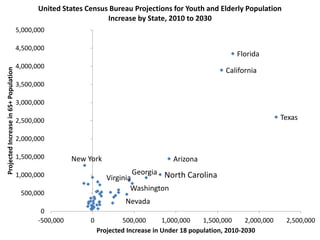
Arizona
California
Florida
Georgia
Nevada
New York
North Carolina
Texas
Virginia
Washington
0
500,000
1,000,000
1,500,000
2,000,000
2,500,000
3,000,000
3,500,000
4,000,000
4,500,000
5,000,000
-500,000 0 500,000 1,000,000 1,500,000 2,000,000 2,500,000
ProjectedIncreasein65+Population
Projected Increase in Under 18 population, 2010-2030
United States Census Bureau Projections for Youth and Elderly Population
Increase by State, 2010 to 2030
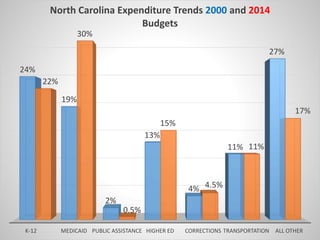
K-12 MEDICAID PUBLIC ASSISTANCE HIGHER ED CORRECTIONS TRANSPORTATION ALL OTHER
24%
19%
2%
13%
4%
11%
27%
22%
30%
0.5%
15%
4.5%
11%
17%
North Carolina Expenditure Trends 2000 and 2014
Budgets
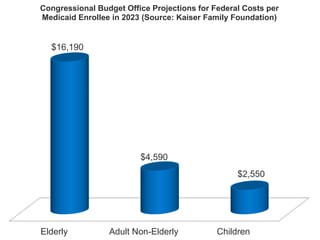
Elderly Adult Non-Elderly Children
$16,190
$4,590
$2,550
Congressional Budget Office Projections for Federal Costs per
Medicaid Enrollee in 2023 (Source: Kaiser Family Foundation)
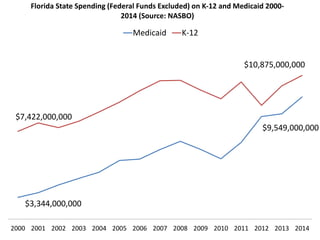
$3,344,000,000
$9,549,000,000
$7,422,000,000
$10,875,000,000
2000 2001 2002 2003 2004 2005 2006 2007 2008 2009 2010 2011 2012 2013 2014
Florida State Spending (Federal Funds Excluded) on K-12 and Medicaid 2000-
2014 (Source: NASBO)
Medicaid K-12
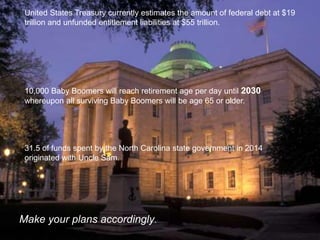
United States Treasury currently estimates the amount of federal debt at $19
trillion and unfunded entitlement liabilities at $55 trillion.
10,000 Baby Boomers will reach retirement age per day until 2030,
whereupon all surviving Baby Boomers will be age 65 or older.
31.5 of funds spent by the North Carolina state government in 2014
originated with Uncle Sam.
Make your plans accordingly.
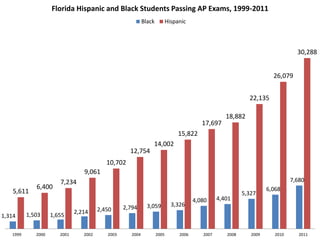
1,314 1,503 1,655
2,214 2,450 2,794 3,059 3,326
4,080 4,401
5,327
6,068
7,680
5,611
6,400
7,234
9,061
10,702
12,754
14,002
15,822
17,697
18,882
22,135
26,079
30,288
1999 2000 2001 2002 2003 2004 2005 2006 2007 2008 2009 2010 2011
Florida Hispanic and Black Students Passing AP Exams, 1999-2011
Black Hispanic
13Foundation for Excellence in Education Copyright.2014 13Foundation for Excellence in Education Copyright.2014
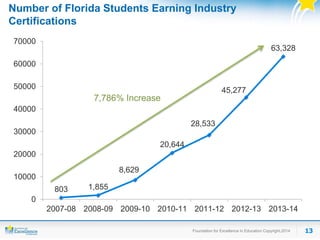
Number of Florida Students Earning Industry
Certifications
803 1,855
8,629
20,644
28,533
45,277
63,328
0
10000
20000
30000
40000
50000
60000
70000
2007-08 2008-09 2009-10 2010-11 2011-12 2012-13 2013-14
7,786% Increase
Foundation for Excellence in Education Copyright.2014 14Foundation for Excellence in Education Copyright.2014 14
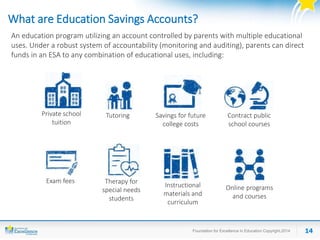
What are Education Savings Accounts?
An education program utilizing an account controlled by parents with multiple educational
uses. Under a robust system of accountability (monitoring and auditing), parents can direct
funds in an ESA to any combination of educational uses, including:
Private school
tuition
Tutoring
Therapy for
special needs
students
Instructional
materials and
curriculum
Online programs
and courses
Contract public
school courses
Exam fees
Savings for future
college costs
15Foundation for Excellence in Education Copyright.2014 15Foundation for Excellence in Education Copyright.2014 15
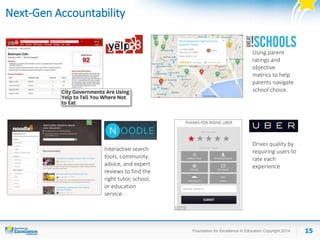
Next-Gen Accountability
Using parent
ratings and
objective
metrics to help
parents navigate
school choice.
Drives quality by
requiring users to
rate each
experience
Interactive search
tools, community
advice, and expert
reviews to find the
right tutor, school,
or education
service.
The North Carolina Constitution guarantees K-12 spending and the public supports it
strongly, but the system as it stands .
The next 15 years seem likely to test the outer limits of our political adaptability.
The working-age taxpayers of 2030 sit in North Carolina classrooms right now- one of
the few things we can control now is how many opportunities we give them to fulfill their
potential. By providing the maximum possible flexibility and creating incentives to
maximize value, ESAs could play a large role in a North Carolina plan.
Thank You !
Matthew Ladner
Senior Advisor for Policy and Research
Excel in Ed
(512) 844-5504
Matthew@excelined.org

Ladner Presentation

  • 4.
    Arizona California Florida Georgia Nevada New York North Carolina Texas Virginia Washington 0 500,000 1,000,000 1,500,000 2,000,000 2,500,000 3,000,000 3,500,000 4,000,000 4,500,000 5,000,000 -500,0000 500,000 1,000,000 1,500,000 2,000,000 2,500,000 ProjectedIncreasein65+Population Projected Increase in Under 18 population, 2010-2030 United States Census Bureau Projections for Youth and Elderly Population Increase by State, 2010 to 2030
  • 7.
    K-12 MEDICAID PUBLICASSISTANCE HIGHER ED CORRECTIONS TRANSPORTATION ALL OTHER 24% 19% 2% 13% 4% 11% 27% 22% 30% 0.5% 15% 4.5% 11% 17% North Carolina Expenditure Trends 2000 and 2014 Budgets
  • 8.
    Elderly Adult Non-ElderlyChildren $16,190 $4,590 $2,550 Congressional Budget Office Projections for Federal Costs per Medicaid Enrollee in 2023 (Source: Kaiser Family Foundation)
  • 9.
    $3,344,000,000 $9,549,000,000 $7,422,000,000 $10,875,000,000 2000 2001 20022003 2004 2005 2006 2007 2008 2009 2010 2011 2012 2013 2014 Florida State Spending (Federal Funds Excluded) on K-12 and Medicaid 2000- 2014 (Source: NASBO) Medicaid K-12
  • 10.
    United States Treasurycurrently estimates the amount of federal debt at $19 trillion and unfunded entitlement liabilities at $55 trillion. 10,000 Baby Boomers will reach retirement age per day until 2030, whereupon all surviving Baby Boomers will be age 65 or older. 31.5 of funds spent by the North Carolina state government in 2014 originated with Uncle Sam. Make your plans accordingly.
  • 12.
    1,314 1,503 1,655 2,2142,450 2,794 3,059 3,326 4,080 4,401 5,327 6,068 7,680 5,611 6,400 7,234 9,061 10,702 12,754 14,002 15,822 17,697 18,882 22,135 26,079 30,288 1999 2000 2001 2002 2003 2004 2005 2006 2007 2008 2009 2010 2011 Florida Hispanic and Black Students Passing AP Exams, 1999-2011 Black Hispanic
  • 13.
    13Foundation for Excellencein Education Copyright.2014 13Foundation for Excellence in Education Copyright.2014 Number of Florida Students Earning Industry Certifications 803 1,855 8,629 20,644 28,533 45,277 63,328 0 10000 20000 30000 40000 50000 60000 70000 2007-08 2008-09 2009-10 2010-11 2011-12 2012-13 2013-14 7,786% Increase
  • 14.
    Foundation for Excellencein Education Copyright.2014 14Foundation for Excellence in Education Copyright.2014 14 What are Education Savings Accounts? An education program utilizing an account controlled by parents with multiple educational uses. Under a robust system of accountability (monitoring and auditing), parents can direct funds in an ESA to any combination of educational uses, including: Private school tuition Tutoring Therapy for special needs students Instructional materials and curriculum Online programs and courses Contract public school courses Exam fees Savings for future college costs
  • 15.
    15Foundation for Excellencein Education Copyright.2014 15Foundation for Excellence in Education Copyright.2014 15 Next-Gen Accountability Using parent ratings and objective metrics to help parents navigate school choice. Drives quality by requiring users to rate each experience Interactive search tools, community advice, and expert reviews to find the right tutor, school, or education service.
  • 17.
    The North CarolinaConstitution guarantees K-12 spending and the public supports it strongly, but the system as it stands . The next 15 years seem likely to test the outer limits of our political adaptability. The working-age taxpayers of 2030 sit in North Carolina classrooms right now- one of the few things we can control now is how many opportunities we give them to fulfill their potential. By providing the maximum possible flexibility and creating incentives to maximize value, ESAs could play a large role in a North Carolina plan.
  • 18.
    Thank You ! MatthewLadner Senior Advisor for Policy and Research Excel in Ed (512) 844-5504 Matthew@excelined.org

Editor's Notes

  • #14 How many students are earning industry certifications in Florida? 803 in 07-08 to 63,328 in 2013-14, that is a 7,786% increase in 6 years. An additional, 5,050 certifications were earned outside CAPE academies and career-themed courses. (not reflected above). Note: If asked question on costs of Florida program, “These results were achieved with an initial cost of $550,000 in 08-09 and are now at $12.1 million in 12-13 in a state with 2.7 million students, which is ________ the size of your state.” BIG NOTE: 35,798 CAPE participants earned industry certifications that articulate into college credit, potentially saving Florida families almost $8 million in tuition costs ($7.84-$7.935 million per FL DOE based on $71.98 per credit hour).
  • #15 Education Savings Accounts are the next wave in school choice. While tax-credit scholarships innovated on how choice was funded, ESAs truly innovate on how choice is delivered. Through these programs, a child’s education funding is deposited into an account that can be used by parents for a variety of educational uses, like private school tuition, curriculum, tutoring, therapeutic services for disabled students, even college savings. ESAs create a system of education that is truly customized for each child. This customization is why the Arizona Supreme Court upheld Arizona’s ESA program: “The ESA does not result in an appropriation of public money to encourage the preference of one religion over another, or religion per se over no religion. Any aid to religious schools would be a result of the genuine and independent private choices of the parents. The parents are given numerous ways in which they can educate their children suited to the needs of each child with no preference given to religious or nonreligious schools or programs. Finally, the ESA does not limit the choices extended to families but expands the options to meet the individual needs of children.”
  • #16 Companies we have engaged: Noodle, Yelp, GreatSchools, Thumbtack, BenefitWallet, SchoolMint (application/registration management), FLVS, Drexel Fund, Cristo Rey, ACE Academies, Deloitte, Wells Fargo “Accountability” falls under three buckets: (1) academic – what have students learned? (2) financial – are funds only going to approved uses? (3) “next-generation accountability.” One of the longest running arguments for school choice is that it will create competition, which will require services to innovate or go out of business. But education isn’t a consumer good, it’s an industry that is really difficult for parents to judge value. To see the benefit of competition, we need to help parents navigate and make informed choices. Lessons from other sectors: Google, Yelp - rating service to find the best restaurant options. Less likely to go to the city DOH to see health ratings. That’s not to say you don’t care about the cleanliness of restaurants, you just intuitively assume that the highest rated restaurants are also relatively correlated with cleanliness. DOH in cities like NY and San Francisco started using Yelp to narrow the restaurants that they do surprise inspections in. Unsurprisingly, they found that low rated Yelp restaurants were disproportionately more likely to be in violation of health ordinances. This tool has become so powerful that Yelp is beginning to partner with DOH to list the restaurant health score when people search. Great Schools uses parent ratings and other metrics to help parents navigate the schools around them. Why not do a combination of both of these? Utilize the opinions of parents and bring in some objective quality ratings like test scores, graduation rates, college admission rates, to provide a robust look at school quality. Parents also need help narrowing the services available. Noodle allows parents to search for tutors, other educational options based on a wide selection of criteria, read parent reviews, see expert recommendations Light regulatory touch: require ESA parents to rate experiences. Uber is disrupting taxi industry by utilizing technology and back end accountability mechanisms to lower costs and replace up-front “accountability”, which often represent less accountability and more occupational licensing and barriers to entry that keep quality, innovative options out. Uber monitors driver quality by requiring riders to rate quality of their driver. If drivers fall below predetermined average rating, they are automatically kicked out. An idea like this would allow administrators to spend their time investigating providers who consistently earn bad ratings from users.