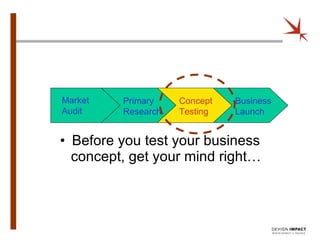
Before you test your business concept, get your mind right… Market Audit Primary Research Concept Testing Business Launch
Remind Yourself What Your Testing Product Benefit:  Have I effectively addressed who  wants or needs it and the signaling cues? Consumption Chain:  Have I effectively addressed the full consumption chain? Competitive Response:  How did they respond? Price:  Is the price achieving the targeted forecasts and profits? Promotion:  Is the packaging and merchandising having the desired effect? Should I adjust, change direction, or get out?
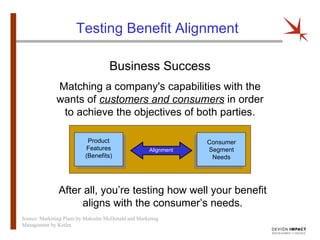
Testing Benefit Alignment Business Success Matching a company's capabilities with the wants of  customers and consumers  in order to achieve the objectives of both parties. Source: Marketing Plans by Malcolm McDonald and Marketing Management by Kotler. After all, you’re testing how well your benefit aligns with the consumer’s needs. Product Features (Benefits) Consumer Segment Needs Alignment
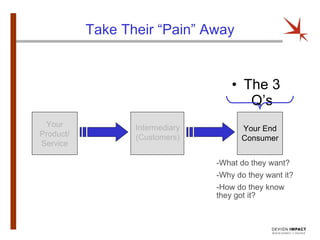
Take Their “Pain” Away The 3 Q’s Your Product/ Service Your End Consumer Intermediary (Customers) -What do they want? -Why do they want it? -How do they know they got it?
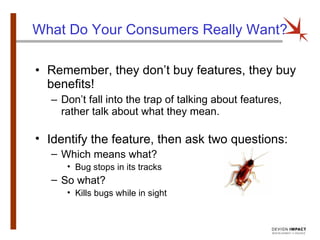
What Do Your Consumers Really Want? Remember, they don’t buy features, they buy benefits! Don’t fall into the trap of talking about features, rather talk about what they mean. Identify the feature, then ask two questions: Which means what? Bug stops in its tracks So what? Kills bugs while in sight
Can you make money at it? What are they willing to pay? Is the price achieving the targeted forecasts and profits?
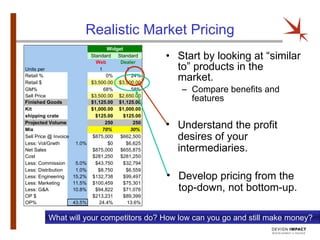
Realistic Market Pricing Start by looking at “similar to” products in the market. Compare benefits and features What will your competitors do? How low can you go and still make money? Understand the profit desires of your intermediaries. Develop pricing from the top-down, not bottom-up.
Keep Your Mind Right While Testing Your are in the business of offering a sustainable (product or service) benefit to a targeted audience, while helping others make money as you do.
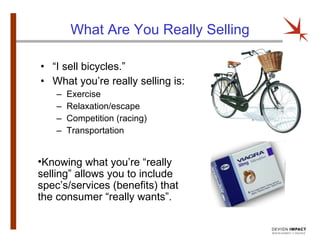
What Are You Really Selling “ I sell bicycles.” What you’re really selling is: Exercise Relaxation/escape Competition (racing) Transportation Knowing what you’re “really selling” allows you to include spec’s/services (benefits) that the consumer “really wants”.
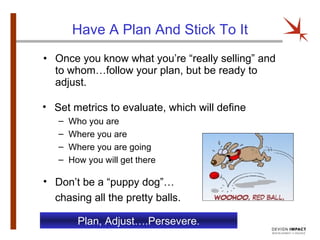
Have A Plan And Stick To It Once you know what you’re “really selling” and to whom…follow your plan, but be ready to adjust. Set metrics to evaluate, which will define Who you are Where you are Where you are going How you will get there Plan, Adjust….Persevere. Don’t be a “puppy dog”… chasing all the pretty balls.
Vector Impact – Client Examples
Testing Prior To Full Market Launch Product/Website/Service Prototype/Development Server Strength- close to real without significant dollars; changes not very expensive Weakness- not real product; limited sample size First Production Run Strength- real product Weakness- real dollars; changes are expensive Methods Focus Groups Strength- real people not data; good for packaging, taste tests, controlled interaction Weakness- not absolute; only directional Controlled “Limited Exposure” Testing Strength- real world dynamics; limited exposure and expense Weakness- may not capture geographic differences; some niche’ audience may be missed
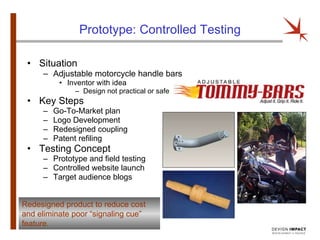
Prototype: Controlled Testing Situation Adjustable motorcycle handle bars Inventor with idea Design not practical or safe Key Steps Go-To-Market plan Logo Development Redesigned coupling Patent refiling Testing Concept Prototype and field testing Controlled website launch Target audience blogs Redesigned product to reduce cost and eliminate poor “signaling cue” feature.
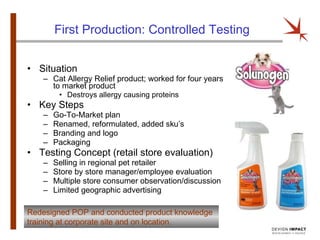
First Production: Controlled Testing Situation Cat Allergy Relief product; worked for four years to market product Destroys allergy causing proteins Key Steps Go-To-Market plan Renamed, reformulated, added sku’s Branding and logo Packaging Testing Concept (retail store evaluation) Selling in regional pet retailer Store by store manager/employee evaluation Multiple store consumer observation/discussion Limited geographic advertising Redesigned POP and conducted product knowledge training at corporate site and on location.
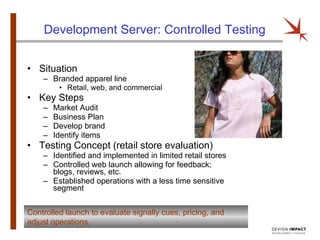
Development Server: Controlled Testing Situation Branded apparel line Retail, web, and commercial Key Steps Market Audit Business Plan Develop brand Identify items Testing Concept (retail store evaluation) Identified and implemented in limited retail stores Controlled web launch allowing for feedback; blogs, reviews, etc. Established operations with a less time sensitive segment Controlled launch to evaluate signally cues, pricing, and adjust operations.
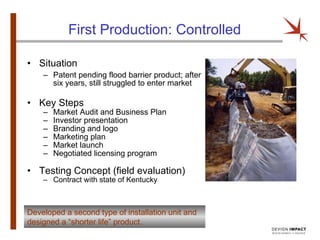
First Production: Controlled Situation Patent pending flood barrier product; after six years, still struggled to enter market Key Steps Market Audit and Business Plan Investor presentation Branding and logo Marketing plan Market launch Negotiated licensing program Testing Concept (field evaluation) Contract with state of Kentucky Developed a second type of installation unit and designed a “shorter life” product.
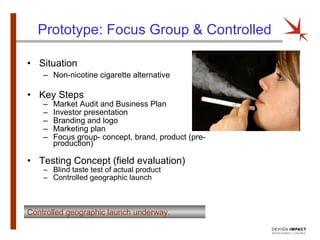
Prototype: Focus Group & Controlled Situation Non-nicotine cigarette alternative Key Steps Market Audit and Business Plan Investor presentation Branding and logo Marketing plan Focus group- concept, brand, product (pre-production) Testing Concept (field evaluation) Blind taste test of actual product Controlled geographic launch Controlled geographic launch underway.
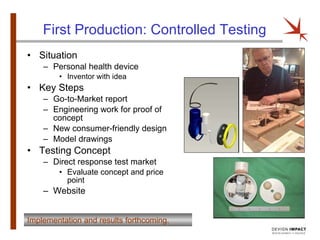
First Production: Controlled Testing Situation  Personal health device Inventor with idea Key Steps Go-to-Market report Engineering work for proof of concept New consumer-friendly design Model drawings Testing Concept Direct response test market Evaluate concept and price point Website Implementation and results forthcoming.
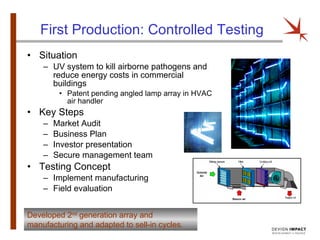
First Production: Controlled Testing Situation  UV system to kill airborne pathogens and reduce energy costs in commercial buildings Patent pending angled lamp array in HVAC air handler Key Steps Market Audit Business Plan Investor presentation Secure management team Testing Concept Implement manufacturing Field evaluation Developed 2 nd  generation array and manufacturing and adapted to sell-in cycles.
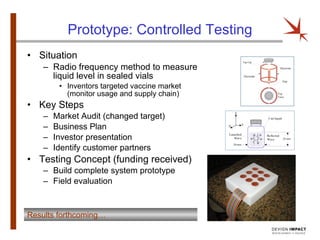
Prototype: Controlled Testing Situation  Radio frequency method to measure liquid level in sealed vials Inventors targeted vaccine market (monitor usage and supply chain)  Key Steps Market Audit (changed target) Business Plan Investor presentation Identify customer partners Testing Concept (funding received) Build complete system prototype Field evaluation Results forthcoming…
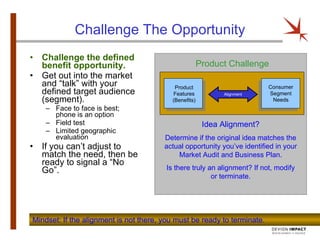
Challenge The Opportunity Challenge the defined benefit opportunity. Get out into the market and “talk” with your defined target audience (segment). Face to face is best; phone is an option Field test Limited geographic evaluation If you can’t adjust to match the need, then be ready to signal a “No Go”. Mindset: If the alignment is not there, you must be ready to terminate.  Product Challenge Idea Alignment? Determine if the original idea matches the actual opportunity you’ve identified in your Market Audit and Business Plan. Is there truly an alignment? If not, modify or terminate. Product Features (Benefits) Consumer Segment Needs Alignment
Market Audit: Challenge The Technology Proof of concept?  Reduced to practice? Better/faster/cheaper? How much?  Scalable? When, and at what price success? Patented? or patentable? Single-use technology/product, or technology/product platform? Enabling technologies/infrastructure required?  Do we have technical know-how to make it work…or do we know how to obtain it Mindset: If this is a unique idea, how do I protect it?
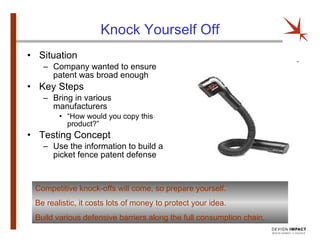
Knock Yourself Off Situation  Company wanted to ensure patent was broad enough Key Steps Bring in various manufacturers “ How would you copy this product?” Testing Concept Use the information to build a picket fence patent defense Competitive knock-offs will come, so prepare yourself. Be realistic, it costs lots of money to protect your idea. Build various defensive barriers along the full consumption chain.
Risk There is risk in every venture. (No slam-dunks) Assess risk factors at each stage – especially important in the feasibility review Define it (Assumptions) Quantify it (L, M, H) Manage it  Don’t ignore it “ A year from now, if everything went south, what went wrong?”
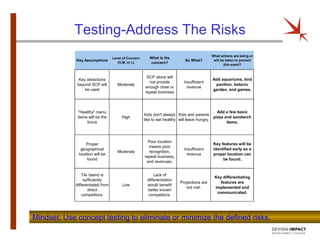
Testing-Address The Risks Mindset: Use concept testing to eliminate or minimize the defined risks.
Wrap-Up A well-executed validation and assessment process provides focus for strategic value and enhances the probability for success And, ultimately can save time and money It often requires product and market recycle based on what you learn during the assessment process Be disciplined and thorough – with due haste
 

Hawkins kaiser module_4

  • 1.
  • 2.
    Before you testyour business concept, get your mind right… Market Audit Primary Research Concept Testing Business Launch
  • 3.
    Remind Yourself WhatYour Testing Product Benefit: Have I effectively addressed who wants or needs it and the signaling cues? Consumption Chain: Have I effectively addressed the full consumption chain? Competitive Response: How did they respond? Price: Is the price achieving the targeted forecasts and profits? Promotion: Is the packaging and merchandising having the desired effect? Should I adjust, change direction, or get out?
  • 4.
    Testing Benefit AlignmentBusiness Success Matching a company's capabilities with the wants of customers and consumers in order to achieve the objectives of both parties. Source: Marketing Plans by Malcolm McDonald and Marketing Management by Kotler. After all, you’re testing how well your benefit aligns with the consumer’s needs. Product Features (Benefits) Consumer Segment Needs Alignment
  • 5.
    Take Their “Pain”Away The 3 Q’s Your Product/ Service Your End Consumer Intermediary (Customers) -What do they want? -Why do they want it? -How do they know they got it?
  • 6.
    What Do YourConsumers Really Want? Remember, they don’t buy features, they buy benefits! Don’t fall into the trap of talking about features, rather talk about what they mean. Identify the feature, then ask two questions: Which means what? Bug stops in its tracks So what? Kills bugs while in sight
  • 7.
    Can you makemoney at it? What are they willing to pay? Is the price achieving the targeted forecasts and profits?
  • 8.
    Realistic Market PricingStart by looking at “similar to” products in the market. Compare benefits and features What will your competitors do? How low can you go and still make money? Understand the profit desires of your intermediaries. Develop pricing from the top-down, not bottom-up.
  • 9.
    Keep Your MindRight While Testing Your are in the business of offering a sustainable (product or service) benefit to a targeted audience, while helping others make money as you do.
  • 10.
    What Are YouReally Selling “ I sell bicycles.” What you’re really selling is: Exercise Relaxation/escape Competition (racing) Transportation Knowing what you’re “really selling” allows you to include spec’s/services (benefits) that the consumer “really wants”.
  • 11.
    Have A PlanAnd Stick To It Once you know what you’re “really selling” and to whom…follow your plan, but be ready to adjust. Set metrics to evaluate, which will define Who you are Where you are Where you are going How you will get there Plan, Adjust….Persevere. Don’t be a “puppy dog”… chasing all the pretty balls.
  • 12.
    Vector Impact –Client Examples
  • 13.
    Testing Prior ToFull Market Launch Product/Website/Service Prototype/Development Server Strength- close to real without significant dollars; changes not very expensive Weakness- not real product; limited sample size First Production Run Strength- real product Weakness- real dollars; changes are expensive Methods Focus Groups Strength- real people not data; good for packaging, taste tests, controlled interaction Weakness- not absolute; only directional Controlled “Limited Exposure” Testing Strength- real world dynamics; limited exposure and expense Weakness- may not capture geographic differences; some niche’ audience may be missed
  • 14.
    Prototype: Controlled TestingSituation Adjustable motorcycle handle bars Inventor with idea Design not practical or safe Key Steps Go-To-Market plan Logo Development Redesigned coupling Patent refiling Testing Concept Prototype and field testing Controlled website launch Target audience blogs Redesigned product to reduce cost and eliminate poor “signaling cue” feature.
  • 15.
    First Production: ControlledTesting Situation Cat Allergy Relief product; worked for four years to market product Destroys allergy causing proteins Key Steps Go-To-Market plan Renamed, reformulated, added sku’s Branding and logo Packaging Testing Concept (retail store evaluation) Selling in regional pet retailer Store by store manager/employee evaluation Multiple store consumer observation/discussion Limited geographic advertising Redesigned POP and conducted product knowledge training at corporate site and on location.
  • 16.
    Development Server: ControlledTesting Situation Branded apparel line Retail, web, and commercial Key Steps Market Audit Business Plan Develop brand Identify items Testing Concept (retail store evaluation) Identified and implemented in limited retail stores Controlled web launch allowing for feedback; blogs, reviews, etc. Established operations with a less time sensitive segment Controlled launch to evaluate signally cues, pricing, and adjust operations.
  • 17.
    First Production: ControlledSituation Patent pending flood barrier product; after six years, still struggled to enter market Key Steps Market Audit and Business Plan Investor presentation Branding and logo Marketing plan Market launch Negotiated licensing program Testing Concept (field evaluation) Contract with state of Kentucky Developed a second type of installation unit and designed a “shorter life” product.
  • 18.
    Prototype: Focus Group& Controlled Situation Non-nicotine cigarette alternative Key Steps Market Audit and Business Plan Investor presentation Branding and logo Marketing plan Focus group- concept, brand, product (pre-production) Testing Concept (field evaluation) Blind taste test of actual product Controlled geographic launch Controlled geographic launch underway.
  • 19.
    First Production: ControlledTesting Situation Personal health device Inventor with idea Key Steps Go-to-Market report Engineering work for proof of concept New consumer-friendly design Model drawings Testing Concept Direct response test market Evaluate concept and price point Website Implementation and results forthcoming.
  • 20.
    First Production: ControlledTesting Situation UV system to kill airborne pathogens and reduce energy costs in commercial buildings Patent pending angled lamp array in HVAC air handler Key Steps Market Audit Business Plan Investor presentation Secure management team Testing Concept Implement manufacturing Field evaluation Developed 2 nd generation array and manufacturing and adapted to sell-in cycles.
  • 21.
    Prototype: Controlled TestingSituation Radio frequency method to measure liquid level in sealed vials Inventors targeted vaccine market (monitor usage and supply chain) Key Steps Market Audit (changed target) Business Plan Investor presentation Identify customer partners Testing Concept (funding received) Build complete system prototype Field evaluation Results forthcoming…
  • 22.
    Challenge The OpportunityChallenge the defined benefit opportunity. Get out into the market and “talk” with your defined target audience (segment). Face to face is best; phone is an option Field test Limited geographic evaluation If you can’t adjust to match the need, then be ready to signal a “No Go”. Mindset: If the alignment is not there, you must be ready to terminate. Product Challenge Idea Alignment? Determine if the original idea matches the actual opportunity you’ve identified in your Market Audit and Business Plan. Is there truly an alignment? If not, modify or terminate. Product Features (Benefits) Consumer Segment Needs Alignment
  • 23.
    Market Audit: ChallengeThe Technology Proof of concept? Reduced to practice? Better/faster/cheaper? How much? Scalable? When, and at what price success? Patented? or patentable? Single-use technology/product, or technology/product platform? Enabling technologies/infrastructure required? Do we have technical know-how to make it work…or do we know how to obtain it Mindset: If this is a unique idea, how do I protect it?
  • 24.
    Knock Yourself OffSituation Company wanted to ensure patent was broad enough Key Steps Bring in various manufacturers “ How would you copy this product?” Testing Concept Use the information to build a picket fence patent defense Competitive knock-offs will come, so prepare yourself. Be realistic, it costs lots of money to protect your idea. Build various defensive barriers along the full consumption chain.
  • 25.
    Risk There isrisk in every venture. (No slam-dunks) Assess risk factors at each stage – especially important in the feasibility review Define it (Assumptions) Quantify it (L, M, H) Manage it Don’t ignore it “ A year from now, if everything went south, what went wrong?”
  • 26.
    Testing-Address The RisksMindset: Use concept testing to eliminate or minimize the defined risks.
  • 27.
    Wrap-Up A well-executedvalidation and assessment process provides focus for strategic value and enhances the probability for success And, ultimately can save time and money It often requires product and market recycle based on what you learn during the assessment process Be disciplined and thorough – with due haste
  • 28.

Editor's Notes

  • #24 Bullet 1 -- Do experts in the field agree that the science is possible, or do you have to invent a “new physics” to make it happen? Can you/have you put together a breadboard that demonstrates the device is likely to work as advertised? Bullet 2 -- Can you at least show theoretical studies that indicate the technology will be better than what already exists? The technology “S” curve may help. Bullet 3 -- Can you estimate how long the development is likely to take, and how much it will cost? Most radically new ideas take longer and cost more than expected. Are there competitors who have a significant head start? Bullet 4 -- Technology/product platforms have a greater chance of developing into a large multi-product businesses and thus are favored by investors. Bullet 5 -- Your idea may be wonderful but if you need “other stuff” to build it or make it work you may have a big problem. For example: Even if you have a way to significantly reduce the cost/hp of auto fuel cells, unless someone is developing the hydrogen fueling station infrastructure you probably won’t have much of a business. Bullet 6 -- How far can you/your existing team take the development? Can you hire others to help? Would it be better to outsource the development? Do you need/can you find a strategic partner?