



Company Profile
PFN creates technologies that provide intelligence to things and
networks, pioneering the development of IoT's next generation
: the Smart Internet of Things
Preferred Networks, Inc. (PFN)
 Founded:March, 2014
 HQ:Hongo (Tokyo, Japan)
 Branch: San Mateo(CA, USA)
 Directors:Toru Nishikawa, Daisuke Okanohra, Junich Hasegawa
 Mission:
PFN creates technologies that provide intelligence to things and
networks, pioneering the development of IoT's next generation: the
Smart Internet of Things.
To accelerate evolving business in IoT/IoE
PFN was split from PFI (founded in March of 2006)
 http://www.preferred-networks.jp/
3
October 1, 2014
4
1.Nippon Telegraph and Telephone Corporation
Preferred Networks, Inc.
NTT and PFN sign a business capital tie-up contract
with the aim of developing next-generation Big Data
technologies for the age of IoT
2.Joint R&D Contract with Toyota on Self-driving Cars
Preferred Networks, Inc. (HQ: Tokyo, President & CEO: Toru Nishikawa)
today announced that the company starts a joint research
and development project with
Toyota Motor Corporation (HQ: Aichi, CEO: Akio Toyoda)
on self-driving cars to examine the feasibility of its machine learning
and deep learning technologies.
http://blogs.wsj.com/japanrealtime/2014/10/01/ntt-toyota-seek-deep-learning-
expertise/
Problems that PFN solves and
How we do it
Problems that IoT/IoE applications face
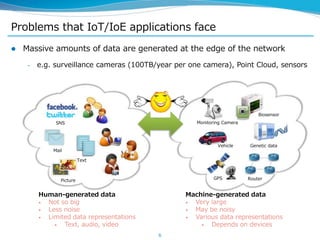
 Massive amounts of data are generated at the edge of the network
– e.g. surveillance cameras (100TB/year per one camera), Point Cloud, sensors
6
Mail
Picture
SNS
Text
Genetic data
GPS Router
Biosensor
Monitoring Camera
Vehicle
Human-generated data
• Not so big
• Less noise
• Limited data representations
• Text, audio, video
Machine-generated data
• Very large
• May be noisy
• Various data representations
• Depends on devices
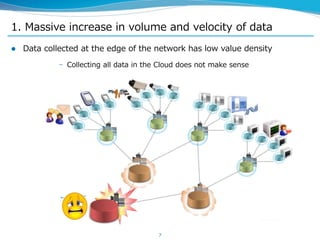
1. Massive increase in volume and velocity of data
 Data collected at the edge of the network has low value density
– Collecting all data in the Cloud does not make sense
7
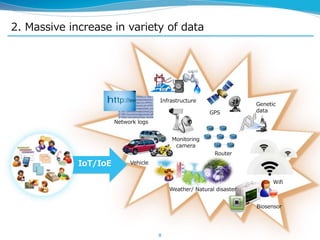
2. Massive increase in variety of data
8
IoT/IoE
GPS
Router
Vehicle
Network logs
Biosensor
Weather/ Natural disaster
Infrastructure
Wifi
Genetic
data
Monitoring
camera
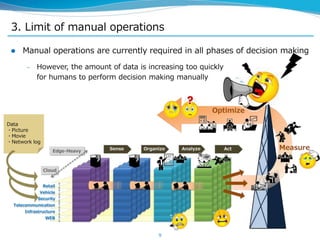
 Manual operations are currently required in all phases of decision making
– However, the amount of data is increasing too quickly
for humans to perform decision making manually
3. Limit of manual operations
9
WEB
Infrastructure
Telecommunication
Security
Vehicle
Retail
Data
・Picture
・Movie
・Network log
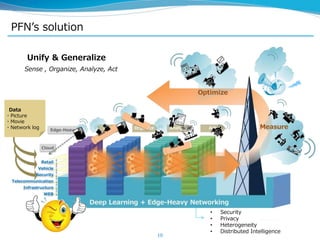
PFN’s solution
10
Unify & Generalize
Sense , Organize, Analyze, Act
• Security
• Privacy
• Heterogeneity
• Distributed Intelligence
Data
・Picture
・Movie
・Network log
WEB
Infrastructure
Telecommunication
Security
Vehicle
Retail
Core Technologies of PFN
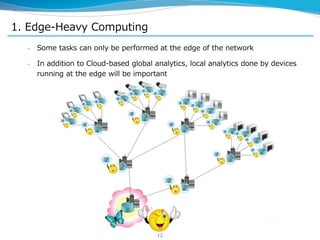
1. Edge-Heavy Computing
– Some tasks can only be performed at the edge of the network
– In addition to Cloud-based global analytics, local analytics done by devices
running at the edge will be important
12
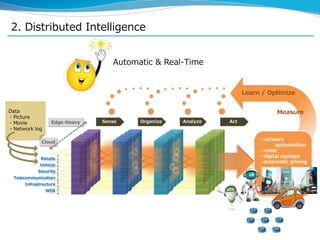
2. Distributed Intelligence
Automatic & Real-Time
Data
・Picture
・Movie
・Network log
・network
optimization
・robot
・digital signage
・automatic driving
WEB
Infrastructure
Telecommunication
Security
Vehicle
Retails
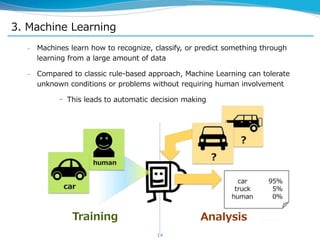
3. Machine Learning
– Machines learn how to recognize, classify, or predict something through
learning from a large amount of data
– Compared to classic rule-based approach, Machine Learning can tolerate
unknown conditions or problems without requiring human involvement
– This leads to automatic decision making
14
Training Analysis
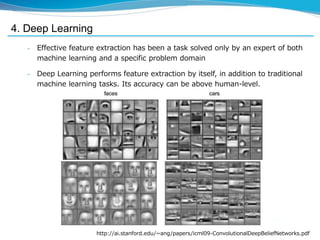
– Effective feature extraction has been a task solved only by an expert of both
machine learning and a specific problem domain
– Deep Learning performs feature extraction by itself, in addition to traditional
machine learning tasks. Its accuracy can be above human-level.
http://ai.stanford.edu/~ang/papers/icml09-ConvolutionalDeepBeliefNetworks.pdf
4. Deep Learning
5. Visual Recognition
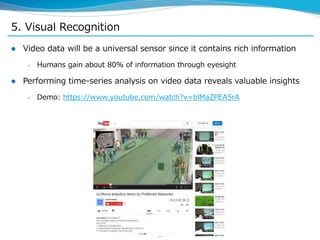
 Video data will be a universal sensor since it contains rich information
– Humans gain about 80% of information through eyesight
 Performing time-series analysis on video data reveals valuable insights
– Demo: https://www.youtube.com/watch?v=blMaZPEA5rA
16
5. Visual Recognition
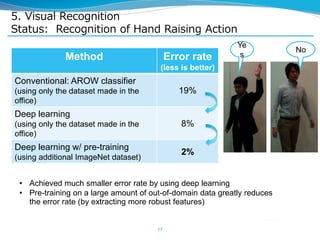
Status: Recognition of Hand Raising Action
17
Method Error rate
(less is better)
Conventional: AROW classifier
(using only the dataset made in the
office)
19%
Deep learning
(using only the dataset made in the
office)
8%
Deep learning w/ pre-training
(using additional ImageNet dataset)
2%
• Achieved much smaller error rate by using deep learning
• Pre-training on a large amount of out-of-domain data greatly reduces
the error rate (by extracting more robust features)
Ye
s
No
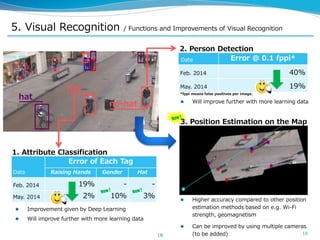
5. Visual Recognition / Functions and Improvements of Visual Recognition
2. Person Detection
1. Attribute Classification
3. Position Estimation on the Map
 Higher accuracy compared to other position
estimation methods based on e.g. Wi-Fi
strength, geomagnetism
 Can be improved by using multiple cameras
(to be added)
 Improvement given by Deep Learning
 Will improve further with more learning data
hat
hat
no-hat
*fppi means false positives per image.
Date
Error of Each Tag
Raising Hands Gender Hat
Feb. 2014 19% - -
May. 2014 2% 10% 3%
Date Error @ 0.1 fppi*
Feb. 2014 40%
May. 2014 19%
 Will improve further with more learning data
1818
5. Visual Recognition / Tools to Improve Visual Recognition and Deep Learning
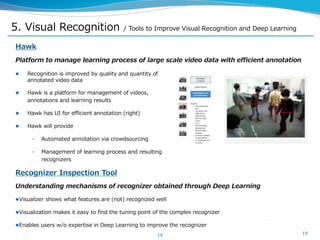
Hawk
Platform to manage learning process of large scale video data with efficient annotation
Recognizer Inspection Tool
Understanding mechanisms of recognizer obtained through Deep Learning
Visualizer shows what features are (not) recognized well
Visualization makes it easy to find the tuning point of the complex recognizer
Enables users w/o expertise in Deep Learning to improve the recognizer
 Recognition is improved by quality and quantity of
annotated video data
 Hawk is a platform for management of videos,
annotations and learning results
 Hawk has UI for efficient annotation (right)
 Hawk will provide
– Automated annotation via crowdsourcing
– Management of learning process and resulting
recognizers
1919
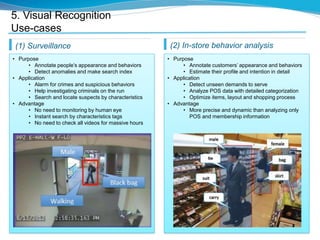
5. Visual Recognition
Use-cases
• Purpose
• Annotate people’s appearance and behaviors
• Detect anomalies and make search index
• Application
• Alarm for crimes and suspicious behaviors
• Help investigating criminals on the run
• Search and locate suspects by characteristics
• Advantage
• No need to monitoring by human eye
• Instant search by characteristics tags
• No need to check all videos for massive hours
• Purpose
• Annotate customers’ appearance and behaviors
• Estimate their profile and intention in detail
• Application
• Detect unseen demands to serve
• Analyze POS data with detailed categorization
• Optimize items, layout and shopping process
• Advantage
• More precise and dynamic than analyzing only
POS and membership information
(1) Surveillance (2) In-store behavior analysis
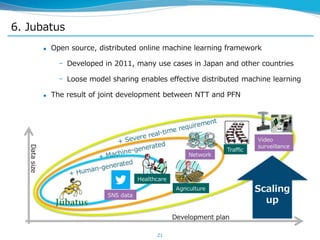
6. Jubatus
 Open source, distributed online machine learning framework
– Developed in 2011, many use cases in Japan and other countries
– Loose model sharing enables effective distributed machine learning
 The result of joint development between NTT and PFN
21
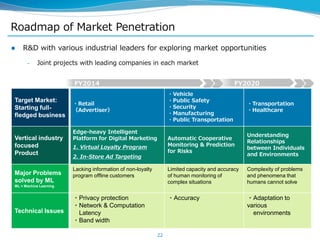
 R&D with various industrial leaders for exploring market opportunities
– Joint projects with leading companies in each market
Roadmap of Market Penetration
Target Market:
Starting full-
fledged business
・Retail
(Advertiser)
・Vehicle
・Public Safety
・Security
・Manufacturing
・Public Transportation
・Transportation
・Healthcare
Vertical industry
focused
Product
Edge-heavy Intelligent
Platform for Digital Marketing
1. Virtual Loyalty Program
2. In-Store Ad Targeting
Automatic Cooperative
Monitoring & Prediction
for Risks
Understanding
Relationships
between Individuals
and Environments
Major Problems
solved by ML
ML = Machine Learning
Lacking information of non-loyalty
program offline customers
Limited capacity and accuracy
of human monitoring of
complex situations
Complexity of problems
and phenomena that
humans cannot solve
Technical Issues
・Privacy protection
・Network & Computation
Latency
・Band width
・Accuracy ・Adaptation to
various
environments
FY2020FY2014
22
Copyright © 2014-
Preferred Networks All Right Reserved.

Hasegawa gfke 2014

  • 1.
  • 2.
    PFN creates technologiesthat provide intelligence to things and networks, pioneering the development of IoT's next generation : the Smart Internet of Things
  • 3.
    Preferred Networks, Inc.(PFN)  Founded:March, 2014  HQ:Hongo (Tokyo, Japan)  Branch: San Mateo(CA, USA)  Directors:Toru Nishikawa, Daisuke Okanohra, Junich Hasegawa  Mission: PFN creates technologies that provide intelligence to things and networks, pioneering the development of IoT's next generation: the Smart Internet of Things. To accelerate evolving business in IoT/IoE PFN was split from PFI (founded in March of 2006)  http://www.preferred-networks.jp/ 3
  • 4.
    October 1, 2014 4 1.NipponTelegraph and Telephone Corporation Preferred Networks, Inc. NTT and PFN sign a business capital tie-up contract with the aim of developing next-generation Big Data technologies for the age of IoT 2.Joint R&D Contract with Toyota on Self-driving Cars Preferred Networks, Inc. (HQ: Tokyo, President & CEO: Toru Nishikawa) today announced that the company starts a joint research and development project with Toyota Motor Corporation (HQ: Aichi, CEO: Akio Toyoda) on self-driving cars to examine the feasibility of its machine learning and deep learning technologies. http://blogs.wsj.com/japanrealtime/2014/10/01/ntt-toyota-seek-deep-learning- expertise/
  • 5.
    Problems that PFNsolves and How we do it
  • 6.
    Problems that IoT/IoEapplications face  Massive amounts of data are generated at the edge of the network – e.g. surveillance cameras (100TB/year per one camera), Point Cloud, sensors 6 Mail Picture SNS Text Genetic data GPS Router Biosensor Monitoring Camera Vehicle Human-generated data • Not so big • Less noise • Limited data representations • Text, audio, video Machine-generated data • Very large • May be noisy • Various data representations • Depends on devices
  • 7.
    1. Massive increasein volume and velocity of data  Data collected at the edge of the network has low value density – Collecting all data in the Cloud does not make sense 7
  • 8.
    2. Massive increasein variety of data 8 IoT/IoE GPS Router Vehicle Network logs Biosensor Weather/ Natural disaster Infrastructure Wifi Genetic data Monitoring camera
  • 9.
     Manual operationsare currently required in all phases of decision making – However, the amount of data is increasing too quickly for humans to perform decision making manually 3. Limit of manual operations 9 WEB Infrastructure Telecommunication Security Vehicle Retail Data ・Picture ・Movie ・Network log
  • 10.
    PFN’s solution 10 Unify &Generalize Sense , Organize, Analyze, Act • Security • Privacy • Heterogeneity • Distributed Intelligence Data ・Picture ・Movie ・Network log WEB Infrastructure Telecommunication Security Vehicle Retail
  • 11.
  • 12.
    1. Edge-Heavy Computing –Some tasks can only be performed at the edge of the network – In addition to Cloud-based global analytics, local analytics done by devices running at the edge will be important 12
  • 13.
    2. Distributed Intelligence Automatic& Real-Time Data ・Picture ・Movie ・Network log ・network optimization ・robot ・digital signage ・automatic driving WEB Infrastructure Telecommunication Security Vehicle Retails
  • 14.
    3. Machine Learning –Machines learn how to recognize, classify, or predict something through learning from a large amount of data – Compared to classic rule-based approach, Machine Learning can tolerate unknown conditions or problems without requiring human involvement – This leads to automatic decision making 14 Training Analysis
  • 15.
    – Effective featureextraction has been a task solved only by an expert of both machine learning and a specific problem domain – Deep Learning performs feature extraction by itself, in addition to traditional machine learning tasks. Its accuracy can be above human-level. http://ai.stanford.edu/~ang/papers/icml09-ConvolutionalDeepBeliefNetworks.pdf 4. Deep Learning
  • 16.
    5. Visual Recognition Video data will be a universal sensor since it contains rich information – Humans gain about 80% of information through eyesight  Performing time-series analysis on video data reveals valuable insights – Demo: https://www.youtube.com/watch?v=blMaZPEA5rA 16
  • 17.
    5. Visual Recognition Status:Recognition of Hand Raising Action 17 Method Error rate (less is better) Conventional: AROW classifier (using only the dataset made in the office) 19% Deep learning (using only the dataset made in the office) 8% Deep learning w/ pre-training (using additional ImageNet dataset) 2% • Achieved much smaller error rate by using deep learning • Pre-training on a large amount of out-of-domain data greatly reduces the error rate (by extracting more robust features) Ye s No
  • 18.
    5. Visual Recognition/ Functions and Improvements of Visual Recognition 2. Person Detection 1. Attribute Classification 3. Position Estimation on the Map  Higher accuracy compared to other position estimation methods based on e.g. Wi-Fi strength, geomagnetism  Can be improved by using multiple cameras (to be added)  Improvement given by Deep Learning  Will improve further with more learning data hat hat no-hat *fppi means false positives per image. Date Error of Each Tag Raising Hands Gender Hat Feb. 2014 19% - - May. 2014 2% 10% 3% Date Error @ 0.1 fppi* Feb. 2014 40% May. 2014 19%  Will improve further with more learning data 1818
  • 19.
    5. Visual Recognition/ Tools to Improve Visual Recognition and Deep Learning Hawk Platform to manage learning process of large scale video data with efficient annotation Recognizer Inspection Tool Understanding mechanisms of recognizer obtained through Deep Learning Visualizer shows what features are (not) recognized well Visualization makes it easy to find the tuning point of the complex recognizer Enables users w/o expertise in Deep Learning to improve the recognizer  Recognition is improved by quality and quantity of annotated video data  Hawk is a platform for management of videos, annotations and learning results  Hawk has UI for efficient annotation (right)  Hawk will provide – Automated annotation via crowdsourcing – Management of learning process and resulting recognizers 1919
  • 20.
    5. Visual Recognition Use-cases •Purpose • Annotate people’s appearance and behaviors • Detect anomalies and make search index • Application • Alarm for crimes and suspicious behaviors • Help investigating criminals on the run • Search and locate suspects by characteristics • Advantage • No need to monitoring by human eye • Instant search by characteristics tags • No need to check all videos for massive hours • Purpose • Annotate customers’ appearance and behaviors • Estimate their profile and intention in detail • Application • Detect unseen demands to serve • Analyze POS data with detailed categorization • Optimize items, layout and shopping process • Advantage • More precise and dynamic than analyzing only POS and membership information (1) Surveillance (2) In-store behavior analysis
  • 21.
    6. Jubatus  Opensource, distributed online machine learning framework – Developed in 2011, many use cases in Japan and other countries – Loose model sharing enables effective distributed machine learning  The result of joint development between NTT and PFN 21
  • 22.
     R&D withvarious industrial leaders for exploring market opportunities – Joint projects with leading companies in each market Roadmap of Market Penetration Target Market: Starting full- fledged business ・Retail (Advertiser) ・Vehicle ・Public Safety ・Security ・Manufacturing ・Public Transportation ・Transportation ・Healthcare Vertical industry focused Product Edge-heavy Intelligent Platform for Digital Marketing 1. Virtual Loyalty Program 2. In-Store Ad Targeting Automatic Cooperative Monitoring & Prediction for Risks Understanding Relationships between Individuals and Environments Major Problems solved by ML ML = Machine Learning Lacking information of non-loyalty program offline customers Limited capacity and accuracy of human monitoring of complex situations Complexity of problems and phenomena that humans cannot solve Technical Issues ・Privacy protection ・Network & Computation Latency ・Band width ・Accuracy ・Adaptation to various environments FY2020FY2014 22
  • 23.
    Copyright © 2014- PreferredNetworks All Right Reserved.