Great Voyages of Discovery

                                Meriel Hartling
                                CSE 684


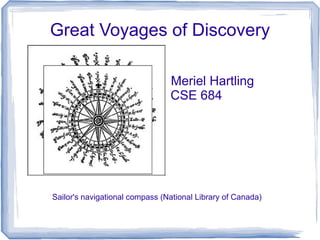
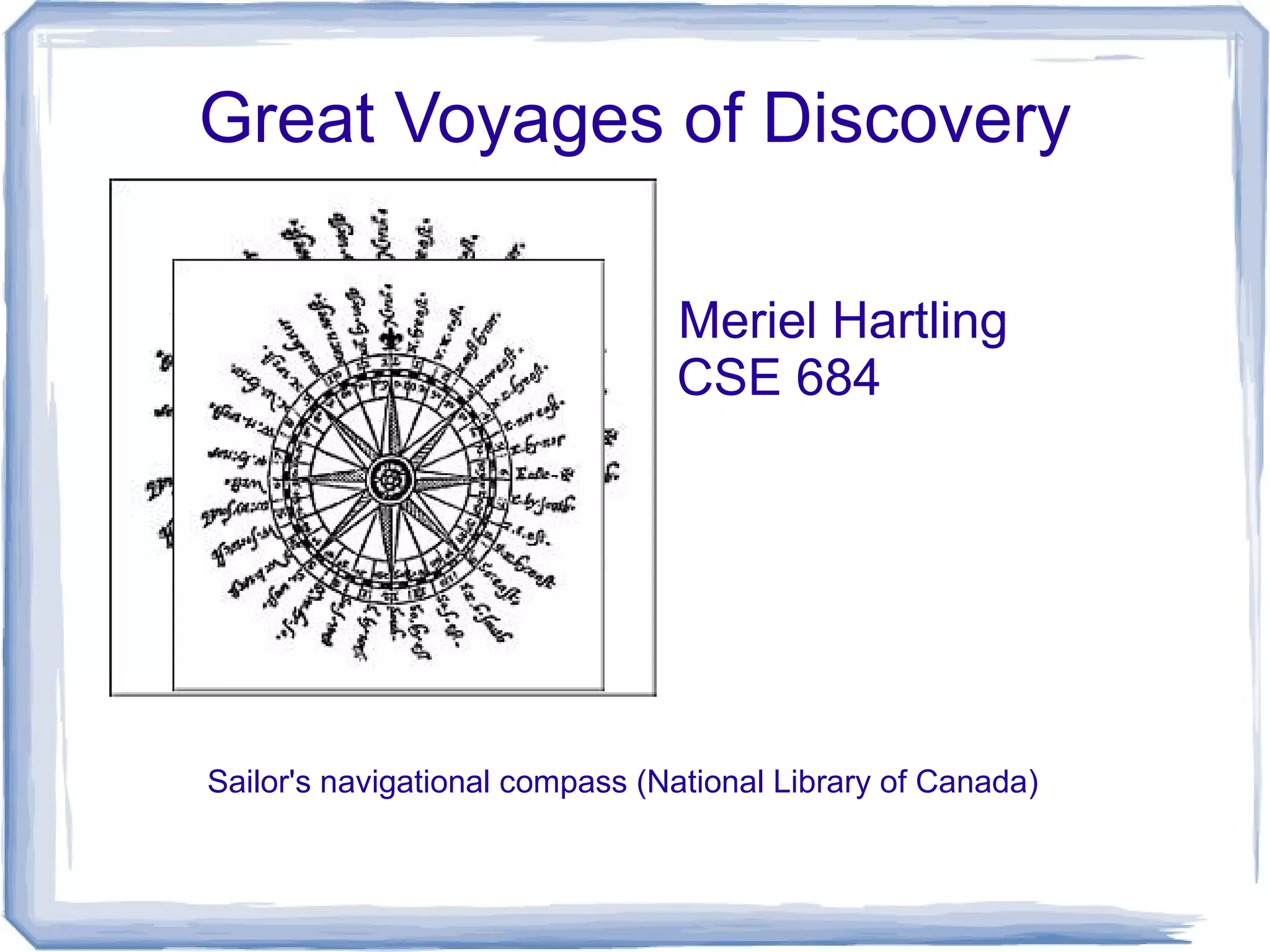
Sailor's navigational compass (National Library of Canada)
A spirit of adventure swept across
       Europe in the 1400s.
                      Explorers like Columbus
                      and Magellan set to find
                      new sea-routes, lands
                      and riches.
                      What motivated these
                      voyages?
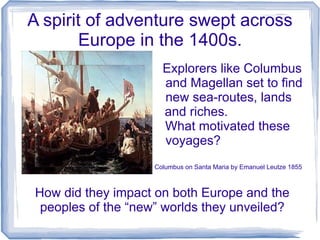
                    Columbus on Santa Maria by Emanuel Leutze 1855


How did they impact on both Europe and the
 peoples of the “new” worlds they unveiled?
In this lesson, we will consider...

●   Motivations behind voyages
●   Means which made the journeys possible
●   Spanish and Portuguese explorations of
    Da Gama, Columbus and Magellan
●   Spanish conquest of the new world
●   Competition between European powers
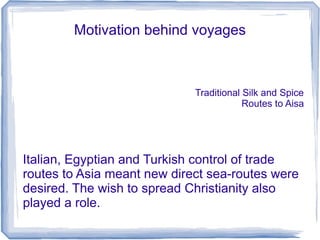
Motivation behind voyages


                             Traditional Silk and Spice
                                         Routes to Aisa


Italian, Egyptian and Turkish control of trade
routes to Asia meant new direct sea-routes were
desired. The wish to spread Christianity also
played a role.
Update


●Motivations behind voyages
●Means which made the journeys possible

●Spanish and Portuguese explorations of

 Da Gama, Columbus and Magellan
●Spanish conquest of the new world

●Competition between European powers
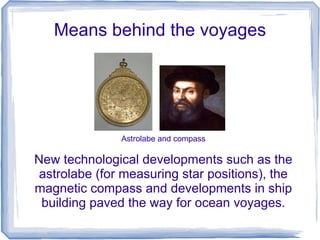
Means behind the voyages


               Astrolabe and compass

New technological developments such as the
 astrolabe (for measuring star positions), the
magnetic compass and developments in ship
 building paved the way for ocean voyages.
Update


●Motivations behind voyages
●Means which made the journeys possible

●Spanish and Portuguese explorations of

 Da Gama, Columbus and Magellan
●Spanish conquest of the new world

●Competition between European powers
Portuguese and Spanish Explorations

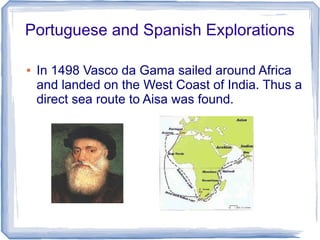
●   In 1498 Vasco da Gama sailed around Africa
    and landed on the West Coast of India. Thus a
    direct sea route to Aisa was found.
In 1492, an Italian sailor, Christopher Columbus
sailed west. It was well known amongst seafarers
that the Earth was round and so Columbus hoped
 to find a direct route to Asia. Instead he landed in
         the what we now call the Bahamas.
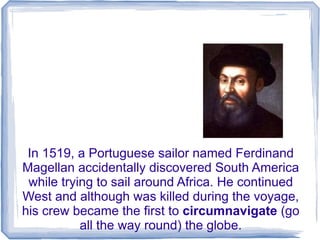
In 1519, a Portuguese sailor named Ferdinand
Magellan accidentally discovered South America
 while trying to sail around Africa. He continued
West and although was killed during the voyage,
his crew became the first to circumnavigate (go
           all the way round) the globe.
Update


●Motivations behind voyages
●Means which made the journeys possible

●Spanish and Portuguese explorations of

 Da Gama, Columbus and Magellan
●Spanish conquest of the new world

●Competition between European powers
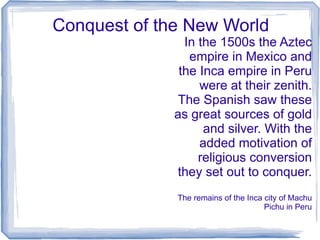
Conquest of the New World
                In the 1500s the Aztec
                 empire in Mexico and
               the Inca empire in Peru
                   were at their zenith.
               The Spanish saw these
              as great sources of gold
                    and silver. With the
                   added motivation of
                   religious conversion
              they set out to conquer.
              The remains of the Inca city of Machu
                                      Pichu in Peru
Why did the Spanish conquests
              succeed?
●   Guns: Gunpowder had not reached the
    Americas.
●   Cavalry: The Americans had no horses and
    had no knowledge of riding an animal.
●   Steel weapons: The American weapons
    (usually made of obsidian) were no match for
    Spanish steel.
●   Germs: diseases like smallpox wiped out huge
    numbers of Americans who had no previous
    exposure to these European diseases.
Update

●   Motivations behind voyages
●   Means which made the journeys possible
●   Spanish and Portuguese explorations of
    Da Gama, Columbus and Magellan
●   Spanish conquest of the new world
●   Competition between European powers
Competition for treasure
           England and France soon
           joined the race to carve up
           the new world. Competition
           for the wealth led Spain in
           1588 to send an enormous
           fleet (the armada) to attack
           England. But faster English
           ships and better guns
           defeated the Spanish.
           The Spanish Armada (English School 1600)
Update

●   Motivations behind voyages
●   Means which made the journeys possible
●   Spanish and Portuguese explorations of
    Da Gama, Columbus and Magellan
●   Spanish conquest of the new world
●   Competition between European powers
Conclusion: A new European
           Worldview.

  The voyages of discovery changed the way
Europeans saw the world. They learned that the
Americas were a separate landmass from Asia.
Many saw this as a source of great wealth and
 set up trade networks and began to establish
    colonies. This would have wide ranging
                consequences.
Summary
●   The voyages were motivated by a need for new routes to Asia.
●   They were made possible by new technology: compass,
    astrolabe, better ships.
●   Da Gama discovered a new route to India by sailing around
    Africa.
●   Columbus discovered a route to the Caribbean islands
    unveiling the continent of North America.
●   Magellan discovered South America before his crew rounded
    the globe.
●   Better technology and resistance to disease helped the
    Spanish conquer the new world.
●   Greed for treasure led to competition between European
    powers like Spain and England.
References

●   Text based on World History by Burskein and
    Shek
●   All graphics come from Wikipedia.
Hartling clickthroughpresentation

Hartling clickthroughpresentation

  • 1.
    Great Voyages ofDiscovery Meriel Hartling CSE 684 Sailor's navigational compass (National Library of Canada)
  • 2.
    A spirit ofadventure swept across Europe in the 1400s. Explorers like Columbus and Magellan set to find new sea-routes, lands and riches. What motivated these voyages? Columbus on Santa Maria by Emanuel Leutze 1855 How did they impact on both Europe and the peoples of the “new” worlds they unveiled?
  • 3.
    In this lesson,we will consider... ● Motivations behind voyages ● Means which made the journeys possible ● Spanish and Portuguese explorations of Da Gama, Columbus and Magellan ● Spanish conquest of the new world ● Competition between European powers
  • 4.
    Motivation behind voyages Traditional Silk and Spice Routes to Aisa Italian, Egyptian and Turkish control of trade routes to Asia meant new direct sea-routes were desired. The wish to spread Christianity also played a role.
  • 5.
    Update ●Motivations behind voyages ●Meanswhich made the journeys possible ●Spanish and Portuguese explorations of Da Gama, Columbus and Magellan ●Spanish conquest of the new world ●Competition between European powers
  • 6.
    Means behind thevoyages Astrolabe and compass New technological developments such as the astrolabe (for measuring star positions), the magnetic compass and developments in ship building paved the way for ocean voyages.
  • 7.
    Update ●Motivations behind voyages ●Meanswhich made the journeys possible ●Spanish and Portuguese explorations of Da Gama, Columbus and Magellan ●Spanish conquest of the new world ●Competition between European powers
  • 8.
    Portuguese and SpanishExplorations ● In 1498 Vasco da Gama sailed around Africa and landed on the West Coast of India. Thus a direct sea route to Aisa was found.
  • 9.
    In 1492, anItalian sailor, Christopher Columbus sailed west. It was well known amongst seafarers that the Earth was round and so Columbus hoped to find a direct route to Asia. Instead he landed in the what we now call the Bahamas.
  • 10.
    In 1519, aPortuguese sailor named Ferdinand Magellan accidentally discovered South America while trying to sail around Africa. He continued West and although was killed during the voyage, his crew became the first to circumnavigate (go all the way round) the globe.
  • 11.
    Update ●Motivations behind voyages ●Meanswhich made the journeys possible ●Spanish and Portuguese explorations of Da Gama, Columbus and Magellan ●Spanish conquest of the new world ●Competition between European powers
  • 12.
    Conquest of theNew World In the 1500s the Aztec empire in Mexico and the Inca empire in Peru were at their zenith. The Spanish saw these as great sources of gold and silver. With the added motivation of religious conversion they set out to conquer. The remains of the Inca city of Machu Pichu in Peru
  • 13.
    Why did theSpanish conquests succeed? ● Guns: Gunpowder had not reached the Americas. ● Cavalry: The Americans had no horses and had no knowledge of riding an animal. ● Steel weapons: The American weapons (usually made of obsidian) were no match for Spanish steel. ● Germs: diseases like smallpox wiped out huge numbers of Americans who had no previous exposure to these European diseases.
  • 14.
    Update ● Motivations behind voyages ● Means which made the journeys possible ● Spanish and Portuguese explorations of Da Gama, Columbus and Magellan ● Spanish conquest of the new world ● Competition between European powers
  • 15.
    Competition for treasure England and France soon joined the race to carve up the new world. Competition for the wealth led Spain in 1588 to send an enormous fleet (the armada) to attack England. But faster English ships and better guns defeated the Spanish. The Spanish Armada (English School 1600)
  • 16.
    Update ● Motivations behind voyages ● Means which made the journeys possible ● Spanish and Portuguese explorations of Da Gama, Columbus and Magellan ● Spanish conquest of the new world ● Competition between European powers
  • 17.
    Conclusion: A newEuropean Worldview. The voyages of discovery changed the way Europeans saw the world. They learned that the Americas were a separate landmass from Asia. Many saw this as a source of great wealth and set up trade networks and began to establish colonies. This would have wide ranging consequences.
  • 18.
    Summary ● The voyages were motivated by a need for new routes to Asia. ● They were made possible by new technology: compass, astrolabe, better ships. ● Da Gama discovered a new route to India by sailing around Africa. ● Columbus discovered a route to the Caribbean islands unveiling the continent of North America. ● Magellan discovered South America before his crew rounded the globe. ● Better technology and resistance to disease helped the Spanish conquer the new world. ● Greed for treasure led to competition between European powers like Spain and England.
  • 19.
    References ● Text based on World History by Burskein and Shek ● All graphics come from Wikipedia.