SUBMITED BY
HARSHIT CHOUBEY
20/31014
BA.(H) GEOGRAPHY
2nd YEAR,3RD SEMESTER
SUBMITED TO
PREETI TEWARI MA’AM
DEPARTMENT OF GEOGRAPHY
(CLIMATOLOGY)
TOPIC NAME ;
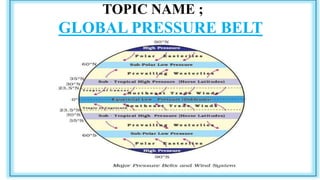
GLOBAL PRESSURE BELT
PressureIntroduction
• Earth is wrapped in a blanket of air called the
'atmosphere', which is made up of several layers ofgases.
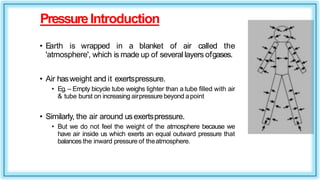
• Air hasweight and it exertspressure.
• Eg. – Empty bicycle tube weighs lighter than a tube filled with air
& tube burst on increasing airpressure beyond apoint
• Similarly, the air around usexertspressure.
• But we do not feel the weight of the atmosphere because we
have air inside us which exerts an equal outward pressure that
balances the inward pressure of theatmosphere.
Atmospheric Pressure
• Theatmosphere is held on the Earth by gravitational pull
of the Earth.
• On the surface of the earth, a column of air exerts
weight in terms ofpressure
• Theweight of the column of air at agiven place andtime
is called air pressure or atmosphericpressure.
• Atmospheric pressure =force per unit area.
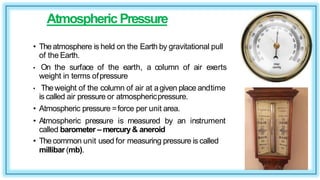
• Atmospheric pressure is measured by an instrument
called barometer – mercury& aneroid
• Thecommon unit used for measuring pressure is called
millibar (mb).
AtmosphericPressureVariation
• Distribution of atmospheric pressure on the surface of the earth
is not uniform. It varies bothvertically and horizontally.
• Thermal expansion & compression of air results in atmospheric
pressure variations.
• Atmospheric pressure variations sets air in motion (from high
pressure to low pressure)
• Horizontal motion of air is called wind. It redistributes heat and
moisture across latitudes, thus maintaining constant temperature
of planet Earth (latitudinal heatbalance)
VerticalDistribution
• The atmospheric pressure decreases with
height.
• Due to gravity the air at the surface of Earth
is denser and hence hashigher pressure.
• In the air column, upper air mass
compresses the lower air mass, hence lower
layers are denser than upper layers & thus,
exert more pressure.
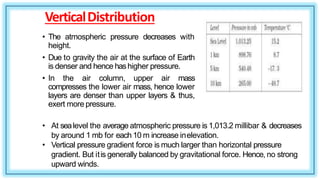
• At sealevel the average atmospheric pressure is 1,013.2 millibar & decreases
by around 1 mb for each 10 m increase inelevation.
• Vertical pressure gradient force is much larger than horizontal pressure
gradient. But itis generally balanced by gravitational force. Hence, no strong
upward winds.
HorizontalDistribution
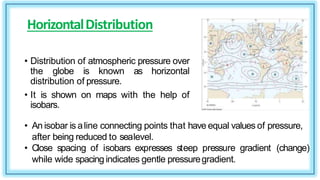
• Distribution of atmospheric pressure over
the globe is known as horizontal
distribution of pressure.
• It is shown on maps with the help of
isobars.
• An isobar is aline connecting points that have equal values of pressure,
after being reduced to sealevel.
• Close spacing of isobars expresses steep pressure gradient (change)
while wide spacing indicates gentle pressuregradient.
PressureBelts
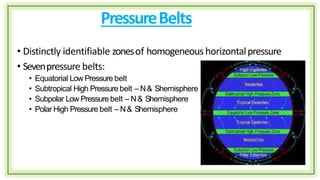
• Distinctly identifiable zonesof homogeneous horizontalpressure
• Sevenpressure belts:
• Equatorial Low Pressure belt
• Subtropical High Pressurebelt – N& Shemisphere
• Subpolar Low Pressure belt – N& Shemisphere
• Polar High Pressure belt – N& Shemisphere
EquatorialLowPressureBelt
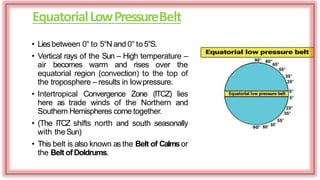
• Liesbetween 0° to 5°N and 0° to 5°S.
• Vertical rays of the Sun – High temperature –
air becomes warm and rises over the
equatorial region (convection) to the top of
the troposphere – results in lowpressure.
• Intertropical Convergence Zone (ITCZ) lies
here as trade winds of the Northern and
Southern Hemispheres come together.
• (The ITCZ shifts north and south seasonally
with theSun)
• This belt is also known as the Belt of Calmsor
the Belt ofDoldrums.
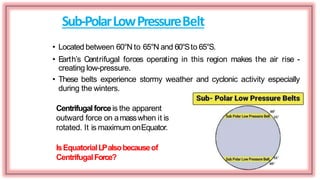
Sub-PolarLowPressureBelt
• Located between 60°N to 65°N and 60°Sto 65°S.
• Earth’s Centrifugal forces operating in this region makes the air rise -
creating low-pressure.
• These belts experience stormy weather and cyclonic activity especially
during the winters.
Centrifugalforceis the apparent
outward force on amasswhen it is
rotated. It is maximum onEquator.
IsEquatorialLPalsobecauseof
CentrifugalForce?
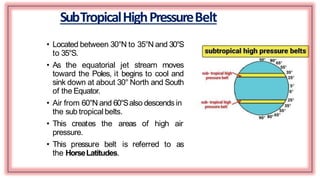
SubTropicalHighPressureBelt
• Located between 30°N to 35°N and 30°S
to 35°S.
• As the equatorial jet stream moves
toward the Poles, it begins to cool and
sink down at about 30° North and South
of the Equator.
• Air from 60°N and 60°Salso descends in
the sub tropical belts.
• This creates the areas of high air
pressure.
• This pressure belt is referred to as
the HorseLatitudes.
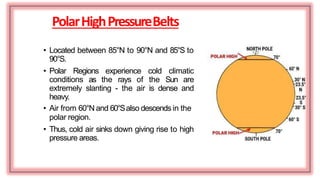
PolarHighPressureBelts
• Located between 85°N to 90°N and 85°S to
90°S.
• Polar Regions experience cold climatic
conditions as the rays of the Sun are
extremely slanting - the air is dense and
heavy.
• Air from 60°N and 60°Salso descends in the
polar region.
• Thus, cold air sinks down giving rise to high
pressure areas.
SHIFTING OF PRESSURE BELT
• If the earth had not been inclined towards the sun, the pressure belts, as
described above, would have been as they are.
• But it is not so, because the earth is inclined 23 1/2° towards the sun. On account
of this inclination, differences in heating of the continents, oceans, and pressure
conditions in January and July vary greatly. January represents winter season and
July, summer season in the Northern Hemisphere. Opposite conditions prevail in
the Southern Hemisphere.
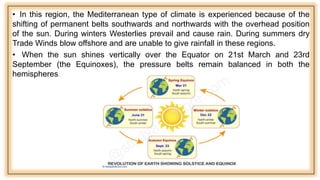
• When the sun is overhead on the Tropic of Cancer (21 June) the pressure belts
shift 5° northward and when it shines vertically overhead on Tropic of Capricorn (22
December), they shift 5° southward from their original position. The shifting of the
pressure belts causes seasonal changes in the climate, especially between
latitudes 30° and 40° in both hemispheres.
• In this region, the Mediterranean type of climate is experienced because of the
shifting of permanent belts southwards and northwards with the overhead position
of the sun. During winters Westerlies prevail and cause rain. During summers dry
Trade Winds blow offshore and are unable to give rainfall in these regions.
• When the sun shines vertically over the Equator on 21st March and 23rd
September (the Equinoxes), the pressure belts remain balanced in both the
hemispheres.
THANK YOU
TO
ALL
OF
YOU.

HARSHIT CHOUBEY CLIMATOLOGY PPT.pdf

  • 1.
    SUBMITED BY HARSHIT CHOUBEY 20/31014 BA.(H)GEOGRAPHY 2nd YEAR,3RD SEMESTER SUBMITED TO PREETI TEWARI MA’AM DEPARTMENT OF GEOGRAPHY (CLIMATOLOGY)
  • 2.
    TOPIC NAME ; GLOBALPRESSURE BELT
  • 3.
    PressureIntroduction • Earth iswrapped in a blanket of air called the 'atmosphere', which is made up of several layers ofgases. • Air hasweight and it exertspressure. • Eg. – Empty bicycle tube weighs lighter than a tube filled with air & tube burst on increasing airpressure beyond apoint • Similarly, the air around usexertspressure. • But we do not feel the weight of the atmosphere because we have air inside us which exerts an equal outward pressure that balances the inward pressure of theatmosphere.
  • 4.
    Atmospheric Pressure • Theatmosphereis held on the Earth by gravitational pull of the Earth. • On the surface of the earth, a column of air exerts weight in terms ofpressure • Theweight of the column of air at agiven place andtime is called air pressure or atmosphericpressure. • Atmospheric pressure =force per unit area. • Atmospheric pressure is measured by an instrument called barometer – mercury& aneroid • Thecommon unit used for measuring pressure is called millibar (mb).
  • 5.
    AtmosphericPressureVariation • Distribution ofatmospheric pressure on the surface of the earth is not uniform. It varies bothvertically and horizontally. • Thermal expansion & compression of air results in atmospheric pressure variations. • Atmospheric pressure variations sets air in motion (from high pressure to low pressure) • Horizontal motion of air is called wind. It redistributes heat and moisture across latitudes, thus maintaining constant temperature of planet Earth (latitudinal heatbalance)
  • 6.
    VerticalDistribution • The atmosphericpressure decreases with height. • Due to gravity the air at the surface of Earth is denser and hence hashigher pressure. • In the air column, upper air mass compresses the lower air mass, hence lower layers are denser than upper layers & thus, exert more pressure. • At sealevel the average atmospheric pressure is 1,013.2 millibar & decreases by around 1 mb for each 10 m increase inelevation. • Vertical pressure gradient force is much larger than horizontal pressure gradient. But itis generally balanced by gravitational force. Hence, no strong upward winds.
  • 7.
    HorizontalDistribution • Distribution ofatmospheric pressure over the globe is known as horizontal distribution of pressure. • It is shown on maps with the help of isobars. • An isobar is aline connecting points that have equal values of pressure, after being reduced to sealevel. • Close spacing of isobars expresses steep pressure gradient (change) while wide spacing indicates gentle pressuregradient.
  • 8.
    PressureBelts • Distinctly identifiablezonesof homogeneous horizontalpressure • Sevenpressure belts: • Equatorial Low Pressure belt • Subtropical High Pressurebelt – N& Shemisphere • Subpolar Low Pressure belt – N& Shemisphere • Polar High Pressure belt – N& Shemisphere
  • 9.
    EquatorialLowPressureBelt • Liesbetween 0°to 5°N and 0° to 5°S. • Vertical rays of the Sun – High temperature – air becomes warm and rises over the equatorial region (convection) to the top of the troposphere – results in lowpressure. • Intertropical Convergence Zone (ITCZ) lies here as trade winds of the Northern and Southern Hemispheres come together. • (The ITCZ shifts north and south seasonally with theSun) • This belt is also known as the Belt of Calmsor the Belt ofDoldrums.
  • 10.
    Sub-PolarLowPressureBelt • Located between60°N to 65°N and 60°Sto 65°S. • Earth’s Centrifugal forces operating in this region makes the air rise - creating low-pressure. • These belts experience stormy weather and cyclonic activity especially during the winters. Centrifugalforceis the apparent outward force on amasswhen it is rotated. It is maximum onEquator. IsEquatorialLPalsobecauseof CentrifugalForce?
  • 11.
    SubTropicalHighPressureBelt • Located between30°N to 35°N and 30°S to 35°S. • As the equatorial jet stream moves toward the Poles, it begins to cool and sink down at about 30° North and South of the Equator. • Air from 60°N and 60°Salso descends in the sub tropical belts. • This creates the areas of high air pressure. • This pressure belt is referred to as the HorseLatitudes.
  • 12.
    PolarHighPressureBelts • Located between85°N to 90°N and 85°S to 90°S. • Polar Regions experience cold climatic conditions as the rays of the Sun are extremely slanting - the air is dense and heavy. • Air from 60°N and 60°Salso descends in the polar region. • Thus, cold air sinks down giving rise to high pressure areas.
  • 13.
    SHIFTING OF PRESSUREBELT • If the earth had not been inclined towards the sun, the pressure belts, as described above, would have been as they are. • But it is not so, because the earth is inclined 23 1/2° towards the sun. On account of this inclination, differences in heating of the continents, oceans, and pressure conditions in January and July vary greatly. January represents winter season and July, summer season in the Northern Hemisphere. Opposite conditions prevail in the Southern Hemisphere. • When the sun is overhead on the Tropic of Cancer (21 June) the pressure belts shift 5° northward and when it shines vertically overhead on Tropic of Capricorn (22 December), they shift 5° southward from their original position. The shifting of the pressure belts causes seasonal changes in the climate, especially between latitudes 30° and 40° in both hemispheres.
  • 14.
    • In thisregion, the Mediterranean type of climate is experienced because of the shifting of permanent belts southwards and northwards with the overhead position of the sun. During winters Westerlies prevail and cause rain. During summers dry Trade Winds blow offshore and are unable to give rainfall in these regions. • When the sun shines vertically over the Equator on 21st March and 23rd September (the Equinoxes), the pressure belts remain balanced in both the hemispheres.
  • 15.