
A purple title slide with an image, for a general
presentation
24/02/2015
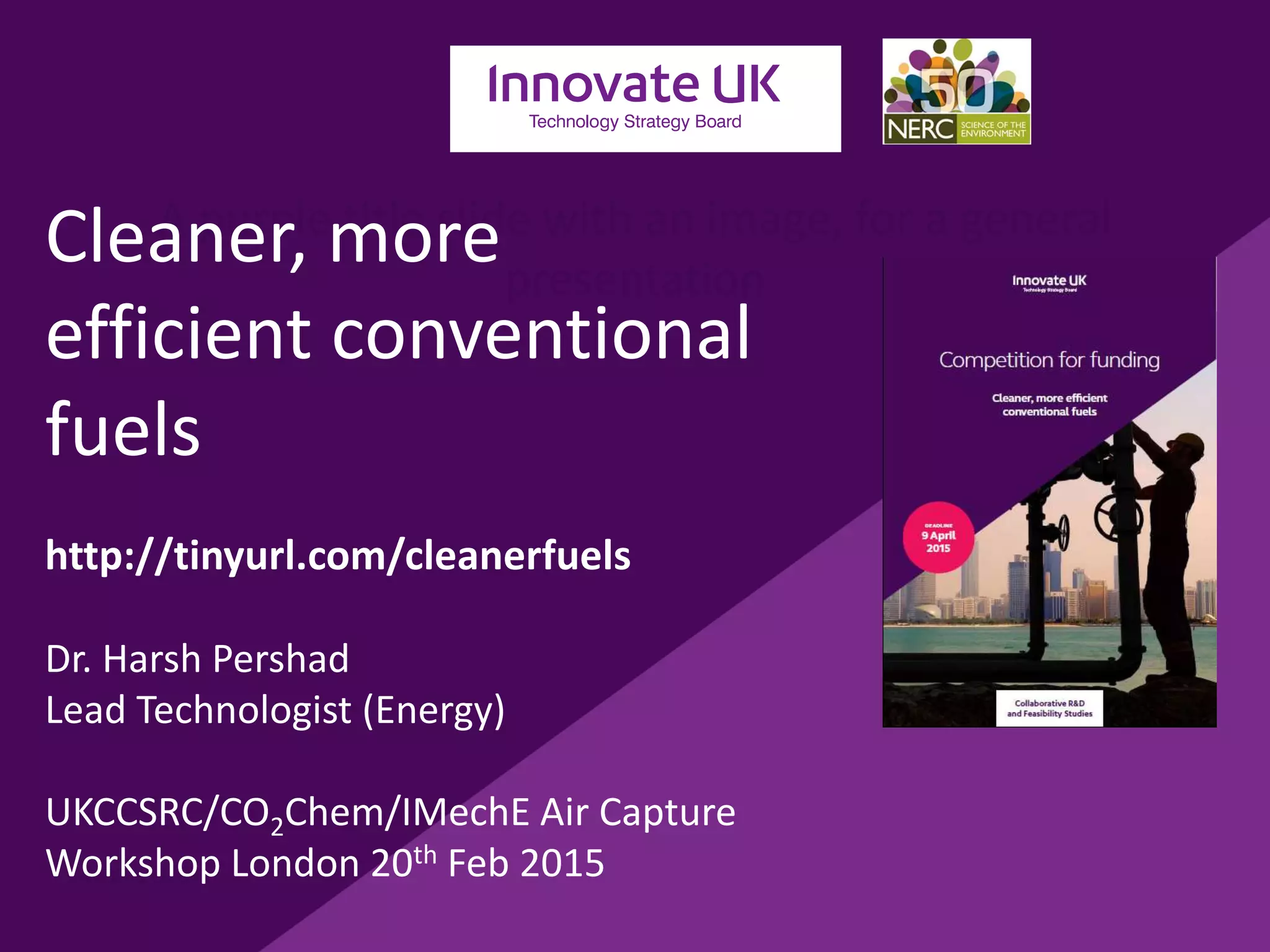
Cleaner, more
efficient conventional
fuels
http://tinyurl.com/cleanerfuels
Dr. Harsh Pershad
Lead Technologist (Energy)
UKCCSRC/CO2Chem/IMechE Air Capture
Workshop London 20th Feb 2015
Purpose of talk: Encourage collaboration between academics
and business to submit innovative projects for the Energy
Catalyst and for our £5m £6m funding competitions into
cleaner and more efficient conventional fuels.
Outline
• Introduction to Innovate UK
• Energy Catalyst
• Cleaner, More Efficient Conventional Fuel Competitions
• Website, Registration and Briefing events details
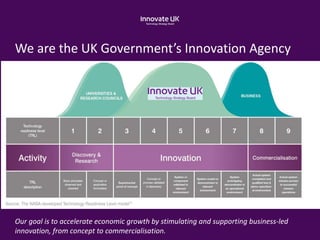
We are the UK Government’s Innovation Agency
Our goal is to accelerate economic growth by stimulating and supporting business-led
innovation, from concept to commercialisation.
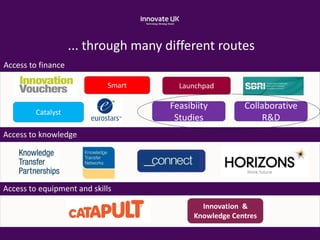
... through many different routes
Collaborative
R&D
Collaborative
R&D
SmartSmart LaunchpadLaunchpad
Innovation &
Knowledge Centres
Innovation &
Knowledge Centres
CatalystCatalyst
Access to finance
Access to knowledge
Access to equipment and skills
Feasibiity
Studies
Feasibiity
Studies
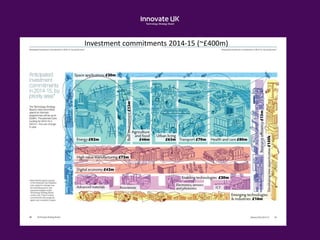
Investment commitments 2014-15 (~£400m)
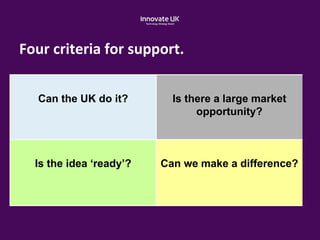
Can the UK do it? Is there a large market
opportunity?
Is the idea ‘ready’? Can we make a difference?
Four criteria for support.
Purpose of talk: Encourage collaboration between academics
and business to submit innovative projects for the Energy
Catalyst and for our £5m funding competitions into cleaner
and more efficient conventional fuels.
Outline
• Introduction to Innovate UK
• Energy Catalyst
• Cleaner, More Efficient Conventional Fuel Competitions
• Website, Registration and Briefing events details
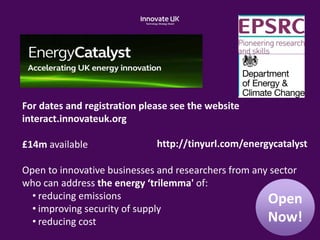
For dates and registration please see the website
interact.innovateuk.org
£14m available
Open to innovative businesses and researchers from any sector
who can address the energy ‘trilemma' of:
• reducing emissions
• improving security of supply
• reducing cost
http://tinyurl.com/energycatalyst
Open
Now!
Open
Now!
Purpose of talk: Encourage collaboration between academics
and business to submit innovative projects for the Energy
Catalyst and for our £5m £6m funding competitions into
cleaner and more efficient conventional fuels.
Outline
• Introduction to Innovate UK
• Energy Catalyst
• Cleaner, More Efficient Conventional Fuel Competitions
• Website, Registration and Briefing events details
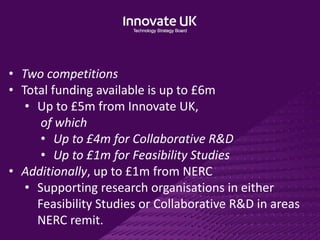
• Two competitions
• Total funding available is up to £6m
• Up to £5m from Innovate UK,
of which
• Up to £4m for Collaborative R&D
• Up to £1m for Feasibility Studies
• Additionally, up to £1m from NERC
• Supporting research organisations in either
Feasibility Studies or Collaborative R&D in areas
NERC remit.
Intended outcomes
Up to £5m Innovate UK funding and up to £1m NERC funding
for:
• Improved efficiency, reduced cost and minimum
environmental impacts from coal, natural gas and oil.
• UK businesses take advantage of the opportunities from the
changing oil and gas sector, and from the increasing focus on
carbon-abated use of fossil fuels, through innovative
technologies and UK supply chains.
Objectives
• Support SMEs developing technologies to link with
operators, large companies, research organisations, and
other SMEs.
• Support the development of technologies that make the
most effective use of UK Continental Shelf resources and
existing infrastructure.
• Develop technologies to maximise the efficiency,
effectiveness and sustainability of fossil fuel use.
• Drive earlier maturation of next generation technologies for
carbon abatement.
• Build on UK’s competitive advantages
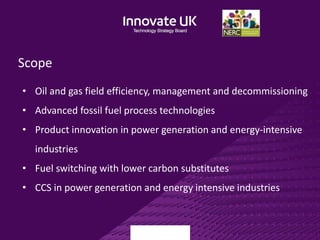
Scope
• Oil and gas field efficiency, management and decommissioning
• Advanced fossil fuel process technologies
• Product innovation in power generation and energy-intensive
industries
• Fuel switching with lower carbon substitutes
• CCS in power generation and energy intensive industries
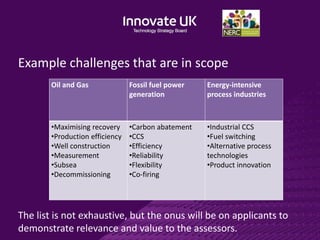
Example challenges that are in scope
Oil and Gas Fossil fuel power
generation
Energy-intensive
process industries
•Maximising recovery
•Production efficiency
•Well construction
•Measurement
•Subsea
•Decommissioning
•Carbon abatement
•CCS
•Efficiency
•Reliability
•Flexibility
•Co-firing
•Industrial CCS
•Fuel switching
•Alternative process
technologies
•Product innovation
The list is not exhaustive, but the onus will be on applicants to
demonstrate relevance and value to the assessors.
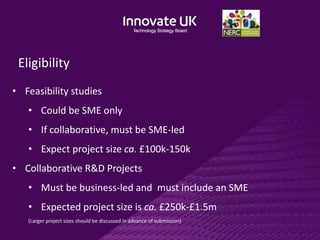
Eligibility
• Feasibility studies
• Could be SME only
• If collaborative, must be SME-led
• Expect project size ca. £100k-150k
• Collaborative R&D Projects
• Must be business-led and must include an SME
• Expected project size is ca. £250k-£1.5m
(Larger project sizes should be discussed in advance of submission)
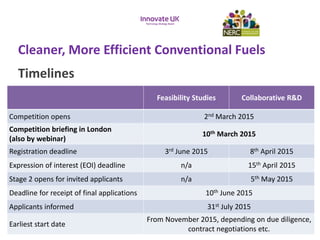
Cleaner, More Efficient Conventional Fuels
Timelines
Feasibility Studies Collaborative R&D
Competition opens 2nd March 2015
Competition briefing in London
(also by webinar)
10th March 2015
Registration deadline 3rd June 2015 8th April 2015
Expression of interest (EOI) deadline n/a 15th April 2015
Stage 2 opens for invited applicants n/a 5th May 2015
Deadline for receipt of final applications 10th June 2015
Applicants informed 31st July 2015
Earliest start date
From November 2015, depending on due diligence,
contract negotiations etc.
Purpose of talk: Encourage collaboration between academics
and business to submit innovative projects for the Energy
Catalyst and for our £5m £6m funding competitions into
cleaner and more efficient conventional fuels.
Outline
• Introduction to Innovate UK
• Energy Catalyst
• Cleaner, More Efficient Conventional Fuel Competitions
• Website, Registration and Briefing events details
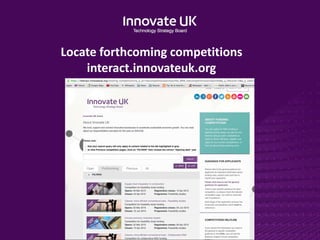
Locate forthcoming competitions
interact.innovateuk.org
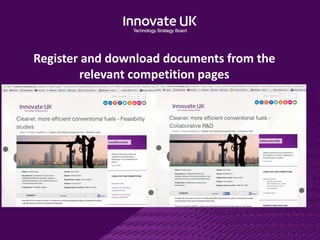
Register and download documents from the
relevant competition pages
A purple title slide with an image, for a general
presentation
Cleaner, more
efficient
conventional fuels
http://tinyurl.com/cleanerfuels
Dr. Harsh Pershad
Lead Technologist (Energy)
Email support@innovateuk.gov.uk
Appendix
24/02/2015
Illustrative projects that would be “in scope”
N.B. List is not prescriptive, not exhaustive - we are interested in
disruptive or radical innovations that can drive step change
improvements in key performance indicators (e.g. costs, risks).
24/02/2015
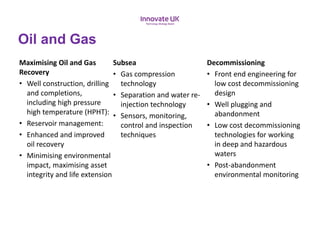
Oil and Gas
Maximising Oil and Gas
Recovery
• Well construction, drilling
and completions,
including high pressure
high temperature (HPHT):
• Reservoir management:
• Enhanced and improved
oil recovery
• Minimising environmental
impact, maximising asset
integrity and life extension
Subsea
• Gas compression
technology
• Separation and water re-
injection technology
• Sensors, monitoring,
control and inspection
techniques
Decommissioning
• Front end engineering for
low cost decommissioning
design
• Well plugging and
abandonment
• Low cost decommissioning
technologies for working
in deep and hazardous
waters
• Post-abandonment
environmental monitoring
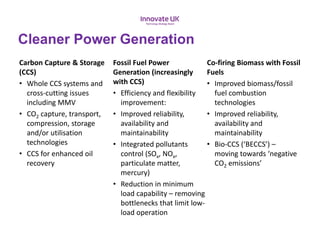
Cleaner Power Generation
Carbon Capture & Storage
(CCS)
• Whole CCS systems and
cross-cutting issues
including MMV
• CO2 capture, transport,
compression, storage
and/or utilisation
technologies
• CCS for enhanced oil
recovery
Fossil Fuel Power
Generation (increasingly
with CCS)
• Efficiency and flexibility
improvement:
• Improved reliability,
availability and
maintainability
• Integrated pollutants
control (SOx, NOx,
particulate matter,
mercury)
• Reduction in minimum
load capability – removing
bottlenecks that limit low-
load operation
Co-firing Biomass with Fossil
Fuels
• Improved biomass/fossil
fuel combustion
technologies
• Improved reliability,
availability and
maintainability
• Bio-CCS (‘BECCS’) –
moving towards ‘negative
CO2 emissions’
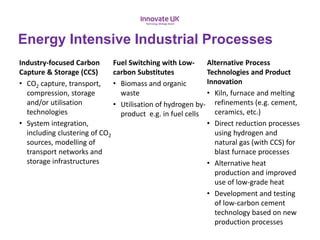
Energy Intensive Industrial Processes
Industry-focused Carbon
Capture & Storage (CCS)
• CO2 capture, transport,
compression, storage
and/or utilisation
technologies
• System integration,
including clustering of CO2
sources, modelling of
transport networks and
storage infrastructures
Fuel Switching with Low-
carbon Substitutes
• Biomass and organic
waste
• Utilisation of hydrogen by-
product e.g. in fuel cells
Alternative Process
Technologies and Product
Innovation
• Kiln, furnace and melting
refinements (e.g. cement,
ceramics, etc.)
• Direct reduction processes
using hydrogen and
natural gas (with CCS) for
blast furnace processes
• Alternative heat
production and improved
use of low-grade heat
• Development and testing
of low-carbon cement
technology based on new
production processes
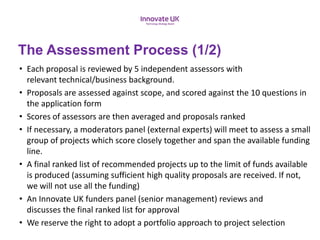
• Each proposal is reviewed by 5 independent assessors with
relevant technical/business background.
• Proposals are assessed against scope, and scored against the 10 questions in
the application form
• Scores of assessors are then averaged and proposals ranked
• If necessary, a moderators panel (external experts) will meet to assess a small
group of projects which score closely together and span the available funding
line.
• A final ranked list of recommended projects up to the limit of funds available
is produced (assuming sufficient high quality proposals are received. If not,
we will not use all the funding​)
• An Innovate UK funders panel (senior management) reviews and
discusses the final ranked list for approval
• We reserve the right to adopt a portfolio approach to project selection
The Assessment Process (1/2)
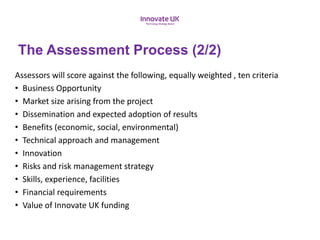
Assessors will score against the following, equally weighted , ten criteria
• Business Opportunity
• Market size arising from the project
• Dissemination and expected adoption of results
• Benefits (economic, social, environmental)
• Technical approach and management
• Innovation
• Risks and risk management strategy
• Skills, experience, facilities
• Financial requirements
• Value of Innovate UK funding
The Assessment Process (2/2)

Harsh Pershad (Innovate UK) presenting 'Funding Opportunities from Innovate UK' at the UKCCSRC/IMechE/CO2Chem Air Capture Workshop on 20th February 2015 in London

  • 1.
    A purple titleslide with an image, for a general presentation 24/02/2015 Cleaner, more efficient conventional fuels http://tinyurl.com/cleanerfuels Dr. Harsh Pershad Lead Technologist (Energy) UKCCSRC/CO2Chem/IMechE Air Capture Workshop London 20th Feb 2015
  • 2.
    Purpose of talk:Encourage collaboration between academics and business to submit innovative projects for the Energy Catalyst and for our £5m £6m funding competitions into cleaner and more efficient conventional fuels. Outline • Introduction to Innovate UK • Energy Catalyst • Cleaner, More Efficient Conventional Fuel Competitions • Website, Registration and Briefing events details
  • 3.
    We are theUK Government’s Innovation Agency Our goal is to accelerate economic growth by stimulating and supporting business-led innovation, from concept to commercialisation.
  • 4.
    ... through manydifferent routes Collaborative R&D Collaborative R&D SmartSmart LaunchpadLaunchpad Innovation & Knowledge Centres Innovation & Knowledge Centres CatalystCatalyst Access to finance Access to knowledge Access to equipment and skills Feasibiity Studies Feasibiity Studies
  • 5.
  • 6.
    Can the UKdo it? Is there a large market opportunity? Is the idea ‘ready’? Can we make a difference? Four criteria for support.
  • 7.
    Purpose of talk:Encourage collaboration between academics and business to submit innovative projects for the Energy Catalyst and for our £5m funding competitions into cleaner and more efficient conventional fuels. Outline • Introduction to Innovate UK • Energy Catalyst • Cleaner, More Efficient Conventional Fuel Competitions • Website, Registration and Briefing events details
  • 8.
    For dates andregistration please see the website interact.innovateuk.org £14m available Open to innovative businesses and researchers from any sector who can address the energy ‘trilemma' of: • reducing emissions • improving security of supply • reducing cost http://tinyurl.com/energycatalyst Open Now! Open Now!
  • 9.
    Purpose of talk:Encourage collaboration between academics and business to submit innovative projects for the Energy Catalyst and for our £5m £6m funding competitions into cleaner and more efficient conventional fuels. Outline • Introduction to Innovate UK • Energy Catalyst • Cleaner, More Efficient Conventional Fuel Competitions • Website, Registration and Briefing events details
  • 10.
    • Two competitions •Total funding available is up to £6m • Up to £5m from Innovate UK, of which • Up to £4m for Collaborative R&D • Up to £1m for Feasibility Studies • Additionally, up to £1m from NERC • Supporting research organisations in either Feasibility Studies or Collaborative R&D in areas NERC remit.
  • 11.
    Intended outcomes Up to£5m Innovate UK funding and up to £1m NERC funding for: • Improved efficiency, reduced cost and minimum environmental impacts from coal, natural gas and oil. • UK businesses take advantage of the opportunities from the changing oil and gas sector, and from the increasing focus on carbon-abated use of fossil fuels, through innovative technologies and UK supply chains.
  • 12.
    Objectives • Support SMEsdeveloping technologies to link with operators, large companies, research organisations, and other SMEs. • Support the development of technologies that make the most effective use of UK Continental Shelf resources and existing infrastructure. • Develop technologies to maximise the efficiency, effectiveness and sustainability of fossil fuel use. • Drive earlier maturation of next generation technologies for carbon abatement. • Build on UK’s competitive advantages
  • 13.
    Scope • Oil andgas field efficiency, management and decommissioning • Advanced fossil fuel process technologies • Product innovation in power generation and energy-intensive industries • Fuel switching with lower carbon substitutes • CCS in power generation and energy intensive industries
  • 14.
    Example challenges thatare in scope Oil and Gas Fossil fuel power generation Energy-intensive process industries •Maximising recovery •Production efficiency •Well construction •Measurement •Subsea •Decommissioning •Carbon abatement •CCS •Efficiency •Reliability •Flexibility •Co-firing •Industrial CCS •Fuel switching •Alternative process technologies •Product innovation The list is not exhaustive, but the onus will be on applicants to demonstrate relevance and value to the assessors.
  • 15.
    Eligibility • Feasibility studies •Could be SME only • If collaborative, must be SME-led • Expect project size ca. £100k-150k • Collaborative R&D Projects • Must be business-led and must include an SME • Expected project size is ca. £250k-£1.5m (Larger project sizes should be discussed in advance of submission)
  • 16.
    Cleaner, More EfficientConventional Fuels Timelines Feasibility Studies Collaborative R&D Competition opens 2nd March 2015 Competition briefing in London (also by webinar) 10th March 2015 Registration deadline 3rd June 2015 8th April 2015 Expression of interest (EOI) deadline n/a 15th April 2015 Stage 2 opens for invited applicants n/a 5th May 2015 Deadline for receipt of final applications 10th June 2015 Applicants informed 31st July 2015 Earliest start date From November 2015, depending on due diligence, contract negotiations etc.
  • 17.
    Purpose of talk:Encourage collaboration between academics and business to submit innovative projects for the Energy Catalyst and for our £5m £6m funding competitions into cleaner and more efficient conventional fuels. Outline • Introduction to Innovate UK • Energy Catalyst • Cleaner, More Efficient Conventional Fuel Competitions • Website, Registration and Briefing events details
  • 18.
  • 19.
    Register and downloaddocuments from the relevant competition pages
  • 20.
    A purple titleslide with an image, for a general presentation Cleaner, more efficient conventional fuels http://tinyurl.com/cleanerfuels Dr. Harsh Pershad Lead Technologist (Energy) Email support@innovateuk.gov.uk
  • 21.
  • 22.
    Illustrative projects thatwould be “in scope” N.B. List is not prescriptive, not exhaustive - we are interested in disruptive or radical innovations that can drive step change improvements in key performance indicators (e.g. costs, risks). 24/02/2015
  • 23.
    Oil and Gas MaximisingOil and Gas Recovery • Well construction, drilling and completions, including high pressure high temperature (HPHT): • Reservoir management: • Enhanced and improved oil recovery • Minimising environmental impact, maximising asset integrity and life extension Subsea • Gas compression technology • Separation and water re- injection technology • Sensors, monitoring, control and inspection techniques Decommissioning • Front end engineering for low cost decommissioning design • Well plugging and abandonment • Low cost decommissioning technologies for working in deep and hazardous waters • Post-abandonment environmental monitoring
  • 24.
    Cleaner Power Generation CarbonCapture & Storage (CCS) • Whole CCS systems and cross-cutting issues including MMV • CO2 capture, transport, compression, storage and/or utilisation technologies • CCS for enhanced oil recovery Fossil Fuel Power Generation (increasingly with CCS) • Efficiency and flexibility improvement: • Improved reliability, availability and maintainability • Integrated pollutants control (SOx, NOx, particulate matter, mercury) • Reduction in minimum load capability – removing bottlenecks that limit low- load operation Co-firing Biomass with Fossil Fuels • Improved biomass/fossil fuel combustion technologies • Improved reliability, availability and maintainability • Bio-CCS (‘BECCS’) – moving towards ‘negative CO2 emissions’
  • 25.
    Energy Intensive IndustrialProcesses Industry-focused Carbon Capture & Storage (CCS) • CO2 capture, transport, compression, storage and/or utilisation technologies • System integration, including clustering of CO2 sources, modelling of transport networks and storage infrastructures Fuel Switching with Low- carbon Substitutes • Biomass and organic waste • Utilisation of hydrogen by- product e.g. in fuel cells Alternative Process Technologies and Product Innovation • Kiln, furnace and melting refinements (e.g. cement, ceramics, etc.) • Direct reduction processes using hydrogen and natural gas (with CCS) for blast furnace processes • Alternative heat production and improved use of low-grade heat • Development and testing of low-carbon cement technology based on new production processes
  • 26.
    • Each proposalis reviewed by 5 independent assessors with relevant technical/business background. • Proposals are assessed against scope, and scored against the 10 questions in the application form • Scores of assessors are then averaged and proposals ranked • If necessary, a moderators panel (external experts) will meet to assess a small group of projects which score closely together and span the available funding line. • A final ranked list of recommended projects up to the limit of funds available is produced (assuming sufficient high quality proposals are received. If not, we will not use all the funding​) • An Innovate UK funders panel (senior management) reviews and discusses the final ranked list for approval • We reserve the right to adopt a portfolio approach to project selection The Assessment Process (1/2)
  • 27.
    Assessors will scoreagainst the following, equally weighted , ten criteria • Business Opportunity • Market size arising from the project • Dissemination and expected adoption of results • Benefits (economic, social, environmental) • Technical approach and management • Innovation • Risks and risk management strategy • Skills, experience, facilities • Financial requirements • Value of Innovate UK funding The Assessment Process (2/2)