Proprietary Information
Theimportanceof life of
fieldin flowassurance – a
wax deposition study
KBCUsersGroupConference
London18th June2018
AlessandroSperanza
June 18, 20181
Proprietary Information
Outline
• What is wax and how does it deposit?
• Selecting a mitigation strategy
• A waxy condensate gathering system case
• Flow assurance issues during the life of the field
• Maximus/FloWax wax deposition study. Is wax really a problem?
• Conclusions
June 18, 2018 2
Proprietary Information
WhatisPetroleumWax?
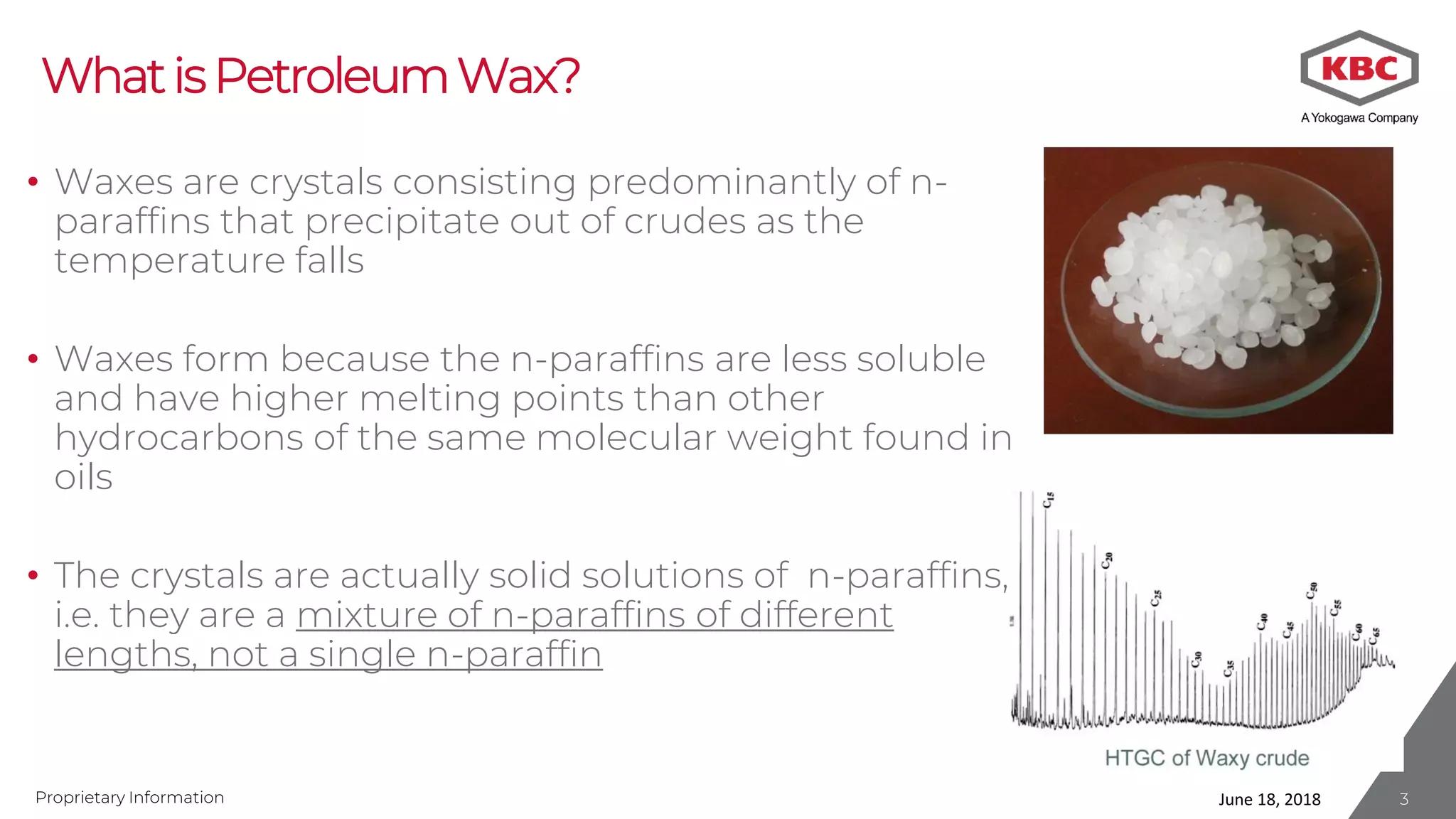
• Waxes are crystals consisting predominantly of n-
paraffins that precipitate out of crudes as the
temperature falls
• Waxes form because the n-paraffins are less soluble
and have higher melting points than other
hydrocarbons of the same molecular weight found in
oils
• The crystals are actually solid solutions of n-paraffins,
i.e. they are a mixture of n-paraffins of different
lengths, not a single n-paraffin
June 18, 2018 3
Proprietary Information
Whatisthewaxdeposit?
• Wax crystals form at temperature below WAT (wax appearance
temperature)
• Typically at interface between oil and pipeline
• Temperature gradient across pipe section drives deposit formation
• Solid crystals form a large network with large amount of trapped liquid
(60 – 80%)
• Stationary deposit grows as long as conditions hold
• Temperature below WAT
• Temperature gradient across pipe section
• Aging: the deposit hardens as oil diffuses through gel back to flow
June 18, 2018 4
Proprietary Information
Flowassurancestrategy
• Wax avoidance
• Keep away from WAT (insulation, active heating, blending….)
• Inject inhibitors to keep n-paraffins in solution
• Remediation
• Pigging (how often?)
• Periodic maintenance
• Live with it
• How much deposit can I tolerate?
June 18, 2018 5
Proprietary Information
Selectinga mitigationstrategy
• How much a problem is a big problem?
• What does “waxy fluid” really mean?
• Is a deposit going to form? How thick? Where? When?
• Quantitative predictions
• Fluid PVT modelling (composition, wax precipitation, WAT etc.)
• Wax deposition (insulation, flow rate, choking …)
• Thermo-hydraulics (pressure drop, production profile, temperature drop…)
• Variation of producing conditions
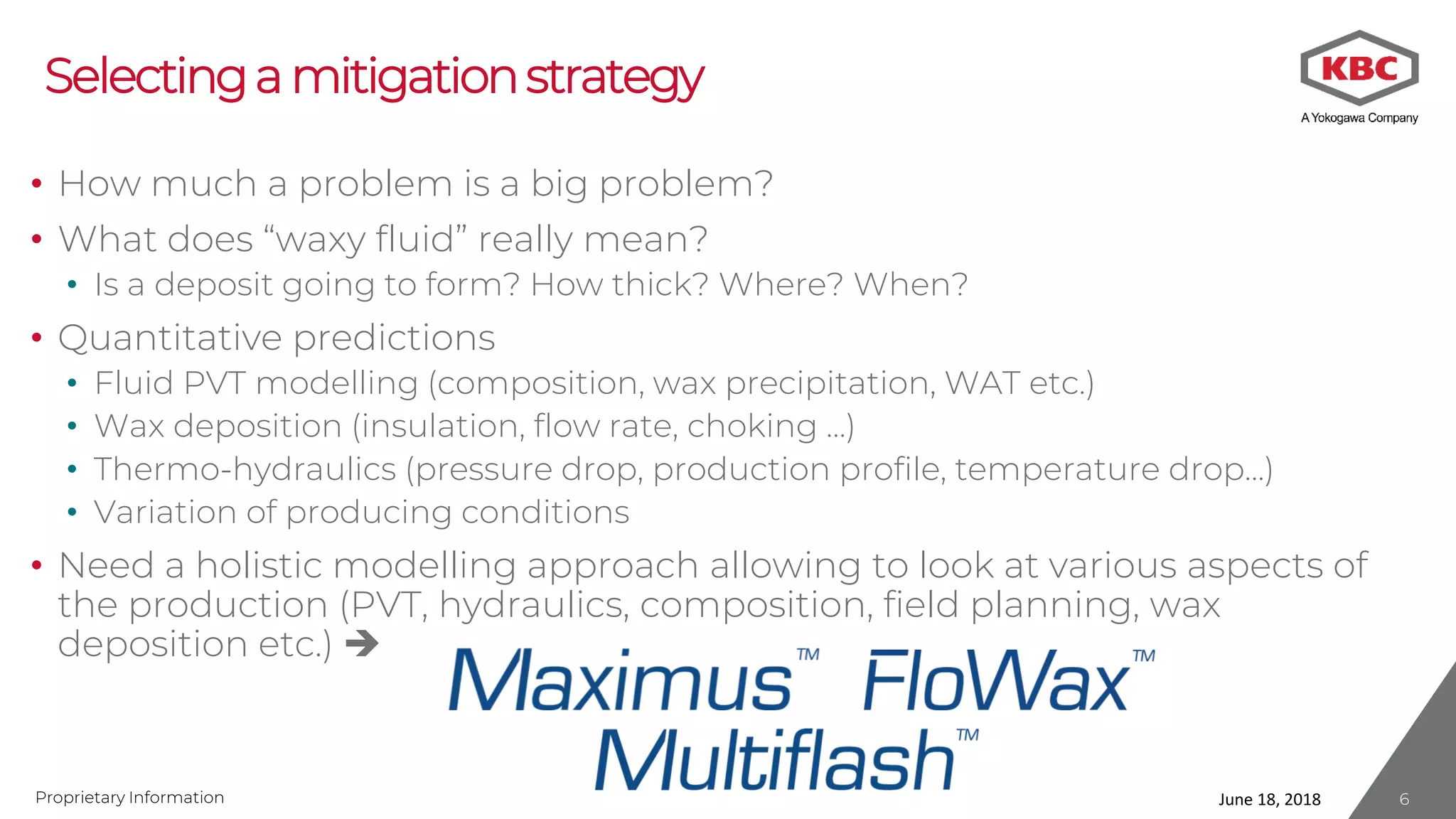
• Need a holistic modelling approach allowing to look at various aspects of
the production (PVT, hydraulics, composition, field planning, wax
deposition etc.) 
June 18, 2018 6
Proprietary Information
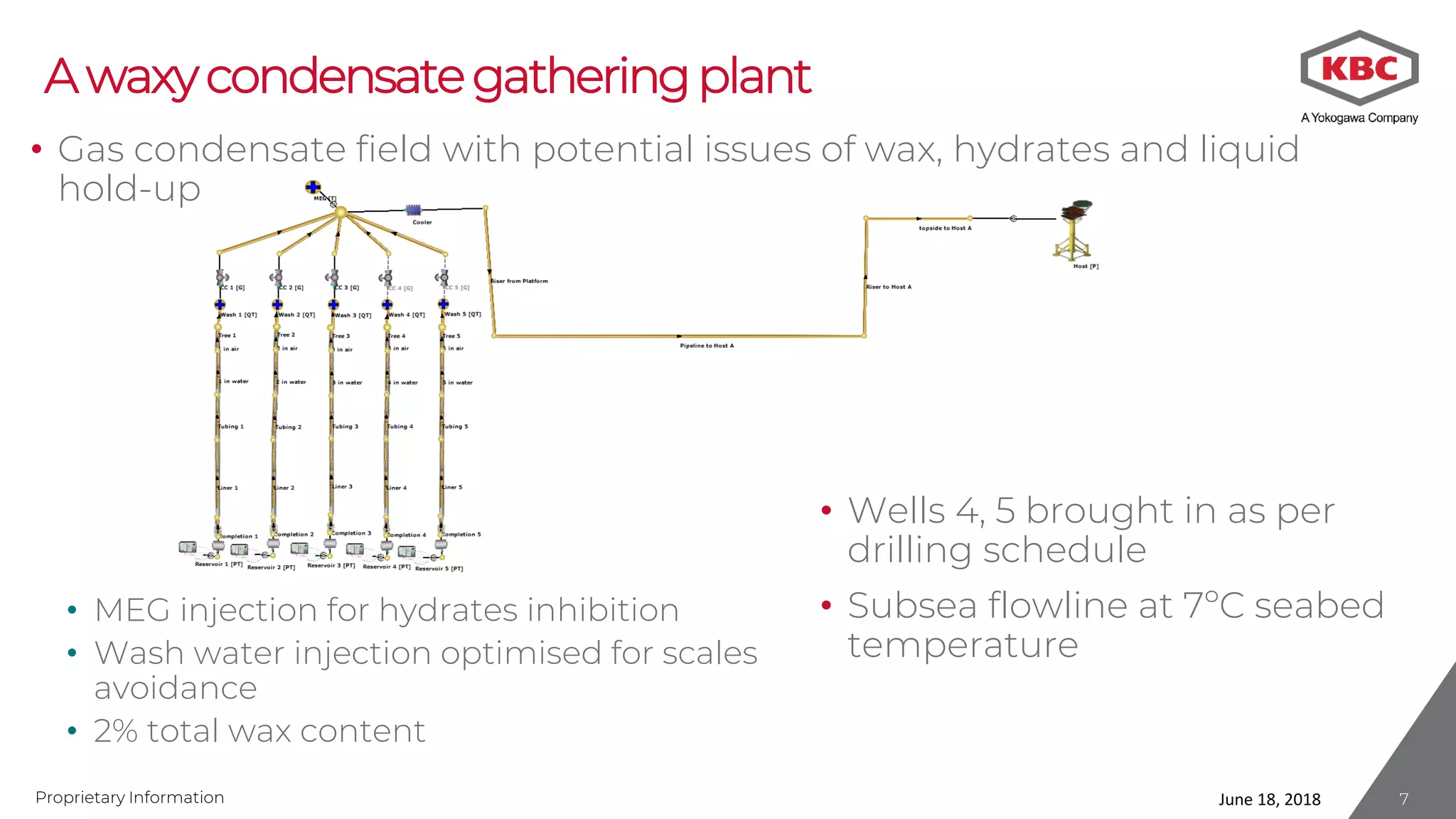
• Gas condensate field with potential issues of wax, hydrates and liquid
hold-up
• MEG injection for hydrates inhibition
• Wash water injection optimised for scales
avoidance
• 2% total wax content
Awaxycondensategatheringplant
• Wells 4, 5 brought in as per
drilling schedule
• Subsea flowline at 7ºC seabed
temperature
June 18, 2018 7
Proprietary Information
Importanceoflifeoffield
• Bottom hole pressure decreases as reservoir is depleted
• Composition varies all the time, as different wells come into production
and conditions of producing wells change
• As pressure drops, temperature in the transport line decreases
• Difficult to select appropriate design case unless variations are
considered
• May introduce large design margins or underestimate risks
June 18, 2018 8
Proprietary Information
Flowassuranceissues
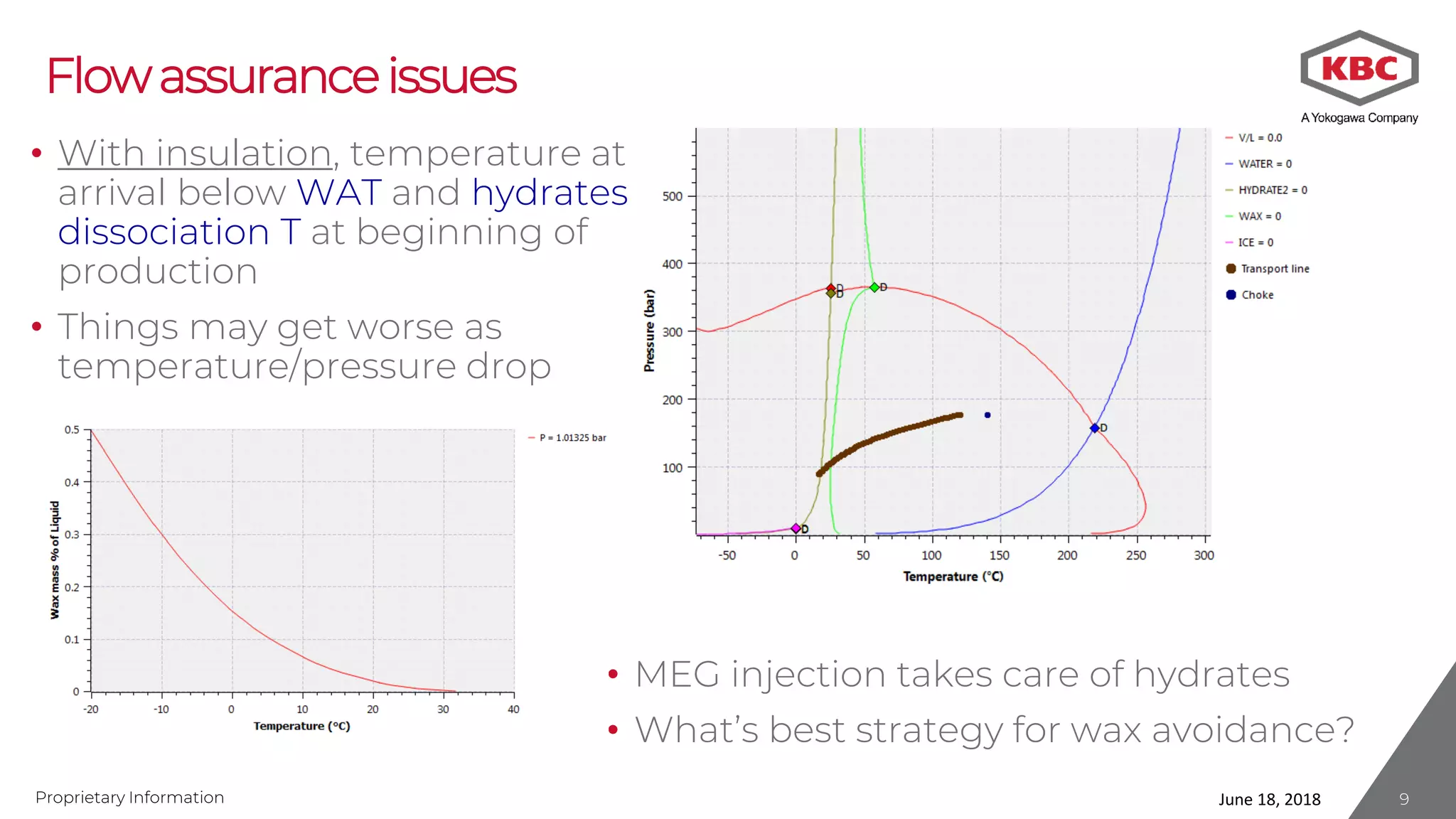
• With insulation, temperature at
arrival below WAT and hydrates
dissociation T at beginning of
production
• Things may get worse as
temperature/pressure drop
• MEG injection takes care of hydrates
• What’s best strategy for wax avoidance?
June 18, 2018 9
Proprietary Information
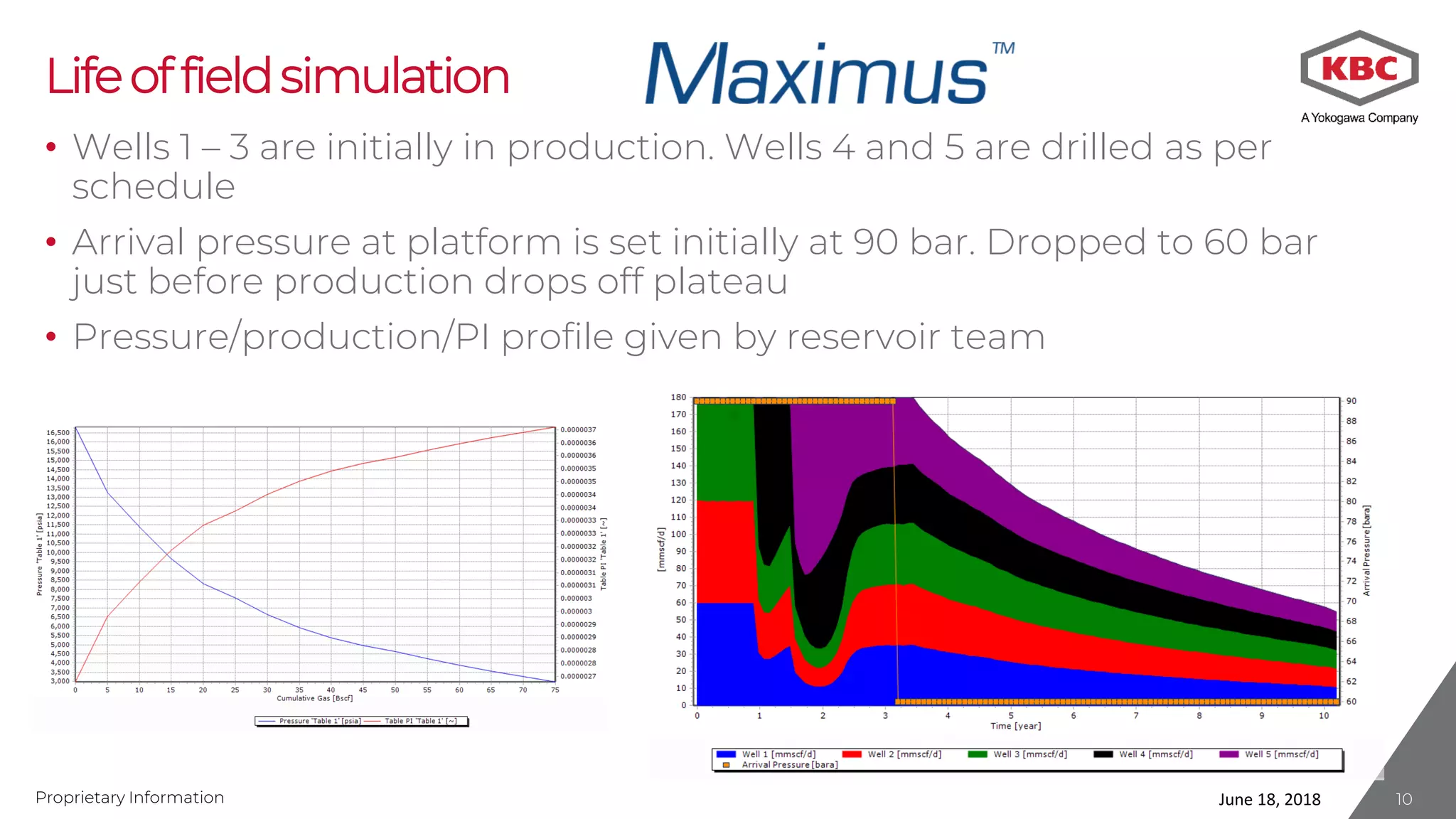
Lifeoffieldsimulation
• Wells 1 – 3 are initially in production. Wells 4 and 5 are drilled as per
schedule
• Arrival pressure at platform is set initially at 90 bar. Dropped to 60 bar
just before production drops off plateau
• Pressure/production/PI profile given by reservoir team
June 18, 2018 10
Proprietary Information
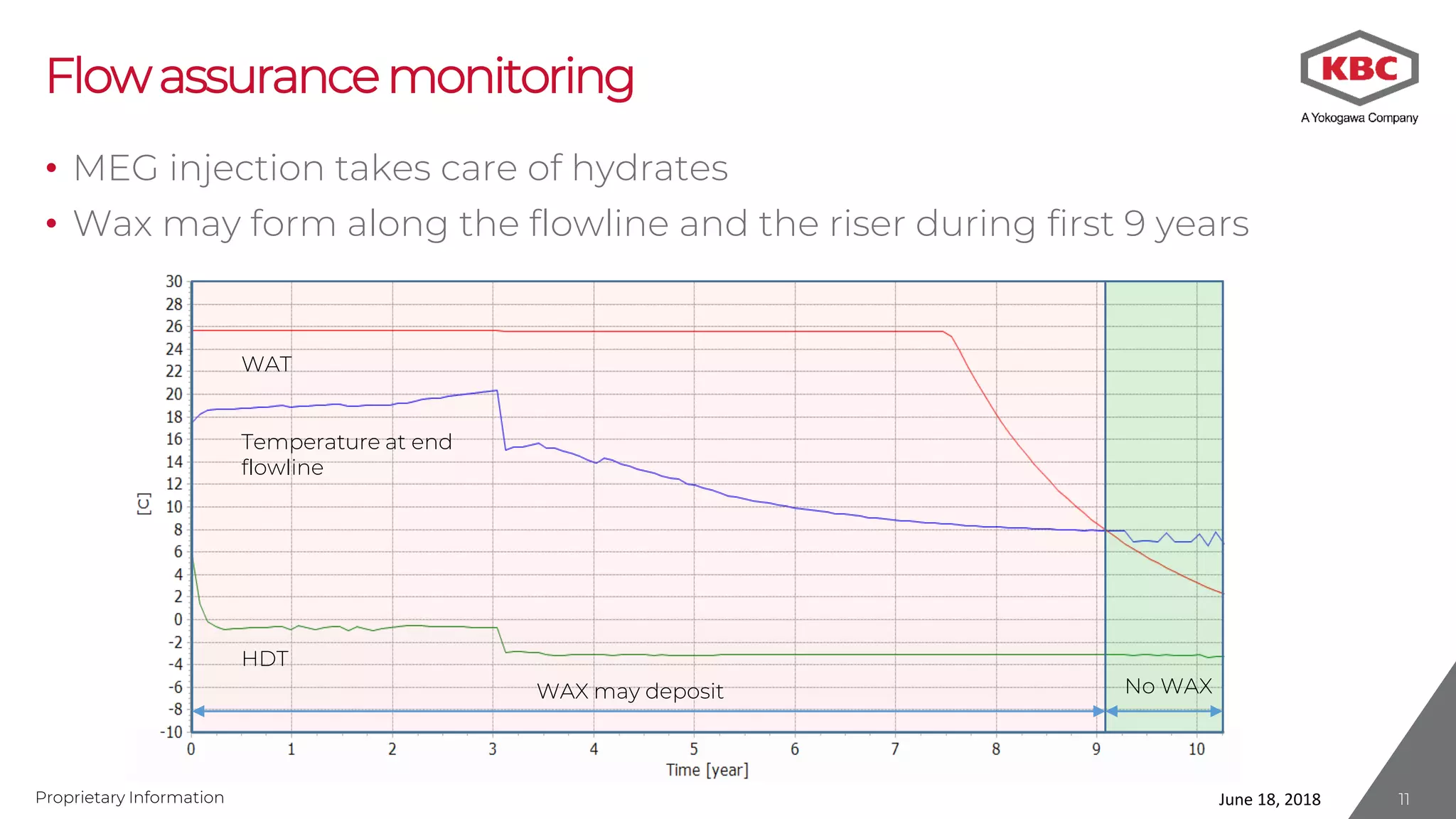
Flowassurancemonitoring
• MEG injection takes care of hydrates
• Wax may form along the flowline and the riser during first 9 years
June 18, 2018
WAT
Temperature at end
flowline
HDT
WAX may deposit No WAX
11
Proprietary Information
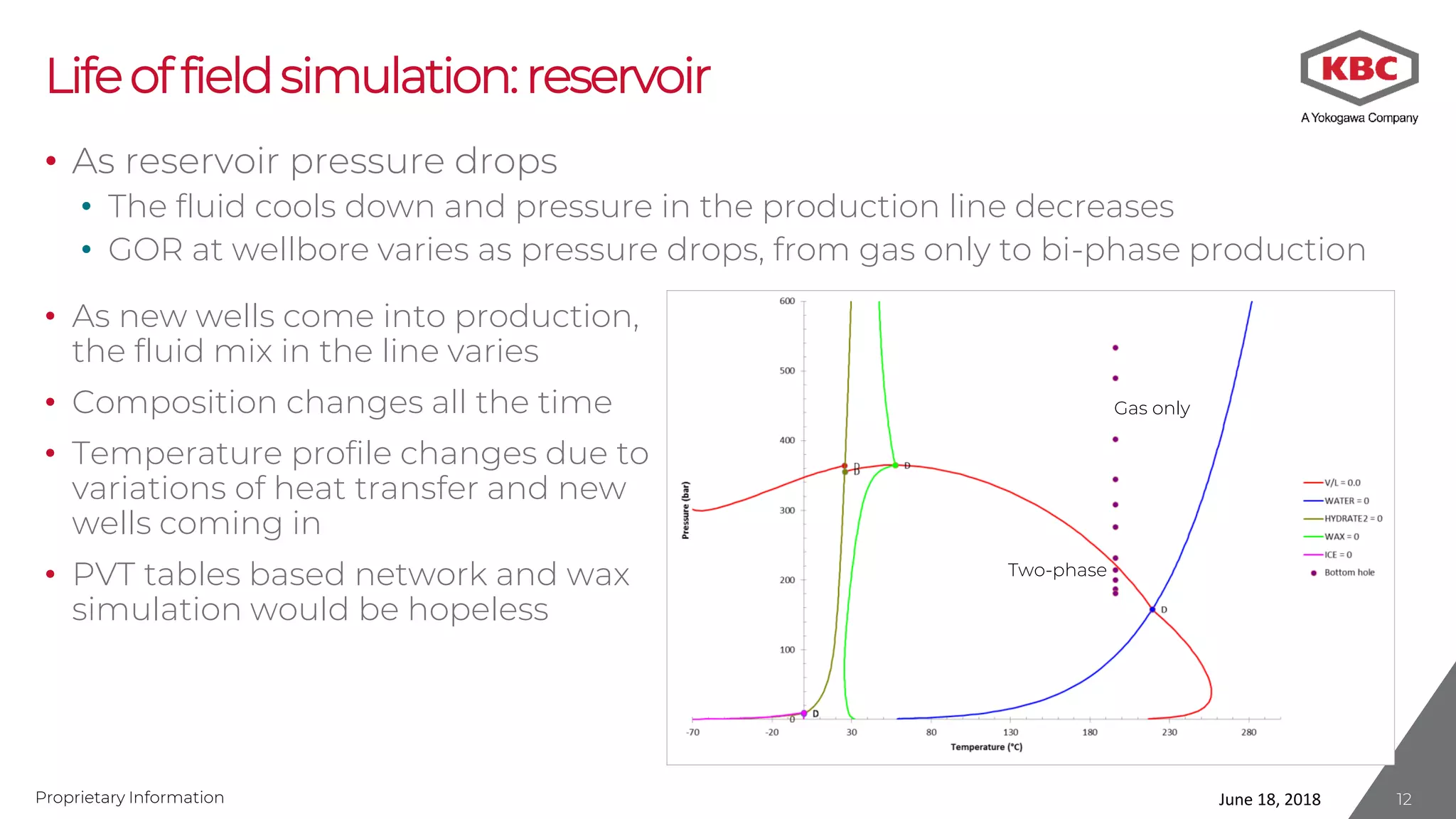
Lifeoffieldsimulation:reservoir
• As reservoir pressure drops
• The fluid cools down and pressure in the production line decreases
• GOR at wellbore varies as pressure drops, from gas only to bi-phase production
June 18, 2018
Gas only
Two-phase
• As new wells come into production,
the fluid mix in the line varies
• Composition changes all the time
• Temperature profile changes due to
variations of heat transfer and new
wells coming in
• PVT tables based network and wax
simulation would be hopeless
12
Proprietary Information
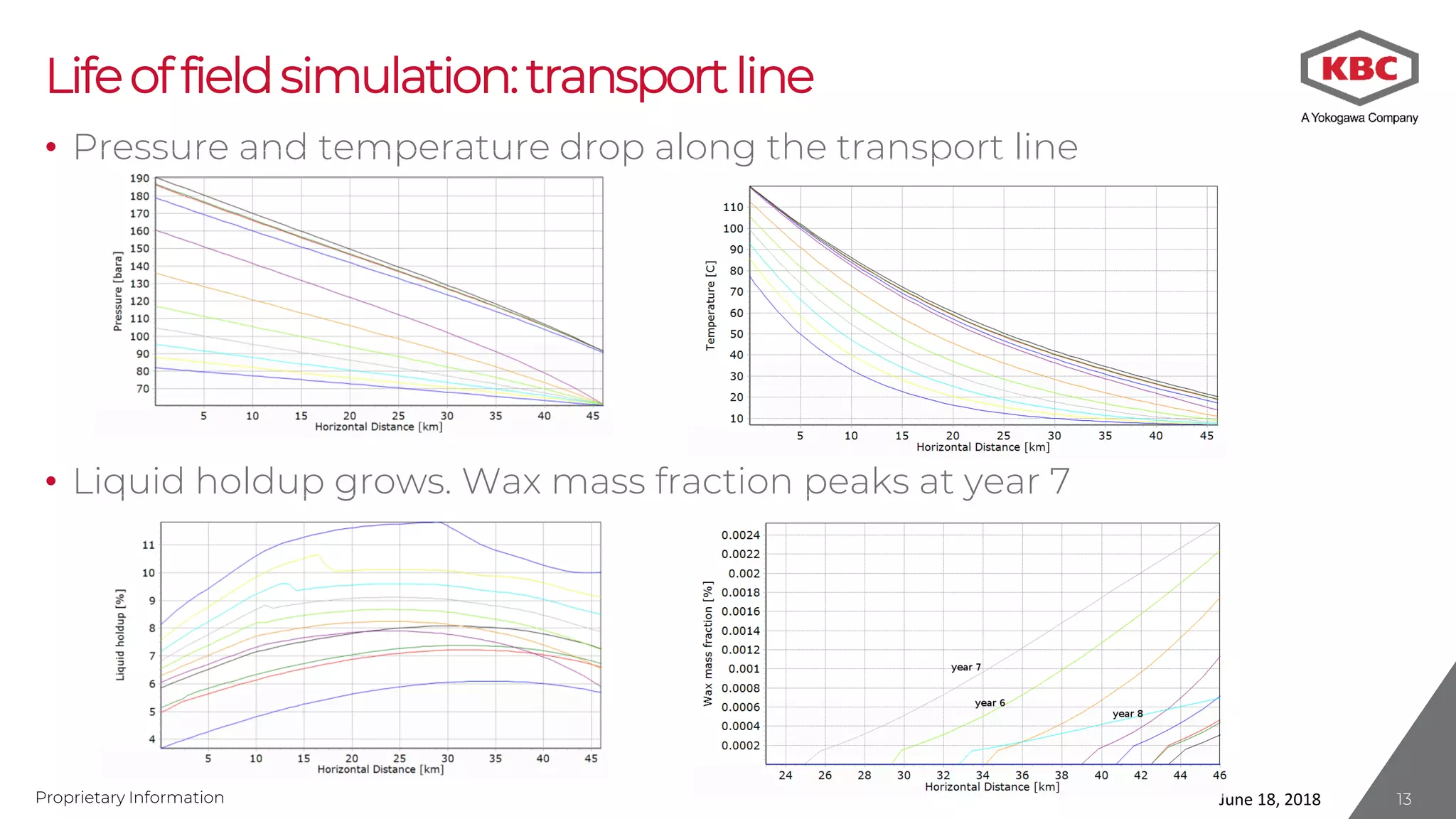
Lifeoffieldsimulation:transportline
• Pressure and temperature drop along the transport line
• Liquid holdup grows. Wax mass fraction peaks at year 7
June 18, 2018 13
Proprietary Information
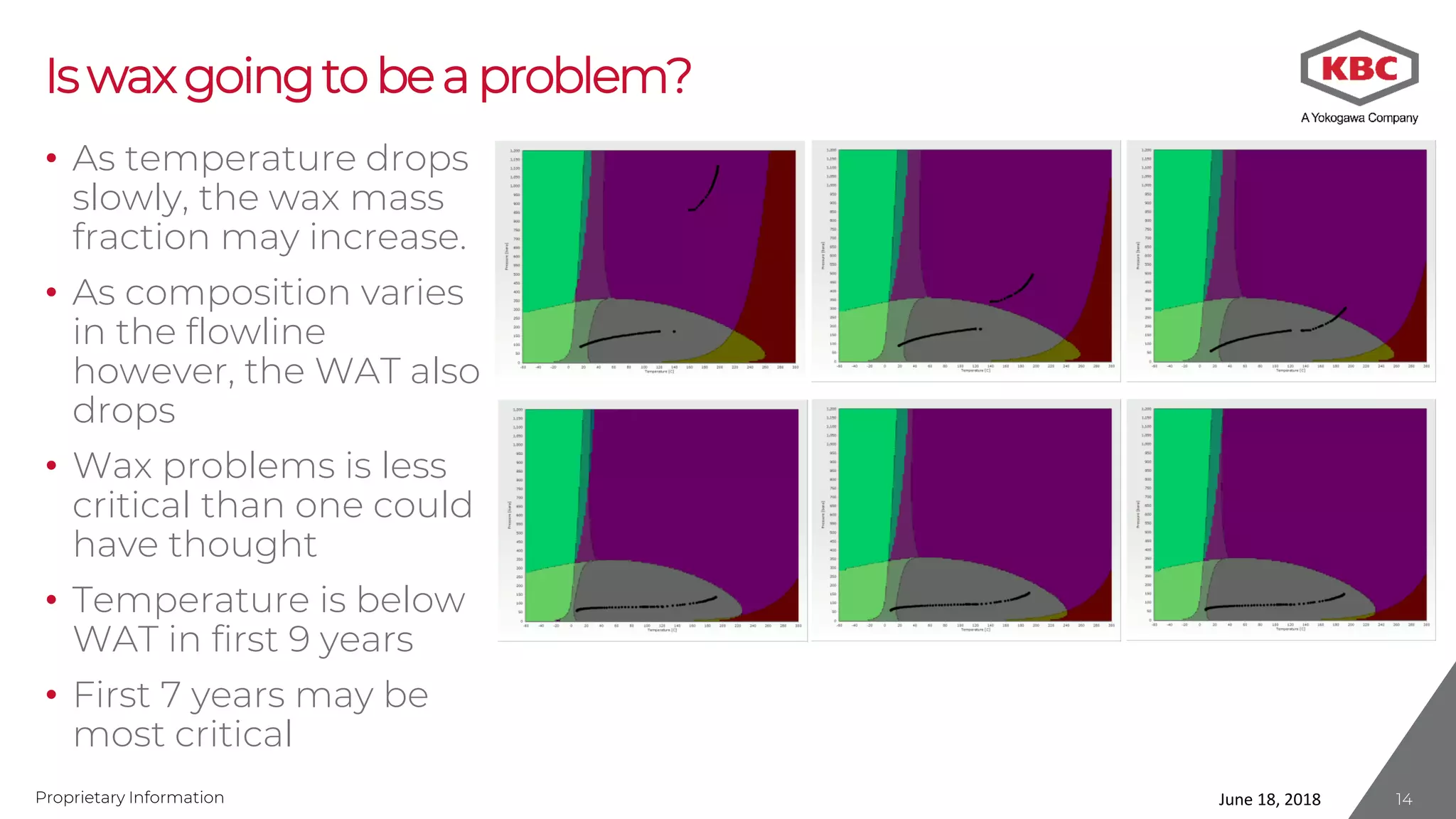
Iswaxgoingtobea problem?
• As temperature drops
slowly, the wax mass
fraction may increase.
• As composition varies
in the flowline
however, the WAT also
drops
• Wax problems is less
critical than one could
have thought
• Temperature is below
WAT in first 9 years
• First 7 years may be
most critical
June 18, 2018 14
Proprietary Information
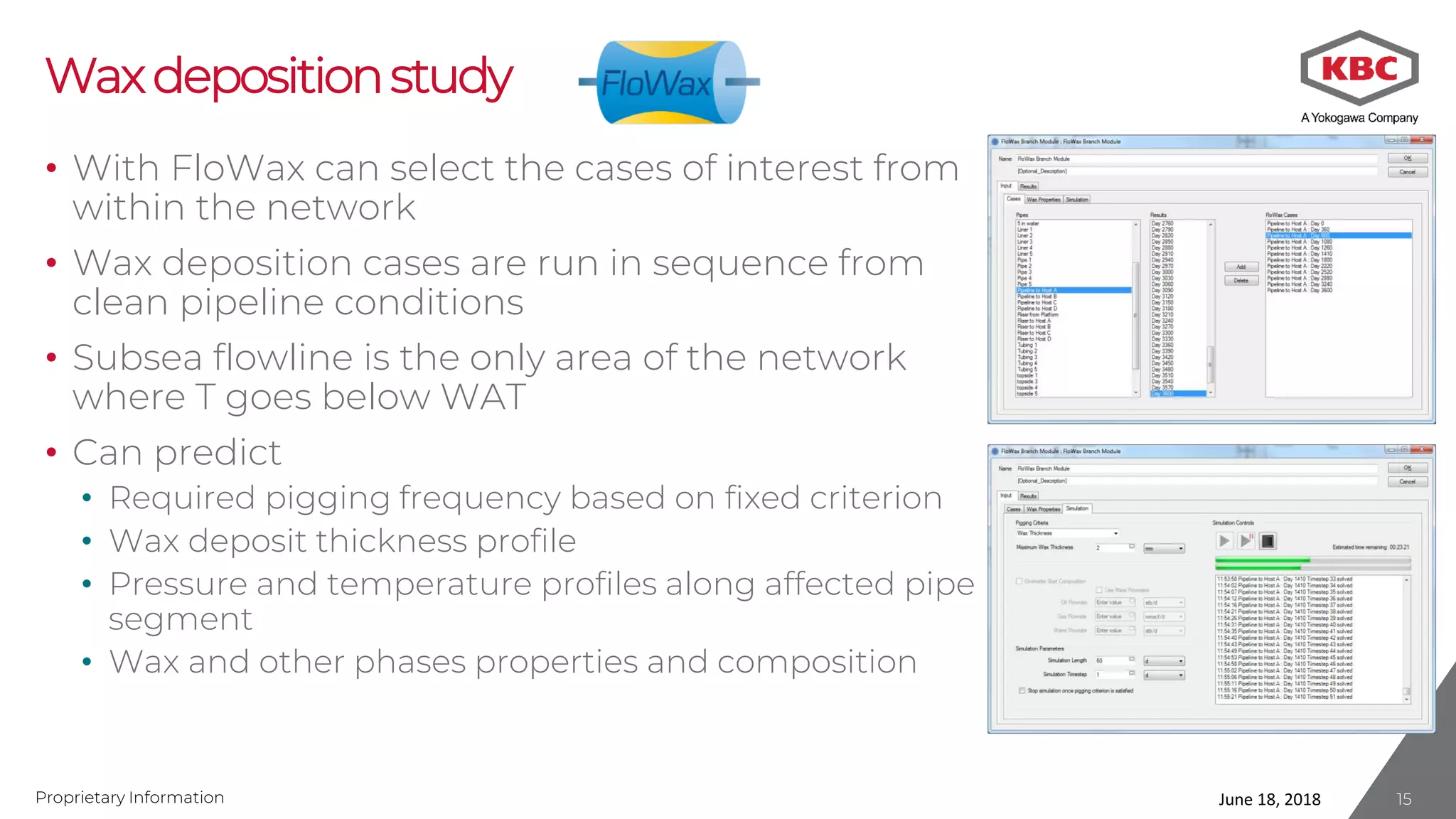
Waxdepositionstudy
• With FloWax can select the cases of interest from
within the network
• Wax deposition cases are run in sequence from
clean pipeline conditions
• Subsea flowline is the only area of the network
where T goes below WAT
• Can predict
• Required pigging frequency based on fixed criterion
• Wax deposit thickness profile
• Pressure and temperature profiles along affected pipe
segment
• Wax and other phases properties and composition
June 18, 2018 15
Proprietary Information
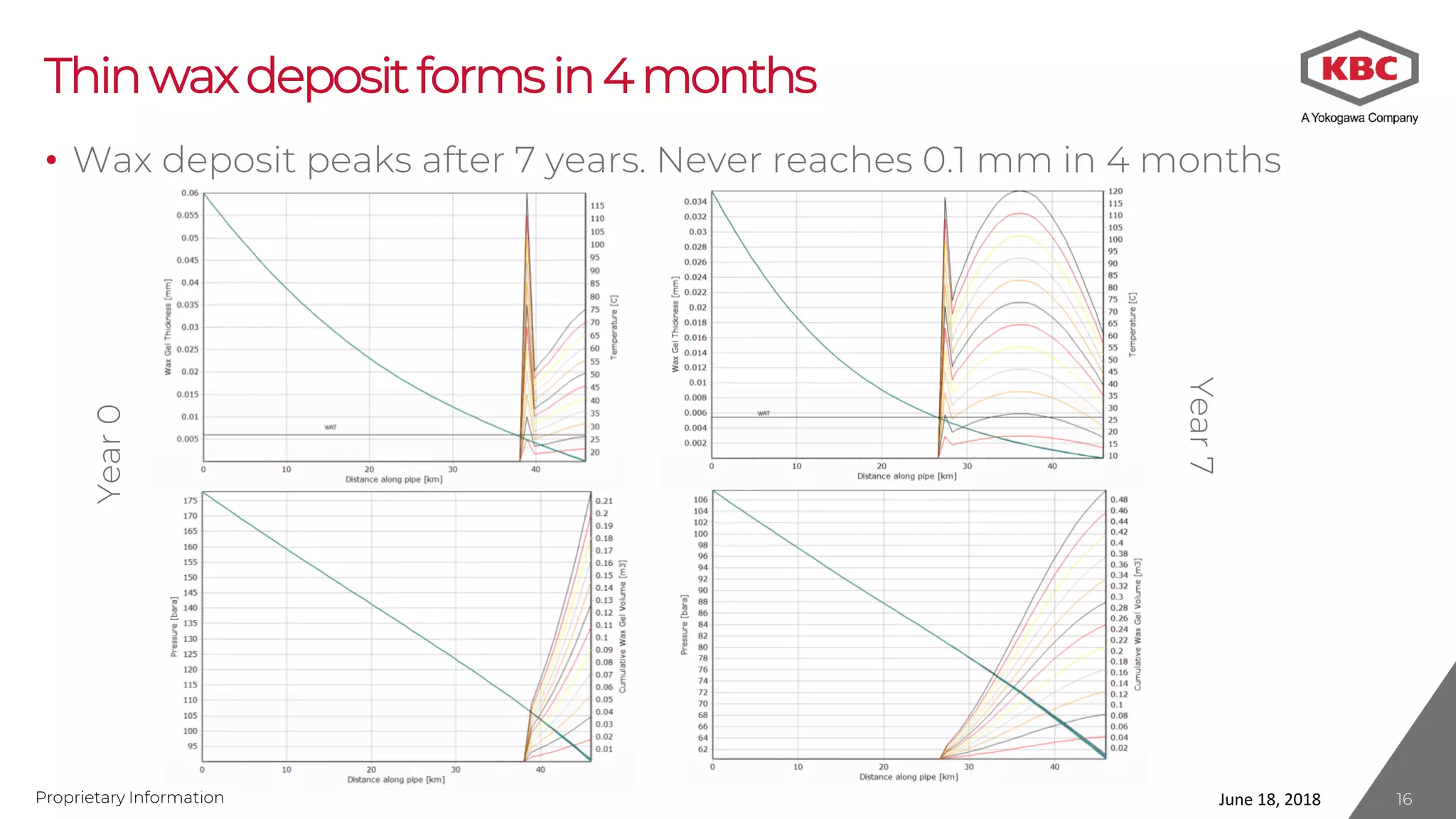
Thinwaxdepositformsin4months
• Wax deposit peaks after 7 years. Never reaches 0.1 mm in 4 months
June 18, 2018
Year0
Year7
16
Proprietary Information
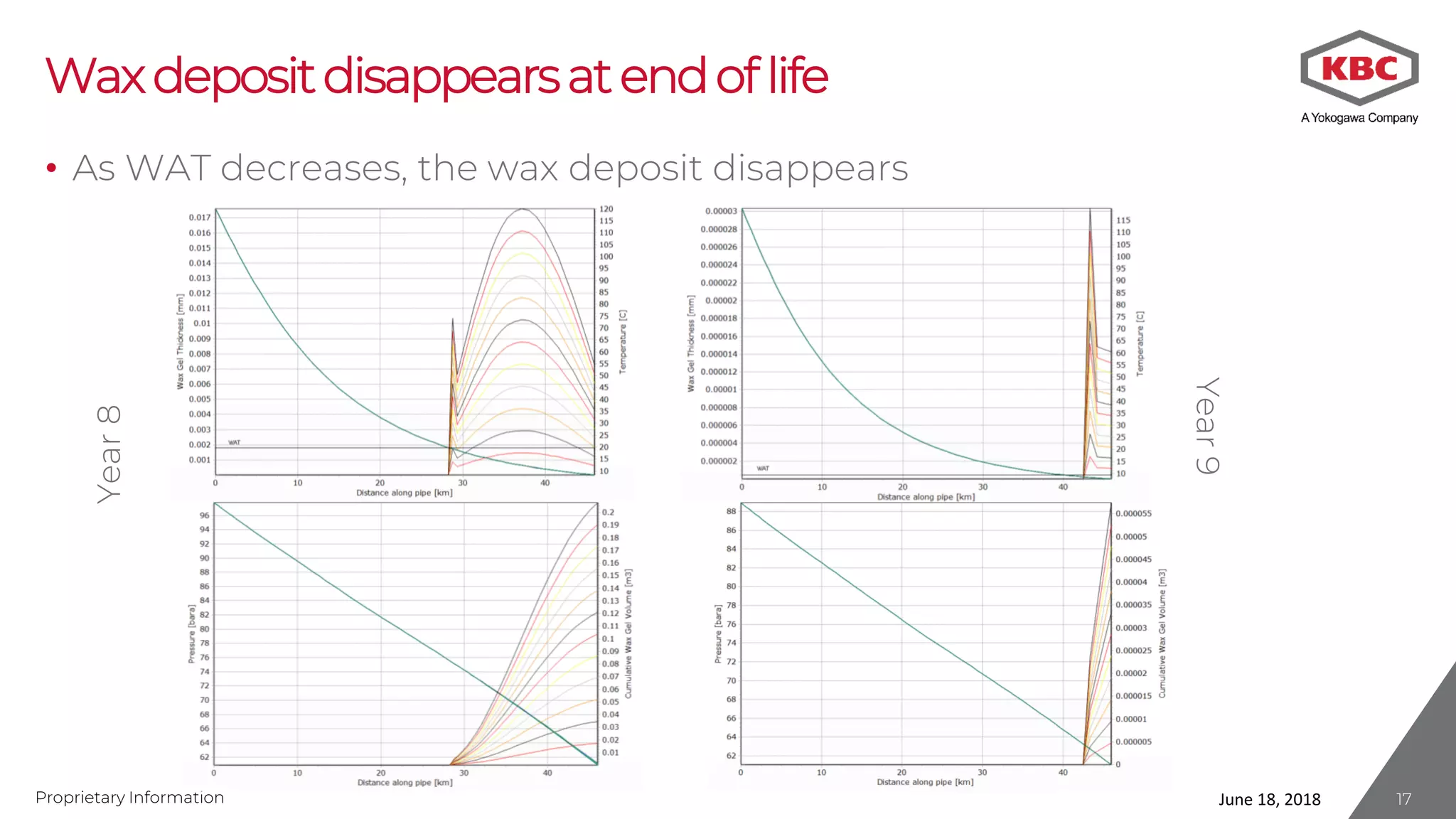
Waxdepositdisappearsatendof life
• As WAT decreases, the wax deposit disappears
June 18, 2018
Year8
Year9
17
Proprietary Information
Conclusions
• Wax deposition may represent a major flow assurance issue
• Costs for wax deposition avoidance or remediation may jeopardise the
economics of the project
• Correct estimation of the size of the problem is a crucial part of design
and operations management
• Sound thermodynamics and mechanistic wax deposition modelling
offers a powerful tool for design and operations
• Life of field simulations allows to pinpoint the real areas and periods of
risk during production and highlight the evolution of the problem
• Integrated wax deposition simulations, within field planning modelling,
offers a major advantage for the correct elaboration of the best
avoidance or mitigation strategy
June 18, 2018 18
Proprietary Information June 18, 2018 19
Thankyou

Europe User Conference: The importance of life of field in flow assurance

  • 1.
    Proprietary Information Theimportanceof lifeof fieldin flowassurance – a wax deposition study KBCUsersGroupConference London18th June2018 AlessandroSperanza June 18, 20181
  • 2.
    Proprietary Information Outline • Whatis wax and how does it deposit? • Selecting a mitigation strategy • A waxy condensate gathering system case • Flow assurance issues during the life of the field • Maximus/FloWax wax deposition study. Is wax really a problem? • Conclusions June 18, 2018 2
  • 3.
    Proprietary Information WhatisPetroleumWax? • Waxesare crystals consisting predominantly of n- paraffins that precipitate out of crudes as the temperature falls • Waxes form because the n-paraffins are less soluble and have higher melting points than other hydrocarbons of the same molecular weight found in oils • The crystals are actually solid solutions of n-paraffins, i.e. they are a mixture of n-paraffins of different lengths, not a single n-paraffin June 18, 2018 3
  • 4.
    Proprietary Information Whatisthewaxdeposit? • Waxcrystals form at temperature below WAT (wax appearance temperature) • Typically at interface between oil and pipeline • Temperature gradient across pipe section drives deposit formation • Solid crystals form a large network with large amount of trapped liquid (60 – 80%) • Stationary deposit grows as long as conditions hold • Temperature below WAT • Temperature gradient across pipe section • Aging: the deposit hardens as oil diffuses through gel back to flow June 18, 2018 4
  • 5.
    Proprietary Information Flowassurancestrategy • Waxavoidance • Keep away from WAT (insulation, active heating, blending….) • Inject inhibitors to keep n-paraffins in solution • Remediation • Pigging (how often?) • Periodic maintenance • Live with it • How much deposit can I tolerate? June 18, 2018 5
  • 6.
    Proprietary Information Selectinga mitigationstrategy •How much a problem is a big problem? • What does “waxy fluid” really mean? • Is a deposit going to form? How thick? Where? When? • Quantitative predictions • Fluid PVT modelling (composition, wax precipitation, WAT etc.) • Wax deposition (insulation, flow rate, choking …) • Thermo-hydraulics (pressure drop, production profile, temperature drop…) • Variation of producing conditions • Need a holistic modelling approach allowing to look at various aspects of the production (PVT, hydraulics, composition, field planning, wax deposition etc.)  June 18, 2018 6
  • 7.
    Proprietary Information • Gascondensate field with potential issues of wax, hydrates and liquid hold-up • MEG injection for hydrates inhibition • Wash water injection optimised for scales avoidance • 2% total wax content Awaxycondensategatheringplant • Wells 4, 5 brought in as per drilling schedule • Subsea flowline at 7ºC seabed temperature June 18, 2018 7
  • 8.
    Proprietary Information Importanceoflifeoffield • Bottomhole pressure decreases as reservoir is depleted • Composition varies all the time, as different wells come into production and conditions of producing wells change • As pressure drops, temperature in the transport line decreases • Difficult to select appropriate design case unless variations are considered • May introduce large design margins or underestimate risks June 18, 2018 8
  • 9.
    Proprietary Information Flowassuranceissues • Withinsulation, temperature at arrival below WAT and hydrates dissociation T at beginning of production • Things may get worse as temperature/pressure drop • MEG injection takes care of hydrates • What’s best strategy for wax avoidance? June 18, 2018 9
  • 10.
    Proprietary Information Lifeoffieldsimulation • Wells1 – 3 are initially in production. Wells 4 and 5 are drilled as per schedule • Arrival pressure at platform is set initially at 90 bar. Dropped to 60 bar just before production drops off plateau • Pressure/production/PI profile given by reservoir team June 18, 2018 10
  • 11.
    Proprietary Information Flowassurancemonitoring • MEGinjection takes care of hydrates • Wax may form along the flowline and the riser during first 9 years June 18, 2018 WAT Temperature at end flowline HDT WAX may deposit No WAX 11
  • 12.
    Proprietary Information Lifeoffieldsimulation:reservoir • Asreservoir pressure drops • The fluid cools down and pressure in the production line decreases • GOR at wellbore varies as pressure drops, from gas only to bi-phase production June 18, 2018 Gas only Two-phase • As new wells come into production, the fluid mix in the line varies • Composition changes all the time • Temperature profile changes due to variations of heat transfer and new wells coming in • PVT tables based network and wax simulation would be hopeless 12
  • 13.
    Proprietary Information Lifeoffieldsimulation:transportline • Pressureand temperature drop along the transport line • Liquid holdup grows. Wax mass fraction peaks at year 7 June 18, 2018 13
  • 14.
    Proprietary Information Iswaxgoingtobea problem? •As temperature drops slowly, the wax mass fraction may increase. • As composition varies in the flowline however, the WAT also drops • Wax problems is less critical than one could have thought • Temperature is below WAT in first 9 years • First 7 years may be most critical June 18, 2018 14
  • 15.
    Proprietary Information Waxdepositionstudy • WithFloWax can select the cases of interest from within the network • Wax deposition cases are run in sequence from clean pipeline conditions • Subsea flowline is the only area of the network where T goes below WAT • Can predict • Required pigging frequency based on fixed criterion • Wax deposit thickness profile • Pressure and temperature profiles along affected pipe segment • Wax and other phases properties and composition June 18, 2018 15
  • 16.
    Proprietary Information Thinwaxdepositformsin4months • Waxdeposit peaks after 7 years. Never reaches 0.1 mm in 4 months June 18, 2018 Year0 Year7 16
  • 17.
    Proprietary Information Waxdepositdisappearsatendof life •As WAT decreases, the wax deposit disappears June 18, 2018 Year8 Year9 17
  • 18.
    Proprietary Information Conclusions • Waxdeposition may represent a major flow assurance issue • Costs for wax deposition avoidance or remediation may jeopardise the economics of the project • Correct estimation of the size of the problem is a crucial part of design and operations management • Sound thermodynamics and mechanistic wax deposition modelling offers a powerful tool for design and operations • Life of field simulations allows to pinpoint the real areas and periods of risk during production and highlight the evolution of the problem • Integrated wax deposition simulations, within field planning modelling, offers a major advantage for the correct elaboration of the best avoidance or mitigation strategy June 18, 2018 18
  • 19.
    Proprietary Information June18, 2018 19 Thankyou