Harm Reduction
Education & Outreach Team at
AIDS Programs South Saskatchewan
Refers to an approach
designed to reduce the
harmful consequences
associated with high risk
activities.
We do not try to ‘save’ or
‘rescue’ anyone, we
support them wherever
they are without
judgement or assumption
What is
harm
reduction?
• North American culture
looks at situations of
substance abuse as
individual problems rather
then looking at societal
factors
• Most social ills are seen as
the result of actions by
people who are ‘bad’
• Strong social expectations
are not good reasons for
making a particular ethical
decision
Negative
Connotation
to Harm
Reduction
“I don’t believe in harm reduction”
“So you don’t believe in seat belts
or car seats?”
Regina Harm Reduction in Practice
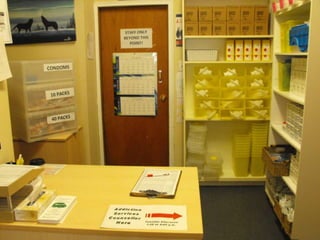
• Needle Exchange Programs
• Condom distribution
• Formula for HIV+ pregnant
mothers
• Clinic or Hospital Setting
Support
• Planned Parenthood Regina
• Methadone Programs
• Talking Circles
• Peer Support Programs
• Housing Support
Harm reduction models are
evidence-based and are consistently
evaluated to show good results and
effectiveness. This means that they are
an ideal model for anyone who works
with individuals who are engaging in
behaviour that puts them at risk for
harm – which some might say involves
almost everyone on the planet!
Harm Reduction
Principles
• Recognizes the intrinsic value and dignity of all human beings
• Does not judge individuals on the basis of their individual
behaviours
• Accepts that isolating people and communities based on
moral judgments is harmful
• Enhances social and health programs, disease prevention and
education by reducing oppression
• Expects accessible, flexible, culturally responsive and non-
judgmental services for all
• Recognizes the rights and abilities of individuals in making
their own choices
Human Dignity and Human Rights
• Accepts risk-taking as normal human behaviour
• Recognizes that people have more success in changing
behaviours when they make choices that reduce the
possibility of harm, rather than totally eliminating harm
or risk as their first step towards change
• Identifies a range of risks related to STI, HIV/AIDS and
Hepatitis C infection and the context in which they occur
• Encourages people to start “where they’re at” in order
to protect themselves, their partners and their
communities
Values of Harm Reduction
• Challenges the harmful policies and practices that
result from myths within and about communities and
about risk-taking behaviours
• Challenges the harmful policies and practices that
isolate individuals and communities and prevent
them from accessing needed services
Make available, support in other forms to meet
clients wants and needs
Provide information both verbal and no verbal
Focus on Harms
• Demands that individuals and communities
affected be directly involved in organization of
strategies for harm reduction
• Recognizes diversity within the community
or communities, accepting that there is no
one homogenous group
• Contributes to the safety and well-being of
the community
Balance
• Recognizes the right for comprehensive, non-judgmental
medical and social services and the fulfillment of the basic needs
of all individuals and communities
• Supports the development and provision of accessible harm
reduction tools and information
Deal with priority issues
Harm
Reduction
Myths
Myth
Harm
reduction
programs
enable
and/or
promote
drug use
Fact
Harm reduction
enables people to
make informed choices
and encourages safer
substance use should
someone decide to use
any substance (legal or
illegal)
Myth
It is illegal
to give
out needles
Fact
Distribution of needles
and drug equipment is
not a crime.
Police and health care
providers share in the
understanding that harm
reduction programs use
a harm reduction
strategy
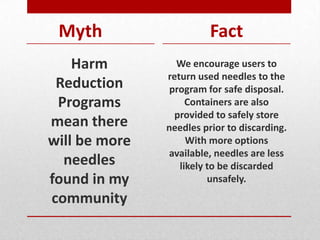
Myth
Harm
Reduction
Programs
mean there
will be more
needles
found in my
community
Fact
We encourage users to
return used needles to the
program for safe disposal.
Containers are also
provided to safely store
needles prior to discarding.
With more options
available, needles are less
likely to be discarded
unsafely.
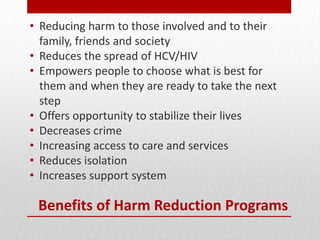
Benefits of Harm Reduction Programs
• Reducing harm to those involved and to their
family, friends and society
• Reduces the spread of HCV/HIV
• Empowers people to choose what is best for
them and when they are ready to take the next
step
• Offers opportunity to stabilize their lives
• Decreases crime
• Increasing access to care and services
• Reduces isolation
• Increases support system
Harm
Reduction:
Building
trust, reducing

Harm Reduction Presentation 2014

  • 1.
    Harm Reduction Education &Outreach Team at AIDS Programs South Saskatchewan
  • 2.
    Refers to anapproach designed to reduce the harmful consequences associated with high risk activities. We do not try to ‘save’ or ‘rescue’ anyone, we support them wherever they are without judgement or assumption What is harm reduction?
  • 3.
    • North Americanculture looks at situations of substance abuse as individual problems rather then looking at societal factors • Most social ills are seen as the result of actions by people who are ‘bad’ • Strong social expectations are not good reasons for making a particular ethical decision Negative Connotation to Harm Reduction
  • 4.
    “I don’t believein harm reduction” “So you don’t believe in seat belts or car seats?”
  • 5.
    Regina Harm Reductionin Practice • Needle Exchange Programs • Condom distribution • Formula for HIV+ pregnant mothers • Clinic or Hospital Setting Support • Planned Parenthood Regina • Methadone Programs • Talking Circles • Peer Support Programs • Housing Support
  • 7.
    Harm reduction modelsare evidence-based and are consistently evaluated to show good results and effectiveness. This means that they are an ideal model for anyone who works with individuals who are engaging in behaviour that puts them at risk for harm – which some might say involves almost everyone on the planet!
  • 8.
  • 9.
    • Recognizes theintrinsic value and dignity of all human beings • Does not judge individuals on the basis of their individual behaviours • Accepts that isolating people and communities based on moral judgments is harmful • Enhances social and health programs, disease prevention and education by reducing oppression • Expects accessible, flexible, culturally responsive and non- judgmental services for all • Recognizes the rights and abilities of individuals in making their own choices Human Dignity and Human Rights
  • 10.
    • Accepts risk-takingas normal human behaviour • Recognizes that people have more success in changing behaviours when they make choices that reduce the possibility of harm, rather than totally eliminating harm or risk as their first step towards change • Identifies a range of risks related to STI, HIV/AIDS and Hepatitis C infection and the context in which they occur • Encourages people to start “where they’re at” in order to protect themselves, their partners and their communities Values of Harm Reduction
  • 11.
    • Challenges theharmful policies and practices that result from myths within and about communities and about risk-taking behaviours • Challenges the harmful policies and practices that isolate individuals and communities and prevent them from accessing needed services Make available, support in other forms to meet clients wants and needs Provide information both verbal and no verbal Focus on Harms
  • 12.
    • Demands thatindividuals and communities affected be directly involved in organization of strategies for harm reduction • Recognizes diversity within the community or communities, accepting that there is no one homogenous group • Contributes to the safety and well-being of the community Balance
  • 13.
    • Recognizes theright for comprehensive, non-judgmental medical and social services and the fulfillment of the basic needs of all individuals and communities • Supports the development and provision of accessible harm reduction tools and information Deal with priority issues
  • 14.
  • 15.
    Myth Harm reduction programs enable and/or promote drug use Fact Harm reduction enablespeople to make informed choices and encourages safer substance use should someone decide to use any substance (legal or illegal)
  • 16.
    Myth It is illegal togive out needles Fact Distribution of needles and drug equipment is not a crime. Police and health care providers share in the understanding that harm reduction programs use a harm reduction strategy
  • 17.
    Myth Harm Reduction Programs mean there will bemore needles found in my community Fact We encourage users to return used needles to the program for safe disposal. Containers are also provided to safely store needles prior to discarding. With more options available, needles are less likely to be discarded unsafely.
  • 18.
    Benefits of HarmReduction Programs • Reducing harm to those involved and to their family, friends and society • Reduces the spread of HCV/HIV • Empowers people to choose what is best for them and when they are ready to take the next step • Offers opportunity to stabilize their lives • Decreases crime • Increasing access to care and services • Reduces isolation • Increases support system
  • 19.

Editor's Notes

  • #6 Needle exchange program distributed 1,500,000 millions in 2012 Our needle exchange is the busiest in SaskatchewanDistribute clean needles, ties, spoons, water, alcohol swabs, condoms and information about harm reduction, HIV and Hepatitis C prevention and resources Now open from 9:00 to 5:00 Monday through Friday and 10:00 to 5:00 on SaturdayWe are the only needle exchange program open on Saturday’s 9cents/needleSome people can inject over 10 times/day ~2000 people are using injectable drugs in RQHR 20,000 condoms/year Return rate over 95%Three sites in our city Injected drugs of choice in RQHR: cocaine, mohpine, diolaudid, oxycontin,
  • #8 This model is effective for service providers, healthcare professionals, and clientsHarm reduction recognizes that people assess risk in a variety of ways and that people see the risks associated with various behaviours differently.  Harm reduction philosophies do not judge people for their choices but rather acknowledges that risk occurs and that people have the right to have access to as much information and resources as they need to make healthy decisions and reduce any potential harmsHarm reduction values the human rights of people who use drugs and affirms that they are the primary agents of change for reducing the harms of their drug use. We believe a harm reduction approach is essential to developing innovative strategies to deal with Canada’s drug problem.Harm reduction is not Monday to Friday 9 - 5
  • #16 People do not just take up and start injecting drugs one day like drinking or experimentation with sex We provide individuals who access our services opportunities to enter treatment, get tested
  • #17 Harm reduction program providers often have an agreement with the local police that allows the public access to services without interferenceAPSS has a relationship with police where they are not allowed to come into the office WITHOUT authorization from staff to maintain confidentiality