 
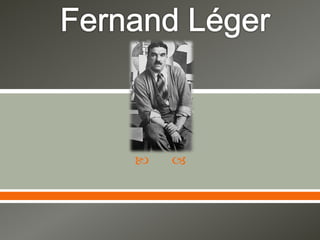
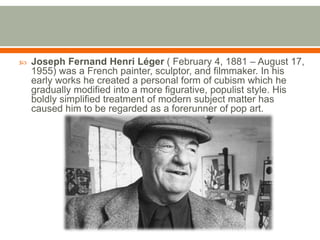
 Joseph Fernand Henri Léger ( February 4, 1881 – August 17,
1955) was a French painter, sculptor, and filmmaker. In his
early works he created a personal form of cubism which he
gradually modified into a more figurative, populist style. His
boldly simplified treatment of modern subject matter has
caused him to be regarded as a forerunner of pop art.
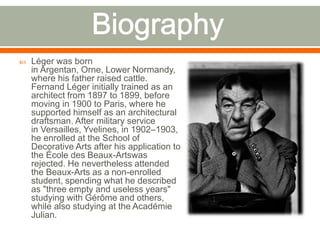
 Léger was born
in Argentan, Orne, Lower Normandy,
where his father raised cattle.
Fernand Léger initially trained as an
architect from 1897 to 1899, before
moving in 1900 to Paris, where he
supported himself as an architectural
draftsman. After military service
in Versailles, Yvelines, in 1902–1903,
he enrolled at the School of
Decorative Arts after his application to
the École des Beaux-Artswas
rejected. He nevertheless attended
the Beaux-Arts as a non-enrolled
student, spending what he described
as "three empty and useless years"
studying with Gérôme and others,
while also studying at the Académie
Julian.
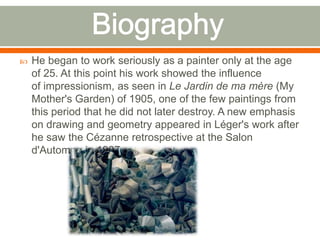
 He began to work seriously as a painter only at the age
of 25. At this point his work showed the influence
of impressionism, as seen in Le Jardin de ma mère (My
Mother's Garden) of 1905, one of the few paintings from
this period that he did not later destroy. A new emphasis
on drawing and geometry appeared in Léger's work after
he saw the Cézanne retrospective at the Salon
d'Automne in 1907.
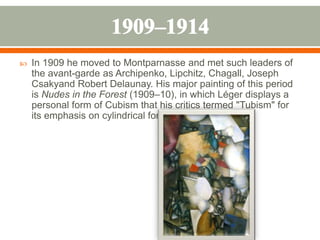
 In 1909 he moved to Montparnasse and met such leaders of
the avant-garde as Archipenko, Lipchitz, Chagall, Joseph
Csakyand Robert Delaunay. His major painting of this period
is Nudes in the Forest (1909–10), in which Léger displays a
personal form of Cubism that his critics termed "Tubism" for
its emphasis on cylindrical forms.
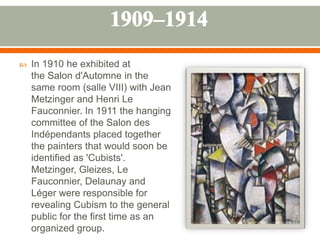
 In 1910 he exhibited at
the Salon d'Automne in the
same room (salle VIII) with Jean
Metzinger and Henri Le
Fauconnier. In 1911 the hanging
committee of the Salon des
Indépendants placed together
the painters that would soon be
identified as 'Cubists'.
Metzinger, Gleizes, Le
Fauconnier, Delaunay and
Léger were responsible for
revealing Cubism to the general
public for the first time as an
organized group.

Fernand léger

  • 1.
  • 2.
     Joseph FernandHenri Léger ( February 4, 1881 – August 17, 1955) was a French painter, sculptor, and filmmaker. In his early works he created a personal form of cubism which he gradually modified into a more figurative, populist style. His boldly simplified treatment of modern subject matter has caused him to be regarded as a forerunner of pop art.
  • 3.
     Léger wasborn in Argentan, Orne, Lower Normandy, where his father raised cattle. Fernand Léger initially trained as an architect from 1897 to 1899, before moving in 1900 to Paris, where he supported himself as an architectural draftsman. After military service in Versailles, Yvelines, in 1902–1903, he enrolled at the School of Decorative Arts after his application to the École des Beaux-Artswas rejected. He nevertheless attended the Beaux-Arts as a non-enrolled student, spending what he described as "three empty and useless years" studying with Gérôme and others, while also studying at the Académie Julian.
  • 4.
     He beganto work seriously as a painter only at the age of 25. At this point his work showed the influence of impressionism, as seen in Le Jardin de ma mère (My Mother's Garden) of 1905, one of the few paintings from this period that he did not later destroy. A new emphasis on drawing and geometry appeared in Léger's work after he saw the Cézanne retrospective at the Salon d'Automne in 1907.
  • 5.
     In 1909he moved to Montparnasse and met such leaders of the avant-garde as Archipenko, Lipchitz, Chagall, Joseph Csakyand Robert Delaunay. His major painting of this period is Nudes in the Forest (1909–10), in which Léger displays a personal form of Cubism that his critics termed "Tubism" for its emphasis on cylindrical forms.
  • 6.
     In 1910he exhibited at the Salon d'Automne in the same room (salle VIII) with Jean Metzinger and Henri Le Fauconnier. In 1911 the hanging committee of the Salon des Indépendants placed together the painters that would soon be identified as 'Cubists'. Metzinger, Gleizes, Le Fauconnier, Delaunay and Léger were responsible for revealing Cubism to the general public for the first time as an organized group.